Cicero on the “Unforgettable Ides of March”

Cicero, Letters to Atticus (14.4) 10 April 44

“But should all these things befall us, the Ides of March may console. Our heroes too accomplished most gloriously and magnificently everything it was in their power to do. For the rest, we need money and troops, neither of which we have.”

Sed omnia licet concurrant, Idus Martiae consolantur. nostri autem ἥρωες quod per ipsos confici potuit gloriosissime et magnificentissime confecerunt; reliquae res opes et copias desiderant, quas nullas habemus


Cicero, Letters to Brutus  I.15 (23) 14 July 43

“Therefore, come here, by the gods, as fast as possible; Convince yourself that it would do your country no greater good if you come quickly than you did on the Ides of March when you freed your fellow citizens from slavery.”

subveni igitur, per deos, idque quam primum, tibique persuade non te Idibus Martiis, quibus servitutem a tuis civibus depulisti, plus profuisse patriae quam, si mature veneris, profuturum.


Cicero, Letters to Brutus, 1.15 (23) July 43

“After the death of Caesar and your unforgettable Ides of March, Brutus, you will not have lost sight of the the fact that I said that one thing was overlooked by you—how much a storm loomed over the Republic. The greatest disease was warded off thanks to you—a great blight was cleansed from the Roman people—and you won immortal fame for your part. But the mechanism of monarchy fell then to Lepidus and Antonius—one of whom is more erratic, while the other is rather unclean—both fearing peace and ill-fit to idle time.”

Post interitum Caesaris et vestras memorabilis Idus Martias, Brute, quid ego praetermissum a vobis quantamque impendere rei publicae tempestatem dixerim non es oblitus. magna pestis erat depulsa per vos, magna populi Romani macula deleta, vobis vero parta divina gloria, sed instrumentum regni delatum ad Lepidum et Antonium, quorum alter inconstantior, alter impurior, uterque pacem metuens, inimicus otio.

Image result for Ancient Roman death of caesar
The death of Julius Caesar in the Roman Senate by Vincenzo Camuccini


It Was Winter, It Was Snowing

Homer, Il. 3.222-3

“Yet, then a great voice came from his chest And [Odysseus’] words were like snowy storms”

ἀλλ’ ὅτε δὴ ὄπα τε μεγάλην ἐκ στήθεος εἵη καὶ ἔπεα νιφάδεσσιν ἐοικότα χειμερίῃσιν,

Quintilian, 12.10.64-65

“Homer said that speech pours forth from Nestor’s lips sweeter than honey—no greater pleasure can be formed than this. But when he is about to demonstrate the greatest ability and power in Ulysses, he grants him a voice, the strength of speech “like a winter blizzard” in its force and abundance of words.

Because of this, no mortal will compete with him and men gaze at him as a god. This is the force and speed Eupolis admioes in Pericles, this force Aristophanes compares to thunderbotls. This is truly the power of speaking.”

et ex ore Nestoris dixit dulciorem melle profluere sermonem, qua certe delectatione nihil fingi maius potest: sed summam expressurus in Ulixe facundiam et magnitudinem illi vocis et vim orationis nivibus 〈hibernis〉 copia [verborum] atque impetu parem tribuit. Cum hoc igitur nemo mortalium contendet, hunc ut deum homines intuebuntur. Hanc vim et celeritatem in Pericle miratur Eupolis, hanc fulminibus Aristophanes comparat, haec est vere dicendi facultas.

Thucydides 4.103

“It was winter and it was snowing”

χειμὼν δὲ ἦν καὶ ὑπένειφεν…

Hermippus 37 (Athenaeus 650e)

“Have you ever seen a pomegranate seed in drifts of snow?”

ἤδη τεθέασαι κόκκον ἐν χιόνι ῥόας;

Pindar, Pythian 1. 20

“Snowy Aetna, perennial nurse of bitter snow”

νιφόεσσ᾿ Αἴτνα, πάνετες χιόνος ὀξείας τιθήνα

Plutarch, Moralia 340e

“Nations covered in depths of snow”

καὶ βάθεσι χιόνων κατακεχωσμένα ἔθνη

Herodotus, Histories 4.31

“Above this land, snow always falls…

τὰ κατύπερθε ταύτης τῆς χώρης αἰεὶ νίφεται

Diodorus Siculus, 14.28

“Because of the mass of snow that was constantly falling, all their weapons were covered and their bodies froze in the chill in the air. Thanks to the extremity of their troubles, they were sleepless through the whole night”

διὰ γὰρ τὸ πλῆθος τῆς κατὰ τὸ συνεχὲς ἐκχεομένης χιόνος τά τε ὅπλα πάντα συνεκαλύφθη καὶ τὰ σώματα διὰ τὸν ἀπὸ τῆς αἰθρίας πάγον περιεψύχετο. διὰ δὲ τὴν ὑπερβολὴν τῶν κακῶν ὅλην τὴν νύκτα διηγρύπνουν·

Ammianus Marcellinus, History V. V. Gratianus 27.9

“He will tolerate sun and snow, frost and thirst, and long watches.”

solem nivesque et pruinas et sitim perferet et vigilias

Basil, Letter 48

“We have been snowed in by such a volume of snow that we have been buried in our own homes and taking shelter in our holes for two months already”

καὶ γὰρ τοσούτῳ πλήθει χιόνων κατενίφημεν, ὡς αὐτοῖς οἴκοις καταχωσθέντας δύο μῆνας ἤδη ταῖς καταδύσεσιν ἐμφωλεύειν.

Livy, 10.46

“The snow now covered everything and it was no longer possible to stay outside…”

Nives iam omnia oppleverant nec durari extra tecta poterat

Plautus, Stichus 648

“The day is melting like snow…”

quasi nix tabescit dies.

Seneca, De Beneficiis 4

“I will go to dinner just as I promised, even if it is cold. But I certainly will not if it begins to snow.”

Ad cenam, quia promisi, ibo, etiam si frigus erit; non quidem, si nives cadent.

Snowy Mountain

Snow istotle

Populist Politics and Savage Consensus

During the Peloponnesian War, the Athenian Democracy deliberated on and voted for the killing of men and the enslavement of women and children. To ask why is not an idle historical musing.

Thucydides, 5.116.4

“The [Athenians] killed however many of the Melian men were adults, and made the women and children slaves. Then they settled the land themselves and later on sent five hundred colonists.”

οἱ δὲ ἀπέκτειναν Μηλίων ὅσους ἡβῶντας ἔλαβον, παῖδας δὲ καὶ γυναῖκας ἠνδραπόδισαν. τὸ δὲ χωρίον αὐτοὶ ᾤκισαν, ἀποίκους ὕστερον πεντακοσίους πέμψαντες.

5.32

“Around the same period of time in that summer, the Athenians set siege to the Scionaeans and after killing all the adult men, made the women and childen into slaves and gave the land to the Plataeans.”

Περὶ δὲ τοὺς αὐτοὺς χρόνους τοῦ θέρους τούτου Σκιωναίους μὲν Ἀθηναῖοι ἐκπολιορκήσαντες ἀπέκτειναν τοὺς ἡβῶντας, παῖδας δὲ καὶ γυναῖκας ἠνδραπόδισαν καὶ τὴν γῆν Πλαταιεῦσιν ἔδοσαν νέμεσθαι·

This was done by vote of the Athenian democracy led by Cleon: Thucydides 4.122.6. A similar solution was proposed during the Mytilenean debate. Cleon is described by Thucydides as “in addition the most violent of the citizens who also was the most persuasive at that time by far to the people.” (ὢν καὶ ἐς τὰ ἄλλα βιαιότατος τῶν πολιτῶν τῷ τε δήμῳ παρὰ πολὺ ἐν τῷ τότε πιθανώτατος, 3.36.6)

3.36

“They were making a judgment about the men there and in their anger it seemed right to them not only to kill those who were present but to slay all the Mytileneans who were adults and to enslave the children and women.”

περὶ δὲ τῶν ἀνδρῶν γνώμας ἐποιοῦντο, καὶ ὑπὸ ὀργῆς ἔδοξεν αὐτοῖς οὐ τοὺς παρόντας μόνον ἀποκτεῖναι, ἀλλὰ καὶ τοὺς ἅπαντας Μυτιληναίους ὅσοι ἡβῶσι, παῖδας δὲ καὶ γυναῖκας ἀνδραποδίσαι.

In his speech in defense of this policy, Cleon reflects on the nature of imperialism and obedience. Although he eventually failed to gain approval for this vote which was overturned, his arguments seem to have worked on later occasions.

Thucydides, 3.37

“The truth is that because you live without fear day-to-day and there is no conspiring against one another, you think imagine your ‘allies’ to live the same way. Because you are deluded by whatever is presented in speeches you are mistaken in these matters or because you yield to pity, you do not not realize you are being dangerously weak for yourselves and for some favor to your allies.

You do not examine the fact that the power you hold is a tyranny and that those who are dominated by you are conspiring against you and are ruled unwillingly and that these people obey you not because they might please you by being harmed but because you are superior to them by strength rather than because of their goodwill.

The most terrible thing of all is  if nothing which seems right to us is established firmly—if we will not acknowledge that a state which has worse laws which are unbendable is stronger than a state with noble laws which are weakly administered, that ignorance accompanied by discipline is more effective than cleverness with liberality, and that lesser people can inhabit states much more efficiently than intelligent ones.

Smart people always want to show they are wiser than the laws and to be preeminent in discussions about the public good, as if there are no more important things where they could clarify their opinions—and because of this they most often ruin their states. The other group of people, on the other hand, because they distrust their own intelligence, think that it is acceptable to be less learned than the laws and less capable to criticize an argument than the one who speaks well. But because they are more fair and balanced judges, instead of prosecutors, they do well in most cases. For this reason, then, it is right that we too, when we are not carried away by the cleverness and the contest of intelligence, do not act to advise our majority against our own opinion.”

διὰ γὰρ τὸ καθ᾿ ἡμέραν ἀδεὲς καὶ ἀνεπιβούλευτον πρὸς ἀλλήλους καὶ ἐς τοὺς ξυμμάχους τὸ αὐτὸ ἔχετε, καὶ ὅ τι ἂν ἢ λόγῳ πεισθέντες ὑπ᾿ αὐτῶν ἁμάρτητε ἢ οἴκτῳ ἐνδῶτε, οὐκ ἐπικινδύνως ἡγεῖσθε ἐς ὑμᾶς καὶ οὐκ ἐς τὴν τῶν ξυμμάχων χάριν μαλακίζεσθαι, οὐ σκοποῦντες ὅτι τυραννίδα ἔχετε τὴν ἀρχὴν καὶ πρὸς ἐπιβουλεύοντας αὐτοὺς καὶ ἄκοντας ἀρχομένους, οἳ οὐκ ἐξ ὧν ἂν χαρίζησθε βλαπτόμενοι αὐτοὶ ἀκροῶνται ὑμῶν, ἀλλ᾿ ἐξ ὧν ἂν ἰσχύι μᾶλλον ἢ τῇ ἐκείνων εὐνοίᾳ περιγένησθε.

πάντων δὲ δεινότατον εἰ βέβαιον ἡμῖν μηδὲν καθεστήξει ὧν ἂν δόξῃ πέρι, μηδὲ γνωσόμεθα ὅτι χείροσι νόμοις ἀκινήτοις χρωμένη πόλις κρείσσων ἐστὶν ἢ καλῶς ἔχουσιν ἀκύροις, ἀμαθία τε μετὰ σωφροσύνης ὠφελιμώτερον ἢ δεξιότης μετὰ ἀκολασίας, οἵ τε φαυλότεροι τῶν ἀνθρώπων πρὸς τοὺς ξυνετωτέρους ὡς ἐπὶ τὸ πλέον ἄμεινον οἰκοῦσι τὰς πόλεις.

οἱ μὲν γὰρ τῶν τε νόμων σοφώτεροι βούλονται φαίνεσθαι τῶν τε αἰεὶ λεγομένων ἐς τὸ κοινὸν περιγίγνεσθαι, ὡς ἐν ἄλλοις μείζοσιν οὐκ ἂν δηλώσαντες τὴν γνώμην, καὶ ἐκ τοῦ τοιούτου τὰ πολλὰ σφάλλουσι τὰς πόλεις· οἱ δ᾿ ἀπιστοῦντες τῇ ἐξ ἑαυτῶν ξυνέσει ἀμαθέστεροι μὲν τῶν νόμων ἀξιοῦσιν εἶναι, ἀδυνατώτεροι δὲ τὸν1 τοῦ καλῶς εἰπόντος μέμψασθαι λόγον, κριταὶ δὲ ὄντες ἀπὸ τοῦ ἴσου μάλλον ἢ ἀγωνισταὶ ὀρθοῦνται τὰ πλείω. ὣς οὖν χρὴ καὶ ἡμᾶς ποιοῦντας μὴ δεινότητι καὶ ξυνέσεως ἀγῶνι ἐπαιρομένους παρὰ δόξαν τῷ ὑμετέρῳ πλήθει παραινεῖν.

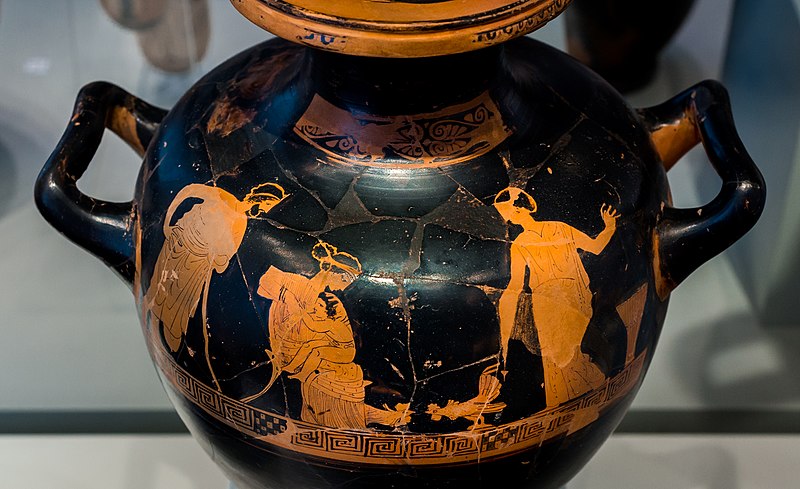
description: father Amphiaraos (bearded man in mantle) standing, leaning on his stick, mother Eriphyle sitting in a chair, suckling her baby son Alkmaion, their elder daughter Domonassa spinning wool from a baske
ca. 450-440 BC – material: pottery (clay) – height: 27 cm – findspot: Attica – museum / inventory number: Berlin, Altes Museum (Antikensammlung) F 2395

War, Some Proverbs

Arsenius 7.16n

“In war, iron is stronger for safety than gold;
But for living, reason is better than wealth.”

᾿Εν μὲν πολέμῳ πρὸς ἀσφάλειαν σίδηρος χρυσοῦ κρείττων,
ἐν δὲ τῷ ζῆν ὁ λόγος τοῦ πλούτου [Socrates]

“You can’t fuck-up twice in a war
Οὐκ ἔστιν ἐν πολέμῳ δὶς ἁμαρτάνειν

Zenobius

“War is tear-free” A proverb applied to those who succeed easily through every danger and beyond expectations.”

῎Αδακρυς πόλεμος: ἐπὶ τῶν ἔξω κινδύνου παντὸς ῥᾷστα δὲ καὶ παρ’ ἐλπίδα τὰ πράγματα κατορθούντων.

Michael Apostolios

“Beginning of wars”: A proverb applied to those who try to do wrong
᾿Αρχὴ πολέμων: ἐπὶ τῶν ἀδικεῖν ἐπιχειρούντων.

“Endless War is Sweet”: A proverb applied to those who throw themselves into dangers because of inexperience

Γλυκὺς ἀπείρων πόλεμος: ἐπὶ τῶν ὑπ’ ἀπειρίας ἑαυτοὺς καθιέντων εἰς κινδύνους.

Gregorius

“War is sweet for someone with no experience of it”

Γλυκὺς ἀπείρῳ πόλεμος

[A variation on the line above]

Heraclitus, D64

“war is father of everything; war is king of everything.”

πόλεμος πάντων μὲν πατήρ ἐστι, πάντων δὲ βασιλεύς


Heraclitus, R53

“Heraclitus claims that Zeus and war are the same thing.”

καὶ | τὸν π̣όλεμο̣[ν] καὶ | τὸν Δ[ί]α τὸν αὐ̣τὸν | εἶν[αι, κα]θάπερ καὶ | τὸν [Ἡ]ράκλειτον λέ|γειν

Xenophon, Hiero 2

“If war is a terrible evil, then tyrants receive its greatest portion.”

εἰ δὲ πόλεμος μέγα κακόν, τούτου πλεῖστον μέρος οἱ τύραννοι μετέχουσιν.


Diogenes Laertius [Demetrius 82]

“Speech can win in politics however much iron can gain in War.”

ὅσον ἐν πολέμῳ δύνασθαι σίδηρον, τοσοῦτον ἐν πολιτείᾳ ἰσχύειν λόγον

Diogenes Laertius [Diogenes 50]

“Alliances come after war.”

μετὰ τὸν πόλεμον ἡ συμμαχία

Qajar-era Iranian court painter Mirza Baba’s depiction of Fath Ali Shah’s victory over the Russians at Yerevan (Siege of Erivan), part of the Russo-Persian War of 1804–1813. The painting is kept at the National Museum of Iran in Tehran.

Presocratic Healthcare Plan: Everyone a Doctor, Everyone a Sage

A Letter to Hippocrates: Ps.-Hipp. Epist. 23 (9.392–93 Littré)

“Democritus writes to Hippocrates on the nature of human beings:

“Hippocrates, all people should know the art of medicine, since it it is noble and also advantageous for life and it is a special possession of those people who have deep experience in education and argumentation. I think that the pursuit of wisdom is the sibling and roommate of medicine since wisdom frees the soul of suffering, and medicine rids the body of illnesses.”

Δημόκριτος Ἱπποκράτει περὶ φύσιος ἀνθρώπου.

χρὴ πάντας ἀνθρώπους ἰητρικὴν τέχνην ἐπίστασθαι, ὦ Ἱππόκρατες, καλὸν γὰρ ἅμα καὶ ξυμφέρον ἐς τὸν βίον, τουτέων δὲ μάλιστα τοὺς παιδείας καὶ λόγων ἴδριας γεγενημένους. ἱστορίην σοφίης γὰρ δοκέω ἰητρικῆς ἀδελφὴν καὶ ξύνοικον· σοφίη μὲν γὰρ ψυχὴν ἀναρύεται παθέων, ἰητρικὴ δὲ νούσους σωμάτων ἀφαιρέεται [. . .].

Image from Wikipedia

Plato Says It’s Like We’re Drunk All The Time

Plato Phadeo 79c2-c8

“Therefore, weren’t we saying this long before that the mind, whenever it uses the body for examining anything—either through seeing or hearing or any other kind of perception, since examining a thing through the body is to examine it through the senses—at that moment the mind is dragged down by body towards things that never exist in the same way and it wanders and is troubled and gets dizzy as if it’s drunk, since it has been contaminated by those sorts of things.”

Οὐκοῦν καὶ τόδε πάλαι ἐλέγομεν, ὅτι ἡ ψυχή, ὅταν μὲν τῷ σώματι προσχρῆται εἰς τὸ σκοπεῖν τι ἢ διὰ τοῦ ὁρᾶν ἢ διὰ τοῦ ἀκούειν ἢ δι’ ἄλλης τινὸς αἰσθήσεως—τοῦτο γάρ ἐστιν τὸ διὰ τοῦ σώματος, τὸ δι’ αἰσθήσεως σκοπεῖν τι—τότε μὲν ἕλκεται ὑπὸ τοῦ σώματος εἰς τὰ οὐδέποτε κατὰ ταὐτὰ ἔχοντα, καὶ αὐτὴ πλανᾶται καὶ ταράττεται καὶ εἰλιγγιᾷ ὥσπερ μεθύουσα, ἅτε τοιούτων ἐφαπτομένη;

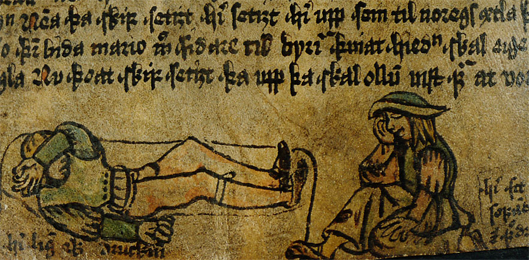
Illumination from AM 147 4to of two intoxicated 15th century Icelanders

Leaders, Corrupting the State for their Own Profit

Theognis, Elegies 39–52

“Kyrnos, this city is pregnant and I am afraid she will bear a man
Meant to correct our evil arrogance.
The citizens are still sane, but the leaders have changed
And have fallen into great evil.

Good people, Kyrnos, have never yet destroyed a city,
But whenever it pleases wicked men to commit outrage,
They corrupt the people and issue legal judgment in favor of the unjust,
For the sake of their own private profit and power.

Don’t expect this city to stay peaceful for very long
Even if it is not at a moment of great peace now,
When these deeds are dear to evil men,
As their profit accrues with public harm.

Civil conflicts and murder of kin comes from this,
And tyrants do too: may this never bring our city pleasure.”

Κύρνε, κύει πόλις ἥδε, δέδοικα δὲ μὴ τέκηι ἄνδρα
εὐθυντῆρα κακῆς ὕβριος ἡμετέρης.
ἀστοὶ μὲν γὰρ ἔθ’ οἵδε σαόφρονες, ἡγεμόνες δέ
τετράφαται πολλὴν εἰς κακότητα πεσεῖν.
οὐδεμίαν πω, Κύρν’, ἀγαθοὶ πόλιν ὤλεσαν ἄνδρες,
ἀλλ’ ὅταν ὑβρίζειν τοῖσι κακοῖσιν ἅδηι
δῆμόν τε φθείρουσι δίκας τ’ ἀδίκοισι διδοῦσιν
οἰκείων κερδέων εἵνεκα καὶ κράτεος·
ἔλπεο μὴ δηρὸν κείνην πόλιν ἀτρεμέ’ ἧσθαι,
μηδ’ εἰ νῦν κεῖται πολλῆι ἐν ἡσυχίηι,
εὖτ’ ἂν τοῖσι κακοῖσι φίλ’ ἀνδράσι ταῦτα γένηται,
κέρδεα δημοσίωι σὺν κακῶι ἐρχόμενα.
ἐκ τῶν γὰρ στάσιές τε καὶ ἔμφυλοι φόνοι ἀνδρῶν·
μούναρχοι δὲ πόλει μήποτε τῆιδε ἅδοι.

Image result for ancient greece megara ruins

A Plague of Caspian Rats

Aelian, On the Nature of Animals 17.17

“Amyntas in his work which he named Stages writes that in the Caspian land there are many herds of cattle and horses almost beyond counting. He adds this as well, that in some seasons an unconquerable plague of rats blights the land. He continues with evidence, saying that even though the rivers flow at that of year with a huge surge, the rats swim fearlessly and they even hold on to each other’s tales, biting down on one another, to form a bridge and they they cross the strait in this way.

After swimming into the farmland, he says, they grind down the roots of crops and swarm over trees and once they use their fruits for their meals they sever the branches too just because they are not able to eat them. For this reason, the Caspians—in order to ward off this invasion of rats and the ruin they bring—do not kill the predatory birds which come in turn, flying down from the clouds, and fulfill their nature by freeing the Caspians of this plague.

Caspian foxes are so numerous that they frequent both the sheepfolds in the country and they also appear in cities. By Zeus, a fox will show up in a house not to steal something or ruin it, but like some kind of pet. The Caspian foxes wag their tails just like pet dogs in our land.

The rats of the terrible plague afflicting the Caspians are almost the same in size when you look a them as the ikhneumenos of Egypt, but they are wild, and terrible, and they have teeth strong enough to cut and even eat metal. The rats in Teridon, Babylonia are like this too—and traders bring their skins to sell among the Persians. Indeed, these skins are soft and can be sewn together as a tunic to warm people. And they call them kandutanes, because it is dear to them.

Here is something amazing about these rats: if a pregnant female is caught and her fetus is removed, when the female fetus is dissected and examined, it also has a baby.”

᾽Αμύντας ἐν τοῖς ἐπιγραφομένοις οὕτως ὑπ᾽ αὐτοῦ Σταθμοῖς κατὰ τὴν γῆν τὴν Κασπίαν καὶ βοῶν ἀγέλας λέγει πολλὰς καὶ κρείττονας ἀριθμοῦ εἶναι καὶ ἵππων. ἐπιλέγει δὲ ἄρα καὶ ἐκεῖνο, ἐν ὡρῶν τισι περιτροπαῖς μυῶν ἐπιδημίας γίνεσθαι πλῆθος ἄμαχον· καὶ τὸ μαρτύριον ἐπάγει λέγων, τῶν ποταμῶν τῶν ἀεννάων σὺν πολλῶι τῶι ῥοίζωι φερομένων, τοὺς δὲ καὶ μάλα ἀτρέπτως ἐπινήχεσθαί τε αὐτοῖς καὶ τὰς οὐρὰς ἀλλήλων ἐνδακόντας ἕρμα τοῦτο ἴσχειν, καὶ τοῦ διαβάλλειν τὸν πόρον σύνδεσμόν σφισιν ἰσχυρότατον ἀποφαίνει τόνδε.

ἐς τὰς ἀρούρας δὲ ἀπονηξάμενοι, φησί, καὶ τὰ λήια ὑποκείρουσι καὶ διὰ τῶν δένδρων ἀνέρπουσι καὶ τὰ ὡραῖα δεῖπνον ἔχουσι καὶ τοὺς κλάδους δὲ διακόπτουσιν, οὐδὲ ἐκείνους κατατραγεῖν ἀδυνατοῦντες. οὐκοῦν ἀμυνόμενοι οἱ Κάσπιοι τὴν ἐκ τῶν μυῶν ἐπιδρομήν τε ἅμα καὶ λύμην φείδονται τῶν γαμψωνύχων, οἵπερ οὖν καὶ αὐτοὶ κατὰ νέφη πετόμενοι εἶτα αὐτοὺς ἀνασπῶσιν, καὶ ἰδίαι τινὶ φύσει τοῖς Κασπίοις ἀναστέλλουσι τὸν λιμόν. ἀλώπηκες δὲ αἱ Κάσπιαι, τὸ πλῆθος αὐτῶν τοσοῦτόν ἐστιν ὡς καὶ ἐπιφοιτᾶν οὐ μόνον τοῖς αὐλίοις τοῖς κατὰ τοὺς ἀγρούς, ἤδη γε μὴν καὶ ἐς τὰς πόλεις παριέναι. καὶ ἐν οἰκίαι ἀλώπηξ φανεῖται οὐ μὰ Δία ἐπὶ λύμηι οὐδὲ ἁρπαγῆι, ἀλλὰ οἷα τιθασός· καὶ ὑποσαίνουσί τε αἱ Κάσπιοι καὶ ὑπαικάλλουσι τῶν παρ᾽ ἡμῖν κυνιδίων <δίκην>.

οἱ δὲ μύες οἱ τοῖς Κασπίοις ἐπίδημον ὄντες κακόν, μέγεθος αὐτῶν ὅσον κατά γε τοὺς Αἰγυπτίων ἰχνεύμονας ὁρᾶσθαι, ἄγριοι δὲ καὶ δεινοὶ καὶ καρτεροὶ τοὺς ὀδόντας, καὶ διακόψαι τε καὶ διατραγεῖν οἷοί τε εἰσὶ καὶ σίδηρον. τοιοῦτοι δὲ ἄρα καὶ οἱ μύες οἱ ἐν τῆι Τερηδόνι τῆς Βαβυλωνίας (F 7) εἰσίν, ὧνπερ οὖν καὶ τὰς δορὰς οἱ τούτων κάπηλοι ἐς Πέρσας ἄγουσι φόρτον. εἰσὶ δὲ ἁπαλαί, καὶ συνερραμέναι χιτῶνές τε ἅμα γίνονται καὶ ἀλεαίνουσιν αὐτούς. καλοῦνται δὲ ἄρα οὗτοι κανδυτᾶνες, ὡς ἐκείνοις φίλον.

θαυμάσαι δὲ τῶν μυῶν τῶνδε ἄξιον ἄρα καὶ τοῦτο· ἐὰν ἁλῶι μῦς κύουσα, κἆιτα ἐξαιρεθῆι τὸ ἔμβρυον, αὐτῆς δὲ διατμηθείσης ἐκείνης εἶτα μέντοι καὶ αὐτὸ διανοιχθῆι, καὶ ἐκεῖνο ἔχει βρέφος.

Color photograph of a medieval manuscript showing rats rowing a boat

Ste-Genevieve, MS 143 (Taken from Pinterest)There are not  independent words for rat mouse in Ancient Greek.

μυόβρωτος: “mouse-eaten”

μυοδόχος: “containing mice”

μυοθήρας: “mouse-catcher”

μυοκτόνος: “mouse-killer”

μυομαχία: “a battle of mice”

μυοπάρων: “a small pirate boat”

μυόχοδον: “mouse dung”

Populist Politics and Killing Children at the Border

In more horrifying news from the border, Texas troopers have been told to push children back into the Rio Grande. Here’s a reminder that state sanctioned violence against children is an ancient practice of imperial states, whether they are dictatorships or democracies


Velleius Paterculus 2.28

“The evils of the civil war seemed to have ended when they were rekindled by Sulla’s cruelty. Once he was made dictator—and this honor had been avoided for a hundred and twenty years since the last time it had been used was one year after Hannibal quit Italy—and it is obvious that the fear which prompted the Roman people to want a dictator was less than how much they feared his power. As dictator, Sulla applied the power which earlier dictators had used only to save the country from the greatest dangers with unmeasured degrees of savagery.

He was the first—and I wish he had been the last—to discover the model of proscription with the result that in the same state in which legal recourse is available to an actor booed from the stage, in that state a price was set for the murder of a Roman citizen: he would have the most who killed the most! The reward for the killing of an enemy would be no greater than for the murder of a citizen.

In essence, each man was valued for the price of his own death. Such savagery was applied not only to those who had carried arms against them, but against many innocents too. In addition to this, the goods of the proscribed were offered for sale: children already deprived of their father’s goods were also prohibited from the right of seeking public office and, the most unjust thing of all, they had to maintain the standards of their social rank without recourse to the rights.”

Videbantur finita belli civilis mala, cum Sullae crudelitate aucta sunt. Quippe dictator creatus (cuius honoris usurpatio per annos centum et viginti intermissa; nam proximus post annum quam Hannibal Italia excesserat, uti adpareat populum Romanum usum dictatoris haud metu desiderasse tali quo timuisset potestatem) imperio, quo priores ad vindicandam maximis periculis rem publicam olim usi erant, eo in inmodicae crudelitatis licentiam usus est.3 Primus ille, et utinam ultimus, exemplum proscriptionis invenit, ut in qua civitate petularitis convicii iudicium histrioni ex albo redditur, in ea iugulati civis Romani publice constitueretur auctoramentum, plurimumque haberet, qui plurimos interemisset, neque occisi hostis quam civis uberius foret praemium Geretque quisque merces mortis suae.4 Nec tantum in eos, qui contra arma tulerant, sed in multos insontis saevitum. Adiectum etiam, ut bona proscriptorum venirent exclusique paternis opibus liberi etiam petendorum honorum iure prohiberentur simulque, quod indignissimum est, senatorum filii et onera ordinis sustinerent et iura perderent.

During the Peloponnesian War, the Athenian Democracy deliberated on and voted for the killing of men and the enslavement of women and children. To ask why is not an idle historical musing.

Thucydides, 5.116.4

“The [Athenians] killed however many of the Melian men were adults, and made the women and children slaves. Then they settled the land themselves and later on sent five hundred colonists.”

οἱ δὲ ἀπέκτειναν Μηλίων ὅσους ἡβῶντας ἔλαβον, παῖδας δὲ καὶ γυναῖκας ἠνδραπόδισαν. τὸ δὲ χωρίον αὐτοὶ ᾤκισαν, ἀποίκους ὕστερον πεντακοσίους πέμψαντες.

5.32

“Around the same period of time in that summer, the Athenians set siege to the Scionaeans and after killing all the adult men, made the women and childen into slaves and gave the land to the Plataeans.”

Περὶ δὲ τοὺς αὐτοὺς χρόνους τοῦ θέρους τούτου Σκιωναίους μὲν Ἀθηναῖοι ἐκπολιορκήσαντες ἀπέκτειναν τοὺς ἡβῶντας, παῖδας δὲ καὶ γυναῖκας ἠνδραπόδισαν καὶ τὴν γῆν Πλαταιεῦσιν ἔδοσαν νέμεσθαι·

This was done by vote of the Athenian democracy led by Cleon: Thucydides 4.122.6. A similar solution was proposed during the Mytilenean debate. Cleon is described by Thucydides as “in addition the most violent of the citizens who also was the most persuasive at that time by far to the people.” (ὢν καὶ ἐς τὰ ἄλλα βιαιότατος τῶν πολιτῶν τῷ τε δήμῳ παρὰ πολὺ ἐν τῷ τότε πιθανώτατος, 3.36.6)

3.36

“They were making a judgment about the men there and in their anger it seemed right to them not only to kill those who were present but to slay all the Mytileneans who were adults and to enslave the children and women.”

περὶ δὲ τῶν ἀνδρῶν γνώμας ἐποιοῦντο, καὶ ὑπὸ ὀργῆς ἔδοξεν αὐτοῖς οὐ τοὺς παρόντας μόνον ἀποκτεῖναι, ἀλλὰ καὶ τοὺς ἅπαντας Μυτιληναίους ὅσοι ἡβῶσι, παῖδας δὲ καὶ γυναῖκας ἀνδραποδίσαι.

In his speech in defense of this policy, Cleon reflects on the nature of imperialism and obedience. Although he eventually failed to gain approval for this vote which was overturned, his arguments seem to have worked on later occasions.

Thucydides, 3.37

“The truth is that because you live without fear day-to-day and there is no conspiring against one another, you think imagine your ‘allies’ to live the same way. Because you are deluded by whatever is presented in speeches you are mistaken in these matters or because you yield to pity, you do not not realize you are being dangerously weak for yourselves and for some favor to your allies.

You do not examine the fact that the power you hold is a tyranny and that those who are dominated by you are conspiring against you and are ruled unwillingly and that these people obey you not because they might please you by being harmed but because you are superior to them by strength rather than because of their goodwill.

The most terrible thing of all is  if nothing which seems right to us is established firmly—if we will not acknowledge that a state which has worse laws which are unbendable is stronger than a state with noble laws which are weakly administered, that ignorance accompanied by discipline is more effective than cleverness with liberality, and that lesser people can inhabit states much more efficiently than intelligent ones.

Smart people always want to show they are wiser than the laws and to be preeminent in discussions about the public good, as if there are no more important things where they could clarify their opinions—and because of this they most often ruin their states. The other group of people, on the other hand, because they distrust their own intelligence, think that it is acceptable to be less learned than the laws and less capable to criticize an argument than the one who speaks well. But because they are more fair and balanced judges, instead of prosecutors, they do well in most cases. For this reason, then, it is right that we too, when we are not carried away by the cleverness and the contest of intelligence, do not act to advise our majority against our own opinion.”

διὰ γὰρ τὸ καθ᾿ ἡμέραν ἀδεὲς καὶ ἀνεπιβούλευτον πρὸς ἀλλήλους καὶ ἐς τοὺς ξυμμάχους τὸ αὐτὸ ἔχετε, καὶ ὅ τι ἂν ἢ λόγῳ πεισθέντες ὑπ᾿ αὐτῶν ἁμάρτητε ἢ οἴκτῳ ἐνδῶτε, οὐκ ἐπικινδύνως ἡγεῖσθε ἐς ὑμᾶς καὶ οὐκ ἐς τὴν τῶν ξυμμάχων χάριν μαλακίζεσθαι, οὐ σκοποῦντες ὅτι τυραννίδα ἔχετε τὴν ἀρχὴν καὶ πρὸς ἐπιβουλεύοντας αὐτοὺς καὶ ἄκοντας ἀρχομένους, οἳ οὐκ ἐξ ὧν ἂν χαρίζησθε βλαπτόμενοι αὐτοὶ ἀκροῶνται ὑμῶν, ἀλλ᾿ ἐξ ὧν ἂν ἰσχύι μᾶλλον ἢ τῇ ἐκείνων εὐνοίᾳ περιγένησθε.

πάντων δὲ δεινότατον εἰ βέβαιον ἡμῖν μηδὲν καθεστήξει ὧν ἂν δόξῃ πέρι, μηδὲ γνωσόμεθα ὅτι χείροσι νόμοις ἀκινήτοις χρωμένη πόλις κρείσσων ἐστὶν ἢ καλῶς ἔχουσιν ἀκύροις, ἀμαθία τε μετὰ σωφροσύνης ὠφελιμώτερον ἢ δεξιότης μετὰ ἀκολασίας, οἵ τε φαυλότεροι τῶν ἀνθρώπων πρὸς τοὺς ξυνετωτέρους ὡς ἐπὶ τὸ πλέον ἄμεινον οἰκοῦσι τὰς πόλεις.

οἱ μὲν γὰρ τῶν τε νόμων σοφώτεροι βούλονται φαίνεσθαι τῶν τε αἰεὶ λεγομένων ἐς τὸ κοινὸν περιγίγνεσθαι, ὡς ἐν ἄλλοις μείζοσιν οὐκ ἂν δηλώσαντες τὴν γνώμην, καὶ ἐκ τοῦ τοιούτου τὰ πολλὰ σφάλλουσι τὰς πόλεις· οἱ δ᾿ ἀπιστοῦντες τῇ ἐξ ἑαυτῶν ξυνέσει ἀμαθέστεροι μὲν τῶν νόμων ἀξιοῦσιν εἶναι, ἀδυνατώτεροι δὲ τὸν1 τοῦ καλῶς εἰπόντος μέμψασθαι λόγον, κριταὶ δὲ ὄντες ἀπὸ τοῦ ἴσου μάλλον ἢ ἀγωνισταὶ ὀρθοῦνται τὰ πλείω. ὣς οὖν χρὴ καὶ ἡμᾶς ποιοῦντας μὴ δεινότητι καὶ ξυνέσεως ἀγῶνι ἐπαιρομένους παρὰ δόξαν τῷ ὑμετέρῳ πλήθει παραινεῖν.

color photograph of migrants in a river through razor wire

Humility and Pride: The Masks We Wear Day-to-Day

Cicero, Letters to Friends 20.16

“They imagined that I would be a humbled person after this, when the country was actually making me prouder than I had been at any point in my life when it declared it could not live without me, a single citizen!”

abiectiore animo me futurum, cum res publica maiorem etiam mihi animum quam umquam habuissem daret cum declarasset se non potuisse me uno civi carere


Seneca, Moral Epistles 120, 21-22

“Those people I describe are like this, that kind of man Horace talks about, someone who is never the same or even really like himself. That’s how far he walks in the opposite direction. Did I mention that many are like this? It is the same way with most people. Everyone changes their plans and prayers daily. Someone wants a spouse, then only a bit of fun on the side. Someone wants to rule, then they act more officious than an enslaved person. One day, someone flexes to the point of derision, only to withdraw and shrink into more humility than those who are truly without pretense. They throw money about and then hoard it!

This is how a silly mind exposes itself. It takes this form and then another and then never looks like itself. This is, for me, the worst way to be. I do understand, it is hard to take the shape of one person alone. No one can truly be singular except for the wise person, so the rest of us try on different masks in turn. We seem sober and serious one moment and then wasteful and silly the next. We often change our roles and play a part against where we started.

For this reason, try to play the same character to the end of life’s game that you started at the beginning. Try to make people praise you. If you can’t, at least let them recognize you. Otherwise, when it comes to someone you saw yesterday, they can ask, “who is this person?” That’s how much change you allow. Goodbye!”


Homines isti tales sunt, qualem hunc describit Horatius Flaccus, numquam eundem, ne similem quidem sibi; adeo in diversum aberrat. Multos dixi? Prope est, ut omnes sint. Nemo non cotidie et consilium mutat et votum. Modo uxorem vult habere, modo amicam, modo regnare vult, modo id agit, ne quis sit officiosior servus, modo dilatat se usque ad invidiam, modo subsidit et contrahitur infra humilitatem vere iacentium, nunc pecuniam spargit, nunc rapit. 

Sic maxime coarguitur animus inprudens; alius prodit atque alius et, quo turpius nihil iudico, impar sibi est. Magnam rem puta unum hominem agere. Praeter sapientem autem nemo unum agit, ceteri multiformes sumus. Modo frugi tibi videbimur et graves, modo prodigi et vani. Mutamus subinde personam et contrariam ei sumimus, quam exuimus. Hoc ergo a te exige, ut, qualem institueris praestare te, talem usque ad exitum serves. Effice ut possis laudari, si minus, ut adgnosci. De aliquo, quem here vidisti, merito dici potest: “hic qui est?” Tanta mutatio est. Vale.

Hieronymous Bosch, he Seven Deadly Sins and the Four Last Things – Pride, 1486