N.B This is a different Pythagoras from the one with the theorem.
Suda, s.v. Pythagoras of Ephesos
“Pythagoras of Ephesos. Once he overthrew the government called the reign of the Basilidai, Pythagoras became the harshest tyrant. He seemed and sometimes was very kind to the people and the masses, increasing their hopes, but under-delivering on their profits. Because he despoiled those in high esteem and power and liquidated their property, he was not at all tolerable.
He did not hesitate to impose the harshest punishments or to mercilessly kill those who had done no wrong—for he had gotten just this crazy. His lust for money was endless. He was also quickest to anger in response to any insults to those near to him. On their own, these things would have been enough reason for people to kill him in the worst way, but he also was contemptuous of the divine. Indeed, many of his previously mentioned victims he actually killed in temples.
When the daughters of one man took refuge in a temple, he did not dare to extract them forcefully, but he waited them out so long that the girls resolved their hunger with a rope. A plague then afflicted the people along with a famine and Pythagoras, who was worried for himself, sent representatives to Delphi, requesting relief from these sufferings. She said that he needed to build temples and take care of the dead. He lived before Cyrus of Persia, according to Batôn.”
“But there are some souls who live with us on the earth and have come to possess unjust profit, which is clearly inhuman. They implore the guards, whether they are shepherds or guard-dogs, or the highest of all masters as they beg them, trying to persuade them with pleasing words and enchanting spells—as the stories of evil men go. They are able to profiteer among human beings without suffering anything!
But we say that the crime we call now “profiteering” is the same as a disease in the body’s flesh, or what we would call a plague in some seasons and years, or what, once the word is translated, is injustice itself in cities and states.”
“Sertorius, when he noticed that the uprising among the indigenous people was overwhelming, turned nasty to his allies: he accused some and had them killed; others he threw into prison; but he liquidated the wealth of the richest men. Even though he acquired a great deal of gold and silver this way, he did not put any of it into the public treasury for the war effort, instead he hoarded it for himself. He didn’t use it to pay the soldiers either or even share some of it with his commanders.
When it came to capital cases, he did not consult the council or advisers, but had hearings in private and gave judgments after serving as the solitary judge. He did not consider his commanders worthy of invitations to his banquets and demonstrated no beneficence to his friends. As he was generally driven mad by the worsening state of his own rule, he acted tyrannically toward everyone: he was hated by the people and conspired against by his friends.”
“What strait or what channel do you imagine has as many currents, twists, and tide changes as the disturbances in the breaking waves produced by elections? A missed day or extra night often changes everything and a small whisper of a rumor can transform public opinion.
Often too, something happens without any clear reason and and you notice how the people are frequently amazed at what happened, as if they didn’t do it themselves! Nothing is more uncertain than a mob; nothing is less clear than what people want; nothing is more obscure than the whole logic of elections!”
Quod enim fretum, quem Euripum tot motus, tantas, tam varias habere putatis agitationes commutationesque fluctuum, quantas perturbationes et quantos aestus habet ratio comitiorum? Dies intermissus aut nox interposita saepe perturbat omnia, et totam opinionem parva non numquam commutat aura rumoris. Saepe etiam sine ulla aperta causa fit aliud atque existimaris, ut non numquam ita factum esse etiam populus admiretur, quasi vero non ipse fecerit. Nihil est incertius volgo, nihil obscurius voluntate hominum, nihil fallacius ratione tota comitiorum.
“Otanês was first urging the Persians to entrust governing to the people, saying these things: “it seems right to me that we no longer have a monarchy. For it is neither pleasing nor good. For you all know about the arrogance of Kambyses and you were a party to the insanity of the Magus. How could monarchy be a fitting thing when it permits an unaccountable person to do whatever he pleases? Even if you put the best of all men into this position he might go outside of customary thoughts. For hubris is nurtured by the fine things present around him, and envy is native to a person from the beginning.
The one who has these two qualities possesses every kind of malice. For one who is overfilled does many reckless things, some because of arrogance and some because of envy. Certainly, it would be right for a man who is a tyrant at least to have no envy at all, since he has all the good things. Yet he becomes the opposite of this towards his citizens: for he envies those who are best around him and live, and he takes pleasure in the worst of the citizens—he is the best at welcoming slanders.
He becomes the most disharmonious of all people—for if you admire him only moderately, then he is upset because you do not support him ardently. But if someone supports him excessively, he is angry at him for being a toady. The worst things are still to be said: he overturns traditional laws, he rapes women, and kills people without reason.”
1. Authoritarianism [oligarchy] would appear to be a certain lust for power that is greedy for strength and profit. An oligarch is the sort who:
2. When the people are debating who should be selected to assist leading a parade, steps right up and declares that absolute control is required. If others propose ten people to do a job, he declares that “one is enough, provided he is a real man”. He can recall only that one Homeric verse—“the rule of many is not good, there should be one ruler’—and he understands nothing of the rest.
3. Don’t miss out that he uses these kinds of statements: “We should get together and deliberate about this on our own and avoid the democrat mob and the assembly. Stop being insulted or honored by them when we hold public offices” or “They should run the state or we should.”
4. In the middle of the day he goes out finely dressed with his hair hanging at mid-length and his fingernails finely done, peacocking around, laying about with words like this:
5. “Thanks to all these whistleblowers, this country is unlivable!” “We are being treated the worst in the courts because of their corruption!” “I can’t imagine what these people pursuing politics even want!” “The people are completely ungrateful—all they want is a handout!” He says he is ashamed in the assembly whenever some skinny person sits next to him.”
“When Plato saw that someone was doing evil things, but claiming that he was carrying out justice for other people, he said. “This man carries his mind on his tongue.”
“Foolish people honor and wonder at those who have a lot of money and are scoundrels, and hold serious people in contempt when they see that they are poor.”
“The Law of the Twelve Tables commands that anyone who has conspired with an enemy against the state or handed a citizen to a public enemy, should suffer capital punishment.”
Marcianus, ap. Dig., XLVIII, 4, 3: Lex XII Tabularum iubet eum qui hostem concitaverit quive civem hosti tradiderit capite puniri.
“[Cases concerning] death and citizenship must not be pursued except before the greatest assembly and those whom the censors have recorded in the rolls of the citizens.”
de capite civis nisi per maximum comitiatum ollosque, quos censores in partibus populi locasint, ne ferunto.
The death penalty is not the enactment of justice, it is the execution of vengeance when justice is impossible or not actually desired. It does not function as a deterrent. It is meted out disproportionately to people without financial and social capital, which in the United States means that people of color face capital charges and are executed at far higher rates. The moral peril is compounded by the imperfection of our criminal system where at least 1 in 25 people on death row are actually innocent. The death penalty is not part of a justice system, it is part of a vengeance system.
Note the connection in several passages between the sanctity of the state, the power to end a life, and citizenship.
“These opponents have not said that I am guilty of any of the actions for which the established penalty is death–robbing a temple, theft, enslaving someone, betraying the state…”
“Whoever raises a human being into power and thus enslaves the laws, whoever makes the state subordinate to his petty faction and transgresses what is right by doing all of this violently and stirring up civil strife, he should be considered the most inimical to the whole state.
And the kind of person who does not share these actions, but does occupy some of the most important offices of the state and either fails to observe them or does not fail but will not avenge his country because of cowardice, he should be considered as a citizen at a second degree of evil.
Let each person whose worth is small bear witness to the officers of the state by bringing this person to court for his plotting violent and unconstitutional revolution. Give them the same charges we have for temple robbery and run the trial as it is in those cases where the death penalty comes by majority vote.”
“It is right that punishments for other crimes come after them, but punishment for treason should precede the dissolution of the state. If you miss that opportune moment when those men are about to do something treacherous against their state, it is not possible for you to obtain justice from the men who did wrong: for they become stronger than the punishment possible from those who have been wronged.”
“Death is not the most extreme penalty–there are those described in Hades for offenses like this which are beyond death and are truly described, but they are useless in deterring some kinds of minds from their crimes.”
From Brill’s New Pauly on the death penalty in Greece and Rome by Gottfriend Schiemann:
“In Athens not only premeditated killing (phónos) and sedition and high treason (katálysis toû dḗmoû, prodosía ) resulted in the death penalty, but also religious offences such as desecration of the temple (hierosylía) and (cf. in particular the case against Socrates [2], 399 BC) publicly taught godlessness (asébeia). In a similar way, in Rome there was provision for the state death penalty for sedition and high treason (perduellio) by beheading (decollatio , in Greece apokephalízein) with an axe, later a sword. In the Roman Imperial period this was the typical death penalty for honestiores , but now sometimes also for homicide.”
Jacob van Maerlant, (The traitor Ganelon drawn and quartered)., Spieghel Historiael, West Flanders, c. 1325-1335
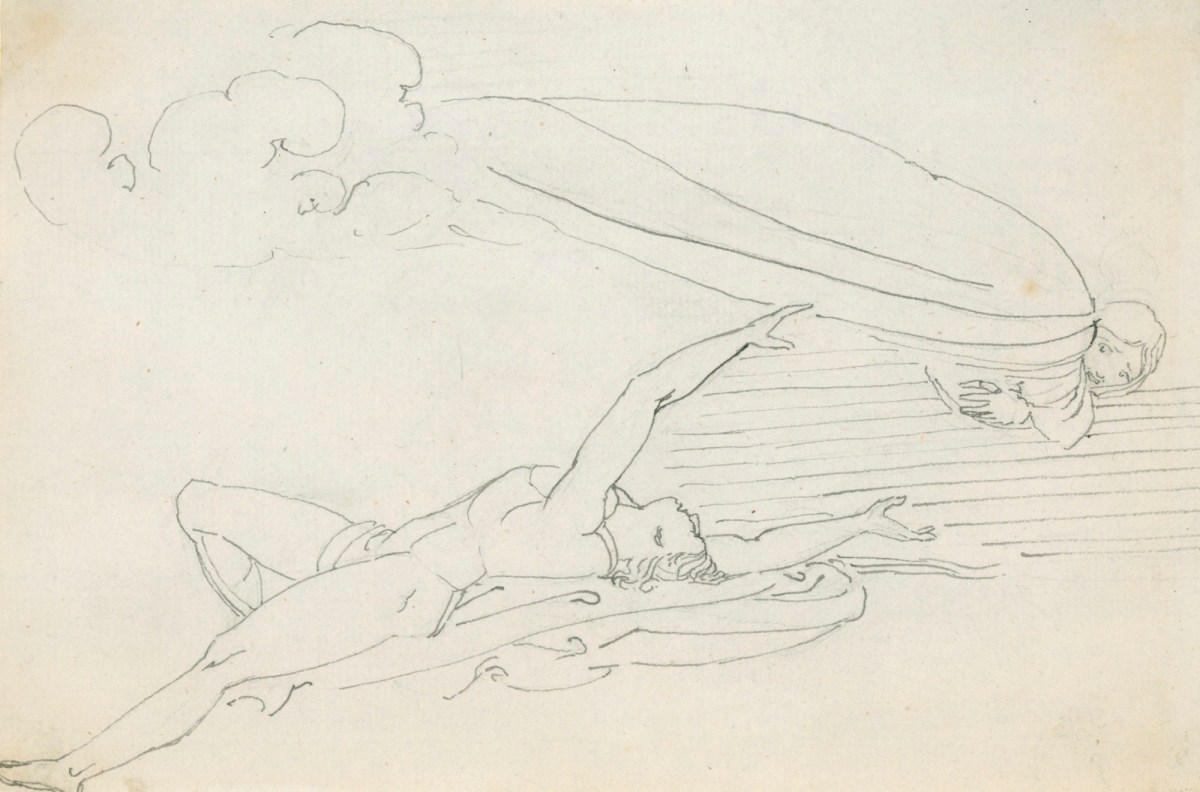
John Flaxman; The Ghost of Patroclus Appearing to Achilles; 1792-3 (c) Royal Academy of Arts
Homer, Iliad 23.65-76
And there appeared to him the ghost of poor Patroclus all in his likeness for stature, and the lovely eyes, and voice, and wore such clothing as Patroclus had worn on his body. The ghost came and stood over his head and spoke a word to him: You sleep, Achilles; you have forgotten me; but you were not careless of me when I lived, but only in death. Bury me as quickly as may be, let me pass through the gates of Hades. The souls, the images of dead men, hold me at a distance, and will not let me cross the river and mingle among them, but I wander as I am by Hades’ house of the wide gates. And I call upon you in sorrow, give me your hand; no longer shall I come back from death, once you give me my rite of burning.
Ghosts, apparitions, miracles, supernatural events, to what extent do we believe in them? And if they were to be real, how much would they differ from each other? At first we need to begin by establishing what we understand by supernatural. If we refer to occurrences that fall outside the laws of nature, then the scope of these events has immediately enlarged, considering that we do not live in nature, but in a world – a human product. Nowadays many things have gone missing from that world; people, places, events. And these disappearances, through quarantine, incarceration or simply prolonged absence, are a kind of supernatural event in reverse – a sudden dis-apparition. But the missing haven’t been abandoned, instead, they lie in a state of abeyance, without being immediately present. With the irresistible and ceaseless flow of time — paraphrasing here Anna Komnene — we begin to question their reality.
Have these things and persons in abeyance then become ghostly presences or apparitions? I like Derrida’s idea that ghosts today are but the return or persistence of elements from the past, because it instantly complicates matters around ghostliness: Since elements from the past are always around us, can we really talk about absence or ghosts? Would it be correct to identify all absences as ghostly? Not sure here what it is exactly that returns or reappears.
We need to turn to dictionaries now, but they aren’t of much help. The only antonyms of ghostly (what is the opposite of a ghost?) that I could find, were the terms ‘natural’ and ‘angelic’, both of which do little in reference to the world, so that there’s not an exact territory of coincidence between ghosts and death. A dictionary of classical literature, on the other hand, tells us that ghosts are difficult to distinguish from supernatural entities or delusions, and yet the really striking part of the definition is that while ghosts seem generally ‘powerless and ineffectual’, they are persistent. I am fascinated by this combination of both persistence and powerlessness in the ghost, because of what it has to say to us about contemporary political narratives.
An example of this persistence comes down to us from the Iliad: Without a proper burial, the ghost of Patroclus, Achilles’ companion, is condemned to wander around the house of Hades for eternity. It would be hard to overstate how important burials were for antiquity (and continue to be so for us, for no clear reason, accounting for the shock at the mass graves of Bergamo and Hart Island during the pandemic) but I don’t want this commonplace trope to distract us from the mysterious apparition. It is one of the strangest dreams in classical literature and the only ghost to appear in the Iliad: Breaking away from the pattern of Homeric dreams, which generally involve divinities that bring knowledge of the future (following a structure of apparition at night when the person has retired, speech, departure, reaction and then dawn), dead Patroclus’ apparition in book XXIII makes no real sense, and it doesn’t bring any new information or steer the narrative in any direction.
The strangeness begins earlier, when Achilles himself performs two unusual tasks one after another (18.316-317): First, he attempts to summon Patroclus back to life by the uncommon gesture of placing his hand on the chest of the dead body as if it were alive and then he greets Patroclus with the formal χαῖρέ (hail!), establishing a distance between himself and Patroclus, implying a separation between them that is hard for Achilles to grasp — is he alive or dead? This attention to detail might seem pesky but given that the repertory of epic is so limited, any deviation in patterns of speech and behavior is telling us something; an innovation is taking place. After the funeral feast, Achilles slumbers into sleep by the seashore, and Patroclus appears to him ‘all in his likeness’ (23.66) with a puzzling request to be buried as soon as possible, given that Achilles had already decided to bury him the next day.
Gregory Buchakjian, photograph of Istanbul’s Tarlabaşı neighborhood that was due to be demolished. May 2013, a few weeks before the Gezi Park demonstrations started. Courtesy of the artist.
Patroclus is dead (at the hand of Hector, who was in turn subsequently slain by Achilles — the heart of the epic) but he hasn’t entered Hades yet. He finds himself in an in-between space, a uniquely hybrid dream/underworld scene where, far from heroic convention, this meeting about memory and the past, is still possible. And yet Patroclus asks Achilles to give him his hand for the last time for he’s nevermore to return from Hades after his burial (23.75). In spite of the immense affection between them, when Achilles tries to embrace him, the shadow suddenly turns into nothingness and dissolves into air (23.99-101), ‘with a shrill cry’. This extraordinary moment of tenderness, apparently innocuous, happens at a pivotal moment in the epic, when the death of Achilles is near – this was no news. Achilles himself is too baffled, and speaks with sadness about Patroclus’ weeping and wailing (23.106), before lighting the funeral pyre, followed by the long funeral games, a series of competitions held in honor of Patroclus and that take up most of the book.
The ghost appears thrice in the book, however on the last appearance (23.221-225), there’s a heartbreaking scene: a distraught Achilles is said to call upon Patroclus’ ghost for a last time, ‘as a father mourns the bones of a son, who was married only now, and died to grieve his unhappy parents’ and ‘[Achilles] dragged himself by the fire in close lamentation’. It seems as if the span of the apparition has come to an end, yet something is about to occur that makes the brief encounter with Patroclus gain immense depth. In book XXIV, Achilles is still agonizingly mourning Patroclus and abusing Hector’s body, dragging it around his friend’s tomb – Hector’s mother Hecuba remarks that even that did not bring Patroclus back to life (24.755-57). The apparition of Patroclus in fact restored Achilles’ humanity which had been buried in his anger and pain. A moment of reckoning arrives here: now he begins to see all the desolation that his anger has caused and there’s a final encounter with mortality in which Achilles accepts Patroclus’ death and also his own.
Commentary on the Iliad is long and intricate – it is a song about war and its disastrous consequences, but also one about political foundations and origins. But I want to dwell on the neglected figure of the ghost. Homeric terminology for the ghost is complex and “Psyché” encompasses meanings as diverse as both life and departed life, and is also used indistinguishably with other terms for soul and mind. As we had earlier seen, the status of the ghost is undefinable, and therefore it stands outside of and sometimes in opposition to the order of memory that establishes a polis upon return to the homeland from the battlefield. In the world of epic, commemoration of great deeds from the past is caught between two temporal modes: Remembering the life of a hero who has already died (remembrance of Achilles from a future standpoint) and preserving that memory as something not forgotten (the lasting permanence of the past), therefore the appearance of the ghost of Patroclus breaks down here the collective recollections of victory and turns inwards, towards remembrance of the past together with Achilles but not collectively with others (23.78).
Though we speak a lot about memory-narratives in the present, collective memory is a function of the regime of history, where things and events have already consolidated into a foundation (or against foundations). Whether the permanence of the memory that founded the body politic in the first place undergoes change, the substance of the space of the polis goes back to a single source. What I want to propose here is an idea of ghosts as communities of memory, distinct from but parallel to political foundations. What if it were possible for memory to become fragmented into different filaments of remembrance of things past and future articulated around the present and stemming from different sources?
A notion of ghosts as communities of memory came from recent work by Turkish sociologists Cihan Erdal (a young scholar now imprisoned in Turkey alongside thousands of other students on bogus charges of political activities) and Derya Fırat, on ‘presentism’ and the temporality of Gezi, the popular uprising that took place in Turkey in 2013 and after which the political landscape of the country has significantly deteriorated into authoritarian rule. Erdal and Fırat question the defeatism of the Western and Turkish Left in regard to utopian moments and whether something remains from them? Has the defeat of Gezi in anyway affected our sense of temporality?
Gezi Park protests graffiti, “The solution is Gandalf, what’s up Derrida?”, Istanbul, June 2013, photograph by the author
On a close reading of Enzo Traverso’s work on the melancholy of the Left, and his assertion that utopias have become a historical form of the past, they speak about the presentism after 1989 that absorbs the past and the future through the opening up of a self-dissolving, sparse present tense, so that this present-timeism builds a thick wall between the present and the past, putting an end to the transference of experience […] particularly in the absence of an alternative model of society. Following from that, their central argument is that the Gezi Park protests attempted to establish a new radical imagination of time (moving simultaneously between past and present, memory and expectation) that disrupted the current neoliberal presentism, and that they did so by imagining utopias both past and future – as a dialogue between different moments of mourning and memory, and between different ghosts that return and persist.
A few words on presentism would help to clarify the extent to which the Iliad as a foundational narrative is able to time-travel in order to tell us something about the present: Admittedly there’s no concept of linear time in Homer, in the same way that our fractured temporality — the temporariness of life under presentist authoritarian regimes, we’ve been ejected from time — attempts to grasp the past in order to imagine other possibilities: The subject of the Iliad is time itself and the durability of memory that withstands the withering flow of this ever-present time. Achilles’ most famously referred description as κλέος ἄφθιτον (of unwithering glory) expresses this desire as an action yet to be completed (9.410-416) simultaneously in the past and future. Time might be abstract but it is also a force that produces change, and this is what presentism (in Homer as the returning cycles of nature and in our times as the capitalist eternity of markets and the internet) is attempting to erase by collapsing the future-orientation of utopia or memory into an obsolete historical form, predicated on the ends of history: This is the best of all possible worlds.
While it’s been constantly argued that memory and mourning is the way out of the amnesia of presentism (why are we so shocked about Bergamo and Hart Island but not so much about the mass graves of wars elsewhere within the same time period?), the politics of ghosts proposed by Erdal and Fırat reframes this work of memory beyond both static remembrance of the past and restoration of past utopias. Remembrance becomes here a different orientation, which created means of communication between different historical moments and social movements, preventing the present or the past from exercising authority over each other. Ghosts from the past are speaking to each other in the here-and-now, expressing not only the”no longer” that has passed, but a sense of continuity anchored in “not yet” and “would be” referred towards the future — a typology of Iliadic time.
The ghosts that we are dealing with in here are moments of upheaval, uprising and utopia that have been deeply buried in the collective imagination but that have the power to return any time – the function of latency – without destroying the fabric of time by attempting futile restorations. These ghosts are not only moments of political action, but also catalysts thereof, such as commemorations of events and memories of violence. In the context of Gezi, for example, Erdal and Fırat mention that when Taksim Square was banned for workers in 1979, the symbols of the left factions were hung on Konak Square in the city of Izmir, a gesture that was repeated in 2013 on the facade of the Atatürk Cultural Center in Istanbul. As a checkpoint in political memory, the building was subsequently demolished, and yet this doesn’t guarantee that these ghosts will not return again and again: Apparently, the trade-free shopping between ghosts continues. Within the world of the Iliad, physical objects, decaying structures — of ships and tombs, and moments lost in time provide a record of the past that continues to exert force upon the present.
The fundamental problem that Erdal and Fırat see with with the work of mourning (over utopian pasts) is that it requires a dead body and a burial, but how can something be buried if it is absent or has never been completed? For Derrida, the ghost cannot even be called a being, because it doesn’t exist – it is both present and non-existent, and therefore one cannot enter into mourning with ghosts, because ghosts never die, they always keep coming back. The recognition of the presence of the ghost in its unburied state, is also a call for practical justice and therefore, a reinscription of experience within time, rather than against it: This proposal is also a formulation of justice so that time out of joint can be rectified. It is one that will provide an exit from the present in crisis and will bring us to justice by building this new relationship with both past and future. It is a politics of ghosts that, on the one hand, aims to put an end to the violence of the present against the past, and on the other hand, it will overcome the possibility of the past and future to dominate / erode the present.
Atatürk Cultural Center, Gezi Park protests, Istanbul, June 2013, photograph by the author
In a time of global upheaval, although we are still trapped in the presentism of catastrophe and disaster which is one of the most common narratives of capitalism — the emergency, the possibility of closing the distance between the present and a horizon of expectation about the future has not been completely closed. The future is still a latent possibility that might awake again at some undefined point. Is this future coming from the past? There’s no assurance, sometimes the future arises out of itself, but the cancellation of movement inside historical planes is not a viable solution when the present alone is too fragile to hold institutions and moral reflexions. In a world replete with ghosts – paraphrasing Derrida – the supernatural is no longer an extraordinary occurrence, but the nature of all political action. Insofar as all human action remains unpredictable, in both motive and intended goal, it is always miraculous and supernatural in the sense that it is highly improbable and yet actual.
But if all worldly existence and political life is invaded by ghosts, how to distinguish then between the ghost and reality? We think that memory should be reconstructed today and considered as a radical invitation to democratize the relationship between generations in political space. Political space is always a term that brings us back to the Iliad again: This isn’t only a concept of memory, since physical spaces as the containers of memory, are replete with debris that functions as “clocks” measuring time through both deterioration and durability. The constant apparitions of the past in these spaces remind us that although encounters with ghosts are ephemeral, they can serve as markers of the short distance between no longer and not yet, as expressed in the “now” emphasis in the words of Menelaus in the Iliad, while remembering Patroclus in such a way that this now, although stemming from the present, becomes a memory for a would-be future:
Homer, Iliad 17.670-672
Now let each one of you remember poor Patroclus who was gentle, and understood how to be kindly toward all men while he lived. Now death and fate have closed in upon him.
Here the conversation about ghosts and the supernatural is also a conversation about very long spans of memory across time: While all politics is grounded in human action and all human action is supernatural, our standard liberal model of society attempts to dovetail action and do away with politics by reducing it to bureaucratic administration and the satisfaction of human needs in nature, therefore its alleged emphasis on the social and economic question. But it was at the very beginning of our tradition of politics, in the Iliad, when the ability to change the flow of time in any direction, was considered the benchmark of rising above the cycles of nature, and therefore making action and speech identical with freedom. Anthropologists David Graeber and David Weingrow speak about freedoms that were common to many early human societies in the past and that we have abandoned: The freedom to refuse orders, to move away and to create entirely new social orders or move between different ones. This ability for new beginnings is at the heart of the Iliad‘s struggle against the destructive influence of time.
Little did they know (they couldn’t), Cihan Erdal and Derya Fırat, at the time their work was published in the end of 2019, that the politics of ghosts would become a mainstay of political life only a few months later when we would temporarily lose the world, and become entirely surrounded by ghosts. But interestingly enough, they do mention at the end of their essay the songs of Victor Jara rising from the squares and balconies in the capital Santiago in Chile or the yellow vests in the streets of Paris as a part of the conversation between ghosts. Only a few days ago, a referendum in Chile overthrew the constitution from the Pinochet dictatorship, even as many other uprisings are taking place and failing elsewhere. The ghost dialogue about new beginnings continues…
‘Being here, today, is accepting to live with our ghosts, to long for them, to feed them’ said Lebanese artists Joana Hadjithomas and Khalil Joreige years ago (I know the quote is real, but I cannot locate its source, therefore it remains itself a ghost), speaking about incomplete mourning: these ghosts are present among us, and the spaces they occupy are irredeemable – a gap that cannot be closed, but they can suddenly break out of the present by throwing us back into the future, a future that can be remembered and over which it is also possible to act. In a fragment from the Myrmidons, a lost play of Aeschylus, recounting aspects of the story of Achilles and Patroclus, unknown or too obvious to the Iliad, Achilles scolds his comrade Antilochus, reversing the nature of mourning over his companion Patroclus – we are not in mourning over the missing, but over ourselves:
Scholia to Aristophanes
Antilochus, bewail me, the living, rather than him, the dead; for I have lost my all.
᾿Αντίλοχ’, ἀποίμωξόν με τοῦ τεθνηκότος τὸν ζῶντα μᾶλλον.
[Fragments in italics, from Cihan Erdal and Derya Fırat, “Toplumsal Hareketler ve Bellek İlişkisi: Yas ve Anmadan Hayaletler Siyasetine” (The Relationship Between Social Movements and Memory: From Mourning and Remembrance to the Politics of Ghosts) Birikim, December 2019, translated and paraphrased by the author]
Cihan Erdal, courtesy of Omer Ongun
On September 25, 2020, Cihan Erdal, a 32-years-old PhD researcher in the Department of Sociology and Anthropology at Carleton University in Canada, was arrested in Istanbul. The charges stem from events back in 2014, which are being used to continue persecuting members of the leftist HDP political party. Erdal and 81 others have been targeted because they are all signatories to a letter calling for the government to protect a Kurdish town under ISIS attacks. He was placed in solitary confinement in Ankara until October 23, 2020. No indictment and no hearing date has been announced yet. If convicted, he might be facing a potential life sentence. Some 2500 academics worldwide have signed a petition for his release. As an LGBT person, he is at risk of additional persecution over his sexuality. Cihan has been based in Canada since 2017 and his research is largely focused on youth-led social movements in Europe, including Turkey. Learn more about the case at https://freecihanerdal.wordpress.com/
Send letters to Cihan Erdal:
Cihan Erdal adına Sincan 2 Nolu F Tipi Yüksek Güvenlikli Kapalı Ceza İnfaz Kurumu 06930 Yenikent/Sincan-ANKARA
Acknowledgements: Gregory Buchakjian & Joana Hadjithomas in Beirut for (almost) a decade of conversations, both present and absent, about ghosts, our own and others’. Dedicated to Cihan Erdal, for your prompt liberation.
Demolition of Atatürk Cultural Center, Istanbul, May 2018, photograph by the author
Arie Amaya-Akkermans is a writer and art critic based in Istanbul. He’s also tweeting about Classics, continental philosophy, contemporary art and Turkey/Greece.
Bibliography:
Arie Amaya-Akkermans, “Revolution or Redemption? The Middle East” in Revolutions: Finished and Unfinished, from Primal to Final, ed. P. Caringella, W. Cristaudo & G. Hughes, Cambridge Scholars Publishing, 2012, pp 329-249
Hannah Arendt, “Introduction to Politics” in The Promise of Politics, Schocken Books, 2005, pp 93-200
Hannah Arendt, “What is Freedom?” in Between Past and Future, Penguin Classics, 2006, pp 142-169
Hannah Čulík-Baird, “The Fragment as Form”, UT Austin Lecture, 25th September 2020, online.
Cihan Erdal & Derya Fırat, “Toplumsal Hareketler ve Bellek İlişkisi: Yas ve Anmadan Hayaletler Siyasetine” (The Relationship Between Social Movements and Memory: From Mourning and Remembrance to the Politics of Ghosts) in Birikim, 368, December 2019, 35-43
R.K. Fischer, “The Concept of Miracle in Homer”, Antichthon, 29 (1995), pp 1-14
Lorenzo F. Garcia, Homeric Durability: Telling Time in the Iliad, Hellenic Studies Series 58, Center for Hellenic Studies, 2013, online.
George Alexander Gazis, Homer and the Poetics of Hades, Oxford University Press, 2018
David Graeber, Debt: The First 5000 Years, Melville House, 2012
Agnes Heller, A Philosophy of History in Fragments, Wiley-Blackwell, 1993
Nat Muller, “What Was Lost: Joana Hadjithomas and Khalil Joreige in conversation with Nat Muller” Ibraaz, 2012, online.
W.B. Stanford, “Ghosts and Apparitions in Homer, Aeschylus and Shakespeare” in Hermathena, No. 56 (November, 1940), pp 84-92
David Wengrow, What Makes Civilization: The Ancient Near East and the Future of the West, Oxford University Press, 2018
“If we truly encounter some pain and grief, we need to force cheer and ease from the good things we have left to us, smoothing away everything from the outside with our inner strength.
But for those things whose nature bears no evil, but whose pain is completely and simply fashioned from empty opinion, we need to behave as with children who fear masks, putting them into their hands and turning them over, training them not to think too much of them. In this way, by touching things and submitting them to reason, we can uncover their weakness, their emptiness, and their histrionic facade.”
Marcus Cornelius Fronto to Antoninus Augustus Ambr. 390 17
“Aesopus the tragedian reportedly never put a mask on his face until he had looked at it for awhile from the other side so that he might change his gestures and alter his voice in line with the appearance of the mask.”
Tragicus Aesopus fertur non prius ullam suo induisse capiti personam, antequam diu ex adverso contemplaret, ut pro personae voltu gestum sibi capessere ac vocem <adsimulare posset>
Diogenes Laertius, Ariston 160
“[He compared] the wise man to a good actor who could take up the role of both Thersites and Agamemnon and play either appropriately
“There will soon be a time when the tragic actors will believe that their masks and costumes are their real selves. You have these things as material and a plot. Say something so we may know whether you are a tragic actor or a comedian. For they have the rest of their material in common [apart from the words]. If one, then, should deprive the actor of his buskins and his masks and introduce him to the stage as only a ghost, has the actor been lost or does he remain? If he has a voice, he remains.”
“Remember that you are an actor in a drama, whatever kind the playwright desires. If he wishes it to be short, it is short. If he wants it to be long, it is long.
If he wants you to act as a beggar, act even that part seriously. And the same if you are a cripple, a ruler, or a fool. This is your role: to play well the part you were given. It is another’s duty to choose.”
Teles the Philosopher, On Self-Sufficiency (Hense, 5)
“Just as a good actor will carry off well whatever role the poet assigns him, so too a good person should manage well whatever chance allots. For chance, as Biôn says, just like poetry, assigns the role of the first speaker and the second speaker, now a king and then a vagabond. Don’t long to be the second speaker when you have the role of the first. Otherwise, you will create disharmony.”
By chance a fox had seen a tragic mask: What a sight, he has no brains inside!–he gasped. To whomever fortune grants honor and glory, It deprives of common sense, as in this story.
Personam tragicam forte vulpes viderat: O quanta species, inquit, cerebrum non habet! Hoc illis dictum est, quibus honorem et gloriam Fortuna tribuit, sensum communem abstulit.





_Portretten_van_Griekse_en_Romeinse_filosofen_en_schrijvers_(serietitel),_RP-P-2007-362.jpg)
.jpg)