Patience, The Greatest Virtue?

Dicta Catonis 1.38

“Defeat one you could destroy with an enduring mind.
Patience is the greatest virtue of human kind.”

Quem superare potes interdum vince ferendo;
maxima enim est hominum semper patientia virtus.

Seneca, De Beneficiis 30

“Often, a thing which patience could unravel is torn by a violent tug.”

Saepe, quod explicari pertinacia potuit, violentia trahentis abruptum est

Aristotle, Nicomachean Ethics 1100b-1100a

“Still, nobility shines bright even in tough times, when someone bears even many severe misfortunes patiently, not because they cannot sense them, but because of their unselfishness and greatness of spirit. If the actions one takes rules their life—as we just said—then none of the happy people can ever be miserable.”

ὅμως δὲ καὶ ἐν τούτοις διαλάμπει τὸ καλόν, ἐπειδὰν φέρῃ τις εὐκόλως πολλὰς καὶ μεγάλας ἀτυχίας, μὴ δι᾿ ἀναλγησίαν, ἀλλὰ γεννάδας ὢν καὶ μεγαλόψυχος. εἰ δ᾿ εἰσὶν αἱ ἐνέργειαι κύριαι τῆς ζωῆς, καθάπερ εἴπομεν, οὐδεὶς ἂν γένοιτο τῶν μακαρίων ἄθλιος.

Cicero, Tusculan Disputations 14

“I do not deny that pain is painful—otherwise, why would bravery be desired? But I do say that it is suppressed through patience, if we possess any amount at all. If we have none, then why do we raise philosophy on high and robe ourselves in its glory?

Non ego dolorem dolorem esse nego,—cur enim fortitudo desideraretur?—sed eum opprimi dico patientia, si modo est aliqua patientia: si nulla est, quid exornamus philosophiam aut quid eius nomine gloriosi sumus?

Pin on The Simpsons (The Golden Era)

Marcus Aurelius, Meditations 11. 6

“Whenever you are really angry and upset, [remember] that human life is short and soon we will all be in the ground.”

ὅταν λίαν ἀγανακτῇς ἢ καὶ δυσπαθῇς, ἀκαριαῖος ὁ ἀνθρώπειος βίος καὶ μετ᾿ ὀλίγον πάντες ἐξετάθημεν.


A Leader’s First Duty

Plutarch, Theseus and Romulus 2

“A ruler’s first duty is to save the state itself. This is saved no less in refraining from what is not fitting than from pursuing what is fitting. But the one who shirks or overreaches is no longer a king or a ruler, but in fact becomes a demagogue or a despot. He fills the subjects with hatred and contempt. While the first problem seems to come from being too lenient or a concern for humanity, the second comes from self-regard and harshness.”

δεῖ γὰρ τὸν ἄρχοντα σώζειν πρῶτον αὐτὴν τὴν ἀρχήν· σώζεται δ᾿ οὐχ ἧττον ἀπεχομένη τοῦ μὴ προσήκοντος ἢ περιεχομένη τοῦ προσήκοντος. ὁ δ᾿ ἐνδιδοὺς ἢ ἐπιτείνων οὐ μένει βασιλεὺς οὐδὲ ἄρχων, ἀλλ᾿ ἢ δημαγωγὸς ἢ δεσπότης γιγνόμενος, ἐμποιεῖ τὸ μισεῖν ἢ καταφρονεῖν τοῖς ἀρχομένοις. οὐ μὴν ἀλλ᾿ ἐκεῖνο μὲν ἐπιεικείας δοκεῖ καὶ φιλανθρωπίας εἶναι, τοῦτο δὲ φιλαυτίας ἁμάρτημα καὶ χαλεπότητος.

Theseus Minotaur BM Vase E84.jpg
Tondo of an Attic red-figured kylix, ca. 440-430 BC BM E84

“Do Not Acquit this Man”

Publilius Syrus, 296

“Acquitting the guilty convicts the judge.”

Iudex damnatur cum nocens absolvitur.

Dinarchus, Against Aristogiton 107; 105

“Will you really acquit this damned man who never did you anything good from his first public act but instead has done every evil he could?”

τὸν δὲ κατάρατον τοῦτον, ὃς ἀγαθὸν μὲν ὑμᾶς οὐδεπώποτε πεποίηκεν ἐξ οὗ πρὸς τὴν πόλιν προσελήλυθε, κακὸν δ᾿ ὅ τι δυνατός ἐστιν, ἀφήσετε;

“You have to believe, by god, that he will be no better in the future after getting this judgment from you and will never stop taking bribes against you if you acquit him.”

οὐ γὰρ δὴ μὰ τὸν Ἡρακλέα βελτίω γενήσεσθαι αὐτὸν προσδοκᾶτε συγγνώμης νυνὶ τυγχάνοντα παρ᾿ ὑμῶν, οὐδὲ τὸ λοιπὸν ἀφέξεσθαι τοῦ λαμβάνειν χρήματα καθ᾿ ὑμῶν, ἐὰν νῦν ἀφῆτε αὐτόν.

Seneca, Moral Epistles 97.3

“The crime was less offensive than the acquittal.”

Minus crimine quam absolutione peccatum est

Demosthenes, On the False Legation

“For your reputation, for your religion, for your safety, for every advantage you have, do not acquit this man—no, exact vengeance upon him to make him an example to everyone, to our citizens and to the rest of the world.”

οὔτε γὰρ πρὸς δόξαν οὔτε πρὸς εὐσέβειαν οὔτε πρὸς ἀσφάλειαν οὔτε πρὸς ἄλλ᾿ οὐδὲν ὑμῖν συμφέρει τοῦτον ἀφεῖναι, ἀλλὰ τιμωρησαμένους παράδειγμα ποιῆσαι πᾶσι, καὶ τοῖς πολίταις καὶ τοῖς ἄλλοις Ἕλλησιν.

Quintilian, 7.4

“This is a domestic problem, in which sometimes it is enough to claim that there was only one crime, or it was just a mistake, or less severe than is claim for an acquittal”

Est enim domestica disceptatio, in qua et semel peccasse et per errorem et levius quam obiciatur absolutioni nonnumquam sufficit.

Dinarchus, Against Demosthenes 29

“Do not acquit this man, citizens, do not acquit and leave unpunished someone who has signed off on the misfortunes of this state and the world, a man who has been caught in corruption against the state….”

μὴ ἀφῆτε, ἄνδρες Ἀθηναῖοι, μὴ ἀφῆτε τὸν ἐπὶ τοῖς τῆς πόλεως καὶ τῶν ἄλλων Ἑλλήνων ἀτυχήμασιν ἐπιγεγραμμένον ἀτιμώρητον, εἰλημμένον ἐπ᾿ αὐτοφώρῳ δῶρα ἔχοντα κατὰ τῆς πόλεως

Lysias, Against Nicomachus 30

“Today you need to change your minds about what you have done. You need to refuse to keep being abused by these people. Don’t reproach those who have done wrong in private! Do not acquit the guilty when it is in your power to punish them.”

νῦν τοίνυν ὑμῖν μεταμελησάτω τῶν πεπραγμένων, καὶ μὴ ὑπὸ τούτων ἀεὶ κακῶς πάσχοντες ἀνέχεσθε, μηδὲ ἰδίᾳ μὲν ὀνειδίζετε τοῖς ἀδικοῦσιν, ἐπειδὰν δ᾿ ἐξῇ δίκην παρ᾿ αὐτῶν λαμβάνειν, ἀποψηφίζεσθε.

Andocides, Against Alcibiades 25

“I will show from the very facts he uses that he is more fit for death than acquittal. I will explain it to you.”

ἐξ αὐτῶν δὲ τούτων ἐπιδείξω αὐτὸν ἐπιτηδειότερον τεθνάναι μᾶλλον ἢ σῴζεσθαι. διηγήσομαι δ᾿ ὑμῖν.

Lysias, Against the Corn-Dealers 17

“You need to understand that it is impossible for you to acquit. If you ignore the charge when they admit that they are conspiring against the traders, then you will seem to make a judgment against the importers. If they were making up any other kind of defense, no one would criticize a vote to acquit since you can choose to believe whatever side you want. But, as things are now, you can’t imagine you are doing something amazing if you acquit unpunished those who admit that they broke the law!”

Ἐνθυμεῖσθαι δὲ χρὴ ὅτι ἀδύνατον ὑμῖν ἐστιν ἀποψηφίσασθαι. εἰ γὰρ ἀπογνώσεσθε ὁμολογούντων αὐτῶν ἐπὶ τοὺς ἐμπόρους συνίστασθαι, δόξεθ᾿ ὑμεῖς ἐπιβουλεύειν τοῖς εἰσπλέουσιν. εἰ μὲν γὰρ ἄλλην τινὰ ἀπολογίαν ἐποιοῦντο, οὐδεὶς ἂν εἶχε τοῖς ἀποψηφισαμένοις ἐπιτιμᾶν· ἐφ᾿ ὑμῖν γὰρ ὁποτέροις βούλεσθε πιστεύειν· νῦν δὲ πῶς οὐ δεινὰ ἂν δόξαιτε ποιεῖν, εἰ τοὺς ὁμολογοῦντας παρανομεῖν ἀζημίους ἀφήσετε;

acquit

Just Think Your Way Out of Sickness!

For more on plagues and leadership, see this post.

Aelian, Varia Historia 13.27

“Remember that Socrates’ body was thought to be orderly and in control of wisdom for this reason too. When the Athenians were suffering a pandemic and some were dying and others were near death, Socrates was the only one who was not sick. What mind do we think shared space with such a body?”

Ὅτι τὸ Σωκράτους σῶμα πεπίστευτο κόσμιον καὶ σωφροσύνης ἐγκρατὲς γεγονέναι καὶ ταύτῃ. ἐνόσουν Ἀθηναῖοι πανδημεί, καὶ οἱ μὲν ἀπέθνῃσκον, οἱ δὲ ἐπιθανατίως εἶχον, Σωκράτης δὲ μόνος οὐκ ἐνόσησε τὴν ἀρχήν. ὁ τοίνυν τοιούτῳ συνὼν σώματι τίνα ἡγούμεθα ἐσχηκέναι ψυχήν;

Apollonius of Tyana, 8.28

“Do these practices merely make a refinement of the senses or establish power over the greatest and most amazing forces? You need to see what I mean from different things, not the least of which were done during that epidemic in Ephesus.

When the disease was in the shape of an old beggar, I saw it and once I saw it I tackled it. I did not stop the disease but instead I destroyed it. The one I prayed to is clear as day in the temple which I built in thanks. It was for Herakles the Defender, the one I chose as a helper—because he is wise and brave, he once cleansed Elis of a plague and wiped away the waves of filth which the earth released when Augeas was tyrant.”

“Ἆρ᾿ οὖν τὸ οὕτως διαιτᾶσθαι λεπτότητα μόνον ἐργάζεται τῶν αἰσθήσεων ἢ ἰσχὺν ἐπὶ τὰ μέγιστά τε καὶ θαυμασιώτατα; θεωρεῖν δ᾿ ἔξεστιν ὃ λέγω καὶ ἀπ᾿ ἄλλων μέν, οὐχ ἥκιστα δὲ κἀκ τῶν ἐν Ἐφέσῳ περὶ τὴν νόσον ἐκείνην πραχθέντων· τὸ γὰρ τοῦ λοιμοῦ εἶδος, πτωχῷ δὲ γέροντι εἴκαστο, καὶ εἶδον καὶ ἰδὼν εἷλον, οὐ παύσας νόσον, ἀλλ᾿ ἐξελών, ὅτῳ δ᾿ εὐξάμενος, δηλοῖ τὸ ἱερόν, ὃ ἐν Ἐφέσῳ ὑπὲρ τούτου ἱδρυσάμην, Ἡρακλέους μὲν γὰρ Ἀποτροπαίου ἐστί, ξυνεργὸν δ᾿ αὐτὸν εἱλόμην, ἐπειδὴ σοφός τε καὶ ἀνδρεῖος ὢν ἐκάθηρέ ποτε λοιμοῦ τὴν Ἦλιν, τὰς ἀναθυμιάσεις ἀποκλύσας, ἃς παρεῖχεν ἡ γῆ κατ᾿ Αὐγέαν τυραννεύοντα.

File:Philosopher probably Apollonius of Tyana Heraklion museum original.jpg
Statue of a philosopher, probably Apollonius of Tyana. Late 2nd – 3rd century AD.

The Worst Part of a Plague: Despair

Thucydides 2.48

“Let each person who understands something about this, whether a doctor or a private citizen, speak about what its likely origin was and whatever causes he believes likely of such a great change. I will only say what kind of a disease it was and how someone might recognize it and be able not to be ignorant about it if it should appear again. I will describe it clearly because I was sick myself and I watched others suffering from it too.”

  1.  λεγέτω μὲν οὖν περὶ αὐτοῦ ὡς ἕκαστος γιγνώσκει καὶ ἰατρὸς καὶ ἰδιώτης, ἀφ᾽ ὅτου εἰκὸς ἦν γενέσθαι αὐτό, καὶ τὰς αἰτίας ἅστινας νομίζει τοσαύτης μεταβολῆς ἱκανὰς εἶναι δύναμιν ἐς τὸ μεταστῆσαι σχεῖν: ἐγὼ δὲ οἷόν τε ἐγίγνετο λέξω, καὶ ἀφ᾽ ὧν ἄν τις σκοπῶν, εἴ ποτε καὶ αὖθις ἐπιπέσοι, μάλιστ᾽ ἂν ἔχοι τι προειδὼς μὴ ἀγνοεῖν, ταῦτα δηλώσω αὐτός τε νοσήσας καὶ αὐτὸς ἰδὼν ἄλλους πάσχοντας.

Thucydides, 2.51

“The most terrible feature of the sickness was the despair that came when anyone perceived they were getting sick. For when they fell into to this depression they surrendered much of their will and could not endure the thought of the disease. In addition people were dying like sheep, contracting the disease by caring for one another.

This caused the most fatalities. For if they were not willing to visit one another out of fear, then they died alone and many households vanished because they lacked anyone to care for them. But if they did go to visit, then they were still dying. This happened the most with those who still tried to be virtuous. Shame would not let them spare themselves as they went to visit their friends, even as the cries of the people dying were ending and the whole family was exhausted, overcome by the sickness.

But it was those who had survived who pitied the dying and the struggling because they understood what it was like and no longer had fear for themselves. The same person didn’t get sick a second time to the point of dying.”

[4] δεινότατον δὲ παντὸς ἦν τοῦ κακοῦ ἥ τε ἀθυμία ὁπότε τις αἴσθοιτο κάμνων (πρὸς γὰρ τὸ ἀνέλπιστον εὐθὺς τραπόμενοι τῇ γνώμῃ πολλῷ μᾶλλον προΐεντο σφᾶς αὐτοὺς καὶ οὐκ ἀντεῖχον), καὶ ὅτι ἕτερος ἀφ᾽ ἑτέρου θεραπείας ἀναπιμπλάμενοι ὥσπερ τὰ πρόβατα ἔθνῃσκον: καὶ τὸν πλεῖστον φθόρον τοῦτο ἐνεποίει. [5] εἴτε γὰρ μὴ ‘θέλοιεν δεδιότες ἀλλήλοις προσιέναι, ἀπώλλυντο ἐρῆμοι, καὶ οἰκίαι πολλαὶ ἐκενώθησαν ἀπορίᾳ τοῦ θεραπεύσοντος: εἴτε προσίοιεν, διεφθείροντο, καὶ μάλιστα οἱ ἀρετῆς τι μεταποιούμενοι: αἰσχύνῃ γὰρ ἠφείδουν σφῶν αὐτῶν ἐσιόντες παρὰ τοὺς φίλους, ἐπεὶ καὶ τὰς ὀλοφύρσεις τῶν ἀπογιγνομένων τελευτῶντες καὶ οἱ οἰκεῖοι ἐξέκαμνον ὑπὸ τοῦ πολλοῦ κακοῦ νικώμενοι. [6] ἐπὶ πλέον δ᾽ ὅμως οἱ διαπεφευγότες τόν τε θνῄσκοντα καὶ τὸν πονούμενον ᾠκτίζοντο διὰ τὸ προειδέναι τε καὶ αὐτοὶ ἤδη ἐν τῷ θαρσαλέῳ εἶναι: δὶς γὰρ τὸν αὐτόν, ὥστε καὶ κτείνειν, οὐκ ἐπελάμβανεν.

Edvard Munch, “Despair” 1894

Senators, Do Not Fail the Republic!

Cicero Philippic 3.14

“For this reason, Senators—by the gods almighty—take this opportunity offered to you and finally remember that you are the leaders of the most powerful council in the world. Give a sign to the Roman people that your response will not fail the Republic since they do insist that their own dedication will not fail you. You don’t need my warning!

No person is so foolish that they don’t understand that if we remain asleep at this moment we will have to live through a rule that is not only cruel and arrogant but ignoble and disgraceful too. You know this man’s arrogance, his friends, and his whole household. To serve shameful lusts, bullies, disgusting and irreverent thieves, those drunkards—well, that is the worst suffering married to the greatest dishonor.

But if—and the gods forbid this—if the final story of our Republic is being told, may we face it like noble gladiators when they fall with honor. Let us who were the leaders of the whole world and model for every people act so that we die with dignity rather than serve in disgrace. Nothing is more hateful than dishonor; nothing is more despicable than servitude. We were born into honor and freedom: let us keep them or die with dignity.

For too long we have hidden our thoughts. Now it is out in the open. Everyone is making what they think, what they want for each side clear. There are traitorous citizens—too many given the value of our Republic—but they are a mere few in comparison to those who know what’s right…”

14] Hanc igitur occasionem oblatam tenete, per deos immortalis, patres conscripti, et amplissimi orbis terrae consili principes vos esse aliquando recordamini! Signum date populo Romano consilium vestrum non deesse rei publicae, quoniam ille virtutem suam non defuturam esse profitetur. Nihil est quod moneam vos.

Nemo est tam stultus qui non intellegat, si indormierimus huic tempori, non modo crudelem superbamque dominationem nobis sed ignominiosam etiam et flagitiosam ferendam. Nostis insolentiam Antoni, nostis amicos, nostis totam domum. Libidinosis, petulantibus, impuris, impudicis, aleatoribus, ebriis servire, ea summa miseria est summo dedecore coniuncta.

Quod si iam—quod di omen avertant!—fatum extremum rei publicae venit, quod gladiatores nobiles faciunt, ut honeste decumbant, faciamus nos, principes orbis terrarum gentiumque omnium, ut cum dignitate potius cadamus quam cum ignominia serviamus. Nihil est detestabilius dedecore, nihil foedius servitute. Ad decus et ad libertatem nati sumus: aut haec teneamus aut cum dignitate moriamur.

Nimium diu teximus quid sentiremus; nunc iam apertum est. Omnes patefaciunt in utramque partem quid sentiant, quid velint. Sunt impii cives—pro caritate rei publicae nimium multi, sed contra multitudinem bene sentientium admodum pauci…

Oil painting on canvas, An Ideal Classical Landscape with Cicero and Friends, by Jacob More (Edinburgh 1740 ? Rome 1793), signed and dated: Rome, 1780.

It Was Winter, It Was Snowing

Homer, Il. 3.222-3

“Yet, then a great voice came from his chest And [Odysseus’] words were like snowy storms”

ἀλλ’ ὅτε δὴ ὄπα τε μεγάλην ἐκ στήθεος εἵη καὶ ἔπεα νιφάδεσσιν ἐοικότα χειμερίῃσιν,

Quintilian, 12.10.64-65

“Homer said that speech pours forth from Nestor’s lips sweeter than honey—no greater pleasure can be formed than this. But when he is about to demonstrate the greatest ability and power in Ulysses, he grants him a voice, the strength of speech “like a winter blizzard” in its force and abundance of words.

Because of this, no mortal will compete with him and men gaze at him as a god. This is the force and speed Eupolis admioes in Pericles, this force Aristophanes compares to thunderbotls. This is truly the power of speaking.”

et ex ore Nestoris dixit dulciorem melle profluere sermonem, qua certe delectatione nihil fingi maius potest: sed summam expressurus in Ulixe facundiam et magnitudinem illi vocis et vim orationis nivibus 〈hibernis〉 copia [verborum] atque impetu parem tribuit. Cum hoc igitur nemo mortalium contendet, hunc ut deum homines intuebuntur. Hanc vim et celeritatem in Pericle miratur Eupolis, hanc fulminibus Aristophanes comparat, haec est vere dicendi facultas.

Thucydides 4.103

“It was winter and it was snowing”

χειμὼν δὲ ἦν καὶ ὑπένειφεν…

Hermippus 37 (Athenaeus 650e)

“Have you ever seen a pomegranate seed in drifts of snow?”

ἤδη τεθέασαι κόκκον ἐν χιόνι ῥόας;

Pindar, Pythian 1. 20

“Snowy Aetna, perennial nurse of bitter snow”

νιφόεσσ᾿ Αἴτνα, πάνετες χιόνος ὀξείας τιθήνα

Plutarch, Moralia 340e

“Nations covered in depths of snow”

καὶ βάθεσι χιόνων κατακεχωσμένα ἔθνη

Herodotus, Histories 4.31

“Above this land, snow always falls…

τὰ κατύπερθε ταύτης τῆς χώρης αἰεὶ νίφεται

Diodorus Siculus, 14.28

“Because of the mass of snow that was constantly falling, all their weapons were covered and their bodies froze in the chill in the air. Thanks to the extremity of their troubles, they were sleepless through the whole night”

διὰ γὰρ τὸ πλῆθος τῆς κατὰ τὸ συνεχὲς ἐκχεομένης χιόνος τά τε ὅπλα πάντα συνεκαλύφθη καὶ τὰ σώματα διὰ τὸν ἀπὸ τῆς αἰθρίας πάγον περιεψύχετο. διὰ δὲ τὴν ὑπερβολὴν τῶν κακῶν ὅλην τὴν νύκτα διηγρύπνουν·

Ammianus Marcellinus, History V. V. Gratianus 27.9

“He will tolerate sun and snow, frost and thirst, and long watches.”

solem nivesque et pruinas et sitim perferet et vigilias

Basil, Letter 48

“We have been snowed in by such a volume of snow that we have been buried in our own homes and taking shelter in our holes for two months already”

καὶ γὰρ τοσούτῳ πλήθει χιόνων κατενίφημεν, ὡς αὐτοῖς οἴκοις καταχωσθέντας δύο μῆνας ἤδη ταῖς καταδύσεσιν ἐμφωλεύειν.

Livy, 10.46

“The snow now covered everything and it was no longer possible to stay outside…”

Nives iam omnia oppleverant nec durari extra tecta poterat

Plautus, Stichus 648

“The day is melting like snow…”

quasi nix tabescit dies.

Seneca, De Beneficiis 4

“I will go to dinner just as I promised, even if it is cold. But I certainly will not if it begins to snow.”

Ad cenam, quia promisi, ibo, etiam si frigus erit; non quidem, si nives cadent.

Snowy Mountain

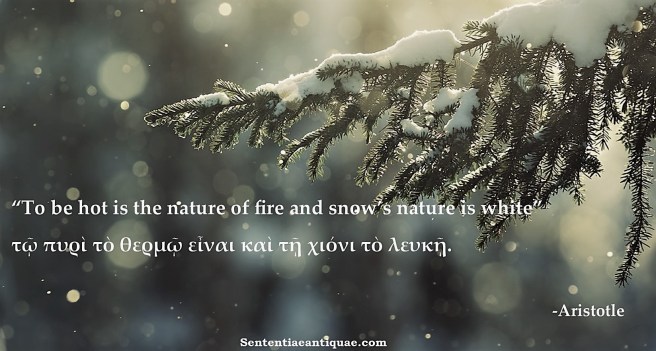
Snow istotle

Life After Insurrection

“This president is guilty of inciting insurrection. He has to pay a price for that.” – Nancy Pelosi

Is there life after political excommunication in the wake of a failed insurrection (particularly for a man who likes beauty pageants)?

Alcaeus 130B

. . . I’m a wretched man.
I’m living the lot of a rustic
But yearning to hear the assembly
Called, O Agesilaidas, and the council—

Privileges my father and my father’s father
Grew old having, even among countrymen
Who were wicked to one another,
And of which I’m now dispossessed.

I’ve fled to the hinterlands, like Onymakles.
And although I’m alone, a wolf-man,
I’ve made a home here after quitting the fight.
After all, isn’t it better to put an end to insurrection?

In the precinct of the blessed gods
I’ve made a home and tread the black earth.
In these gatherings I’ve found a place.
And here I’m keeping my feet out of trouble—

Here where the women of Lesbos judged on beauty
Parade, their robes trailing,
And the divine sound of the women’s holy ululations
rings out from every quarter—
a yearly affair.

Ἀγνοις . . σβιότοις . . ις ὀ τάλαις ἔγω
ζώω μοι̑ραν ἔχων ἀγροϊωτίκαν
ἰμέρρων ἀγόρας ἄκουσαι
καρυ[ζο]μένας ὠ̑ (᾿Α)γεσιλαΐδα

καὶ β[ό]λλας· τὰ πάτηρ καὶ πάτερος πάτηρ
κα<γ>γ[ε]γήρασ’ ἔχοντες πεδὰ τωνδέων
τὼν [ἀ]λλαλοκάκων πολίταν
ἔγ[ω ἀ]πὺ τούτων ἀπελήλαμαι

φεύγων ἐσχατίαισ’, ὠς δ᾿ Ὀνυμακλέης
ἔνθα[δ’] οἰ̑ος ἐοίκησα λυκαιχμίαις
[φεύγων t]ον [π]όλεμον· στάσιν γὰρ
πρὸς κρ . [. . . . ] . οὐκ †ἄμεινον† ὀννέλην·

. ] . [ . . . ] . [. . ] . μακάρων ἐς τέμ[ε]νος θέων
ἐοι[κησα] με[λ]αίνας ἐπίβαις χθόνος
χλι . [. ] . [ . ] . [.]ν συνόδοισί μ’ αὔταις
οἴκημι κ[ά]κων ἔκτος ἔχων πόδας,

ὄππαι Λ[εσβί]αδες κριννόμεναι φύαν
πώλεντ’ ἐλκεσίπεπλοι, περὶ δὲ βρέμει
ἄχω θεσπεσία γυναίκων
ἴρα[ς ὀ]λολύγας ἐνιαυσίας

Larry Benn has a B.A. in English Literature from Harvard College, an M.Phil in English Literature from Oxford University, and a J.D. from Yale Law School. Making amends for a working life misspent in finance, he’s now a hobbyist in ancient languages and blogs at featsofgreek.blogspot.com.

Ancestral Law For Insurrection

Aristotle, Constitution of the Athenians 17

“These are the ancestral laws of the Athenians: if anyone commits insurrection to act as a tyrant or helps someone else conduct a tyranny, they and their family will be disenfranchised.”

θέσμια τάδε Ἀθηναίων καὶ πάτρια, ἐάν τινες τυραννεῖν ἐπανιστῶνται [ἐπὶ τυραννίδι] ἢ συγκαθιστῇ τὴν τυραννίδα ἄτιμον εἶναι αὐτὸν καὶ γένος

Strabo, Geography  15.12

‘When there is insurrection, as frequently happens even in our time, sometimes it turns out some ways, other times it turns out differently and not the same for everyone. A disturbance is advantageous for some people but it disappoints the expectations of others.”

στασιαζόντων δέ, ὅπερ συμβαίνει πολλάκις, καὶ δὴ καὶ ἐφ᾿ ἡμῶν, ἄλλοτ᾿ ἄλλως συμβαίνει καὶ οὐ τὰ αὐτὰ πᾶσι· τοῖς μὲν γὰρ συνήνεγκεν ἡ ταραχή, τοῖς δὲ παρὰ γνώμην ἀπήντησεν.

In ‘honor’ of a year since our own failed insurrection, I wrote a piece for the Society for Classical Studies’ Blog Madness on Capitol Hill | The Nation

A Failsafe for Democracy

Lycurgus, Against Leocrates 124    

“These examples are enough I think to understand the opinion your forefathers had against those who broke the laws. I still want to remind you of the monument in the Senate house which recalls traitors and those who destroy the democracy. For I make your judgement easy if I provide you with many examples.

After the reign of the Thirty, your fathers, who had suffered the kinds of things from fellow citizens no Greek ever would have considered and who barely made it back to their own land, blocked every avenue to crime because they learned from experience and knew which offices and approaches were open to those who would dissolve the democracy.

They decreed by vote and by oath that anyone who came upon someone trying to establish a tyranny, betraying the state or overthrowing democracy would not be considered guilty for killing them because it seemed better to them that people who were pursuing these actions should die than they should suffer being enslaved to them. For they believed foremost that citizens should live in such away as to never come into suspicion for these crimes.”

Ἱκανὰ μὲν οὖν καὶ ταῦτα τὴν τῶν προγόνων γνῶναι διάνοιαν, ὡς εἶχον πρὸς τοὺς παρανομοῦντας εἰς τὴν πόλιν· οὐ μὴν ἀλλ᾿ ἔτι βούλομαι τῆς στήλης ἀκοῦσαι ὑμᾶς τῆς ἐν τῷ βουλευτηρίῳ περὶ τῶν προδοτῶν καὶ τῶν τὸν δῆμον καταλυόντων· τὸ γὰρ μετὰ πολλῶν παραδειγμάτων διδάσκειν ῥᾳδίαν ὑμῖν τὴν κρίσιν καθίστησι. μετὰ γὰρ τοὺς τριάκοντα οἱ πατέρες ὑμῶν, πεπονθότες ὑπὸ τῶν πολιτῶν οἷα οὐδεὶς πώποτε τῶν Ἑλλήνων ἠξίωσε,1 καὶ μόλις εἰς τὴν ἑαυτῶν κατεληλυθότες, ἁπάσας τὰς ὁδοὺς τῶν ἀδικημάτων ἐνέφραξαν, πεπειραμένοι καὶ εἰδότες τὰς ἀρχὰς καὶ τὰς ἐφόδους τῶν τὸν δῆμον προδιδόντων. ἐψηφίσαντο γὰρ καὶ ὤμοσαν, ἐάν τις τυραννίδι ἐπιτιθῆται ἢ τὴν πόλιν προδιδῷ ἢ τὸν δῆμον καταλύῃ, τὸν αἰσθανόμενον καθαρὸν εἶναι ἀποκτείναντα, καὶ κρεῖττον ἔδοξεν αὐτοῖς τοὺς τὴν αἰτίαν ἔχοντας τεθνάναι μᾶλλον ἢ πειραθέντας μετὰ ἀληθείας αὐτοὺς δουλεύειν· ἀρχὴν γὰρ οὕτως ᾤοντο δεῖν ζῆν τοὺς πολίτας, ὥστε μηδ᾿ εἰς ὑποψίαν ἐλθεῖν μηδένα τούτων τῶν ἀδικημάτων.

In ‘honor’ of a year since our own failed insurrection, I wrote a piece for the Society for Classical Studies’ Blog

https://commons.wikimedia.org/wiki/File:Parthenon_from_south.jpg