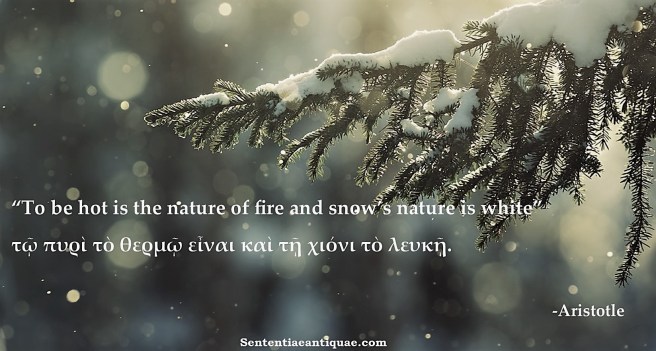
“Have you ever seen a pomegranate seed in drifts of snow?”
ἤδη τεθέασαι κόκκον ἐν χιόνι ῥόας;
Pindar, Pythian 1. 20
“Snowy Aetna, perennial nurse of bitter snow”
νιφόεσσ᾿ Αἴτνα, πάνετες χιόνος ὀξείας τιθήνα
Plutarch, Moralia 340e
“Nations covered in depths of snow”
καὶ βάθεσι χιόνων κατακεχωσμένα ἔθνη
Herodotus, Histories 4.31
“Above this land, snow always falls…
τὰ κατύπερθε ταύτης τῆς χώρης αἰεὶ νίφεται
Diodorus Siculus, 14.28
“Because of the mass of snow that was constantly falling, all their weapons were covered and their bodies froze in the chill in the air. Thanks to the extremity of their troubles, they were sleepless through the whole night”
“Is there truly some power of the cold, Favorinus, a principle and substantial thing, just as fire is the principle power of heat, by the presence of and through sharing of which each thing becomes cold? Or is coldness the subtraction of warmth just as people say that darkness is bereavement of life and stillness the absence of movement? Cold does seem to be still while warm has movement while the cooling of higher temperatures occurs by no presence of a force but instead thanks to the separation of heat. For heat appears to leave at the very same time that the rest of a substance cools. And steam, which water emits as it boils, escapes with the passing of the warmth. For this reason the larger amount loses mass when it cools as it loses the heat and nothing else replaces it.
As a starting point, shouldn’t someone be suspicious of this argument that it denies many types of forces by defining them not as characteristics or aspects but instead as the opposite of aspects and characteristics—for example, weight is the negation of lightness, hardness the absence of softness, black the opposite of whiteness, bitter of sweet, and of these rest of matters each develops an opposite force rather than mere negation….”
“I will go to dinner just as I promised, even if it is cold. But I certainly will not if it begins to snow.”
Ad cenam, quia promisi, ibo, etiam si frigus erit; non quidem, si nives cadent.
χιών, ὁ: “snow”
χιονόβατος: “snow-path” (“where one walks in snow”)
χιονοβλέφαρος: “with a dazzling white eye”
χιονόβλητος: “snow-struck”
χιονοθρέμμων, ὁ: “snow-nourishing”
χιονόκτυπος: “snow-beaten”
χιονόμελι: “snow-honey”
χιονόπεπλος, “robe of snow”
χιονωπός: “snow-white”
χιονωτός: “snow-beaten”
Longus, Daphnis and Chloe 3.3.1
“A winter more bitter than war fell upon Daphnis and Chloe: for a great snowstorm descended suddenly and blocked all the roads, closing off all the farmers.”
“The fury of snow and hail comes from a cloud
and thunder comes from bright lightning.
A city is destroyed by great men and the people fall
into the slavery of monarchy thanks to ignorance.”
Niphetos: This denotes thin, falling snow. There are four results of water condensing in the air. High, above the earth, the lesser type is snow and the greater force is hail. Below on the land, the lesser type is hoar-frost and the greater part is frost. But snow falling [niphetos] is not a specific type of condensing, instead it is just a different type of appearance. “When the Skythian land is blanketed in show, they cannot live without freezing weather” [Men. Fr. 10.10. And elsewhere: “Queen, even a snow storm brings you fruit as you are” [Gr. Anth. 6.242].
This is how the narrative describes Penelope and Odysseus during their encounter while Odysseus is in disguise.
Odyssey 19.204–212
‘As she was listening her tears began to flow and her skin’s color receded
As when snow melts on the highest mountaintops,
The snow the east wind melts after the west wind piles it up,
And rivers grow full and flow from the thaw—
That’s how her beautiful cheeks melted, pouring tears
As she wept for her own husband even as he sat there. But Odysseus
Pitied his wife as she mourned in his heart—
But his eyes stood motionless like horn or iron
Under his brows as he cloaked his tears with a trick.”
Penelope and Odysseus, by Johann Heinrich Tischbein
Cicero, in Catilinam 2.23
“How will they bear the Appenines covered in frosts and snow? Maybe they think that they can tolerate the cold, because they learned to dance naked at dinner parties.”
Quo autem pacto illi Appeninum atque illas pruinas ac nivis perferent? Nisi idcirco se facilius hiemem toleraturos putant, quod nudi in conviviis saltare didicerunt.