Finale Verbum? Who Killed Famae Volent?

Piccolomini, de Educatione Liberorum XXXV

“What then should we say, considering that there is great utility in both silence and in speaking? We would have you hold to the middle course, and find yourself neither always speaking nor always quiet.”

Quid ergo dicemus, cum et silentii et orationis magna utilitas sit? Tenere te medium volumus, neque tacere semper neque loqui semper.

FV screenshot

Fatalis Vetustas? Unanticipated Consequences

When Aristotle was asked what the most burdensome thing in life is he said “staying silent.”

῾Ο αὐτὸς ἐρωτηθείς, τί δυσκολώτατόν ἐστιν ἐν βίῳ, εἶπε· „τὸ σιωπᾶν”. Gnom. Vat. 58

A few months back I posted a personal reflection on the blog and message board related to the Classics Job Market. The resulting piece on Famae Volent was too long, filled with ‘hand-wringing’, and probably more than a little self-indulgent. Apart from a few snide comments on the message board itself, however, I was surprised by the eagerness of people to talk about FV—it is almost as if many of us were just waiting to be given permission to talk about the blog and what it means to us.

But over the next few months, the situation changed. To cut to the chase for those of you who don’t already know, the website has careened to the brink of closure. The turnaround was sudden enough that a student of mine asked me if I was responsible for killing FV!

I really don’t think anything I have written is nearly that important: I was on the crest of a wave. For reasons that will become immediately clear, I have more to say about FV and its imminent demise. In Classics and Higher Ed, we are in the midst of many different clashing tides—I want to give a different perspective (or two) on Famae Volent and make the rather surprising suggestion that it should be saved.

Fusilis Vexatio: Some background

“Silence works as wisdom for a foolish person”

Taciturnitas stulto homini pro sapientia est, Publilius Syrus 692

 One of the many surprises that followed the FV blog post was that the current editors—the Servii—contacted me. I must confess to longstanding curiosity about the identity of the blog moderators—they refer to an ‘ur-Servius’ (the original) and other Servii before them, but it seems that this group has been in control for a few ‘seasons’.

In truth, I was happy both to be contacted and to hear their comments which were both kind and justly critical. From our exchanges, I got the sense of thoughtful people who were trying to do good.. I think we forget that beyond the deletions and clever comments are people who haven’t done this job for money or glory or anything other than their own vision of service to the field.

They started by (1) apologizing for deleting a post that seemed to have come from me or Erik and (2) offering to have a conversation because… “We agree with parts of it, want to push back on other parts, and are more generally interested in hearing your thoughts on whether you think it is possible to improve the climate within the framework of FV’s basic system” [all quotes excerpted from email exchanges].

(They also asked to preserve their anonymity. I have not confirmed their identities beyond observing coordination between the emails and the site. Early on, we discussed possible public methods of confirmation; but after our multiple conversations, I have no doubt that they are who they say they are. The paranoid and conspiracy-minded might think I am making this all up—well, that would be interesting too.)

I was interested both (1) in hearing the moderators’ responses to my post and (2) in just listening to their own reflections on what FV does and what it is for. I must confess that I lost almost all objectivity after reading the following.

“One thing that we thought might be helpful to you from your end is to keep in mind that there’s no one group of Servii — we’ve been running it the past two years, and it was many different groups before us (with whom we have had no contact). So when you see an increased level of moderation over the last few years, what you’re really seeing is that we’re more active in enforcing community standards than past generations have been, not that there’s been any change (necessarily) in content. We’ve been taking a more active role than our predecessors, and have actually had complaints and attempts to out us because of our “fascist” over-moderation — not kidding.”

Even as I re-read this I appreciate their honesty and imagine the difficulty of being in their place: they conceded that “a lot of FV commentary is by nature cowardly” but pushed back a little on my emphasis on morally repugnant material, explaining that while I had sensed “an increasing amount of negativity directed at PoC, women, traditionally underrepresented social classes and people from marginalized groups”, they had tracked more voices objecting to the “dark corners” of FV than a few years back. So, in their words, before they made the decision to close the site, there is “a certain amount of polarization– but it is not exactly because the ideas are somehow new: rather, it is that the actual conversation about them is.” In fact, they insisted that most of the material they deleted (prior to mid-March) was actually aimed toward senior white men. (A pattern not necessarily supported by subsequent events).

Fluxuosum Vallum: A Conversation
  Continue reading “Finale Verbum? Who Killed Famae Volent?”

Famae Volent: A Personal History

For a few years I have been thinking about an article I would like to read in the New Yorker or the Baffler. It would really be about the desperation of the academic job market and a lost generation of would-be professors across the humanities, but it would tell this story as it is embedded in the digital record of academic wikis and discussion boards. So, it would be a zeitgeisty piece that explored the relationship between the information age’s revolution and the concurrent collapse of the industrial age’s systems of learning.

This imagined article would also explore the interrelationship between the transformation of information, the rise of the internet and the polarization of politics, all the while integrating theories about the narcissism of social media with the solipsism of our individual information bubbles. And it would do all of this without claiming simple causes or clear relationships, without apportioning blame but instead leaving it for the well-informed reader to consider which great ideas were the first of the paving stones to our current hell.

The centerpiece of this discussion? The decades-old Classics water-cooler/cesspool: Famae Volent. Don’t worry, I don’t have the knowledge, the skills, or the time to write this article. I don’t know who the blog administrators are; I don’t know if I would recover from reading the comments in the entirety again; and I don’t actually think the world-at-large would be so terribly interested in what is essentially a minor metonym for a major metamorphosis.

But the past few weeks have made me think a little too much about Famae Volent (FV). I can confess directly now what I was once embarrassed to admit: I have read the comments on FV nearly every day for the past decade. I have commented myself only 6 or 7 times, which qualifies me as some kind of lurker. I write this to try to figure out why I am so drawn to it, to claim hyperbolically that it has been the most important forum in Classics for the past decade, to lament that it has turned a bit darker this year, and to try to make some sense of this darkness. For the regular readers of this blog who don’t know about FV, it might be better not to click the ‘more’ button below. For those who know about the site, I cannot promise to say anything agreeable about it.

FV cannot be understood from the perspective of Classics alone–it is, I think, a product of the intersection of new technologies, old worlds, changing/dying disciplines, the desperation produced by economic upheaval, and the discord produced by current standards of dissent (supercharged by the ‘safety’ afforded by anonymity). But at the same time, FV is a phenomenon within a particular and bounded community. One could argue that it was the only new community mechanism created in classics in over a generation. And, in addition, before the coalescence of classics twitter as a force or the emergence of other online fora FV was arguably the online center of Classics in that it was the only centralized forum available to everyone.

But over the past year the comments have turned darker in a harmful way. There have been more administrator deletions of comments that break community guidelines than ever before. There have been more personal attacks than I can remember. And, this is what really gets me, there has been more polarized language dismissing attempts to address the marginalization of women, people of color, and people from different classes than in previous years.

Almost everyone I talk to in Classics knows of FV and has read it but admits so the way you might admit you did drugs in college or once accidentally shoplifted and didn’t go back to confess your crime. What does it mean for something to be so central and universal yet kept at a distance? Or, more simply, what is FV really and what is it for?

So, to start again, I am trying to figure out what attracts me to something that so thoroughly confuses. Part of it is the garbage-fire warmth: sometimes we just want to watch the chaos and destruction unfold. But I need to know if there is more. I want to know if there is good to FV and, if there is, if it can possibly outweigh the bad. Can I separate its story from my story? Is it really representative of my field or our field?

Continue reading “Famae Volent: A Personal History”

Homeric Advice for Starting a Conversation at #AIASCS

There is a useful and interesting debate about Class and Classics which was initiated by Eric Adler’s article on Eidolon. Across the academy, conferences are famous for being hierarchical, expensive, humiliating, of questionable worth, and a general venue for all sorts of debauchery. (There are papers too.)

Professional conferences often require social engagement. But talking to new people can be hard. If you find yourself at a loss for words this conference season, why not try something new by using an old script?

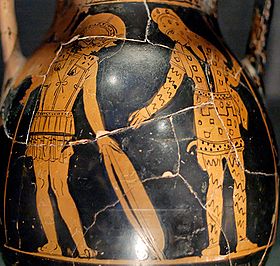
Diomedes: Il. 6.123-129

“Bestie, who are you of mortal humans?
For I have never seen you before in this ennobling battle.
But now you stride out far ahead of everyone
In your daring—where you await my ash-wood spear.
Those who oppose my might are children of miserable parents!
But, if you are one of the immortals come down from the sky,
I don’t wish to fight with the sky-dwelling gods!”

τίς δὲ σύ ἐσσι φέριστε καταθνητῶν ἀνθρώπων;
οὐ μὲν γάρ ποτ’ ὄπωπα μάχῃ ἔνι κυδιανείρῃ
τὸ πρίν· ἀτὰρ μὲν νῦν γε πολὺ προβέβηκας ἁπάντων
σῷ θάρσει, ὅ τ’ ἐμὸν δολιχόσκιον ἔγχος ἔμεινας·
δυστήνων δέ τε παῖδες ἐμῷ μένει ἀντιόωσιν.
εἰ δέ τις ἀθανάτων γε κατ’ οὐρανοῦ εἰλήλουθας,
οὐκ ἂν ἔγωγε θεοῖσιν ἐπουρανίοισι μαχοίμην.

Glaukos, 6.145-151

“Oh, you great-hearted son of Tydeus, why are you asking about pedigree?
The generations of men are just like leaves on a tree:
The wind blows some to the ground and then the forest
Grows lush with others when spring comes again.
In this way, the race of men grows and then dies in turn.
But if you are willing, learn about these things so you may know
My lineage well—many are the men who know me.”

Τυδεΐδη μεγάθυμε τί ἢ γενεὴν ἐρεείνεις;
οἵη περ φύλλων γενεὴ τοίη δὲ καὶ ἀνδρῶν.
φύλλα τὰ μέν τ’ ἄνεμος χαμάδις χέει, ἄλλα δέ θ’ ὕλη
τηλεθόωσα φύει, ἔαρος δ’ ἐπιγίγνεται ὥρη·
ὣς ἀνδρῶν γενεὴ ἣ μὲν φύει ἣ δ’ ἀπολήγει.
εἰ δ’ ἐθέλεις καὶ ταῦτα δαήμεναι ὄφρ’ ἐὺ εἰδῇς
ἡμετέρην γενεήν, πολλοὶ δέ μιν ἄνδρες ἴσασιν

Then switch nametags!

Image result for diomedes and glaucus

This post was inspired by the ever dynamic Rogue Classicist:

If you are serious about getting to know new people (and there are always a lot of nice, interesting people at the annual meeting), Zeno has some great advice:

“We have two ears but one mouth so that we may listen more and talk less”

δύο ὦτα ἔχομεν, στόμα δὲ ἕν, ἵνα πλείω μὲν ἀκούωμεν, ἥττονα δὲ λέγωμεν

“Troy Fell, Let It Perish With Its Name”: Jupiter Decides the Fate of Refugees From the East

“When they make peace through joyful weddings,
(May it happen), when the laws and treaties have joined them,
Do not allow the Latins to change their ancient name
either in becoming Trojans or being called Teucrians.
Don’t let them change their language or their clothing,
may it be Latium, may there be Alban kings for generations;
may the Roman race be strong through Italian power.
It fell: let Troy perish with its name.”

Laughing, the master of man and creation responded:
“Truly you are the sister of Jove and Saturn’s other child:
Such waves of rage turn within your chest.
But come, put down your rage conceived in vain—
I grant what you want, and, overcome, I willingly give in.
The Ausonians will preserve their inherited tongue and customs,
The name will stay as it is—the Teucrians will fade into the land
Once they have shared their blood. I will provide their sacred rites
And will unite all the Latins in a single tongue.
You will see a race mixed with Ausonian blood rise up
And outpace all men, even the gods in devotion,
No other race will perform your honors the same.”

cum iam conubis pacem felicibus, esto,
component, cum iam leges et foedera iungent,
ne vetus indigenas nomen mutare Latinos
neu Troas fieri iubeas Teucrosque vocari
aut vocem mutare viros aut vertere vestem.
Sit Latium, sint Albani per saecula reges,
sit Romana potens Itala virtute propago:
occidit, occideritque sinas cum nomine Troia.”
Olli subridens hominum rerumque repertor
“Es germana Iovis Saturnique altera proles:
irarum tantos volvis sub pectore fluctus.
Verum age et inceptum frustra submitte furorem
do quod vis, et me victusque volensque remitto.
Sermonem Ausonii patrium moresque tenebunt,
utque est nomen erit; commixti corpore tantum
subsident Teucri. Morem ritusque sacrorum
adiciam faciamque omnis uno ore Latinos.
Hinc genus Ausonio mixtum quod sanguine surget,
supra homines, supra ire deos pietate videbis,
nec gens ulla tuos aeque celebrabit honores.”

Caveat Lector: Personal commentary follows…

Continue reading ““Troy Fell, Let It Perish With Its Name”: Jupiter Decides the Fate of Refugees From the East”

38 Students at Public University are Registered for Ancient Greek–Why?

I have tweeted more than once about my surprise at having many more students registered for Ancient Greek than usual (my previous record was 26; 41 were registered last evening; 39 are registered now). I have joked that it was because of this poster:

Greek Poster 2015

But this is not very scientific. I feared that many students might be there by accident–it just seemed so contrary to my experience that so many students would sign up. (Hint: it isn’t due to the posters!)

So, I started the class today with a questionnaire. Below are the questions and a tally of the common answers. I think most of them are here to stay!

How did you learn about this class?

The current instructor (previous students x3)
From a friend
Need for credit/requirement for major (x3)
The university
Advisor (x12)
Core Curriculum options list (x6)
It still had room (x2)
Other Classics Classes
No reason
Another professor

Why do you want to learn ancient Greek?

To translate ancient Greek texts some for seminary (x3)
Love the Classics/Greece/Latin/Mythology (X13)
Because it is different/interesting/new (x8)
Good preparation for medicine/science major (x2)

Do you have any concerns before starting the course?

“Will this go too slowly?” (x2)
Language learning is difficult (x3)
How different are ancient and modern Greek?
None (x4)
It seems difficult (x3)
When do we need the books?

What would you like to accomplish?

Learn a language other than English
To learn to read Greek (x9)
Rudimentary understanding (x7)
To hold a conversation in Ancient Greek (x3 !)
To be able to speak fluently
To do my best (!)

So, general interest is important, but this year it seems the advisors have been critical–which is a big change. (I will be sending some thank-you emails shortly). Also note the importance of Greek 1 being in the University’s core curriculum.

The final desire expressed above by one student, that she wanted to her her best, made me think of Peleus’ advice to Achilles, which will now be my motto for this ‘epic’ course.

Iliad, 11.783-784

“Old Peleus ordered his son Achilles
Always to be the best and stand out from all the rest.”

Πηλεὺς μὲν ᾧ παιδὶ γέρων ἐπέτελλ’ ᾿Αχιλῆϊ
αἰὲν ἀριστεύειν καὶ ὑπείροχον ἔμμεναι ἄλλων·