Building Ships, Feeding Minds: Reflections on Teaching in Latin and Greek

Today I teach the final classes of the semester, closing out a decade since I earned my PhD. For the first time in that span, I am not eager to have the semester end. So, here are some random Greek and Latin passages reflecting on teaching.

Teaching is of no minor import

Plato, Laws 803

“We should speak next about the teaching and communication of these subjects: how to do so, who should do it, and when it is right to apply each of them. In the same way that a shipwright anticipates the outline of his creation at the beginning in laying out the keel, I seem to be outlining the whole, trying to imagine the shape of lives based on the habits of their minds and in actuality then laying out their keels, by seeking out precisely through what method and with what habits we might best navigate through this journey of life.”

τούτων δὲ αὐτῶν διδασκαλία καὶ παράδοσις λεγέσθω τὸ μετὰ τοῦτο, τίνα τρόπον χρὴ καὶ οἷστισι καὶ πότε πράττειν ἕκαστα αὐτῶν· οἷον δή τις ναυπηγὸς τὴν τῆς ναυπηγίας ἀρχὴν καταβαλλόμενος τὰ τροπιδεῖα ὑπογράφεται <τὰ> τῶν πλοίων σχήματα, ταὐτὸν δή μοι κἀγὼ φαίνομαι ἐμαυτῷ δρᾷν τὰ τῶν βίων πειρώμενος σχήματα διαστήσασθαι κατὰ τρόπους τοὺς τῶν ψυχῶν, ὄντως αὐτῶν τὰ τροπιδεῖα καταβάλλεσθαι, ποίᾳ μηχανῇ καὶ τίσι ποτὲ τρόποις ξυνόντες τὸν βίον ἄριστα διὰ τοῦ πλοῦ τούτου τῆς ζωῆς διακομισθησόμεθα, τοῦτο σκοπῶν ὀρθῶς.

How does it balance with innate skills and character? It’s complicated.

Quintilian, 2.19

“In sum, nature is education’s raw material: the latter shapes, the former is shaped. There is no art without substance; material has a worth apart from art; and yet, the highest art is superior to the best material.”

Denique natura materia doctrinae est: haec fingit, illa fingitur. Nihil ars sine materia, materiae etiam sine arte pretium est; ars summa materia optima melior.

How important is education?

Plutarch, Can Virtue Be Taught 439f

“ ‘If people are not made better through education, their teacher’s pay is wasted’  The teachers are the first to guide children after they leave their mother and, just as nurses help shape the body with hands, teachers shape their character: with their habits they put children on the first step toward excellence. This is why the Spartan, when asked what he accomplished through teaching, said ‘I make noble things appealing to children.’ ”

“εἰ μὴ γίνονται μαθήσει βελτίονες ἄνθρωποι, παραπόλλυται ὁ μισθὸς τῶν παιδαγωγῶν”; πρῶτοι γὰρ οὗτοι παραλαμβάνοντες ἐκ γάλακτος, ὥσπερ αἱ τίτθαι ταῖς χερσὶ τὸ σῶμα πλάττουσιν, οὕτω τὸ ἦθος ῥυθμίζουσι τοῖς ἔθεσιν, εἰς ἴχνος τι πρῶτον ἀρετῆς καθιστάντες. καὶ ὁ Λάκων ἐρωτηθεὶς τί παρέχει παιδαγωγῶν, “τὰ καλά,” ἔφη, “τοῖς παισὶν ἡδέα ποιῶ.”

,Image result for Ancient Greek teaching vase

Hmmm, how do you do this?

Suetonius, On Grammarians 37

“Marcus Verrius flaccus, a freedman, became especially famous through his manner of teaching. For he was in the habit of matching students with their equals in order to encourage learning. He would not merely specify the subjects they would write about, but he would offer a prize which the winner would earn. This prize was some pretty or rare old book. For this reason, Augustus chose him as tutor to his grandsons….”

Verrius Flaccus libertinus docendi genere maxime claruit. Namque ad exercitanda discentium ingenia aequales inter se committere solebat, proposita non solum materia quam scriberent, sed et praemio quod victor auferret. Id erat liber aliquis antiquus pulcher aut rarior. Quare ab Augusto quoque nepotibus eius praeceptor electus

No course of learning is without some regrets….

Letters of Cicero, Fragments. (Suet. Gram. 26)

On Lucius Plotius Gallus,

“I still have a memory from my childhood when a certain Plotius began to teach in Latin for the first time. When crowds circled him and everyone was eager to study with him, I was upset because it was forbidden to me. I was restricted by the advice of the most educated men who used to believe that minds were better fed by training in Greek.”

Plotius Gallus. de hoc Cicero in epistula ad M. Titinium sic refert: equidem memoria teneo pueris nobis primum Latine docere coepisse Plotium quendam. ad quem cum fieret concursus et studiosissimus quisque apud eum exerceretur, dolebam mihi idem non licere; continebar autem doctissimorum hominum auctoritate, qui existimabant Graecis exercitationibus ali melius ingenia posse. (Suet.Gram. 26)

Marcus Antonius Offered Cicero Life, If He Burned All His Books

The following piece from the elder Seneca (Yes, Seneca the Elder, not the Younger) is based upon the imaginary story that Marcus Antonius offered to preserve Cicero’s life in exchange for the destruction of all his books. 

Seneca the Elder, Suasoria 7

Cicero Deliberates whether to burn all his writings since Antony has promised his safety if he did so

Deliberat Cicero an scripta sua conburat, promittente Antonio incolumitatem si fecisset, 11

Here the conditions [of the agreement] were intolerable. For nothing is so intolerable as to burn up the proofs of your own genius. In addition, this was an insult to the Roman people, whose language Cicero had elevated so that their eloquence outstripped the knowledge of arrogant Greece as much as their fortune in war. This would be a crime against humanity! Cicero would regret breaths bought at so high a price, since he would have to grow old as a slave using his eloquence only for one thing: praising Antony. This was a wretched sentence: to be granted life, but surrender genius.

Pompeius Silo proceeded to argue that Antony was not negotiating but instead was mocking Cicero. This was a not a condition, it was an insult: For even after the books were burned he would still kill him. Antony was not so foolish that he believed that burning the books was a concern to Cicero, a man whose writings were already famous over the whole world. Antony did not seek this thing he could do himself, unless of course he did not have the power over Cicero’s books which he had over Cicero. He sought nothing other than to kill Cicero after reducing him to a state of shame because he had spoken bravely and often about his contempt for death. Hence, Antony was not giving him life on a condition, but he was seeking his death in dishonor. Thus, Cicero ought to suffer bravely now what he would certainly suffer later in shame.

Hic condiciones intolerabiles. <Nihil tam intolerabile> esse quam monumenta ingenii sui ipsum exurere. Iniuriam illum facturum populo Romano, cuius linguam huc ipse extulisset ut insolentis Graeciae studia tanto antecederet eloquentia quantofortuna; iniuriam facturum generi humano. Paenitentiam illum acturum tam care spiritus empti, cum in servitute senescendum fuisset <et> in hoc unum eloquentia utendum, ut laudaret Antonium. Male cum illo agi: dari vitam, eripi ingenium.

Silo Pompeius sic egit ut diceret Antonium non pacisci sed inludere: non esse illam condicionem sed contumeliam; combustis enim libris nihilominus occisurum; non esse tam stultum Antonium ut putaret ad rem pertinere libros a Cicerone conburi, cuius scripta per totum orbem terrarum celebrarentur, nec hoc petere eum, quod posset ipse facere, nisi forte non esset in scripta Ciceronis ei ius cui esset in Ciceronem; quaeri nihil aliud quam ut ille Cicero multa fortiter de mortis contemptu locutus ad turpes condiciones perductus occideretur. Antonium illi non vitam cum condicione promittere, sed mortem sub infamia quaerere. Itaque quod turpiter postea passurus esset, nunc illum debere fortiter pati.


Image result for Ancient Rome Cicero and Marcus Antonius
Not a fan of Cicero.

Lending, Buying, Loving Books: Passages for #WorldBookDay

Callimachus

μέγα βιβλίον μέγα κακόν

“Big book, big problem.”


Cicero on Lending Books, Letters to Atticus, 8

“Beware of lending your books to anyone; save them for me, as you write that you will. The greatest excitement for them has gripped me, along with a contempt for everything else.”

libros vero tuos cave cuiquam tradas; nobis eos, quem ad modum scribis, conserva. summum me eorum studium tenet, sicut odium iam ceterarum rerum.


Vergerio, a Lament on the Books We’ve Lost: de ingenuis moribus et liberalibus adulescentiae studiis, XXXVIII:

“Letters and books are a record of things and the common treasury of all knowable things. Therefore, if we ourselves are unable to produce anything of our own, we ought to take care that we transmit those which we have received from earlier generations to posterity intact and uncorrupted. By this we can lend counsel to those who will come after us, and we will in this one way repay the labors of those who have come before us. In this matter, we may justly censure a certain age and the ages which immediately succeeded it. Indeed, we may feel indignant (though we accomplish nothing in so doing) that these earlier ages have allowed so many notable works of famous authors to perish. Of certain of these, indeed, only the names, though decorated with the highest praise, have come down to us. Of others, parts and fragments have come to us. Then, from the splendor of the praises and the noted name, we desire their works as well. We may be indignant that the rest of their labors have perished when we consider the excellence and dignity of those which survive; though it must be conceded that they are in many places so corrupt, cut up, and mangled, that it would almost be better if nothing of them had survived to our day.”

Nam sunt litterae quidem ac libri certa rerum memoria et scibilium omnium communis apotheca. Idque curare debemus ut quos a prioribus accepimus, si nihil ipsi ex nobis gignere forte possumus, integros atque incorruptos posteritati transmittamus, eoque pacto et his qui post nos futuri sunt utiliter consulemus et his qui praeterierunt vel unam hanc suorum laborum mercedem repensabimus. In quo iuste forsitan possumus quoddam saeculum proximasque superiores aetates accusare. Indignari quidem licet, proficere autem nihil, quod tam multa illustrium auctorum praeclara opera deperire passi sunt. Et quorundam quidem nomina sola, summis tamen laudibus ornata, aliorum etiam pars vigiliarum et fragmenta quaedam ad nos pervenerunt. Unde fit ut ex splendore laudum ac nominis opera desideremus illorum. Horum vero reliquos labores deperisse indignemur ex earum rerum quae superant adhuc excellentia ac dignitate, tametsi ea ipsa in plerisque partium suarum tam vitiose corrupta, quaedam etiam intercisa ac mutilata suscepimus, ut paene melius fuerit ex his nihil ad nos pervenisse.

Plato’s Book Purchases: Aulus Gellius, Attic Nights 3.16

  • This too has been entrusted to history by the most trustworthy men: Plato bought three books of Philolaus the Pythagorean and Aristotle acquired a few volumes of the philosopher Speusippus at inconceivable prices.

It has been said that the philosopher Plato was a man without great financial resources; yet he nevertheless purchased three books of the Pythagorean Philolaus for ten thousand denarii. That amount, some write, Dio of Syracuse, his friend, gave to him.  Aristotle too is said to have bought a few books of the philosopher Speusippus after his death for three Attic talents. That is as much as seventy-two thousand sesterces!

The acerbic Timon wrote a very libelous book which is called the Sillos [i.e. “Lampoon”]. In that book, he takes on Plato insultingly for the fact that he bought the book of Pythagorean philosophy for so high a price and that he cobbled together that noble dialogue the Timaeus from it. Here are Timon’s lines on the matter:

And You, Plato: the desire of education seized you
And you bought a small book for a vast sum,
This book is where you learned to write a Timaios.”

 P.Oxy. XI 1362

XVII. Id quoque esse a gravissimis viris memoriae mandatum, quod tris libros Plato Philolai Pythagorici et Aristoteles pauculos Speusippi philosophi mercati sunt pretiis fidem non capientibus. 

1Memoriae mandatum est Platonem philosophum tenui admodum pecunia familiari fuisse atque eum tamen tris Philolai Pythagorici libros decem milibus denarium mercatum. 2 Id ei pretium donasse quidam scripserunt amicum eius Dionem Syracosium. 3 Aristotelem quoque traditum libros pauculos Speusippi philosophi post mortem eius emisse talentis Atticis tribus; ea summa fit nummi nostri sestertia duo et septuaginta milia. 4 Timon amarulentus librum maledicentissimum conscripsit, qui sillos inscribitur. 5 In eo libro Platonem philosophum contumeliose appellat, quod inpenso pretio librum Pythagoricae disciplinae emisset exque eo Timaeum, nobilem illum dialogum, concinnasset. Versus super ea re Timonos hi sunt (fr. 828):

καὶ σύ, Πλάτων· καὶ γάρ σε μαθητείης πόθος ἔσχεν,
πολλῶν δ’ ἀργυρίων ὀλίγην ἠλλάξαο βίβλον,
ἔνθεν ἀπαρχόμενος τιμαιογραφεῖν ἐδιδάχθης.

Image result for ancient books

On Not Confusing the Author with His Book: Martial, Epigrams Book 11.15

“I do have drafts that Cato’s wife
And those dreadful Sabine women might read:
But I want this whole little book to laugh
and to be dirtier than other little books.
Let it soak up wine and not shudder
To be died dark with Cosmian ink,
Let it play with the boys and love the girls
And let it just name directly that ‘thing’
From which we are born, the parent of all
Which holy Numa called a little dick.
Remember still, Apollinoris, that
These verses are Saturnalian.
This little book’s morals aren’t mine!”

Sunt chartae mihi quas Catonis uxor
et quas horribiles legant Sabinae:
hic totus volo rideat libellus
et sit nequior omnibus libellis.
Qui vino madeat nec erubescat
pingui sordidus esse Cosmiano,
ludat cum pueris, amet puellas,
nec per circuitus loquatur illam,
ex qua nascimur, omnium parentem,
quam sanctus Numa mentulam vocabat.
Versus hos tamen esse tu memento
Saturnalicios, Apollinaris:
mores non habet hic meos libellus.


No Fence-sitters in a Time of Civil Strife

Aristotle, Constitution of the Athenians

“Because [Solon] noticed that his city was often breaking out into civil strife and that some of the citizens welcomed the results because of ambivalence, he made a law particularly aimed at these people: whoever did not pick up arms for one side or the other during a time of civil conflict was to be disenfranchised and have no part of the state.”

ὁρῶν δὲ τὴν μὲν πόλιν πολλάκις στασιάζουσαν, τῶν δὲ πολιτῶν ἐνίους διὰ τὴν ῥᾳθυμίαν [ἀγα]πῶντας τὸ αὐτόματον, νόμον ἔθηκεν πρὸς αὐτοὺς ἴδιον, ὃς ἂν στασιαζούσης τῆς πόλεως μ[ὴ] θῆται τὰ ὅπλα μηδὲ μεθ’ ἑτέρων, ἄτιμον εἶναι καὶ τῆς πόλεως μὴ μετέχειν.

Image result for Solon ancient greek

Cicero, Letters to Atticus 10.1.2

“In all honesty, I shall ignore that law of Solon—your countryman and, I suppose, mine too—which mandated death for anyone who was a part of neither side in a time of civil strife [or sedition]: unless you advise otherwise, I will abstain from that side and this one. But the other side is more certain to me—nevertheless, I won’t race ahead of myself on this.”

ego vero Solonis, popularis tui et ut puto etiam mei, legem neglegam, qui capite sanxit si qui in seditione non alterius utrius partis fuisset, et, nisi si tu aliter censes, et hinc abero et illim. sed alterum mihi est certius, nec praeripiam tamen.


Giorgio Agamben, Stasis: Civil War as a Political Paradigm. Stanford, 2015, 16:

“The stasis…takes place neither in the oikos nor in the polis, neither in the family nor in the city; rather, it constitutes a zone of indifference between the unpolitical space of the family and the political space of the city. In transgressing the threshold, the oikos is politicized; conversely, the polis is ‘economised’, that is, it is reduced to an oikos. This means that in the system of Greek politics civil war functions as a threshold of politicisation and depoliticisation, through which the house is exceeded in the city and the city is depoliticized in the family.”

Be Smart, Don’t Fart: The Pythagorean Prohibition of Beans

Cicero, de Divinatione 1.30:

“Plato therefore encourages people to go to sleep with their bodies thus disposed that there be nothing which could introduce any wandering from or disturbance of sleep. From which it is thought that the Pythagoreans prohibited the consumption of beans, because that food causes a great flatulence which is contrary to the tranquility of a mind seeking the truth.”

Iubet igitur Plato sic ad somnum proficisci corporibus adfectis, ut nihil sit, quod errorem animis perturbationemque adferat. Ex quo etiam Pythagoreis interdictum putatur, ne faba vescerentur, quod habet infiationem magnam is cibus tranquillitati mentis quaerenti vera contrariam.


Cicero the Literary Critic

Cicero, ad Atticum 2.20

“I received some books from Vibius. He really is a terrible poet, and knows nothing: but he is not entirely useless. I am copying them down, and will send them back.”

a Vibio libros accepi. Poeta ineptus et tamen scit nihil, sed non est inutilis. Describo et remitto.

Lending Books, Equal Rights and Bad Poets: Some Cicero on His Birthday

Equal Rights for All Citizens

Cicero, de re publica I.49

“Since law constitutes the bond of civil society, and the authority of the law is equal, how can the society of citizens be maintained when their condition is not equal? If it be not pleasing to place their wealth on equal footing, and if everyone is endowed with unequal abilities, certainly all of those who are citizens of the same republic ought to have equal rights. For, what is the state but the shared rights of its citizens?”

quare cum lex sit civilis societatis vinculum, ius autem legis aequale, quo iure societas civium teneri potest, cum par non sit condicio civium? si enim pecunias aequari non placet, si ingenia omnium paria esse non possunt, iura certe paria debent esse eorum inter se qui sunt cives in eadem re publica. quid est enim civitas nisi iuris societas civium?

Turning thought into speech

Tusculan Disputations 1.3.

“But it can happen that someone may have a good thought which he cannot express well.”

fieri autem potest, ut recte quis sentiat et id quod sentit polite eloqui non possit

The Human condition

Tusculan Disputations 1.7.1

“Are we not wretched, we who live though we must die? What joy can there be in life, when we must think day and night that we must at some time die?”

qui vivimus, cum moriendum sit, nonne miseri sumus? quae enim potest in vita esse iucunditas, cum dies et noctes cogitandum sit iam iamque esse moriendum?

Tusc. Disp. 1.1.

“I thought it better to illustrate this in Latin, not because philosophy cannot be understood from Greek writers and Greek teachers, but it was always my opinion that the Romans have either discovered all things with more wisdom by themselves, or have improved those things which they received from the Greeks and deemed worthy of their labor.”

hoc mihi Latinis litteris inlustrandum putavi, non quia philosophia Graecis et litteris et doctoribus percipi non posset, sed meum semper iudicium fuit omnia nostros aut invenisse per se sapientius quam Graecos aut accepta ab illis fecisse meliora, quae quidem digna statuissent, in quibus elaborarent.

On lending books

Letters to Atticus, 8

“Beware of lending your books to anyone; save them for me, as you write that you will. The greatest excitement for them has gripped me, along with a contempt for everything else.”

libros vero tuos cave cuiquam tradas; nobis eos, quem ad modum scribis, conserva. summum me eorum studium tenet, sicut odium iam ceterarum rerum.

Image result for Cicero

On Plato, the murderer

Tusc. Disp. 1.33-4

“But death takes us away from the evils of life, not its joys, if we are truthful. This position, indeed, was so thoroughly explored by Hegesias of Cyrene that he was banned by king Ptolemy from speaking in the schools, because so many went to seek their deaths after hearing him. There is, in fact, an epigram of Callimachus written against Theombrotus of Abracia, who, although nothing bad had happened to him, hurled himself from a wall into the sea, after reading Plato. This Hegesias, whom I just mentioned, wrote a book calld the Apokarteron, in which a man dying of hunger, after being called back to life by his friends, responds to them by enumerating the many ills of human life.”

a malis igitur mors abducit, non a bonis, verum si quaerimus. et quidem hoc a Cyrenaico Hegesia sic copiose disputatur, ut is a rege Ptolomaeo prohibitus esse dicatur illa in scholis dicere, quod multi is auditis mortem sibi ipsi consciscerent.

Callimachi quidem epigramma in Ambraciotam Theombrotum est, quem ait, cum ei nihil accidisset adversi, e muro se in mare abiecisse, lecto Platonis libro. eius autem, quem dixi, Hegesiae liber est apokarteron, quo a vita quidem per inediam discedens revocatur ab amicis; quibus respondens vitae humanae enumerat incommoda.

On a bad poet

Letters to Atticus, 2.20

“I received some books from Vibius. He really is a terrible poet, and knows nothing: but he is not entirely useless. I am copying them down, and will send them back.”

a Vibio libros accepi. Poeta ineptus et tamen scit nihil, sed non est inutilis. Describo et remitto.

On a threat to the state

Against Catiline, 2.20

“They have even driven some of our rural men, who are poor and needy, into the very same hope of renewing the old mode of land seizure. I place both of them in the same class of predators and thieves, but I warn them to stop raving and thinking about proscriptions and dictatorships. The painful memory of those former times is so sewn into the fabric of our state that the people – nay, not even cows are likely to tolerate it!”

… qui etiam non nullos agrestis homines tenuis atque egentis in eandem illam spem rapinarum veterum impulerunt. Quos ego utrosque in eodem genere praedatorum direptorumque pono, sed eos hoc moneo, desinant furere ac proscriptiones et dictaturas cogitare. Tantus enim illorum temporum dolor inustus est civitati ut iam ista non modo homines sed ne pecudes quidem mihi passurae esse videantur.

Some shorter bits

Epist. ad Fam. 6.6.6

“I would prefer the most unfair peace to the justest war”

iniquissimam pacem iustissimo bello anteferrem

Philippics 12.5

“All men make mistakes; but it is fools who persist in them”

cuiusvis hominis est errare; nullius nisi insipientis perseverare in errore

On Old Age, 24

“No one is so old that he thinks he could not live another year”

nemo enim est tam senex qui se annum non putet posse vivere

In Verrem, 1.1.4

“There is nothing so sacred that it cannot be sullied, nor anything so protected that it cannot be overcome by money”.

nihil esse tam sanctum quod non violari, nihil tam munitum quod non expugnari pecunia possit.

Tusculan Disputations, 2.47

“Reason is the mistress and queen of all things”

domina omnium et regina ratio

De Oratore, 3.7

“O, how misleading is the hope of men”

O fallacem hominum spem

(NSFW) Famous Indulgences

Martial 2.89

“Gaurus, I can pardon you when you have fun drawing out your night with too much wine: that was Cato’s vice too. You ought to be praised when you write poems without the blessing of Apollo or the Muses, for that was Cicero’s vice. When you vomit, you share Antonius’ vice, and when you indulge yourself, that of Apicius. But tell me: whose vice do you share when you gorge yourself on cock?”

Quod nimio gaudes noctem producere uino
ignosco: uitium, Gaure, Catonis habes.
Carmina quod scribis Musis et Apolline nullo
laudari debes: hoc Ciceronis habes.
Quod uomis, Antoni: quod luxuriaris, Apici.
Quod fellas, uitium dic mihi cuius habes?


NOTE: Cato, despite his censorious attitude, was a heavy drinker. Cicero’s poetry was much reviled in antiquity. Marc Anthony was known for partying, and even composed a treatise on his own drunkenness. Apicius was a Roman gourmet.

Intentional Obfuscation: The Origins of Legal Language

Cicero, Pro Murena 25-26

“At one time, few people knew whether something could be done lawfully or not; the fasti were not public at that time. Lawyers then had considerable power, and they were asked about the days as though they were Chaldean astrologers. A certain scribe was then discovered, named Gnaeus Flavius, who nailed the eyes of the crows. (1) He proposed that the Fasti be disseminated to the people each day for them to memorize, and in this way, he plucked that special wisdom away from the lawyers so eager to guard it.

The lawyers were incensed, fearing that because the knowledge of the days was made public, everything could be done without their involvement. Therefore, they put together a mode of speaking which would require their involvement in all affairs.

A case could easily be transacted this way:

‘The Sabine estate is mine.” “No, it’s mine!’

Then a judgment would be given. But the lawyers would not have this. A lawyer would have it,

‘The estate, which is in the field, which is called the Sabine.’

Yes, I grant, that is wordy enough – what next?

‘I say, according to the laws of the Quirites, that it is mine.’

What then?

‘Therefore, according to my right, I seize your hand and summon you to court.’

The man who was sought in such a proceeding would then hardly know what to say to such a loquacious litigant.”

1.) This was a proverbial expression, which meant in effect that you could beat someone at their own game.

Side Note: This passage reminds me of that memorable Dickensian character, Wackford Squeers, from Nicholas Nickleby:

“Philosophy’s the chap for me. If a parent asks a question in the classical, commercial, or mathematical line, say I, gravely, ‘Why, sir, in the first place, are you a philosopher?’ – ‘No, Mr. Squeers,’ he says, ‘I an’t.’ ‘Then, sir,’ says I, “I am sorry for you, for I shan’t be able to explain it. ‘Naturally the parent goes away and wishes he was a philosopher, and equally naturally, thinks I’m one.”

Posset agi lege necne pauci quondam sciebant; fastos enim volgo non habebant. Erant in magna potentia qui consulebantur; a quibus etiam dies tamquam a Chaldaeis petebatur. Inventus est scriba quidam, Cn. Flavius, qui cornicum oculos confixerit et singulis diebus ediscendis fastos populo proposuerit et ab ipsis <his> cautis iuris consultis eorum sapientiam compilarit. Itaque irati illi, quod sunt veriti ne dierum ratione pervolgata et cognita sine sua opera lege <agi> posset, verba quaedam composuerunt ut omnibus in rebus ipsi interessent. Cum hoc fieri bellissime posset: ‘Fundus Sabinus meus est.’ ‘Immo meus,’ deinde iudicium, noluerunt. ‘Fvndvs’ inquit ‘qvi est in agro qvi sabinvs vocatvr.’ Satis verbose; cedo quid postea? ‘evm ego ex ivre Qviritivm mevm esse aio.’ Quid tum? ‘inde ibi ego te ex ivre manvm consertvm voco.’ Quid huic tam loquaciter litigioso responderet ille unde petebatur non habebat.

Brother/Lover from the Same Mother

Cicero, pro Caelio 32

“Indeed, that is what I would do quite eagerly if I weren’t always hindered by the enmity of her husband, or, pardon me, I meant to say her brother – I’m always making that mistake.”

Quod quidem facerem vehementius, nisi intercederent mihi inimicitiae cum istius mulieris viro—fratre volui dicere; semper hic erro.

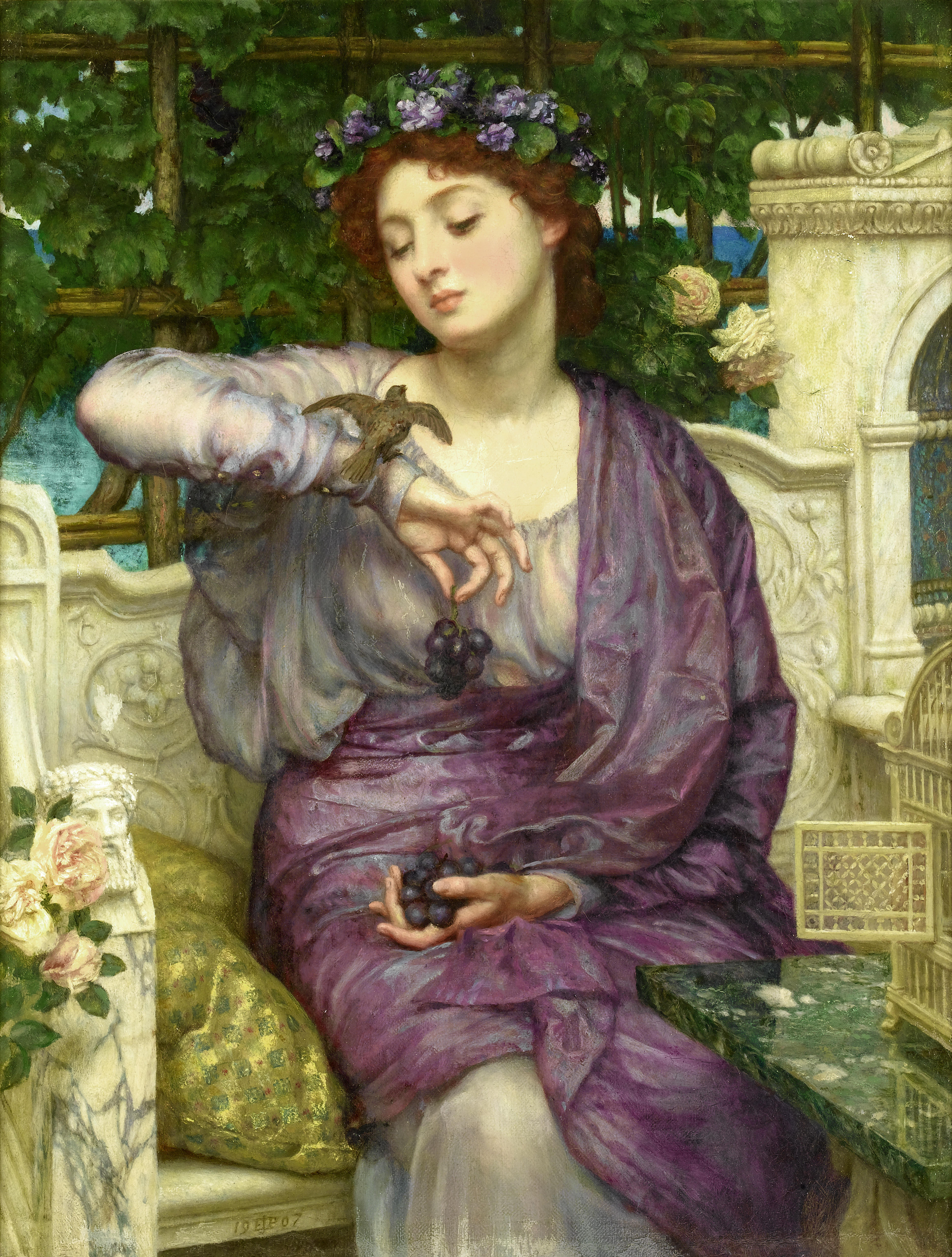
Sir Edward John Poynter, ‘Lesbia and Her Sparrow’

The siblings here alluded to are Cicero’s personal enemy Publius Clodius and his sister Clodia. (They were children of the distinguished and somewhat infamous patrician Claudian family; they used the popular ‘Clodius’ form of their name to emphasize their attachment to the popular party and the people it pandered to. Indeed, Publius Clodius had his status formally changed from patrician to plebeian so that he could stand for election as a Tribune.) This Clodia is usually identified with the Lesbia of Catullus’ poems. The rather ungentlemanly things which he writes about her seem to have been rather consistent with the common street gossip regarding her.