After the death of Hektor in Iliad 22, the poem moves to Andromache who gives a remarkable speech, most of which is occupied with thoughts of their son.
Iliad 22.482-507
“And now you go under the hidden places of the earth to Hades’ home,
But you leave me in hateful grief, a widow in our home—
And your child too, still an infant, the one we bore
You and I, ill-fated, Hektor, you will not be of any use to him
Since you have died, and he won’t be to you.
For even if he should escape the Achaeans’ war of many tears,
Still there would be toil and griefs for this child afterward.
For others will deprive him of his lands.
The day that makes a child an orphan separates him from his peers.
He looks down all the time; his cheeks are covered in tears;
And the child goes in need to his father’s friends,
Asking one for a cloak and another for a tunic.
He holds out his little cup while they pity him—
He can moisten his lips but never fill his hunger.
A luckier child chases him from the feast,
Striking him with his hands and laying into him with words:
“Go away—your father doesn’t dine with us.”
And the cheerful child will return to his widowed mother,
Atsyanax, who used to eat only marrow and the rich fat
Of sheep as he sat on his father’s needs.
Then when sleep would come over him, he would stop playing
And rest on a bed in the arms of a nurse, his heart full
Of everything good on that soft bed.
But now, he would suffer much once he has lost this dear father,
Astyanax, as the Trojans call him as a nickname,
For you alone defended their bulwarks and great walls.”
I was profoundly moved by this speech for its vividness and terrible irony long before I was a parent myself. The first time I read this passage in Greek as I prepared for my PhD exams, I wept while completing it. As a parent now, I struggle even to think about reading it. The terrible irony of course is that Astyanax is actually killed by the victors before he can suffer the deprivations his mother predicts, although she does fear this fate:
Iliad 24.732–738
“You, child, will also either follow me
Where you will toil completing the wretched works
Of a cruel master or some Achaean will grab you
And throw you from the wall to your evil destruction
Because he still feels anger at Hektor killing his brother
Or father or son, since many a man of the Achaeans dined
On the endless earth under Hektor’s hands.”
In the popular tradition the one who carries out the killing of Astyanax is Odysseus, that ‘hero’ of that other epic who gets to go home to his own son and father. If the way we talk about and treat our enemies dehumanizes them—and us—what does it mean when we murder, torture, or harm children?
In the future Andromache imagines, Astyanax is marginalized even among his own people by the loss of his father–he loses his status, his friends, and his former happiness. But in a foreign land, he loses all hope of happiness–he is a slave to another if he is lucky to be alive. I have to ask myself every time I read this whether or not an orphaned child is significantly better off today.
I can’t stop thinking about some of the details that surfaced last week about the separation of children from families by the US Government at our borders and within them. This is not some new legacy of course—from slavery through the devastation of indigenous families up into the modern judicial system and its enforcement of the new (and old) “Jim Crows”, we have a powerful and inescapable legacy of separating children from families. This creates an essential cognitive dissonance. You cannot be ‘pro-family’ and tear families apart.
I know that there has been extensive prevarication about the extent and severity of these separations. I don’t want to hear more of this because it all just amounts to fragile attempts of denial and blame shifting. We are obliterating families for being unlucky, brown-skinned, poor, and on the wrong side of man-made borders. We can’t comfort ourselves that our essential goodness has changed much in a few thousand years.
“My son was crying as I put him in the seat. I did not even have a chance to try to comfort my son, because the officers slammed the door shut as soon as he was in his seat. I was cry, too. I cry even now when I think about that moment when the border officers took my son away.” pic.twitter.com/2EmdndFIKo
This is from Plato the Attic Comedian, not the Attic Philosopher. Who knew there were at least 30 men with the same name?
Plato, Fr. 202 (Stobaeus, 2.3.3)
“If one wicked person
perishes, then two politicians grow in his place.
For there is no Iolaus* in the city
Who might cauterize the politicians’ heads.
If you’ve been bent over, then you’ll be a politician.”
*Iolaus is Herakles’ nephew who helped the hero kill the Hydra by cauterizing its necks to prevent new heads from growing.
Platôn, Alliance (fr. 168)
“They are like those boys who each time they draw a line
in the street to divide themselves into two groups
stand with some of them on one side of the line and some on the other.
One who stands in the middle of the two hurls a pot sherd–
If the white side faces up, one group must flee right away
And the others must chase them.”
Listen, I know Hektor gets a lot of love in the world and he is often seen as the one good man in a rather bad world. So, I hate to share this with you, but he’s not perfect either…
Euripides Andromache, 222-227
“Dearest Hektor, I tried for your sake
With your love affairs if Kupris made you stumble,
And often then I offered my breast to your bastards
So that I might demonstrate no bitterness for you.
And by doing these things I attracted my husband
To my virtue…”
“For they claim that this is against the history—for there is no history of sons born to Hektor from another woman. But those who say these things have not done their research. For Anaksikratês says in the second book of his Argive Affairs that those with Aineias and Skamandrios, Hektor’s son and an older son […] that first was his bastard who was taken away…[and the legitimate son] was killed.
But these men were saved. For Skamandrios arrived in Ida and Aineias—along with his son Askanios—and Ankhises his father, and his other sons and, and Aigestas who was Ankhises’ servant moved to Dardanos. Therefore Euripides does not oddly claim that [Hektor] had illegitimate sons.”
Anatole Mori in her commentary on this fragment for Brill’s New Jacoby notes that there are several later mythographical traditions that put Askanios and Skamandrios together:
“According to the fifth-century mythographer Hellanikos of Lesbos, Neoptolemos released Skamandrios and other descendants of Hektor, who returned with Askanios to Troy (BNJ 4 F 31 = Dionysios of Halikarnassos, Antiquities of Rome 1.47.53). The joint foundation of Skepsis by Skamandrios and Askanios is likewise noted by the geographer Strabo (Geography 13.1.52; Geography 14.5.29… On the various sources for the tradition of Skamandrios as a Trojan survivor, see P. M. Smith, ‘Aineiadai as Patrons of Iliad XX and the Homeric Hymn to Aphrodite’, HSCPh 85 (1981), 17-58, at 53-58. C.”
As Mori also notes, this name might be familiar to readers of the Iliad which takes pain to not that “Hektor used to call his son Skamandrios but the rest / called him Astyanax, for he alone kept Ilion safe” (τόν ῥ’ ῞Εκτωρ καλέεσκε Σκαμάνδριον, αὐτὰρ οἱ ἄλλοι
/ ᾿Αστυάνακτ’· οἶος γὰρ ἐρύετο ῎Ιλιον ῞Εκτωρ. 6.402–403). The Homeric scholia are silent on this. This seems a likely case of an instance where the Iliad knowingly suppresses details from myth to streamline the themes in its narrative (so, here, conflating multiple sons of Hektor into one). Indeed, Homeric epic seems to have a thing with eliminating second sons (as with Telegonus in the Odyssey.)
When it comes to the act of nursing a husband’s illegitimate children, the scholia to Euripides do bring up a Homeric example:
“[and I often then [gave my] breast]: This is the kind of woman Antênor’s wife was. For Homer has “Megês killed Pedaios, the son of Antênor / who was actually a bastard, but shining Theanô raised him carefully / equal to her own dear children, because she wanted to please her husband.”
(Note some linguistic similarity to Euripides’ passage above in the phrases χαριζομένη πόσεϊ ᾧ and τὴν σὴν χάριν.) The Homeric epics are not wholly silent on bastard sons--they feature Menelaos’ son Megapenthes. According to the scholion to this passage (Schol. A ad Hom. 5.70b) “it was the foreign custom to have children with a lot of women. (Ariston. ὅς ῥα νόθος μὲν ἔην: ὅτι βαρβαρικὸν ἔθος τὸ ἐκ πλειόνων γυναικῶν παιδοποιεῖσθαι. A). The bT Scholion to the same passage goes further:
“It is the foreign custom to have sex with many women—indeed, Laertes* “avoids the wrath of his wife” (1.433) Or she must quickly make it right through the priesthood. But the poetry attributes this custom to women—for it is a mark of a wise woman to cover the mistake her husband has made.”
*The Odyssey specifically remarks that Laertes did not sleep with Eurykleia, his very attractive slave, because he did not want to anger Antikleia, his wife.
So, in Euripides’ play, Andromache’s nursing of her husbands’ bastards is both a sign of her foreignness and of her dedication to her husband (and, perhaps here, a mark of her quality as a slave since she was already so accustomed to supporting another….).
Here’s some mythical-grade misogyny, with a variation on the Potiphar’s wife motif, and some infanticide.
Apollodorus, Bibliotheca, 3.155
“Hektor married Andromache, Êetiôn’s daughter, and Alexandros [Paris] married Oinônê the daughter of Kebren the river. She learned the power of prophecy from Rhea and warned Alexander not to sail to Helen. Because she did not persuade him, she said that if he was wounded, he should come to her because she alone would be able to heal him.
But he did steal Helen from Sparta and, while Troy was attacked, he was struck by Herakles’ arrows from Philoktêtes. He went to Oinône in Ida. She, because she took delight in his suffering, said she would not heal him. Alexandros returned to Troy and was dying, but Oinônê changed her mind and was bringing medicine to heal him only to find him dead. She hanged herself.”
This story is the one basically told in Parthenius (Love Tales, 4.7). Another version of the tale is preserved in Photios but is attributed to the historian and mythographer Konon (BNJ 26 F1 = Photios, Bibliotheka 186). A few notes of caution: Konon is dated to the 1st century CE; Photios to the 9th Century CE
Konon BNJ 26 F1 = Photios, Bibliotheka 186
[This section] is about how a child Koruthos, who surpassed his father in beauty, was born from Alexander/Paris and Oinône, the woman he married before he kidnapped Helen. His mother sent him to Helen to make Alexandros jealous and devise some evil for Helen. When Koruthos got to ‘know’ Helen, Alexandros arrived in the bedroom, and saw Koruthos sitting near her, and, already enraged out of suspicion, he killed him.
Because of the outrage against herself and the killing of her child, she cursed Alexandros a lot and predicted—for she had the inspiration of prophecy and was skilled in preparing medicines—that he would be wounded by one of the Achaeans some day and because he could not find treatment, he would need her and come home.
Later on, Alexander was wounded in the battle against the Achaeans in front of Troy by Philoktetes and he was suffering terribly. He was brought in a wagon to Idea and sent a herald to ask for Oinône. She arrogantly reproached him, saying that he should go back to Helen. Then Alexander died along the road because of the wound.
A powerful change of mind over took her at the time of his death before she heard of it, and once she gathered some medicine, she rushed to overtake him. Once she learned from the herald that he was dead and that she had killed him, she killed the herald for his arrogance by smashing a stone on his head. She threw herself over Alexander’s corpse and, after repeatedly blaming their shared fate, she hanged herself with her belt.”
A couple of takeaways from this one. First, it seems that Oinône knew about Paris’ lust for Helen before he departed for Sparta and remained behind on Mt. Ida once he returned to Troy. Second, it is entirely unclear when the child returns to Troy to tempt Helen. This story is a variation on the same story told about Phoinix in book 9 (his mother had him seduce his father’s lover; his father exiled him). No one in this story looks great (except for Koruthos, he looks real great). Paris is, well, a jerk. Poor Oinône is depicted as a witch-prophetess who, despite all the abuse, still loves her terrible husband.
Like Apollodorus’ version above, Ovid’s Heroides (5) do not mention the son. The earliest extant reference to Oinône seems to be Hellanicus, but some speculation links her to Bacchylides fr. 20d (where three letters OIN[….] seem to refer to a wife of Paris. See Gantz Early Greek Myth, 1993 n. 67 on page 839
“Traveler, weep for the age of this dead girl—
For she left when she was only twelve, causing her friends much grief
And leaving behind immortal pain. The rest of it
This memorial announces to everyone who passes by.
Much-wept Hades, why did you take Kleoptolemê when she
Was still a girl, at an ill-fated age? Didn’t you feel any shame?
You left for her dear mother Mnêsô everlasting grief
In exchange for mortal misfortune.
Dear Mother and sisters and Meidotelês who fathered you
As a source of pain for himself, Kleoptolemê,–
They look forward only to grief, and not your bed-chamber, now that you’ve died,
but a lament instead of a husband, a funeral instead of a marriage.”
The Odyssey is somewhat preoccupied with Telemachus’ paternity and the means by which it might be established. As mentioned in an earlier post, Aristotle suggests that children who are not like their father are monstrous. The Odyssey is also preoccupied with monstrous bodies–the giant Kikones, the deformed (morally and physically) Kyklopes, the transformed sailors, the mutilated bodies of servants–and the transformation of Odysseus’ body because of trauma at sea, age, and the needs of disguise. The threat of finding a monster at home might also be implied…
Athena signals Telemachus’ positive identity from the beginning. But the boy himself is uncertain!
Homer, Odyssey 1.207-209
“…if in fact this great child is from the same Odysseus.
For you look terribly like that man in his beautiful eyes
and his head…”
Telemachus famously quibbles over the identification, wondering in classic moody adolescent fashion if any of this is true. Some of the scholia try to support him…
Od. 1.215-216
“My mother says that I am his, but I, well, I just
Don’t know. For no one ever witnesses his own origin…”
“No one knows his own origin..” and elsewhere [we find] “they claim that that man is my father” (Od.4.387.) Similarly, Euripides says “a mother is a more dear parent than a father / for she knows the child is hers but he only thinks it” and Menander says, “no one knows from what man he is born / but we all suspect or believe it.” And some claim that Telemachus says these things because he was left when he was small.”
Later in the Odyssey, Nestor likens son to father (implicitly).
Od. 3.121-125
“..when shining Odysseus father was preeminent in all kinds of tricks, your father, if truly you are his son. And wonder overtakes me as I look at you
For your speeches, at least, are really fine—no one would expect
A younger man to utter such suitable things.”
In Sparta, Helen notes that Telemachus looks like, well, Telemachus even though she has never seen him! Menelaos agrees. The scholia get a little frustrated.
Od. 4.138-146
“For I do not think that anyone looks so suitable,
Neither a man nor a woman, and wonder overtakes me as I look at him,
How this one looks like the son of great-hearted Odysseus,
Telemachus, the one that man left just born in his household
When the Achaeans left for the sake of dog-faced me
And went to Troy, raising their bold war.”
“Fair Menelaos spoke to her and answered:
‘I was just thinking the same thing, wife, which you imagined.
For these are the same kind of feet and hands,
The look of the eyes and the hair on the head as that man.”
“These sort of feet are that man’s”: For likeness in bodies especially shows through in the extremities and the gaze. And however so much grows more slowly, that much provides more precise signs of recognition over time. This is why it is said “From feet to the head.”
The threat of children not looking like fathers is central to the fall of the race of iron. But it is couched within a general social collapse. In this case, ancient scholia turn to the abstract issue. In this case, a child dissimilar to parents would be a monstrum, but in the sense of an omen or a sign of a fallen generation. From this perspective the tension latent in Telemachus’ potential dissimilarity to his father is about stability of the last generation of epic heroes. The bastard sons of Odysseus and potential infidelity of Penelope signal, perhaps, the end of the race of heroes and a premature end to heroic epic.
Hesiod, Works and Days 180–185
“Zeus will destroy this race of mortal humans
Or they will perish when they are born with temples already grey.
Then a father will not be like his children, nor children at all like parents;
A guest will not be dear to a host, a friend not to a friend
And a relative will not be dear as in years before.”
b. “Similar to…” likeness, similarity, a shared voice or similarity in mind or in shape, [lost here] because of the multitude of wickedness and adulteries…”
“similar to”: the similarity is clearly the commonness, the conversation, and the affection. For affection (philia) develops from similarity. Altogether this expresses tragically the oncoming evils in life following this, the distrust between children and fathers, between guests and hosts, and among friends. Friendship is the third thing mentioned. Also: cognate, companionable, hospitable.”
Later, Aristotle channels some of the same cultural assumptions from a scientific perspective. Here the monstrum (greek teras) is an indication of deformity.
Aristotle, Generation of Animals, Book 4, 767b
“These causes are also of the same. Some [offspring] are born similar to their parents while others are not. Some are similar to their father; others are like their mother, applying both to the body as a whole and to each part. Offspring are more like their parents than their ancestors and more like their ancestors than passersby.
Males are more similar to their father and females are more similar to their mother. But some are not like any of their relatives, but are still akin to human beings while others are like not at all like humans in their appearance, but rather like some monster. For whoever is not like his parents is in some way a monster because nature has in these cases wandered in some way from the essential character.”
For him, we offer a feast before the Alektran gates and leave
a pile of newly-made wreaths on his altars
as fires for the eight bronze-speared dead
—the sons whom Megara, Kreon’s daughter bore.
When it comes to the sons Herakles had with Megara, Lysimakos says that some people claim they were not murdered by Herakles but by some foreigners. Others Claim that king Lykos killed them. Sokrates says that they were murdered by Augeas.
There are also debates about the number of the children. Dionysios in the first book of his Cycle says that they were Thêrimakhos and Dêikoôn. To these, Euripides adds Aristodêmos. But the Argive Deinias says that the sons were Thêrimakhos, Kreontiadês, Dêikoôn, and Deion. But Pherecydes claims in his second book that they are Antimakhos, Klumenos, Glênos, Thêrimakhos, Kreontiadês, claiming that they were thrown into a fire by their father.
Batôn records in the second book of his Attic History that the sons’ names were Poludôros, Anikêtos, Mêkistophonos, Patroklês, Toxokleitos, Menebrontes, and Khersibios. Herodoros claims that Herakles went insane twice. He was purified first by Sikalos, according to Menekratês, who says that he had eight sons, and that they were not called Heraclids—for he was not yet named Herakles, but Alkaiads.”
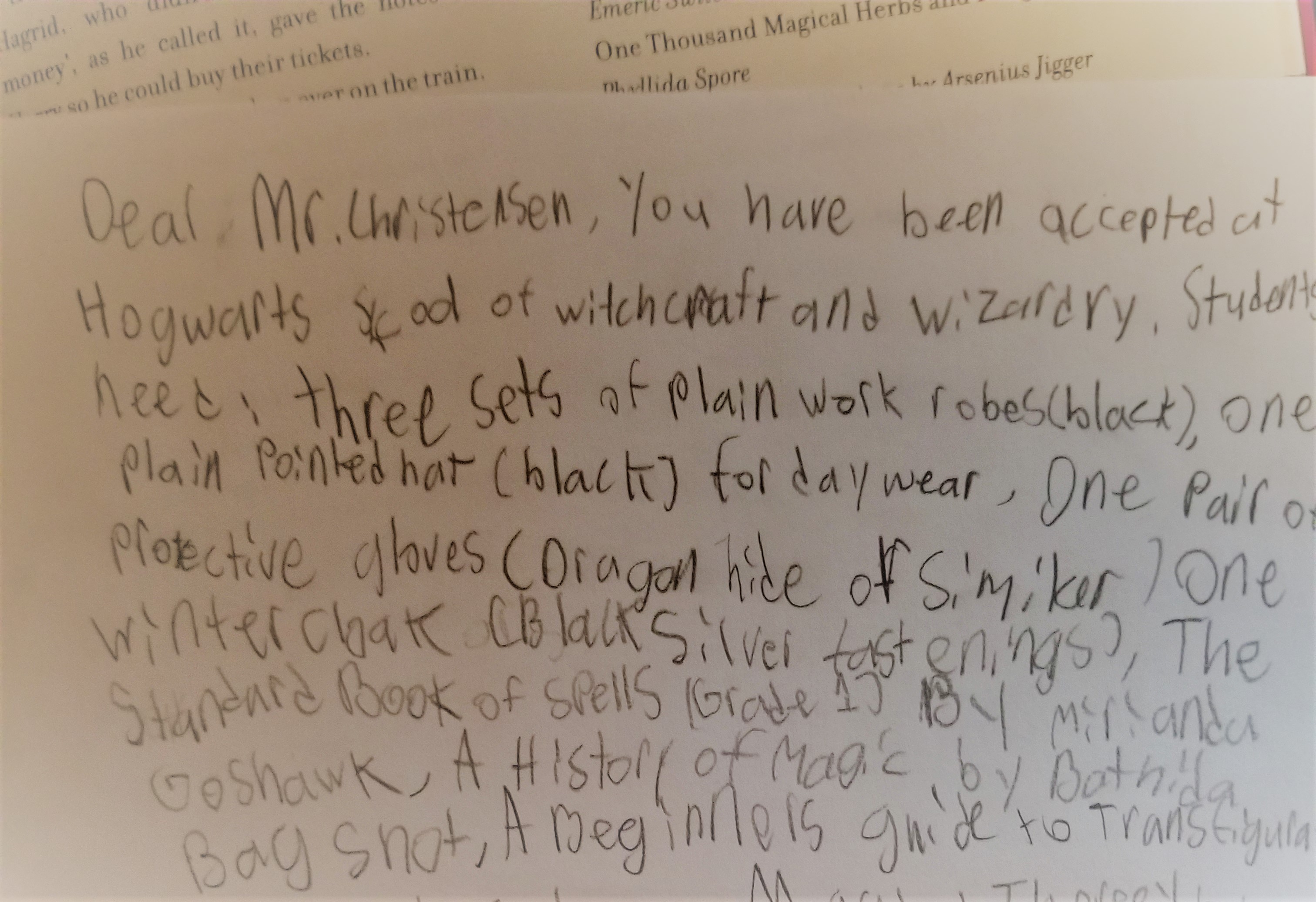
This week, I discovered that my children were secretly making holiday gifts for each other. I walked into the office and found my daughter writing a Hogwarts acceptance letter for her brother, because he wants magic to be real.
The starting address killed me here. But then the level of detail!
Let’s just say that after witnessing this I left the room and had a sudden, prolonged attack of itchy eyes.
I was crying in part because the moment was just so sweet and emerged from a year of the children learning to love the world of Harry Potter. But this was the same day J. K. Rowling was in the news for supporting bigotry, for showing public support of a transphobic UK Academic. (And a lot of analysis online has made it clear that this is not a casual mistake, that she has a pattern of antagonism towards transgender people.) There was a lot of justifiable anger and disappointment online, as several communities wrangled with how to wrangle with this.
This is not, of course, the first time the author of the Harry Potter series has courted controversy. At times she has expressed offensive or poorly nuanced political views; at others, she has seemed to hastily adapt her fictional world to the realities of the contemporary one, claiming, for example, that Dumbledore was always gay.
Euripides, Suppliant Women, 913-917
“For even an infant learns to speak
And listen to things he has no understanding of.
Whatever someone learns, he wants to save
For old age. So, teach your children well.”
As many of my former and current students know, I resisted the whole Harry Potter phenomenon for years because I was already teaching when it started (and was thus too cool for the narrative), because, like others, I was weaned on other narratives which had seemed forgotten, like Lloyd Alexander’s cycle, Susan Cooper’s Dark is Rising Sequence, or the unending Wheel of Time. But I was mostly frustrated that at its core, the Harry Potter books are just the same old heroic narrative recycled
As I have written about before the heroic pattern has a great potential to cause harm. The basic heroic narrative is regressive, heteronormative, male-centered, and often, when realized in a western context, racist. It limits roles, sets people up for severe disappointment, and can also eventuate in violence
I was worried about some of these influences when my kids started reading the books because narratives can have such powerful impact on how we view ourselves in the world. My children are young, already shaped by social expectations for gender. The Potter books don’t really give much space to women, they cast good and evil in a rather stark divide (until near the end), and they tokenize non-white characters. My children are bi-racial and are not Christian.
I was worried they would not see themselves in the books or would simply see themselves as peripheral. When it comes to people who look like them or have names closer to theirs, things get a little bleak: The Indian characters in the book are mere UK colonial props, like chicken curry in a pub.
But oh, whatever my reservations, how they fell in love! My daughter, who had read eagerly for a bit but then got overwhelmed by longer books, started listening to the audiobooks while we were driving and then would immediately go to the book when we got home. Before long, she would listen while reading and made a huge leap in her confidence and comprehension. My son, precocious in the way only younger brothers can be, tore through the books in a few months. And then started again a second time.
Seneca, EM 3.3
“What you see happen to children happens to us, too, who are but slightly greater children.”
quod vides accidere pueris, hoc nobis quoque maiusculis pueris evenit.
Experiencing the books together was something something I will cherish until I die. We all listened together in the car and I cried uncontrollably at their smiles when Gryffindor won the house cup at the end of the first book. I heard the stories through their eyes and listened as they debated who was good and bad, cringed at the burgeoning Romances, and wept when their favorite characters died.
Over six months we listened to all the books together, they read them separately, and they watched the movies. Relatives gave them Harry Potter Legos. A babysitter introduced them to the online House quiz. My daughter has a Ravenclaw Scarf; her brother, like Harry himself, is sometimes Slytherin, sometimes Gryffindor. They are now re-listening to the books any time we drive.
In many ways this is different from the way I experienced narratives with my parents: my father was deaf and we would sometimes talk about what we read, but we rarely ever watched movies together (until closed caption was common) and my mother’s genre interests rarely overlapped with mine. My siblings were almost always a little young for what I was reading. Such a deep, shared experience was new to me.
But as a parent, it was also not free of certain burdens. As someone who studies narrative and myth, moreover, I have been really cautious about the stories we tell them from the beginning. Because I was swept away with them to Wizarding world, I don’t know what they have absorbed and what they haven’t, so the world is theirs now. But when the creator of this series makes pronouncements in public, I hear it, but they do not. They don’t know who JK Rowling is. They know the story and they love it. They remake the stories in their play and they find their own lives within it.
I know from the comments in response to the twitter thread that there is a little too much naivete at work here, that the extent of the damage a story can do is unacknowledged, and that the fame and money our love of narrative bestows on authors gives them outsize power in the world. A boycott makes sense, from this perspective.
Yet, there is some wisdom in the child’s eye view here. As adults, we lionize authors/creators/artists mistakenly, partly because of the author/god metaphor but also because of capitalism and individualism. But this is a backwards way of seeing human creativity and creation. We need to change the way we see what artists do in the world; we need to change the way we talk about it.
As a Homerist I fight the tendency to worship authors and essentialize the relationship between them and their work all the time. I am always asserting that (1) there was no Homer and, at best, the name is a metonym and (2) more importantly, even if there were a Homer or if we could isolate a single singer who put together the Iliad and the Odyssey, Epic and literature are a product of interaction between audiences and performers over time. Everyone always wants to talk about the performer but not the audience. Everyone wants to talk about the author, but it is the reader who matters more.
Languages, story-worlds, plot conventions, and all the other things that make narratives possible are products of groups and multiple creators: even individual poets do what they do by contrasting with what is already there. We have a modern collective insanity when it comes to valuing the contribution of individuals and rewarding them. Let me be clear: I don’t think it is a problem if someone creates something people love and gets rich. I just think it is a problem that they see getting rich as valorizing whatever they do and say apart from the work of art.
Sometimes bad people make good things; other times good people make bad things. But people always change and the work changes too. We face particular problems in our society when someone like Orson Scott Card gets rich from creative work and then uses it to hurt people. Let’s be clear here: the problem is not narrative or even Orson Scott Card, the problem is the cancerous effect that money has on human relationships and identity.
I have two responses to this, one a coward’s and one impractical. First, I don’t believe you can buy your way to or from virtue. Capitalism is so deeply thievery and exploitation that to refuse to spend on one corruption is merely to spend on another one. The choice is illusory agency. Of course, it is probably prevarication to say that how we spend does not matter. So, second, for the bold, infringe on copyright; for the more law-abiding, public libraries weaken the advantages that our passions confer.
Our passions are so often unpredictable. Works that move people, that change their lives, don’t necessarily have to be great pieces of art. As others have said, the Potter books are not terribly well-written and much of it is silly, retrograde, or derivative. But it works as story because young people are so willing to fall deeply, and madly in love with a world with rules, magic, and endings.
This inspiration comes from countless other readers, writers, storytellers, and singers. I think that ‘great’ authors just end up being in the right place and right time and have the privilege and luck to tell their stories and have them heard. They also need the cultural prestige and position to do so.
Because I have read the Homeric epics without author for so long and have spent so many years thinking about orality, authorship, and reader reception, it is easy for me to dismiss all authors. I extend this to musicians all the time and have often found myself arguing with my brother about whether or not it matters what a songwriter says a song is about. When artists release their work into the world it becomes something else. But it was already something different before it left them because our languages, images, and narrative patterns are in every part compressed potentials of meaning we don’t fully comprehend at any given moment.
My favorite metaphor to help me understand this comes from Plato’s dialogue, the Ion. Plato has Socrates provide a simile to the rhapsode Ion in about a magnet: he argues that a singer is like a metal ring which is endowed with magnetic power because from another magnetic ring (poet) touching a magnet (the muse/god). He makes it very clear that the audience is part of this process.
535e-536a
“Do you understand that the audience is the last of the rings which I was describing as transmitting through one another the power from the Herakleian stone and that you are the middle as the rhapsode and interpreter—that the poet himself is the first ring? The god moves the soul of all of these people wherever he wants, stringing the power from one into another.”
This is my favorite way of thinking about artistic creation: imagine if the first ring is not god, but instead human culture in its messiness, in its synchronic and diachronic forms. Authors convey this power and direct it, and audiences transmit it on. I would even argue that magnetism is a good starting metaphor, but it fails to explain the multidirectional network of creative acts, how some nodes can weaken or strengthen their force, how feedback loops from recipient back to speaker can change the force, and how none of us can fully understand the scope of narrative creation because we are inside of not outside of time.
Seneca, De Tranquillitate Animi 8
“Quoting the good words of a bad author will never shame me.”
Numquam me in voce bona mali pudebit auctoris
So, when it comes to the importance of authors, I usually take a pretty hard stance. If JKR wasn’t going to write Harry Potter someone like her would have eventually. Our world was ready for it and the audience was willing to make it real.
When authors turn out to disappoint us—and they always will because they are human and not heroes in their own stories—we can ignore them and detach them from their narratives with no guilt. Perhaps we need to defund them or deplatform them at times, but the story lives beyond the storyteller before the tale is ever told. There’s a larger question here we need to have about loving or praising ‘good’ art from ‘bad’ people.
This doesn’t mean that their stories themselves are innocent. The HP universe has deep body image problems, is certainly ableist, racist and heteronormative. But it is not any of these things because of the author in particular: these stories reflect our world. They reflect us. More progressive authors like Ursula Le Guin or even Robert Heinlein pushed us to rethink our assumptions about gender and sex; and more recently N. K. Jemesin, Ann Leckie, or Ada Palmer help us to see how we are by depicting how we aren’t. And as we grow older and wiser as audiences, we can see these things and make new, better stories.
And I hope to read many of these stories with my children. Unfortunately, many of them also depict sexual acts and I am not ready for that just yet. For now, I am going to just wait to see the look on my son’s face when he gets his acceptance letter. It will destroy me. But, that’s probably because I’m a Hufflepuff, which is something my children, not JKR, taught me.
Strabo 1.8
“Whenever you also consider the amazing and the disturbing, you amplify the pleasure which is a magic charm for learning. In the early years, we must use this sort of thing to entice children, but as their age increases we must lead them to a knowledge of reality as soon as their perception has gotten stronger and they no longer need much cajoling. Every illiterate and ignorant person is in some way a child and loves stories like a child.”
“You should know that while Homer and many other authors say that the only child of Achilles and Deidameia was Neoptolemos, Demetrios of Ilion records that here were two, Oneiros [“dream”] and Neoptolemos.
They say that Orestes killed him in Phôkis accidentally and when he recognized that he did, he built him a tomb near Daulis. He dedicated the sword he killed him with there and then went to the “White Island”, which Lykophron calls the “foaming cliff”, and propitiated Achilles.”
BNJ 59 F 1b Ptolemy Chennos, Novel History, Book 3 = Photios, Bibliotheca 190, 148b21
“And [he says] that there were two children of Achilles and Deidamia, Neoptolemos and Oneiros. Oneiros was killed accidentally by Orestes in Phôkis while they fighting over erecting a tent.”
During the Peloponnesian War, the Athenian Democracy deliberated on and voted for the killing of men and the enslavement of women and children. To ask why is not an idle historical musing.
Thucydides, 5.116.4
“The [Athenians] killed however many of the Melian men were adults, and made the women and children slaves. Then they settled the land themselves and later on sent five hundred colonists.”
“Around the same period of time in that summer, the Athenians set siege to the Scionaeans and after killing all the adult men, made the women and childen into slaves and gave the land to the Plataeans.”
This was done by vote of the Athenian democracy led by Cleon: Thucydides 4.122.6. A similar solution was proposed during the Mytilenean debate. Cleon is described by Thucydides as “in addition the most violent of the citizens who also was the most persuasive at that time by far to the people.” (ὢν καὶ ἐς τὰ ἄλλα βιαιότατος τῶν πολιτῶν τῷ τε δήμῳ παρὰ πολὺ ἐν τῷ τότε πιθανώτατος, 3.36.6)
3.36
“They were making a judgment about the men there and in their anger it seemed right to them not only to kill those who were present but to slay all the Mytileneans who were adults and to enslave the children and women.”
In his speech in defense of this policy, Cleon reflects on the nature of imperialism and obedience. Although he eventually failed to gain approval for this vote which was overturned, his arguments seem to have worked on later occasions.
Thucydides, 3.37
“The truth is that because you live without fear day-to-day and there is no conspiring against one another, you think imagine your ‘allies’ to live the same way. Because you are deluded by whatever is presented in speeches you are mistaken in these matters or because you yield to pity, you do not not realize you are being dangerously weak for yourselves and for some favor to your allies.
You do not examine the fact that the power you hold is a tyranny and that those who are dominated by you are conspiring against you and are ruled unwillingly and that these people obey you not because they might please you by being harmed but because you are superior to them by strength rather than because of their goodwill.
The most terrible thing of all is if nothing which seems right to us is established firmly—if we will not acknowledge that a state which has worse laws which are unbendable is stronger than a state with noble laws which are weakly administered, that ignorance accompanied by discipline is more effective than cleverness with liberality, and that lesser people can inhabit states much more efficiently than intelligent ones.
Smart people always want to show they are wiser than the laws and to be preeminent in discussions about the public good, as if there are no more important things where they could clarify their opinions—and because of this they most often ruin their states. The other group of people, on the other hand, because they distrust their own intelligence, think that it is acceptable to be less learned than the laws and less capable to criticize an argument than the one who speaks well. But because they are more fair and balanced judges, instead of prosecutors, they do well in most cases. For this reason, then, it is right that we too, when we are not carried away by the cleverness and the contest of intelligence, do not act to advise our majority against our own opinion.”




,_from_the_Villa_Torre_de_Palma_near_Monforte,_3rd-4th_century_AD,_National_Archaeology_Museum_of_Lisbon,_Portugal_(12973806145).jpg)
