Helen’s Serving Girl Wrote the First Greek Sex Manual

From the Suda

Astuanassa: A handmaid of Helen, Menelaos’ wife. She first discovered positions for intercourse and wrote On Sexual Positions. Philainis and Elephantinê rivaled her in this later—they were women who danced out these sorts of wanton acts.

Ἀστυάνασσα, Ἑλένης τῆς Μενελάου θεράπαινα: ἥτις πρώτη τὰς ἐν τῇ συνουσίᾳ κατακλίσεις εὗρε καὶ ἔγραψε περὶ σχημάτων συνουσιαστικῶν: ἣν ὕστερον παρεζήλωσαν Φιλαινὶς καὶ Ἐλεφαντίνη, αἱ τὰ τοιαῦτα ἐξορχησάμεναι ἀσελγήματα.

Photius Bibl. 190.149a 27-30

We have learned about this embroidered girdle, that Hera took it from Aphrodite and gave it to Helen. Her handmaid Astuanassa stole it but Aphrodite took it back from her again.

Περὶ τοῦ κεστοῦ ἱμάντος ὡς λάβοιμὲν αὐτὸν ῞Ηρα παρὰ ᾿Αφροδίτης, δοίη δ’ ῾Ελένῃ, κλέψοι δ’ αὐτὸν ἡ ῾Ελένης θεράπαινα ᾿Αστυάνασσα, ἀφέλοι δ’ αὐτὸν ἐξ αὐτῆς πάλιν ᾿Αφροδίτη.

Hesychius, sv. Astuanassa

Astuanassa: A handmaiden of Helen and the first to discover Aphrodite and her licentious positions.

᾿Αστυάνασσα· ῾Ελένης θεράπαινα ἥτις πρώτη ἐξεῦρεν ᾿Αφροδίτην καὶ ἀκόλαστα σχήματα
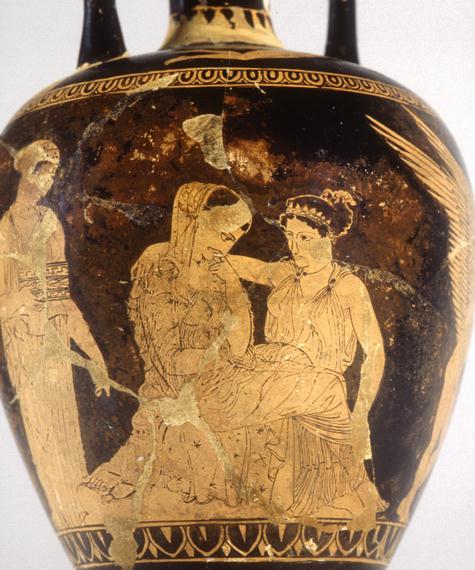
Image result for Ancient Greek Helen vase

As is largely unsurprising from the perspective of Greek misogyny, excessive interest in sexual behavior is projected a female quality. Expertise beyond interest is made the province of female ‘professionals’ (slaves) who may act as scapegoats and marginal figures for the corruption of both men and women. There is a combination of such interest with an excessive emphasis on eating (and eating really well) in Athenaeus where the pleasures of the body are combined.

Athenaeus, Deipnosophists 8.335c

“Dear men, even though I have great admiration for Chrysippus as the leader of the Stoa, I praise him even more because he ranks Arkhestratos, well-known for his Science of Cooking along with Philainis who is credited with a licentious screed about sexual matters—even though the iambic poet of Samos, Aiskhriôn, claims that Polycrates the sophist started this slander of her when she was really quite chaste. The lines go like this:

“I, Philainis, circulated among men
Lie here thanks to great old age.
Don’t laugh, foolish sailor, as your trace the cape
Nor make me a target of mockery or insult
For, by Zeus and his sons in Hell
I was never a slut with men nor a public whore.
Polykrates, Athenian by birth,
A bit clever with words and with a nasty tongue,
Wrote what he wrote. I don’t know anything about it.”

But the most amazing Chrysippus combines in the fifth book of his On Goodness and Pleasure that both “the books of Philianis and the Gastronomiai of Arkhestratos and forces of erotic and sexual nature, and in the same way slave-girls who are expert at these kinds of movements and positions and who are engaged in their practice.” He adds that they learn this type of material completely and then thoroughly possess what has been written on these topics by Philainis and Arkhestratos and those who have written on similar topics. Similarly, in his seventh book, he says ‘As you cannot wholly learn the works of Philianis and Arkhestratos’ Gastronomia because they do have something to offer for living better.’ “

Χρύσιππον δ᾿, ἄνδρες φίλοι, τὸν τῆς στοᾶς ἡγεμόνα κατὰ πολλὰ θαυμάζων ἔτι μᾶλλον ἐπαινῶ τὸν πολυθρύλητον ἐπὶ τῇ Ὀψολογίᾳ Ἀρχέστρατον αἰεί ποτε μετὰ Φιλαινίδος κατατάττοντα, εἰς ἣν ἀναφέρεται τὸ περὶ ἀφροδισίων ἀκόλαστον cσύγγραμμα, ὅπερ φησὶ | ποιῆσαι Αἰσχρίων ὁ Σάμιος ἰαμβοποιὸς Πολυκράτη τὸν σοφιστὴν ἐπὶ διαβολῇ τῆς ἀνθρώπου σωφρονεστάτης γενομένης. ἔχει δὲ οὕτως τὰ ἰαμβεῖα·

ἐγὼ Φιλαινὶς ἡ ᾿πίβωτος ἀνθρώποις
ἐνταῦθα γήρᾳ τῷ μακρῷ κεκοίμημαι.
μή μ᾿, ὦ μάταιε ναῦτα, τὴν ἄκραν κάμπτων
χλεύην τε ποιεῦ καὶ γέλωτα καὶ λάσθην.
ὐ γὰρ μὰ τὸν Ζῆν᾿, οὐ μὰ τοὺς κάτω κούρους, |
dοὐκ ἦν ἐς ἄνδρας μάχλος οὐδὲ δημώδης.
Πολυκράτης δὲ τὴν γενὴν Ἀθηναῖος,
λόγων τι παιπάλημα καὶ κακὴ γλῶσσα,
ἔγραψεν οἷ᾿ ἔγραψ᾿· ἐγὼ γὰρ οὐκ οἶδα.

ἀλλ᾿ οὖν ὅ γε θαυμασιώτατος Χρύσιππος ἐν τῷ πέμπτῳ Περὶ τοῦ Καλοῦ καὶ τῆς Ἡδονῆς φησι· καὶ βιβλία τά τε Φιλαινίδος καὶ τὴν τοῦ Ἀρχεστράτου Γαστρονομίαν καὶ δυνάμεις ἐρωτικὰς καὶ συνουσιαστικάς, ὁμοίως δὲ καὶ τὰς θεραπαίνας ἐμπείρους τοιῶνδε κινήσεών τε καὶ σχημάτων καὶ περὶ τὴν eτούτων μελέτην γινομένας. καὶ πάλιν· ἐκμανθάνειν | τ᾿ αὐτοὺς τὰ τοιαῦτα καὶ κτᾶσθαι τὰ περὶ τούτων γεγραμμένα Φιλαινίδι καὶ Ἀρχεστράτῳ καὶ τοῖς τὰ ὅμοια γράψασιν. κἀν τῷ ἑβδόμῳ δέ φησι· καθάπερ γὰρ οὐκ ἐκμανθάνειν τὰ Φιλαινίδος καὶ τὴν Ἀρχεστράτου Γαστρονομίαν ἔστιν ὡς φέροντά τι πρὸς τὸ ζῆν ἄμεινον.

Fighting Fortune: Two Enter, One Leaves

Seneca, Moral Epistles 51.7-9

“What if we did what Hannibal did and give our time to  pampering ourselves once we have stopped the course of events and given on the war? There’s no one who’d fail to upbraid us for our poorly scheduled laziness, something full of danger for a victor, and much more for someone merely about to conquer. And this is less appropriate for us than for those waving Punic sigils, since our danger is greater than theirs if we relax and our labor is more if we persevere.

Fortune is waging war against me. I will not be defeated; I will not accept the yoke. No, I’ll shake it off, something I have to do with greater dedication. The soul should not be coddled. If I give up to pleasure, then I must also yield to pain, to labor, to poverty. Ambition and rage would desire to have the same right over me too and I would be stretched to pieces, no, ripped to pieces, overcome by all these forces.

Freedom sits before me. My labor is for that prize. What is freedom, you ask? To be a slave to nothing, to no need, to no chance. It means meeting Fortune in the arena as an equal. On the day when I see that I am in control, she will be able to do nothing. Should I give in to death when death is in my hand?”

Si faceremus, quod fecit Hannibal, ut interrupto cursu rerum omissoque bello fovendis corporibus operam daremus, nemo non intempestivam desidiam victori quoque, nedum vincenti, periculosam merito reprehenderet; minus nobis quam illis Punica signa sequentibus licet, plus periculi restat cedentibus, plus operis etiam perseverantibus. Fortuna mecum bellum gerit; non sum imperata facturus. Iugum non recipio, immo, quod maiore virtute faciendum est, excutio.

Non est emolliendus animus; si voluptati cessero, cedendum est dolori, cedendum est labori, cedendum est paupertati; idem sibi in me iuris esse volet et ambitio et ira; inter tot adfectus distrahar, immo discerpar. Libertas proposita est; ad hoc praemium laboratur. Quae sit libertas, quaeris? Nulli rei servire, nulli necessitati, nullis casibus, fortunam in aequum deducere. Quo die illa me intellexero plus posse, nil poterit. Ego illam feram, cum in manu mors sit?

still shot from Mad Max beyond the thunderdome. Tina Turner in shadows looking down at the arena

Hippocrates: Unmarried Women are Sad Because of Periods

Hippocrates of Cos, On Girls [Peri Parthenôn] 1

“Let’s talk first concerning the disease which is called sacred and paralyzed people and the many anxieties which frighten people seriously enough that they lose their minds and believe that they see evil spirits by night or even at times by die or sometimes on all hours. Many have hanged themselves before because of this kind of vision, more often women than men.

For a woman’s nature is more depressed and sorrowful. And young women, when they are at the age of marriage and without a husband, suffer terribly at the time of their menstruation, which they did not suffer earlier in life. For blood collects later in their uterus so that it may flow out. When, then, the mouth of the exit does not create an opening, the blood pools up more because of food and the body’s growth. When the blood has nowhere to flow, it rises up toward the heart and the diaphragm. When these organs are filled, the heart is desensitized and from this transformation it becomes numb. Madness overtakes women because of this numbness.”

Πρῶτον περὶ τῆς ἱερῆς νούσου καλεομένης, καὶ περὶ τῶν ἀποπληκτικῶν, καὶ περὶ τῶν δειμάτων, ὁκόσα φοβεῦνται ἰσχυρῶς ἄνθρωποι, ὥστε παραφρονέειν καὶ ὁρῆν δοκέειν δαίμονάς τινας ἐφ᾿ ἑωυτῶν δυσμενέας, ὁκότε μὲν νυκτός, ὁκότε δὲ ἡμέρης, ὁκότε δὲ ἀμφοτέρῃσι τῇσιν ὥρῃσιν. ἔπειτα ἀπὸ τῆς τοιαύτης ὄψιος πολλοὶ ἤδη ἀπηγχονίσθησαν, πλέονες δὲ γυναῖκες ἢ ἄνδρες· ἀθυμοτέρη γὰρ καὶ λυπηροτέρη ἡ φύσις ἡ γυναικείη. αἱ δὲ παρθένοι, ὁκόσῃσιν ὥρη γάμου, παρανδρούμεναι, τοῦτο μᾶλλον πάσχουσιν ἅμα τῇ καθόδῳ τῶν ἐπιμηνίων, πρότερον οὐ μάλα ταῦτα κακοπαθέουσαι. ὕστερον γὰρ τὸ αἷμα ξυλλείβεται ἐς τὰς μήτρας, ὡς ἀπορρευσόμενον· ὁκόταν οὖν τὸ στόμα τῆς ἐξόδου μὴ ᾖ ἀνεστομωμένον, τὸ δὲ αἷμα πλέον ἐπιρρέῃ διά τε σιτία καὶ τὴν αὔξησιν τοῦ σώματος, τηνικαῦτα οὐκ ἔχον τὸ αἷμα ἔκρουν ἀναΐσσει ὑπὸ πλήθους ἐς τὴν καρδίην καὶ ἐς τὴν διάφραξιν. ὁκόταν οὖν ταῦτα πληρωθέωσιν, ἐμωρώθη ἡ καρδίη, εἶτ᾿ ἐκ τῆς μωρώσιος νάρκη, εἶτ᾿ ἐκ τῆς νάρκης παράνοια ἔλαβεν.

Hippocrates should have consulted a woman physician like Trotula

Words of Mourning: Some Poems of Anyte of Tegea

The following epigrams are attributed to the poet Anyte of Tegea, one of a handful of Hellenistic women preserved in the Greek Anthology.

Gr. Anth. 7.490

“I mourn for the virgin Antibia, to whose father’s home
Many suitors came longing to marry,
Thanks to the fame of her beauty and wisdom.
But ruinous fate made all their hopes turn in the dust.”

Παρθένον Ἀντιβίαν κατοδύρομαι, ἇς ἐπὶ πολλοὶ
νυμφίοι ἱέμενοι πατρὸς ἵκοντο δόμον,
κάλλευς καὶ πινυτᾶτος ἀνὰ κλέος· ἀλλ᾿ ἐπὶ πάντων
ἐλπίδας οὐλομένα Μοῖρ᾿ ἐκύλισε πρόσω.

7.208

“Dâmis built this grave for his battle-fierce but dead
Horse, after murderous Ares pierce his chest.
The blood spurted black from his thick-hided skin
And he dyed the earth with his painful life’s blood.”

Μνᾶμα τόδε φθιμένου μενεδαΐου εἵσατο Δᾶμις
ἵππου, ἐπεὶ στέρνον τοῦδε δαφοινὸς Ἄρης
τύψε· μέλαν δέ οἱ αἷμα ταλαυρίνου διὰ χρωτὸς
ζέσσ᾿, ἐπὶ δ᾿ ἀργαλέᾳ βῶλον ἔδευσε φονᾷ.

7.724

“Your courage, Proarkhos, killed you in the fight and dying
You put the home of your father Pheidias into dark grief.
Yet this rock above you sings out a noble song:
That you died in a struggle for your dear homeland.”

Ἦ ῥα μένος σε, Πρόαρχ᾿, ὄλεσ᾿ ἐν δαΐ, δῶμά τε πατρὸς
Φειδία ἐν δνοφερῷ πένθει ἔθου φθίμενος·
ἀλλὰ καλόν τοι ὕπερθεν ἔπος τόδε πέτρος ἀείδει,
ὡς ἔθανες πρὸ φίλας μαρνάμενος πατρίδος.

7.538

“When he was alive this man was once Manês.
But now that’s dead, he can be equal to great Dareios.”

Μάνης οὗτος ἀνὴρ ἦν ζῶν ποτέ· νῦν δὲ τεθνηκὼς
ἶσον Δαρείῳ τῷ μεγάλῳ δύναται.

Image result for Ancient tegea
Tegea from Wikipedia

On Seeing the Clown in the Mirror

CW: ableism, cruel humor

Seneca, Moral Epistles 50.2-3

“You know that Harpaste, my wife’s clown, has stayed in my home as a hereditary burden. I am particularly turned off by these weirdos. If I want to be entertained by a clown, I don’t need to search very far–I can laugh at myself.

This clown suddenly lost the ability to see. I know this will sound unbelievable, but I am telling the truth: she does not know she is blind. She goes around asking her servant to move her to another room. She says that her place is rather dark.

Well, what  we laugh at her for, actually happens to the rest of us too. No one knows they are greedy; no one knows they desire too much. At least the blind seek out a guide, while we blunder about without one and claim, “I am not really ambitious, but no one can manage to live in Rome otherwise. Oh, I am not excessive, living in the city requires great expenses. It isn’t my fault that I am anxious or that I haven’t figured out my life yet, my youth makes me this way.”

Why do we lie to ourselves? Our problems aren’t external, they are inside us. They sit in our guts themselves. That’s why pursuing health is hard, because we are ignorant of our own disease.”

Harpasten, uxoris meae fatuam, scis hereditarium onus in domo mea remansisse. Ipse enim aversissimus ab istis prodigiis sum; si quando fatuo delectari volo, non est mihi longe quaerendus; me rideo. Haec fatua subito desiit videre. Incredibilem rem tibi narro, sed veram: nescit esse se caecam. Subinde paedagogum suum rogat ut migret. Ait domum tenebricosam esse.

Hoc quod in illa ridemus, omnibus nobis accidere liqueat tibi; nemo se avarum esse intellegit, nemo cupidum. Caeci tamen ducem quaerunt, nos sine duce erramus et dicimus: “Non ego ambitiosus sum, sed nemo aliter Romae potest vivere. Non ego sumptuosus sum, sed urbs ipsa magnas inpensas exigit Non est meum vitium, quod iracundus sum, quod nondum constitui certum genus vitae; adulescentia haec facit.” Quid nos decipimus? Non est extrinsecus malum nostrum; intra nos est, in visceribus ipsis sedet, et ideo difficulter ad sanitatem pervenimus, quia nos aegrotare nescimus.

Color photograph of an oil painting of the bust and head of a clown. The clown has a striped white and red shirt, a red nose, and somewhat discolored makeup.
Joseph Kutter, “Tête de clown / Head of a Clown” 1937

Returning to a Moment’s Hesitation: Sophocles’ Electra Online, LIVE Tonight at UIC

Sophocles, Electra 20-22

“Before any man tries to leave this house
you need to plan: this is no longer the right time
for hesitation: now is the final of deeds”

πρὶν οὖν τιν᾿ ἀνδρῶν ἐξοδοιπορεῖν στέγης,
ξυνάπτετον λόγοισιν· ὡς ἐνταῦθ᾿ †ἐμὲν
ἵν᾿ οὐκέτ᾿ ὀκνεῖν καιρός, ἀλλ᾿ ἔργων ἀκμή.

There’s still time to register for the Live, in person performance

Poster for Sophocles' Electra, using Ann Carson's translation, an image of a woman with a knife behind her back

if you can’t make it in person, catch the live stream at 6 PM EDT

Sophocles, Elektra 1070-1074

“Tell them that their home is already plagued,
and that the strife among their children
is no longer balanced out
by the fact that they all love life.”

ὅτι σφὶν ἤδη τὰ μὲν ἐκ δόμων νοσεῖται,
τὰ δὲ πρὸς τέκνων διπλῆ φύ-
λοπις οὐκέτ᾿ ἐξισοῦται
φιλοτασίῳ διαίτᾳ.
πρόδοτος δὲ μόνα σαλεύει

Sophocles, Elektra 71-76

“Do not send me from this land in dishonor,
but as a master of my wealth and the captain of my house.
I have said enough now. Old man, it is your task
to go and safeguard this need.
And the two of us will go: for it is the perfect moment
and the perfect moment is man’s greatest guide in every deed.”

καὶ μή μ᾿ ἄτιμον τῆσδ᾿ ἀποστείλητε γῆς,
ἀλλ᾿ ἀρχέπλουτον καὶ καταστάτην δόμων.
εἴρηκα μέν νυν ταῦτα· σοὶ δ᾿ ἤδη, γέρον,
τὸ σὸν μελέσθω βάντι φρουρῆσαι χρέος.
75νὼ δ᾿ ἔξιμεν· καιρὸς γάρ, ὅσπερ ἀνδράσιν
μέγιστος ἔργου παντός ἐστ᾿ ἐπιστάτης.

The Center for Hellenic Studies , the Kosmos Society and Out of Chaos Theatre have been presenting scenes from Greek tragedy on the ‘small screen’ with discussion and interpretation since March 2020 As Paul O’Mahony, whose idea this whole thing was said in an earlier blog post, Since we are “unable to explore the outside world, we have no option but to explore further the inner one.

Each week during the pandemic, we selected scenes from a play, actors and experts from around the world, and put them all together for 90 minutes or so to see what will happen. This process was therapeutic for us; and it helped us think about how tragedy may have had similar functions in the ancient world as well.

This year and last we have been experimenting with new formats, appearing twice in person for hybrid events. This performance of Sophocles’ Electra, using Ann Carson’s translation, is sponsored by UIC, Loyola College, and the Center for Hellenic Studies.

Sophocles, Elektra 91-95

“This hateful bed in our painful house
shares the pains of all my nights
how much I mourn for my wretched father…”

τὰ δὲ παννυχίδων κήδη στυγεραὶ
ξυνίσασ᾿ εὐναὶ μογερῶν οἴκων,
ὅσα τὸν δύστηνον ἐμὸν θρηνῶ
πατέρ᾿

At this in-person and online event, we return to one of many plays set around the House of Atreus, Sophokles’ Elektra. This story follows Orestes’ return home to murder his mother (and her lover Aegisthus) for the killing of his father Agamemnon. For fans of tragedy, the tale is famous from our only full trilogy from ancient Athens, Aeschylus’ Oresteia. But it was legendary—and perhaps even paradigmatic—Homer’s Odyssey as well, where Orestes is held up repeatedly as a model of youthful initiative to Telemachus and Clytemnestra’s betrayal of her husband appears as a constant threat to Odysseus’ homecoming.

The story of Orestes is, like the end of the Odyssey, about the cycle of vengeance and the dangerous narrative pull of the call to revenge. In Aeschylus’ Eumenides, Orestes ends up in Athens where he is judged by a jury for his mother’s murder: his story pits the orders of one god (Apollo) against he claims of others (the Furies) and the loyalty of a son to mother or father. The story of the Elektra is a prolonged rumination on the choices made before that crises. This version of the tale is often dated to the end of Sophocles’ life, during the middle of the Peloponnesian War. It features Orestes returning with Pylades in disguise to announce his death. The title character, Electra, has been mourning her father’s murder and longing for her brother’s return. Once she finds out about Orestes’ true identity, the play turns to the murder, but prior to that ever delayed moment of recognition, the audiences witnesses Orestes’ hesitation and Electra’s sorrow.

Sophocles, Electra 1047

“Nothing is more hateful than a bad plan.”

βουλῆς γὰρ οὐδέν ἐστιν ἔχθιον κακῆς.

Scenes (Ann Carson’s translation)

Lines 338-442 (pp61-63)
Lines 692-1118 (pp70-82)
Lines 1464-2008 (pp93-111)

Sophocles, Elektra 1082-1089

“No noble person wants
to ruin their good reputation by living badly
namelessly, my child.
So you have accepted for yourself
a life of fame and constant sorrow,
making a weapon from a noble cure–
with one strike you win two prizes
to be called a child excellent and wise.”

οὐδεὶς τῶν ἀγαθῶν
ζῶν κακῶς εὔκειαν αἰσχῦναι θέλοι
νώνυμος, ὦ παῖ παῖ·
ὡς καὶ σὺ πάγκλαυτον αἰ-
ῶνα κλεινὸν εἵλου,
ἄκος καλὸν καθοπλίσα-
σα δύο φέρειν ἑνὶ λόγῳ,
σοφά τ᾿ ἀρίστα τε παῖς κεκλῆσθαι.

Performers

Electra – Melíza Gutierrez

Clytemnestra -Eunice Roberts

Chorus – Phoebe Golfinos and Julia Strug

Old Man – Paul O’Mahony

Orestes – Ernest Emmanuel Peeples

Aegisthus – André Teamer

Special Guests, Jonah Flannagan Radding

Facilitator Extraordinaire: Krishni Burns

Sophocles, Elektra 1282-1287

“My love–I am hearing a voice
I never hoped to hear,
but still I kept my eagerness quiet.
I heard with no cry in response.
But now, I have you. You are clear as day,
holding the dearest vision before me,
something I never could forget in any troubles.”

ὦ φίλ᾿, ἔκλυον
ἃν ἐγὼ οὐδ᾿ ἂν ἤλπισ᾿ αὐδάν.
έσχον ὀργὰν ἄναυδον
οὐδὲ σὺν βοᾷ κλύουσ᾿ ἁ τάλαινα.
νῦν δ᾿ ἔχω σε· προὐφάνης δὲ
φιλτάταν ἔχων πρόσοψιν,
ἇς ἐγὼ οὐδ᾿ ἂν ἐν κακοῖς λαθοίμαν.

Sophocles, Elektra 119-120

“I can’t hold out any longer
bearing the weight of my grief alone.”

μούνη γὰρ ἄγειν οὐκέτι σωκῶ
λύπης ἀντίρροπον ἄχθος.

From our last performance of the play

RGTO.Electra.poster-01

Sophocles, Elektra 1038

“When you’re in your right mind, then you can lead us.”

ὅταν γὰρ εὖ φρονῇς, τόθ᾿ ἡγήσῃ σὺ νῷν.

Memento Mori All Day Long

Seneca, Moral Epistles 49.10-11

“What can I do? Death is stalking me; life is rushing away. Teach me something for these things. Make it so that I don’t flee death and life doesn’t flee me. Encourage me against what is difficult, but make me accept the inevitable. Make the tightening borders of my time relax.

Teach me that the good of life is not found in its length, but in its use. Show me as well how it happens all the time that someone who has lived long has lived too little. Tell me as I go to sleep, “You might not wake” and then when I awake, “you may not sleep any more”. When I leave my home, tell me “you might not return”. And when I come back, tell me “Maybe you won’t leave again.”

You’re wrong if you believe that only a sea journey brings life and death so close together–the distance between them is slim everywhere. There’s nowhere were death shows itself so close, but everywhere it remains near by.”

Quid agam? Mors me sequitur, fugit vita; adversus haec me doce aliquid. Effice, ut ego mortem non fugiam, vita me non effugiat. Exhortare adversus difficilia, adde aequanimitatem adversus inevitabilia. Angustias temporis mei laxa. Doce non esse positum bonum vitae in spatio eius, sed in usu, posse fieri, immo saepissime fieri, ut qui diu vixit, parum vixerit. Dic mihi dormituro: “Potes non expergisci”; dic experrecto: “Potes non dormire amplius.” Dic exeunti: “Potes non reverti”; dic redeunti: “Potes non exire.” Erras, si in navigatione tantum existimas minimum esse, quo a morte vita diducitur; in omni loco aeque tenue intervallum est. Non ubique se mors tam prope ostendit; ubique tam prope est.

sign saying "time is up. Please wrap up now."
from wikimedia commons

Helen’s Sisters Were Unfaithful, But it Was Their Father’s Fault

Ever wondered why Helen left Menelaos or why her sister cheated on Agamemnon (other than the obvious)? Ancient poetry traced it back to a sin of their father

Schol. Ad Euripides’ Orestes 249

“Stesichorus says that when Tyndareus was sacrificing to the gods he overlooked Aphrodite. For this reason, the angry goddess made his daughters thrice and twice married deserters of husbands. The segment reads like this:

“Because when Tyndareus was sacrificing to all the gods
He neglected only the gentle-giving Kyprian
She was enraged and she made the daughters of Tyndareus
Twice and thrice married deserters of husbands.”

A fragment of Hesiod agrees with this (fr. 176):

“Smile-loving Aphrodite
Was enraged when she saw them: then she hung bad fame upon them.
After that, Timandra abandoned Ekhemos and left;
She went to Phyleus who was dear to the holy gods.
And so Klytemnestra abandoned shining Agamemnon
To lie alongside Aigisthos as she chose a lesser husband;
In the same way, Helen shamed the marriage-bed of fair Menelaos…”

Στησίχορός φησιν ὡς θύων τοῖς θεοῖς Τυνδάρεως ᾿Αφροδίτης ἐπελάθετο• διὸ ὀργισθεῖσαν τὴν θεὸν διγάμους τε καὶ τριγάμους καὶ λειψάνδρους αὐτοῦ τὰς θυγατέρας ποιῆσαι. ἔχει δὲ ἡ χρῆσις οὕτως [frg. 26]•
‘οὕνεκά ποτε Τυνδάρεως
ῥέζων πᾶσι θεοῖς μόνης λάθετ’ ἠπιοδώρου
Κύπριδος, κείνα δὲ Τυνδάρεω κούραις
χολωσαμένη διγάμους τε καὶ τριγάμους τίθησι
καὶ λιπεσάνορας’.

καὶ ῾Ησίοδος δέ [frg. 117]•
τῆισιν δὲ φιλομμειδὴς ᾿Αφροδίτη
ἠγάσθη προσιδοῦσα, κακῆι δέ σφ’ ἔμβαλε φήμηι.
Τιμάνδρη μὲν ἔπειτ’ ῎Εχεμον προλιποῦσ’ ἐβεβήκει,
ἵκετο δ’ ἐς Φυλῆα φίλον μακάρεσσι θεοῖσιν•
ὣς δὲ Κλυταιμνήστρη <προ>λιποῦσ’ ᾿Αγαμέμνονα δῖον
Αἰγίσθῳ παρέλεκτο, καὶ εἵλετο χείρον’ ἀκοίτην.
ὣς δ’ ῾Ελένη ᾔσχυνε λέχος ξανθοῦ Μενελάου…

This passage provides an explanation for why the daughters of Tyndareus—Helen and Klytemnestra—were unfaithful: it was Aphrodite’s game from the beginning because their father did not worship her correctly. A few interesting aspects here: first, Helen is “thrice-married” because after Paris dies, she marries Deiphobus (although some accounts associate her with Theseus too). Second, Hesiod’s fragmentary poems seems to be in the process of cataloging women who leave their husbands.

The first woman in the tale is Timandra, who, according to only this passage, was a third daughter of Tyndareus who left her husband Ekhemos, a king of Arcadia. They had a son together, named Leodocus before she eloped with Phyleus. In another fragment from Hesiod (fr. 23) we learn more about the family of Tyndareus and Leda:

“After climbing into the lush bed of Tyndareus
Well-tressed Leda, as fair as the rays of the moon,
Gave birth to Timandra, cow-eyed Klytemnestra,
And Phylonoe whose body was most like the immortal goddesses.
Her…the arrow bearing goddess
Made immortal and ageless for all days.”

ἣ μὲν [Τυνδαρέου θαλερὸν λέχο]ς εἰσαναβᾶσα
Λήδη ἐ̣[υπλόκαμος ἰκέλη φαέεσσ]ι σελήνης
γείνατ[ο Τιμάνδρην τε Κλυταιμήστρ]ην τε βοῶπ[ιν
Φυλο̣[νόην θ’ ἣ εἶδος ἐρήριστ’ ἀθαν]άτηισι.
τ̣ὴ̣ν[ ἰο]χέαιρα,
θῆκ[εν δ’ ἀθάνατον καὶ ἀγήραον ἤ]ματα πάντ̣[α. (7-12)

Later on in the same fragment –after hearing about the marriage and children of Klytemnestra—we learn about Timandra:

“Ekhemos made Timandra his blooming wife,
The man who was the lord of all Tegea and Arcadia, wealthy in sheep,
A rich man who was dear to the gods.
She bore to him Laodakos, the horse-taming shepherd of the host,
After she was subdued by golden Aphrodite.”

Τιμάνδρην δ’ ῎Εχεμος θαλερὴν ποιήσατ’ ἄκοιτιν,
ὃς πάσης Τεγ[έης ἠδ’ ᾿Αρκαδίης] πολυμήλου
ἀφνειὸς ἤνασ[σε, φίλος μακάρεσσι θ]ε̣ο[ῖ]σ̣ιν•
ἥ οἱ Λαόδοκον̣ μ[εγαλήτορα ποιμέν]α̣ λαῶν
γ]είνα[θ]’ ὑποδμη[θεῖσα διὰ] χρυσῆν ᾿Αφ[ροδίτην (28-31)

This section of the Hesiodic Catalogue of Women seems to be mentioning only Leda’s children with Tyndareus and not those possibly fathered by Zeus (Helen, Kastor, Polydeukes). But we hear nothing of the future of Leda’s attractive daughter Phylonoe (also spelled Philonoe) other than that Artemis made her immortal. The ancient sources? Nothing at all to explain this.

Image result for helen and her sisters greek
The Rape of Helen by Francesco Primaticcio (c. 1530–1539, Bowes Museum)

Helen’s Sisters Were Unfaithful, But it Was Their Father’s Fault

Ever wondered why Helen left Menelaos or why her sister cheated on Agamemnon (other than the obvious)? Ancient poetry traced it back to a sin of their father

Schol. Ad Euripides’ Orestes 249

“Stesichorus says that when Tyndareus was sacrificing to the gods he overlooked Aphrodite. For this reason, the angry goddess made his daughters thrice and twice married deserters of husbands. The segment reads like this:

“Because when Tyndareus was sacrificing to all the gods
He neglected only the gentle-giving Kyprian
She was enraged and she made the daughters of Tyndareus
Twice and thrice married deserters of husbands.”

A fragment of Hesiod agrees with this (fr. 176):

“Smile-loving Aphrodite
Was enraged when she saw them: then she hung bad fame upon them.
After that, Timandra abandoned Ekhemos and left;
She went to Phyleus who was dear to the holy gods.
And so Klytemnestra abandoned shining Agamemnon
To lie alongside Aigisthos as she chose a lesser husband;
In the same way, Helen shamed the marriage-bed of fair Menelaos…”

Στησίχορός φησιν ὡς θύων τοῖς θεοῖς Τυνδάρεως ᾿Αφροδίτης ἐπελάθετο• διὸ ὀργισθεῖσαν τὴν θεὸν διγάμους τε καὶ τριγάμους καὶ λειψάνδρους αὐτοῦ τὰς θυγατέρας ποιῆσαι. ἔχει δὲ ἡ χρῆσις οὕτως [frg. 26]•
‘οὕνεκά ποτε Τυνδάρεως
ῥέζων πᾶσι θεοῖς μόνης λάθετ’ ἠπιοδώρου
Κύπριδος, κείνα δὲ Τυνδάρεω κούραις
χολωσαμένη διγάμους τε καὶ τριγάμους τίθησι
καὶ λιπεσάνορας’.

καὶ ῾Ησίοδος δέ [frg. 117]•
τῆισιν δὲ φιλομμειδὴς ᾿Αφροδίτη
ἠγάσθη προσιδοῦσα, κακῆι δέ σφ’ ἔμβαλε φήμηι.
Τιμάνδρη μὲν ἔπειτ’ ῎Εχεμον προλιποῦσ’ ἐβεβήκει,
ἵκετο δ’ ἐς Φυλῆα φίλον μακάρεσσι θεοῖσιν•
ὣς δὲ Κλυταιμνήστρη <προ>λιποῦσ’ ᾿Αγαμέμνονα δῖον
Αἰγίσθῳ παρέλεκτο, καὶ εἵλετο χείρον’ ἀκοίτην.
ὣς δ’ ῾Ελένη ᾔσχυνε λέχος ξανθοῦ Μενελάου…

This passage provides an explanation for why the daughters of Tyndareus—Helen and Klytemnestra—were unfaithful: it was Aphrodite’s game from the beginning because their father did not worship her correctly. A few interesting aspects here: first, Helen is “thrice-married” because after Paris dies, she marries Deiphobus (although some accounts associate her with Theseus too). Second, Hesiod’s fragmentary poems seems to be in the process of cataloging women who leave their husbands.

The first woman in the tale is Timandra, who, according to only this passage, was a third daughter of Tyndareus who left her husband Ekhemos, a king of Arcadia. They had a son together, named Leodocus before she eloped with Phyleus. In another fragment from Hesiod (fr. 23) we learn more about the family of Tyndareus and Leda:

“After climbing into the lush bed of Tyndareus
Well-tressed Leda, as fair as the rays of the moon,
Gave birth to Timandra, cow-eyed Klytemnestra,
And Phylonoe whose body was most like the immortal goddesses.
Her…the arrow bearing goddess
Made immortal and ageless for all days.”

ἣ μὲν [Τυνδαρέου θαλερὸν λέχο]ς εἰσαναβᾶσα
Λήδη ἐ̣[υπλόκαμος ἰκέλη φαέεσσ]ι σελήνης
γείνατ[ο Τιμάνδρην τε Κλυταιμήστρ]ην τε βοῶπ[ιν
Φυλο̣[νόην θ’ ἣ εἶδος ἐρήριστ’ ἀθαν]άτηισι.
τ̣ὴ̣ν[ ἰο]χέαιρα,
θῆκ[εν δ’ ἀθάνατον καὶ ἀγήραον ἤ]ματα πάντ̣[α. (7-12)

Later on in the same fragment –after hearing about the marriage and children of Klytemnestra—we learn about Timandra:

“Ekhemos made Timandra his blooming wife,
The man who was the lord of all Tegea and Arcadia, wealthy in sheep,
A rich man who was dear to the gods.
She bore to him Laodakos, the horse-taming shepherd of the host,
After she was subdued by golden Aphrodite.”

Τιμάνδρην δ’ ῎Εχεμος θαλερὴν ποιήσατ’ ἄκοιτιν,
ὃς πάσης Τεγ[έης ἠδ’ ᾿Αρκαδίης] πολυμήλου
ἀφνειὸς ἤνασ[σε, φίλος μακάρεσσι θ]ε̣ο[ῖ]σ̣ιν•
ἥ οἱ Λαόδοκον̣ μ[εγαλήτορα ποιμέν]α̣ λαῶν
γ]είνα[θ]’ ὑποδμη[θεῖσα διὰ] χρυσῆν ᾿Αφ[ροδίτην (28-31)

This section of the Hesiodic Catalogue of Women seems to be mentioning only Leda’s children with Tyndareus and not those possibly fathered by Zeus (Helen, Kastor, Polydeukes). But we hear nothing of the future of Leda’s attractive daughter Phylonoe (also spelled Philonoe) other than that Artemis made her immortal. The ancient sources? Nothing at all to explain this.

Image result for helen and her sisters greek
The Rape of Helen by Francesco Primaticcio (c. 1530–1539, Bowes Museum)

Friendship and the Human Commonwealth

Seneca, Moral Epistle 47.2-3

“Am I talking like an Epicurean again? Well, the same thing is good for me as for you–I am not your friend unless whatever bothers you matters to me too. Friendship makes everything into a partnership between us. There’s nothing good or bad for individuals: life is lived in common. It isn’t possible for anyone who only pays attention to themselves to live happily, someone who turns everything into a question of their own convenience. You need to live for another, if you want to live for yourself

This sense of community,  when safeguarded carefully and sacredly, this force that mixes people of all kinds together, and insists that there are certain rights of the whole human race, is also important for what we are talking about, the closer commonwealth of friendship we must nurture. One who has much in common with humanity, has everything in common with a friend.”

Iterum ego tamquam Epicureus loquor? Mihi vero idem expedit, quod tibi; aut non sum amicus, nisi quicquid agitur ad te pertinens, meum est. Consortium rerum omnium inter nos facit amicitia. Nec secundi quicquam singulis est nec adversi; in commune vivitur. Nec potest quisquam beate degere, qui se tantum intuetur, qui omnia ad utilitates suas convertit; alteri vivas oportet, si vis tibi vivere. Haec societas diligenter et sancte observata, quae nos homines hominibus miscet et iudicat aliquod esse commune ius generis humani, plurimum ad illam quoque, de qua loquebar, interiorem societatem amicitiae colendam proficit. Omnia enim cum amico communia habebit, qui multa cum homine.

Color photograph of a dog and cat nuzzling one another in grass