How Do I Feel About the Liberal Arts?

Seneca, Moral Epistles 88.1-2

“You are longing to know how I feel about the liberal arts. Well, I respect nothing–I include nothing among the good disciplines–that aims at making money. These arts are for profit–they’re useful to the point that they exercise the wit but do not occupy it forever. They should be studied only when it is impossible to attend to anything more important. These studies are basic, not our true work.

You see why the liberal arts have their name: they are worthy of a free person. But there is only one true liberal discipline, the study that makes you free. This is the study of wisdom, it is sublime, bold, and filled with a greatness of spirit. The other disciplines are minor and childish. You can’t believe that there’s anything good in those disciplines whose teachers you can see are of the most reprehensible and criminal kind? We should not be learning these things, but to have finished them. Some people have decided when it comes to the liberal arts that they make someone good–yet those very people neither demonstrate nor seek real knowledge of this material.”

De liberalibus studiis quid sentiam, scire desideras: nullum suspicio, nullum in bonis numero, quod ad aes exit. Meritoria artificia sunt, hactenus utilia, si praeparant ingenium, non detinent. Tamdiu enim istis inmorandum est, quamdiu nihil animus agere maius potest; rudimenta sunt nostra, non opera. Quare liberalia studia dicta sint, vides; quia homine libero digna sunt. Ceterum unum studium vere liberale est, quod liberum facit. Hoc est sapientiae, sublime, forte, magnanimum. Cetera pusilla et puerilia sunt; an tu quicquam in istis esse credis boni, quorum professores turpissimos omnium ac flagitiosissimos cernis? Non discere debemus ista, sed didicisse. Quidam illud de liberalibus studiis quaerendum iudicaverunt, an virum bonum facerent; ne promittunt quidem nec huius rei scientiam adfectant.

DiCaprio from Wolf of Wall Street throwing money out the window. The meme has the latin caption quod ad aes exit. This means "I respect no art--I include no skill among the goof--that aims at making money

Outlaw Wealth? Maybe Not

Seneca, Moral Epistle  87.41

“Let’s imagine that we are called to an assembly: a law is on offer concerning outlawing wealth. Would we be advocating for or against it based on our philosophical arguments? Could we use our disputations to persuade the Roman people to request and praise poverty, that fundamental cause of our own empire,  and also to fear their own wealth?

Could we make them see that they have discovered it among those they have conquered, to understand that from wealth  ambition, corruption, and strife have disrupted a city once the most sacred and moderate, that thanks to it we show off the spoils of other nations excessively; and that whatever one people have stolen from all others can be easily taken back from the one by everyone else?

It is enough to advocate for the law and to control our own actions rather than to write our way around them. Let us speak more bravely, if we can; if we cannot, more honestly.”

Putemus nos ad contionem vocatos; lex de abolendis divitiis fertur. His interrogationibus suasuri aut dissuasuri sumus? His effecturi, ut populus Romanus paupertatem, fundamentum et causam imperii sui, requirat ac laudet, divitias autem suas timeat, ut cogitet has se apud victos repperisse, hinc ambitum et largitiones et tumultus in urbem sanctissimam et temperantissimam inrupisse, nimis luxuriose ostentari gentium spolia, quod unus populus eripuerit omnibus, facilius ab omnibus uni eripi posse? Hanc satius est suadere et expugnare adfectus, non circumscribere. Si possumus, fortius loquamur; si minus, apertius. Vale.

bad choice good choice meme with woman disliking "outlawing wealth" and liking "be less ostentatious"

Going into Exile to Save the State

Seneca, Moral Epistles 86.1-3

“I write to you while staying that that very home of Scipio Africanus, now that I have given my due to his memory and the altar that I believe is the grave of so great a man. I am certain that his spirit returned to the sky it came from, not because he led enormous armies–for irate Cambyses also had armies and he used his rage well–but thanks to his exceptional moderation and his dutifulness.

I judge this quality to be more admirable than the fact that left his country while he was defending it. For  either Scipio had to stay in Rome, or Rome could be free. He said, “I wish to limit the laws in no way, nor to undermine our customs. Let the law be equal for all citizens. My country: use the good I have done without me. I have been responsible for your freedom and I will also be its test. I leave as an exile, if I have grown beyond what is good for you.”

How can I but admire this greatness of spirit that guided him to depart voluntarily into exile and unburden the state? Circumstances were drawn to a point where either freedom would abuse Scipio or Scipio would abuse freedom.”

In ipsa Scipionis Africani villa iacens haec tibi scribo adoratis manibus eius et ara, quam sepulchrum esse tanti viri suspicor. Animum quidem eius in caelum, ex quo erat, redisse persuadeo mihi, non quia magnos exercitus duxit, hos enim et Cambyses furiosus ac furore feliciter usus habuit, sed ob egregiam moderationem pietatemque, quam magis in illo admirabilem iudico, cum reliquit patriam, quam cum defendit; aut Scipio Romae esse debebat aut Roma in libertate. “Nihil,” inquit, “volo derogare legibus, nihil institutis. Aequum inter omnes cives ius sit. Utere sine me beneficio meo, patria. Causa tibi libertatis fui, ero et argumentum; exeo, si plus quam tibi expedit, crevi.”

Quidni ego admirer hanc magnitudinem animi, qua in exilium voluntarium secessit et civitatem exoneravit? Eo perducta res erat, ut aut libertas Scipioni aut Scipio libertati faceret iniuriam

Color photograph of a bronze statue head from a 3/4 angle. Lips are pursed, eyes are intense.
“Scipio Africanus the Elder”. The Roman general Scipio earned the surname Africanus after his victory at the Battle of Zama, which ended the Second Punic War in 202 BC. This bust of Scipio Africanus the Elder is at the National Museum in Naples, Italy.

Togas? I’m Forum!

Vergil, Aeneid 1.278-282:

On these I place neither spatial nor temporal limits: I have given them power without end. Indeed even harsh Juno, who now wears out sea and land and sky with fear, will change her mind for the better, and with me she will cherish the Romans, masters of the world, the toga-bearing nation.

His ego nec metas rerum nec tempora pono;
imperium sine fine dedi. Quin aspera Iuno,
quae mare nunc terrasque metu caelumque fatigat,               280
consilia in melius referet, mecumque fovebit
Romanos rerum dominos gentemque togatam:

Suetonius, Divus Augustus (40)

Augustus even sought to bring back the old fashion of clothing, and when once he saw before the assembly a crowd dressed like commoners, he was angry and shouted, “Behold the Romans, masters of the world, the toga-bearing nation!” He gave the aediles the job of ensuring that they not allow anyone afterward to stop in or around the forum unless they were wearing a toga without an overcoat.

Etiam habitum vestitumque pristinum reducere studuit, ac visa quondam pro contione pullatorum turba indignabundus et clamitans: “en Romanos, rerum dominos, gentemque togatam!” negotium aedilibus dedit, ne quem posthac paterentur in Foro circave nisi positis lacernis togatum consistere.

toga | Art History Glossary


Retirement and Its Labors

Petrarch, de Otio et Solitudine (4):

I recount leaders in war. Marcus Tullis Cicero, after the innumerable labors which he bore in politics, after so many pivotal moments which his highly turbulent consulship and that immortal contest with the wicked had given rise to, and once the liberty of the citizens had been broken, he sailed away from everyone as though with his stern submerged, stripped of all ornaments, and retreated into retirement. In this retirement, he spoke of himself as ‘traversing the country, he was often alone.’ But what business, I ask, what busy activity could be compared to his retirement? To be sure, he took pity on his country’s downfall and greatly bewailed it, but from that grief there flowed forth monuments of his divine intelligence, which made their way to all people. He says in the same place, ‘In a short time, I wrote more things once the republic had been overturned than I had in the space of many years while it still stood firm.’ But indeed, he could not bend his fate: he was safe in the storm, but suffered a shipwreck in port.

Petrarch and the Sonnets | Dave Z'Art

Duces bellorum memoro: M. Tullius Cicero post innumerabiles labores quos in republica pertulit, post tam multa discrimina que sibi suus ille turbulentissimus consulatus et cum improbis certamen immortale pepererat, fracta tandem libertate civium, velut puppe submerse nudus ornamentis suis omnibus enavit inque otium secessit. In quo quidem «rura peragrando», sicut ipse de se loquitur, «sepe solus erat». ⟨2⟩ Sed quod negotium, queso, cum illius otio, que frequentia cum illius solitudine conferenda est? Quam licet ipse casum patrie miseratus graviter defleat, inde tamen ad omnes populos perventura divini ingenii monimenta fluxerunt: «plura» enim, ut ibidem ait idem, «brevi tempore eversa quam multis annis stante republica scripsit». Atqui fatum suum declinare non valuit: in tempestate tutus, in portu naufragium passus est.

It’s Not the Hand You’re Dealt

Seneca, Moral Epistle 85.40-41

“Phidias didn’t know how to make sculptures from only ivory! He used to craft them from bronze too. If he had been given marble or some simpler material, he would have created the best sculpture possible for that material.

So, a wise person will demonstrate virtue among wealth, if they can, or among poverty, if they cannot; in their homeland, or in exile; as a general, if not as a soldier. If they can, in health, or disabled. Whatever fortune they receive, they will make something  memorable from it.

Animal tamers are skilled–they know how to accustom the most savage animals to obey human commands. But they are not happy merely with excising their wildness until they make them calm enough to sleep in their beds. The master puts his hand in lion’s mouths and the tiger is kissed by his keepers. A small Ethiopian orders an elephant to lower to its knees or to walk on a tightrope.

In the same way, the wise person is a master of taming evils. Grief, need, shame, prison, and exile should be feared; but meeting a wise person tames them.”

Non ex ebore tantum Phidias sciebat facere simulacra; faciebat ex aere. Si marmor illi, si adhuc viliorem materiam obtulisses, fecisset, quale ex illa fieri optimum posset. Sic sapiens virtutem, si licebit, in divitiis explicabit, si minus, in paupertate; si poterit, in patria, si minus, in exilio; si poterit, imperator, si minus, miles; si poterit, integer, si minus, debilis. Quamcumque fortunam acceperit, aliquid ex illa memorabile efficiet.

Certi sunt domitores ferarum, qui saevissima animalia et ad occursum expavescenda hominem pati subigunt nec asperitatem excussisse contenti usque in contubernium mitigant. Leonibus magister manum insertat, osculatur tigrim suus custos, elephantum minimus Aethiops iubet subsidere in genua et ambulare per funem. Sic sapiens artifex est domandi mala. Dolor, egestas, ignominia, carcer, exilium ubique horrenda, cum ad hunc pervenere, mansueta sunt. Vale.

Photograph o a carved elephant. On a pedastal, it is turned to the side looking forward with trunk moving laterally to face the viewer
Elephant by Bernini, in the Piazza della Minerva, Rome

The Symphony of an Educated Mind

Seneca, Moral Epistle 84.9-11

“I believe that it is sometimes not possible to tell if something is the true copy–for this impresses its own form on everything that uses it as an example so they they draw together in unity. Don’t you see how the chorus is made up of many voices? Still, a single voice comes from all of them. One voice is a soprano, another is a bass, and there’s a baritone too. There are women alongside the men; instruments join them. The voices of the individuals are hidden, they contribute to the whole.

I am speaking of a the chorus that the ancient philosophers knew. Our performances today have more singers than there were audience members in the theaters. A line of singers fills every aisle; bronze horns surround the whole theater and every kind of drum and instrument surrounds the stage. Still, a single song emerges from the different sounds.

This is how I want my mind to be: filled with many disciplines, a variety of precepts, and the examples of many ancient people, all balanced together to one end.”

Puto aliquando ne intellegi quidem posse, si imago vera sit; haec enim omnibus, quae ex quo velut exemplari traxit, formam suam inpressit, ut in unitatem illa conpetant. Non vides, quam multorum vocibus chorus constet? Unus tamen ex omnibus redditur; aliqua illic acuta est, aliqua gravis, aliqua media. Accedunt viris feminae, interponuntur tibiae. Singulorum illic latent voces, omnium apparent. De choro dico, quem veteres philosophi noverant; in commissionibus nostris plus cantorum est quam in theatris olim spectatorum fuit. Cum omnes vias ordo canentium inplevit et cavea aenatoribus cincta est et ex pulpito omne tibiarum genus organorumque consonuit, fit concentus ex dissonis. Talem animum nostrum esse volo; multae in illo artes, multa praecepta sint, multarum aetatum exempla, sed in unum conspirata

color photograph still from mind blown gif

Aeneas? I Never Met Him!

Greek Anthology 16.151:

On an Image of Dido

O stranger, you’re looking at a model of wide-famed Dido, an image shining with divine beauty. ‘I was such as you see, but I did not have the mind that you hear about, since I earned by fame for good deeds. I never saw Aeneas, nor did he ever come in the times of Troy’s destruction to Libya. Rather, fleeing from the compulsion of marrying Iarbas, I drove the double-edged sword into my heart. Muses, why did you arm divine Vergil against me to say such things against my self-control!?’

εἰς εἰκόνα Διδοῦς

ἀρχέτυπον Διδοῦς ἐρικυδέος, ὦ ξένε, λεύσσεις,

εἰκόνα θεσπεσίῳ κάλλεϊ λαμπομένην.

τοίη καὶ γενόμην, ἀλλ᾽ οὐ νόον, οἷον ἀκούεις,

ἔσχον, ἐπ᾽ εὐφήμοις δόξαν ἐνεγκαμένη.

οὐδὲ γὰρ Αἰνείαν ποτ᾽ ἐσέδρακον, οὐδὲ χρόνοισι

Τροίης περθομένης ἤλυθον ἐς Λιβύην:

ἀλλὰ βίας φεύγουσα Ἰαρβαίων ὑμεναίων

πῆξα κατὰ κραδίης φάσγανον ἀμφίτομον.

Πιερίδες, τί μοι ἁγνὸν ἐφωπλίσσασθε Μάρωνα

οἷα καθ᾽ ἡμετέρης ψεύσατο σωφροσύνης;

“Nothing Wakes the Dead”: Your Weekly Reminder that Life is Short

IG IX,2 640 from Thessaly, c. ? from PHI

“They say either the Fates’ thread or some god’s rage
raged terribly at me, Parmonis, and violently
Rushed me out of bed unwillingly
when I was longing for my sweet husband Epitunkhanos.

If there is any memory for the dead, well, I led a blameless life—
Abandoning only my husband, a man I beg to stop
Torturing his heart with terrible grief and the terrible struggle.

For this is nothing more—since nothing wakes the dead—
Than wearing down the soul of those who still live. For there is nothing else.”

1 ἢ μίτος ὥς φασιν Μοιρῶν ἢ δαίμονος ὀργή,
ἥτις ἐμοὶ δεινῶς ἐχολώσατο καί με βιαίως
ἐξ εὐνῆς ποθέουσαν ἐμῆς ἀνδρὸς γλυκεροῖο
Παρμονὶν ἐξεδίωξε Ἐπιτυνχάνου οὐκ ἐθέλουσα[ν].

5 εἴ γέ τις οὖν μνήμη θνητοῖς, βίον ἔσχον ἄ[μ]εμπτον,
ἄνδρα μόνον στέρξασα, ὃν εἰσέτι θυμὸν ἀνώγω
παύσασθαι δεινοῦ πένθους δεινοῦ τε κυδοιμοῦ.
οὐδὲν γὰρ πλέον ἐστί —— θανόντα γὰρ οὐδὲν ἐγείρει ——
ἢ τείρει ψυχὴν ζώντων μόνον· ἄλλο γὰρ οὐδέν.
10 {²duae rosae partim deletae}²

Not quite sure about Παρμονὶν here, but I think it is her name…

Related image
A different Epitaph from the Museum of Fine Arts in St. Petersburg.


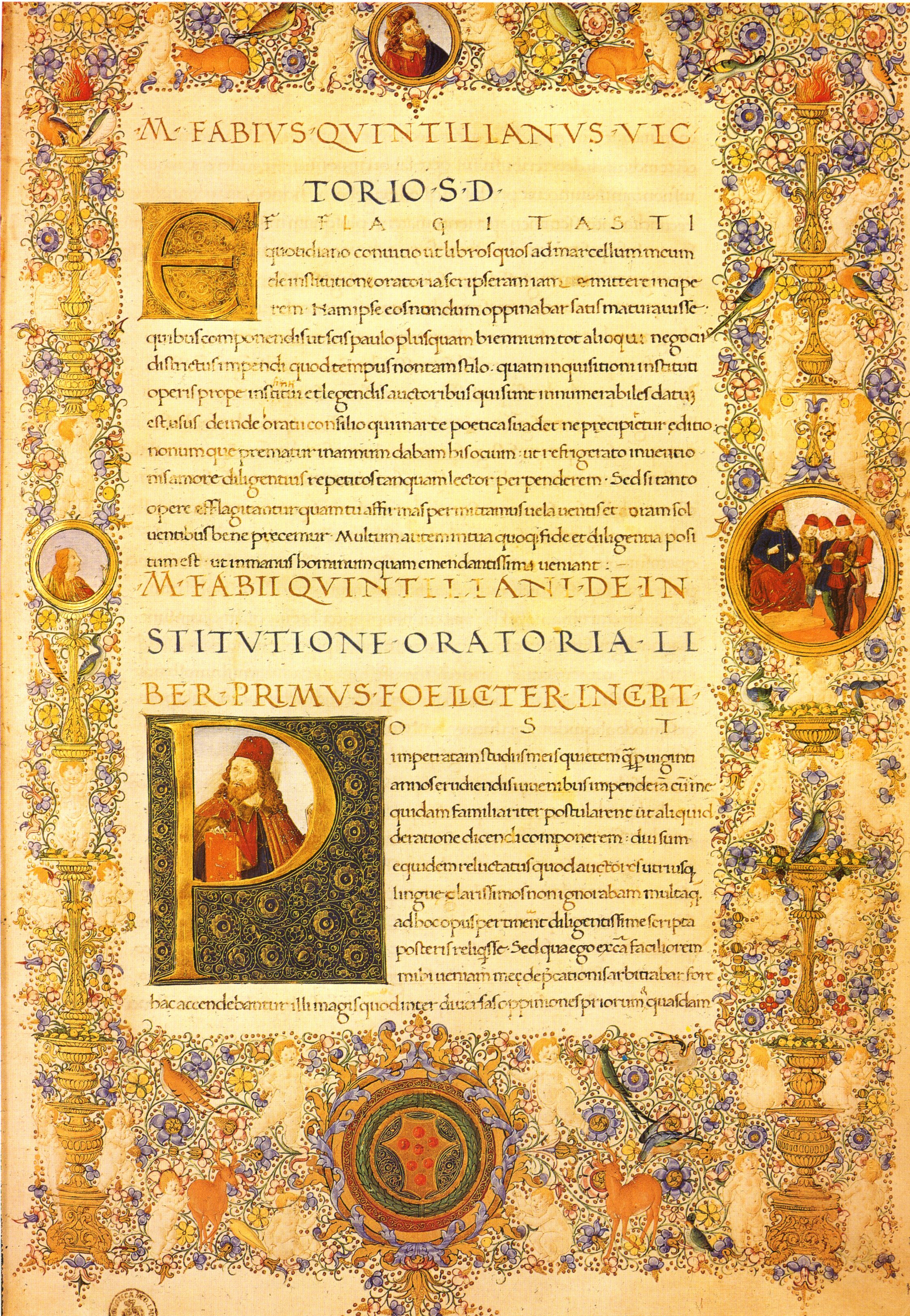
Quintilian’s Reading Recommendations

Quintilian, Institutio Oratoria 1.8.5-6

It was laid down in the best way possible that the student’s reading should begin with Homer and Vergil, although one needs a firmer capacity for judgment to understand their virtues. But there is time remaining for this, since they will not be read only once. For the time being, the mind should rise up from the sublimity of heroic song and draw its breath from the grandeur of the matter and be imbued with the noblest things.

Tragedies are useful: lyric poems will nourish the mind as well, if you carefully select not just the authors but even the parts of the work which are to be read. For the Greeks wrote a lot of things licentiously, and I wouldn’t even want to explain certain parts of Horace. Elegies, especially those about love, and hendecasyllabics, which are parts of Sotadean verse (and one should never teach about these) should be removed from the classroom if they can; if not, they should at least be reserved for a firmer time of life.

File:Quintilian, Institutio oratoria, Florence, Plut. 46.12.jpg - Wikimedia  Commons

Ideoque optime institutum est ut ab Homero atque Vergilio lectio inciperet, quamquam ad intellegendas eorum virtutes firmiore iudicio opus est: sed huic rei superest tempus, neque enim semel legentur. Interim et sublimitate heroi carminis animus adsurgat et ex magnitudine rerum spiritum ducat et optimis inbuatur. Vtiles tragoediae: alunt et lyrici, si tamen in iis non auctores modo sed etiam partes operis elegeris: nam et Graeci licenter multa et Horatium nolim in quibusdam interpretari. Elegia vero, utique qua amat, et hendecasyllabi, qui sunt commata sotadeorum (nam de sotadeis ne praecipiendum quidem est), amoveantur si fieri potest, si minus, certe ad firmius aetatis robur reserventur.