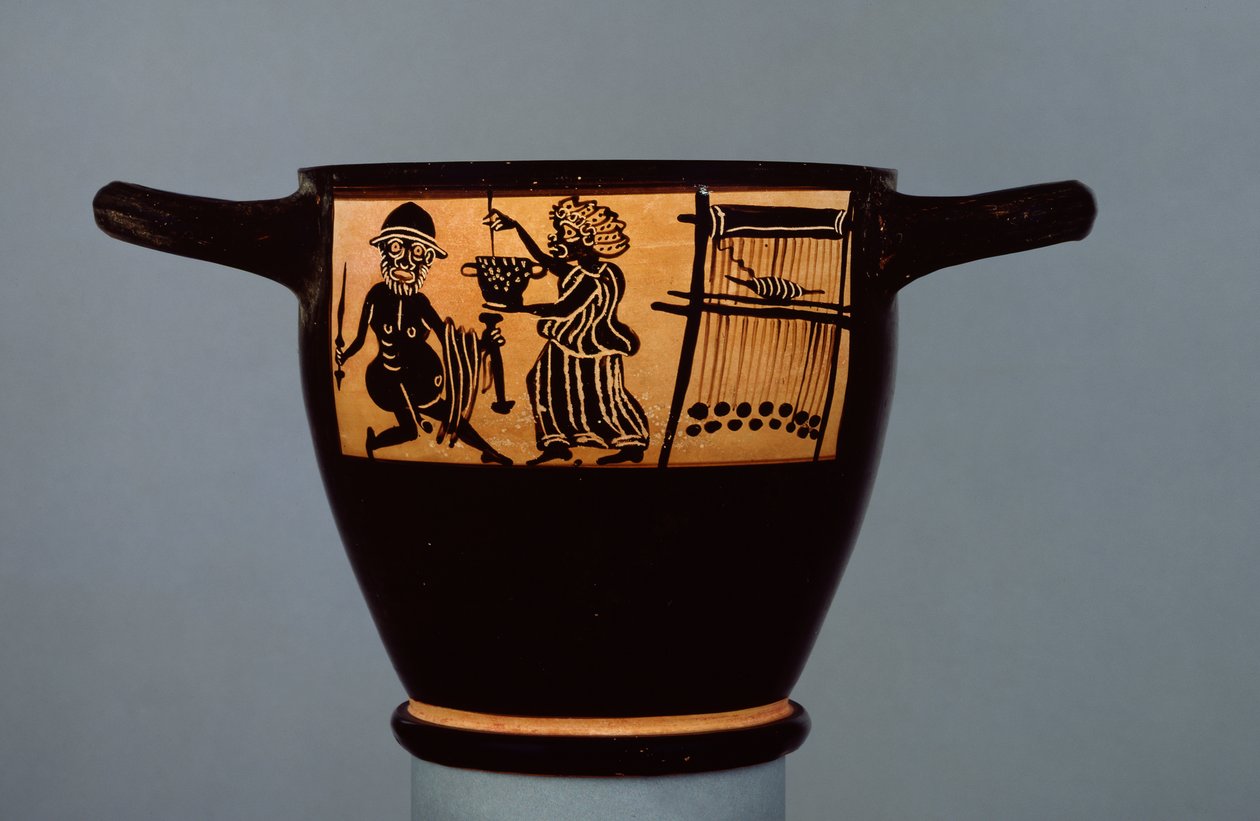
This site has been the quietest in its existence over the past few months. We have spent some time thinking about what to do with it and to what extent it is an artefact of a time that has passed. Antiquarians don’t give up the old easily.
But we do change the way we see them. I spent a good part of the past few years posting about the Iliad on Substack, exploring how to use social media more for good than stoking the fires of discontent. I enjoyed the rhythm of the posts, the opportunity to revisit old friends (those Homeric ones), and taking seriously the responsibility of discussing scholarship and sharing new work with an emphasis on enthusiasm and inclusion, rather than critique and disdain (both of which had taken over too much of my public work).
I enjoyed and and it seemed to enjoy some success as well. But then it became harder and harder to justify reconciling staying with Substack with my aims and values. My break conveniently coincided with a professional move that has arisen from and influenced in turn the way I view my work in the world.
As part of staying engaged and returning to the question of what this form is and what it can do, I am going to be resurrecting Painful Signs here, on the o.g. site. I will be tinkering with design at times, but primarily just recopying and updating posts on the Iliad starting from the beginning. I won’t promise any strict posting schedule, but I like to find a rhythm and inhabit it. So, let’s see what happens.
PS: I am giving a series of five Roundtable by the 92nd St Y talks on the Iliad called “The Homeric Iliad: Or, The Meaning of Life and Death” running once a week, starting Monday, October 27th, 12-1 PM. If you can’t catch the sessions live, recordings will be available.
With the exception of inevitable Odyssey posting thanks to the gravity of the upcoming Nolan movie, I plan on focusing almost exclusively on the Iliad. I am going to publish more than once a week (no promises) three or four basic kinds of posts: (1) essays meant for people teaching or learning about the Iliad in translation; (2) book-by-book reading questions; (3) revised essays, thoughts on epic from other sources; (4) random posts on scholia, certain passages, the the bric-a-brac that Homer geeks thrive on. (Also, no promises I will stick just to those four categories).
This is a post on why I am leaving my substack site. I am publishing it on Substack and here, for users who do not want to contribute to that site’s metrics.
Substack is a startup that relies on user content and promotion to generate (shared) revenue. Many writers have complained that the benefits are fleeting over time. Others have complained about the way the platform encourages different kinds of writing and an emphasis on metrics. I donated any funds generated to charity and have written at my own pace, promoting by half measures. I stayed as long as I did because I liked the format and regretted the idea of giving up a space because it was also promoting horrible ideas.
Open discourse and freedom of speech are wonderful ideals. But our world is far from ideal. What do we mean when we talk about free speech? Ancient Athens offers us parrhêsia, what a modern free speech advocate might call “frank and open debate”—for criticizing your friends in private and also for expressing unpopular opinions in public for the benefit of the state. In addition, “equal access to public speech” (Isêgoria) promises that each citizen be given that opportunity. Both kinds of speech should bring with them responsibility (to speak for the benefit of the people) and accountability (for what the speech does in the world). This ideal also requires that people have common starting grounds in relation to power.
Our recent spate of protests has led to the limiting phrase of “time, manner, and place” to allow University administrations to exert greater control over ideas expressed on their campuses. We should take a cue and apply this to hateful ideas as well: Nazism, white supremacy, and all of the other horrors allowed (or often espoused) by free speech absolutists belong in the past, treated as admonitory, and in controlled circumstances where people are given the option to engage with them.
As anyone who remembers the “cancel culture” panic of yesteryear can attest to, the people who cried most loudly about it, were those whose traditional power was being contested, almost entirely because other people were exercising their freedom. Now that we face an actual canceling of culture in the form of domestic concentration camps, a mafia state onslaught against higher ed, and an expansion of militarized police straight out of dystopian fantasy, those voices are coincidentally, if not suspiciously, silent.
But there is a connection between the attack on education and diversity and the platforming of hate: our power structures are aiming at undermining the thinking and reasoning skills that make it possible to be critical of the non-stop production of bad information. There’s an additional link between these efforts and the support for ‘AI’ and LLM generated pabulum: the intentional deadening of the human heart and mind.
I should have known better and earlier. In my recent book StorylifeI call near the end for a major shift in education to address how narrative shapes us
Our vulnerability to narrative is increased when we do not learn about its power, when we are not taught how to engage with it directly. We need to be taught to develop the tools to engage with story intentionally rather than passively allowing it to shape us. From primary school education on, we need to emphasize rich and complex engagement with narrative. This means focusing less on standardized testing and more on reading and discussing stories together. (And “story” here is inclusive of narrative in all its forms, visual, aural, moving, and static.) This means emphasizing media literacy alongside the history of ideas. This means teaching about cognition, psychology, and evolution much earlier in education and framing STEM fields as subject to discourse too, not just as instruments to make us better partners for computers or more effective gears in production machines
We need to be able to exercise the judgment that recognizes that some speech does demonstrable harm to our fellow people and our shared human enterprise. Leaving is an exercise of this freedom. My apologies for taking so long to make this decision. The cause is partly a naïve hope that things would change and a denial that they were as bad as they are. The posts from this site have been downloaded and will be re-released on my old website sententiaeantiquae.com book-by-book starting in September. I hope you’ll join me there.
This is a continuation of my substack on the Iliad. All proceeds from the substack are donated to classics adjacent non-profits on a monthly basis. Last year this substack provided over $2k in charitable donations.
Over a year ago I posted a bit from Plato’s Ion, discussing the proposition that there is something about laughter that is alien to the expectations of Homeric performance. In doing so, I perhaps was not specific enough in focusing just on Homer. There was an entire tradition of epic parody that was predicated on people knowing epic forms and norms. Athenaeus, in his Deipnosophists, has one of his speakers trace the founding of parody to the iambic poet Hipponax:
Polemon, in the twelfth book of his To Timaios, writes about his studies on the authors of parody “I would call Boeiotos and Euboios word-smiths since they play deftly with multiple meanings and they surpass the poets who preceded them in earlier generations. But it must be admitted that the founder of this genre was Hipponax, the iambic poet. For he writes as follows in hexameter:
“Muse, tell me the tale the sea-swallowing Stomach-slicing, son of Eurymedon, who eats without order, How he died a terrible death thanks to a vile vote in the public council along the strand of the barren sea.”
Parody is also accredited to Epicharmus of Syracuse in some of his plays, Cratinus the Old Comic poetry in his play The Sons of Eunêos, and also to Hegemon of Thasos, whom they used to call “Lentil Soup”, as he says himself.”
There were many forms of epic parody between the performance of Homeric epics and when Athenaeus composed his work: Animal epic, like that of theBatrakhomuomahkia, gastronomic parody, like that of Matro of Pitane, or the work of Hegemon the parodist. We have evidence for the performance of parody at competitions in the 4th century BCE.
A detail of a black-figure pottery vase showing the god of the North Wind Boreas blowing Odysseus across the sea. Theban, 4th century BCE. (Ashmolean Museum, Oxford, England
There’s a sense of secondariness to parody that leads most reasonable thinkers to insist that parody follows the original. How can something be mocked if it does not already exist? But this common sense believe doesn’t accord either with the way epic developed in performance or with human behavior. Thanks to fragments from Panyasis or Aristeas we know that archaic epic could be ‘unheroic’ and more fantastic. We also know from early Greek art that there was little off limits: consider the Oedipus parody vases that show absurd figures and masturbating monsters.
But could it be funny? Howard Clarke sums it up thus: “the Odyssey has more laughs than the Iliad, 23 to 11. But the Iliad has more smiles, 14 ” (1969, 246). There’s laughter in Homer, but there’s general agreement that there’s a cruel streak to it. Joseph William Hewitt puts things a bit more starkly (1928, 437):
Neither Iliad nor Odyssey contain much of what we might call healthy, happy laughter. The sinister elements predominate heavily. One of these is scorn, aroused by a prophet’s warning or by what is thought to be a beggar’s braggadocio ” or bluff. The giggling of the maidens in the palace of Odysseus was inspired by scorn of the helpless beggar.6 There is also cruel scorn of an opponent’s weakness, a laugh of exultation over a fallen foe.’ Such laughter has a basis that is perfectly intelligible and, to a considerable degree, justifiable. Laughter often comes with the relief from tension.
One might wonder what a definition of happy and healthy laughter could be in a time of war, but that’s a different question altogether. Anyone who has been a teenager (or has watched Goodfellas) knows that laughter can be sinister, harmful. Humor, like most human reactions, is rife with opportunities for misunderstanding
When Hewitt identifies the relief from tension, I think he is probably thinking of that striking passage in Iliad 2 where there Achaeans laugh at Odysseus’ abuse of Thersities, “even though their aggrieved” (οἳ δὲ καὶ ἀχνύμενοί περ ἐπ’ αὐτῷ ἡδὺ γέλασσαν, 2.170). That concessive phrase gives Homerists interpretive fits because we don’t know at what they are aggrieved. The passage gets stranger too because the generic Achaean conversation insists that while Odysseus has done numberless good things (ὢ πόποι ἦ δὴ μυρί’ ᾿Οδυσσεὺς ἐσθλὰ ἔοργε, 272) this is the best thing he has done by far (νῦν δὲ τόδε μέγ’ ἄριστον ἐν ᾿Αργείοισιν ἔρεξεν, 274).
There’s certainly an edge to Homeric laughter. The two passages that always stick out for me are near the beginning and end of the Iliad. In the first, the gods laugh at Hephaestus as he limps around the Olympian party (1.595-600). It seems a cruel response to someone with a disability, but the laughter may have multiple purposes. It is certainly a relief from tension—Hera and Zeus were arguing dangerously prior to Hephaestus’ comic play—and it may rely as much on the role Hephaestus adopts as a cup-bearer as on his physical abilities. Even a physically able blacksmith god delivering drinks during a feast could seem inapposite when that role is usually reserved for a younger, more attractive servant/lover (as in Ganymede).
Humor often functions as a type of social control, laughing-at enforces cultural norms as a replacement for or prelude to violence. But sometimes bad luck is funny too. The second example is from the end of the funeral games when Ajax son of Oileus:
“Ajax then slipped while running, for Athena sabotaged him, In that place where the manure from the loud bulls who had been killed When swift-footed Achilles sacrificed them for Patroklos. His mouth and nose filled with bull shit when he fell. Much-enduing Odysseus took the bowl because he was first And shining Ajax was awarded the bull Because he came second. And he stood with his hands On its horns and addressed the Achaeans while spitting out manure: ‘Fools, the goddess sabotaged me, that one who before Always stood like a mother on Odysseus’ side, helping him.” So he spoke, and everyone laughed sweetly at him.
There are several funny things here: first, the physical and visual humor of a man slipping in dung and getting it all over his face. Second, I can’t help but find the fact that his prize for coming in second is another bull. Perhaps a promise of eternal bullshit. Third, there are metapoetic/traditional resonances at play. Athena is antagonistic against Ajax in the stories of the homecomings because he rapes Kassandra. The Odyssey makes it very clear: Ajax dies because of sacrilege; but Odysseus, favored by Athena, makes it home. I also suspect that there’s meaning in calling Achilles swift-footed here, when he is overseeing the race and witnessing a man who professes to be slow in the Odyssey defeating a younger hero in madcap fashion.
Boeotian black-figure skyphos, decorated with a scene of Odysseus being given a drugged potion by Circe, from the workshop of the Mystae Painter, from Thebes, Boeotia, late 5th century [reproduction]
There is, then, something judgmental about the humor. We might even imagine an ethical consideration. What we laugh at tells us something about what we value and who we are. How we use humor also helps us understand harsher, meaner emotions. These scenes strike me as well as being about watching and judging things. Each scene capitalizes upon the metatheatrical effect of being external audiences witnessing internal audiences having unpredictable responses. The Olympian laughter papers over an irreconcilable difference; Thersites’ beating is a reassertion of a political order—the laughter seals his place as a scapegoat. And Ajax’s ill-luck foreshadows some of the concerns that pace the Odyssey: that tenuous relationship between who we are, what we do, and the fate that takes us.
I started thinking about this again, in part, after reading through Oliver Thomas’ “The Mocking Homer of the Exegetical Scholia to the Iliad” (2022). While some of the framing of the question—e.g. what “kind of person” made the Iliad—differs from how I would put it, there’s real value in looking at how earlier interpreters understood the tone of the Homeric narrator. Thomas traces specific words in the scholia, starting with a case study of διασύρει. The first discussion, of whether Homer or Hektor are really mocking Paris (according to Plutarch and Eustathius) is a good introduction to the problem of narrative frames. The scholia seem much clearer on the ethical import of mocking Thersites, however. Surprising in the article is the degree to which some ancient scholars saw the depiction of Hektor as one of biting mockery.
Most valuable in the piece, for thinking about how ancient scholarship may have reshaped the Homeric poems, is the penultimate section where Thomas discusses the evidence for ancient critics like Aristonicus and Zoilos objecting to lines on the grounds that there were too silly or comedic, following earlier scholars like Aristotle who try to separate between the comic and the tragic. Thomas ends by rightly noting the tension between what these critics assert and what a majority of other comments show. Homeric poetry may not be farce, but it is engaged with a wide array of human experiences and emotions. Tears, violence, and range without laughter lack that ring of truth that makes art so moving.
Three men robbing a miser in his house, in a scene from a phlyax play painted by Asteas; c. 350–340 BC
Short Bibliography
n.b. this is not exhaustive. please let me know if there are other articles to include.
Benson, R. D. (2021). Homeric Epithets that Seem to Be Humorously Ironic. Arion: A Journal of Humanities and the Classics, 29(1), 35–62. https://doi.org/10.2307/arion.29.1.0035
Brown, Christopher G.. “Ares, Aphrodite, and the laughter of the gods.” Phoenix, vol. XLIII, 1989, pp. 283-293.
Caleb M. X. Dance, ‘Laughing with the gods : the tale of Ares and Aphrodite in Homer, Ovid, and Lucian’, Classical World, 113.4 (2019-2020) 405-434. Doi: 10.1353/clw.2020.0037
Clarke, Howard W.. “The humor of Homer.” The Classical Journal, vol. LXIV, 1969, pp. 246-252.
Colakis, Marianthe. “The Laughter of the Suitors in ‘Odyssey.’” The Classical World 79, no. 3 (1986): 137–41. https://doi.org/10.2307/4349839.
Guidorizzi, Giulio. “The laughter of the suitors: a case of collective madness in the Odyssey / transl. by Lowell Edmunds.” Poet, public, and performance in ancient Greece. Eds. Edmunds, Lowell, Wallace, Robert W. and Bettini, Maurizio. Baltimore (Md.): Johns Hopkins University Pr., 1997. 1-7.
Halliwell, F. Stephen (2008). Greek laughter: a study in cultural psychology from Homer to early Christianity. Cambridge ; New York: Cambridge University Pr.
Halliwell, Stephen. “Imagining divine laughter in Homer and Lucian.” Greek laughter and tears : antiquity and after. Eds. Alexiou, Margaret and Cairns, Douglas. Edinburgh Leventis Studies; 8. Edinburgh: Edinburgh University Pr., 2017. 36-53.
Hoffer, Stanley E.. “Telemachus’ « laugh » (Odyssey 21.105): deceit, authority, and communication in the bow contest.” American Journal of Philology, vol. 116, no. 4, 1995, pp. 515-531.
Hunt, W. Irving. “Homeric Wit and Humor.” Transactions of the American Philological Association (1869-1896) 21 (1890): 48–58. https://doi.org/10.2307/2935808.
Konstan, David. “Laughing at ourselves: gendered humor in ancient Greece.” Laughter, humor, and the (un)making of gender: historical and cultural perspectives. Eds. Foka, Anna and Liliequist, Jonas. New York: Palgrave Macmillan, 2015. 13-29.
Donald E. Lavigne, ‘Bad Kharma: a « fragment » of the « Iliad » and iambic laughter’, Aevum Antiquum, N. S., 8. (2008) 115-138. Doi: 10.1400/210042
Levine, Daniel B.. Γέλῳ ἔκθανον. Laughter and the demise of the suitors. Univ. of Cincinnati, 1980.
Levine, Daniel B. “Homeric Laughter and the Unsmiling Suitors.” The Classical Journal 78, no. 2 (1982): 97–104. http://www.jstor.org/stable/3297058.
Levine, Daniel B. “Penelope’s Laugh: Odyssey 18.163.” The American Journal of Philology 104, no. 2 (1983): 172–78. https://doi.org/10.2307/294290.
Minchin, Elizabeth. “From gentle teasing to heavy sarcasm: instances of rhetorical irony in Homer’s « Iliad ».” Hermes, vol. 138, no. 4, 2010, pp. 387-402.
Miralles, Carles. “Laughter in the Odyssey.” Laughter down the centuries. 1. Eds. Jäkel, Siegfried and Timonen, Asko. Annales Universitatis Turkuensis. Ser. B, Humaniora; 208 – Annales Universitatis Turkuensis. Ser. B, Humaniora; 208. Turku: Turun Yliopisto, 1994; 1994. 15-22.
Siegfried Jäkel, ‘The phenomenon of laughter in the Iliad’, in Laughter down the centuries. 1, ed. by Siegfried Jäkel and Asko Timonen, Annales Universitatis Turkuensis. Ser. B, Humaniora, 208 – Annales Universitatis Turkuensis. Ser. B, Humaniora, 208 (Turku: Turun Yliopisto, 1994; 1994), pp. 23-27.
This is a continuation of my substack on the Iliad. All proceeds from the substack are donated to classics adjacent non-profits on a monthly basis. Last year this substack provided over $2k in charitable donations.
This post is part three of three looking more closely at the proposition that our Iliad is made up of a series of songs or ‘episodes’ put together in a monumental performance. The first part looks at some of the internal evidence for performance and provides some historical context. The second part explores how much support there is for this model in the classical period. The third part offers some remarks on how this approach may or may not be different from neoanalysis and begins to sketch out how our Iliad may be broken up into songs or episodes.
In earlier posts, I have surveyed some internal evidence for episodic composition of the Homeric epics and later literary and iconographic support as well. The basic idea is that the epics themselves show smaller songs with recognizable titles or themes at home in the larger arc of the Trojan War potentially combined into narratives of longer duration (as in Odysseus’ tale of his own experiences to the Phaeacians in the Odyssey). Later authors like Aristotle and Aelian start (or continue?) a tradition of talking about the epics as composed of smaller episodes to support this.
I find the model attractive because it can help us understand how multiple performers of Homer could come together for a major event (like the Panathenaia in Athens) and sing longer epics that are like the poems we have from antiquity. Of course, this model does not explain how such performances would lead to our text. In addition, I want to be very clear that I don’t think this process was necessarily one of a majority of fixed songs. Nor do I think it would have occurred once or yielded the epics we have so easily.
The Ransom of Hector, hydria, by the Pioneer Group, Attic Greek, 510-500 BC, red-figure terracotta – Sackler Museum – Harvard University
Analysis vs. Neoanalysis
I preface this post with those initial caveats because the episodic thought experiment has led to some navel gazing. A question that I struggle to resolve for myself is how the approach I am taking may be differentiated from earlier scholarly frameworks like analysis or neoanalysis. At some level, many of the ideas will seem similar, but there are some contrasting foundational assumptions. Let me try to walk through what I think the differences are and see if they make sense.
Analysis was an approach to Homer that dominated near the end of the 19th century and for the first quarter of the 20th. The Analysts were primarily opposed to Unitarians. The latter group argued for the artistic unity of the Homeric epics against the growing consensus of scholarship in general that the Iliad and the Odyssey as we have them were not the products of a single author (or authors for each poem). Due to stylistic inconsistency, textual variations, and other aesthetic judgments based on the features of more modern literary authors, scholars had established that the epics we have couldn’t possibly be the product of individual minds.
As a response to this, Analysts sought to show how editorial intervention had changed the poems or how various songs had been edited together to create the epics that survived antiquity. Often Analysts were in search of the most “original” or ancient core of either epic and as a result endeavored in part to identify where parts of the epics we have came from. The poems of the so-called epic cycle were often seen as likely sources for sections that were otherwise added or adapted to the core stories of “The Rage of Achilles” and “The Homecoming of Odysseus”. Unitarians labored to show the “artistic unity” of the poems we have against this onslaught. The sheer volume of discrepancies and the lack of ‘scientific rigor’ in the Unitarian approaches rendered their arguments mostly romantic and easily undermined in the face of the ‘evidence’ provided by the Analysts.
The advent of oral-formulaic theory through the work of Milman Parry and Albert Lord and many others shifted the debate radically. In a simplistic summary, oral-formulaic theory countermanded questions about consistency, style, and the difficulty of composition offered by the Analysts in an evidence-based way that appealed to the scientific bent of scholarship coming out of the 19th century. A great deal of Homeric scholarship from the 1930s into the 1970s was engaged either with fleshing out the details of oral-formulaic theory or with coming to terms of how it shifted our notions of authorship, textualization, and transmission.
Neoanalysis eventually emerged as scholars returned to questions of the relationship between our epics and other narrative traditions. Neoanalysis does not generally claim that the epics we have were made up by editing together other narratives, but instead explores how the parts of the Iliad and Odyssey that we have may have drawn on other poems (or poetic traditions) such as the Aithiopis or the Kypria. This approach has been pretty fruitful in showing how our epics draw on motifs, plots, and scenes that we believe were in other lost poems. But often, neoanalytic claims betray older analytic motivations. Erwin Cook summarizes some of these tensions well in his work on Iliad 8:
“Analytic scholars such as Wilamowitz used the episode to support their argument that Book 8 was “late” because it echoes accounts based on the Aithiopis in which Nestor again suffers a chariot wreck, and his son, Antilokhos, rescues him at the cost of his own life.9 An assumption underlying this argument is that one account is “imitating” the other. The derivative account is inherently “inferior” to its model, and betrays its dependency in part by its aesthetic shortcomings, including its imperfect integration into the narrative. For example, the Neoanalyst Wolfgang Kullmann accepts Analytic claims about the relative priority of the two episodes, though he avoids the Analytic conclusion that the Iliadic passage is interpolated by arguing that the Aithiopis is earlier than the Iliad.”
My reservations about Neoanalysis have generally been (1) that the approach too often assumes that the Iliad or Odyssey are drawing on poems that were prior to them (therefore in some way more original and authentic) and (2) that a great deal of the evidence we have for the contents or even existence of these poems comes from scholarship that developed to explicate the Iliad and the Odyssey. There’s an essential circularity to claiming that the Homeric epics are based on material that only ended up being preserved in reference to the Iliad or the Odyssey. If we imagine epic performance as lasting hundreds of years in many different contexts, it seems tenuous to me to make significant compositional claims based on secondary evidence when many thousands of other performances may have helped shape their character. In addition to this concern for circularity, I think the hierarchical models favored by such approaches tend to create stemmata and trees that look like manuscript traditions and not the flowing and circulating of motifs, ideas, and structures that could make it very likely for a song we imagine as late to have actually influenced something we conceive as earlier while they were both in the process of developing into their final forms. (And to add more apprehension to this: the very notion of a final form is ill-fit to composition in performance.)
Overall, it should be clear that I am not fundamentally opposed to the notion that the epics we have integrate material that existed prior to their final performances and textualization. My basic contention is that we cannot really know anything other than the poems we have and it is more fruitful to imagine that even if we have anIliad that was influenced by anAethiopis, each of the story traditions that these poems represent went through innumerable iterations that influenced each other. As a result, pointing to a scene in our Iliad and claiming it was based on a specific scene in a specific poem thoroughly misconstrues the nature of oral-derived poetry. (Many Neoanalysts are certainly proponents for the orality of the Homeric epics, of course.)
Given these distinctions, then, how is imagining our epic poem coming together through the performance of discrete episodes related to Neoanalysis? Some of the assumptions are certainly the same, namely that there were more or less fixed story traditions within the Trojan War narrative myth and that these traditions were recognizable to audiences.
I believe that this approach is different in two basic ways. First, I am exploring how the Iliad is made up of smaller parts to explain its compositional unity and not assuming the priority of any given part over another. Second, I am not proposing that the individual episodes are fixed and portable objects, but rather different song traditions with recognizable features that could be performed independently of the whole if needed. Unlike the Analysts, I am not proposing that there is a core and original Iliad that this process will be able to identify. Unlike some Neoanalysts, I am not trying to reconstruct how the Iliad was based on or made up of earlier poems. Instead, I am trying to imagine what it might look like over time to have a more or less regular list of episodes that could be performed as part of a larger performance. Karol Zieliński (2023, 664) presents a somewhat stronger articulation:
“If, as we have already demonstrated, the songs of the cycle showed a given episode in the context of the whole Trojan War, then it follows that they must have retained a certain degree of independence. The presentation of these episodes in sequence must have taken place on special occasions, e.g. during great festivals like the Panathenaia. But the independence of a song depicting a given episode from the perspective of the whole war could have been possible only because the thematic range of the cycle had already been established and familiar, so it seems that the principle of sequential presentation is deeply rooted in Greek tradition.”
(I must also confess to worrying that the distinction I am attempting to draw is too fine to be a difference that makes a difference. There are many different shades of Neoanalysis. This approach certainly contrasts with that of Martin West in The Making of the Iliad where he sees the integration of different narrative traditions as a very writerly pursuit. But there would be far less tension with the work of scholars like Christos Tsagalis whose approach is more flexible and in tune with oral traditional theory).
Here again, I think the Apologoi—books 9-12 of the Odyssey—can provide an instructive example. Imagine Odysseus’ audience in Skheria: they have no notion of Odysseus’ tale as a series of discrete episodes that may have had an independent existence in different story traditions. Instead, they experience a coherent narrative with many turns, all functioning in the service of explaining how Odysseus ended up on their island. The parts have different length and importance: the Cyclops episode and the Nekyia are longer and much more detailed than the tale of Aeolus or the Lotus-eaters. Circe’s island presents a beginning, middle, and end that is much more well-developed than the brief tales of the Laistrygonians or the Kikones. But they are connected through the narrative conceit of sea-faring in a way that renders them separate even as part of a whole. At the same time, they are thematically connected to the epic as a whole: the scenes end with the deaths of Odysseus’ men after they eat the cattle of the sun (anticipated by the proem in Odyssey 1) and Odysseus swept up on Calypso’s island, where the external audience finds him in Odyssey 5.
Now imagine the 10 scenes of the Apologoi as a set list in a live performance. It would take very little effort for a seasoned group of performers to musically “sample” or anticipate parts of the 9th and 10th songs at the beginning of the set. The songs could be blended together smoothly or abruptly as the performance required, giving the sense of functioning as a single composition even when the individual songs may have come from different places. In the context of one performance, moreover, the musicians might adapt the songs to fit one another in a way they might not if they were performed in a different order or individually.
We performed some of the Iliad during the first year of the COVID-19 Pandemic online
The Iliadic Set List
I have spent a good deal of time talking about the idea. Now it is time to make it a little more concrete and see what comes of it. I have reached out to a few friends to help explore methods for testing this, both quantitative (using statistical language modeling) and qualitative (thinking about thematic and artistic aspects). I am also trying to figure out how to use analogical methods too: to really think about how modern professional musicians “stitch” their performances together.
For now, here’s a list of the books of the Iliad and the episodes we have some reason to believe would have been identifiable in antiquity, based on evidence in ancient literature, art, and scholarship.
Book || “episode/Song”
1 Overarching: Rage of Achilles + Ransoming of Briseis + Strife of Agamemnon and Achilles
2 False Dream +Thersites +Catalog of Ships
3 Teichoskopia + Duel of Menelaos and Paris + Helen and Paris in the Bedroom
4 Oath Breaking (Pandaros) +Epipolesis
5 +Diomedea / Aristeia of Diomedes +Wounding of Aphrodite + Theomachy
6 Hektor’s Visit to the city + [Glaukos and Diomedes as an independent episode]
7 Duel between Hektor and Ajax
8 Echoes of the Aethiopis
9 Embassy to Achilles
10 Doloneia
11 Aristeia of Agamemnon + Wounding of Diomedes
12 Teikhomakhia
13 Fighting by the Ships/Battle of the ships
14 Dios Apate
15Echoes of Succession Myths
16 Patrokleia
17 Fight over the body: Menelaos v. Hektor over Euphorbus
18 Arms of Achilles / Shield of Achilles
19Reconciliation (?); Achilles talks to his horses
20 Aeneas vs. Achilles
21 Theomachy
22 Achilles Kills Hektor + Achilles mutilates the body
23 Achilles kills captives + Contest for Patroklos
24 Ransoming of Hektor + Laments of Hecuba and Andromache
I have italicized a few episodes I want to identify but can’t find good support for.
For me, what is surprising in this list is not so much that there is some support for an episode in nearly every book, but that there is so little support for books 8 and 15, which have been identified by scholars like Bruce Heiden as really important to the structure and themes of our particular Iliad. In addition, even a cursory review of the material shows much that is not accounted for. The greater portion of the episodes identified in antiquity accord with the epic’s first third (where it seems to engage the most with the traditions that precede the war). There’s a compositional echoing of the Odyssey here as well: both epics seem to be more fluid and strange in their second halves than their first. Scenes like Agamemnon’s intervention in the sparing of Adrastus in book 6 may be special to this version of the Iliad and therefore more significant for its interpretation. Political scenes like those in books 1, 2, 9, 19, and the beginning of 24 that people like Elton Barker have shown are crucial for understanding the Iliad’s politics also seem underrepresented in the episodic tradition.
None of this vitiates the thought experiment–instead, I think it provides a really unique chance to reconsider again that dynamic relationship between the Iliad we have and the performance traditions that produced it. Thinking about the relationship between the synchronic moment of that performance and how singers came together to respond to their audiences and their times is one of the things that not only keeps the Iliad alive for me, but keeps its study vital.
Next steps include mapping out the line numbers for the episodes and interstitial parts, doing more research to see if other song traditions have been overlooked, and then taking turns with others working on this process, and pushing through the various frameworks for thinking about this reimagined performance. If you’re reading this and have thoughts, please share them. Like the epics in their composition, their interpretation is something that happens best with many people taking turns.
Bibliography: As Always, not exhaustive. Also, shared bibliography for all three posts.
Beck, Bill. “Lost in the middle : story time and discourse time in the « Iliad ».” Yearbook of Ancient Greek Epic, vol. 1, 2017, pp. 46-64. Doi: 10.1163/24688487-00101003
Rinon, Yoav. “« Mise en abyme » and tragic signification in the « Odyssey »: the three songs of Demodocus.” Mnemosyne, Ser. 4, vol. 59, no. 2, 2006, pp. 208-225. Doi: 10.1163/156852506777069673
Beck, Deborah. “The presentation of song in Homer’s « Odyssey ».” Orality, literacy and performance in the ancient world, edited by Elizabeth Minchin, Mnemosyne. Supplements; 335. Leiden ; Boston (Mass.): Brill, 2012, pp. 25-53.
Dué, Casey, Susan Lupack, and Robert Lamberton. “Panathenaia.” Chapter. In The Cambridge Guide to Homer, edited by Corinne Ondine Pache, 187–89. Cambridge: Cambridge University Press, 2020.
Edmunds, Lowell. “Three short essays on Demodocus’s song of Ares and Aphrodite (Odyssey 8.266-369).” Yearbook of Ancient Greek Epic, vol. 4, 2020, pp. 55-71. Doi: 10.1163/24688487-00401003
Edwards, Mark W.. “Neoanalysis and beyond.” Classical Antiquity, vol. IX, 1990, pp. 311-325. Doi: 10.2307/25010933
Haft, Adele J.. “Odysseus’ wrath and grief in the Iliad. Agamemnon, the Ithacan king, and the sack of Troy in Books 2, 4, and 14.” The Classical Journal, vol. LXXXV, 1989-1990, pp. 97-114.
Finkelberg, Margalit. “The first song of Demodocus.” Mnemosyne, vol. XL, 1987, pp. 128-132. Doi: 10.1163/156852587X00111
Finkelberg, Margalit. “The sources of Iliad 7.” Colby Quarterly, vol. 38, no. 2, 2002, pp. 151-161.
Gaisser, Julia Haig. “Adaptation of traditional material in the Glaucus-Diomedes episode.” TAPA, vol. C, 1969, pp. 165-176.
Heiden, Bruce. “The placement of « book divisions » in the Iliad.” The Journal of Hellenic Studies, vol. 118, 1998, pp. 68-81. Doi: 10.2307/632231
Herrero de Jáuregui, Miguel. “Priam’s catabasis: traces of the epic journey to Hades in Iliad 24.” TAPA, vol. 141, no. 1, 2011, pp. 37-68. Doi: 10.1353/apa.2011.0005
Howes, George Edwin. “Homeric Quotations in Plato and Aristotle.” Harvard Studies in Classical Philology 6 (1895): 153–237. https://doi.org/10.2307/310358.
Hunter, Richard L.. “The songs of Demodocus: compression and extension in Greek narrative poetry.” Brill’s companion to Greek and Latin epyllion and its reception, edited by Manuel Baumbach and Silvio Bär, Brill’s Companions in Classical Studies. Leiden ; Boston (Mass.): Brill, 2012, pp. 83-109.
Kakridis, Johannes Theophanes. “Auch Homer ist in die Lehre gegangen.” Gymnasium, vol. XCIX, 1992, pp. 97-100.
Karanika, Andromache. “Wedding and performance in Homer: a view in the « Teichoskopia ».” Trends in Classics, vol. 5, no. 2, 2013, pp. 208-233.
Kelly, Adrian. “Performance and rivalry: Homer, Odysseus, and Hesiod.” Performance, iconography, reception: studies in honour of Oliver Taplin, edited by Martin Revermann and Peter J. Wilson, Oxford ; New York: Oxford University Pr., 2008, pp. 177-203.
Marks, Jim. “Resisting Aristotle : episodes in the Epic cycle.” Tecendo narrativas : unidade e episódio na literatura grega antiga, edited by Christian Werner, Antonio Dourado-Lopes and Erika Werner, São Paulo: Humanitas, FFLCH/USP, 2015, pp. 55-71.
Most, Glenn W. “The Structure and Function of Odysseus’ Apologoi.” Transactions of the American Philological Association (1974-) 119 (1989): 15–30. https://doi.org/10.2307/284257.
Murray, P.. “Homer and the bard.” Aspects of the epic, edited by Tom Winnifrith, P. Murray and Karl Watts Gransden, New York: St. Martin’s Pr., 1983, pp. 1-15.
Nagy, Gregory and Olga M. Davidson. “On the problem of envisioning Homeric composition: some comparative observations.” Philologia Antiqua, vol. 16, 2023, pp. 15-25. Doi: 10.19272/202304601002
Nelson, Thomas J.. “Iphigenia in the « Iliad » and the architecture of Homeric allusion.” TAPA, vol. 152, no. 1, 2022, pp. 55-101. Doi: 10.1353/apa.2022.0007
Nishimura, Yoshiko T.. “The Circe-episodes in the « Odyssey ».” Journal of Classical Studies, vol. 45, 1997, pp. 40-49.
Postlethwaite, Norman. “The duel of Paris and Menelaos and the Teichoskopia in Iliad 3.” Antichthon, vol. XIX, 1985, pp. 1-6.
Rengakos, Antonios (2002). Zur narrativen Funktion der Telemachie. In André Hurst & Françoise Létoublon (Eds.), La mythologie et l’« Odyssée »: hommage à Gabriel Germain : actes du colloque international de Grenoble, 20-22 mai 1999 (pp. 87-98). Droz.
Rinon, Yoav. “« Mise en abyme » and tragic signification in the « Odyssey »: the three songs of Demodocus.” Mnemosyne, Ser. 4, vol. 59, no. 2, 2006, pp. 208-225. Doi: 10.1163/156852506777069673
Roisman, Hanna M.. “« Rhesus »’ allusions to the Homeric Hector.” Hermes, vol. 143, no. 1, 2015, pp. 1-23.
Segal, Charles (1994). Singers, heroes, and gods in the Odyssey. Cornell University Pr.
Sels, Nadia. “The untold death of Laertes: reevaluating Odysseus’s meeting with his father.” Mnemosyne, Ser. 4, vol. 66, no. 2, 2013, pp. 181-205. Doi: 10.1163/156852511X584991
Thomas, Oliver. “Phemius Suite.” The Journal of Hellenic Studies, vol. 134, 2014, pp. 89-102. Doi: 10.1017/S007542691400007X
Tsagalis, Christos. “Towards an Oral, Intertextual Neoanalysis” Trends in Classics, vol. 3, no. 2, 2011, pp. 209-244. https://doi.org/10.1515/tcs.2011.011
Wyatt, William F.. “Homeric transitions.” Ἀρχαιογνωσία, vol. 6, 1989-1990, pp. 11-24.
YAMAGATA, NAOKO. “USE OF HOMERIC REFERENCES IN PLATO AND XENOPHON.” The Classical Quarterly 62, no. 1 (2012): 130–44. http://www.jstor.org/stable/41820000.
A Short Course from the Roundtable at the 92nd Street Y
This is a continuation of my substack on the Iliad. All proceeds from the substack are donated to classics adjacent non-profits on a monthly basis. Last year this substack provided over $2k in charitable donations.
Earlier this year, I published Storylife: On Epic, Narrative, and Living Thingswith Yale University press. Storylife applies biological analogies to Homeric poetry and early myth to explore how narrative develops independent of individual human intention and to propose that stories have an agency of their own. It uses the architecture of Homeric language in particular—which is repetitive and often characterized as formulaic—as a case study for how complex structures and thought can develop from smaller structures in a fashion similar to multicellular life.
Storylife asks readers to rethink human creativity, the importance of collective actions (and reactions) and the lives we build together with and against narrative. It asks audiences to reconsider how much we control over stories and, in closing, how we should educate ourselves once we acknowledge the power that narrative exerts over us.
Roundtable at the 92nd Street Y has asked me to run some sessions based on this work. Each session will touch upon questions and answers offered in the book, but will expand with additional concepts from literature and science.
Modern literary and linguistic theories have provided different models for thinking about how language works and where stories come from. This introductory session focuses on the nature of Homeric poetry and the history of talking about its performance, authorship, and reception over time (the so-called “Homeric Question”). This session will also provide an overview of modern approaches from computational linguistics (Large Language Models), cognitive science, and evidence from Homeric language for the development and function of stories.
This session focuses on using models from biology and the natural sciences to help us understand the structure of Homeric language and poetry and the relationship between audiences and community reception in the creation and perpetuation of stories. In addition to analogies from cellular structure and the comparison of the epigenetic potential of DNA (when qualities are “activated” by environmental features) to illustrate how syntax and meaning work in traditional languages like Homeric epic, this session will use the distinction between convergent and parallel evolution and blending theory from cognitive science to help us rethink engagement between ancient epic and their audiences.
This session asks how we reconsider our relationship with narratives if we use models from symbiosis (the biological state of different organisms living together) to understand their impact on the communities that tell them. We will look at two examples from Greek epic and myth–the rhetoric of heroic glory and the so-called “Last Hero”, the boxer Kleomedes–to explore the impact of stories on their audiences as examples of both parasitism (when one organism’s ‘success’ depends on harm to others) and mutualism (when multiple organisms benefit from a symbiotic biological relationship). The session will end with a discussion on how we should teach and learn about narratives with these lessons in mind.
Part 2: Evidence for ‘Episodes’ from Literature and Art
This is a continuation of my substack on the Iliad. All proceeds from the substack are donated to classics adjacent non-profits on a monthly basis. Last year this substack provided over $2k in charitable donations.
This post is part one of three looking more closely at the proposition that our Iliad is made up of a series of songs or ‘episodes’ put together in a monumental performance. The first part looks at some of the internal evidence for performance and provides some historical context. The second part explores how much support there is for this model in the classical period. The third part offers some remarks on how this approach may or may not be different from neoanalysis and begins to sketch out how our Iliad may be broken up into songs or episodes.
In the last post, I explored the composition of the Homeric epics through a combination of episodes, focusing especially on the evidence from the Odyssey and on the tradition of the “Panathenaic rule”, the conventional performance of Homer in Athens by multiple rhapsodes. The internal and external evidence suggests that the full epics are made up of smaller parts integrated by multiple performers. In addition, it suggests that the epics evolved during performance over time. This means that we don’t imagine ancient performers creating from scratch each time, but working in concert and competition to integrate–or ‘stitch together’, to observe one of the etymologies of rhapsode–traditional themes and songs into a much larger performance.
As I discussed when talking about Odysseus’ story in books 9-12 of the Odyssey, it seems likely that longer compositions were in part developed from shorter, recognizable episodes. Logically, this makes sense, and late evidence from the Roman imperial period has provided some support for this, both in terms of the general idea itself and with some indication of what sections may have been considered self-standing songs. The 2nd Century CE Roman Aelian (Claudius Aelianus) reports that the epics were sung in “separate parts”:
Varia Historia, 13.14
“The tradition is that the ancients used to sing Homeric epics in separate parts. For example, they sang the “Battle By the Ships”, the “Doloneia”, the “Aristeia of Agamemnon”, the “Catalogue of Ships,” the “Patrokleia” and the “Ransoming” or the “Contest for Patroklos” and the “Breaking of the Oaths”. These were from the Iliad. From the other poem they sang “Events at Pylos” and “Events at Sparta” “Calpyso’s Cave,” “The Raft Story”, “The Tales of Alkinoos” and “The Kyklopeia” and the “Nekyuia” or “Events with Kirke”, “the Washing”, “The Murder of the Suitors,” “The Events in the Country”, “Laertes’ Tale”.
Rather late, Lyrkourgos the Spartan was the first to bring the poetry of Homer together into Greece; He brought them back with him from Ionia when he was living abroad. Later, Peisistratos collected them and had the Iliad and the Odyssey performed.”
Here, Aelian combines several details that have been irresistible to Homerists interested in the epics’ textualization and performance: a connection between their final form and quasi-legendary foundation narratives along with details about the relationship between parts and the whole. Near the end of the anecdote, we find famous and semi-legendary leaders of Sparta and Athens as authorities who introduced the full epics into their communities, aligning in part with a historical movement that modern scholars have called Panhellenism. But before that, we find the attractive idea that really old performers (palaioi) sang (aiedon) the epics of Homer split into parts. And the parts align with some of the discrete sections of each epic that we have recognized as somewhat self-standing, such as the catalog of ships or the Doloneia.
I am one of those who really like this passage and find it valuable to think with. Nevertheless, I am concerned about how much of it we can rely on. My anxieties come in two forms: first, the relative antiquity of Aelian; second, the lack of corresponding evidence for episodes of these names or consistent nomenclature for episodes prior to Aelian.
Let me start with the first: Aelian is from the so-called second sophistic. I don’t know if we can say that anything he knows or reports about Homer does not come from Hellenistic editing practices. That is to say that he is almost six centuries removed from the Panathenaic rule at Athens and was educated in a system dominated by the editorial and rhetorical practices that canonized and transmitted the epics more or less as we have them.
In addition to limits on what Aelian could have known or how his knowledge was shaped by the rhetorical and editorial tradition preceding him, the contents of this passage are correspondingly curious: there is a lot of each epic not reported within his anecdote. Now, the omissions may simply be a case of Aelian leaving out the most well known plot points such as the embassy to Achilles in the Iliad or the Telemachea in the Odyssey. But the language he uses for the “separated epics” also gives me pause because it assumes each epic as a pre-existing whole. I am not sure that if there were traditional terminology for individual songs it would sound like this.
This leads me to the second concern I have for this passage: the lack of corresponding support from earlier evidence prior to the Hellenistic period. One of the most famous passages for thinking about the composition of the epics comes from Aristotle. In it he writes about the epics being composed of “episodes”:
Poetics 1459a
“For this reason, Homer should seem rather inspired compared to others: for, although the war has a beginning and an end, he did not try to compose the whole story. For the story would have been too overwhelming and incomprehensible or, if kept to a reasonable length, confusing because of its complexity. Instead, although he has taken up one plot [meros], he has employed many other episodes [epeisodiois] such as the catalog of ships and other episodes through which he has varied his composition.”
It is really tempting to read this passage and infer that Aristotle’s episodes may be in some way coterminous with Arrian’s “separated parts”. But when I read epeisodos elsewhere, I think it functions as much as a “scene” as it does a specific and self contained narrative equivalent to the songs of Phemius and Demodocus in the Odyssey. There’s also something else I find both intriguing and compelling here: epeisodios seems to be etymologically tied to the parts of tragedy between the choral odes. The term seems to be related to the entrance and exit of different actors or characters on the stage. Applied to epic performance, it is tempting to imagine epeisodion as delimiting the space for a single singer or song within a larger composition.
I can’t be the only one to miss episode cards like this from Buffy the Vampire Slayer
In the Poetics, Aristotle’s primary focus is on the genre of tragedy. His episodes, if read carefully, blur the lines between major scenes in Attic tragedy and parts of the Trojan War narrative integrated into Iliad or the Odyssey. At times I am certain he means that the overall plot of the “rage of Achilles” is expanded or embellished through other episodes from the whole war. Aristotle does us a favor here by distinguishing between an episode of the war and the story of the whole. But if one reads through the Poetics carefully, the issue is much more uncertain. There is some indication in Plato that audiences thought in terms of particular scenes. For example, consider the longish question in the Ion where Socrates is trying to prove to the rhapsode that he is divinely inspired when he recites Homer:
Plato, Ion 535 c
Tell me this Ion and don’t hide anything from me whatever I ask you. Whenever you are performing epic and you especially astound the audience—either when you sing about Odysseus leaping upon the threshold and then appearing to the suitors as he pours arrows out on them all of a sudden or the part about Achilles chasing after Hektor or one of the sad things about Andromache or Hekuba or Priam—are you at that point in your own mind or are you outside yourself and does your spirit think you are among the events themselves, inspired by the very words you are speaking, either in the Ithaka or Troy or wherever the songs take you?
Here, Plato has his Socrates point to scenes of particular vividness or tension–action scenes where Odysseus is about to murder the suitors and Achilles is chasing Hektor. These suspenseful scenes that create the emotion implied by the verb ἐκπλήξῃς. In addition, Ion may or may not be referring to specific events when he mentions “something of the pitiful things about Andromache, Hecuba, and Priam”. I am tempted to imagine these as correlating to their laments for Hektor, but the language itself (specifically the ἐλεινῶν τι + περὶ) makes me think Ion means what happens to them.
While both scenes certainly are from episodes (the ‘murder of the suitors’ or the pursuit of Hektor) they may not correspond to specific episodes themselves. This does not mean that Plato did not conceive of episodes: later in the same dialogue he refers to the “battle around the wall” as a part of the Iliad: “Or often in the Iliad too, for example in the teikhomakhia, when he says…” (πολλαχοῦ δὲ καὶ ἐν ᾿Ιλιάδι, οἷον καὶ ἐπὶ τειχομαχίᾳ· λέγει γὰρ καὶ ἐνταῦθα, 539 b3). He also seems to refer to funeral games from Patroklos earlier when he mentions the chariot race specifically (“Tell me now what Nestor says to his son Antilochous when he is advising him to be careful around the turning post in the chariot race for Patroklos.” ΣΩ. Εἰπὲ δή μοι ἃ λέγει Νέστωρ ᾿Αντιλόχῳ τῷ ὑεῖ, παραινῶν εὐλαβηθῆναι περὶ τὴν καμπὴν ἐν τῇ ἱπποδρομίᾳ τῇ ἐπὶ Πατρόκλῳ, 537a7“)
Plato provides at least the possibility that 5th and 4th century authors conceived of discrete parts of the Iliad as having their own titles and perhaps independent standing. I suspect there is more extensive support for this contention among the Greek orators, but the more interesting data is available from Greek art. In vase painting especially we have images from the 6th century and earlier that correlate to famous scenes from the Trojan War narrative such as the judgment of Paris and the ransoming of Hektor. As authors like Steven Lowenstam have shown, these are not simply static scenes but they act as metonyms for narratives. Of course, it is a mistake to see these images as correlating with the narrative we have. Instead, they indicate the basic premise of each episode as part of a larger whole (to go back to Aristotle). What the total evidence shows, though, is not a clustering of episodes from the Iliad and the Odyssey but a wide range of scenes from the Trojan War in general and a concentration of those that are not actually in our extant epics.
There is little agreement among classical scholars about the relationship between iconography and narrative traditions. Generally, I think it is unwise to overdetermine such things–by which I mean limiting to a less than useful extreme the range of relationships an image can have with the story it inspires in viewers. When it comes to traditional narrative episodes, images can denote very specific things or be rather open. Consider images of a crucified Christ: one may be a simple figure on a cross while another may show a wound from the centurion’s spear etc. There is iconographic drift even within one general narrative tradition.
An image can, therefore, stand metonymically to potential variations for narrative traditions. The popular image of a human figure blinding a giant–almost always identified as Odysseus–can support a level of detail that implies or conveys a very specific narrative correspondence. Consider how the krater in the image below allows alignment with the story where Odysseus gets Polyphemus drunk before blinding him while the image below it shows a “sleeping Cyclops” but without the specific allusion to wine, unless we consider the lines and dots stylized vines. The third image has neither.
Eleusis Amphora, dated to ca. 660 BCOdysseus blinds sleeping Polyphemus. Black-figure vessel for wine.Clay. Ca. 500 BCE. Paris, Louvre Museum.Neck Amphora from the British Museum, c. 520BC
So, iconography is indicative but not necessarily determinative for episodic performance. There are tempting parallels from other traditions that could push the boundaries of what we think the relationship between epic performance and images were, however. In Rajasthan, the performance of religious epics like Devnarayan, which can take a full week of all night recitations, are offered alongside a tapestry with images from the story. In this tradition, the Bhopa, a religious figure and singer, recites the tale while a partner illuminates the Par or Phad to correspond with parts of the tale. (I first learned about this from William Dalrymple’s 2006 article “Homer in India”)
A Phad to accompany the epic of Pabuji
I offer this analogy not because I believe that something similar happened in the performance of Homer in ancient Greece, but because it can point to some essential features of the relationship between episodic performance and imagery. First, the relationship between an image and a tale in this dynamic is metaphorical and metonymic: the image is not the story, but instead provides a possible window into the story. It can trigger a range of associative details that unfold over time. So, images stand for a story, but when they fix it in time can become something else on their own (and vice versa, to avoid making image secondary to the always primary narrative). Second, discrete series of images help to order or sequence more or less complex series. I often recall the cognitive concept of 7 plus/minus 2, which is generally how many discrete tasks/facts a human mind can keep track of at any given time. Any technology or practice that can divide larger sequences into manageable sets of 7 plus/minus 2 can help to explain the creation of longer and intricate compositions by individuals or groups.
Digression aside, there are multiple ways to think about the relationship between image and story in Greek myth. For thinking about the performance of Homer, I think that early art, when combined with the textual evidence the archaic and classical material discussed here, mostly supports the premise that many parts of the Homeric epics that we know had an independent status as shorter songs. The concretization of these scenes into identifiable parts could also be scene as a feature of the evolution of the epics and their later textualization. By phrasing it this way, I am leaving open two possibilities: one is that later scholars identified separate parts of the poems and gave them names based on their content; the other is that the songs were extant and the names are only articulated later. The material from the Homeric scholia is somewhat scattershot: episodia denote larger scenes much less frequently than shorter scenes or motifs. Much later authors, like Eustathius, seem to use the term more frequently to indicate different narrative traditions, but all this signals to me is a shifting of the term over time to be more inclusive. From Herodian to Eustathius, we can observe the development of episodes for nearly every book of the epic.
“He also thought about destroying the poems of Homer, asking why what had been granted to Plato might not be granted to him, namely, banishing him from society. But he was also not far from removing the writings and busts of Vergil and Livy from all libraries, railing against the one for having no talent and almost no learning, and inveighing against the other for being tediously prolix and negligent in historical research.”
Cogitavit etiam de Homeri carminibus abolendis, cur enim sibi non licere, dicens, quod Platoni licuisset, qui eum e civitate quam constituebat eiecerit? Sed et Vergili ac Titi Livi scripta et imagines paulum afuit quin ex omnibus bibliothecis amoveret, quorum alterum ut nullius ingenii minimaeque doctrinae, alterum ut verbosum in historia neglegentemque carpebat.
“[one must] survive the heat and tolerate the cold…”
καὶ καῦμα ἀνέχεσθαι καὶ ψῦχος ὑπομένειν
Hippocrates, Air, Water, Places 10.10-20
“Whenever the heat suddenly grows intense thanks to the spring rains and the wind from the south, the temperature necessarily doubles thanks to the hot roiling earth and the burning sun. Since human bowels are not prepare and their brains are not fully dried—for spring is the time when the body and its meat are naturally fatty—that’s when fevers are the most severe in every case, especially among the chronically ill.”
This is a continuation of my substack on the Iliad. All proceeds from the substack are donated to classics adjacent non-profits on a monthly basis. Last year this substack provided over $2k in charitable donations.
This post is part one of three looking more closely at the proposition that our Iliad is made up of a series of songs or ‘episodes’ put together in a monumental performance. The first part looks at some of the internal evidence for performance and provides some historical context. The second part explores how much support there is for this model in the classical period. The third part offers some remarks on how this approach may or may not be different from neoanalysis and begins to sketch out how our Iliad may be broken up into songs or episodes.
One of the suggestions about the composition and textualization of the Homeric poems I have mentioned in a previous post is that the poems we have received from antiquity are somehow made up of shorter songs or episodes. The inspiration for this comes in part from the poems themselves where we don’t find ‘epic’ poets performing songs anywhere near the length of the Iliad or the Odyssey but instead performances that occur during meals–as in Phemios’ song during book 1 of the Odyssey–or other activities, as when Demodokos sings the song of Hephaestus, Ares, and Aphrodite in book 8.
Scholars like Richard Hunter have seen evidence in these performances for the aesthetics and poetics of Homeric epic writ large (see Segal 1994 for the clearest articulation of this). I think Casey Dué puts this well in her Achilles Unbound when she writes (2019, 42):
“There are, moreover, several passages within the poems that depict the performance of epic poetry, such as the performances of Phemios for the suitors in the house of Odysseus and those of Demodokos for the Phaeacians in the house of King Alkinoos. These passages show a bard performing at banquets, often taking requests for various episodes involving well-known heroes. Such passages in the Homeric texts that refer to occasions of performance are fascinating windows into how ancient audiences imagined the creation of epic poetry ”
Others have extended the idea from these performances to Odysseus’ own narration in Odyssey 9-12 (see Beck 2005 for a discussion). Despite broad agreement that there is some relationship between the depiction of singers in the epics themselves and the generation of epic poetry, however, there remains some skepticism that the shorter performances represented in Homer actually correlate in any meaningful way to the Iliad and Odyssey themselves, both because of the length of the latter and the performance context of the former (see especially Murray 1983).
Three of the inset examples we do find–the song of the homecomings of the Achaeans in Odyssey 1, Demodokos’ song of the strife between Achilles and Odysseus or the tale of the Trojan horse in Odyssey 8–provide us mere titles and little else. Even the reported song of Hephaestus’ trapping of Ares and Aphrodite in book 8 is more of a summary than a song itself. Each takes place while people are doing other things: dining and drinking or playing games. Only Odysseus seems to hold his audience in rapt attention.
Nevertheless, despite the difference in length and putative performance contexts, these shorter songs can help us think about the larger compositions. Based on these examples in the Odyssey and the length of the transmitted narrative Homeric hymns such as the Hymns to Demeter,Aphrodite, Apollo, and Hermes, which are between 200 and 500 lines, scholars have often imagined a traditional performance of a ‘Homeric bard’ as being around the length of the shortest books of the Iliad and the Odyssey. For example, Odyssey 6 is the shortest at 331 lines; Iliad 5 is the longest book at 909 lines. The second longest Homeric Hymn, Apollo, is 546 lines, but many believe it is really two older songs put together. The Hymn to Aphrodite, at just under 300 lines, seems like a reasonable analog to the songs presented in the Odyssey.
Odysseus and the Sirens. Detail from an Attic red-figured stamnos, ca. 480-470 BC. From Vulci.
At a medium pace–c. 5 seconds per line–a 300 line song would probably take about 25 minutes to perform. 25 minutes certainly seems tolerable for a ‘dinner theater’ performance. But the Odyssey may have another model for us too. The story Odysseus tells provides an interesting example because books 9-12 have 2233 lines. Performed at the same pace, this would take a little over three hours (with a slight break after 1473, 11.333 when everyone is silent lasting until 11.378 when Odysseus resumes his take). This is a long tale, but not much more so than the running time of Christopher Nolan’s Oppenheimer (2023, 3 hours).
There’s a certain common sense logic to an argument that follows from these considerations, namely, that the major compositions we have in the Iliad and the Odyssey are likely made up of shorter songs. Indeed, the internal examples of the Odyssey provide some support for this. Those four books are generally split into distinct episodes themselves:
Book 9 (1) the first attack against the Cicones at Ismaros; (2) the Lotus-eaters; (3) the Cyclops scene
Book 10 (4) Aeolus and the bag of the winds, (5) the Laistrygonians and (6) Circe;
Book 11 (7) The Nekyia [in two parts, Catalog of Heroines [Intermezzo]; Catalog of Heroes]
Book 12 (8) Sirens, (9) Skylla and Charybdis, and (10) Helios’ Cattle
(see Most 1989; Cook 1995, 65-80; Christensen 2018 and 2020 Chapter 4 for more on these structures and their functions).
While these episodes vary in length, the average (c. 223 lines) is closer to the shorter of the narrative Homeric Hymns like Aphrodite than it is to the representation of songs by Phemios and Demodokos. What I find even more interesting from this comparison is that several of these scenes are also represented in early Greek art including Odysseus and the Cyclops, the Sirens, and Circe. Evidence from other poetic traditions like the Hesiodic Catalogue of Women also implies that scenes like the Nekyia were traditional too. So, one way of looking at Odysseus’ own story is as a collection of traditional episodes connected together for a specific performance. On a narrative level, of course, it is a series of memories provided by Odysseus to explain how he ended up naked on the shore of Ithaka. But there is no a priori reason that the majority of these scenes unfold in the order they do.
Nirvana’s Final Set List
The Panathenaic Rule
The implication from this analysis, of course, is that larger compositions can be brought together from smaller known songs for the right occasion. Such an argument has been bolstered as well by the report of the Panathenaic rule, the only evidence we really have for the monumental performance of the epics in their entirety in antiquity. According to this tradition, rhapsodes would take up singing the Iliad or Odyssey in sequence, picking up where another left off. Additional evidence has suggested that this was a venue where shorter compositions could have been performed to create a corporate whole.
But before pursuing that line of thought, let’s look at some of the evidence for the Panathenaic rule. The first comes from a dialogue ascribed to Plato.
[Plato], Hipparchus 228b–c
Hipparchus was the oldest and the wisest of Peisistratos’ sons. He provided many other wonderful deeds as an indication of his wisdom and was the first to bring Homer’s epics to this country. He compelled the rhapsodes at the Panathenaic games to go through them in order (ἐφεξῆς ) and taking turns (ὑπολήψεως), even as they still do now.
A few qualifying remarks. There’s no good reason to believe that the Panathenaic festival–an annual competition for traditional song–was the only context for the performance of epic poetry. Instead, one possibility is that it is the venue that provided the best opportunity to concretize and eventually textualize the epics we have. The basic outline is that there was a state sponsored festival that provided for the performance of Homeric epic by multiple rhapsodes. Note, however, that the passage refers to “Homer’s works” (τὰ ῾Ομήρου ἔπη) rather than the Iliad and Odyssey in general.
There’s also some debate about how to translate the words I render as “taking turns” and “in order”. There are good discussions in works by Derek Collins, Jose Gonzalez, and Gregory Nagy (see the helpful overview in Dué, Lupack, and Lamberton too). Collins (2004) believes that this passage makes it very unlikely that the epics were performed in their entirety at the festival and points to a passage he positions as indicating an older tradition in Diogenes Laertius’ Lives of the Eminent Philosophers
Diogenes Laertius 1.57 = Dieuchidas of Megara FGH 485 F 6
Solon legislated that Homer’s songs be performed by rhapsodes by prompt [ὑποβολῆς] where when the first stopped, the subsequent singer would start.”
Here we have another traditional lawmaker establishing the performance of Homer by rhapsodes (again, note the generic nature of τά τε ῾Ομήρου) as part of an annual festival sponsored by the city. As Nagy has explored, there is an etymological felicity in the name rhapsode for the creation of a larger composition from individual songs. He has reconstructed the meaning as “one who stitches the songs together”. Nagy (2002) translates ἐξ ὑποβολῆς “by relay” instead of “prompt” for some good reasons he elaborates. I am less concerned about the precision of translation for either passage than what I think both passages indicate: a practice of multiple singers taking turns performing Homeric songs in some kind of an order.
It is not clear, as I mentioned above, that the resulting performance had to be our Iliad or Odyssey. There’s also no good reason to assume that what each rhapsode performed was a fixed song. Indeed, Collins believes that there was plenty of room for rhapsodic improvisation and Nagy argues as part of his evolutionary model for the textualization of the Homeric epics that the fixity of the songs changed over time. What I would like to imagine is a flexibility between the two possibilities: that songs that were in some way recognizably Homeric had to be performed but that rhapsodes were expected to embellish and connect them in different ways.
Austin City Limits, eat your heart out. Theater of Dionysus, Athens.
Bibliography: As Always, not exhaustive. Also, shared bibliography for all three posts.
Beck, Bill. “Lost in the middle : story time and discourse time in the « Iliad ».” Yearbook of Ancient Greek Epic, vol. 1, 2017, pp. 46-64. Doi: 10.1163/24688487-00101003
Rinon, Yoav. “« Mise en abyme » and tragic signification in the « Odyssey »: the three songs of Demodocus.” Mnemosyne, Ser. 4, vol. 59, no. 2, 2006, pp. 208-225. Doi: 10.1163/156852506777069673
Beck, Deborah. “The presentation of song in Homer’s « Odyssey ».” Orality, literacy and performance in the ancient world, edited by Elizabeth Minchin, Mnemosyne. Supplements; 335. Leiden ; Boston (Mass.): Brill, 2012, pp. 25-53.
Dué, Casey, Susan Lupack, and Robert Lamberton. “Panathenaia.” Chapter. In The Cambridge Guide to Homer, edited by Corinne Ondine Pache, 187–89. Cambridge: Cambridge University Press, 2020.
Edmunds, Lowell. “Three short essays on Demodocus’s song of Ares and Aphrodite (Odyssey 8.266-369).” Yearbook of Ancient Greek Epic, vol. 4, 2020, pp. 55-71. Doi: 10.1163/24688487-00401003
Edwards, Mark W.. “Neoanalysis and beyond.” Classical Antiquity, vol. IX, 1990, pp. 311-325. Doi: 10.2307/25010933
Haft, Adele J.. “Odysseus’ wrath and grief in the Iliad. Agamemnon, the Ithacan king, and the sack of Troy in Books 2, 4, and 14.” The Classical Journal, vol. LXXXV, 1989-1990, pp. 97-114.
Finkelberg, Margalit. “The first song of Demodocus.” Mnemosyne, vol. XL, 1987, pp. 128-132. Doi: 10.1163/156852587X00111
Finkelberg, Margalit. “The sources of Iliad 7.” Colby Quarterly, vol. 38, no. 2, 2002, pp. 151-161.
Gaisser, Julia Haig. “Adaptation of traditional material in the Glaucus-Diomedes episode.” TAPA, vol. C, 1969, pp. 165-176.
Heiden, Bruce. “The placement of « book divisions » in the Iliad.” The Journal of Hellenic Studies, vol. 118, 1998, pp. 68-81. Doi: 10.2307/632231
Herrero de Jáuregui, Miguel. “Priam’s catabasis: traces of the epic journey to Hades in Iliad 24.” TAPA, vol. 141, no. 1, 2011, pp. 37-68. Doi: 10.1353/apa.2011.0005
Howes, George Edwin. “Homeric Quotations in Plato and Aristotle.” Harvard Studies in Classical Philology 6 (1895): 153–237. https://doi.org/10.2307/310358.
Hunter, Richard L.. “The songs of Demodocus: compression and extension in Greek narrative poetry.” Brill’s companion to Greek and Latin epyllion and its reception, edited by Manuel Baumbach and Silvio Bär, Brill’s Companions in Classical Studies. Leiden ; Boston (Mass.): Brill, 2012, pp. 83-109.
Kakridis, Johannes Theophanes. “Auch Homer ist in die Lehre gegangen.” Gymnasium, vol. XCIX, 1992, pp. 97-100.
Karanika, Andromache. “Wedding and performance in Homer: a view in the « Teichoskopia ».” Trends in Classics, vol. 5, no. 2, 2013, pp. 208-233.
Kelly, Adrian. “Performance and rivalry: Homer, Odysseus, and Hesiod.” Performance, iconography, reception: studies in honour of Oliver Taplin, edited by Martin Revermann and Peter J. Wilson, Oxford ; New York: Oxford University Pr., 2008, pp. 177-203.
Marks, Jim. “Resisting Aristotle : episodes in the Epic cycle.” Tecendo narrativas : unidade e episódio na literatura grega antiga, edited by Christian Werner, Antonio Dourado-Lopes and Erika Werner, São Paulo: Humanitas, FFLCH/USP, 2015, pp. 55-71.
Most, Glenn W. “The Structure and Function of Odysseus’ Apologoi.” Transactions of the American Philological Association (1974-) 119 (1989): 15–30. https://doi.org/10.2307/284257.
Murray, P.. “Homer and the bard.” Aspects of the epic, edited by Tom Winnifrith, P. Murray and Karl Watts Gransden, New York: St. Martin’s Pr., 1983, pp. 1-15.
Nagy, Gregory and Olga M. Davidson. “On the problem of envisioning Homeric composition: some comparative observations.” Philologia Antiqua, vol. 16, 2023, pp. 15-25. Doi: 10.19272/202304601002
Nelson, Thomas J.. “Iphigenia in the « Iliad » and the architecture of Homeric allusion.” TAPA, vol. 152, no. 1, 2022, pp. 55-101. Doi: 10.1353/apa.2022.0007
Nishimura, Yoshiko T.. “The Circe-episodes in the « Odyssey ».” Journal of Classical Studies, vol. 45, 1997, pp. 40-49.
Postlethwaite, Norman. “The duel of Paris and Menelaos and the Teichoskopia in Iliad 3.” Antichthon, vol. XIX, 1985, pp. 1-6.
Rengakos, Antonios (2002). Zur narrativen Funktion der Telemachie. In André Hurst & Françoise Létoublon (Eds.), La mythologie et l’« Odyssée »: hommage à Gabriel Germain : actes du colloque international de Grenoble, 20-22 mai 1999 (pp. 87-98). Droz.
Rinon, Yoav. “« Mise en abyme » and tragic signification in the « Odyssey »: the three songs of Demodocus.” Mnemosyne, Ser. 4, vol. 59, no. 2, 2006, pp. 208-225. Doi: 10.1163/156852506777069673
Roisman, Hanna M.. “« Rhesus »’ allusions to the Homeric Hector.” Hermes, vol. 143, no. 1, 2015, pp. 1-23.
Segal, Charles (1994). Singers, heroes, and gods in the Odyssey. Cornell University Pr.
Sels, Nadia. “The untold death of Laertes: reevaluating Odysseus’s meeting with his father.” Mnemosyne, Ser. 4, vol. 66, no. 2, 2013, pp. 181-205. Doi: 10.1163/156852511X584991
Thomas, Oliver. “Phemius Suite.” The Journal of Hellenic Studies, vol. 134, 2014, pp. 89-102. Doi: 10.1017/S007542691400007X
Tsagalis, Christos. “Towards an Oral, Intertextual Neoanalysis” Trends in Classics, vol. 3, no. 2, 2011, pp. 209-244. https://doi.org/10.1515/tcs.2011.011
Wyatt, William F.. “Homeric transitions.” Ἀρχαιογνωσία, vol. 6, 1989-1990, pp. 11-24.
YAMAGATA, NAOKO. “USE OF HOMERIC REFERENCES IN PLATO AND XENOPHON.” The Classical Quarterly 62, no. 1 (2012): 130–44. http://www.jstor.org/stable/41820000.