Linguistic Laws: Look to the Learned

Aeneas Silvius Piccolomini, de Liberorum Educatione:

“There is the greatest number of those who pamper and arrange their hair, who drink at the baths, who dine out with unseemly zeal, who serve unlawful profit and pleasure. There are few who abstain from these things. Let it not be that we imitate the former; let us avoid them. How many there are, who degrade the Latin language! In place of the word ‘love’ (amare) and ‘to chase after ladies with carnal desire,’ the people of this land say hovizare. They call ‘the expenses incurred on a journey’ cerealia. When they want to say that someone will come, they do not say, ‘he will come,’ but ‘the coming will be soon.’ What then? Shall we follow these people (because they are the majority) and adopt our mode of speaking from the mob? Let this error go away. For indeed, though something faulty has settled in the minds of ever so many people, it should not be accepted as a rule of speech, because good morals – not vice – make for linguistic correctness. Just as it is proper, in life, to call upon and imitate the custom of the good, so too in the field of speech, we must call upon and imitate the established usage of the learned.”


Maximus est eorum numerus, qui comas nutriunt et in gradus frangunt, qui perpotant in balneis, qui summo studio cenas sectantur, qui lucris illicitis, qui libidini serviunt; pauci, qui ab his abstinent. Absit, ut illos imitemur; istos fugiamus. Quam multi sunt, qui verba Latina depravant! Pro eo, quod est ‘amare’ atque ‘insequi Veneris cupiditate feminas,’ ‘hovizare’ huius terrae populus dicit; ‘sumptus qui fiunt ab itinerantibus,’ ‘ceralia’ vocat; quando venturum quemquam significare vult, ipse inquit non ‘veniet,’ sed ‘erit cito venire.’ Quid igitur? Sequemurne istos, quia plurimi sunt, et loquendi consuetudinem ex multitudine recipiemus? Facessat hic error. Non enim, quod vitiose quamvis multis insiderit, pro regula sermonis accipiendum erit, quia non vitia sed mores boni consuetudinem faciunt. Sicut ergo vivendi consensum bonorum, sic et loquendi consonantiam eruditorum appellare et imitari consuetudinem oportebit.

Scarcity, Simile, and Reading the Iliad

Homer, Iliad 12.421-426

“But, just as two men strive over boundary stones,
As they hold their yardsticks in hand in a shared field
and they struggle over a fair share of the limited earth,
So did the fortifications separate them.
But over them still they struck one another
On their oxhide circles and winged shields.”

ἀλλ’ ὥς τ’ ἀμφ’ οὔροισι δύ’ ἀνέρε δηριάασθον
μέτρ’ ἐν χερσὶν ἔχοντες ἐπιξύνῳ ἐν ἀρούρῃ,
ὥ τ’ ὀλίγῳ ἐνὶ χώρῳ ἐρίζητον περὶ ἴσης,
ὣς ἄρα τοὺς διέεργον ἐπάλξιες· οἳ δ’ ὑπὲρ αὐτέων
δῄουν ἀλλήλων ἀμφὶ στήθεσσι βοείας
ἀσπίδας εὐκύκλους λαισήϊά τε πτερόεντα.

Schol. T ad Il. 12.423b

“This is about the intensity. For those who possess more might look down on [fighting like this?”

ex. ὀλίγῳ ἐνὶ χώρῳ: εἰς ἐπίτασιν· οἱ γὰρ πλείονα κεκτημένοι ἴσως καταφρονοῦσιν. T

As some already know, I am a Homerist by practice and training, which means I have spent the better part of the past 20 years, reading, thinking, and writing about the Homeric epics. After all this, I am still regularly surprised by how much I don’t understand and often shocked by the fact that I have spent so many years doing just this.

The truth is, there was a time when I had little regard for the Homeric epics. I started reading them because I wanted to understand everything that came after. About the same time I started reading Homer in the original, which was transformative on its own, I read both epics again in translation. The oceanic gap between the experience of the Greek and the translations rattled my confidence in my own aesthetic judgments (and in the act of translation).

But the difference between Homeric phraseology and Vergil (the Latin author with whom I had the most familiarity at the time) was striking: nearly every line of Homer is a self-contained unit of sense. Rather than being hypotactic (subordinating and delaying meaning), Homeric poetry is paratactic, building by adding. It is useful to know the language and stories of the Iliad before you start reading; but it is not necessary for enjoyment: the epic constructs itself in front of you as it tells its tale.

The simile above is one of the first things that I carried around with me everyday once I started reading Homeric Greek (I eventually made investigating it into a senior thesis). It is such a small, nearly forgettable moment. But its simplicity belies a compact and complex representation of the way Homeric poetry works and why it still matters.

In the middle of the battle over the walls the Greek have constructed against the resurgent Trojan defenders, the warring sides are compared to two men fighting over measuring their share of a common field. Even to this day, this comparison seems so disarmingly true as it reduces the grand themes of the struggles between Trojans and Greek, Agamemnon and Achilles, to that of two men over shared resources. The Iliad, at one level, is all about scarcity: scarcity of goods, of women, of honor, of life-time, and, ultimately, the scarcity of fame.

This simile works through metonymy to represent not just the action on the field of battle at this moment, but the conditions that prompt the greater conflict and those that constrain human life. It leaps through time and space and indicates how this poem differs from simple myths. The normal mortals who love this poem aren’t kings or demigods; we live small, sometimes desperate lives, the conditions of which are improved or exacerbated by how well we work together to make fair shares of our public goods.

The scholiast’s comments above, then, are doubly laughable. If I am reading them right (and the verb καταφρονοῦσιν without an object can be annoying), the commentator is imagining that these men in the simile are struggling over this small bit of land because they are poor and that wealthier men would not bother. Not only is this a tragic misunderstanding of human nature (wait tables or tend bar for only a few weeks and you will discover that the good tippers are not the wealthiest ones), but it is a poor reading of the epic, where the wealthiest and most powerful men alive are more than happy to keep fighting and ensuring that their people die.

The point of the simile is that provides a meeting point between the actors of the poem and the worlds of the audiences; the line that separates imaginative story in the audience’s minds from the lives they live becomes permeable and the hero meets the mortal in the shared experience. This is how the world becomes a part of but also shapes the poem.

This simile isn’t what interested me in Classics in the beginning, but it put me on the path I could not turn from. Anyone else have a similar tale?

Venetus A Book 12
Iliad 12, from the Venetus A Manuscript (via the Homer Multitext Project)

Greek Studies vs. Intemperate Drink

J.E. Sandys, A History of Classical Scholarship Vol. III

“Fabricius counted among his correspondents the leading scholars of his age. He was assisted in the compilation of the Bibliotheca Latina by the Danish scholar, Christian Falster; and, in that of the Bibliotheca Graeca, by Kiister. He was also largely aided in the latter by Stephan Bergler (c. 1680 c. 1746), who, by his knowledge of Greek, might have attained a place among the foremost scholars of his time, but was reduced to the level of a literary hack by an insatiable craving for drink. Early in the century he was a corrector of proofs at Leipzig; in 1705 he left for Amsterdam, where he produced indices to the edition of Pollux begun by Lederlin and continued by Hemsterhuys, and himself completed Lederlin’s edition of Homer (1707). We next find him helping Fabricius at Hamburg and elsewhere. During his second stay at Leipzig, he produced an excellent edition of Alciphron (1715); his edition of Aristophanes was published after his death by the younger Burman (1760) ; his work on Herodotus is represented only by some critical notes in the edition of Jacob Gronovius (1715); while his Latin translation of Herodian was not published until 1789. His rendering of a modern Greek work on moral obligations led to, his being invited to undertake the tuition of the author’s sons at Bucharest, a position for which his intemperate habits made him peculiarly unfit. However, he was thus enabled to send Fabricius a few notes on the Greek MSS in his patron’s library. After this he disappears from view. On his patron’s death in 1730, he is said to have left for Constantinople, and to have adopted the religion of Islam. If so, he probably ended his days in perfect sobriety.”

The Art of Poetry and the Muses (AP Vergil Week)

Servius, Commentary on the Aeneid
“Poets divide their songs into three parts: they propose, they invoke, and they narrate. Quite often, though, they just do two things, and mix the proposition with the invocation, as Homer did in both of his works. Indeed, this is better. But Lucan inverted this order by first proposing, then narrating, and afterward invoking, as in ‘nor if I the poet accept you in my heart.’ It is to be noted that a divine will is not invoked in all poems, except when we are looking for something beyond human power. So, Horace, in his de Arte Poetica ‘let the gods not play a part unless a problem requiring a champion presents itself.’ Vergil is right to employ the invocation of the Muse, because he was not able to know about Juno’s anger by himself. Similarly, in the ninth book, who would have believed that Turnus had escaped from the camp if Vergil had not added, ‘Juno supplied him spirit and strength.’ Here there is no addition of ‘sing of wrath, goddess,’ but instead ‘Muse, relate to me the causes,’ meaning ‘Be present so that you can recall them to me.’ Many people said that there were nine Muses, and many claim that there were seven. Numa Pompilius had made a small brazen house for them, which, after it was struck by lightning and placed in the temple of Honor and Virtue, Fulvius Nobilior moved to the temple of Hercules, for which reason it was called the ‘Temple of Hercules and the Muses.’ Some people say that the Muses were virgins; they say that pigs were sacrificed to them, because they bear so many offspring. Some, however, assign children to them, as for example Orpheus, Linus, and the Sirens. Some say that they were eight in number, as it seemed to Athens, others say that there are four of them, some claim that they are Boeotian, others Athenian, and still others Sicilian. Epicharmus Siculus does not call them Muses, but ‘the ones living in harmony.’ (homonoousas).”

sane in tres partes dividunt poetae carmen suum: proponunt invocant narrant. plerumque tamen duas res faciunt et ipsam propositionem miscent invocationi, quod in utroque opere Homerus fecit; namque hoc melius est. Lucanus tamen ipsum ordinem invertit; primo enim proposuit, inde narravit, postea invocavit, ut est “nec si te pectore vates accipio” (1.63). sane observandum est, ut non in omnibus carminibus numen aliquod invocetur, nisi cum aliquid ultra humanam possibilitatem requirimus. hinc in arte poetica Horatius “nec deus intersit nisi dignus vindice nodus inciderit” . bene ergo invocat Vergilius, non enim poterat per se iram numinis nosse. item in nono libro nisi adderet “Iuno vires animumque ministrat” , quis crederet Turnum evasisse de castris? †et hic musa non addidit μῆνιν ἄειδε θεὰ. sed ‘musa mihi causas memora’ pro adesto, ut memores. sane musas multi novem, multi septem dixerunt. his Numa aediculam aeneam brevem fecerat, quam postea de caelo tactam et in aede Honoris et Virtutis conlocatam Fulvius Nobilior in aedem Herculis transtulit, unde aedes Herculis et Musarum appellatur. has alii virgines perhibent; nam ideo et porcam eis sacrificari aiunt, quod multum pariat. alii eis etiam filios dant, Orpheum Linum sirenas. alii has octo, ut Athenis visuntur, alii quattuor dicunt, alias Boeotias, alias Atthidas, alias Siculas. has musas Siculus Epicharmus non musas, sed ὁμονοούσας dicit.

Expansion and Empire: Paterculus and Aeneid 6 for AP Vergil Week

Velleius Paterculus, History of Rome 2.16.4

“Gradually, then, by granting citizenship to those who had not carried arms or had put them down rather late, the population was rebuilt as Pompeius, Sulla and Marius restored the flagging and sputtering power of the Roman people.”

Paulatim deinde recipiendo in civitatem, qui arma aut non ceperant aut deposuerant maturius, vires refectae sunt, Pompeio Sullaque et Mano fluentem procumbentemque rem populi Romani restituentibus.

wolfboys

Any student of Roman history understands that Rome’s expansion and strength relied in part on its ability to absorb and assimilate hostile populations. Today we often forget that the Italian peninsula was far from a uniform culture. (And a tour through modern Italy will confirm the persistence of many differences).  The process, of course, was not without pain and hard compromises, as Vergil echoes in Aeneid 6 during Anchises’ prophecy to Aeneas (851-3):

tu regere imperio populos, Romane, memento
(hae tibi erunt artes), pacique imponere morem,
parcere subiectis et debellare superbos.

“Roman, remember that your arts are to rule
The nations with your empire, to enforce the custom of peace,
To spare the conquered and to subjugate the proud.”

There is of course a different imperial model mentioned at the end of the Aeneid when Zeus decides the fate of the Trojans exiles

“When they make peace through joyful weddings,
(May it happen), when the laws and treaties have joined them,
Do not allow the Latins to change their ancient name
either in becoming Trojans or being called Teucrians.
Don’t let them change their language or their clothing,
may it be Latium, may there be Alban kings for generations;
may the Roman race be strong through Italian power.
It fell: let Troy perish with its name.”

Laughing, the master of man and creation responded:
“Truly you are the sister of Jove and Saturn’s other child:
Such waves of rage turn within your chest.
But come, put down your rage conceived in vain—
I grant what you want, and, overcome, I willingly give in.
The Ausonians will preserve their inherited tongue and customs,
The name will stay as it is—the Teucrians will fade into the land
Once they have shared their blood. I will provide their sacred rites
And will unite all the Latins in a single tongue.
You will see a race mixed with Ausonian blood rise up
And outpace all men, even the gods in devotion,
No other race will perform your honors the same.”

cum iam conubis pacem felicibus, esto,
component, cum iam leges et foedera iungent,
ne vetus indigenas nomen mutare Latinos
neu Troas fieri iubeas Teucrosque vocari
aut vocem mutare viros aut vertere vestem.
Sit Latium, sint Albani per saecula reges,
sit Romana potens Itala virtute propago:
occidit, occideritque sinas cum nomine Troia.”
Olli subridens hominum rerumque repertor
“Es germana Iovis Saturnique altera proles:
irarum tantos volvis sub pectore fluctus.
Verum age et inceptum frustra submitte furorem
do quod vis, et me victusque volensque remitto.
Sermonem Ausonii patrium moresque tenebunt,
utque est nomen erit; commixti corpore tantum
subsident Teucri. Morem ritusque sacrorum
adiciam faciamque omnis uno ore Latinos.
Hinc genus Ausonio mixtum quod sanguine surget,
supra homines, supra ire deos pietate videbis,
nec gens ulla tuos aeque celebrabit honores.”

I suspect that Roman conceptions of empire were also involved in the expansion of the idea of world citizenship (the recently maligned cosmopolitanism). Although the following are attractive sentiments, with the exception of Diogenes and Epictetus, the speakers claim world citizenship from a position of power.


Diogenes Laertius, 6.63, on Diogenes the Cynic (4th Century BCE)

“When asked where he was from, he said “I am a world-citizen.”

ἐρωτηθεὶς πόθεν εἴη, “κοσμοπολίτης,” ἔφη.

Diogenes Jules Batien-Lepage

Cicero is one of the earliest sources attributing the sentiment to Socrates.

Cicero, Tusculan Disputations 5.108

“Socrates, when he was asked what state was his, used to say “the world”. For he judged himself an inhabitant and citizen of the whole world.”

Socrates cum rogaretur, cujatem se esse diceret, Mundanum, inquit. Totius enim mundi se incolam et civem arbitrabatur.”

Seneca, Epictetus, and Marcus Aurelius articulate different versions of what becomes a central part of Stoic philosophy.

Seneca, De vita beata, 20.5

“I know that my country is the world and that the gods are guardians, those judges of my deeds and words above and beyond me.”

Patriam meam esse mundum sciam et praesides deos, hos supra circaque me stare factorum dictorumque censores.

Seneca, De Otio, 4.1

“We encounter two republics with our mind–one is great and truly public, by which gods and men are contained and in which we may not gaze upon this corner or that one, but we measure the boundaries of our state with the sun; the other we enter by the fact of being born. This will be the state of Athens or Carthage or of any other city at all. It does not extend to all people but to certain ones. Some people serve the good of both republics at the same time, the greater and the lesser, some serve only the lesser or only the greater.”

Duas res publicas animo complectamur, alteram magnam et vere publicam, qua dii atque homines continentur, in qua non ad hunc angulum respicimus aut ad illum, sed terminos civitatis nostrae cum sole metimur; alteram, cui nos adscripsit condicio nascendi. Haec aut Atheniensium erit aut Carthaginiensium,aut alterius alicuius urbis, quae non ad omnis pertineat homines sed ad certos. Quidam eodem tempore utrique rei publicae dant operam, maiori minorique, quidam tantum minori, quidam tantum maiori.

Epictetus, Dissertationes 1.9.1

“If what is said about the kinship of humans and god by the philosopher is true, what is left for all people other than that advice of Socrates never to say when someone asks where you are from that you are Athenian or Corinthian but that you are a citizen of the world?”

εἰ ταῦτά ἐστιν ἀληθῆ τὰ περὶ τῆς συγγενείας τοῦ θεοῦ καὶ ἀνθρώπων λεγόμενα ὑπὸ τῶν φιλοσόφων, τί ἄλλο ἀπολείπεται τοῖς ἀνθρώποις ἢ τὸ τοῦ Σωκράτους, μηδέποτε πρὸς τὸν πυθόμενον ποδαπός ἐστιν εἰπεῖν ὅτι Ἀθηναῖος ἢ Κορίνθιος, ἀλλ᾽ ὅτι κόσμιος;

Aeneas and Odysseus: Some Alternative Myths for AP Vergil Week

Dionys. Hal. A. R. I, c. 72: (Fowler 2000,68; Damastes fr. 3)

“After summarizing the sacrifices in Argos and how everything was done with each, he says that Aineas came from the Molossoi to Italy with Odysseus and became the founder of the city. And he named it.”

῾Ο τὰς ἱερείας τὰς ἐν ῎Αργει καὶ τὰ καθ’ ἑκάστην πραχθέντα συναγαγὼν Αἰνείαν φησὶν ἐκ Μολοττῶν εἰς ᾿Ιταλίαν ἐλθόντα μετ’ ᾿Οδυσσέως, οἰκιστὴν γενέσθαι τῆς πόλεως· ὀνομάσαι

As Fowler (Early Greek Mythography 2. 2013, 564-5) notes, the Greek could mean either that Aeneas came to Italy with Odysseus or came to Italy and founded the city with Odysseus. Either way, the story is certainly not one at home in our Odyssey.

Note though that the close collocation of Odysseus and Aeneas appears in Hesiod’s Theogony too (1008-1013):

“And well-crowned Kythereia gave birth to Aeneias
after having lovely sex with the hero Anchises
on the hills of windy Ida with its many valleys.
And Kirke the daughter of Helios the son of Hyperion
after sex with enduring-minded Odysseus
gave birth to Agrios and blameless and strong Latinus.”

Αἰνείαν δ’ ἄρ’ ἔτικτεν ἐυστέφανος Κυθέρεια,
᾿Αγχίσῃ ἥρωι μιγεῖσ’ ἐρατῇ φιλότητι
῎Ιδης ἐν κορυφῇσι πολυπτύχου ἠνεμοέσσης.
Κίρκη δ’ ᾿Ηελίου θυγάτηρ ῾Υπεριονίδαο
γείνατ’ ᾿Οδυσσῆος ταλασίφρονος ἐν φιλότητι
῎Αγριον ἠδὲ Λατῖνον ἀμύμονά τε κρατερόν τε·

It may be important that a possible reference is here too to Italy (in the name Latinus). In other texts, there is still an indirect association between Aeneas, Odysseus and the founding of Rome:

Geoponica, 11.2.8.6 (10th Century CE)

“For they say that Latinus was the brother of Telegonos and the son of Circe. and the father-in-law of Aeneas, that he founded the Akropolis before Aeneas arrived, and discovered laurel there.”

τὸ παλάτιον ὠνομάσθη, ἀπὸ τῆς ἐπικλήσεως δάφνης τῆς ἐν ῾Ρώμῃ. φασὶ γὰρ Λατῖνον τὸν Τηλεγόνου μὲν ἀδελφόν, Κίρκης δὲ παῖδα, πενθερὸν δὲ Αἰνείου, κτίζοντα τὴν ἀκρόπολιν πρὸ τῆς Αἰνείου παρουσίας, εὑρηκέναι ἐκεῖ δάφνην.

Aelian claims that the Greeks let Aeneas go: Varia Historia, 3.22

“After they captured Troy, the Greeks pitied the fate of the captured people and they announced this altogether Greek thing: that each of the free men could select and take one of his possessions. Aeneas selected and was carrying his ancestral gods, after dismissing everything else. Impressed by the righteousness of this man, the Greeks conceded that he may take a second possession away. Then, Aeneas placed his father—who was extremely old—on his shoulders and walked off. Because they were so amazed, they granted him all of his own possessions, attesting to the fact that men who are enemies by nature become mild when faced with righteous men who revere the gods and their parents.”

῞Οτε ἑάλω τὸ ῎Ιλιον, οἰκτείραντες οἱ ᾿Αχαιοὶ τὰς τῶν ἁλισκομένων τύχας καὶ πάνυ ῾Ελληνικῶς τοῦτο ἐκήρυξαν, ἕκαστον τῶν ἐλευθέρων ἓν ὅ τι καὶ βούλεται τῶν οἰκείων ἀποφέρειν ἀράμενον. ὁ οὖν Αἰνείας τοὺς πατρῴους θεοὺς βαστάσας ἔφερεν, ὑπεριδὼν τῶν ἄλλων. ἡσθέντες οὖν ἐπὶ τῇ τοῦ ἀνδρὸς εὐσεβείᾳ οἱ ῞Ελληνες καὶ δεύτερον αὐτῷ κτῆμα συνεχώρησαν λαβεῖν• ὃ δὲ τὸν πατέρα πάνυ σφόδρα γεγηρακότα ἀναθέμενος τοῖς ὤμοις ἔφερεν. ὑπερεκλαγέντες οὖν καὶ ἐπὶ τούτῳ οὐχ ἥκιστα, πάντων αὐτῷ τῶν οἰκείων κτημάτων ἀπέστησαν, ὁμολογοῦντες ὅτι πρὸς τοὺς εὐσεβεῖς τῶν ἀνθρώπων καὶ τοὺς θεοὺς καὶ τοὺς γειναμένους δι’ αἰδοῦς ἄγοντας καὶ οἱ φύσει πολέμιοι ἥμεροι γίνονται.

Pausanias also has a strange account that Aeneas traveled through Greece proper and that Anchises died there

Pausanias, 8.12.8

“Of the roads leading to Orkhomenos there remains the one that goes by Mt. Anchisia and a monument to Anchises near the base of the mountain. When Aeneas was traveling to Sicily, he stopped his ships near Laconia and founded the cities Aphrodisias and Etis. His father came to his area for some reason and died. Aeneas buried him there. For this reason they named the mountain for Anchises. The Aiolians who live Troy near Troy now offer some support for this since they have no monument to Anchises in their land.

λείπεται δὲ ἔτι τῶν ὁδῶν ἡ ἐς ᾿Ορχομενόν, καθ’ ἥντινα ᾿Αγχισία τε ὄρος καὶ ᾿Αγχίσου μνῆμά ἐστιν ὑπὸ τοῦ ὄρους τοῖς ποσίν. ὡς γὰρ δὴ ἐκομίζετο ἐς Σικελίαν ὁ Αἰνείας, ἔσχε ταῖς ναυσὶν ἐς τὴν Λακωνικήν, καὶ πόλεών τε ᾿Αφροδισιάδος καὶ ῎Ητιδος ἐγένετο οἰκιστὴς καὶ τὸν πατέρα ᾿Αγχίσην κατὰ πρόφασιν δή τινα παραγενόμενον ἐς τοῦτο τὸ χωρίον καὶ αὐτόθι τοῦ βίου τῇ τελευτῇ χρησάμενον ἔθαψεν ἐνταῦθα· καὶ τὸ ὄρος τοῦτο ἀπὸ τοῦ ᾿Αγχίσου καλοῦσιν ᾿Αγχισίαν.τούτου δὲ συντελοῦσιν ἐς πίστιν Αἰολέων οἱ ῎Ιλιον ἐφ’ ἡμῶν ἔχοντες, οὐδαμοῦ τῆς σφετέρας ἀποφαίνοντες μνῆμα ᾿Αγχίσου.

Humanizing a Monster: The Saddest Scene in Latin Literature (AP Vergil Week)

As a high-school Latin teacher, I am tasked with guiding young minds through the world’s finest piece of propaganda literature, Vergil’s Aeneid. We read through substantial portions of the text in preparation for the AP Latin exam, but this reading is largely dictated by a syllabus of readings which do not include the part of the poem which I regard as the most emotionally affecting scene in all of Latin literature. This is the scene in which Aeneas describes his first glimpse of the cyclops Polyphemus:

“Hardly had he spoken, when we saw the pastor Polyphemus moving himself in a great mass among his flocks and seeking the well-known beach – a horrible monster, deformed, huge, whose eye had been taken. A broken pine guided his hand and firmed his step, while his woolly sheep kept him company; that was his one pleasure, the one solace in his suffering.” (Aeneid 3.655-661)

Vix ea fatus erat summo cum monte videmus
ipsum inter pecudes vasta se mole moventem
pastorem Polyphemum et litora nota petentem,
monstrum horrendum, informe, ingens, cui lumen ademptum.
trunca manum pinus regit et vestigia firmat;
lanigerae comitantur oves; ea sola voluptas
solamenque mali.

To be sure, Polyphemus is described as an object of horror, but lines 660-1 (ea sola voluptas solamenque mali) turn Polyphemus into an object of pity rather than revulsion. [Indeed, I think that this is intentional; throughout the poem, Ulysses is portrayed as an unequivocal villain, and Polyphemus can be read as one of his many victims here.] I made sure to include this scene on my class syllabus (though not required for the course), because I think that it is an excellent example of subtle psychological complexity on Vergil’s part. Yet, as I was discussing the scene with my students, it occurred to me that this complexity was not Vergil’s invention it all – Homer had already built this into the character of Polyphemus! In Odyssey Book IX, Odysseus is attempting to escape from Polyphemus’ cave by hiding on the underside of a ram, which is moving slowly in response to the burden. Polyphemus then addresses the ram:

“Oh gentle ram, why do you come from the cave behind the rest of the flock? You never before tarried behind the other skeep, but striding far before the others you snatched the mild blossoms, you came first to the banks of the rivers, and you ever desired first to return home in the evening. But now you are last by far. Are you worried about my eye, which that rotten bastard Noone and his awful friends took from me after wrecking my mind with wine – I do not say that he has escaped death. Would that you could be of one mind with me, and could tell me where that man has fled from my wrath. Once slain, his brain would drip through my cave here and there to the ground, and it would ease my heart from those troubles which that worthless bastard Noone gave me.” (Odyssey 9.446-460)

κριὲ πέπον, τί μοι ὧδε διὰ σπέος ἔσσυο μήλων
ὕστατος; οὔ τι πάρος γε λελειμμένος ἔρχεαι οἰῶν,
ἀλλὰ πολὺ πρῶτος νέμεαι τέρεν᾽ ἄνθεα ποίης
μακρὰ βιβάς, πρῶτος δὲ ῥοὰς ποταμῶν ἀφικάνεις,
πρῶτος δὲ σταθμόνδε λιλαίεαι ἀπονέεσθαι
ἑσπέριος: νῦν αὖτε πανύστατος. ἦ σύ γ᾽ ἄνακτος
ὀφθαλμὸν ποθέεις, τὸν ἀνὴρ κακὸς ἐξαλάωσε
σὺν λυγροῖς ἑτάροισι δαμασσάμενος φρένας οἴνῳ,
Οὖτις, ὃν οὔ πώ φημι πεφυγμένον εἶναι ὄλεθρον.
εἰ δὴ ὁμοφρονέοις ποτιφωνήεις τε γένοιο
εἰπεῖν ὅππῃ κεῖνος ἐμὸν μένος ἠλασκάζει:
τῷ κέ οἱ ἐγκέφαλός γε διὰ σπέος ἄλλυδις ἄλλῃ
θεινομένου ῥαίοιτο πρὸς οὔδεϊ, κὰδ δέ κ᾽ ἐμὸν κῆρ
λωφήσειε κακῶν, τά μοι οὐτιδανὸς πόρεν Οὖτις.

As horrifying as his earlier behavior had been, and as menacing as his threats to repaint his walls with Odysseus’ blood may sound, this speech is nevertheless given in the context of a much more deeply humanizing emotion: Polyphemus’ solicitous concern for his ram. He knows these animals, and evinces a tender regard for their well-being even in the midst of his own suffering. Indeed, this affectionate concern for his ram serves as a stark counterpoint to the actions of Odysseus, who throughout the poem shows no apparent serious regard for his companions. At no point in the poem does Odysseus show any outward emotional attachment to his men, and it is notable that even in his own tale of his sufferings, the loss of his men is primarily framed as something which happened to him. Polyphemus is thus portrayed as being, despite his monstrous qualities, a more compassionate figure than Odysseus.

Yet, putting Odyssean knavery aside, I think that the lines in the Aeneid reflect a very close reading of the Odyssey. Polyphemus tells his ram that murdering Odysseus would alleviate the sufferings in his heart (κὰδ δέ κ᾽ ἐμὸν κῆρ λωφήσειε κακῶν), but once the ram has left the cave, he is deprived of his chance at attaining this relief. Consequently, it is literally true that his flocks are now his only comfort. So, while it may appear that the phrase “that was his one pleasure, his one solace in his suffering” (ea sola voluptas solamenque mali) is included simply to heighten the pathos of the scene and underscore the humanity of even a monster like Polyphemus, it turns out that this brilliant psychological conceit is deeply rooted in a few lines of Homer.

Embracing the Dead: Homer, Vergil and Macrobius for AP Vergil Week

Odyssey 11.204-222

“So she spoke but as I pondered this in my thoughts,
I wanted to clutch the soul of my departed mother.
Three times I reached out as my heart urged me to embrace her,
And three times she drifted from my hands like a shadow
Ora dream. The grief in my heart only grew sharper
And I spoke to her, uttering winged words.

“Mother, why don’t you wait as I come to hold you,
So we may even in Hades throw our arms around another
And have our fill together of cruel grief?
Or is it that dread Persephone sends only this ghost to me
So I may groan, grieving still more?”

So I spoke and my lady mother responded right away:
“Oh, my child, most ill-fated of all men,
Zeus’ daughter Persephone does not allow you things,
This is the law of mortals whenever they die.
We possess no tendons, flesh or bones—
Those things the strong force of burning fire
Consumed, and when the spirit first leaves its white bones,
The soul flits about and flies like a dream.”

ὣς ἔφατ’, αὐτὰρ ἐγώ γ’ ἔθελον φρεσὶ μερμηρίξας
μητρὸς ἐμῆς ψυχὴν ἑλέειν κατατεθνηυίης.
τρὶς μὲν ἐφωρμήθην, ἑλέειν τέ με θυμὸς ἀνώγει,
τρὶς δέ μοι ἐκ χειρῶν σκιῇ εἴκελον ἢ καὶ ὀνείρῳ
ἔπτατ’· ἐμοὶ δ’ ἄχος ὀξὺ γενέσκετο κηρόθι μᾶλλον,
καί μιν φωνήσας ἔπεα πτερόεντα προσηύδων·
‘μῆτερ ἐμή, τί νύ μ’ οὐ μίμνεις ἑλέειν μεμαῶτα,
ὄφρα καὶ εἰν ᾿Αΐδαο φίλας περὶ χεῖρε βαλόντε
ἀμφοτέρω κρυεροῖο τεταρπώμεσθα γόοιο;
ἦ τί μοι εἴδωλον τόδ’ ἀγαυὴ Περσεφόνεια
ὤτρυν’, ὄφρ’ ἔτι μᾶλλον ὀδυρόμενος στεναχίζω;’
ὣς ἐφάμην, ἡ δ’ αὐτίκ’ ἀμείβετο πότνια μήτηρ·
‘ὤ μοι, τέκνον ἐμόν, περὶ πάντων κάμμορε φωτῶν,
οὔ τί σε Περσεφόνεια Διὸς θυγάτηρ ἀπαφίσκει,
ἀλλ’ αὕτη δίκη ἐστὶ βροτῶν, ὅτε τίς κε θάνῃσιν.
οὐ γὰρ ἔτι σάρκας τε καὶ ὀστέα ἶνες ἔχουσιν,
ἀλλὰ τὰ μέν τε πυρὸς κρατερὸν μένος αἰθομένοιο
δαμνᾷ, ἐπεί κε πρῶτα λίπῃ λεύκ’ ὀστέα θυμός,
ψυχὴ δ’ ἠΰτ’ ὄνειρος ἀποπταμένη πεπότηται.

Macrobius, Saturnalia 5.13

“What do you make of the fact that all of Vergil’s work is made as sort of mirroring of Homer’s”?

Quid, quod et omne opus Virgilianum velut de quodam Homerici opus speculo formatum est?

Aeneid, 6.700-2

“Three times I tried there to wrap my arms around his neck,
Three times his ghost fled the empty closure of my hands,
Something like a blowing breeze or a flying dream.”

Ter conatus ibi collo dare brachia circum,
ter frustra comprensa manus effugit imago,
par levibus ventis volucrique simillima somno.

These lines in the underworld are repeated from Aeneas’ description of his flight from Troy when he bursts back into the city and encounters the ghost of Creusa.

Macrobius (Saturnalia 5.4 ) lists this a one of many passages adapted from Homer. But in his version, he offers a slightly different version of the Latin. Instead of the line listed in most MSS (2.794=6.702) Macrobius has Par levibus ventis volucrique simillima fumo, “similar to light winds and something like floating smoke”.

In his commentary, John Connington doesn’t make much of this variation. He does mention another.

Commentary on 2.792-794

[794] Hom.’s words are σκιῆ εἴκελον ἢ καὶ ὀνείρῳ. Virg., in talking of sleep, probably has a dream in his mind. In any case there is no probability in Macrobius’ (Sat. 5. 5) misquotation ‘fumo,’ which Wakef. adopts. The Medicean of Pierius has a curious variety, “Par levibus pennis volucrique simillima vento.”

Macrobius, Saturnalia 5.14-15

“Has it been proved to you that Vergil cannot be understood by someone who is ignorant of the sound of Latin and is equally distant to one who has not drunk Greek learning deep with the fullest thirst?

If I did not fear making you antsy, I could fill huge volumes with the material he translated from the most obscure Greek teachings. But these assertions are enough to support the thesis I have proposed.”

probatumne vobis est Vergilium, ut ab eo intellegi non potest qui sonum Latinae vocis ignorat, ita nec ab eo posse qui Graecam non hauserit extrema satietate doctrinam?

nam si fastidium facere non timerem, ingentia poteram volumina de his quae a penitissima Graecorum doctrina transtulisset implere: sed ad fidem rei propositae relata sufficient.’


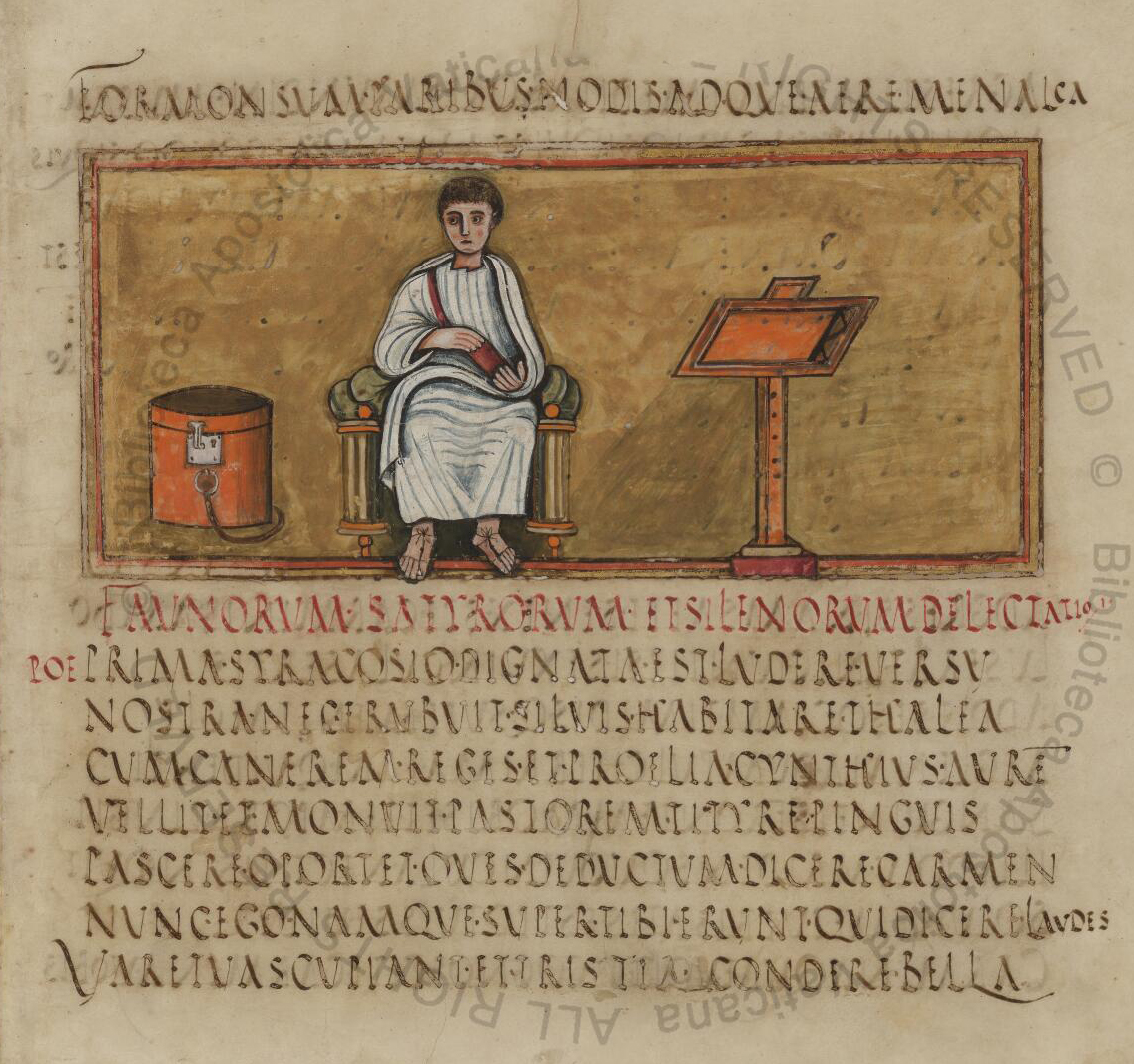
Image result for Medieval manuscript Vergil

On Rivers and Poets: Quintilian And Callimachus

Quintilian, An Orator’s Education 10.1.47

“Hence, as Aratus believes that we must begin with Zeus, we think that it is right to begin with Homer. For, truly, just as what he says about the ocean, which he says is the source and the force of every river and stream, so too does Homer furnish the model and origin for every type of eloquence. No one has exceeded him for sublimity in the large themes or quiet sense in the personal ones. At the same time he is ebullient and terse, joyful and severe, a source of wonder for his expansions and his brevity—preeminent by far for both his poetic and rhetorical mastery.”

Igitur, ut Aratus ab Iove incipiendum putat, ita nos rite coepturi ab Homero videmur. Hic enim, quem ad modum ex Oceano dicit ipse 〈omnium〉 amnium fontiumque cursus initium capere, omnibus eloquentiae partibus exemplum et ortum dedit. Hunc nemo in magnis rebus sublimitate, in parvis proprietate superaverit. Idem laetus ac pressus, iucundus et gravis, tum copia tum brevitate mirabilis, nec poetica modo sed oratoria virtute eminentissimus.

Callimachus, Hymn to Apollo 2.108-112

“Envy spoke surreptitiously into Apollo’s ears:
“I don’t love the singer who doesn’t sing as wide as the sea”
Apollo then kicked Envy with his foot and said this:
“The flowing of the Assyrian river is huge, but it carries a great deal
Of trash from the earth and hauls garbage with its water.
The bees do not carry water from just anywhere to Demeter
But only that which is clean and unmixed and flows down
From a sacred fountain, a little stream from a high peak.”

ὁ Φθόνος ᾿Απόλλωνος ἐπ’ οὔατα λάθριος εἶπεν·
‘οὐκ ἄγαμαι τὸν ἀοιδὸν ὃς οὐδ’ ὅσα πόντος ἀείδει.’
τὸν Φθόνον ὡπόλλων ποδί τ’ ἤλασεν ὧδέ τ’ ἔειπεν·
‘᾿Ασσυρίου ποταμοῖο μέγας ῥόος, ἀλλὰ τὰ πολλά
λύματα γῆς καὶ πολλὸν ἐφ’ ὕδατι συρφετὸν ἕλκει.
Δηοῖ δ’ οὐκ ἀπὸ παντὸς ὕδωρ φορέουσι μέλισσαι,
ἀλλ’ ἥτις καθαρή τε καὶ ἀχράαντος ἀνέρπει
πίδακος ἐξ ἱερῆς ὀλίγη λιβὰς ἄκρον ἄωτον.’

Image result for Okeanos ancient Greek

“If Misfortune is Beautiful…” Helen on The Trojan War

This semester I am reading Euripides’ Helen with my advanced Greek students. The opening speech presents Helen herself on stage retelling the “alternate-fact” version of the Trojan War (told as well by Stesichorus and Herodotus) that she herself never went to Troy. This monologue is pretty amusing, both for the plays of meaning presented within it and the playful treatment of the Trojan War tradition.

16–36

“The land of my father is not nameless,
Sparta, nor my father Tyndareus. And, indeed, there is
a certain story that Zeus flew to my mother Leda
after he took the form of a swan, a bird,
when he completed this ‘bedding’ deceptively
under the pretext of fleeing an eagle, if the story is true.

I am called Helen. And I should tell you the evils
I have suffered. Three goddesses went to the folds
O Mt. Ida to Alexander about their beauty,
Hera, the Kyprian, and the Zeus-born maiden,
Because they wanted him to complete a judgement of their ‘form’.
My beauty–if misfortune is beautiful–
Is what the Kyprian offered, for Alexander to marry,
In order to win. After Idaian Paris left the cow-stall
He went to Sparta seeking my bed.
But Hera, miffed because she did not defeat the goddesses,
Made my bed with Alexander an empty thing.
She did not give me, but instead, she made
A breathing ghost like me, crafting it from the sky,
For tyrant Priam’s son. He seemed to have me,
And it was an empty thing, because he did not have me….”

ἡμῖν δὲ γῆ μὲν πατρὶς οὐκ ἀνώνυμος
Σπάρτη, πατὴρ δὲ Τυνδάρεως· ἔστιν δὲ δὴ
λόγος τις ὡς Ζεὺς μητέρ’ ἔπτατ’ εἰς ἐμὴν
Λήδαν κύκνου μορφώματ’ ὄρνιθος λαβών,
ὃς δόλιον εὐνὴν ἐξέπραξ’ ὑπ’ αἰετοῦ
δίωγμα φεύγων, εἰ σαφὴς οὗτος λόγος·
῾Ελένη δ’ ἐκλήθην. ἃ δὲ πεπόνθαμεν κακὰ
λέγοιμ’ ἄν. ἦλθον τρεῖς θεαὶ κάλλους πέρι
᾿Ιδαῖον ἐς κευθμῶν’ ᾿Αλέξανδρον πάρα,
῞Ηρα Κύπρις τε διογενής τε παρθένος,
μορφῆς θέλουσαι διαπεράνασθαι κρίσιν.
τοὐμὸν δὲ κάλλος, εἰ καλὸν τὸ δυστυχές,
Κύπρις προτείνασ’ ὡς ᾿Αλέξανδρος γαμεῖ,
νικᾶι. λιπὼν δὲ βούσταθμ’ ᾿Ιδαῖος Πάρις
Σπάρτην ἀφίκεθ’ ὡς ἐμὸν σχήσων λέχος.
῞Ηρα δὲ μεμφθεῖσ’ οὕνεκ’ οὐ νικᾶι θεὰς
ἐξηνέμωσε τἄμ’ ᾿Αλεξάνδρωι λέχη,
δίδωσι δ’ οὐκ ἔμ’ ἀλλ’ ὁμοιώσασ’ ἐμοὶ
εἴδωλον ἔμπνουν οὐρανοῦ ξυνθεῖσ’ ἄπο
Πριάμου τυράννου παιδί· καὶ δοκεῖ μ’ ἔχειν,
κενὴν δόκησιν, οὐκ ἔχων….


Attic red-figure krater c. 450–440 BC (ParisLouvre)