All the Simons You’ll Ever Need

Diogenes Laertius, Lives of the Eminent Philosophers 2.13: Simon

“Simon was an Athenian and a leather-worker. Socrates used to go to his workshop and talk to him and he wrote down everything he remembered. This is why people call his dialogues “leathered”. There are thirty of them in one book.

[list of dialogues]

People say that Simon was the first person to have dialogues in the Socratic fashion. When Pericles said he would fund him and asked him to join his side, Simon said “I would never sell my freedom of speech”. Another Simon composed speeches On Rhetoric; a second was a doctor around the time of Seleukos Nicanor; a third was a sculptor.”

Σίμων Ἀθηναῖος, σκυτοτόμος. οὗτος ἐρχομένου Σωκράτους ἐπὶ τὸ ἐργαστήριον καὶ διαλεγομένου τινά, ὧν ἐμνημόνευεν ὑποσημειώσεις ἐποιεῖτο· ὅθεν σκυτικοὺς αὐτοῦ τοὺς διαλόγους καλοῦσιν. εἰσὶ δὲ τρεῖς καὶ τριάκοντα ἐν ἑνὶ φερόμενοι βιβλίῳ·

Οὗτος, φασί, πρῶτος διελέχθη τοὺς λόγους τοὺς Σωκρατικούς. ἐπαγγειλαμένου δὲ Περικλέους θρέψειν αὐτὸν καὶ κελεύοντος ἀπιέναι πρὸς αὐτόν, οὐκ ἂν ἔφη τὴν παρρησίαν ἀποδόσθαι.

Γέγονε δὲ καὶ ἄλλος Σίμων ῥητορικὰς τέχνας γεγραφώς· καὶ ἕτερος ἰατρὸς κατὰ Σέλευκον τὸν Νικάνορα· καί τις ἀνδριαντοποιός.

From Michael Apostolios, Paroemiographer

“I know Simôn and Simôn knows me.” There were two leaders, Nikôn and Simôn. Simon overpowered him because he was a man of the worst ways and it is said that he erased all memory of Nikôn. This proverb is used for people who recognize the evil in one another.”

Οἶδα Σίμωνα καὶ Σίμων ἐμέ: δύο ἐγένοντο ἡγεμόνες, Νίκων καὶ Σίμων. ὑπερίσχυσε δὲ ὁ Σίμων κακοτροπώτατος ὢν, ὥστε καὶ τὴν ἐπὶ Νίκωνα φήμην ἀπαλεῖψαι. λεχθείη δ’ ἂν ἡ παροιμία ἐπὶ τῶν ἀλλήλους ἐπὶ κακίᾳ γινωσκόντων.

From the Suda,  tau 293

“Telkhines: evil gods. Or jealous and harmful humans. There were two Telkhines, Simôn and Nikôn. Nikôn overpowered and erase dthe memory of Simôn. So, there is the proverb, “I know Simon and Simon knows me. This is used for those who recognize evil in one another.”

Τελχῖνες: πονηροὶ δαίμονες. ἢ ἄνθρωποι φθονεροὶ καὶ βάσκανοι. δύο ἐγένοντο Τελχῖνες, Σίμων καὶ Νίκων. ὑπερίσχυσε δὲ ὁ Νίκων τὴν ἐπὶ Σίμωνι φήμην ἀπαλεῖψαι. καὶ παροιμία· οἶδα Σίμωνα καὶ Σίμων ἐμέ. ἐπὶ τῶν ἀλλήλους ἐπὶ κακίᾳ γινωσκόντων.

Zenobius explains it all

“I know Simôn and Simôn knows me”: There were two leaders who were evil Telkhinians by birth—for they were making the land infertile by spraying it with water from the Styx. They were Simôn and Nikôn. Simon overpowered because he was the most evil in his ways with the result that he erased any memory of Nikôn. For this reason in the proverb they only name Simôn. The proverb is applied to those who recognize the evil in one another.”

Οἶδα Σίμωνα καὶ Σίμων ἐμέ: Τελχίνων φύσει βασκάνων ὄντων, (καὶ γὰρ τῷ τῆς Στυγὸς ὕδατι τὴν  γῆν καταῤῥαίνοντες ἄγονον ἐποίουν,) δύο ἐγένοντο ἡγεμόνες, Σίμων καὶ Νίκων. ῾Υπερίσχυε δὲ ὁ Σίμων κακοτροπώτατος ὢν, ὥστε τὴν ἐπὶ Νίκωνι φήμην ἀπαλεῖψαι. Διόπερ οἱ παροιμιαζόμενοι μόνον τὸν Σίμωνα ὀνομάζουσι. Λεχθείη δ’ ἂν ἡ παροιμία ἐπὶ τῶν ἀλλήλους ἐπὶ κακίᾳ γινωσκόντων.

Sigma 447 [A completely different Simon]

“Simôn, Simonos: a proper name and also a proverb: “No one is more thieving than Simôn.” And Aristophanes adds that whenever [people] see Simôn, they immediately turn into wolves. He was a Sophist who took public property for his own. Simôn and Theoros and Kleonymos are perjurers. Aristophanes has, “if a thunderbolt hits perjurers, how did it not burn Simôn, or Kleônumos or Theôros?”

Σίμων, Σίμωνος: ὄνομα κύριον. καὶ παροιμία· Σίμωνος ἁρπακτικώτερος. ᾿Αριστοφάνης· ὅταν ἴδωσι Σίμωνα, λύκοι ἐξαίφνης γίνονται. σοφιστὴς δὲ ἦν, ὃς τῶν δημοσίων ἐνοσφίζετο. Σίμων καὶ Θέωρος καὶ Κλεώνυμος, οὗτοι ἐπίορκοι. ᾿Αριστοφάνης· εἴπερ βάλλει τοὺς ἐπιόρκους ὁ κεραυνός, πῶς δῆτ’ οὐχὶ Σίμων’ ἐνέπρησεν οὐδὲ Κλεώνυμον οὐδὲ Θέωρον; καί τοι σφόδρα γ’ εἰσὶν ἐπίορκοι.

Plato Says It’s Like We’re Drunk All The Time

Plato Phadeo 79c2-c8

“Therefore, weren’t we saying this long before that the mind, whenever it uses the body for examining anything—either through seeing or hearing or any other kind of perception, since examining a thing through the body is to examine it through the senses—at that moment the mind is dragged down by body towards things that never exist in the same way and it wanders and is troubled and gets dizzy as if it’s drunk, since it has been contaminated by those sorts of things.”

Οὐκοῦν καὶ τόδε πάλαι ἐλέγομεν, ὅτι ἡ ψυχή, ὅταν μὲν τῷ σώματι προσχρῆται εἰς τὸ σκοπεῖν τι ἢ διὰ τοῦ ὁρᾶν ἢ διὰ τοῦ ἀκούειν ἢ δι’ ἄλλης τινὸς αἰσθήσεως—τοῦτο γάρ ἐστιν τὸ διὰ τοῦ σώματος, τὸ δι’ αἰσθήσεως σκοπεῖν τι—τότε μὲν ἕλκεται ὑπὸ τοῦ σώματος εἰς τὰ οὐδέποτε κατὰ ταὐτὰ ἔχοντα, καὶ αὐτὴ πλανᾶται καὶ ταράττεται καὶ εἰλιγγιᾷ ὥσπερ μεθύουσα, ἅτε τοιούτων ἐφαπτομένη;

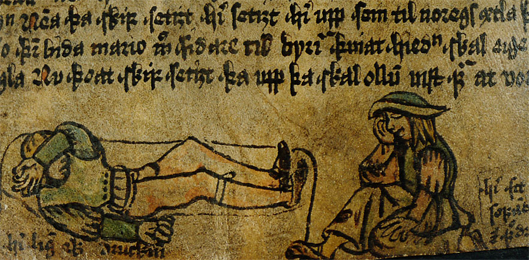
Illumination from AM 147 4to of two intoxicated 15th century Icelanders

Leaders, Corrupting the State for their Own Profit

Theognis, Elegies 39–52

“Kyrnos, this city is pregnant and I am afraid she will bear a man
Meant to correct our evil arrogance.
The citizens are still sane, but the leaders have changed
And have fallen into great evil.

Good people, Kyrnos, have never yet destroyed a city,
But whenever it pleases wicked men to commit outrage,
They corrupt the people and issue legal judgment in favor of the unjust,
For the sake of their own private profit and power.

Don’t expect this city to stay peaceful for very long
Even if it is not at a moment of great peace now,
When these deeds are dear to evil men,
As their profit accrues with public harm.

Civil conflicts and murder of kin comes from this,
And tyrants do too: may this never bring our city pleasure.”

Κύρνε, κύει πόλις ἥδε, δέδοικα δὲ μὴ τέκηι ἄνδρα
εὐθυντῆρα κακῆς ὕβριος ἡμετέρης.
ἀστοὶ μὲν γὰρ ἔθ’ οἵδε σαόφρονες, ἡγεμόνες δέ
τετράφαται πολλὴν εἰς κακότητα πεσεῖν.
οὐδεμίαν πω, Κύρν’, ἀγαθοὶ πόλιν ὤλεσαν ἄνδρες,
ἀλλ’ ὅταν ὑβρίζειν τοῖσι κακοῖσιν ἅδηι
δῆμόν τε φθείρουσι δίκας τ’ ἀδίκοισι διδοῦσιν
οἰκείων κερδέων εἵνεκα καὶ κράτεος·
ἔλπεο μὴ δηρὸν κείνην πόλιν ἀτρεμέ’ ἧσθαι,
μηδ’ εἰ νῦν κεῖται πολλῆι ἐν ἡσυχίηι,
εὖτ’ ἂν τοῖσι κακοῖσι φίλ’ ἀνδράσι ταῦτα γένηται,
κέρδεα δημοσίωι σὺν κακῶι ἐρχόμενα.
ἐκ τῶν γὰρ στάσιές τε καὶ ἔμφυλοι φόνοι ἀνδρῶν·
μούναρχοι δὲ πόλει μήποτε τῆιδε ἅδοι.

Image result for ancient greece megara ruins

Goodbye Heroes!

Anacreonta 23

“I want to speak of the Atreides,
And I am willing to sing about Kadmos
But the sound of my strings
Echoes only with Love.

Just yesterday I changed my strings,
And then the whole lyre,
And I was trying to sing
The labors of Herakles.
But the lyre returned
Only the sound of Love.

So, Goodbye, heroes,
For the rest of my life.
My lyre sings only tales of Love”

θέλω λέγειν Ἀτρείδας,
θέλω δὲ Κάδμον ᾄδειν,
ἁ βάρβιτος δὲ χορδαῖς
Ἔρωτα μοῦνον ἠχεῖ.

ἤμειψα νεῦρα πρώην
καὶ τὴν λύρην ἅπασαν·
κἀγὼ μὲν ᾖδον ἄθλους
Ἡρακλέους· λύρη δὲ
Ἔρωτας ἀντεφώνει.

χαίροιτε λοιπὸν ἡμῖν,
ἥρωες· ἡ λύρη γὰρ
μόνους Ἔρωτας ᾄδει.

Pietro Perugino, “Fortitude and Temperance with Six Antique Heroes” c. 1497-1500 [fresco]
https://youtu.be/1O22YHDDAys

Cicero Says August Is the Start of a Whole New Year!

Cicero, Letters to Atticus, 5.15 [=LCL 108]

“I made it to Laodicea on July 31st: you will start the reckoning of the year from this day. Nothing was lacking or unexpected in my arrival, but it is amazing how much this work wears me out. It provides me far too little space for my intellectual curiosity and the work for which I have earned my position.”

Laodiceam veni prid. Kal. Sext.; ex hoc die clavum anni movebis. nihil exoptatius adventu meo, nihil c<>arius; sed est incredibile quam me negoti taedeat, non habeat satis magnum campum ille tibi non ignotus cursus animi et industriae meae, praeclara opera cesset.

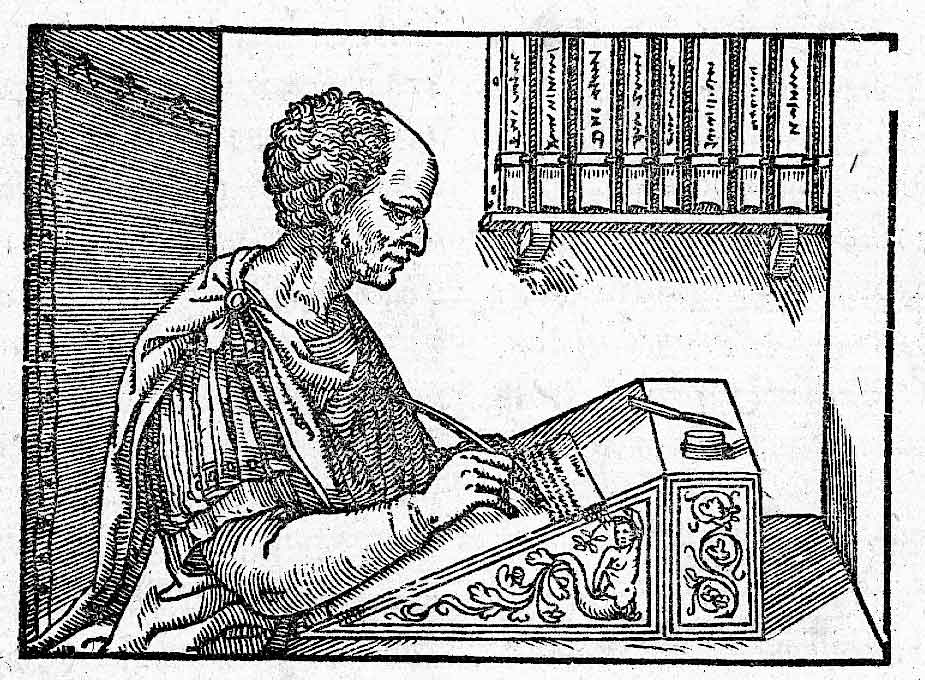
Cicero writing his letters, woodcut 1547

Being Awake in The Shared World

Plutarch, On Superstition [Moralia 166c]

“Heraclitus says the universe is singular and shared for those who are awake, but each of us returns to our own world when we are sleeping. The superstitious person lacks the shared world. When they are awake they fail to use their thoughts and when they are asleep they are not freed from trouble, since their power of reasoning is dreamed away and fear is always awake. There’s no way to escape or place to move.”

ὁ Ἡράκλειτός φησι τοῖς ἐγρηγορόσιν ἕνα καὶ κοινὸν κόσμον εἶναι, τῶν δὲ κοιμωμένων ἕκαστον εἰς ἴδιον ἀναστρέφεσθαι. τῷ δὲ δεισιδαίμονι κοινὸς οὐδείς ἐστι κόσμος· οὔτε γὰρ ἐγρηγορὼς τῷ φρονοῦντι χρῆται οὔτε κοιμώμενος ἀπαλλάττεται τοῦ ταράττοντος, ἀλλ᾿ ὀνειρώττει μὲν ὁ λογισμός, ἐγρήγορε δ᾿ ὁ φόβος ἀεί, φυγὴ δ᾿ οὐκ ἔστιν οὐδὲ μετάστασις.

This passage’s emphasis on our shared reality being dependent on using reason may seem super stoic, but it reminds me of Epicurean doctrine too: the notion that what is real is not readily available to individuals, but only comes from sharing experiences and knowledge with others. Those who rail against “wokeness” are like Heraclitean sleepers, refusing to acknowledge that their definitions and interpretations are creations of their own, set apart from the shared universe of human experience by their own arrogance and fear. Dreaming, of course, lets us explore those other worlds of our creation, to compare them for better or worse to the one we make together.

Diogenes Laertius, Epicurus 31

“[Epicureans] dismiss dialectic as being unnecessary—they believe that it is enough for natural scientists to employ the normal words for things. In his Canon, Epicurus asserts that our sensory perceptions and prior experiences and conceptions are the criteria of the truth; and Epicureans also believe that the imagined movements of thoughts are the same. He articulates his own beliefs in his Brief to Herodotus and in his Kurian Beliefs. He says, “Every perception is free of thought and receptive to no memory. Because does not move under its own power or another’s, it cannot add anything or take it away. And there is nothing capable of refuting the senses. For one related perception cannot countermand another because of their equal power nor can inequivalent senses undermine those of a different capacity, since they are not judging the same domains.

Reason depends entirely on perceptions. Different kinds of senses cannot undermine each other, since we use them all. The interdependence of the senses ensures the truth of what we perceive. Our ability to see and hear is just like our ability to feel pain. This is why we must strive to make meaning about unclear things from what actually appears before us.”

Τὴν διαλεκτικὴν ὡς παρέλκουσαν ἀποδοκιμάζουσιν· ἀρκεῖν γὰρ τοὺς φυσικοὺς χωρεῖν κατὰ τοὺς τῶν πραγμάτων φθόγγους. ἐν τοίνυν τῷ Κανόνι λέγων ἐστὶν ὁ Ἐπίκουρος κριτήρια τῆς ἀληθείας εἶναι τὰς αἰσθήσεις καὶ προλήψεις καὶ τὰ πάθη, οἱ δ᾿ Ἐπικούρειοι καὶ τὰς φανταστικὰς ἐπιβολὰς τῆς διανοίας. λέγει δὲ καὶ ἐν τῇ πρὸς Ἡρόδοτον ἐπιτομῇ καὶ ἐν ταῖς Κυρίαις δόξαις. “πᾶσα γάρ,” φησίν, “αἴσθησις ἄλογός ἐστι καὶ μνήμης οὐδεμιᾶς δεκτική· οὔτε γὰρ ὑφ᾿ αὑτῆς οὔτε ὑφ᾿ ἑτέρου κινηθεῖσα δύναταί τι προσθεῖναι ἢ ἀφελεῖν· οὐδὲ ἔστι τὸ δυνάμενον αὐτὰς διελέγξαι. οὔτε γὰρ ἡ ὁμογένεια αἴσθησις τὴν ὁμογενῆ διὰ τὴν ἰσοσθένειαν, οὔθ᾿ ἡ ἀνομογένεια τὴν ἀνομογένειαν, οὐ γὰρ τῶν αὐτῶν εἰσι κριτικαί· οὔτε μὴν λόγος, πᾶς γὰρ λόγος ἀπὸ τῶν αἰσθήσεων ἤρτηται. οὔθ᾿ ἡ ἑτέρα τὴν ἑτέραν, πάσαις γὰρ προσέχομεν. καὶ τὸ τὰ ἐπαισθήματα δ᾿ ὑφεστάναι πιστοῦται τὴν τῶν αἰσθήσεων ἀλήθειαν. ὑφέστηκε δὲ τό τε ὁρᾶν ἡμᾶς καὶ ἀκούειν, ὥσπερ τὸ ἀλγεῖν· ὅθεν καὶ περὶ τῶν ἀδήλων ἀπὸ τῶν φαινομένων χρὴ σημειοῦσθαι.

John Singer Sargent “Lady and Child asleep in a punter under the willows ” 1887

Don’t Stop Thinking about…Tomorrow?

Simonides, Fr. 20

“As long as any person holds on to the beloved flower of youth,
Their heart is light, because they imagine many things are endless.
No one young thinks they will grow old and die.
The healthy person doesn’t spare a thought for sickness either.

Fools have minds like this, because they don’t understand
That mortals have only a short time for youth and life too.
You, learn these things and hold on to the end of your time,
Taking pleasure in the good things in your mind.”

θνητῶ⎦ν δ’ ὄ⎣φρα τις⎦ ἄνθος ἔχη⎣ι πολυήρατον ἥβης,
κοῦφο⎦ν ἔχω⎣ν θυμ⎦ὸν πόλλ’ ἀτέλεσ⎣τα νοεῖ·
οὔ⎦τε γὰρ ἐλπ⎣ίδ’ ἔχ⎦ει γηρασέμεν ⎣οὔτε θανεῖσθαι,
οὐδ’, ὑ⎦γιὴς ὅτα⎣ν ἦι, φ⎦ροντίδ’ ἔχει κ⎣αμάτου.
νή⎦πιοι, οἷς ταύ⎣τηι⎦ κεῖται νόος, ο⎣ὐδὲ ἴσασιν
ὡς χρό⎦νος ἔ⎣σθ’ ἥβη⎦ς καὶ βιότου ὀλ⎣ίγος
θνη⎦τοῖς. ἀλλὰ ⎣σὺ⎦ ταῦτα μαθὼν ⎣βιότου ποτὶ τέρμα
ψυχῆι τῶν⎦ ἀγαθῶν τλῆθι χα⎣ριζόμενος.

A cleaner version of the text:

θνητῶν δ’ ὄφρα τις ἄνθος ἔχῃ πολυήρατον ἥβης,
κοῦφον ἔχων θυμὸν πόλλ’ ἀτέλεστα νοεῖ.
οὔτε γὰρ ἐλπίδ’ ἔχει γηρασέμεν οὐδὲ θανεῖσθαι,
οὐδ’ ὑγιὴς ὅταν ᾖ, φροντίδ’ ἔχει καμάτου.
νήπιοι, οἷς ταύτῃ κεῖται νόος· οὐδὲ ἴσασιν
ὡς χρόνος ἔσθ’ ἥβης καὶ βιότοι’ ὀλίγος
θνητοῖς· ἀλλὰ σὺ ταῦτα μαθὼν βιότου ποτὶ τέρμα
ψυχῇ τῶν ἀγαθῶν τλῆθι χαριζόμενος.

N.B.This fragment is preserved in Stobaeus’ Extracts, under a section entitled “Concerning life, that it is brief and cheap and full of worry” ΠΕΡΙ ΤΟΥ ΒΙΟΥ, ΟΤΙ ΒΡΑΧΥΣ ΚΑΙ ΕΥΤΕΛΗΣ ΚΑΙ ΦΡΟΝΤΙΔΩΝ ΑΝΑΜΕΣΤΟΣ.

Edvard Munch, “Old age” 1908

Legislation, For Drunks

Aristophanes, Acharnians 532-534

“[Perikles] used to make laws written like drinking songs:
That the Megarians were not to stay in the market
Nor the sea nor the beach in between”

ἐτίθει νόμους ὥσπερ σκόλια γεγραμμένους,
ὡς χρὴ Μεγαρέας μήτε γῇ μήτ’ ἐν ἀγορᾷ
μήτ’ ἐν θαλάττῃ μήτ’ ἐν ἠπείρῳ μένειν.

Schol. Ar. Ach. 532 

“[Perikles] used to make laws written like drinking songs”:

Timokreon of Rhodes, the lyric poet, wrote a drinking song like this against Wealth, which begins:

“Blind Wealth, I wish you had shown yourself
Neither on land nor on sea
Nor the beach in between.

You should have stayed underneath
living in Hell—thanks to you
all these evils for humans never cease.”

ἐτίθει νόμους· μιμούμενος τὸν τῶν σκολίων ποιητήν. Τιμοκρέων δὲ ὁ Ῥόδιος μελοποιὸς τοιοῦτον ἔγραψε σκόλιον κατὰ τοῦ Πλούτου, οὗ ἡ ἀρχή·

ὤφελέν σ᾿ ὦ τυφλὲ Πλοῦτε
μήτε γῇ μήτ᾿ ἐν θαλάσσῃ
μήτ᾿ ἐν ἠπείρῳ φανῆμεν,
ἀλλὰ Τάρταρόν τε ναίειν
κ᾿ Αχέροντα· διὰ σὲ γὰρ πάντ᾿
αἰὲν ἀνθρώποις κακά.

Mihály Zichy, “Drinking Song” 1874

A Bad End

Euripides. Bacchae. 1114-1136

His priestess-mother got the killing going,
attacking him. He tore off his headdress
so she would know him and not kill him,
poor Agave. Touching her face, he said:
“It’s me, mother. Your son, Pentheus.
You bore me in Echion’s house.
O mother, have mercy on me.
Don’t kill your son over his mistake.”

Foaming at the mouth and wild eyes whirling,
she did not think as thinking requires:
in thrall to Bacchus, she was unmoved.
She gripped his left arm below the elbow,
jammed her foot against the poor man’s ribs,
then ripped arm from shoulder with strength not her own.
The god had made it easy for her hands.

Ino all the while worked his other arm,
ripping flesh. Autone and the Bacchic pack
grabbed at him too, screaming in unison.
While he groaned (all that his breathing allowed)
theirs were shouts of joy. One left with his arm;
one his foot, the shoe still on. The mauling
exposed his ribs. And then, with hands blood stained,
as they would a ball, they tossed around his flesh.

πρώτη δὲ μήτηρ ἦρξεν ἱερέα φόνου
καὶ προσπίτνει νιν: ὃ δὲ μίτραν κόμης ἄπο
ἔρριψεν, ὥς νιν γνωρίσασα μὴ κτάνοι
τλήμων Ἀγαύη, καὶ λέγει, παρηίδος
ψαύων: Ἐγώ τοι, μῆτερ, εἰμί, παῖς σέθεν
Πενθεύς, ὃν ἔτεκες ἐν δόμοις Ἐχίονος:
οἴκτιρε δ᾽ ὦ μῆτέρ με, μηδὲ ταῖς ἐμαῖς
ἁμαρτίαισι παῖδα σὸν κατακτάνῃς.
ἣ δ᾽ ἀφρὸν ἐξιεῖσα καὶ διαστρόφους
κόρας ἑλίσσουσ᾽, οὐ φρονοῦσ᾽ ἃ χρὴ φρονεῖν,
ἐκ Βακχίου κατείχετ᾽, οὐδ᾽ ἔπειθέ νιν.
λαβοῦσα δ᾽ ὠλένης ἀριστερὰν χέρα,
πλευραῖσιν ἀντιβᾶσα τοῦ δυσδαίμονος
ἀπεσπάραξεν ὦμον, οὐχ ὑπὸ σθένους,
ἀλλ᾽ ὁ θεὸς εὐμάρειαν ἐπεδίδου χεροῖν:
Ἰνὼ δὲ τἀπὶ θάτερ᾽ ἐξειργάζετο,
ῥηγνῦσα σάρκας, Αὐτονόη τ᾽ ὄχλος τε πᾶς
ἐπεῖχε βακχῶν: ἦν δὲ πᾶσ᾽ ὁμοῦ βοή,
ὃ μὲν στενάζων ὅσον ἐτύγχαν᾽ ἐμπνέων,
αἳ δ᾽ ἠλάλαζον. ἔφερε δ᾽ ἣ μὲν ὠλένην,
ἣ δ᾽ ἴχνος αὐταῖς ἀρβύλαις: γυμνοῦντο δὲ
πλευραὶ σπαραγμοῖς: πᾶσα δ᾽ ᾑματωμένη
χεῖρας διεσφαίριζε σάρκα Πενθέως.

Hans Bellmer. La Poupee. c.1938

Larry Benn has a B.A. in English Literature from Harvard College, an M.Phil in English Literature from Oxford University, and a J.D. from Yale Law School. Making amends for a working life misspent in finance, he’s now a hobbyist in ancient languages and blogs at featsofgreek.blogspot.com.

Gellius, Totally Understanding Oral Traditions

Gellius, Attic Nights, 3.11.2-5

“Some report that Homer was older by birth than Hesiod—among this number are Philochorus and Xenophanes. But others say he was younger, including the poet Lucius Accius and Ephorus the historian. In the first book of On Images, however, Marcus Varro says that there is little agreement about which was born first, but that what is not in bout is that they lived at the same time. Evidence from this comes from the inscription on the tripod which was allegedly put on Mt. Helikon.

Accius, still, in book one of the Didasalica uses somewhat superficial arguments…he continues ‘since Homer, when he recounts at the start of his poem that Achilles is the son of Peleus and does not add who Peleus is—which is something he would have added if he had not seen it already explained by Hesiod (Fr. 211). Similarly, when it comes to the Cyclops’ Accius says, ‘Homer would have highlighted the fact that he was one-eyed and would not have passed over such a marvelous detail if it had not already been popularized in the older poems of Hesiod.”

(2) alii Homerum quam Hesiodum maiorem natu fuisse scripserunt, in quis Philochorus et Xenophanes; alii minorem, in quis L. Accius poeta et Ephorus historiae scriptor. (3) M. autem Varro in primo De imaginibus, uter prior sit natus, parum constare dicit, sed non esse dubium, quin aliquo tempore eodem vixerint; idque ex epigrammate ostendi, quod in tripode scriptum est, qui in monte Helikone ab Hesiodo positus traditur. (4) Accius autem in primo didascalico levibus admodum argumentis utitur … (5) quod Homerus, inquit, cum in principio carminis Achillem esse filium Pelei diceret, quis esset Peleus, non addidit; quam rem procul, inquit, dubio dixisset, nisi ab Hesiodo iam dictum videret. de Cyclope itidem, inquit, vel maxime quod unoculus fuit, rem tam insignem non praeterisset, nisi aeque prioris Hesiodi carminibus involgatum esset.

Image result for hesiod
This is a mood.