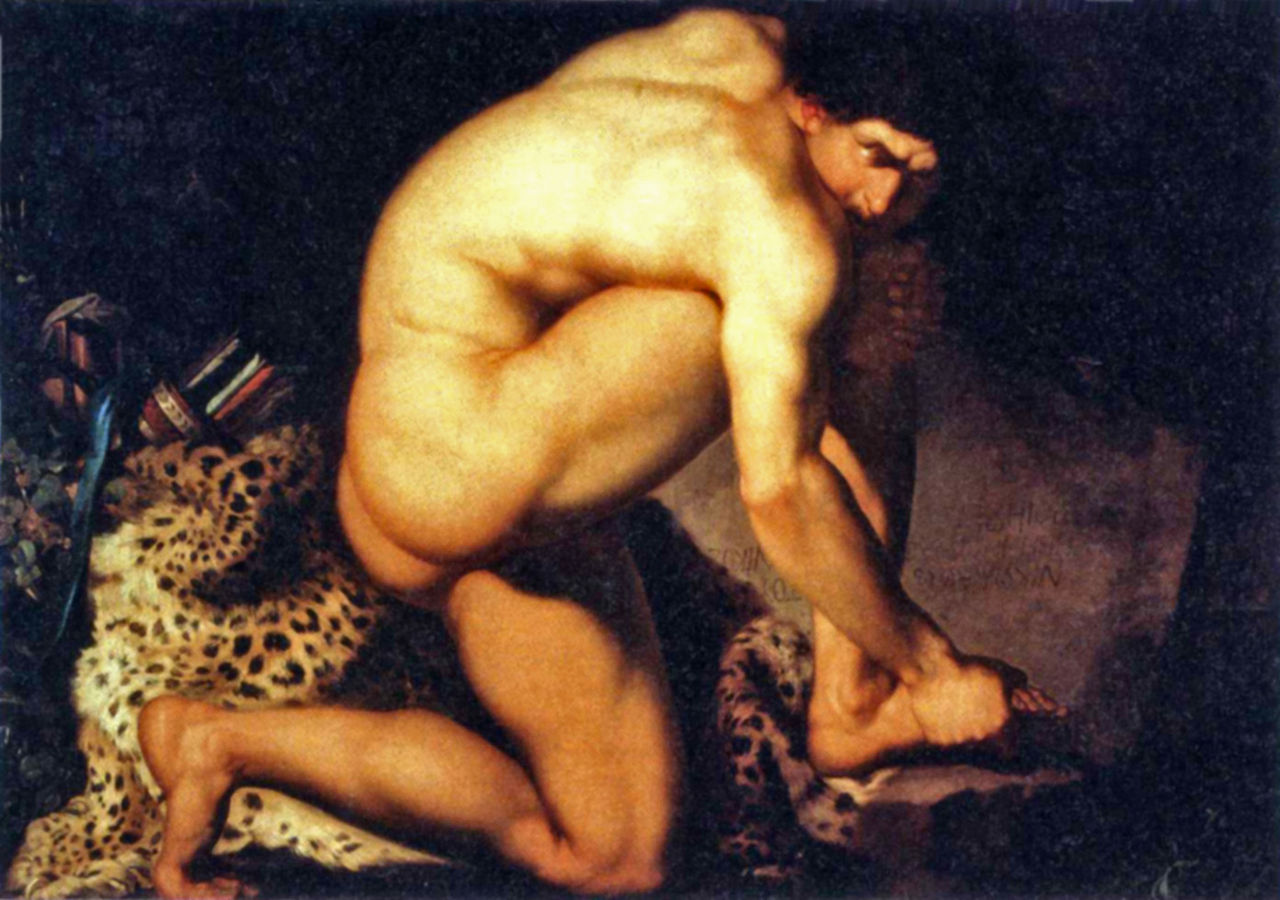
Does your pure eye not see wrong? Can’t it see suffering? Why do you look on the deceitful and stay silent while the ungodly devour the righteous?
You’ve made humans like the fish of the sea, and like beasts without a master.
He [the enemy] pulls up the lot of them with his fish-hook, hauls them out with his net, and collects them in his seine. This makes him glad; his heart rejoices.
And so he makes offerings to his seine, and he burns incense to his net. For after all, thanks to them he has bettered his portion and his victuals are excellent.
Philo. On the Creation. XXI. 65-66.
Of the forms of life, the most undeveloped and least formed is the race of fish, and the most complete and the best in all respects is the race of humans . . .
Of living things, God created fish first. Their essence, however, is more that of a body than a living thing. In a way they are alive and not alive. They are capable of movement yet lacking in life. The principle of life is scattered in them as if by chance and solely for the preservation of their bodies–just as they say salt is put on meat to prevent it easily spoiling.
“People who teach translation have never made a lot of money”
numquam magnas mercedes accepisse eos qui hermeneumata docerent.
Pliny, Letters C. Plinius Arrio Antonino Suo S.
“How could I give you a greater sign of how much I want to copy you and admire you than the fact that I am trying to translate your Greek epigrams to Latin? Still, this is a decline. I bring to it the feebleness of my own ability, and add to this the poverty, or what Lucretius calls “the cheapness of our own language.” Nevertheless, if these Latin translations of mine seem at all charming to you, you will know how much pleasure your Greek originals brought me! Farewell.”
Quemadmodum magis adprobare tibi possum, quanto opere mirer epigrammata tua Graeca, quam quod quaedam Latine aemulari et exprimere temptavi? in deterius tamen. Accidit hoc primum imbecillitate ingenii mei, deinde inopia ac potius, ut Lucretius ait, egestate patrii sermonis. Quodsi haec, quae sunt et Latina et mea, habere tibi aliquid venustatis videbuntur, quantum putas inesse iis gratiae, quae et a te et Graece proferuntur! Vale.
Cicero, de optime genere oratorum 18
“Two kinds of objections are possible for this task. The first is: “It is better in Greek.” One can answer such people by asking if they can make anything better in Latin. Another is: “Why should I read this translation rather than the Greek?” Well, the same people often embrace a Latin Andria, Synephebi, and even an Andromache, Antiope and Epigonoi. Why is there so much intolerance for speeches translated from Greek when there is none for translated poems?
Huic labori nostro duo genera reprehensionum opponuntur. Unum hoc: “Verum melius Graeci.” A quo quaeratur ecquid possint ipsi melius Latine? Alterum: “Quid istas potius legam quam Graecas?” Idem Andriam et Synephebos nec minus Andromacham aut Antiopam aut Epigonos Latinos recipiunt. Quod igitur est eorum in orationibus e Graeco conversis fastidium, nullum cum sit in versibus?
Life & Death at the Tip of the Tongue (painting) by Omer Toledano, 2001
I first read “Oedipus the King” in the original more than 25 years ago when I had to grapple with Freud’s concept of the “Oedipal conflict”.
According to Freud, every boy between the ages of 1 and 7 wants to have a sexual relationship with his mother and therefore wants to get rid of his father. This is the “positive” Oedipus complex. Likewise, every boy wants to have a sexual relationship with his father and therefore wants to get rid of his mother (“negative” Oedipus complex). The same applies to girls by analogy.
Reading the Sophocles play made me realize how much Freud is turning reality into its opposite: at the end of the play, Oedipus wants to kill his mother – in honor of his father, whose death he wants to atone for on the basis of Apollo’s revelation. If Jocasta had not committed suicide beforehand, he would have murdered her. He wants to carry out this matricide with the same justification that is used to justify and demand other matricides in Greek mythology: because the mothers are responsible for the death of their respective fathers.
Over time I have studied all the great Sophocles pieces that have survived. In a discussion of such texts, I would like to bring a psychologist’s reasonable, non-Freudian perspective. As a psychologist, I pay attention to whether there are contradictions between what someone says and what he does. In general, I’m more trained to pay attention to the “action messages” of the actors instead of just listening to what they say. Or I pay attention to what someone does not say, although it should actually be addressed. I may question whether the emotions or insights presented are really real. Perhaps they are only pretended and played. Maybe I come across completely illogical points of view – and then try to be particularly attentive here and to interpret them meaningfully. Sometimes I’m probably more willing to judge certain statements as “outrageous” and rather to pillory them. All in all, in this job I have learned to pay attention to contradictions, to take them seriously and to try to resolve them. Having worked with dream interpretation, I am familiar with symbolism and allegory.
I want to briefly tie this to the great “Antigone”. It is probably the oldest, most impressive plea for a democratic society. That’s why it’s still relevant today. These values are fully represented by Antigone (and Haimon). Creon – that is important to recognize from my point of view! – embodies exactly the opposite: an arbitrary, brutal, unreasonable, godless, unjust dictatorship. From the beginning he successfully reduced the council of elders to the role of a vicarious agent. Through his brutality, he has the majority of the population and his henchmen firmly under control.
Here is an example for each of the features mentioned above:
Contradiction between what someone says and does: Creon praises the council of elders for having served so well for three generations of rulers – but it is clear that his decision not to bury Polynices presents this body with a fait accompli. He never dreamed of discussing this with his “council” in advance. The Athenians of that time must have experienced this as an immediate affront: a decision is not even discussed with a few select advisors – it is made by Creon all by himself. This corresponds to the state model of absolutism: “L’État, c’est moi.”
Noting what someone is NOT saying: When Creon talks about what happened at the end, he laments that he killed his son, but that he explicitly did this to Antigone and that he ordered Polynices to be punished completely inappropriately as well, he says NOT A SINGLE word about it.
Feigning insight: Obviously the play itself is about acting as if in a theater. For example, Creon ends up pretending to show remorse and heed the advice that was given to him. Free Antigone and bury Polynices. But Creon reverses the order! What an infamy! He excludes from the funeral the person who stood up for it from the beginning and would have been most worthy to officiate this ceremony! Whether he just wanted to increase the likelihood of Antigone’s death by delaying her liberation through a very elaborate burial, or even quickly instructed his bodyguard to break into Antigone’s dungeon during the burial and kill her, but make it look like suicide, that remains open to me. In any case, at this point he PROVES that he is in no way interested in the divine revelations.
Making sense of illogical points of view: Antigone claims that she would never have broken a burial law for her children or a husband. From my point of view, this emphasizes the special meaning of a – symbolically meant – “sibling” relationship, i.e. an obligation that Athens has towards a community that originates from its own “motherland” – i.e. towards Sparta. Comparatively fewer obligations to colonies (“children”) or other distant allies (“husband”).
There are a number of other things I would like to draw your attention to. Also, for example, that from my point of view Sophocles is a deeply democratic-minded author who brings allegories to the stage in all of his plays that confront his compatriots with political events that happened not too long ago.
About Klaus: Born in 1960, I studied psychology at the University of Saarbrücken (Diploma, 1988). Since 1993 I worked in my own psychotherapeutic practice (katathymic-imaginative psychotherapy, behavioral therapy, NLP, hypnosis and psych-analysis according to Josef Breuer). Since 1995 I have been researching the history of psychoanalysis and therefore came to study especially the stories of Narcissus and Oedipus, which were incorporated into Freud’s theory. I look at those ancient tales from a completely new perspective. In 2012 I published Sigmund Freud’s long-lost letters to the writer Wilhelm Jensen. Since 2022 I’m living in Costa Rica.
“We use ‘self-sufficient’ not to mean a person alone—someone living in isolation—but to include one’s parents, children, spouse, friends, and even fellow citizens, since a human being is a social creature by nature. Now, some limit needs to be observed in these ties—for it will go on endlessly if you extend it to someone’s ancestors and descendants. But that’s a problem for another time.
We posit that self-sufficiency is something which in itself makes life attractive and lacks nothing and for this reason we think it is happiness, since we imagine that happiness is the most preferable of all things when it is not counted with others. It is clear that it is desirable even with the least of the goods—the addition of goods increases the total, since the greater good is always desirable.”
No man is an Iland, intire of itselfe; every man
is a peece of the Continent, a part of the maine;
if a Clod bee washed away by the Sea, Europe
is the lesse, as well as if a Promontorie were, as
well as if a Manor of thy friends or of thine
owne were; any mans death diminishes me,
because I am involved in Mankinde;
And therefore never send to know for whom
the bell tolls; It tolls for thee.
“As I slept through the night
Under sea-purple blankets,
Stretched out, drunk,
I was dreaming I stretched out
Mid-run on a fast course,
On the very tips of my toes.
I was enjoying myself with the girls
But some boys younger
Than Luaios were mocking me,
Teasing me harshly,
Because of those pretty girls.
Then, they all ran away from my dream
When I reached out to kiss them.
They left me alone and poor me,
I only wanted to sleep again.”
. . . [Diomedes] hurled his long-shadowed spear
at Hector’s head and did not miss: he hit
his helmet’s tip. But bronze deflected bronze
from fair skin: the spear failed on Hector’s headpiece
(three layers, cone shaped, Phoebus Apollo’s gift).
Hector scurried back and blended with the pack,
fell to his knee and stayed there, thick hand bracing
the ground. Black night blanketed his eyes.
But while Tydeus’s son tracked his spear’s woosh
to where it fell far beyond the first fighters,
Hector revived, scuttered into his car,
and off he drove, into the crush of men.
He’d given black fate the slip.
11.355-356. “[F]ell to his knee and stayed there . . . Black night blanketed his eyes” (στῆ δὲ γνὺξ ἐριπὼν . . . ἀμφὶ δὲ ὄσσε κελαινὴ νὺξ ἐκάλυψεν):
The controversy in the scholia:
One scholiast says of Homer and these verses:
“The blind one is fond of lies, and he is the perfect liar. For first, Hector was not wounded, as he himself says, and then there’s the scurrying [ἀνέδραμε] of a man who has his strength (11.354). Isn’t an account of why he fell to his knees and died of something insignificant missing?
This scholiast and others, as well as the poem’s ancient editors, were vexed by the formular indication of Hector’s death (“black night blanketed his eyes”) when Hector obviously survived Diomedes’ spear.
The scholia explains the seemingly inappropriate use of the formula in 11.355-356 by offering that it was improperly transferred from the 5.309-310 account of Aeneas (Schol. A. 356a. and T. 356c).
An alternative theory:
In Book 5, Apollo’s actions saved Aeneas following a boulder’s blow to the warrior’s hip (5.343-346).
In Book 11, Apollo’s action saved Hector from a spear’s assault: he had gifted Hector a spear-stopping helmet.
The Cambridge Commentary says that the ascription of the helmet to Apollo is only an idiom for the gear’s strength and good construction.
I’m not sure that’s right. It seems to me the helmet is in fact a metonym for Apollo’s intervention. That is to say, it is through the helmet that Apollo saved Hector. I’m building on what an insightful scholiast says:
“He [Hector] would have died, were it not for the divinity of the helmet” ( . . . άπέθανεν αν, εί μή διά την θειότητα τοϋ so κράνους [Schol. T. 353b]).
It is divinity itself, not good metalworking, which saved Hector. The divinity is an emanation from Apollo.
In both the Aeneas and Hector episodes, (1) it is Diomedes who attempts a kill, (2) he only just fails, and that’s thanks to (3) Apollo’s intervention. Perhaps we can say that the formular verses “[he] fell to his knee and stayed there . . . black night blanketed his eyes” belong to a larger formula whose elements are Diomedes, a warrior’s near death at his hand, and Apollo’s saving intervention.
Today is, according to many, the anniversary of the eruption of Vesuvius in the Bay of Naples in 79 CE. Pliny’s account is the most famous, but Martial had his say too (Epigrams, 4.4):
“Here is Vesuvius, just yesterday green with shading vines–
here the noble grape made filled deep pools:
these were the hills Bacchus loved more than Nysae.
On this mountain the Satyrs not so long ago led their dance.
Here was the home Venus considered more pleasing than Sparta.
This place was famous because of its Herculean name.
All of this lies covered in flames and sorrowful ash.
Not even the gods wished for this to be their right.”
Hic est pampineis uiridis modo Vesbius umbris,
presserat hic madidos nobilis uua lacus:
haec iuga quam Nysae colles plus Bacchus amauit;
hoc nuper Satyri monte dedere choros;
haec Veneris sedes, Lacedaemone gratior illi; 5
hic locus Herculeo nomine clarus erat.
Cuncta iacent flammis et tristi mersa fauilla:
nec superi uellent hoc licuisse sibi.
Mount Vesuvius is thought to have erupted #onthisday in AD 79. This fragment of a wall painting may depict the owners of a house in Pompeii pic.twitter.com/fMspVy8wXO
“The hair is gray on my head.
Boy, give me water, add some wine
Make my heart numb.
Soon you will cover me, no longer alive.
You want nothing when you’re dead.”