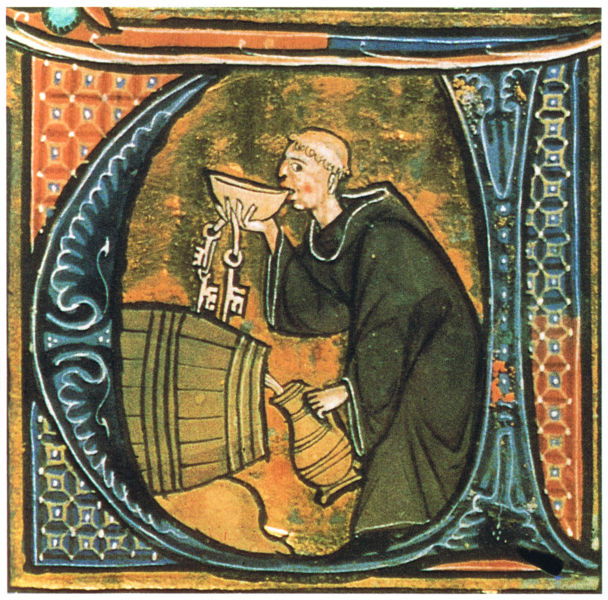
“My head is weighed down by wine, Onomakritos, and wine wrestles
Me down, and I am no longer the master of my own decision,
The house is turning around. But, come on, let me try
To stand up and check that wine doesn’t also have my feet
Or the mind in my chest. I fear I will do something stupid
All armored like I am and earn serious shame.
Wine, when drunk in massive amounts, is evil. But if someone
Drinks it with understanding, it is no evil but a good.”
A Plan for the Establishment of Public Schools and the Diffusion of Knowledge in Pennsylvania:
“I do not wish the LEARNED OR DEAD LANGUAGES, as they are commonly called, to be reduced below their present just rank in the universities of Europe, especially as I consider an acquaintance with them as the best foundation for a correct and extensive knowledge of the language of our country. Too much pains cannot be taken to teach our youth to read and write our American language with propriety and elegance. The study of the Greek language constituted a material part of the literature of the Athenians, hence the sublimity, purity and immortality of so many of their writings. The advantages of a perfect knowledge of our language to young men intended for the professions of law, physic or divinity are too obvious to be mentioned, but in a state which boasts of the first commercial city in America, I wish to see it cultivated by young men, who are intended for the compting house, for many such, I hope, will be educated in our colleges. The time is past when an academical education was thought to be unnecessary to qualify a young man for merchandize. I conceive no profession is capable of receiving more embellishments from it.
Connected with the study of our own language is the study of ELOQUENCE. It is well known how great a part it constituted of the Roman education. It is the first accomplishment in a republic, and often sets the whole machine of government in motion. Let our youth, therefore, be instructed in this art. We do not extol it too highly when we attribute as much to the power of eloquence as to the sword in bringing about the American revolution.”
“Where in the world is Crassus? Did he slink back to Alexandria because he was tired of his home? Is he cleaning his walls? Or, more likely, is the drunk suffering from a hangover?”
Crassus ipse ubi gentium est? An Alexandriam taedio domus remeavit? An parietes suos detergit? An, quod verius est, ex crapula helluo attemptatur?
From the Suda:
“Kraipalê: The pounding that comes from drinking too much wine. We also have the participle “carousing” which is when someone acts poorly because of drinking, or just being drunk. It derives from the word “head” (kara) and “pound” (pallein). Or, it could also come from screwing up (sphallesthai) timely matters (kairiôn)
Kraipalôdês: “Prone to drunkenness”: The ancients knew well the weaknesses of the spirit, weather it was a person who was prone to excessive drinking or a love-seeker who has his brain in his genitals.”
“If someone has head pain from a hangover, have him drink a cup of unmixed wine. For different head pains, have the patient eat bread warm from unmixed wine.”
“Those who are suffering bodily from drinking and being hungover can find relief from sleeping immediately, warmed with a cover. On the next day, they can be restored with a bath, a massage, and whatever food does not cause agitation but restores the warmth dispelled and lost from the body by wine.”
“Wine (being of a wet nature) stretches those who are slow and makes them quick, but it tends to restrain those who are quick already. On that account, some who are melancholic by nature become entirely dissipated in drunken stupors (kraipalais). Just as a bath can make those who are all bound up and stiff more readily able to move, so does it check those who are already movable and loose, so too does wine, which is like a bath for your innards, accomplish this same thing.
Why then does cabbage prevent drunkenness (kraipale)? Either because it has a sweet and purgative juice (and for this reason doctors use it to clean out the intestines), even though it is itself of a cold nature. Here is a proof: doctors use it against exceptionally bad cases of diarrhea, after preparing it by cooking it, removing the fiber, and freezing it. It happens in the case of those suffering from the effects of drunkenness (kraipalonton) that the cabbage juice draws the wet elements, which are full of wine and still undigested, down to their stomachs, while the body chills the rest which remains in the upper part of the stomach. Once it has been chilled, the rest of the moist element can be drawn into the bladder. Thus, when each of the wet elements has been separated through the body and chilled, people are likely to be relieved of their drunkenness (akraipaloi). For wine is wet and warm.”
“This misery and fear have easily relieved me of my hangover.”
miseria haec et metus crapulam facile excusserunt
If you have read this far, you’re probably not that hungover
Plautus, Rudens 585-590
“But why am I standing here, a sweating fool?
Maybe I should leave here for Venus’ temple to sleep off this hangover
I got because I drank more than I intended?
Neptune soaked us with the sea as if we were Greek wines
And he hoped to relieve us with salty-beverages.
Shit. What good are words?”
sed quid ego hic asto infelix uuidus?
quin abeo huc in Veneris fanum, ut edormiscam hanc crapulam,
quam potaui praeter animi quam lubuit sententiam?
quasi uinis Graecis Neptunus nobis suffudit mare,
itaque aluom prodi sperauit nobis salsis poculis;
quid opust uerbis?
Plautus, Stichus 226-230
“I am selling Greek moisturizers
And other ointments, hangover-cures
Little jokes, blandishments
And a sycophant’s confabulations.
I’ve got a rusting strigil, a reddish flask,
And a hollowed out follower to hide your trash in.”
uel unctiones Graecas sudatorias
uendo uel alias malacas, crapularias;
cauillationes, assentatiunculas,
ac periuratiunculas parasiticas;
robiginosam strigilim, ampullam rubidam,
parasitum inanem quo recondas reliquias.
“If only we got hangovers before we drank
Then no one would ever drink more
Than is good for them. But now, because
We do not expect to escape drinking’s penalty,
We too eagerly drink unmixed wines”
“It is fitting that an evil man have an evil understanding of justice
And no concern for any criticism to come.
For a wicked man many crimes are ready,
And he thinks that everything he does is good.”
“Kurnos, a good man’s judgment is always firm
And he is constant in both bad times and good ones.
But if a god grants life and wealth to a wicked man,
He cannot refrain from evil because of his stupidity.”
Benjamin Rush, Essays: Moral, Literary, and Political
“VII. The Latin and Greek languages are the first tests of genius in schools. Where boys discover a want of capacity for them, they are generally taken from school, or remain there the butts of their companions. Dr. Swift early discovered a want of taste for the dead languages. It would be unjust to mention this fact, without ascribing it to the voice of reason and nature speaking in this great man. He had no relish for the husks of literature. Truth and knowledge were alone commensurate to the dignity and extent of his mind.
[…]
IX. The study of some of the Latin and Greek classics is unfavourable to morals and religion. Indelicate amours, and shocking vices both of gods and men, fill many parts of them. Hence an early and dangerous acquaintance with vice; and hence, from an association of ideas, a diminshed respect for the unity and perfections of the true God. Those classics which are free from this censure, contain little else but the histories of murders, perpetrated by kings, and related in such a manner as to excite pleasure and admiration. Hence the universal preference of the military character to all others.—To the same cause we may ascribe the early passion for a cockade in school boys; and the the frequent adoption of the principles and vices of armies, by young men who are destined for other professions.
X. The study of the Latin and Greek languages is improper in the present state of society and government in United States. While Greek and Latin are the only avenues to science, education will always be confined to a few people. It is only by rendering knowledge universal, that a republican form of government can be preserved in our country.”
“Whoever believes that his neighbor knows nothing
And he alone forms clever plans,
That guy is a fool with an impaired mind.
For we all equally think of clever things,
But where one man is not willing to seek evil profit,
Another is pleased by deceptive plots.”
“If someone praises you for as long as you see him
But lashes you with an evil tongue when you are apart,
That kind of man is not a very good friend at all.
He’s the kind who speaks smoothly with his tongue, but harbors different thoughts.
Let me have that kind of friend who knows his companion
And puts up with him when he’s mean or in a rage,
Like a brother. But you, friend, keep these things your heart
And you will remember me in future days.”
“One can survive the ruin from counterfeit silver and gold
Kurnos—and a wise person can easily discover it.
But if a dear friend’s mind is hidden in his chest
When he is false and he has a deceptive heart,
Well this the most counterfeit thing god has made for mortals
And it is the most painful thing of all to recognize.
For you cannot know the mind of a man or a woman
Before you investigate them, like an animal under a yoke—
And you cannot imagine what they are like at the right time
Since the outer image often misleads your judgment.”
“Also in the first book of On Proverbs, he writes in this way: “an examination of riddles is not foreign to philosophy and the ancients made a display of their education through them. For during their drinking they used to toss riddles around not as people do now when they question one another which sexual position is the best or which or what kind of fish is tastiest or in season or which is best for eating after Arcturus rises or the pleiades or the dog star. And then as a prize they give those who answer kisses worthy of condemnation by anyone with good sense; and as a punishment to those who are defeated, they make them drink unmixed wine, a thing which is more delightful for them to drink than the cup of Health.”
Seneca the Elder, Historical Fragments, 1 [=Lactant. Inst. Div. 7.15.14]
“Seneca outlined the periods of Roman history in “life-stages”. The first was her infancy under the king Romulus, who parented Rome and educated her. Then there followed a childhood under various kings thanks to whom the city grew and was shaped by many practices and institutions. Then, while Tarquin was king and Rome began to become more adult, it could not endure servitude and, once the yoke of arrogant rule was thrown off, preferred to heed laws instead of kings.
Once the Roman adolescence ended with the close of the Punic war, it began to show the full strength of adulthood. For, when Carthage was subdued, that city which was an ancient rival for power, Rome extended her hands over the whole earth, both land and sea until every king and nation had bent to her power.
But, since there was no reason left for wars, Rome began to use her strengths poorly and wore herself out. This was the first step of old age: when Rome was wounded by civil wars and suffering from internal evil, she returned again to the practice of individual rule, as if she had devolved into a second infancy. Thus she lost the freedom which she defended when Brutus was its agent and champion and grew weak in old age, as if she had not the strength to support herself unless she could use the ‘cane’ of kings.”
Seneca Romanae urbis tempora distribuit in aetates; primam enim dixit infantiam sub rege Romulo fuisse, a quo et genita et quasi educata sit Roma, deinde pueritiam sub ceteris regibus, a quibus et aucta sit et disciplinis pluribus institutisque formata. At vero Tarquinio regnante, cum iam quasi adulta esse coepisset, servitium non tulisse, et reiecto superbae dominationis iugo maluisse legibus obtemperare quam regibus, cumque esset adulescentia eius fine Punici belli terminata, tum denique confirmatis viribus coepisse iuvenescere. Sublata enim Carthagine, quae diu aemula imperii fuit, manus suas in totum orbem terra marique porrexit, donec regibus cunctis et nationibus imperio subiugatis, cum iam bellorum materia deficeret, viribus suis male uteretur, quibus se ipsa confecit. Haec fuit prima eius senectus, cum bellis lacerata civilibus atque intestino malo pressa rursus ad regimen singularis imperii recidit quasi ad alteram infantiam revoluta. Amissa enim libertate, quam Bruto duce et auctore defenderat, ita consenuit tamquam sustentare se ipsa non valeret nisi adminiculo regentium uteretur.
Head of Old Man, 1st Century BCE. Torlonia Museum (Rome)