“Whenever you also consider the amazing and the disturbing, you amplify the pleasure which is a magic charm for learning. In the early years, we must use this sort of thing to entice children, but as their age increases we must lead them to a knowledge of reality as soon as their perception has gotten stronger and they no longer need much cajoling.
Every illiterate and ignorant person is in some way a child and loves stories like a child. The one who has been only partially educated is similar, for he does not abound in the ability to reason and, in addition, his childish custom persists. Since not only frightening but also disturbing tales bring pleasure, we need to use both of these kinds of tales for children and those who are grown up too. For children, we provide pleasing fictions to encourage them and frightening tales to deter them.”
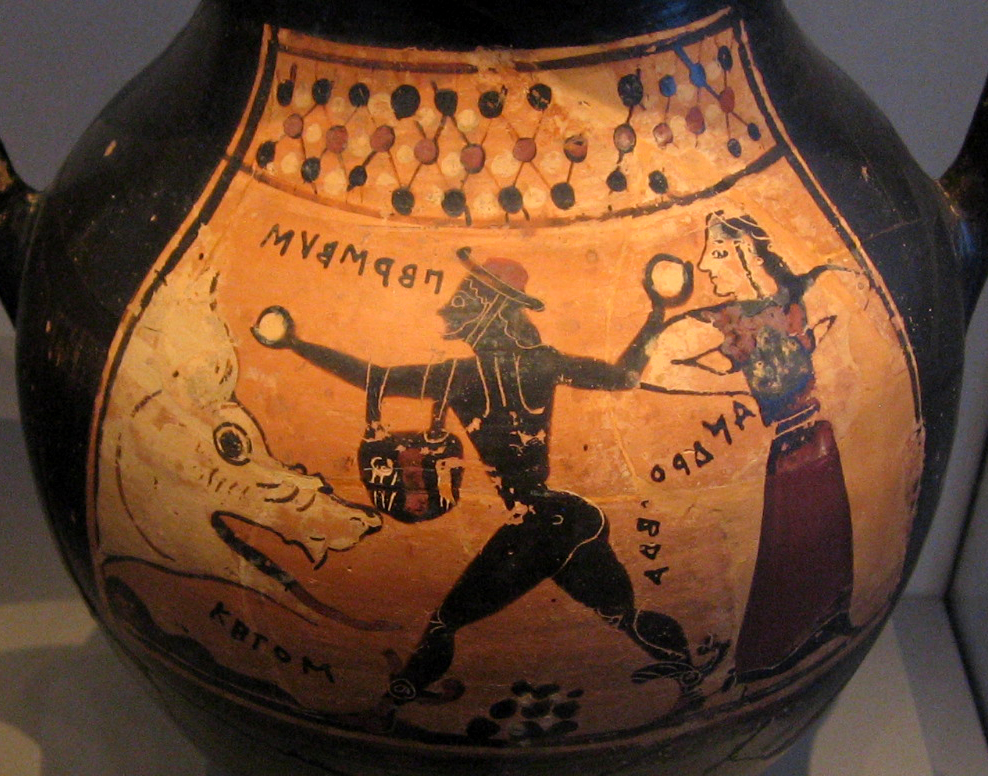
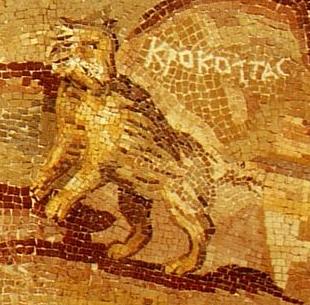
2 “Daliôn says in the first book of his Ethiopian Matters that there is an animal in Ethiopia called a krokotta. When that creature goes near backyards it hears people chattering, and especially the words/names of children. But when it goes out at night, it speaks words/names and the children who come out are devoured by it”
“[We should note the fact that] there is a creature in Ethiopia which is named krokottas which is like a combination of wolf and a dog, but it is more savage than both and is heavier in its face and at the end of its feet. It is also amazing for its boldness, and it is extremely capable compared to the rest in its teeth and its belly. For they also tear to pieces easily every type of bone and whatever they take up is consumed easily and their digestion is indescribable. In addition, while some of them have been described as imitating human language, we don’t believe it. Nevertheless, some have added that they call out people by name at night—and that they try to use a human voice in doing this—and then they gobble up whoever comes out as they fall upon them.”
The New York Times reports that the current US administration is trying to narrowly define gender in order to strip transgender people of federal protections. Here are some ancient intersex stories we posted over the summer. Human beings have known that gender is not simply binary and is not simply about how we are born for a very long time.
6 Also in Antioch near the Maiander river there was an intersex person, when Antipater who was the Athenians and Marcus Vinicius and Titus Statilus Taurus were consuls. The person was called Kourbinus. As a maiden of famous parents when she was thirteen she was suited by many because of her beauty.
After her parents chose the suitor they wanted, they appointed the day for the marriage But the girl shouted out as she was about to leave the house when the most severe amount of pain over took her.
Those near her lifted her up and were taking care of her because she had pains in her guts and twisting within them. This pain remained for three days straight and her suffering made everyone confused, since they could not give her relief from the toils at night or day.
Even though the doctors in the city applied every type of healing to her they found no cause for the suffering. On the fourth day near dawn, the pains greatly increased and, as she shouted out with a terrible groan, suddenly the masculine parts descended from her and a girl became a man.
After some time, he was taken to Rome to be presented to Claudius Caesar. And he, on account of the fame, had an altar erected for Zeus the Defender of Evils on the Capitoline.”
7 “There was also in Mêouania, an Italian city, in the home of Agrippina Augusta, an intersex person when Dionysodorus was archon in Athens and in Rome Decimus Junius Silanos Torquatos and Quintus Aterius Atonius were consuls.
The girl’s name was Philôtis and she was Smyrnaian in origin. When the time of her marriage came and she had been promised by her parents to a man, male genitals appeared on her and she became a man.”
8 “There was also another intersex person in the same time period in Epidaurus, a child of poor parents who was called Sumpherousa first but was named Sumpherôn when he became a man. He spent his life gardening.”
9 “In Laodikeia there was also a Syrian women named Aitêtê who changed her form when she was already living with her husband and then changed her name to Aitêtos once she became a man. This was when Makrinos was archon in Athens and Lucius Lamia Aelianos and Sextus Carminius Veterus were consuls. I even saw him myself.”
The story of Teiresias, Phlegon of Tralles, On Marvels 4
“Hesiod—along with Dikaiarkhos, Klearkhos, Kallimakhos and some others—relates these things about Teiresias. When Teiresias the son of Euêros in Arcadia was a young man he saw snakes copulating, he wounded one and immediately changed his form. He changed into a woman from a man and then had sex with a man.
But after Apollo prophesied to him that, if he saw snakes copulating again and wounded one in the same way, he would be as he was before, Teiresias took care to do the things which were prophesied by the god and thus regained his older form.
When Zeus was fighting with Hera and saying that in sex a wife surpassed her husband in the pleasures of intercourse—even while Hera was claiming the opposite—it seemed right to them to send for Teiresias because he had tried out both ways. When they questioned him, he responded that if there were ten portions, a man took pleasure in one and a woman took pleasure in ten.
In her rage over this, Hera took out his eyes and made him blind. But Zeus gave him the gift of prophecy and to live for seven generations.”
What is a little different about this version is the presence of Apollo and the claim that Zeus lengthened Teiresias’ life as part of his ‘reward’. This second part helps to explain Tiresias’ presence from the birth of Dionysus to the fall of Thebes with the Epigonoi.
5 “Others tell the story that in the land of the Lapiths the king Elatos had a daughter whose name was Kainis. After Poseidon had sex with her he promised to make her into whatever she wanted. She said she wanted to be changed into a man who was invulnerable. When Poseidon did this—as was right—he changed her name to Kaineus.”
This story is older than Ovid and Phlegon. It is detailed in the fragments of Akousilaus, perhaps alluded to in Homer, definitely indicated by Apollonius Rhodes, and present even in Plato. While the sex-change narrative remains an important element, the main feature of Kaineus’ tale is his hubris–because of his invulnerability he asks to be made into a god.
“Poseidon has sex with Kainê of Elatos. Then—for it was not right for him [sic] to have children with him nor anyone else—Poseidon turned him into an invulnerable man, who had the greatest strength of the men at that time. Whenever anyone tried to strike him with iron or bronze, [the attacker] was completely defeated.
Then [Kaineus] became king of the Lapiths and was warring with the Centaurs. After he set up his javelin in the agora he was asking to be included in the number of the gods. This was not pleasing to the gods. And when Zeus saw him doing this, he threatened him and raised the Centaurs against him. They struck him straight down into the earth and placed a stone above as assign. Then he died.”
In this account, Poseidon seems to be changing Kaineus because of his inability to have children. This makes it rather clear what women are good for from this cultural perspective. In addition, it is interesting that Kaineus as an intersex figure is involved in the war between the Lapiths and Centaurs, a conflict which has its origins in a rapes at a wedding and is often seen as a reflection of the civilized Lapiths struggling against the primitive and violent urges of the Centaurs.
But, as can be seen from the relief below which dates to the early Archaic period, the punishment of Kaineus is a primary motif of the story tradition. In a way, if the sex-change and rape were equally ancient, this is a tale about a women who is raped ultimately being punished for surviving and thriving and exacting retribution for her suffering.
D Scholia ad Il. 264
“Kaineus was a son of Elatos and king of the Lapiths. He was a very beautiful virgin girl before. But after Poseidon had sex with her, she asked to be changed from a young woman into a man. And he became invulnerable, and the most excellent of those alive at the time. And after he stuck his javelin into the middle of the agora, he demanded to be entered into the number of the gods for this reason.
Zeus was annoyed by this request and he arranged the following type of payback from him for impiety. For, even though he was invincible, he made him less while he was fighting the Centaurs. For they were hurling and striking him with pines and oak trees and they drove him into the ground. Apollonius recalls this in the Argonautica saying this, “For the singers used to report the fame that Kaineus was killed by Centaurs, when he alone from the rest of the best drove them, they surged back. They were not strong enough to repel him nor to kill him, but he went under the earth, unbroken, unbent, pummeled by the striking force of powerful pines.”
This story is held up as a wistful impossibility by Plato in the laws. This passage is, well, upsetting.
Plato’s Laws 944d-c
“What then would be the right punishment for someone who has thrown away this kind of a power of a defensive weapon for the opposite? For it is not possible for a person to do the opposite of what they say the god did when he changed the Thessalian Kaineus from a women into a man. For one who throws away his shield, the opposite of this transformation, changing from a man into a women, in some way would be the best of all punishments for this.”
“Some animals are called Ephemera and they take their name from the length of their life. For they are born in wine and when the container is opened they fly out, they see the light, and they die. Therefore, nature has granted that they come into life but it has also rescued them from the evils in life, since they neither experience any suffering of their own and they know nothing of others’ misfortunes.”
“If you wish to be stripped of your vices, you must withdraw from the exemplars of vice. The miser, the corrupter, the savage, the fraud – these would all harm you much if they had merely been near you, but instead they lurk inside you. Transition to better examples: live with the Catos, live with Laelius, with Tubero. If you would even like to take up quarters with the Greeks, spend some time with Socrates and Zeno: the first will teach you how to die when it is necessary, and the second before it is necessary. Live with Chrysippus and Posidonius: they will give you the knowledge of human and divine things. They will goad you on to work, and will instruct you not just to speak knowledgeably and cast off your words for the delight of the audience, but also to harden your mind and steel it against threats. There is one safe harbor in this storm-tossed and turbid life, and that is to scorn the future, to stand confidently, and to be prepared not to hide and turn your back, but to take the slings and arrows of Fortune straight to the chest.”
Si velis vitiis exui, longe a vitiorum exemplis recedendumest. Avarus, corruptor, saevus, fraudulentus, multum nocituri si propea te fuissent, intra te sunt. Ad meliores transi: cum Catonibus vive, cum Laelio, cum Tuberone. Quod si convivere etiam Graecis iuvat, cum Socrate, cum Zenone versare: alter te docebit mori si necesse erit, alter antequamnecesse erit. Vive cum Chrysippo, cum Posidonio: hi tibi tradent humanorum divinorumque notitiam, hi iubebunt in opere esse nec tantum scite loqui et in oblectationem audientium verba iactare, sed animum indurare et adversus minas erigere. Unus est enim huius vitae fluctuantis et turbidae portus eventura contemnere, stare fidenter ac paratum tela fortunae adverso pectore excipere, non latitantem nec tergiversantem.
Apparently there was also a tradition that has Aphrodite pulling a Zeus-Amphitryon trick with Paris and Menelaos.
Nikias of Mallos, BNJ 60 F 2a [=Schol. V ad Od. 23.218]
“Priam’s child Alexander left Asia and went to Sparta with the plan of abducting Helen while he was a guest there. But she, because of her noble and husband-loving character, was refusing him and saying that she would honor her marriage with the law and thought more of Menelaos. Because Paris was ineffective, the story is that Aphrodite devised this kind of a trick: she exchanged the appearance of Alexander for Menelaos’ character to persuade Helen in this way. For, because she believed that this was truly Menelaos, she was not reluctant to leave with him. After she went to the ship before him, he took her inside and left. This story is told in Nikias of Mallos’ first book”
This kind of doubling and uncertainty about identity is certainly at home in any discussion of Euripides’ Helen (well, at least the first third where no one knows who anybody is). But it is also apt for the Odyssey where Odysseus cryptically insists (16.204):
“India gives birth to single-horned horses, people say, and the same land feeds single-horned asses too. They get drinking cups from these horns. And if anyone puts fatal poison inside of them, when someone drinks from them, the conspiracy won’t hurt him at all. It seems that the horn of both the horse and the ass is a ward against evil.”
Past mid-October, it is about time things start to get a bit creepy…
Aelian, On the Nature of Animals 1.51
“People say that the spine of a human corpse turns into a snake as the marrow decomposes. As the beast slips out, so the most savage creature is born from the mildest. In this way the remains of men who were once fine and noble rest and they have peace as their prize just as the soul too does of these kinds of men according to what is sung and hymned by the wise.
But the spines of evil men bring forth these kinds of things after life too. Well, the truth is that the story is either completely a myth or if these things prove trustworthy, then it seems to me that the evil man’s corpse has earned this reward of becoming the serpent’s father.”
“By your leave, I need to say this: you teachers foremost have destroyed real eloquence. You create certain absurdities by by making your light and silly sounds so that the body of your speech weakens and falls. Young men were not yet restrained by practice-speeches when Sophocles and Euripides used to be able to discover the words with which things ought to be said.
No shut-in professor had yet destroyed their geniuses when Pindar and the nine Lyric poets were afraid to sing Homer’s verses. And lest I use only poets for proof, I surely do not see that Plato or Demosthenes went through this kind of exercise. The grand style, as I may say, is a humble one—it is not uneven or inflated, but emerges thanks to its natural beauty.”
Pace vestra liceat dixisse, primi omnium eloquentiam perdidistis. Levibus enim atque inanibus sonis ludibria quaedam excitando effecistis, ut corpus orationis enervaretur et caderet. Nondum iuvenes declamationibus continebantur, cum Sophocles aut Euripides invenerunt verba quibus deberent loqui. Nondum umbraticus doctor ingenia deleverat, cum Pindarus novemque lyrici Homericis versibus canere timuerunt. Et ne poetas [quidem] ad testimonium citem, certe neque Platona neque Demosthenen ad hoc genus exercitationis accessisse video.3 Grandis et ut ita dicam pudica oratio non est maculosa nec turgida, sed naturali pulchritudine exsurgit.
While Lucian is surely messing with us here, I think there are many tomes of Homeric scholarship set aright through this one paragraph.
Lucian, True History 2.20
“Two or three days had not yet passed when I approached the poet Homer at a moment when we both had free time and I was investigated the rest of the matters about him, especially where he was from. For this is still examined by us to this day. He said that he was not ignorant that some people say he his from Khios and others say Smyrna while a majority claims he is Kolophonian. But he was saying that he is in fact Babylonian and was not called Homer among his people but Tigranes. Later on, after he was a hostage [homêreusas] among the Greeks he changed his nickname.
When I asked him about the lines which were considered spurious and whether they had been written by him, he was claiming they were all his. For this reason I started to believe that the grammarians Zenodotus and Aristarchus were guilty of the most close-minded logic. Since he had responded sufficiently on these matters, I was asking him next why he made his poem start with the “rage of Achilles”. He said that it just leapt into his head that way without any prior thought. Then I was eager to know that thing, whether he wrote the Odyssey before the Iliad as many claim. He denied this.”