“Let’s talk first concerning the disease which is called sacred and paralyzed people and the many anxieties which frighten people seriously enough that they lose their minds and believe that they see evil spirits by night or even at times by die or sometimes on all hours. Many have hanged themselves before because of this kind of vision, more often women than men.
For a woman’s nature is more depressed and sorrowful. And young women, when they are at the age of marriage and without a husband, suffer terribly at the time of their menstruation, which they did not suffer earlier in life. For blood collects later in their uterus so that it may flow out. When, then, the mouth of the exit does not create an opening, the blood pools up more because of food and the body’s growth. When the blood has nowhere to flow, it rises up toward the heart and the diaphragm. When these organs are filled, the heart is desensitized and from this transformation it becomes numb. Madness overtakes women because of this numbness.”
“Kuanippos, a Syracusan by birth, did not sacrifice to Dionysus alone. In rage over this, the god caused him to become drunk and then he raped his daughter Kuanê in some shadowy place. She took his ring and gave it to her nurse as to be proof of what had happened in the future.
When they were later struck by a plague and Pythian Apollo said that they had to sacrifice the impious person to the Gods-who-Protect, everyone else was uncertain about the oracle. Kuanê understood it. She grabbed her father by the hair and sacrificed herself over him once she’d butchered him on the altar.
That’s the story Dositheos tells in the third book of his Sicilian Tales.”
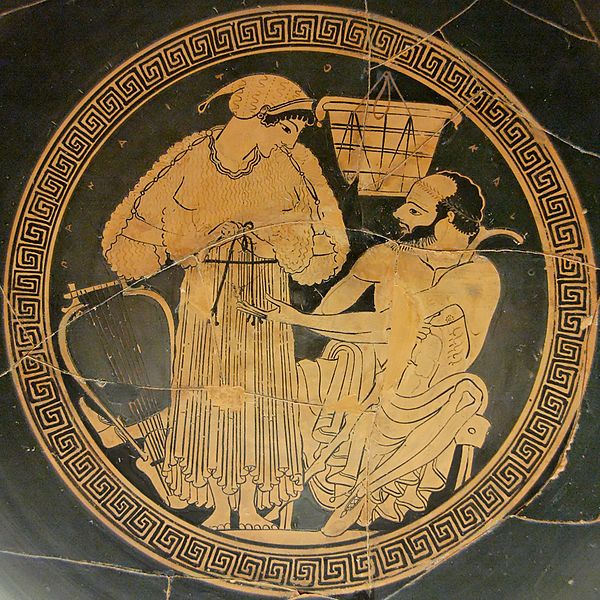
“Beyond the theater is the shrine of Aphrodite. In front of the foundation is a stele on which Telesilla, a poet of lyric, is depicted. Her books are tossed near her feet while she looks at the helmet she holds in her hand as she is about to put it on her head. Telesilla was famous among women and especially honored for her poetry.
But a greater story about her comes from when the Argives were bested by Kleomenes the son of Alexandrides and the Lakedaimonians. Some Argives died during the battle itself and however many fled to the grove of Ares died there too—at first they left the grove under an armistice but they realized they were deceived and were burned with the rest in the grove. As a result, Kleomenes led the Spartans to an Argos bereft of men.
But Telesilla stationed on the wall of the city all the slaves who were unable to bear arms because of youth or old age and, after collecting however many weapons had been left in homes or in the shrines, she armed all the women at the strongest age and once she had armed herself they took up posts were the army was going to attack.
When the Spartans came near and the women were not awestruck by their battle-cry but waited and were fighting bravely, then the Spartans, because they reasoned that if they killed the women the victory would be ill-rumored even as their own defeat would come with great insult, yielded to the women.
The Pythian priestess had predicted this contest earlier in the prophecy relayed by Herodotus who may or may not have understood it (6.77):
But when the female conquers the male
And drives him away and wins glory for the Argives,
It will make many Argive women tear their cheeks.
These are the words of the oracle on the women’s accomplishment.”
Plutarch, On the Virtues of Women 245d-f6 reports a version of this tale; the Suda (s.v. Telesilla) likely takes its account from Pausanias.
“Telesilla, a poetess. On a stele her books are tossed around and she has placed a helmet on her head. And When the Lakedaimonians slaughtered the Argives who had fled to a shrine and were heading to the city to sack it, then Telesilla armed the women of the right age and set them against where they were marching. When the Lakedaimonians saw this, they turned back because they believed it shameful to fight against women whom it would be inglorious to conquer but a great reproached to be defeated by….” [the oracle is listed next”
Earlier I posted a passage from the Odyssey where the narrator tells us that Penelope raised the slave Melanthô and gave her toys. This detail is paired with the slave woman’s sexual behavior—she is now a bad slave because she is having sex with one of the suitors.
Odyssey, 18.321–5
“Then fine-cheeked Melanthô reproached him shamefully. Dolios fathered her and Penelope raised her, she treated her like her own child and used to give her delights for her heart. But she did not have grief in her thoughts for Penelope. Instead she was having sex with and feeling affection for Eurymakhos.”
The meaning of this behavior might not be clear to modern audiences. Ancient audiences might have needed clarification too. The epic shows Odysseus witnessing this later.
20.5–24
“Odysseus was lying there, still awake, devising evils in his heart
For the suitors. And the women went from the hall
The ones who were having sex with the suitors before
Greeting one another with a welcome and a laugh.
And Odysseus’ heart rose in his dear chest.
He debated much in his thoughts and through his heart
Whether after leaping up he should deal out death to each woman
Or he should allow them to have sex with the arrogant suitors
a last and final time. The heart inside his chest barked.
And as a mother dog who stands over her young pups
When she sees an unknown man barks and waits to fight,
So his heart growled within him as he was enraged at the evil deeds.
Then he struck his chest and reproached the heart inside him.
Endure this my heart, you endured a more harrowing thing on that day
When the savage Cyclops, insanely daring, ate
My strong companions. You were enduring this and your intelligence
Led you from that cave even though you thought you were going to die.”
Beyond whether or not the liaison was a good wooing strategy for Eurymachus, these closely paired statements show that despite being integrated into the family structure, Melantho has not internalized her position and has instead exercised agency in pursuing sexuality. (Or, perhaps more accurately, exercising control over her own body to choose a different master.) When the epic returns to the issue, it takes pains to depict the women as in control and to ensure that Odysseus witnesses it. When he reveals himself to the suitors in book 22, he accuses them of forcefully sleeping with the women.
22.35-38
“Dogs, you were expecting that out of the way I would not come
home from the land of the Trojans and you ruined my home,
Took the slave women in my house to bed by force
And wooed the wife of a man who was still alive…”
The difference in tone is in part due to the level of narrative—in the first two scenes mentioned above, the sexual acts are observed through the narrator. When Odysseus talks about it, he characterizes the acts differently because he sees the sexual acts as transgressing his control of the household. If the women—who are animate objects, not people—have sex, then they are the sexual objects of aggressors against Odysseus’ control. This transgressive behavior on their part helps to explain why Odysseus decides to slaughter them.
Who should have sex with the slave women is implied by a narrative passage from the beginning of the epic (1.428–33)
“And with him Eurykleia carried the burning torches. She knew proper things, the daughter of Ops, the son of Peisênor whom Laertes bought to be among his possessions when she was just a girl and he paid a price worth 20 oxen. And he used to honor her equal to his dear wife in his home but he never had sex with her and he was avoiding his wife’s anger.”
It is exceptional here that Laertes does not have sex with Eurykleia. This indicates an economy of sexual slavery in which the slave women are the objects to be used by those who own them. If they are used without permission or act on their own, they represent perversions.
See:
Doherty, Lillian. 2001. “The Snares of the Odyssey: A Feminist Narratological Reading.” 117-133.
Thalmann, William G. 1998. “Female Slaves in the Odyssey.” 22–34
One would not expect Homer to figure importantly in an early 20th century realist novel about the struggle of Californian ranchers against the evils of the railroad, but his influence is felt throughout Frank Norris’ novel The Octopus. While the novel features an expansive cast, with frequent frictionless transitions from one character to another, Norris spends the most time and attention on the aspiring poet Presley, whom we follow from the very opening of the book until its depressing and unsatisfying conclusion. This is understandable enough, given that Presley seems to represent the figure of Norris himself.
Presley is not a rancher, but is closely involved with the social circle of the ranch community set in a fictionalized southern California at the end of the 19th century. His two chief friends in the community are Annixter, a brilliant but wildly churlish owner of a mid-sized ranch who hopes to cash in on the improvements he has made to the land once the railroad offers it for sale, and Vanamee, a wandering mystic who, endowed with a naturally poetic spirit, filters in and out of the community as he struggles to cope with his lover’s death. Presley admires Vanamee in large part due to his natural poetic sensibility, no doubt refined by his frequent solitary perambulations through the southwest.
Presley’s ambition is to write an epic of the American West:
Vanamee understood him perfectly. He nodded gravely.
“Yes, it is there. It is Life, the primitive, simple, direct Life, passionate, tumultuous. Yes, there is an epic there.”
Presley caught at the word. It had never before occurred to him.
“Epic, yes, that’s it. It is the epic I’m searching for. And HOW I search for it. You don’t know. It is sometimes almost an agony. Often and often I can feel it right there, there, at my finger-tips, but I never quite catch it. It always eludes me. I was born too late. Ah, to get back to that first clear-eyed view of things, to see as Homer saw, as Beowulf saw, as the Nibelungen poets saw. The life is here, the same as then; the Poem is here; my West is here; the primeval, epic life is here, here under our hands, in the desert, in the mountain, on the ranch, all over here, from Winnipeg to Guadalupe. It is the man who is lacking, the poet; we have been educated away from it all. We are out of touch. We are out of tune.”
Presley’s fondness for Homer was well known to the other ranchers. Annixter is regularly found reading David Copperfield. Mrs. Derrick, the wife of Magnus Derrick (the most prominent and respected of the ranchers), is an eager enthusiast for literature, but is troubled both by Presley’s fondness for Homer and his own literary efforts:
The monotony of the ranch ate into her heart hour by hour, year by year. And with it all, when was she to see Rome, Italy, and the Bay of Naples? It was a different prospect truly. Magnus had given her his promise that once the ranch was well established, they two should travel. But continually he had been obliged to put her off, now for one reason, now for another; the machine would not as yet run of itself, he must still feel his hand upon the lever; next year, perhaps, when wheat should go to ninety, or the rains were good. She did not insist. She obliterated herself, only allowing, from time to time, her pretty, questioning eyes to meet his. In the meantime she retired within herself. She surrounded herself with books. Her taste was of the delicacy of point lace. She knew her Austin Dobson by heart. She read poems, essays, the ideas of the seminary at Marysville persisting in her mind. “Marius the Epicurean,” “The Essays of Elia,” “Sesame and Lilies,” “The Stones of Venice,” and the little toy magazines, full of the flaccid banalities of the “Minor Poets,” were continually in her hands.
When Presley had appeared on Los Muertos, she had welcomed his arrival with delight. Here at last was a congenial spirit. She looked forward to long conversations with the young man on literature, art, and ethics. But Presley had disappointed her. That he—outside of his few chosen deities—should care little for literature, shocked her beyond words. His indifference to “style,” to elegant English, was a positive affront. His savage abuse and open ridicule of the neatly phrased rondeaux and sestinas and chansonettes of the little magazines was to her mind a wanton and uncalled-for cruelty. She found his Homer, with its slaughters and hecatombs and barbaric feastings and headstrong passions, violent and coarse. She could not see with him any romance, any poetry in the life around her; she looked to Italy for that. His “Song of the West,” which only once, incoherent and fierce, he had tried to explain to her, its swift, tumultous life, its truth, its nobility and savagery, its heroism and obscenity had revolted her.
“But, Presley,” she had murmured, “that is not literature.”
“No,” he had cried between his teeth, “no, thank God, it is not.”
We can understand readily enough that Mrs. Derrick found Homer violent. Both the Iliad and the Odyssey are replete with scenes of appalling and horrific violence. But the impression that Homer is coarse is owing to a curious admixture of upper class snobbery and a rarefied notion of literary polish. (Indeed, one could argue that Pope’s Homer was so poorly received because Pope tamed Homer by rounding off all of the jagged edges and polishing him into rolling, monotonous, and correct Augustan insipidity.) The idea that there is something wild, primal, or untamed about Homer’s poetry had long been a cliché. John Dryden, in his preface to Fables, Ancient and Modern, compared Homer’s free and wild genius to the more restrained intellectual virtues of Vergil:
For the Grecian is more according to my genius than the Latin poet. In the works of the two authors we may read their manners and natural inclinations, which are wholly different. Virgil was of a quiet, sedate temper; Homer was violent, impetuous, and full of fire. The chief talent of Virgil was propriety of thoughts, and ornament of words; Homer was rapid in his thoughts, and took all the liberties, both of numbers and of expressions, which his language, and the age in which he liv’d, allow’d him. Homer’s invention was more copious, Virgil’s more confin’d.
Indeed, it was the wild, violent, or heroic aspect of Homer which made him such choice reading for the manly man in search of poetry. Thus, in his essay, Reading, Thoreau notes that we need not worry that Homer could have an enervating effect on us as readers:
The student may read Homer or Æschylus in the Greek without danger of dissipation or luxuriousness, for it implies that he in some measure emulate their heroes, and consecrate morning hours to their pages. The heroic books, even if printed in the character of our mother tongue, will always be in a language dead to degenerate times; and we must laboriously seek the meaning of each word and line, conjecturing a larger sense than common use permits out of what wisdom and valor and generosity we have. The modern cheap and fertile press, with all its translations, has done little to bring us nearer to the heroic writers of antiquity.
Thus, there is some precedent for Mrs. Derrick’s aversion to Homer, and Presley’s own reception of Homer as something peculiarly endowed with a raw, vital, and unbridled energy perfectly at home in the rugged American West. Even at a social event among the ranchers, he filters life through the Homeric lens:
Presley was delighted with it all. It was Homeric, this feasting, this vast consuming of meat and bread and wine, followed now by games of strength.
As The Octopus progresses, Presley continues to struggle with the development of a Western epic. Though he writes a poem addressing the injustices which the railroad visits upon the ranchers who work the land intersected by the tracks, the grand story of the frontier remains unwritten. Here we see Presley as the stand-in for Norris himself most clearly. In his essay, A Neglected Epic, Norris laments that a story as violent, exciting, and important as the conquest of the frontier had produced no Homeric literature of America:
But when at last one comes to look for the literature that sprang from and has grown up around the last great epic event in the history of civilization, the event which in spite of stupendous difficulties was consummated more swiftly, more completely, more satisfactorily than any like event since the westward migration began — I mean the conquering of the West, the subduing of the wilderness beyond the Mississippi — what has this produced in the way of literature ? The dime novel ! The dime novel and nothing else. The dime novel and nothing better.
The Trojan War left to posterity the character of Hector; the wars with the Saracens gave us Roland; the folklore of Iceland produced Grettir; the Scotch border poetry brought forth the Douglas; the Spanish epic the Cid. But the American epic, just as heroic, just as elemental, just as important and as picturesque, will fade into history, leaving behind no finer type, no nobler hero than Buffalo Bill.
The young Greeks sat on marble terraces overlooking the Aegean Sea and listened to the thunderous roll of Homer’s hexameter. In the feudal castles the minstrel sang to the young boys of Roland. The farm folk of Iceland to this very day treasure up and read to their little ones hand-written copies of the Gretla Saga chronicling the deeds and death of Grettir the Strong. But the youth of the United States learn of their epic by paying a dollar to see the “Wild West Show.”
One senses here that, despite all of the apparently demotic appeal which Homer (or other epics) are supposed to possess, that Norris acknowledges the fundamentally aristocratic origin of epic by contrasting it with vile and tawdry popular entertainments.
Rather than spend all of his energy lamenting the lack of Western epic, Norris bent his mind to an ambitious project: a novelistic triptych, The Epic of the Wheat, which was to chronicle the production of wheat in southern California (The Octopus), the processing of wheat in Chicago, (The Pit), and the consumption of wheat in Europe (The Wolf). Due to his early death at the age of 32, Norris never even began the last book of his trilogy. There is some irony in attempting to replicate the organic and non-teleological development of more authentic epics with a systematized plan for a trilogy. Perhaps the reason that Vergil satisfies so much less than Homer, and Milton seems so lacking in vitality compared to Beowulf, is just this: Vergil and Milton are too methodical, too self-consciously artistic, and too literary. But Norris compensates for this with a violent and primal literary energy of his own. Indeed, though The Octopus is a novel, he manages to capture some of the verbal effects most prominent in Homer, through the use of repetitive phrasing/imagery, and a kind of paratactic pile-on that refuses to deal too much with the lifeless niceties of subordinate clauses. (The Octopus was also apparently written in one go, with minimal editing. While some critics found fault with Norris’ scriptorial quirks, seeing in them little more than sloppiness or lack of attention, I think that they have neglected the parallel between Presley and Norris himself, and thus, overlooked the Homeric program on display in the book.)
I will never know exactly why the American West suggested itself to readers and writers as something especially Homeric. Perhaps it is the brutality, the harshness of life and the constant threat of death, and the general sense that most of that suffering is utterly tragic because it is brought on by human folly and in the last estimate is all for naught. In antiquity, the reception of the Trojan War typically featured the lament that it didn’t have to be that way. The eradication of an entire civilization, and the destruction which was in turn visited upon the eradicators, could have been prevented if humans were slightly less prone to error:
And Troy would still stand, and you, o lofty citadel of Priam, would still remain!
Troiaque nunc staret, Priamique arx alta maneres. [Aeneid, 2.56]
What if Troy still stood? What if the history of the American West were something other than one of genocide, plunder, and brutality? The cultural logic of human civilization made both of those counterfactuals impossible. Similarly, in The Octopus, the greed of the railroad and the unwillingness of the ranchers to yield to its depredations resulted in the murder of almost all of the ranchers; the arch-capitalist railroad agent S. Behrman dies after falling into a shipping hold of wheat, ruined by his greed; and Presley leaves America in disgust. But the railroad continues on as a malevolent but inescapable, impersonal force in human life. Frank Norris may not be Homer; but in The Octopus, he gave America the epic of senseless suffering and brutality it deserves.
“Women know everything, even how Zeus married Hera.”
Homer has, “They traveled together to bed, avoiding their parents’ notice”. Aristokles in his work “On the Cults of Hermione”, provides something of an odd tale about the marriage of Zeus and Hera. For, as the story goes, Zeus was planning on having sex with Hera when he noticed that she was separated from the other gods. Because he did not want to be obvious and did not want to be seen by her, he changed his appearance into a cuckoo and was waiting on a mountain which was first called Thornax but is now just called Cuckoo.
Zeus made a terrible storm on that day and when Hera was going toward the mountain alone, she stopped at the very place where there is currently a temple to Hera Teleia. The cuckoo, flew down and sat on her lap when he saw her, shivering and freezing because of the weather. Hera saw the bird and pitied him and covered him with her cloak. Then Zeus suddenly transformed his appearance and grabbed a hold of Hera. Because she was refusing him due to their mother, he promised that he would marry her.
Among the Argives, who honor the goddess the most of all the Greeks, the cult image of Hera sits in the temple on a throne holding a scepter in one hand on which a cuckoo is seated.”
Pausanias (2.17.4) describes a statue in a temple to Hera outside of Corinth:
“The statue of Hera—extraordinarily huge—sits on a throne made of gold and ivory, a work of Polykleitos. She has a crown embossed with Graces and the Seasons and carries in one hand a pomegranate fruit and in the other a scepter. I must pass over the reason for the pomegranate, since the tale is protected by sacred rite. But people say that the cuckoo bird sitting on the scepter is Zeus: because he was in love with Hera when she was a maiden and turned himself into this bird which she hunted to have as a pet. I record this story as much as the others of the gods which I offer incredulously—but I record them still.”
Valerius Maximus, Memorable Words and Deeds 2.6.14-15
“But why must I praise the bravest men in this category? Take, for example, the women of the Indians, who by national custom are typically married to the same man. When that man has died they submit to a contest and judgment about who of them he loved the most. The winner, as she celebrates with joy and is led by her friends who have happy faces, casts herself upon the flames of her husband and is cremated with him as if the happiest women.
Those who lost persist in a saddened life of grief. Compare Cimbrian daring, add to it the Celtiberian loyalty, insert the Tracian spirit, and even weave in the cleverly developed Lycian method of rejecting grief, you will still find nothing superior to the Indian pyre, which the wifely devotion climbs onto as if it were merely a marriage bed.
To this glory, let’s compare the dishonor of the Punic women, so it may be more clearly foul. At Sicca there is a temple of Venus into which married women used to meet. They used to leave there for business, earning ‘dowries’ by bringing insult to their bodies, trying to arrange a clean marriage with so unclean a chain.”
Verum quid ego fortissimos hoc in genere prudentiae viros laudem? respiciantur Indorum feminae, quae, cum more patrio complures eidem nuptae esse soleant, mortuo marito in certamen iudiciumque veniunt quam ex iis maxime dilexerit. victrix gaudio exsultans, deductaque a necessariis laetum praeferentibus vultum, coniugis se flammis superiacit et cum eo tamquam felicissima crematur; superatae cum tristitia et maerore in vita remanent. protrahe in medium Cimbricam audaciam, adice Celtibericam fidem, iunge animosam Thraciae [potentiam]46 sapientiam, adnecte Lyciorum in luctibus abiciendis callide quaesitam rationem, Indico tamen rogo nihil eorum praeferes, quem uxor<ia>47 pietas in modum genialis tori propinquae mortis secura conscendit.
Cuius gloriae Punicarum feminarum, ut ex comparatione turpius appareat, dedecus subnectam: Siccae enim fanum est Veneris, in quod se matronae conferebant atque inde procedentes ad quaestum dotes corporis iniuria contrahebant, honesta nimirum tam inhonesto vinculo coniugia iuncturae.
“And there is also a notion older than this which seemed right to Lykourgos for Sparta. Because he meant to provide warrior-athletes for Sparta, he said, “Let the girls exercise and permit them to run in public. Certainly this strengthening of their bodies was for the sake of good childbearing and that they would have better offspring.
For one who comes from this training to her husband’s home will not hesitate to carry water or to mill grain because she has prepared from her youth. And if she is joined together with a youth who has joined her in rigorous exercise, she will provide better offspring—for they will be tall, strong and rarely sick. Sparta became so preeminent in war once her marriages were prepared in this way.”
‘They say, dear Philo, that in the time of King Lysimakhos a different kind of plague afflicted the people of Abdera. First, the pandemic struck everyone with a fever which was intense and persistent from the beginning. It broke after about seven days and was followed in some by severe nosebleeds and sweats in others.
But the next symptom put them in a ridiculous state: everyone starting turning to tragedy and they were sounding out iambic lines while shouting. They seemed especially to sing songs from Euripides’ Andromeda, working through Perseus’ speech in song. The city was just full of these pale and drawn seventh-day tragedians, singing “Desire, you tyrant of gods and men”
They sang the rest too in a bellowing voice on and on until winter and deep cold weather stopped their nonsense. I think that Arkhelaos the actor was the cause of this—he was popular then and had performed the Andromeda in the middle of a hot summer and then many of them left the theater with a fever, returning home to relapse into tragic song since the Andromeda was lurking in their memory and Perseus was flitting around everyone’s thoughts with Medousa’s head in his hands.”
Here’s some mythical-grade misogyny, with a variation on the Potiphar’s wife motif, and some infanticide.
Apollodorus, Bibliotheca, 3.155
“Hektor married Andromache, Êetiôn’s daughter, and Alexandros [Paris] married Oinônê the daughter of Kebren the river. She learned the power of prophecy from Rhea and warned Alexander not to sail to Helen. Because she did not persuade him, she said that if he was wounded, he should come to her because she alone would be able to heal him.
But he did steal Helen from Sparta and, while Troy was attacked, he was struck by Herakles’ arrows from Philoktêtes. He went to Oinône in Ida. She, because she took delight in his suffering, said she would not heal him. Alexandros returned to Troy and was dying, but Oinônê changed her mind and was bringing medicine to heal him only to find him dead. She hanged herself.”
This story is the one basically told in Parthenius (Love Tales, 4.7). Another version of the tale is preserved in Photios but is attributed to the historian and mythographer Konon (BNJ 26 F1 = Photios, Bibliotheka 186). A few notes of caution: Konon is dated to the 1st century CE; Photios to the 9th Century CE
Konon BNJ 26 F1 = Photios, Bibliotheka 186
[This section] is about how a child Koruthos, who surpassed his father in beauty, was born from Alexander/Paris and Oinône, the woman he married before he kidnapped Helen. His mother sent him to Helen to make Alexandros jealous and devise some evil for Helen. When Koruthos got to ‘know’ Helen, Alexandros arrived in the bedroom, and saw Koruthos sitting near her, and, already enraged out of suspicion, he killed him.
Because of the outrage against herself and the killing of her child, she cursed Alexandros a lot and predicted—for she had the inspiration of prophecy and was skilled in preparing medicines—that he would be wounded by one of the Achaeans some day and because he could not find treatment, he would need her and come home.
Later on, Alexander was wounded in the battle against the Achaeans in front of Troy by Philoktetes and he was suffering terribly. He was brought in a wagon to Idea and sent a herald to ask for Oinône. She arrogantly reproached him, saying that he should go back to Helen. Then Alexander died along the road because of the wound.
A powerful change of mind over took her at the time of his death before she heard of it, and once she gathered some medicine, she rushed to overtake him. Once she learned from the herald that he was dead and that she had killed him, she killed the herald for his arrogance by smashing a stone on his head. She threw herself over Alexander’s corpse and, after repeatedly blaming their shared fate, she hanged herself with her belt.”
A couple of takeaways from this one. First, it seems that Oinône knew about Paris’ lust for Helen before he departed for Sparta and remained behind on Mt. Ida once he returned to Troy. Second, it is entirely unclear when the child returns to Troy to tempt Helen. This story is a variation on the same story told about Phoinix in book 9 (his mother had him seduce his father’s lover; his father exiled him). No one in this story looks great (except for Koruthos, he looks real great). Paris is, well, a jerk. Poor Oinône is depicted as a witch-prophetess who, despite all the abuse, still loves her terrible husband.
Like Apollodorus’ version above, Ovid’s Heroides (5) do not mention the son. The earliest extant reference to Oinône seems to be Hellanicus, but some speculation links her to Bacchylides fr. 20d (where three letters OIN[….] seem to refer to a wife of Paris. See Gantz Early Greek Myth, 1993 n. 67 on page 839