“Look, buddy,” I said, “Don’t accuse the majority so completely like this. They will have a different opinion if instead of being offensive, you show them the value of abandoning their prejudice against loving learning and make it clear what you mean when you mention philosophers, defining what they do and what there are like as we just did, so they they won’t believe you are talking about the people they suspect.”
Diogenes Laertius, Lives of the Eminent Philosophers: Epicurus 131
“When we say that pleasure is the goal, we are not talking about he pleasures of the insatiable or those sensuous ones, as those who are ignorant or disagree with us or are prejudiced against us believe; but instead we mean not feeling pain in the body nor trouble in the soul.”
Robert Burton, The Anatomy of Melancholy (Preface):
What a company of poets hath this year brought out, as Pliny complains to Sossius Sinesius. This April every day some or other have recited. What a catalogue of new books all this year, all this age (I say), have our Frankfort Marts, our domestic Marts brought out? Twice a year, Proferunt se nova ingenia et ostentant, we stretch our wits out, and set them to sale, magno conatu nihil agimus. So that which Gesner much desires, if a speedy reformation be not had, by some prince’s edicts and grave supervisors, to restrain this liberty, it will run on in infinitum. Quis tam avidus librorum helluo, who can read them?
As already, we shall have a vast chaos and confusion of books, we are oppressed with them, our eyes ache with reading, our fingers with turning. For my part I am one of the number, nos numerus sumus, (we are mere ciphers): I do not deny it, I have only this of Macrobius to say for myself, Omne meum, nihil meum, ’tis all mine, and none mine. As a good housewife out of divers fleeces weaves one piece of cloth, a bee gathers wax and honey out of many flowers, and makes a new bundle of all, Floriferis ut apes in saltibus omnia libant, I have laboriously collected this cento out of divers writers, and that sine injuria, I have wronged no authors, but given every man his own; which Hierom so much commends in Nepotian; he stole not whole verses, pages, tracts, as some do nowadays, concealing their authors’ names, but still said this was Cyprian’s, that Lactantius, that Hilarius, so said Minutius Felix, so Victorinus, thus far Arnobius: I cite and quote mine authors (which, howsoever some illiterate scribblers account pedantical, as a cloak of ignorance, and opposite to their affected fine style, I must and will use) sumpsi, non suripui; and what Varro, lib. 6. de re rust. speaks of bees, minime maleficae nullius opus vellicantes faciunt delerius, I can say of myself, Whom have I injured?
The matter is theirs most part, and yet mine, apparet unde sumptum sit (which Seneca approves), aliud tamen quam unde sumptum sit apparet, which nature doth with the aliment of our bodies incorporate, digest, assimilate, I do concoquere quod hausi, dispose of what I take. I make them pay tribute, to set out this my Maceronicon, the method only is mine own, I must usurp that of Wecker e Ter. nihil dictum quod non dictum prius, methodus sola artificem ostendit, we can say nothing but what hath been said, the composition and method is ours only, and shows a scholar. Oribasius, Aesius, Avicenna, have all out of Galen, but to their own method, diverso stilo, non diversa fide. Our poets steal from Homer; he spews, saith Aelian, they lick it up. Divines use Austin’s words verbatim still, and our story-dressers do as much; he that comes last is commonly best,
———donec quid grandius aetas
Postera sorsque ferat melior.———
Though there were many giants of old in physic and philosophy, yet I say with Didacus Stella, A dwarf standing on the shoulders of a giant may see farther than a giant himself; I may likely add, alter, and see farther than my predecessors; and it is no greater prejudice for me to indite after others, than for Aelianus Montaltus, that famous physician, to write de morbis capitis after Jason Pratensis, Heurnius, Hildesheim, &c., many horses to run in a race, one logician, one rhetorician, after another.
“My nurse was the Island of Tyre but the country which bore me
Was Atthis which rests in Assyrian Gadara.
I, Meleager, came as a shoot of the Muses from Eukrates
And I ran first in play with the Menippiean Graces.
If I am Syrian, why is it a surprise? Friend, we inhabit
One country, the world. One Khaos gave all mortals this life.
I inscribe these words on a tablet before my tomb, now very old.
For old age is Hades’ neighbor next door.
Offer a word to bid this chatty old man farewell,
And may you come to a chatty old age too.”
Aeneas Silvius Piccolomini, de Liberorum Educatione:
“Boys should also read the historians such as Livy and Sallust, though they may need to be further advanced in order to understand them. Justin and Quintus Curtius and Arrian, whom Petrus Paulus translated are true, and not fantastic stories. They ought to run through the deeds of Alexander. Valerius, the historian and philosopher, is not unworthy to be joined with these. But Suetonius ought not to be entrusted to boys. History may also be received with no small profit from the books of Kings, Maccabees, Judith, Esdra, Esther, the evangelists, and the Acts of the Apostles. ‘For history’, as Cicero says, ‘is a witness to the times, the light of the truth, the instructor of life, the messenger of antiquity.’ It is most useful, therefore, to have read as many histories as possible and to exercise oneself in them, so that you might know from the example of others how to pursue what is useful and avoid what is harmful. I would not, however, have you occupied with excessive labor, but it is enough to have learned the histories related by famous authors.On no account, if it were up to me, would I let the histories of the Bohemians or the Hungarians be given to a boy. For they are written by the uneducated, they contain a number of imbecilities, many lies, no notable thoughts, and no ornamentation. For, as Pliny says, ‘no book is so bad that some good may not be taken from it’, and on that account appears willing to grant anything written a reading over, the thought really ought to apply to those who are already learned, and not to children. For, unless children are steeped from the beginning in the best examples, they will never be able to attain good sense.”
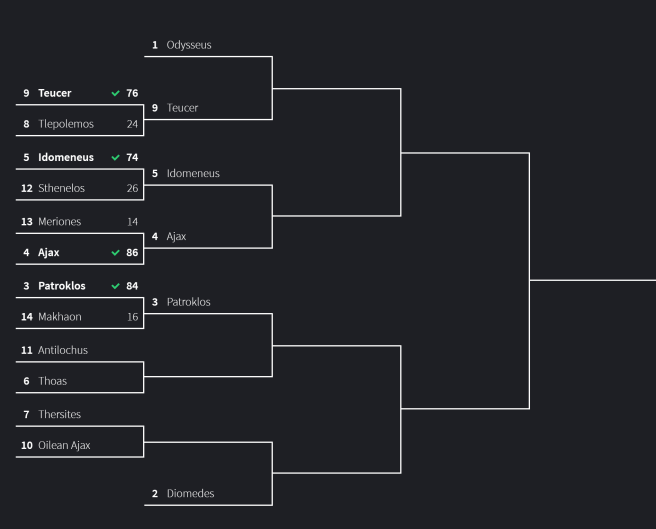
The Achaeans watched with only passing interest as Patroklos and Makhaon began their match. In truth, even the gods found something else to occupy their endless time as Makhaon’s two spears bounced of Patroklos’ (borrowed) shield. Patroklos, too, seemed half invested, quipping weakly, “Makhaon, even in healing you’re second best at the fight” (δεύτερον ἄριστος μάχεσθαι*). Patroklos landed his first javelin into Makhaon’s right shoulder and Asklepios’ son yielded the fight. His brother Podaleirios came over to tend the wound.
*A rather obvious pun since makhesthai (“to fight”) sounds like Makhaon. Achilles later told him that he could have joked about how he was better at using a blade (makhaira) to heal than fight.
Now we turn to the best match of the tournament so far: Antilochus, Nestor’s son, vs. Thoas the Aitolian
Antilochus, the son of Nestor kills his first man in book four of the Iliad (457), he fights alongside Menelaos (5.577) and is a major part of the Greek offensive throughout books 5 and 13: in book 15 Menelaos marks him out, saying “other Greek is younger than you / is faster on his feet or as brave in battle as you are!” (᾿Αντίλοχον δ’ ὄτρυνε βοὴν ἀγαθὸς Μενέλαος· /᾿Αντίλοχ’ οὔ τις σεῖο νεώτερος ἄλλος ᾿Αχαιῶν, 15.568-569). And his swift feet carry him out of the battle to carry Achilles the news of Patroklos’ death (book 17). He is also memorable for his appearance in the funeral games where he is the audience for his father’s enigmatic instructions about the chariot race (12.305-348). And then part of the drama comes from Menelaos accusing him of cheating (and replaying some of the themes from the argument between Achilles and Agamemnon in Iliad 1). Out side of the Iliad, he is famous from the lost Aethiopis where he dies saving his father from Memnon, inciting Achilles’ rage (leading to Achilles’ death before the walls of Troy).
Antilochus is fast, he’s got the advice of Nestor and the favor of Achilles
Thoas the Aitolian, son of Andraimon, may be the youngest of the council of elders (after Achilles) and one of the Iliad’s best kept secrets (I may have some money on this one). One might imagine him a kind of replacement Diomedes, since he rules in Aitolia (the kingdom Tydeus was expelled from) and has some murky mythographical ties to Odysseus. At a critical moment in the epic, he stands up and is marked out as “best of the Aitolians at the spear / and in close combat but few of the Achaeans / could conquer him in the agora, whenever the young men struggled over speeches” (Αἰτωλῶν ὄχ’ ἄριστος ἐπιστάμενος μὲν ἄκοντι / ἐσθλὸς δ’ ἐν σταδίῃ· ἀγορῇ δέ ἑ παῦροι ᾿Αχαιῶν / νίκων, ὁππότε κοῦροι ἐρίσσειαν περὶ μύθων· 15.281–285).
Two young heroes. One with ties to Achilles, another linked to Odysseus. Two Achaeans enter, one man leaves. Who will it be?
“So I resolved to read history, philosophy, economics, and things like that; and I wrote to my mother asking for such books as I had heard of on these topics. She responded with alacrity, and every month the mail brought me a substantial package of what I thought were standard works. In history I decided to begin with Gibbon. Someone had told me that my father had read Gibbon with delight; that he knew whole pages of it by heart, and that it had greatly affected his style of speech and writing. So without more ado I set out upon the eight volumes of Dean Milman’s edition of Gibbon’s Decline and Fall of the Roman Empre. I was immediately dominated both by the story and the style. All through the long glistening middle hours of the Indian day, from when we quitted stables till the evening shadows proclaimed the hour of Polo, I devoured Gibbon. I rode triumphantly through it from end to end and enjoyed it all. I scribbled all my opinions on the margins of the pages, and very soon found myself a vehement partisan of the author against the disparagements of his pompous-pious editor. I was not even estranged by his naughty footnotes. On the other hand the Dean’s apologies and disclaimers roused my ire.”
“Phalaris, after Peristhenes sent him the wives of Euboulos and Aristophantes who had conspired against them so they might die, asked the women if they had known about the conspiracy their husbands planned. They said that not only did they know about it, but that they had begged them to kill the tyrant. And when he asked in turn what evil this was for, they responded, “It is nothing personal, but for a communal injustice. For it is a communal crime when a free state is enslaved.”
He followed up with another question, “What fate did you meet? For you would certainly pay a deserved penalty for your hatred…” and they interrupted, “if we died.” This stalled his anger because he was amazed by the extreme nobility of these answers and judged that women who were prepared to die with such uprightness should live instead of dying.”
Very few of the Greeks paid much attention to yesterday’s match sending Meriones against the bulwark of the Achaeans, since most assumed that Meriones would be expire in no more than a few words.
The Cretan captain, however, saved his breath and tried to outdance the larger Salaminian. He darted left to right, throwing his spears and having them glance off the massive shield of Telamon’s son. Ajax stood rather impassively, parrying thrusts and waiting until Meriones ran straight at him before he locked his hands together and swung them directly into the Cretan’s chest. The ax-swing blow launched him into the air. When he hit the ground, his armor rattled around him like dice in a jar.
As he struggled to get up to his elbows, Idomeneus bellowed with a laugh, “Charioteer, my brother, stay down before you get blood on the ground!*”
*A joke: in Greek, Idomeneus said… πρὶν ἐκχεῖν αἵμα ἐπ’ αἶαν, using the word aia-n for “ground” which sounds a lot like Aias, the son of Telamon.
Now we turn to a strange match-up: Patroklos son of Menoitios vs. Makhaon the son of Asklepios. Perhaps this is why Apollo dislikes him?
Patroklos: the son of Menoitios who fights alongside his angrier half, Achilles. He is not originally from Phthia, but grew up there in exile from Opos after he killed a child his own age in anger over a game of dice. He appears by Achilles’ side throughout the Iliad until he takes his place in battle and falls at Hektor’s hands (helped by Apollo and Euphorbos). He even patiently listens to Achilles’ singing (Πάτροκλος δέ οἱ οἶος ἐναντίος ἧστο σιωπῇ, / δέγμενος Αἰακίδην ὁπότε λήξειεν ἀείδων, 9.190-191).
Patroklos does everything for Achilles: he gives Briseis back, he makes food, he has a bed made up for Phoinix, he goes to see about Makhaon’s wound, and he leads the Myrmidons to Battle, and dies for him. (But he is not listed as one of the leaders of the Myrmidons in the Catalogue of Ships). In battle he’s a terror: he kills Sarpedon and almost breaks through the walls of Troy themselves. Before he dies he may just be the only one to temper Achilles’ rage: As a scholion states (Schol. BT a Il. 307b) “it is likely that Patroklos goes with Achilles when he is enraged for the purpose of calming his spirit. This is because he is kind, as is clear from the fact that he pities the Acheans” (εἰκότως τῷ ᾿Αχιλλεῖ θυμικῷ ὄντι ἤπιος ὢν Πάτροκλος πάρεστι πρὸς τὸ τὸν θυμὸν αὐτοῦ μαλάσσειν. ὅτι δὲ πρᾷός ἐστι, δῆλον ἐξ ὧν οἰκτείρει τοὺς ᾿Αχαιούς)
Makhaon, a healer and leader of the contingent from Oikhaliê, Trikke and Ithômê (yes, where?) is a son of Asklepios and led 30 ships to Troy. He administered his arts to Menelaos in the middle of battle (book 4) and was enjoying his own aristeia in book 11 until he was shot in the shoulder by Paris. He is so beloved by his companions that when Achilles witnesses his rescue in book 11 he sends Patroklos to inquire about him, setting off the sequence of events that will seal everyone’s fate. Also, Diogenes Laertius lets slip that he just might be Aristotle’s ancestor (Ἀριστοτέλης Νικομάχου καὶ Φαιστίδος Σταγειρίτης. ὁ δὲ Νικόμαχος ἦν ἀπὸ Νικομάχου τοῦ Μαχάονος τοῦ Ἀσκληπιοῦ, καθά φησιν Ἕρμιππος ἐν τῷ Περὶ Ἀριστοτέλους, 5.1).
Let’s be honest. This probably isn’t fair. But it just might come down to how mild a temper Patroklos actually has. Don’t take your feelings out about Aristotle on Makhaon. Diogenes might not trust his sources on this….
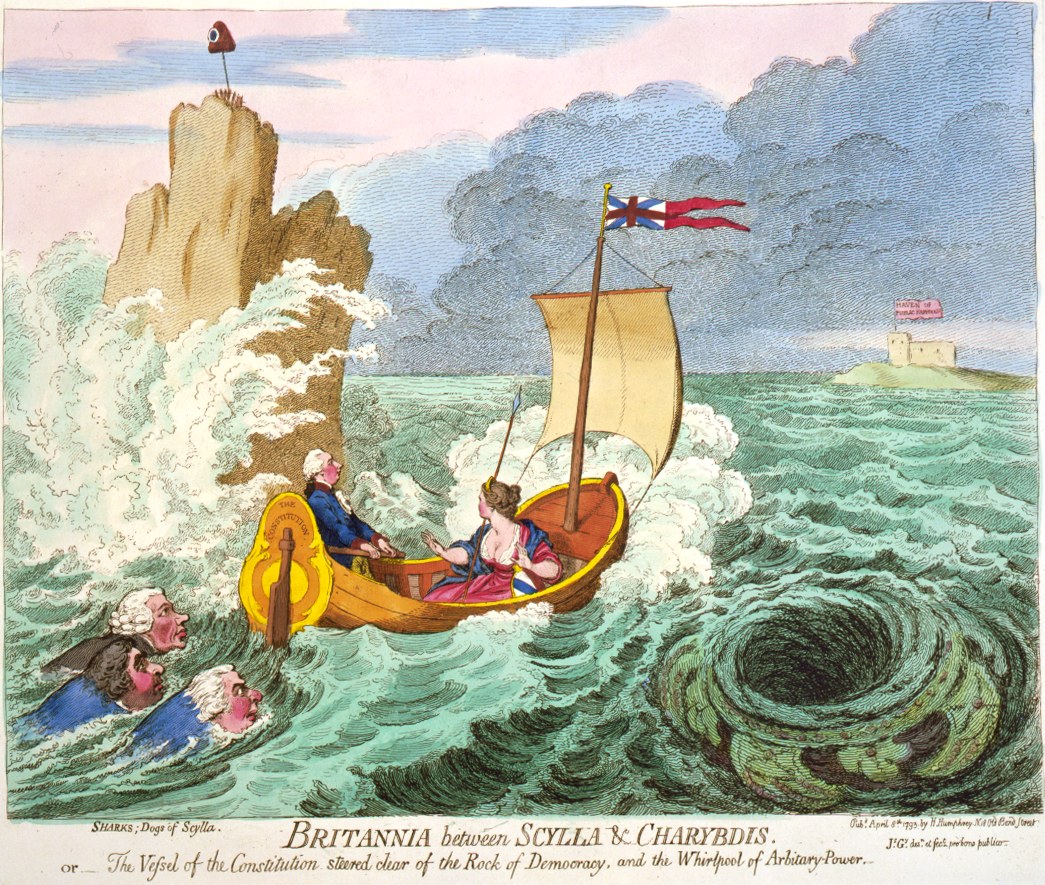
“Avoid Kharybdis and come close to Skyla.” This is similar to the saying, “I avoided it by finding a better evil”
They say about Skyla that she was a Tyrrhenian woman, something if a beast, who was a woman down to the navel but she grew dog heads beneath that point. The rest of her body was a serpent. This kind of a cerature is very silly to imagine. But here is the truth. There were the islands of the Tyrrenians, which used to raid the coasts of Sicily and the Ionian bay. There was a trirereme which had the named Skyla. That trireme used to overtake other ships often and use their food and there was many a story about it. Odysseus fled that ship. trusting a strong and favorable wind and he told this story in Corcyra to Alkinoos, how he was pursued and how he fled and what the shape of the ship was. From these stories, the myth was formed.”
“Charybdis is an obvious name for luxury and endless drinking. Homer has allegorized manifold shamelessness in Skylla, which is why she would logically have a belt of dogs, guardians for her rapacity, daring, and pugnacity. “
“But you, go away from “the smoke and the wave” and depart the ridiculous concerns of mortal life as from that fearsome Charybdis without touching it at all, don’t even, as the people say, brush it with your littlest toe.”
“For satiety seems to be becoming worn out in pleasures from the soul suffering in some way with the body, since the soul does not shirk from its pleasures. But when it is interwoven, as it is said, with the body, it suffers the same things as Odysseus, just as he was held, clinging to the fig tree, not because he desired it or delighted in it, but because he feared Charybdis lurking below him. The soul clings to the body and embraces it in this way not because of goodwill or gratitude but because it fears the uncertainty of death.
As wise Hesiod says, “the gods keep life concealed from human beings.” They have not tied the soul to the body with fleshly bonds, but they have devised and bound around the mind one cell and one guard, our uncertainty and distrust about our end. If a soul had faith in these things—“however so many await men when they die”, to quote Heraclitus—nothing would restrain it at all.”
These are the things, my dearest Martial, which make life happier: possessions not gotten from labor, but left to you; a not ungrateful field, a fireplace always warm; never any strife, rarely putting on the toga, a quiet mind; inborn strength, a healthy body; wise simplicity and equal friends; easy dining, and a simple table; sober nights, but still free of cares; a bed that isn’t sad, but still with its share of modesty; sleep to make the shadows short; to wish to be what you are, and to desire nothing else; not to fear your final day, nor yet to wish for it.
Here is the same epigram translated more poetically by Henry Howard:
My friend, the things that do attain
The happy life be these, I find:
The riches left, not got with pain,
The fruitful ground; the quiet mind;
The equal friend; no grudge, no strife;
No charge of rule nor governance;
Without disease the healthy life;
The household of continuance;
The mean diet, no dainty fare;
True wisdom joined with simpleness;
The night discharged of all care,
Where wine the wit may not oppress;
The faithful wife, without debate;
Such sleeps as may beguile the night:
Content thyself with thine estate,
Neither wish death, nor fear his might.
Vitam quae faciant beatiorem,
Iucundissime Martialis, haec sunt:
Res non parta labore, sed relicta;
Non ingratus ager, focus perennis;
Lis numquam, toga rara, mens quieta; 5
Vires ingenuae, salubre corpus;
Prudens simplicitas, pares amici;
Convictus facilis, sine arte mensa;
Nox non ebria, sed soluta curis;
Non tristis torus, et tamen pudicus; 10
Somnus, qui faciat breves tenebras:
Quod sis, esse velis nihilque malis;
Summum nec metuas diem nec optes.