“This is the third day since I made mention of that comment by Xenocrates in a discussion, that the Athenians rendered a judgment against the man who flayed a ram while it was still alive. But I think that someone who tortures something while it still lives is not worse than the one who kills it. Rather, as it seems to me, we are more sensitive to things that are against common practice than those against nature.
I am also saying these things in a more common way here. But this great, mysterious, and unbelievable matter, as Plato says, is something I am reluctant to frame with the principle of my belief with clever people who are mulling over mortal affairs, just as a captain in a storm pauses before moving his ship or a poet hesitates at raising the machine during the performance of a play.
But it may not be worse also to set the tune and anticipate the theme by using Empedocles’ words. For he allegorizes souls in his lines, suggesting that humans are imprisoned in bodies in order to pay the price for murder, eating flesh, and being cannibals. This belief has an older appearance, however. For there are stories told of the sufferings of Dionysus when he was dismembered and the outrages the Titans committed, how they were punished and struck by lightning after they tasted his blood. This myth is an occult tale about rebirth.”
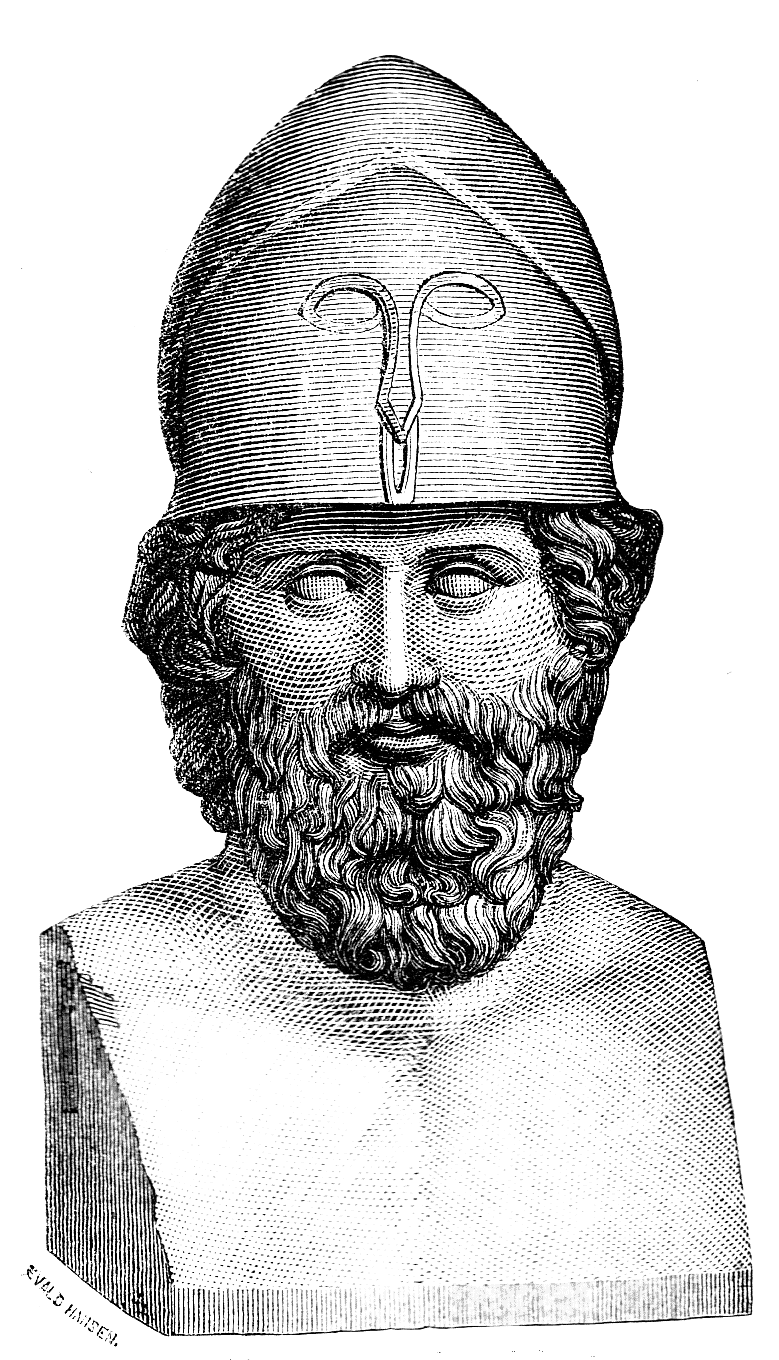
It is said among the Greeks that Themistocles was endowed with a certain incredible greatness of thought and intellect. It is said that once a certain learned man, one of the most educated of his time, approached him and promised to teach him the art of memory, which was then first becoming popular. When Themistocles asked what that could do, the teacher responded that it could make one remember everything. Themistocles responded in turn that the teacher would be doing him a much greater favor if he taught him to forget rather than remember what he wanted. Do you see what force, what a great and powerful mind there was in this man of such sharp intellect? He responded in such a way that we can understand that nothing was ever able to flow out of his mind when once it had gotten in there, since indeed he thought it preferable to be able to forget what he did not want to remember than to remember what he had heard or seen only once.
Ita apud Graecos fertur incredibili quadam magnitudine consili atque ingeni Atheniensis ille fuisse Themistocles; ad quem quidam doctus homo atque in primis eruditus accessisse dicitur eique artem memoriae, quae tum primum proferebatur, pollicitus esse se traditurum; cum ille quaesisset quidnam illa ars efficere posset, dixisse illum doctorem, ut omnia meminisset; et ei Themistoclem respondisse gratius sibi illum esse facturum, si se oblivisci quae vellet quam si meminisse docuisset. Videsne quae vis in homine acerrimi ingeni, quam potens et quanta mens fuerit? Qui ita responderit, ut intellegere possemus nihil ex illius animo, quod semel esset infusum, umquam effluere potuisse; cum quidem ei fuerit optabilius oblivisci posse potius quod meminisse nollet quam quod semel audisset vidissetve meminisse.
There is no one so averse to the Muses that he would not readily submit to having an eternal monument of his own labors made in verse. They say that Themistocles, the chief man in Athens, when he was asked what entertainment or whose voice he would most gladly listen to, responded that he would most gladly hear the voice of the one by whom his own glory was best celebrated. And so, in the same way, Marius esteemed Lucius Plotius, by whose talent he thought that his own accomplishments could be best celebrated.
Neque enim quisquam est tam aversus a Musis, qui non mandari versibus aeternum suorum laborum facile praeconium patiatur. Themistoclem illum, summum Athenis virum, dixisse aiunt, cum ex eo quaereretur, quod acroama aut cuius vocem libentissime audiret: “Eius, a quo sua virtus optime praedicaretur.” Itaque ille Marius item eximie L. Plotium dilexit, cuius ingenio putabat ea quae gesserat posse celebrari.
“When strong winds carry sailors forward
Divergent opinions steering the ship
Or a mob thick with wise men is feebler
Than a single mind with self-control.
In city and under a single
Authority should be one person’s
Whenever we want to find success.”
“My speech is lacking one thing still.
I wish I had the voice in my limbs
And hands and hair and the march of my feet
Or the skills of Daidalos or some god
So I could completely grasp you by your knees
Wailing, laying about you with every kind of argument.
Master, great hope of life for the Greeks,
Heed me—lend an avenging hand to an old woman
Even if she is nothing at all.
For it is right that a good man serve justice
And always do evil everywhere to evil men.”
Agamemnon: Frightening! But I surely can’t trust a woman’s strength.
Hecuba: Why? Didn’t women kill the sons of Aegyptus
And wipe Lemnos clean of all men?
“Listen, put your mind now on true reason.
For a new matter rises fiercely to meet your ears
and a new image of the universe strives to show itself.
Nothing is so simple that at first sight
it is not rather difficult to believe;
and in the same way nothing is so great or miraculous
that over time we don’t slowly fail to behold it with wonder.
Consider first the clear and pure color of the sky
and everything it holds, the wandering stars
the moon and the gleam of the sun with its bright light;
If suddenly mortals now saw all these things
for the first time with no prior experience of them,
could anything possibly be said to be more wondrous
or would the races of men have dared to believe they existed?
Nothing. I believe that is how striking the sight would be.
But now, since we are so used to seeing them,
no one thinks it worthwhile to gaze at heaven’s bright splendor.”
Nunc animum nobis adhibe veram ad rationem.
nam tibi vehementer nova res molitur ad auris
accedere et nova se species ostendere rerum.
sed neque tam facilis res ulla est, quin ea primum
difficilis magis ad credendum constet, itemque
nil adeo magnum neque tam mirabile quicquam,
quod non paulatim minuant mirarier omnes,
principio caeli clarum purumque colorem
quaeque in se cohibet, palantia sidera passim,
lunamque et solis praeclara luce nitorem;
omnia quae nunc si primum mortalibus essent
ex improviso si sint obiecta repente,
quid magis his rebus poterat mirabile dici,
aut minus ante quod auderent fore credere gentes?
nil, ut opinor; ita haec species miranda fuisset.
quam tibi iam nemo fessus satiate videndi,
suspicere in caeli dignatur lucida templa.
This saying is the same or at least as close as possible to what we read in Theocritus’ Travelers: Ὗς ποτ᾽ Ἀθηναίαν ἔριν ἤρισε, that is, A pig has dared to compete with the goddess Minerva. How often the uneducated and the stupid and those prepared for a fight are not afraid to provoke the most eminent men in every discipline to a literary contest. The interpreter of Theocritus says that this saying is circulated among the common people thus: Ὗς ὢν πρὸς Ἀθήνην ἐρίζεις, that is, Though you are a pig, you contend with Minerva. Some scholiast or other adds that those are said to ἐρίζειν who contend with words, and those who content with facts are said to ἐρείδειν. So it’s all the more ridiculous if an unteachable pig vies with Minerva, the custodian of learning.
1.41
SVS CVM MINERVA CERTAMEN SVSCEPIT
Cum hoc aut idem aut certe quam maxime finitimum, quod apud Theocritum legitur in Hodoeporis: Ὗς ποτ᾽ Ἀθηναίαν ἔριν ἤρισε, id est Cum diua est ausus sus decertare Minerua. Quoties indocti stolidique et depugnare parati non verentur summos in omni doctrina viros in certamen literarium prouocare. Theocriti enarrator sic efferri vulgo παροιμίαν scribit: Ὗς ὢν πρὸς Ἀθήνην ἐρίζεις, id est Sus cum sis, cum Minerua contendis. Scholiastes nescio quis addit eos ἐρίζειν dici, qui verbis certant, ἐρείδειν, qui factis, quo magis ridiculum est, si sus indocilis certet cum Minerua disciplinarum praeside.
Stultus, a, um -adj. “Foolish, simple, silly, fatuous”
Stultus, m. “a fool”
Publilius Syrus 451
“It is impossible for one who knows he is a fool not have some intelligence”
Non pote non sapere qui se stultum intellegit.
Dicta Catonis 18
“Be foolish when the time or the affair demands: sometimes to pretend foolishness is the greatest wisdom.”
Insipiens esto, cum tempus postulat aut res: stultitiam simulare loco, prudentia summa est.
Publilius Syrus 692
“Silence works as wisdom for a foolish person”
Taciturnitas stulto homini pro sapientia est.
Lucilius, 19.591
“Finally, nothing is enough for a fool even when he has everything”
Denique uti stulto nil sit satis, omnia cum sint
Publilius Syrus 144
“You make a criminal from a fool by forgiving too much”
Crebro ignoscendo facies de stulto improbum.
Seneca, EM 9.14 [Paraphrasing Chrysippus]
“A fool needs nothing since he knows how to use nothing but wants everything”
Contra stulto nulla re opus est, nulla enim re uti scit, sed omnibus eget
Publilius Syrus 118
“Contempt is harder on the wise than a beating is on a fool”
Contemni gravius est quam stulto percuti.
Macrobius, Saturnalia 1.10
“If someone who wants to buy a horse inspects not the horse itself but its saddle and bridle, he is a fool. Even more foolish is the one who thinks a person can be judged from his clothing or the chance that covers us like clothing.”
quemadmodum stultus est qui empturus equum non ipsum inspicit sed stratum eius ac frenos, sic stultissimus est qui hominem aut ex veste aut ex condicione quae nobis vestis modo circumdata est aestimandum putat.
Publilius Syrus 671
“Fortune makes whomever she wants to destroy into a fool”
Stultum facit Fortuna quem vult perdere
Seneca, EM 58
“Since the danger from living badly is greater than the danger of dying quickly, he is a fool who does not bet the price of a little time on a throw of great gain”
Et cum maius periculum sit male vivendi quam cito moriendi, stultus est, qui non exigua temporis mercede magnae rei aleam redimit.
Publilius Syrus 40
“The wise man rules his spirit, a fool serves his”
Animo imperabit sapiens, stultus serviet.
Ennius, Fr. 306
“It is a fool who, in desiring, desires desirously with a desirous mind.”
Stultus est qui cupida mente cupiens cupienter cupit
“You do huge things for minor reasons—
Listen to me! Why are you hurting me? What’s the reason
What city did I betray? Which child of yours did I kill?
What home did I burn down? I was forced to bed
With my master. You’ll kill me and not him
When he is the cause of these things? You’ll ignore
The cause and just keep pounding on the symptom?”
“Child, I who bore you go to Hades now
So you may not die. If you outrun this fate,
Remember your mother, all I suffered and how I died.
Go to your father and through kisses
Tell him what I died while shedding tears
And throwing your arms around him.
Children are the soul of all humankind—
Whoever has no children mocks them and
While they may feel less pain, feel sadder happiness too”
When these things happen, academic fields face the same challenges we have seen in recent years in film, SFF fiction, and nearly every industry where fame is a commodity that brings power and the cover to abuse with near impunity. We try to cut out the cancer before it does any more damage, but the presence is there for good, in the body. The debate on the existence and merits of ‘cancel culture’ dances around the hard questions of why some people think they’re entitled to fame and why we do in fact have the right to deprive bad actors of financial gain.
But these questions don’t really talk about what happens afterwards. In her 2016 Eidolon piece “Making a Monster”, Sarah Scullin writes about the strange horror of the Holt Parker fiasco, when an author of some influence on ancient sexuality turned out to be a child pornographer, and trying to figure out the balance between cries for a damnatio memoriae and our disciplinary standards of citing work where citation is due.
I have struggled with this question during what seems to be, thanks to our ever restrictive interconnections, the golden age of public assholery. Certain high profile cases of longterm problems suing undergraduates and famous Geniuses stealing papyri have forced me to face the monsters in my bibliography, and the compromises in my acknowledgements. Should I erase the names of people who have broken bad from my forthcoming work? Should I publicly disavow those who helped me in the past?
People and what we make of them
I guess I ask this because, like Scullin in her article, I am not sure of the answer. I incline in part towards not changing a thing, for two reasons. I feel in part that footnotes and acknowledgements to bad men are a kind of disclosure, a owning of the truth that our field is populated by flawed humans like any other. It also attests to the hierarchy of patronage that is central to the academic enterprise. It is a rare person who can make their way in this world without help from someone more experienced and powerful. And, well, power corrupts in all forms. And, well, getting to the top of the academic ladder does not require being a good human being.
So I guess part of the problem is that our performative obeisance exposes us to a chain of associative kleos which, given the tides of time, can go dus- or eu-. But I am also interested in how much of our behavior is based on a static and deeply problematic view of human beings. It is hard for most of us to accept the degree to which persons and personalities are contextual and that in a culture such as ours so much of what we see as signs of character are reactive and transactive negotiations.
A proverb erroneously attributed to Aristotle, “a friend to all is a friend to none”, would seem to indicate that constancy in treatment from one person to another is some kind of a value. In truth, Aristotle seems to come down on the side of not making all the friends in the Nicomachean Ethics 1170e-1171b) where he does say that “people who have many friends and shout familiarly to everyone appear to be friends of no one” (οἱ δὲ πολύφιλοι καὶ πᾶσιν οἰκείως ἐντυγχάνοντες οὐδενὶ δοκοῦσιν εἶναι φίλοι) because Aristotle argues that one significant goal of friendship is the pleasure of sharing each other’s perception of existing and being good.
Is there anyone who is good or bad to everyone they encounter? Indeed, another proverb from ancient Greek—that justice is doing good to your friends and evil to your enemies—would argue the opposite. Why is it so hard for us to comprehend that someone who was kind to us individually was cruel—if not abusive and worse—to someone else? Part of the problem with our response to the fall of great idols is that our shock and surprise runs counter to what we should already know about human beings. We are not stock characters; we are not constant beings; we are, at best, thin veils of temporary will over conflicting insecurities and desire.
Now, I know that pseudo-Lacanian description will gall many, but I would relent only to say that we conflate the reputations we grant to people for work we appreciate or use with the person themself. We make a metonymic error in seeing the kindness done for an individual as a sign of the sum total of a person’s identity. We make people into things they are not and then suffer the paralysis of horror when they turn out to be something different.
Things and what we make of them
For me, this runs up, to, and alongside current conversations about cancel culture. I have written before about my reaction to J. K Rowling being a transphobic trainwreck doing to Hogwart’s what not even Voldemort could achieve. My solution is naively simple: separate the art from the artist. We made Rowling into someone who matters because the world she created matters to us.
Any model of reading and reception that persists in centering the author over the audience is, in my ever so humble opinion, a dangerous distraction from reality rooted in a stubbornly individualistic worldview, steeped partly in monotheism and partly in capitalism (on which, more later). A painting had to be made by someone, of course, but it relies on a syntax of space, color, story, and meaning within and against which the painter operates and whose existence is only completed by the viewer who shares some frames of reference. (And this leaves out the contribution of the laborers who made the canvas and paint, the partner who made the painter’s lunch, the friend who sparked an idea, the custodian who cleans so the painter can paint and so on and so on.)
Literary and academic products draw more on conventions and the contributions of groups, especially audiences, than the individual who brings them to shape in the world. As I talked about probably too much, my favorite metaphor for this from ancient Greece comes from Plato’s Ion, where Socrates explains that a rhapsode (like Ion) is merely one of a series of metal rings that translates the magnetic charge from the “magnet” (which is the Muse or divine power) through a poet, through the rhapsode, to an audience. The one thing I would change about this metaphor is to acknowledge that it is iterative and reflexive. The divine Muse is the sum total of a cultural consciousness, that nearly indescribable shared mind of a language and people particularized in one form of art at one time or another.
Ah, yes, what heady language for academic work! One of the great ironies about the work we do in academia, however, is that despite how collaborative it is, how much it depends on the work of prior scholars, current editors, students, friends and teachers, we mostly credit and prize the individual genius of the scholar who somehow manages to write it down. I tend to thank a lot of people in acknowledgements because I am deeply conscious of my own limitations as a thinker and of how much I have been prompted to think, write, and say by others.
There are different ways to talk about how our minds work with each other. From simple things like cognitive offloading—e.g. couples over time specializing in remembering somethings and not others, relying on each other—to more complex models of group minds and distributed cognition (language etc.), it is clear that not only is no man an island, but each of us is less like a leaf on a tree than a cell in a complex organism. We don’t sense it this way because this is just too big a thought for our limited brains. The human species-wide Dunning-Kruger effect just may be that our individual consciousnesses are for the most part too simple to apprehend how complex we are collectively.
But what if someone is really, really bad? Do we need to socially distance ourselves from bad ideas too?
Where do Ideas come from?
Later, in the same passage of the Ion where he describes the metaphor of a magnet offers as proof the case of Tynnichus, a terrible poet who composed a song everyone loves (Plato, Ion 534d-535a)
“The greatest proof of my argument is Tynnichus of Chalcis who never composed any poem worth remembering except for the paean everyone sings, nearly the most beautiful of all songs, a thing he himself calls “some discovery by the Muses”.
In this example, especially, the god seems to me to demonstrate to us so that there is no doubt, that these poems are not human nor by humans but divine and by the gods and, moreover, that poets aer nother other than interpreters of the gods, inspired in the way that each one is inspired. And the god demonstrated this by having the worst poet compose the finest song.
Tynnichus was, in a way, an original one-hit wonder of ancient Greece. It can indeed make sense to wonder when someone creates a piece of art so impactful that its greatness is universally acknowledged why they fail to ever approach the same heights. We psychoanalyze the artist’s anxiety and fear of failure, that they are suddenly flame-throwing relievers who have lost the strike zone. But perhaps Socrates’ solution is simpler and more elegant. Tynnichus did not compose a great song again because he never composed it to begin with.
Where do great ideas come from? Our answer to this is almost always shaped by what we are already conditioned to look for. We gaze at the biographies of great men. We peer into their minds, looking for the difference that made them greater than others. But our gaze in many cases needs to look outward in time and space.
We give credit for inventions and innovations to individuals despite evidence to the contrary. There is good reason to lend credence to theories of multiple discovery or convergent evolution, showing that the intellectual background and shared conditions of a period can lead individuals like Newton and Leibniz to the same place (calculus!). Convergent evolution shows that similar solutions can develop for similar problems in similar circumstances without assigning genius to one place or another
And as my Brandeis colleague Aparna Baskaran explores in her work, complex systems that appear to have intelligence and intention (from cell movement to blocks of birds) can be explained by physics and mathematics as having neither. We impose agency and genius on the world because this is the way we see it.
Hit those Moneymakers?
“Simonides seems to have been the first to adapt money-making to songs and to compose his works for pay. This is what Pindar says deceptively in his second Isthmian: “For the Muse was not then greedy or out for hire.”
A few weeks ago, a few lines of a song by Micah P. Hinson floated into my head and I went to spotify and started listening. I had not listened to Hinson in years and had nearly forgotten about him. So, I started reading about what had happened to him and discovered pretty quickly that I found him to be quite the objectionable chap. Indeed, so objectionable that I felt uncomfortable using a streaming service to send a fraction of a penny to his bank account. But can we truly buy our way into virtue or out of vice?
One indication of the problem in academia is the way we cite work in most systems: author, date, page. It flattens everything about the process of ideamaking and credits an individual. But the meaning made from that citation has the author of the footnote to thank as well as all the unnamed people who contributed to those ideas. Works have lives far beyond the minds of their authors—imagine if children walked around named Christensen 2010 and Christensen 2011! But citing by article name instead of author would be just a way not talking about the problem
The impetus behind boycotting and de-platforming bad actors is to my mind a good one. It is about depriving harmful people of both the ability to cause further harm and to profit from their harmful action. The melodramatic overreaction to “cancel culture” is in part an entrenched power class’s fragility at being held accountable and in part a panic over what was assumed to be an limitless field of earning. (Although, to be fair, the mobbing part of such cancellation introduces new problems.)
The danger comes in the way we translate our social value into economic worth and how our models of remuneration, citation, and authorship are thoroughly commodified. This is easy for me to see in the proverb “give credit where credit is due,” a saying, perhaps coined by Samuel Adams in 1777 . That word credit from the Latin loan or debt (creditum), according to the OED came through French and Italian conveying both the sense of belief trust and the sense of a loan to be made based on belief and trust.
This overlap between an estimation of moral value and a valuation in financial terms is truly ancient, likely predating Alkaios who famously sings “Man is money—no one poor is noble or honored.” χρήματ᾿ ἄνηρ, πένιχρος δ᾿ οὐδ᾿ εἲς πέλετ᾿ ἔσλος οὐδὲ τιμίος (fr. 360). The conceptual metaphor between reputation and potential financial worth is so ingrained in our culture that we rarely question the logic of rich people deserving their riches. (When we know that great wealth cannot actually be acquired without theft and exploitation.)
Our laws and practices in artistic copyright, intellectual property, publication, patents and more are wholly shaped by the definition of ideas as commodity. Even in the humanities, lines of credit on CVs translate into higher paying jobs, higher wages, better positions. In a school like mine, a book published early in a career might yield no royalties, but the raise I receive of 5% of my salary compounded over 30 years of a career can translate into significant wealth. Our lives (Greek, bioi) are shaped by the translation of our activity into livelihood. And this is one of the most pernicious elisions in our language: the worth of a life in nothing but the value of its work.
To what degree is citing or not citing someone we (or others) find reprehensible about deferred credit, about anxiety over the devaluation of our own esteem. In this, perhaps, is an acknowledgement of the collective nature of our ‘products’ in the risk that others bring us.
“Canceling” a terrible person targets cultural esteem and in many cases may harm them economically. (Although, I think that for someone like Rowling, her income growth will turn merely incremental from exponential.) Because I think poets are not wholly responsible for their poems, I can enjoy the verse of a bad person. But I don’t want to pay for it.
But if citation and mention translates into esteem, what does it mean to talk about the good works of bad people in public? What does it mean to cite the useful article of the shitbird academic? My first answer—to be honest about the field that makes us all complicit in propping up petty and nasty people—does not stand up well to the danger that an unmarked acknowledgment now may translate into future benefit for the person whose work I don’t despise.
Everything’s Coming Up Solon
“People have an ancient famous proverb:
That you should not judge any mortal lives
You can’t see them as good or bad before someone dies
Some of us like to think that the arc of the universe bends towards justice, but instead, I think we’re really talking about a sphere giving in to entropy. Most things get worse, or at least get to be less of what they were, over time. The likelihood of someone you know upsetting or disappointing you overtime is non-negligible. That’s because none of us are consistently anything except for alive, until we’re not.
In the same essay where he declares himself immune to shame over quoting good words from bad authors, Seneca quotes from Publilius Syrus that “whatever can happen to someone else can also happen to you” (cuivis potest accidere quod cuiquam potest, De Tranq. 9). This line is part of an anti-hubris “check yourself before you wreck yourself” ethic, but it also reminds me of Herodotus’ Solon, who warned Croseus not to count a man as lucky before his days have ended
If you live a thoroughly wretched life but your last day is good, does that mean people to come can call you happy, Solon? And if you do mostly good, but have a really bad day, does that undo the good? And can we even manage to think about whether Solon’s notion is about pleasure at your own good and not actually doing good for other people? Clearly, this is not the place to answer this, but it seems likely that at the end of every person’s life we hear something like, “Indeed, Socrates, after all this talk, I guess we still don’t know what happiness is.”
One peril of admiring (or citing) anyone is that over a lifetime we’re all pretty much certain to disappoint. I like to think that Solon’s logic also contains the corollary that if life can turn out badly at the last moment, it can also turn out well. To believe in the possibility of education one must believe that people have the capacity to change. So, perhaps the bad words of a good author will improve and a bad author might turn out to be a better person some day.
But then we are back to the pageantry of withhdrawal and return, of wondering if someone has reformed truly or is merely back in disguise for more lines of credit. What are our limits on forgiveness? How much do we believe in personal growth? Separating the work from the life and the person from work may help liberate us all. And then we can get back to the hard work of living together and understanding ourselves.
“It follows, then, that the most happy person will need to have friends, if he indeed chooses to gaze upon good and appropriate actions. This is what the activities of a good friend are. People also believe that a happy person’s life should be enjoyable. Life is hard for a solitary person. It is not easy to work constantly on your own. It is easier to do with with others and in partnership with them. Activity which is shared—already necessarily pleasant on its own—will be continuous, which is best for a happy person.
[…]
But since the perception of the fact that one is good is desirable and this perception is pleasing on its own, we need to share our friend’s perception that they exist. We achieve this by living together and sharing our words and thoughts. This is exactly what someone might call “living together” for human beings: it does not mean just grazing together like cattle.”






_-_Andromache_Offering_Sacrifice_to_Hector%27s_Shade_-_T05872_-_Tate.jpg)
