Solon Says: Sue Bad Leaders of State

Aeschines, Against Timarchus

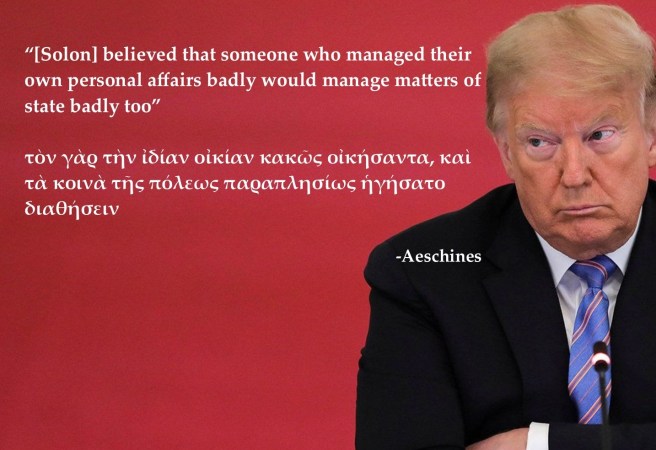
“[Solon] believed that someone who managed their own personal affairs badly would manage matters of state similarly. It did not seem likely to the lawgiver that that the same person who was a scoundrel in private would be a useful citizen in public. He also did not think right that a person should come to speak in public before being prepared for it, not just for words but in life.

And he also thought that advice from a good and noble person, however poorly and simply it was framed, is beneficial to those who hear it, while the words of a person who has no shame, who has made a mockery of his own body and who has shamefully managed his inheritance—well, these words he believed would never help the people who heard them, not even if they were delivered well.

This is why he keeps these kinds of people from the platform, why he forbids them from addressing the public. If someone speaks, then, not merely against these precepts but also for the sake of bribery and criminality, and if the state can no longer endure such a person, he adds “Let any citizens who desires it, and who is able, sue him…”

τὸν γὰρ τὴν ἰδίαν οἰκίαν κακῶς οἰκήσαντα, καὶ τὰ κοινὰ τῆς πόλεως παραπλησίως ἡγήσατο διαθήσειν, καὶ οὐκ ἐδόκει οἷόν τ᾿ εἶναι τῷ νομοθέτῃ τὸν αὐτὸν ἄνθρωπον ἰδίᾳ μὲν εἶναι πονηρόν, δημοσίᾳ δὲ χρηστόν, οὐδ᾿ ᾤετο δεῖν τὸν ῥήτορα ἥκειν ἐπὶ τὸ βῆμα τῶν λόγων ἐπιμεληθέντα πρότερον, ἀλλ᾿ οὐ τοῦ βίου. καὶ παρὰ μὲν ἀνδρὸς καλοῦ καὶ ἀγαθοῦ, κἂν πάνυ κακῶς καὶ ἁπλῶς ῥηθῇ, χρήσιμα τὰ λεγόμενα ἡγήσατο εἶναι τοῖς ἀκούουσι· παρὰ δὲ ἀνθρώπου βδελυροῦ, καὶ καταγελάστως μὲν κεχρημένου τῷ ἑαυτοῦ σώματι, αἰσχρῶς δὲ τὴν πατρῴαν οὐσίαν κατεδηδοκότος, οὐδ᾿ ἂν εὖ πάνυ λεχθῇ συνοίσειν ἡγήσατο τοῖς ἀκούουσι. τούτους οὖν ἐξείργει ἀπὸ τοῦ βήματος, τούτους ἀπαγορεύει μὴ δημηγορεῖν. ἐὰν δέ τις παρὰ ταῦτα μὴ μόνον λέγῃ, ἀλλὰ καὶ συκοφαντῇ καὶ ἀσελγαίνῃ, καὶ μηκέτι τὸν τοιοῦτον ἄνθρωπον δύνηται φέρειν ἡ πόλις, “Δοκιμασίαν μέν,” φησίν, “ἐπαγγειλάτω Ἀθηναίων ὁ βουλόμενος, οἷς ἔξεστιν,” ὑμᾶς δ᾿ ἤδη κελεύει

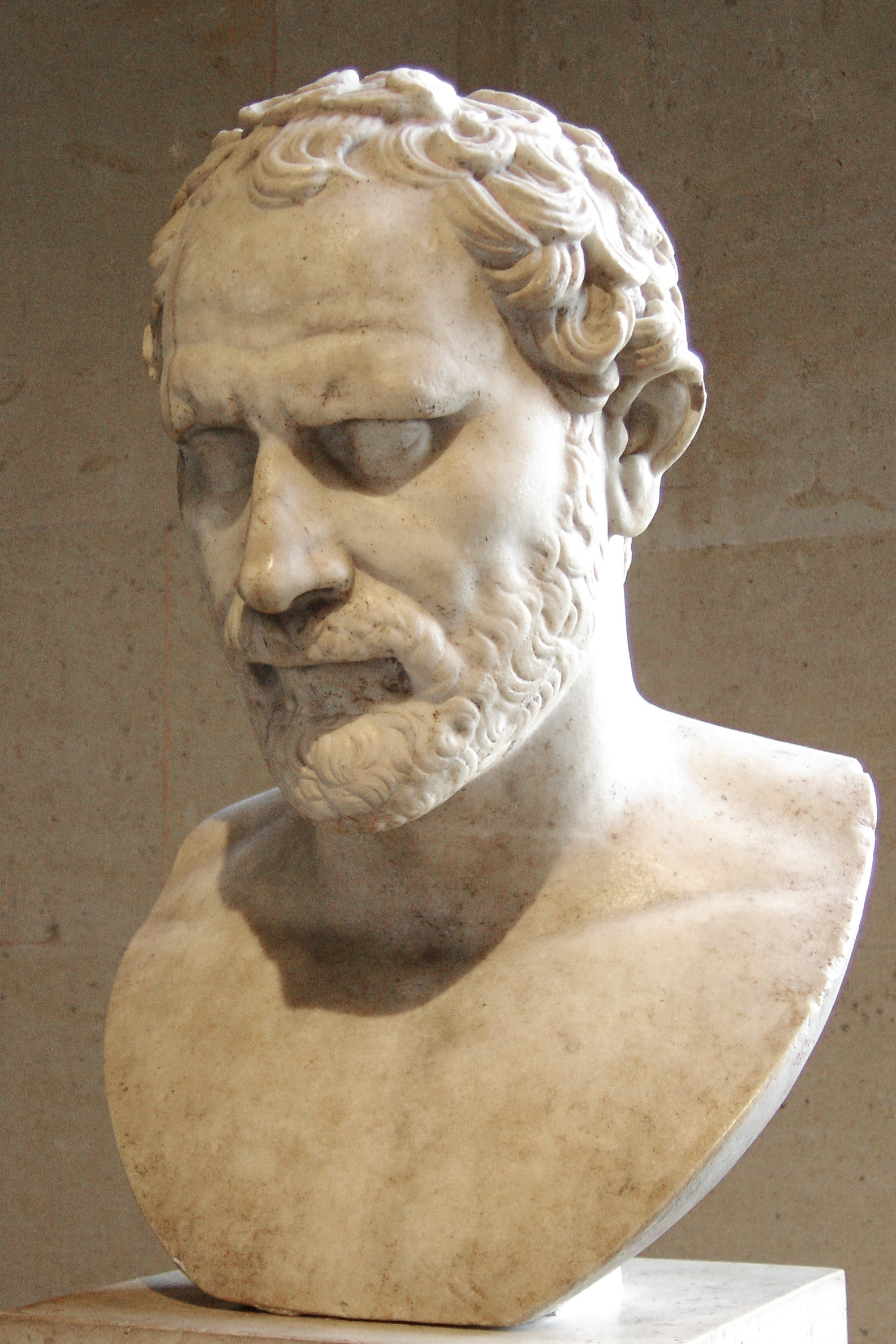
File:Portrait bust of Sophocles on Herm (known as Solon)-Uffizi.jpg
Bust Labeled “Solon” but Probably actually Sophocles. Sue Me.

4 Years of Presidential Memories: People-eating, Tyrant-Loving, Money-Makers and More Useful Greek Compounds

δημεχθής, “hated by the people”
δήμευσις, “confiscation of property”
δημοβόρος, “people devouring”
δημοκόλαξ, “people-flatterer”
δημοπίθηκος, “charlatan”

“You are a people eating king who rules over nobodies”

δημοβόρος βασιλεὺς ἐπεὶ οὐτιδανοῖσιν ἀνάσσεις, Hom. Il. 1.231

τυραννεῖον, “a tyrant’s home”
τυραννοδαίμων, “a superhuman tyrant”
τυραννοδιδάσκαλος, “teacher of tyrants”
τυραννοποιός, “tyrant maker”
τυραννοφόνος, “tyrant slayer”
φιλοτύραννος, “tyrant-lover”

For the etymology of tyrant….

“Bring down a people-eating tyrant however you desire
No criticism for this comes from the gods”

δημοφάγον δὲ τύραννον ὅπως ἐθέλεις κατακλῖναι
οὐ νέμεσις πρὸς θεῶν γίνεται οὐδεμία, Theognis, fr. 1181-2

“Money makes the man. A poor man isn’t noble or honored…”

χρήματ’ ἄνηρ, πένιχρος δ’ οὐδ’ εἲς πέλετ’ ἔσλος οὐδὲ τίμιος, Alcaeus fr. 360

χρηματαγωγός, “money-carrier”
χρηματιστής, “money-maker”
χρηματοδαίτης , “money distributing”
φιλοχρματός, “money-lover”

“Money finds men friends
and honor too, and, at the last,
the seat of power nearest heaven.
No one, truly, is an enemy to money;
Anyone who is denies his hatred.
Wealth is skilled at creeping into places
High and low, places where a poor man,
Even if he enters, cannot get what he wants.
A body that is malformed, wealth makes attractive;
A senseless man, wealth makes wise.”

τὰ χρήματ’ ἀνθρώποισιν εὑρίσκει φίλους,
αὖθις δὲ τιμάς, εἶτα τῆς ὑπερτάτης
τυραννίδος θακοῦσιν ἀγχίστην ἕδραν.
ἔπειτα δ’ οὐδεὶς ἐχθρὸς οὔτε φύεται
πρὸς χρήμαθ’ οἵ τε φύντες ἀρνοῦνται στυγεῖν.
δεινὸς γὰρ ἕρπειν πλοῦτος ἔς τε τἄβατα
καὶ †πρὸς τὰ βατά†, χὠπόθεν πένης ἀνὴρ
οὐδ’ ἐντυχὼν δύναιτ’ ἂν ὧν ἐρᾷ τυχεῖν.
καὶ γὰρ δυσειδὲς σῶμα καὶ δυσώνυμον
γλώσσῃ σοφὸν τίθησιν εὔμορφόν τ’ ἰδεῖν, Soph. Frag. 88

File:Greek Silver Tetradrachm of Athens (Attica).jpg
From Wikimedia Commons

Philosophical Benefits and Warnings

Seneca, Moral Epistle 5.4

“The first thing philosophy promises is a shared communion, humanity and friendship with others. Our differences from others will keep us from this promise. We must examine that those very values through which we hope to create admiration do not become laughable and hateful”

Hoc primum philosophia promittit, sensum communem,humanitatem et congregationem. A qua professione dissimilitudo nos separabit. Videamus, ne ista, per quae admirationem parare volumus, ridicula et odiosa sint.

Orphica fr. 334

“I will sing to those who understand: blockheads, close your doors.”
ἀείσω ξυνετοῖσι, θύρας δ᾿ ἐπίθεσθε βεβήλοι

Epicurus’ Maxims

“Nature’s wealth is the finest and easiest to obtain. But the ‘wealth’ of empty beliefs trails endlessly away.”

XV. ῾Ο τῆς φύσεως πλοῦτος καὶ ὥρισται καὶ εὐπόριστός ἐστιν· ὁ δὲ τῶν κενῶν δοξῶν εἰς ἄπειρον ἐκπίπτει.

On Melissos, Diogenes Laertius, 9.24

“It seemed to him that all of creation was boundless, unchangeable, unmoveable, and a single thing, uniform and multiple. That there was no actual movement, only the appearance of motion. He also thought we should not talk about the gods since we have no knowledge about them.”

Ἐδόκει δ᾽ αὐτῷ τὸ πᾶν ἄπειρον εἶναι καὶ ἀναλλοίωτον καὶ ἀκίνητον καὶ ἓν ὅμοιον ἑαυτῷ καὶ πλῆρες: κίνησίν τε μὴ εἶναι, δοκεῖν δ᾽ εἶναι. ἀλλὰ καὶ περὶ θεῶν ἔλεγε μὴ δεῖν ἀποφαίνεσθαι: μὴ γὰρ εἶναι γνῶσιν αὐτῶν.

Diogenes of Apollonia (D. L. 9.57)

“Diogenes believed these things: that the first principle is air, there are endless universes and empty space.

     ᾿Εδόκει δὲ αὐτῷ τάδε· στοιχεῖον εἶναι τὸν ἀέρα, κόσμους ἀπείρους καὶ κενὸν ἄπειρον·

Image result for Ancient Philosophy medieval manuscript

A Natural Fix for the Public Housing Crisis

Strabo 16

“The Khelônophagoi live underneath turtle shells that are big enough to sail in too. Some of them, because a lot of seaweed is cast onto the shore and makes piles as high as hills, dig into them and live inside. They dispose of corpses as food for fish by allowing them to be drawn away in the high tides.

Three islands are situated in a row: they are named Turtle Island, Seal Island, and Hawk Island. The whole shoreline has palm-trees, olive trees, and laurels and this is not just in the straits but on the outside too. There is a certain Philip’s island, facing which, above the coastline, is a hunting preserve for elephants which is called Pythangelos’ Hunting Ground.

Next to this is Arsinoê which has a city and harbor and beyond these, to Deirê above which is another hunting preserve for elephants. The land right above Deirê is rich in aromatics: the first part part produces myrrh—and it is the land of the Fish-Eaters and Meat-Eaters—and it also produces persea and the Egyptian sykamin. Beyond this land is Likha, another hunting ground for elephants. Frequently there are pools of rain water in the region and when these dry, the elephants dig with their tusks and teeth and uncover water.

On that coast, there are two enormous lakes extending up as far as the Pytholaian headland. One of them has salt water and they call it a sea; the other is fresh and contains both hippopotamuses and crocodiles. It also has papyrus on its shores. People also find the Ibis around this lake. Starting near the Pytholaus, the people who live there have unblemished bodies….”

  1. Οἱ δὲ Χελωνοφάγοι τοῖς ὀστράκοις αὐτῶν σκεπάζονται μεγάλοις οὖσιν, ὥστε καὶ πλεῖσθαι ἐν αὐτοῖς· ἔνιοι δὲ τοῦ φύκους ἀποβεβλημένου πολλοῦ καὶ θῖνας ὑψηλὰς καὶ λοφώδεις ποιοῦντος, ὑπορύττοντες ταύτας ὑποικοῦσι. τοὺς δὲ νεκροὺς ῥίπτουσι τροφὴν τοῖς ἰχθύσιν, ἀναλαμβανομένους ὑπὸ τῶν πλημμυρίδων. τῶν δὲ νήσων τινὲς τρεῖς ἐφεξῆς κεῖνται, ἡ μὲν Χελωνῶν, ἡ δὲ Φωκῶν, ἡ δ᾿ Ἱεράκων λεγομένη· πᾶσα δ᾿ ἡ παραλία φοίνικάς τε ἔχει καὶ ἐλαιῶνας καὶ δαφνῶνας, οὐχ ἡ ἐντὸς τῶν στενῶν μόνον, ἀλλὰ καὶ τῆς ἐκτὸς πολλή. ἔστι δέ τις καὶ Φιλίππου νῆσος, καθ᾿ ἣν ὑπέρκειται τὸ Πυθαγγέλου καλούμενον τῶν ἐλεφάντων κυνήγιον· εἶτ᾿ Ἀρσινόη πόλις καὶ λιμήν, καὶ μετὰ ταῦτα ἡ Δειρή· καὶ τούτων ὑπέρκειται θήρα τῶν ἐλεφάντων. ἀπὸ δὲ τῆς Δειρῆς ἡ ἐφεξῆς ἐστιν ἀρωματοφόρος, πρώτη μὲν ἡ τὴν σμύρναν φέρουσα (καὶ αὕτη μὲν Ἰχθυοφάγων καὶ Κρεοφάγων), φύει δὲ καὶ περσέαν καὶ συκάμινον Αἰγύπτιον· ὑπέρκειται δὲ ἡ Λίχα θήρα τῶν ἐλεφάντων· πολλαχοῦ δ᾿ εἰσὶ συστάδες τῶν ὀμβρίων ὑδάτων, ὧν ἀναξηρανθεισῶν οἱ ἐλέφαντες ταῖς προβοσκίσι καὶ τοῖς ὀδοῦσι φρεωρυχοῦσι καὶ ἀνευρίσκουσιν ὕδωρ. ἐν δὲ τῇ παραλίᾳ ταύτῃ μέχρι τοῦ Πυθολάου ἀκρωτηρίου δύο λίμναι εἰσὶν εὐμεγέθεις· ἡ μὲν ἁλμυροῦ ὕδατος, ἣν καλοῦσι θάλατταν, ἡ δὲ γλυκέος, ἣ τρέφει καὶ ἵππους ποταμίους καὶ κροκοδείλους, περὶ τὰ χείλη δὲ πάπυρον· ὁρῶνται δὲ καὶ ἴβεις περὶ τὸν τόπον. ἤδη δὲ καὶ οἱ πλησίον τῆς ἄκρας τῆς Πυθολάουτὰ σώματα ὁλόκληροί

Related image
Silver Turtle Stater from Aigina

Four Years of Presidential Memories:…Simon Knows Me: A Proverb for Our Times

From Michael Apostolios, Paroemiographer

“I know Simôn and Simôn knows me.” There were two leaders, Nikôn and Simôn. Simone overpowered him because he was a man of the worst ways and it is said that he erased all memory of Nikôn. This proverb is used for people who recognize the evil in one another.”

Οἶδα Σίμωνα καὶ Σίμων ἐμέ: δύο ἐγένοντο ἡγεμόνες, Νίκων καὶ Σίμων. ὑπερίσχυσε δὲ ὁ Σίμων κακοτροπώτατος ὢν, ὥστε καὶ τὴν ἐπὶ Νίκωνα φήμην ἀπαλεῖψαι. λεχθείη δ’ ἂν ἡ παροιμία ἐπὶ τῶν ἀλλήλους ἐπὶ κακίᾳ γινωσκόντων.

From the Suda,  tau 293

“Telkhines: evil gods. Or jealous and harmful humans. There were two Telkhines, Simôn and Nikôn. Nikôn overpowered to erase the memory of Simôn. So, there is the proverb, “I know Simon and Simon knows me. This is used for those who recognize evil in one another.”

Τελχῖνες: πονηροὶ δαίμονες. ἢ ἄνθρωποι φθονεροὶ καὶ βάσκανοι. δύο ἐγένοντο Τελχῖνες, Σίμων καὶ Νίκων. ὑπερίσχυσε δὲ ὁ Νίκων τὴν ἐπὶ Σίμωνι φήμην ἀπαλεῖψαι. καὶ παροιμία· οἶδα Σίμωνα καὶ Σίμων ἐμέ. ἐπὶ τῶν ἀλλήλους ἐπὶ κακίᾳ γινωσκόντων.

Zenobius explains it all

“I know Simôn and Simôn knows me”: There were two leaders who were evil Telkhinians by birth—for they were making the land infertile by spraying it with water from the Styx. They were Simôn and Nikôn. Simon overpowered because he was the most evil in his ways with the result that he erased any memory of Nikôn. For this reason in the proverb they only name Simôn. The proverb is applied to those who recognize the evil in one another.”

Οἶδα Σίμωνα καὶ Σίμων ἐμέ: Τελχίνων φύσει βασκάνων ὄντων, (καὶ γὰρ τῷ τῆς Στυγὸς ὕδατι τὴν  γῆν καταῤῥαίνοντες ἄγονον ἐποίουν,) δύο ἐγένοντο ἡγεμόνες, Σίμων καὶ Νίκων. ῾Υπερίσχυε δὲ ὁ Σίμων κακοτροπώτατος ὢν, ὥστε τὴν ἐπὶ Νίκωνι φήμην ἀπαλεῖψαι. Διόπερ οἱ παροιμιαζόμενοι μόνον τὸν Σίμωνα ὀνομάζουσι. Λεχθείη δ’ ἂν ἡ παροιμία ἐπὶ τῶν ἀλλήλους ἐπὶ κακίᾳ γινωσκόντων.

Sigma 447 [A completely different Simon]

“Simôn, Simonos: a proper name and also a proverb: “No one is more thieving that Simôn.” And Aristophanes adds that whenever [people] see Simôn, they immediately turn into wolves. He was a Sophist who took public property for his own. Simôn and Theoros and Kleonymos are perjurers. Aristophanes has, “if a thunderbolt hits perjurers, how did it not burn Simôn, or Kleônumos or Theôros?”

Σίμων, Σίμωνος: ὄνομα κύριον. καὶ παροιμία· Σίμωνος ἁρπακτικώτερος. ᾿Αριστοφάνης· ὅταν ἴδωσι Σίμωνα, λύκοι ἐξαίφνης γίνονται. σοφιστὴς δὲ ἦν, ὃς τῶν δημοσίων ἐνοσφίζετο. Σίμων καὶ Θέωρος καὶ Κλεώνυμος, οὗτοι ἐπίορκοι. ᾿Αριστοφάνης· εἴπερ βάλλει τοὺς ἐπιόρκους ὁ κεραυνός, πῶς δῆτ’ οὐχὶ Σίμων’ ἐνέπρησεν οὐδὲ Κλεώνυμον οὐδὲ Θέωρον; καί τοι σφόδρα γ’ εἰσὶν ἐπίορκοι.

Image result for trump looking at putin
This was too easy…

Bold Assertion of Bovine Insertion

Historia Augusta, Macrinus (12)

“Macrinus was arrogant, bloodthirsty, and eager to rule like a general, complaining about the discipline of earlier times and praising Severus alone above all other emperors. For he often crucified his soldiers and afflicted them with the punishments reserved for slaves. When he experienced mutinies of the soldiers, he often subjected them to decimation*, and sometimes to centimation. This latter word was his own invention, which he used to demonstrate his clemency, since he was only centimating the soldiers who were really worth of decimation or vicesimation.

It would be tedious to relate all of his cruelties, yet I will record one which, though it was not (as he thought) the greatest, was yet sadder than all of his other tyrannical evils. When some soldiers had violated the slavemaiden of their host who had long been of dubious moral character, Macrinus learned of it through one of his secret spies. He had the men brought before him and asked whether they had committed the crime. When it had been proven, Macrinus ordered two live bulls of immense size to be cut open, and for these two soldiers to be inserted into them with their heads poking out so that they could speak with each other. And so he afflicted them with this punishment because such punishments had not been established for adulterers either in the pastor even in his own time.”

*decimation = killing of every tenth man; centimation (perhaps centesimation?) = killing of every hundredth man; vicesimation = killing of every twentieth man

Image result for macrinus

Fuit igitur superbus et sanguinarius et volens militariter imperare, incusans quin etiam superiorum temporum disciplinam ac solum Severum prae ceteris laudans. Nam et in crucem milites tulit et servilibus suppliccis semper adfecit et, cum seditiones militares pateretur, milites saepius decumavit, aliquando etiam centesimavit, quod verbum proprium ipsius est, cum se clementem diceret, quando eos centesimaret, qui digni essent decimatione atque vicensimatione. Longum est eius crudelitates omnes aperire, attamen unam ostendam non magnam, ut ipse credebat, sed omnibus tyrannicis inmanitatibus tristiorem. Cum quidam milites ancillam hospitis iam diu pravi pudoris affectassent atque per quendam frumentarium ille didicisset, adduci eos iussit interrogavitque, utrum esset factum. Quod cum constitisset, duos boves mirae magnitudinis vivos subito aperiri iussit atque his singulos milites inseri capitibus, ut secum conloqui possent, exertis; itaque poena eos affecit, cum ne adulteris quidem talia apud maiores vel sui temporis essent constituta supplicia.

4 Years of Presidential Memories: Some Relevant Passages Submitted by Friends

We asked for apt inauguration week quotations from friends on Facebook. Here they are. Favorites? New Suggestions?

Silius Italicus, Punica 11.183-4 (From Neil Bernstein)

“Shall I put up with a leader whose sword now stands in place of justice and treaties and whose only praises stem from bloodshed?”

ductoremque feram, cui nunc pro foedere proque
iustitia est ensis solaeque e sanguine laudes?

 Sophocles, Ant. 175-77 (Al Duncan)

“It is impossible to gain a full understanding of any man’s moral nature (psûche), mentality (phronêmà), or judgement (gnome) until he has shown himself exercising the functions of ruler and law-giver.”

ἀμήχανον δὲ παντὸς ἀνδρὸς ἐκμαθεῖν
ψυχήν τε καὶ φρόνημα καὶ γνώμην, πρὶν ἂν
ἀρχαῖς τε καὶ νόμοισιν ἐντριβὴς φανῇ

Arist. Eth. Nic. 5.1130a

“There are many people who can exercise virtue in their own affairs, but are unable to do so in their relations with others. This is why the aphorism of Bias, “Office will reveal the man”, seems a good one, since an official is, by virtue of his position, engaged with other people and the community at large’ (trans. R. Crisp, Aristotle. Nicomachean Ethics)

(Note: Fragment also attributed to Chilon) πολλοὶ γὰρ ἐν μὲν τοῖς οἰκείοις τῇ ἀρετῇ δύνανται χρῆσθαι, ἐν δὲ τοῖς πρὸς ἕτερον ἀδυνατοῦσιν. καὶ διὰ τοῦτο εὖ δοκεῖ ἔχειν τὸ τοῦ Βίαντος, ὅτι ἀρχὴ ἄνδρα δείξει· πρὸς ἕτερον γὰρ καὶ ἐν κοινωνίᾳ ἤδη ὁ ἄρχων.

Soph. Ant. 707-9

“For if anyone believes that only he has good sense (phronein), or has powers of speech (glossa) or moral quality (psûche) unlike any other – such people, when they’re laid open, are seen to be empty.

ὅστις γὰρ αὐτὸς ἢ φρονεῖν μόνος δοκεῖ,
ἢ γλῶσσαν, ἣν οὐκ ἄλλος, ἢ ψυχὴν ἔχειν,
οὗτοι διαπτυχθέντες ὤφθησαν κενοί.

Heraclitus, fr. 44 (Edward McEneely)

“The people must fight for law just as they would for the walls”

μάχεσθαι χρὴ τὸν δῆμον ὑπὲρ τοῦ νόμου ὅκωσπερ τείχεος — Heraclitus

Publilius Syrus (My Sister)

“He conquers who conquers himself.”

Vincit qui se vincit.

[Adaptation of Publilius Syrus: Bis vincit qui se vincit in victoria  “He conquers twice who conquers himself when he is victorious”]

Sallust, Iug. 35.10 (Jim O’Hara)  

“yonder lies a city up for sale, and woe unto it when it finds a buyer.”

Iug. 35.10 sed postquam Roma egressus est, fertur saepe eo tacitus respiciens postremo dixisse: ‘urbem venalem et mature perituram, si emptorem invenerit.’

Vergil, Aeneid 1.203 (William Tortorelli) 

“One day we’re going to look back on even this and laugh (maybe).”

forsan et haec olim meminisse iuvabit.

Thucydides 3.82, (Jonathan MacLellan)

“Many terrible things happened to the cities during the revolution, as it always has been and always will be, as long as human nature is the same, although it sometimes takes a harsher or more mild form as the changes arise in different cities. During peace and times of abundance, cities and individual citizens have better ideas since they do not experience the compulsion of scarcity. But war, in depriving them of their daily needs, is a forceful teacher, and makes the character of most people equal to their present conditions.”

[2] καὶ ἐπέπεσε πολλὰ καὶ χαλεπὰ κατὰ στάσιν ταῖς πόλεσι, γιγνόμενα μὲν καὶ αἰεὶ ἐσόμενα, ἕως ἂν ἡ αὐτὴ φύσις ἀνθρώπων ᾖ, μᾶλλον δὲ καὶ ἡσυχαίτερα καὶ τοῖς εἴδεσι διηλλαγμένα, ὡς ἂν ἕκασται αἱ μεταβολαὶ τῶν ξυντυχιῶν ἐφιστῶνται. ἐν μὲν γὰρ εἰρήνῃ καὶ ἀγαθοῖς πράγμασιν αἵ τε πόλεις καὶ οἱ ἰδιῶται ἀμείνους τὰς γνώμας ἔχουσι διὰ τὸ μὴ ἐς ἀκουσίους ἀνάγκας πίπτειν: ὁ δὲ πόλεμος ὑφελὼν τὴν εὐπορίαν τοῦ καθ᾽ ἡμέραν βίαιος διδάσκαλος καὶ πρὸς τὰ παρόντα τὰς ὀργὰς τῶν πολλῶν ὁμοιοῖ.

Tacitus’ Agricola 42 (Theo Nash)
“Let those in the habit of admiring the flouting of authority know that there can be great men, even under bad rulers.”
sciant, quibus moris est inlicta mirari, posse etiam sub malis princibus magnos viros esse
Cicero (Thomas Klugh)
“Few men desire wisdom”
Pauci viri sapientiae student
Horace, Odes 3.30 (Gabriele Alfinito)
“I will not die, completely”
Non omnis moriar, Horace
Neo-Latin (Mark Clark)
“Don’t let the bastards get you down”
Non illegitimi carborundum
Horace, Epistles 1.14.13
“The fault lies in the mind that never escapes itself”
In culpa est animus, qui se non effugit umquam

Four Years of Presidential Memories: Thunderous-Mouth-Milling and Petty-Bragging, Some Words for a Thursday

The Suda has the following anecdote which seems to be taken and altered from Diogenes Laertius or something similar.

“thunderous-mouth-milling”: Eubulides says this “the eristic, asking his horn questions and discombobulating the orators with his falsely-intellectual arguments, taking with him the “thunderous-mouth-milling” of Demosthenes.

Ῥομβοστωμυλήθρα: Εὐβουλίδης φησίν: οὑριστικὸς κερατίνας ἐρωτῶν καὶ ψευδαλαζόσιν λόγοις τοὺς ῥήτορας κυλίων ἀπῆλθ’, ἔχων Δημοσθένους τὴν ῥομβοστωμυλήθραν.

ῥομβοστωμυλήθρη (lit. “thunderous-mouth-milling” (?) seems to be a misunderstanding or humorous take on ῥωποπερπερήθρη, usually translated as “braggadocio” but is more like “cheap/petty bragging”

From Diogenes Laertius, Lives of the Eminent Philosophers 2.10

“The eristic Euboulides, asking questions about horns
And discombobulating the speakers with his falsely-intellectual arguments
Has gone off, taking the petty self regard of Demosthenes with him

For it seems that Demosthenes was a student of Eubulides and was able to stop his problems with the letter ‘r’ because of it. Eubulides was also in conflict with Aristotle and undermined him a lot.

οὑριστικὸς δ᾿ Εὐβουλίδης κερατίνας ἐρωτῶν
καὶ ψευδαλαζόσιν λόγοις τοὺς ῥήτορας κυλίων
ἀπῆλθ᾿ ἔχων Δημοσθένους τὴν ῥωποπερπερήθραν.

ἐῴκει γὰρ αὐτοῦ καὶ Δημοσθένης ἀκηκοέναι καὶ ῥωβικώτερος ὢν παύσασθαι. ὁ δ᾿ Εὐβουλίδης καὶ πρὸς Ἀριστοτέλην διεφέρετο, καὶ πολλὰ αὐτὸν διαβέβληκε.

Eubulides is now known for some interesting paradoxes.

Image result for ancient greek eubulides
Demosthenes, no longer thunderous-mouth-milling.

Scholastic Thought to Dull the Mind

Hugo of St. Victor, Didascalion:

Book I, Chapter I

On the Origin of the Arts

“Of all the things to be sought in this world, the first is wisdom, in which the form of the perfect good consists. Wisdom illuminates a person so that he may know himself, who was similar to others when he did not understand that he was made before others. Indeed, the immortal soul, illumined by wisdom, looks back upon its origin and recognizes how indecent it is, so that it seeks beyond itself for something for which that which it itself is could be enough. It is read on the tripod of Apollo, ‘gnoti sauton,’ that is, know thyself, because unsurprisingly if a person is not unremembering of his own origin, he may recognize everything which is subject to change, though it be nothing.

The approved opinion among philosophers holds that the spirit is composed from all parts of nature. The Timaeus of Plato formed “actuality” out of divided and undivided and mixed substance, and in the same way out of the same and diverse nature, and a mixed nature from both. For it catches both the initial elements and those things which follow the initial elements, because it comprehends the invisible causes of things through its intelligence, and it collects the visible forms of actual things through its sense impressions, and once it has been divided, it collects movement into two spheres, because it either moves out of the senses to sensible things, or it ascends to invisible things through intelligence. Then, pulling the similarities of things to itself it circles back, and this is because the same mind, which can take universal things, is put together from every substance and nature, because it represents the figure of similitude. For, it was the Pythagorean belief that similar things are comprehended by similar things, as clearly the rational soul could in no way comprehend all things unless it were composed of all things. In support of this, someone says

‘We comprehend the earth with our earthly being, the aether with flame, humor with liquid, and the air with our breath.’

LIBER PRIMUS

CAPUT I

De origine artium.

Omnium expetendorum prima est sapientia, in qua perfecti boni forma consistit. sapientia illuminat hominem ut seipsum agnoscat, qui ceteris similis fuit cum se prae ceteris factum esse non intellexit. [741D] immortalis quippe animus sapientia illustratus respicit principium suum et quam sit indecorum agnoscit, ut extra se quidquam quaerat, cui quod ipse est, satis esse poterat. scriptum legitur in tripode Apollinis: gnoti seauton, id est, cognosce te ipsum, quia nimirum homo si non originis suae immemor esset, omne quod mutabilitati obnoxium est, quam sit nihil, agnosceret. probata apud philosophos sententia animam ex cunctis naturae partibus asserit esse compactam. et Timaeus Platonis ex dividua et individua mixtaque substantia, itemque eadem et diversa, et ex utroque commixta natura, quo universitas designatur, entelechiam formavit. [742A] ipsa namque et initia et quae initia consequuntur capit, quia et invisibiles per intelligentiam rerum causas comprehendit, et visibiles actualium formas per sensuum passiones colligit, sectaque in orbes geminos motum glomerat, quia sive per sensus ad sensibilia exeat sive per intelligentiam ad invisibilia ascendat. ad seipsam rerum similitudines trahens regyrat, et hoc est quod eadem mens, quae universorum capax est, ex omni substantia atque natura, quo similitudinis repraesentet figuram, coaptatur. Pythagoricum namque dogma erat similia similibus comprehendi, ut scilicet anima rationalis nisi ex omnibus composita foret, nullatenus omnia comprehendere posset, [742B] secundum quod dicit quidam:

Terram terreno comprehendimus, aethera flammis, Humorem liquido, nostro spirabile flatu.

Socrates’ Marriage Advice: Damned if You Do….

Socrates is famous in ancient anecdotes for his struggles with his wife XanthippeIn this Roman anecdote, he dispenses some wonderful advice about marriage.


Valerius Maximus, Memorable Sayings and Deeds 7.6 ext 1b-c

“[Socrates] used to say that those who act as so that they become as they would wish to seem finish short and well-known roads to glory. With this saying he was clearly warning that humans should drink virtue itself rather than follow its shadow.

Socrates also, when asked by a certain young man whether he should take a wife or abstain from matrimony altogether, said that whichever he did he would regret it. “From second option, you will experience loneliness, childlessness, the end of your family, and a foreign heir; from the other option, you will have perpetual annoyance, a weaving of complaints, questions about the dowry, the down-turned brows of inlaws, a talkative mother-in-law, a hunter for other people’s marriages, and the uncertain bearing of children.’ He would not endure that the youth believe he was making a choice of happy material in the context of harsh matters.”

Idem expedita et compendiaria via eos ad gloriam pervenire dicebat qui id agerent ut quales videri vellent, tales etiam essent. qua quidem praedicatione aperte monebat ut homines ipsam potius virtutem haurirent quam umbram eius consectarentur.

Idem, ab adulescentulo quodam consultus utrum uxorem duceret an se omni matrimonio abstineret, respondit utrum eorum fecisset, acturum paenitentiam. ‘hinc te’ inquit ‘solitudo, hinc orbitas, hinc generis interitus, hinc heres alienus excipiet, illinc perpetua sollicitudo, contextus querellarum, dotis exprobratio, adfinium grave supercilium, garrula socrus lingua, subsessor alieni matrimonii, incertus liberorum eventus.’ non passus est iuvenem in contextu rerum asperarum quasi laetae materiae facere dilectum.


Image result for Socrates ancient greek