The Portrait of a Civic Monster

Those “foolish decriers of Classical literature” who dismiss the study of ancient texts as irrelevant to our times betray their unfamiliarity with these works as a whole. The recent political horror prompted me to flip back through my Sallust, and I could not help but be struck by his analysis of Catiline’s vicious character because it sounded rather like a prominent figure in our own time. Yet we had no Cicero to save us. (Perhaps because so few are educated on the Classics anymore?) Indeed, I would have happily borne any amount of tedious self-aggrandizement for the next twenty years if it would have spared us this nightmare.

Sallust, Bellum Catilinae (Full text on the Scaife Viewer)

“His mind was bold, cunning, ever changing, and capable of pretending or concealment in any affair. He desired others’ wealth while he wasted his own and burned mad with desire. He had enough eloquence, but too little wisdom. His uncultivated mind always desired things immoderate, incredible, and excessive. After the tyranny of Sulla, the greatest desire of seizing the republic took hold of him; yet he considered it of no account how he achieved this, as long as he earned himself a throne. His vicious mind was agitated more and more each day by the want of money and the knowledge of his guilt; he contributed to this by those vices which I just mentioned. Furthermore, he was incited by degraded public morals, which those awful yet different evils – luxury and avarice – were corrupting.”

Animus audax, subdolus, varius, cuius rei lubet simulator ac dissimulator, alieni adpetens, sui profusus, ardens in cupiditatibus; satis eloquentiae, sapientiae parum. Vastus animus inmoderata, incredibilia, nimis alta semper cupiebat.  Hunc post dominationem L. Sullae lubido maxuma invaserat rei publicae capiundae; neque id quibus modis adsequeretur, dum sibi regnum pararet, quicquam pensi habebat. Agitabatur magis magisque in dies animus ferox inopia rei familiaris et conscientia scelerum, quae utraque iis artibus auxerat, quas supra memoravi.  Incitabant praeterea corrupti civitatis mores, quos pessuma ac divorsa inter se mala, luxuria atque avaritia, vexabant.

Humanizing a Monster (or Monsters Deserve Love Too)

As a high-school Latin teacher, I am tasked with guiding young minds through the world’s finest piece of propaganda literature, Vergil’s Aeneid (Full text on the Scaife Viewer). We read through substantial portions of the text in preparation for the AP Latin exam, but this reading is largely dictated by a syllabus of readings which do not include the part of the poem which I regard as the most emotionally affecting scene in all of Latin literature. This is the scene in which Aeneas describes his first glimpse of the cyclops Polyphemus:

“Hardly had he spoken, when we saw the pastor Polyphemus moving himself in a great mass among his flocks and seeking the well-known beach – a horrible monster, deformed, huge, whose eye had been taken. A broken pine guided his hand and firmed his step, while his woolly sheep kept him company; that was his one pleasure, the one solace in his suffering.” (Aeneid 3.655-661)

Vix ea fatus erat summo cum monte videmus
ipsum inter pecudes vasta se mole moventem
pastorem Polyphemum et litora nota petentem,
monstrum horrendum, informe, ingens, cui lumen ademptum.
trunca manum pinus regit et vestigia firmat;
lanigerae comitantur oves; ea sola voluptas
solamenque mali.

To be sure, Polyphemus is described as an object of horror, but lines 660-1 (ea sola voluptas solamenque mali) turn Polyphemus into an object of pity rather than revulsion. [Indeed, I think that this is intentional; throughout the poem, Ulysses is portrayed as an unequivocal villain, and Polyphemus can be read as one of his many victims here.] I made sure to include this scene on my class syllabus (though not required for the course), because I think that it is an excellent example of subtle psychological complexity on Vergil’s part. Yet, as I was discussing the scene with my students, it occurred to me that this complexity was not Vergil’s invention it all – Homer had already built this into the character of Polyphemus! In Odyssey Book IX, Odysseus is attempting to escape from Polyphemus’ cave by hiding on the underside of a ram, which is moving slowly in response to the burden. Polyphemus then addresses the ram:

“Oh gentle ram, why do you come from the cave behind the rest of the flock? You never before tarried behind the other skeep, but striding far before the others you snatched the mild blossoms, you came first to the banks of the rivers, and you ever desired first to return home in the evening. But now you are last by far. Are you worried about my eye, which that rotten bastard Noone and his awful friends took from me after wrecking my mind with wine – I do not say that he has escaped death. Would that you could be of one mind with me, and could tell me where that man has fled from my wrath. Once slain, his brain would drip through my cave here and there to the ground, and it would ease my heart from those troubles which that worthless bastard Noone gave me.” (Odyssey 9.446-460)

κριὲ πέπον, τί μοι ὧδε διὰ σπέος ἔσσυο μήλων
ὕστατος; οὔ τι πάρος γε λελειμμένος ἔρχεαι οἰῶν,
ἀλλὰ πολὺ πρῶτος νέμεαι τέρεν᾽ ἄνθεα ποίης
μακρὰ βιβάς, πρῶτος δὲ ῥοὰς ποταμῶν ἀφικάνεις,
πρῶτος δὲ σταθμόνδε λιλαίεαι ἀπονέεσθαι
ἑσπέριος: νῦν αὖτε πανύστατος. ἦ σύ γ᾽ ἄνακτος
ὀφθαλμὸν ποθέεις, τὸν ἀνὴρ κακὸς ἐξαλάωσε
σὺν λυγροῖς ἑτάροισι δαμασσάμενος φρένας οἴνῳ,
Οὖτις, ὃν οὔ πώ φημι πεφυγμένον εἶναι ὄλεθρον.
εἰ δὴ ὁμοφρονέοις ποτιφωνήεις τε γένοιο
εἰπεῖν ὅππῃ κεῖνος ἐμὸν μένος ἠλασκάζει:
τῷ κέ οἱ ἐγκέφαλός γε διὰ σπέος ἄλλυδις ἄλλῃ
θεινομένου ῥαίοιτο πρὸς οὔδεϊ, κὰδ δέ κ᾽ ἐμὸν κῆρ
λωφήσειε κακῶν, τά μοι οὐτιδανὸς πόρεν Οὖτις.

As horrifying as his earlier behavior had been, and as menacing as his threats to repaint his walls with Odysseus’ blood may sound, this speech is nevertheless given in the context of a much more deeply humanizing emotion: Polyphemus’ solicitous concern for his ram. He knows these animals, and evinces a tender regard for their well-being even in the midst of his own suffering. Indeed, this affectionate concern for his ram serves as a stark counterpoint to the actions of Odysseus, who throughout the poem shows no apparent serious regard for his companions. At no point in the poem does Odysseus show any outward emotional attachment to his men, and it is notable that even in his own tale of his sufferings, the loss of his men is primarily framed as something which happened to him. Polyphemus is thus portrayed as being, despite his monstrous qualities, a more compassionate figure than Odysseus.

Yet, putting Odyssean knavery aside, I think that the lines in the Aeneid reflect a very close reading of the Odyssey. Polyphemus tells his ram that murdering Odysseus would alleviate the sufferings in his heart (κὰδ δέ κ᾽ ἐμὸν κῆρ λωφήσειε κακῶν), but once the ram has left the cave, he is deprived of his chance at attaining this relief. Consequently, it is literally true that his flocks are now his only comfort. So, while it may appear that the phrase “that was his one pleasure, his one solace in his suffering” (ea sola voluptas solamenque mali) is included simply to heighten the pathos of the scene and underscore the humanity of even a monster like Polyphemus, it turns out that this brilliant psychological conceit is deeply rooted in a few lines of Homer.

Byzantine Verse on Lycanthropy for Werewolf Week

There is a Byzantine didactic poem based on Greek medical treatises. Thankfully, it does not skip the good stuff.

Master Psellos, What can you tell us about wolves about men and anything else you embellish?

The poem is from a collection of didactic verses attributed to Michael Psellos of Constantinople who lived and worked in the 11th century CE. The text comes from the Teubner edition of his poems edited by L. G. Westernik (1982).

Poemata 9.841

“One kind of melancholy is lykanthropy.
And it is clearly a type of misanthropy.
Mark thus a man who rushes from the day
When you see him at night running round graves,
With a pale face, dumb dry eyes, not a care in his rage.”

Μελάγχολόν τι πρᾶγμα λυκανθρωπία·
ἔστι γὰρ αὐτόχρημα μισανθρωπία,
καὶ γνωριεῖς ἄνθρωπον εἰσπεπτωκότα
ὁρῶν περιτρέχοντα νυκτὸς τοὺς τάφους,
ὠχρόν, κατηφῆ, ξηρόν, ἠμελημένον.


Happy Halloween: Werewolves in Greek and Roman Culture

This week we charged full speed down a lykanthropic rabbit-hole in the annual tradition.

Did the Wolf Win or Lose this FIght?
Did the Wolf Win or Lose this Fight?

Here are the sources I’ve gathered in rough chronological order. Most of the material is mentioned in the Oxford Classical Dictionary, although the entry says nothing about the medical texts.

  1. Herodotus’ Histories: A Description of the Neuri, a tribe near the Skythians who could turn into wolves and back.
  2. Plato’s Republic: Lycanthropy is used as a metaphor for the compulsive behavior of tyrants.
  3. Pliny the Elder’s Natural History: Pliny describes the origins of ideas about lycanthropy and blames the traditions on the credulity of the Greeks!
  4. Petronius’ Satyricon: A character tells the story of a companion transforming into a wolf at night and back at day.
  5. Pausanias’ Geography of Greece: Like Pliny, Pausanias tells the story of the human sacrifice performed by Lykaon as an origin of lycanthropic narratives.
  6. Greek Medical Treatises on the Treatment of Lycanthropy: Medical authors from the time of Marcus Aurelius to the fall of Byzantium treat lycanthropy as a mental illness.
  7. Augustine of Hippo, City of God:  St. Augustine (5th Century CE) gives an account similar to Pliny’s, but attributes it to Varro.
  8. Michael Psellus, Poemata 9.841:An 11th century CE monk wrote a book of didactic poems about medicine. His description of lycanthropy is clearly influenced by the Greek medical treatises.

What I have learned from these texts:

  1. The early Greek tradition is harmonious with some structural aspects of Greek myth.  Lycanthropy is related to sacrilegious eating–in a system where what you eat communicates who you are, human flesh is taboo (monsters eat it).  In the Greek lycanthropic tradition, this is non mono-directional. Werewolves who abstain from human flesh can turn back again.
  2. The later ‘folkloric’ tradition (e.g. Petronius) is separate from this structural logic. in the earlier tradition, men transform for 9-10 years (in something of a purificatory period). The other tradition has shorter periods (nightly) that don’t correlate with sacrilege: Petronius’ werewolf doesn’t eat human flesh (that we know of).
  3. The moon-association may be a later accretion on the tradition. All of the medical texts associate werewolves with the night; the Roman texts agree. The lunar cycle may be implied in the Petronius tale (where the transformation happens when the light is almost as bright as day) or in the later medical texts vis a vis the connection with menstrual cycles.
  4. There is one hint of a dog-bite being associated with lycanthropy, but no foundational notion that you contract lycanthropy from a werewolf.  In addition, there are no specific suggestions or methods for how to kill a werewolf.

Continue reading “Happy Halloween: Werewolves in Greek and Roman Culture”

Four Years of Presidential Memories: Scoundrels, Fools, and Failing States

Antisthenes, fr. 103 [=Diogenes Laertius 6.11]

“He used to say that states fail when they cannot distinguish fools from serious men.”

τότ’ ἔφη τὰς πόλεις ἀπόλλυσθαι, ὅταν μὴ δύνωνται τοὺς φαύλους ἀπὸ τῶν σπουδαίων διακρίνειν.

Fr.104

“He used to say that it is strange that we sift out the chaff from the wheat and those useless for war, but we do not forbid scoundrels in politics.”

ἄτοπον ἔφη τοῦ μὲν σίτου τὰς αἴρας ἐκλέγειν καὶ ἐν τῷ πολέμῳ τοὺς ἀχρείους, ἐν δὲ πολιτείᾳ τοὺς πονηροὺς μὴ παραιτεῖσθαι.

Hesychius

“Phaulos: evil, tricky, mean; simple, dumb. Ridiculous”

φαῦλος· κακός, δόλιος, χαλεπός. εὐτελής, ἁπλοῦς. καταγέλαστος

Phaulos lsj

Apostolius Paroemiographus, 9.18.12

“Fish start to stink at the top”: [this is a proverb] applied to people who have scoundrels for leaders.”

᾿Ιχθὺς ἐκ τῆς κεφαλῆς ὄζειν ἄρχεται: ἐπὶ τῶν ἐπιστάτας φαύλους ἐχόντων.

Stobaeus, 2.3.4

“When Plato saw that someone was doing evil things, but claiming that he was carrying out justice for other people, he said. “This man carries his mind on his tongue.”

᾿Ιδών τινα Πλάτων φαῦλα μὲν πράττοντα, δίκας δὲ ὑπὲρ ἑτέρων λέγοντα, εἶπεν, Οὗτος νοῦν „ἐπὶ γλώσσῃ φέρει”.

2.14.3 Mousonius

“[He said] that associating with wise people is worth a lot, but that you should avoid scoundrels and the uneducated.”

῞Οτι χρὴ περὶ πολλοῦ ποιεῖσθαι τὰς τῶν σοφῶν συνουσίας, ἐκκλίνειν δὲ τοὺς φαύλους καὶ ἀπαιδεύτους

Menander fr. 274 (Full text on the Scaife Viewer)

“It is much better to have learned one thing well,
Than to cast about for many deeds foolishly.”

Πολὺ κρεῖττόν ἐστιν ἓν καλῶς μεμαθηκέναι,
ἢ πολλὰ φαύλως περιβεβλῆσθαι πράγματα.

From Beekes 2010

phaulos Beekes 1Phaulos beekes 2

Democritus fr. 234

“Associating with scoundrels frequently increases the possession of wickedness.”

Φαύλων ὁμιλίη ξυνεχὴς ἕξιν κακίης συναέξει.

Socrates, Stobaeus 2.45.3

“It is the same thing to attach your boat to a weak anchor and your hopes to foolish judgment.”

Ταὐτὸν ἐξ ἀσθενοῦς ἀγκυρίου σκάφος ὁρμίζειν καὶ ἐκ φαύλης γνώμης ἐλπίδα.

Eusebius, fr. 7 [=Stobaeus 3.4.104] (Full text on the Scaife Viewer)

“Foolish people honor and wonder at those who have a lot of money and are scoundrels, and hold serious people in contempt when they see that they are poor.”

Οἱ μάταιοι τῶν ἀνθρώπων τοὺς μὲν μεγάλα χρήματα ἔχοντας καὶ φαύλους ἐόντας τιμῶσί τε καὶ τεθωυμάκασι· τῶν δὲ σπουδαίων, ἐπειδὰν ἀχρηματίην καταγνῶσιν, ὑπερφρονέουσιν.

Image result for dirty rotten scoundrels

How Do You Say Trick-Or-Treat in Latin and Greek?

repeated, but an important thread

Send me more languages and more suggestions and I will add them.

Latin — Aut dulcia aut dolum

Modern Greek: φάρσα ή κέρασμα

Ancient Greek: δόλος ἢ μισθός (see below for citation)

I prefer: δόλος ἢ δῶρον (but will take some suggestion for candy or sweet)

But what I really like is δόλος ἢ ξείνιον because I think Odysseus is the original trick(ster)-treater.

Odyssey 9.174-76 (Full text on the Scaife Viewer)

‘After I arrive, I will test these men, whoever they are,
Whether they are arrogant and wild, unjust men
Or kind to guests with a godfearing mind.”

ἐλθὼν τῶνδ’ ἀνδρῶν πειρήσομαι, οἵ τινές εἰσιν,
ἤ ῥ’ οἵ γ’ ὑβρισταί τε καὶ ἄγριοι οὐδὲ δίκαιοι,
ἦε φιλόξεινοι, καί σφιν νόος ἐστὶ θεουδής.’

9.229: “So that I might see him and whether he will give me guest gifts”
ὄφρ’ αὐτόν τε ἴδοιμι, καὶ εἴ μοι ξείνια δοίη.

9.406 “Really, is no one killing you by trick or by force?
ἦ μή τίς σ’ αὐτὸν κτείνει δόλῳ ἠὲ βίηφι;’

9.408 “Friends, No one is killing me with trick or force.”
‘ὦ φίλοι, Οὖτίς με κτείνει δόλῳ οὐδὲ βίηφιν.’

14.330 “absent already for a while, either openly or secretly”
ἤδη δὴν ἀπεών, ἢ ἀμφαδὸν ἦε κρυφηδόν.

cf.  Dutch “treats or your life”

There is this too:

Also:

Image result for Ancient GReek odysseus in disguise

Twitter

https://twitter.com/Nanocyborgasm/status/922826477346926592

Facebook: How do you say trick or trick in Latin?

Euthyphro: How DO you say “trick or treat” in Latin?

Socrates: I’ve sometimes used “Aut dulcia aut dolum!”

Sententiae Antiquae Working on it…

Ion: ‘Dolus donumve’ or indeed ‘dolus nisi donum’

Thrasymachus: While I like the alliteration, I don’t think *donum* works here.

As a “trick”—in this sense—isn’t really a deceit (more like a joke), and as the “treat” is something trifling (not a *gift*, which carries a sense of formality), I am wondering on something like “nugas nucesve,” “jests or nuts.”

While nuces were strewn at wedding and festivals (I’m thinking of the throwing of small bits of candy at bar mitzvahs, etc.), they were also children’s playthings, which captures, I think the idea of “treat,” as something given informally, even anonymously, and without expectation of return

You need the accusative, not the nominative.

Cratylus:  Dulcia aut ludos?

A Ghost Story from Petronius for Werewolf Week

Earlier  we saw how Plato makes being a tyrant equivalent to a type of lycanthropy. The Romans were also into that kind of thing. One of our oldest werewolf tales comes from Petronius’ Satyricon (61-62):

“Trimalchio turned to Niceros and said: “You used to be more pleasant company—I don’t know why you are now so quiet and subdued. If you want to make me happy, please tell us what happened to you.

Niceros, excited at his friend’s request, replied: “May all profit escape me, if I cannot deflate your joy—when I see how you are. Nevertheless, may happiness be ours, even if I am afraid that these scholars will laugh at me. Let them look on: I will tell the story nonetheless, what difference is it to me? It is better to tell a joke than be one.”
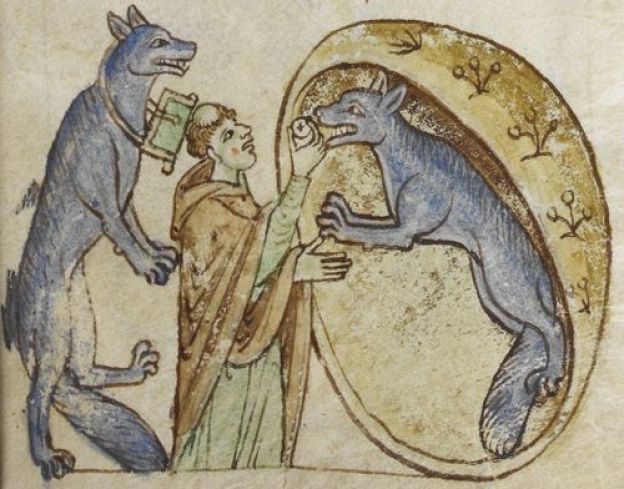
werewolf

Once he had uttered these words, he began the following tale:

‘When I was a slave, we were living in a narrow street where the home of Gavus is now. There is was where the gods decided I would fall in love with the wife of Terence the Innkeeper. You do remember Melissa from Tarentum—that most beautiful little package? By god, I loved her less for her body and sexcapades than I did for her fine morals. She didn’t deny me anything I sought. She made a penny, I got half! I put everything I had into her lap, and I was never cheated.

Her husband passed away at the inn one day. As you can imagine, I risked Skylla and Charybdis so I could get to her: for, as they say, Friends are present in times of need.

By chance, my master was visiting Capua in pursuit of some business. I took my chance and compelled a guest to accompany me to the fifth milestone. He was a soldier and as strong as Orcus. We blundered off around the time of the cock’s crow while the moon was shining as bright as midday. We went among the graves and my friend went among the stones to defecate. I sat singing and counting gravemarkers. And then, as I looked for my companion, he appeared and placed all his clothes near the road.

My breath nearly jumped out my nose—I was standing like a corpse. But he pissed around his clothes and suddenly became a wolf! Don’t you dare imagine I am joking, that I am lying. I make up nothing for such an inheritance as this! But, back to what I started to say, after he turned into a wolf, he began to howl and fled into the forest. At first, I didn’t remember where I was: then I went to gather up his clothes, but they had transformed into stones! What could I do but die from fear?

I drew my sword and struck all the shadows before me until I made it to my girlfriend’s home. I entered as pale as a ghost with sweat rushing down to my groin, my eyes nearly dead. I could hardly regain myself. My Melissa was at first surprised because I had gone out so late. And then she said “I wish you had come earlier, you could have helped us: a wolf entered the house and loosed more blood from the ship than a butcher! He escaped, but he didn’t laugh: an older slave tore his throat with a spear.”

Once I heard these words, I could not sleep any longer. At first light I fled the home of Gaius like an angry landlord. But once I came to the place where his clothing had turned into stone, I found nothing but blood. Honestly, I went home and my soldier was lying like a bull on his bed as a doctor was tending to his neck. I knew that he was a shapeshifter* then, and I wouldn’t have been able to share a meal with him even if you threatened to kill me. Let these men believe what they want about this, but if I am lying, let the gods hate me.”

*”shapeshifter”: Latin, versipellis (lit. “pelt-changer”) is used several times for form-changing in Latin literature. Often, this example and that of Pliny EN 8.80 (cf. LSJ s.v.) are translated as “werewolf”. I chose the more general sense.

[LXI] … Trimalchio ad Nicerotem respexit et: “Solebas, inquit, suavius esse in convictu; nescio quid nunc taces nec muttis. Oro te, sic felicem me videas, narra illud quod tibi usu venit.” Niceros delectatus affabilitate amici: “Omne me, inquit, lucrum transeat, nisi iam dudum gaudimonio dissilio, quod te talem video. Itaque hilaria mera sint, etsi timeo istos scolasticos ne me rideant. Viderint: narrabo tamen, quid enim mihi aufert, qui ridet? satius est rideri quam derideri.”

Haec ubi dicta dedit talem fabulam exorsus est:

“Cum adhuc servirem, habitabamus in vico angusto; nunc Gavillae domus est. Ibi, quomodo dii volunt, amare coepi uxorem Terentii coponis: noveratis Melissam Tarentinam, pulcherrimum bacciballum. Sed ego non mehercules corporaliter aut propter res venerias curavi, sed magis quod benemoria fuit. Si quid ab illa petii, nunquam mihi negatum; fecit assem, semissem habui; in illius sinum demandavi, nec unquam fefellitus sum. Huius contubernalis ad villam supremum diem obiit. Itaque per scutum per ocream egi aginavi, quemadmodum ad illam pervenirem: nam, ut aiunt, in angustiis amici apparent.

[LXII] “Forte dominus Capuae exierat ad scruta scita expedienda. Nactus ego occasionem persuadeo hospitem nostrum, ut mecum ad quintum miliarium veniat. Erat autem miles, fortis tanquam Orcus. Apoculamus nos circa gallicinia; luna lucebat tanquam meridie. Venimus inter monimenta: homo meus coepit ad stelas facere; sedeo ego cantabundus et stelas numero. Deinde ut respexi ad comitem, ille exuit se et omnia vestimenta secundum viam posuit. Mihi anima in naso esse; stabam tanquam mortuus. At ille circumminxit vestimenta sua, et subito lupus factus est. Nolite me iocari putare; ut mentiar, nullius patrimonium tanti facio. Sed, quod coeperam dicere, postquam lupus factus est, ululare coepit et in silvas fugit. Ego primitus nesciebam ubi essem; deinde accessi, ut vestimenta eius tollerem: illa autem lapidea facta sunt. Qui mori timore nisi ego? Gladium tamen strinxi et umbras cecidi, donec ad villam amicae meae pervenirem. In larvam intravi, paene animam ebullivi, sudor mihi per bifurcum volabat, oculi mortui; vix unquam refectus sum. Melissa mea mirari coepit, quod tam sero ambularem, et: ‘Si ante, inquit, venisses, saltem nobis adiutasses; lupus enim villam intravit et omnia pecora tanquam lanius sanguinem illis misit. Nec tamen derisit, etiamsi fugit; senius enim noster lancea collum eius traiecit’. Haec ut audivi, operire oculos amplius non potui, sed luce clara Gai nostri domum fugi tanquam copo compilatus; et postquam veni in illum locum, in quo lapidea vestimenta erant facta, nihil inveni nisi sanguinem. Vt vero domum veni, iacebat miles meus in lecto tanquam bovis, et collum illius medicus curabat. Intellexi illum versipellem esse, nec postea cum illo panem gustare potui, non si me occidisses. Viderint quid de hoc alii exopinissent; ego si mentior, genios vestros iratos habeam.”

How Lady Jane Grey Became So Learned

Roger Ascham, The Scholemaster:

“And one example, whether loue or feare doth worke more in a child, for vertue and learning, I will gladlie report: which maie be hard with some pleasure, and folowed with more profit. Before I went into Germanie, I came to Brodegate in Lecetershire, to take my leaue of that noble Ladie Iane Grey, to whom I was exceding moch beholdinge. Hir parentes, the Duke and Duches, with all the houshould, Gentlemen and Gentlewomen, were huntinge in the Parke: I founde her, in her Chamber, readinge Phaedon Platonis in Greeke, and that with as moch delite, as som ientleman wold read a merie tale in Bocase. After salutation, and dewtie done, with som other taulke, I asked hir, whie she wold leese soch pastime in the Parke? smiling she answered me: I wisse, all their sporte in the Parke is but a shadoe to that pleasure, that I find in Plato: Alas good folke, they neuer felt, what trewe pleasure ment. And howe came you Madame, quoth I, to this deepe knowledge of pleasure, and what did chieflie allure you vnto it: seinge, not many women, but verie fewe men haue atteined thereunto. I will tell you, quoth she, and tell you a troth, which perchance ye will meruell at. One of the greatest benefites, that euer God gaue me, is, that he sent me so sharpe and seuere Parentes, and so ientle a scholemaster. For when I am in presence either of father or mother, whether I speake, kepe silence, sit, stand, or go, eate, drinke, be merie, or sad, be sowyng, plaiyng, dauncing, or doing anie thing els, I must do it, as it were, in soch weight, mesure, and number, euen so perfitelie, as God made the world, or else I am so sharplie taunted, so cruellie threatened, yea presentlie some tymes, with pinches, nippes, and bobbes, and other waies, which I will not name, for the honor I beare them, so without measure misordered, that I thinke my selfe in hell, till tyme cum, that I must go to M. Elmer, who teacheth me so ientlie, so pleasantlie, with soch faire allurementes to learning, that I thinke all the tyme nothing, whiles I am with him. And when I am called from him, I fall on weeping, because, what soeuer I do els, but learning, is ful of grief, trouble, feare, and whole misliking vnto me: And thus my booke, hath bene so moch my pleasure, & bringeth dayly to me more pleasure & more, that in respect of it, all other pleasures, in very deede, be but trifles and troubles vnto me. I remember this talke gladly, both bicause it is so worthy of memorie, & bicause also, it was the last talke that euer I had, and the last tyme, that euer I saw that noble and worthie Ladie.”

Werewolf Week, Religious Returns: St. Augustine on Lycanthropy

In discussing tales of Diomedes’ companions being turned into birds, Augustine in De Civitate Dei (City of God) discusses werewolves (18.17, the full text):

“In order to make this seem more likely, Varro reports other fantastic tales concerning the infamous witch Circe, who transformed Odysseus’ companions into beasts, and concerning the Arcadians, who were by chance transformed when they swam across a certain lake in which they were turned into wolves. Then, they lived as wolves in the same region. If they did not eat human flesh, then they would be returned to human form after swimming across the same lake again.

werewolf-histories

And he also specifies that a certain Demanaetus tasted of the sacrifice which the Arcadians used to make to the Lycaean god, after the child was burned on the altar, and that he transformed into a wolf and, once he became a man again, competing in boxing at the Olympian games and achieved a victory. Varro does not believe for this reason that Pan or Jupiter were given the name “Lykaios” in Arcadia for any other reason than their ability to turn men into wolves, since they did not believe that this could happen except through divine power. As you know, a wolf is called lykos in Greek, and this is where the name Lykaian comes from. Varro adds that the Roman Luperci arose from their own mysteries similarly.

But what can we who talk about these things say about this kind of deceit by the devil’s forces?”

Augustine goes on to object to these tales and discuss Apuleius’ Golden Ass. I started translating this, but it is a bit of a Halloween buzzkill..

No Room For Werewolves in this city...
No Room For Werewolves in this city…

[XVII] Hoc Varro ut astruat, commemorat alia non minus incredibilia de illa maga famosissima Circe, quae socios quoque Vlixis mutauit in bestias, et de Arcadibus, qui sorte ducti tranabant quoddam stagnum atque ibi conuertebantur in lupos et cum similibus feris per illius regionis deserta uiuebant. Si autem carne non uescerentur humana, rursus post nouem annos eodem renatato stagno reformabantur in homines.

Denique etiam nominatim expressit quendam Demaenetum gustasse de sacrificio, quod Arcades immolato puero deo suo Lycaeo facere solerent, et in lupum fuisse mutatum et anno decimo in figuram propriam restitutum pugilatum sese exercuisse et Olympiaco uicisse certamine. Nec idem propter aliud arbitratur historicus in Arcadia tale nomen adfictum Pani Lycaeo et Ioui Lycaeo nisi propter hanc in lupos hominum mutationem, quod eam nisi ui diuina fieri non putarent. Lupus enim Graece *lu/kos dicitur, unde Lycaei nomen apparet inflexum. Romanos etiam Lupercos ex illorum mysteriorum ueluti semine dicit exortos.

Sed de ista tanta ludificatione daemonum nos quid dicamus…

Four Years of Presidential Memories: Ancient Greece and Rome had the Death Penalty for Treason

From the Twelve Tables

“The Law of the Twelve Tables commands that anyone who has conspired with an enemy against the state or handed a citizen to a public enemy, should suffer capital punishment.”

Marcianus, ap. Dig., XLVIII, 4, 3: Lex XII Tabularum iubet eum qui hostem concitaverit quive civem hosti tradiderit capite puniri.

Cicero, De Legibus 3.2 (Latin text)

“[Cases concerning] death and citizenship must not be pursued except before the greatest assembly and those whom the censors have recorded in the rolls of the citizens.”

de capite civis nisi per maximum comitiatum ollosque, quos censores in partibus populi locasint, ne ferunto.

The death penalty is not the enactment of justice, it is the execution of vengeance when justice is impossible or not actually desired. It does not function as a deterrent. It is meted out disproportionately to people without financial and social capital, which in the United States means that people of color face capital charges and are executed at far higher rates.  The moral peril is compounded by the imperfection of our criminal system where at least 1 in 25 people on death row are actually innocent. The death penalty is not part of a justice system, it is part of a vengeance system.

Note the connection in several passages between the sanctity of the state, the power to end a life, and citizenship.

Xenophon, Apology 25 (Full text on the Scaife Viewer)

“These opponents have not said that I am guilty of any of the actions for which the established penalty is death–robbing a temple, theft, enslaving someone, betraying the state…”

ἐφ᾿ οἷς γε μὴν ἔργοις κεῖται θάνατος ἡ ζημία, ἱεροσυλίᾳ, τοιχωρυχίᾳ, ἀνδραποδίσει, πόλεως προδοσίᾳ, οὐδ᾿ αὐτοὶ οἱ ἀντίδικοι τούτων πρᾶξαί τι κατ᾿ ἐμοῦ φασιν.

Plato, Laws 856b-d (Full text on the Scaife Viewer)

“Whoever raises a human being into power and thus enslaves the laws, whoever makes the state subordinate to his petty faction and transgresses what is right by doing all of this violently and stirring up civil strife, he should be considered the most inimical to the whole state.

And the kind of person who does not share these actions, but does occupy some of the most important offices of the state and either fails to observe them or does not fail but will not avenge his country because of cowardice, he should be considered as a citizen at a second degree of evil.

Let each person whose worth is small bear witness to the officers of the state by bringing this person to court for his plotting violent and unconstitutional revolution. Give them the same charges we have for temple robbery and run the trial as it is in those cases where the death penalty comes by majority vote.”

ὃς ἂν ἄγων εἰς ἀρχὴν ἄνθρωπον δουλῶται μὲν τοὺς νόμους, ἑταιρείαις δὲ τὴν πόλιν ὑπήκοον ποιῇ, καὶ βιαίως δὴ πᾶν τοῦτο πράττων καὶ στάσιν ἐγείρων παρανομῇ, τοῦτον δὴ διανοεῖσθαί δεῖ πάντων πολεμιώτατον ὅλῃ τῇ πόλει. τὸν δὲ κοινωνοῦντα μὲν τῶν τοιούτων μηδενί, τῶν μεγίστων δὲ μετέχοντα ἀρχῶν ἐν τῇ πόλει, λεληθότα τε ταῦτα αὐτὸν ἢ μὴ λεληθότα, δειλίᾳ δ᾿ ὑπὲρ Cπατρίδος αὑτοῦ μὴ τιμωρούμενον, δεῖ δεύτερον ἡγεῖσθαι τὸν τοιοῦτον πολίτην κάκῃ. πᾶς δὲ ἀνὴρ οὗ καὶ σμικρὸν ὄφελος ἐνδεικνύτω ταῖς ἀρχαῖς εἰς κρίσιν ἄγων τὸν ἐπιβουλεύοντα βιαίου πολιτείας μεταστάσεως ἅμα καὶ παρανόμου. δικασταὶ δὲ ἔστωσαν τούτοις οἵπερ τοῖς ἱεροσύλοις, καὶ πᾶσαν τὴν κρίσιν ὡσαύτως αὐτοῖς γίγνεσθαι καθάπερ ἐκείνοις, τὴν ψῆφον δὲ θάνατον φέρειν τὴν πλήθει νικῶσαν.

Lycurgus, Against Leocrates, 126-7 

“It is right that punishments for other crimes come after them, but punishment for treason should precede the dissolution of the state. If you miss that opportune moment when those men are about to do something treacherous against their state, it is not possible for you to obtain justice from the men who did wrong: for they become stronger than the punishment possible from those who have been wronged.”

τῶν μὲν γὰρ ἄλλων ἀδικημάτων ὑστέρας δεῖ τετάχθαι τὰς τιμωρίας, προδοσίας δὲ καὶ δήμου καταλύσεως προτέρας. εἰ γὰρ προήσεσθε τοῦτον τὸν καιρὸν, ἐν ᾧ μέλλουσιν ἐκεῖνοι κατὰ τῆς πατρίδος φαῦλόν τι πράττειν, οὐκ ἔστιν ὑμῖν μετὰ ταῦτα δίκην παρ’ αὐτῶν ἀδικούντων λαβεῖν· κρείττους γὰρ ἤδη γίγνονται τῆς παρὰ τῶν ἀδικουμένων τιμωρίας.

Plato, Laws 881a-b

“Death is not the most extreme penalty–there are those described in Hades for offenses like this which are beyond death and are truly described, but they are useless in deterring some kinds of minds from their crimes.”

θάνατος μὲν οὖν οὐκ ἔστιν ἔσχατον, οἱ δὲ ἐν Ἅιδου τούτοισι λεγόμενοι πόνοι ἔτι τε τούτου εἰσὶ μᾶλλον ἐν ἐσχάτοις, καὶ ἀληθέστατα λεγόμενοι οὐδὲν ἀνύτουσι ταῖς τοιαύταις ψυχαῖς ἀποτροπῆς·

From Brill’s New Pauly on the death penalty in Greece and Rome by Gottfriend Schiemann:

“In Athens not only premeditated killing (phónos) and sedition and high treason (katálysis toû dḗmoû, prodosía ) resulted in the death penalty, but also religious offences such as desecration of the temple (hierosylía) and (cf. in particular the case against Socrates [2], 399 BC) publicly taught godlessness (asébeia). In a similar way, in Rome there was provision for the state death penalty for sedition and high treason (perduellio) by beheading (decollatio , in Greece apokephalízein) with an axe, later a sword. In the Roman Imperial period this was the typical death penalty for honestiores , but now sometimes also for homicide.”

Image result for medieval manuscript traitor
Jacob van Maerlant, (The traitor Ganelon drawn and quartered)., Spieghel Historiael, West Flanders, c. 1325-1335