We Need a Kinder, Gentler Hostlity!

Hesiod. Works & Days, 11-26.

Listen, there is not a single species of Strife. On the earth there are actually two. The perceptive person would applaud one, but the other is reprehensible. Each has a spirit thoroughly distinct from the other. One always propagates evil war and battle, being merciless. No one has affection for this oppressive Strife, but compelled by the will of the gods, people honor her.   

Still, it was the other Strife dark Night birthed first. The son of Cronos, seated on high in the ether where he dwells, worked her into the roots of the earth. She’s the gentler one with mankind, and yet this Strife motivates even a totally good-for-nothing man to work. It’s on account of this Strife that when someone habitually sees a rich man who is still desirous of work–eager to plow and plant and set his house in order–then neighbor becomes envious of neighbor and hurries after riches of his own. 

Therefore, this Strife is good for mankind: potter begrudges potter; carpenter feels rancor toward carpenter; beggar envies beggar; and, singer is jealous of singer. 

οὐκ ἄρα μοῦνον ἔην Ἐρίδων γένος, ἀλλ᾽ ἐπὶ γαῖαν
εἰσὶ δύω: τὴν μέν κεν ἐπαινέσσειε νοήσας,
ἣ δ᾽ ἐπιμωμητή: διὰ δ᾽ ἄνδιχα θυμὸν ἔχουσιν.
ἣ μὲν γὰρ πόλεμόν τε κακὸν καὶ δῆριν ὀφέλλει,
15σχετλίη: οὔτις τήν γε φιλεῖ βροτός, ἀλλ᾽ ὑπ᾽ ἀνάγκης
ἀθανάτων βουλῇσιν Ἔριν τιμῶσι βαρεῖαν.
τὴν δ᾽ ἑτέρην προτέρην μὲν ἐγείνατο Νὺξ ἐρεβεννή,
θῆκε δέ μιν Κρονίδης ὑψίζυγος, αἰθέρι ναίων,
γαίης ἐν ῥίζῃσι, καὶ ἀνδράσι πολλὸν ἀμείνω:
20ἥτε καὶ ἀπάλαμόν περ ὁμῶς ἐπὶ ἔργον ἔγειρεν.
εἰς ἕτερον γάρ τίς τε ἰδὼν ἔργοιο χατίζει
πλούσιον, ὃς σπεύδει μὲν ἀρώμεναι ἠδὲ φυτεύειν
οἶκόν τ᾽ εὖ θέσθαι: ζηλοῖ δέ τε γείτονα γείτων
εἰς ἄφενος σπεύδοντ᾽: ἀγαθὴ δ᾽ Ἔρις ἥδε βροτοῖσιν.
25καὶ κεραμεὺς κεραμεῖ κοτέει καὶ τέκτονι τέκτων,
καὶ πτωχὸς πτωχῷ φθονέει καὶ ἀοιδὸς ἀοιδῷ.

Larry Benn has a B.A. in English Literature from Harvard College, an M.Phil in English Literature from Oxford University, and a J.D. from Yale Law School. Making amends for a working life misspent in finance, he’s now a hobbyist in ancient languages and blogs at featsofgreek.blogspot.com.

Grammar is Bread, Ignorance is Gruel

Lorenzo Valla, Ars Grammatica 15-29

It is a bad teacher who does not exemplify their own rules, and there were several of these in centuries gone by, because they did not flip through the learned books of the ancients. So come on kids, sing with me in Latin, and consider this learning as something like bread, which is good by itself and also enhances other dishes. Every art is in need of Grammar, but it needs none of them, and those who don’t know Grammar are definitely just eating gruel. So come on kids, take this bread from my lips, which will make your bodies robust and minister strength to you. For you will read many things written in no books except in ours, although Bostar and Aspar dare to transfer them into their own pamphlets – I mean, what a disgrace! Laugh at them with me, as though they were little crows wearing the peacock’s tail or geese strutting around like swans.

Doctor enim malus est in quo sua non radiat lex,

quales iam seclis aliquot plerique fuere

quod libros veterum non evolvere disertos.

Quare agite, o pueri, mecum cantate latine,

assimilem pani doctrinam hanc esse putantes

que per se valet et reliquas corroborat escas;

indiga grammatice queque ars est, nullius illa,

quam qui non norunt vescuntur pulte profecto.

Hunc, pueri, nostra de voce capessite panem

qui corpus solidum reddat viresque ministret;

namque legetis adhuc in nullis scripta libellis

multa nisi in nostris quamvis ea Bostar et Aspar

in chartas transferre suas, o dedecus, audent!

quos mecum ridete, velut cornicula pavi

si gestet caudam vel se ferat anser olorem.

Thunderous-Mouth-Milling and Petty-Bragging: Some Words for a Thursday

The Suda has the following anecdote which seems to be taken and altered from Diogenes Laertius or something similar.

“thunderous-mouth-milling”: Eubulides says this “the eristic, asking his horn questions and discombobulating the orators with his falsely-intellectual arguments, taking with him the “thunderous-mouth-milling” of Demosthenes.

Ῥομβοστωμυλήθρα: Εὐβουλίδης φησίν: οὑριστικὸς κερατίνας ἐρωτῶν καὶ ψευδαλαζόσιν λόγοις τοὺς ῥήτορας κυλίων ἀπῆλθ’, ἔχων Δημοσθένους τὴν ῥομβοστωμυλήθραν.

ῥομβοστωμυλήθρη (lit. “thunderous-mouth-milling” (?) seems to be a misunderstanding or humorous take on ῥωποπερπερήθρη, usually translated as “braggadocio” but is more like “cheap/petty bragging”
From Diogenes Laertius, Lives of the Eminent Philosophers 2.10

“The eristic Euboulides, asking questions about horns
And discombobulating the speakers with his falsely-intellectual arguments
Has gone off, taking the petty self regard of Demosthenes with him

For it seems that Demosthenes was a student of Eubulides and was able to stop his problems with the letter ‘r’ because of it. Eubulides was also in conflict with Aristotle and undermined him a lot.

οὑριστικὸς δ᾿ Εὐβουλίδης κερατίνας ἐρωτῶν
καὶ ψευδαλαζόσιν λόγοις τοὺς ῥήτορας κυλίων
ἀπῆλθ᾿ ἔχων Δημοσθένους τὴν ῥωποπερπερήθραν.

ἐῴκει γὰρ αὐτοῦ καὶ Δημοσθένης ἀκηκοέναι καὶ ῥωβικώτερος ὢν παύσασθαι. ὁ δ᾿ Εὐβουλίδης καὶ πρὸς Ἀριστοτέλην διεφέρετο, καὶ πολλὰ αὐτὸν διαβέβληκε.

Eubulides is now known for some interesting paradoxes.

Image result for ancient greek eubulides
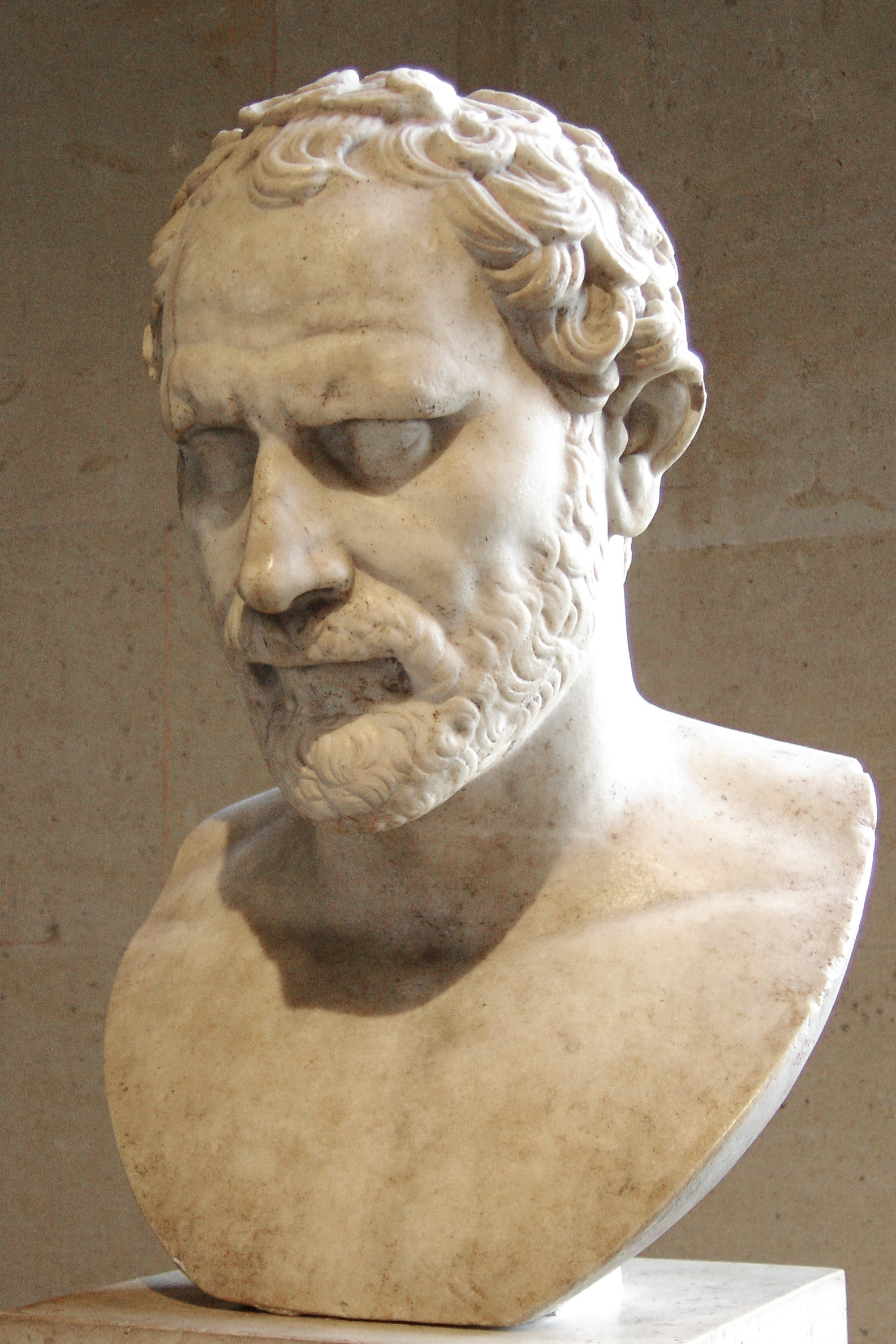
Demosthenes, no longer thunderous-mouth-milling.

Tzetzes Heads Off a Question

John Tzetzes, Allegories of the Odyssey 6.65-90

Consider with me the head as the organ of reason, trusting to that all-wise philosopher Homer. And in the opinion of the doctors and wise philosophers, he who claims that the heart is the reasoning organ is referring to the material and not the final organ. The rush of the blood from the heart, running to the head from the arteries, heats up the brain and stirs up plans.

If someone should say that the heart is the material organ, but the head the final one, then depend upon it, he is still among the wise. But if he says that the heart is the final organ, he is an all-wise student of Aristotle. If then he is not persuaded by the reasoning of the doctors and all of the myriads of proofs they have worked up, then he is employing the old foolish ‘He himself said it!’ that the Pythagoreans used to spout.

Ask him about the witticism of old uncle Tzetzes about which part of the body we call the back, and he will definitely show you the part between the shoulders, under the head and behind the stomach. Put on a smile, then, and say to that ultra wise man, ‘if reasoning and mind (phrenes) were, as you say, not in the head, but set right there in the heart, then everyone would call the stuff near the seat of manhood ‘metaphrena’, and perhaps they would do the same for the entrance of the stomach, since it is behind the heart, diverging from the practice of everyone else who refers to the spot between the shoulders, since it is behind the head and props up our mind.

Will Eyewitnesses to Injustice Spare This Man?

Dinarchus, Against Philocles 110 14-15

“Citizens, you need to remember these things and not take lightly all the information made public by the council—act here as you have in cases judged before. It is shameful to tire of punishing people who have proved themselves traitors to the state and shameful that any insurrectionists and wicked people should be left out there when the gods have clearly shown their true nature and handed them over to you to be punished.

You have seen that the whole electorate accuses this man and now they have given him to you before all the others to get what he deserves.

Sweet Zeus, Savior! I am ashamed that you need us to force you, to push you on to bring punishment to this person who has already been judged. Aren’t you all eyewitnesses of the injustices he committed? Because all the people believe he is neither just nor safe to be trusted with children they rejected him as guardian of the youth. Will you very protectors of the democracy and the laws—those people chance and fortune have given the power of justice over our people—will you spare a man who has attempted these kinds of things?”

ὧν ἀναμιμνησκομένους ὑμᾶς, ὦ Ἀθηναῖοι, δεῖ μὴ παρέργως ἔχειν πρὸς τὰς ὑπὸ τῆς βουλῆς γεγενημένας ἀποφάσεις, ἀλλ᾿ ἀκολούθως ταῖς πρότερον κεκριμέναις· αἰσχρὸν γὰρ ἀπειπεῖν τιμωρουμένους ἐστὶ τοὺς προδότας τῆς πόλεως γεγενημένους, καὶ ὑπολείπεσθαί τινας τῶν ἀδίκων καὶ πονηρῶν ἀνθρώπων, ὅτε οἱ θεοὶ φανεροὺς ὑμῖν ποιήσαντες παρέδοσαν τιμωρήσασθαι, ἑορακότες τὸν δῆμον ἅπαντα κατήγορον τούτου γεγενημένον καὶ προκεχειρικότα πρῶτον τῶν ἄλλων ἐπὶ τὸ τὴν τιμωρίαν ἐν ὑμῖν δοῦναι.

Ἀλλ᾿ ἔγωγε, νὴ τὸν Δία τὸν σωτῆρα, αἰσχύνομαι, εἰ προτραπέντας ὑμᾶς δεῖ4 καὶ παροξυνθέντας ὑφ᾿ ἡμῶν ἐπὶ τὴν τοῦ νῦν εἰσεληλυθότος τὴν κρίσιν τιμωρίαν ἐλθεῖν. [καὶ] οὐκ αὐτόπται ἐστὲ τῶν ὑπὸ τούτου γεγενημένων ἀδικημάτων; καὶ ὁ μὲν δῆμος ἅπας οὔτ᾿ ἀσφαλὲς οὔτε δίκαιον νομίζων εἶναι παρακαταθέσθαι τοὺς ἑαυτοῦ παῖδας ἀπεχειροτόνησεν αὐτὸν ἀπὸ τῆς τῶν ἐφήβων ἐπιμελείας,  ὑμεῖς δ᾿ οἱ τῆς δημοκρατίας καὶ τῶν νόμων φύλακες, οἷς ἡ τύχη καὶ ὁ κλῆρος . . . ὑπὲρ τοῦ δήμου δικάσοντας ἐπέτρεψεν;

Variation on Heraclitus

“You cannot step into the same river twice.” δὶς ἐς τὸν αὐτὸν ποταμὸν οὐκ ἂν ἐμβαίης.

– Heraclitus

Louis MacNeice, Variation on Heraclitus:

Even the walls are flowing, even the ceiling,

Nor only in terms of physics; the pictures

Bob on each picture rail like floats on a line

While the books on the shelves keep reeling

Their titles out into space and the carpet

Keeps flying away to Arabia nor can this be where I stood —

Where I shot the rapids I mean — when I signed

On a line that rippled away with a pen that melted

Nor can this now be the chair — the chairoplane of a chair —

That I sat in the day that I thought I had made up my mind

And as for that standard lamp it too keeps waltzing away

Down an unbridgeable Ganges where nothing is standard

And lights are but lit to be drowned in honour and spite of some dark

And vanishing goddess. No, whatever you say,

Reappearance presumes disappearance, it may not be nice

Or proper or easily analysed not to be static

But none of your slide snide rules can catch what is sliding so fast

And, all you advisers on this by the time it is that,

I just do not want your advice

Nor need you be troubled to pin me down in my room

Since the room and I will escape for I tell you flat:

One cannot live in the same room twice.

File:Heraklit.jpg

A Failsafe for Democracy

Lycurgus, Against Leocrates 124    

“These examples are enough I think to understand the opinion your forefathers had against those who broke the laws. I still want to remind you of the monument in the Senate house which recalls traitors and those who destroy the democracy. For I make your judgement easy if I provide you with many examples.

After the reign of the Thirty, your fathers, who had suffered the kinds of things from fellow citizens no Greek ever would have considered and who barely made it back to their own land, blocked every avenue to crime because they learned from experience and knew which offices and approaches were open to those who would dissolve the democracy.

They decreed by vote and by oath that anyone who came upon someone trying to establish a tyranny, betraying the state or overthrowing democracy would not be considered guilty for killing them because it seemed better to them that people who were pursuing these actions should die than they should suffer being enslaved to them. For they believed foremost that citizens should live in such away as to never come into suspicion for these crimes.”

Ἱκανὰ μὲν οὖν καὶ ταῦτα τὴν τῶν προγόνων γνῶναι διάνοιαν, ὡς εἶχον πρὸς τοὺς παρανομοῦντας εἰς τὴν πόλιν· οὐ μὴν ἀλλ᾿ ἔτι βούλομαι τῆς στήλης ἀκοῦσαι ὑμᾶς τῆς ἐν τῷ βουλευτηρίῳ περὶ τῶν προδοτῶν καὶ τῶν τὸν δῆμον καταλυόντων· τὸ γὰρ μετὰ πολλῶν παραδειγμάτων διδάσκειν ῥᾳδίαν ὑμῖν τὴν κρίσιν καθίστησι. μετὰ γὰρ τοὺς τριάκοντα οἱ πατέρες ὑμῶν, πεπονθότες ὑπὸ τῶν πολιτῶν οἷα οὐδεὶς πώποτε τῶν Ἑλλήνων ἠξίωσε,1 καὶ μόλις εἰς τὴν ἑαυτῶν κατεληλυθότες, ἁπάσας τὰς ὁδοὺς τῶν ἀδικημάτων ἐνέφραξαν, πεπειραμένοι καὶ εἰδότες τὰς ἀρχὰς καὶ τὰς ἐφόδους τῶν τὸν δῆμον προδιδόντων. ἐψηφίσαντο γὰρ καὶ ὤμοσαν, ἐάν τις τυραννίδι ἐπιτιθῆται ἢ τὴν πόλιν προδιδῷ ἢ τὸν δῆμον καταλύῃ, τὸν αἰσθανόμενον καθαρὸν εἶναι ἀποκτείναντα, καὶ κρεῖττον ἔδοξεν αὐτοῖς τοὺς τὴν αἰτίαν ἔχοντας τεθνάναι μᾶλλον ἢ πειραθέντας μετὰ ἀληθείας αὐτοὺς δουλεύειν· ἀρχὴν γὰρ οὕτως ᾤοντο δεῖν ζῆν τοὺς πολίτας, ὥστε μηδ᾿ εἰς ὑποψίαν ἐλθεῖν μηδένα τούτων τῶν ἀδικημάτων.

https://commons.wikimedia.org/wiki/File:Parthenon_from_south.jpg

Senators, Do Not Fail the Republic!

Cicero Philippic 3.14

“For this reason, Senators—by the gods almighty—take this opportunity offered to you and finally remember that you are the leaders of the most powerful council in the world. Give a sign to the Roman people that your response will not fail the Republic since they do insist that their own dedication will not fail you. You don’t need my warning!

No person is so foolish that they don’t understand that if we remain asleep at this moment we will have to live through a rule that is not only cruel and arrogant but ignoble and disgraceful too. You know this man’s arrogance, his friends, and his whole household. To serve shameful lusts, bullies, disgusting and irreverent thieves, those drunkards—well, that is the worst suffering married to the greatest dishonor.

But if—and the gods forbid this—if the final story of our Republic is being told, may we face it like noble gladiators when they fall with honor. Let us who were the leaders of the whole world and model for every people act so that we die with dignity rather than serve in disgrace. Nothing is more hateful than dishonor; nothing is more despicable than servitude. We were born into honor and freedom: let us keep them or die with dignity.

For too long we have hidden our thoughts. Now it is out in the open. Everyone is making what they think, what they want for each side clear. There are traitorous citizens—too many given the value of our Republic—but they are a mere few in comparison to those who know what’s right…”

14] Hanc igitur occasionem oblatam tenete, per deos immortalis, patres conscripti, et amplissimi orbis terrae consili principes vos esse aliquando recordamini! Signum date populo Romano consilium vestrum non deesse rei publicae, quoniam ille virtutem suam non defuturam esse profitetur. Nihil est quod moneam vos.

Nemo est tam stultus qui non intellegat, si indormierimus huic tempori, non modo crudelem superbamque dominationem nobis sed ignominiosam etiam et flagitiosam ferendam. Nostis insolentiam Antoni, nostis amicos, nostis totam domum. Libidinosis, petulantibus, impuris, impudicis, aleatoribus, ebriis servire, ea summa miseria est summo dedecore coniuncta.

Quod si iam—quod di omen avertant!—fatum extremum rei publicae venit, quod gladiatores nobiles faciunt, ut honeste decumbant, faciamus nos, principes orbis terrarum gentiumque omnium, ut cum dignitate potius cadamus quam cum ignominia serviamus. Nihil est detestabilius dedecore, nihil foedius servitute. Ad decus et ad libertatem nati sumus: aut haec teneamus aut cum dignitate moriamur.

Nimium diu teximus quid sentiremus; nunc iam apertum est. Omnes patefaciunt in utramque partem quid sentiant, quid velint. Sunt impii cives—pro caritate rei publicae nimium multi, sed contra multitudinem bene sentientium admodum pauci…

Oil painting on canvas, An Ideal Classical Landscape with Cicero and Friends, by Jacob More (Edinburgh 1740 ? Rome 1793), signed and dated: Rome, 1780.

Life After Insurrection

“This president is guilty of inciting insurrection. He has to pay a price for that.” – Nancy Pelosi

Is there life after political excommunication in the wake of a failed insurrection (particularly for a man who likes beauty pageants)?

Alcaeus 130B

. . . I’m a wretched man.
I’m living the lot of a rustic
But yearning to hear the assembly
Called, O Agesilaidas, and the council—

Privileges my father and my father’s father
Grew old having, even among countrymen
Who were wicked to one another,
And of which I’m now dispossessed.

I’ve fled to the hinterlands, like Onymakles.
And although I’m alone, a wolf-man,
I’ve made a home here after quitting the fight.
After all, isn’t it better to put an end to insurrection?

In the precinct of the blessed gods
I’ve made a home and tread the black earth.
In these gatherings I’ve found a place.
And here I’m keeping my feet out of trouble—

Here where the women of Lesbos judged on beauty
Parade, their robes trailing,
And the divine sound of the women’s holy ululations
rings out from every quarter—
a yearly affair.

Ἀγνοις . . σβιότοις . . ις ὀ τάλαις ἔγω
ζώω μοι̑ραν ἔχων ἀγροϊωτίκαν
ἰμέρρων ἀγόρας ἄκουσαι
καρυ[ζο]μένας ὠ̑ (᾿Α)γεσιλαΐδα

καὶ β[ό]λλας· τὰ πάτηρ καὶ πάτερος πάτηρ
κα<γ>γ[ε]γήρασ’ ἔχοντες πεδὰ τωνδέων
τὼν [ἀ]λλαλοκάκων πολίταν
ἔγ[ω ἀ]πὺ τούτων ἀπελήλαμαι

φεύγων ἐσχατίαισ’, ὠς δ᾿ Ὀνυμακλέης
ἔνθα[δ’] οἰ̑ος ἐοίκησα λυκαιχμίαις
[φεύγων t]ον [π]όλεμον· στάσιν γὰρ
πρὸς κρ . [. . . . ] . οὐκ †ἄμεινον† ὀννέλην·

. ] . [ . . . ] . [. . ] . μακάρων ἐς τέμ[ε]νος θέων
ἐοι[κησα] με[λ]αίνας ἐπίβαις χθόνος
χλι . [. ] . [ . ] . [.]ν συνόδοισί μ’ αὔταις
οἴκημι κ[ά]κων ἔκτος ἔχων πόδας,

ὄππαι Λ[εσβί]αδες κριννόμεναι φύαν
πώλεντ’ ἐλκεσίπεπλοι, περὶ δὲ βρέμει
ἄχω θεσπεσία γυναίκων
ἴρα[ς ὀ]λολύγας ἐνιαυσίας

Larry Benn has a B.A. in English Literature from Harvard College, an M.Phil in English Literature from Oxford University, and a J.D. from Yale Law School. Making amends for a working life misspent in finance, he’s now a hobbyist in ancient languages and blogs at featsofgreek.blogspot.com.
Swelling Latin Genius

Cyril Connolly, The Unquiet Grave:

“Works of art which survive must all be indebted to the spirit of their age. Thus though Virgil and Horace copied Greek models, they imitated them at a time when the flowering of Roman civilization demanded just such a refinement, a taking over of the trusteeship of the past by the swelling Latin genius. In that sense every writer refashions the literature of the past and produces his tiny commentary, nothing is ever quite new; but there comes a moment when a whole culture ripens and prepares to make its own version of the great art of its predecessors.”

Latin Genius, not swelling