No one, not even Cambridge, was to blame
(Blame if you like the human situation):
Heart-injured in North London, he became
The Latin Scholar of his generation.
Deliberately he chose the dry-as-dust,
Kept tears like dirty postcards in a drawer;
Food was his public love, his private lust
Something to do with violence and the poor.
In savage foot-notes on unjust editions
He timidly attacked the life he led,
And put the money of his feelings on
The uncritical relations of the dead,
Where only geographical divisions
Parted the coarse hanged soldier from the don.
“To begin with, they wrongly reject prior meditation on future affairs. For there is nothing which works so well to calm or relieve anxiety as much as the thought throughout your life that there is nothing that is can’t happen; there’s no contemplation better for our human condition as the law of of life and learning obedience to it—this doesn’t make us sad all the time but keeps us from ever being so. For the person who reflects on the nature of things, on the variety of life, and the precarity of human existence is not sad in considering these things but is carrying out the duty of wisdom in the fullest way.
For they pursue both in enjoying the particular harvest of philosophy by considering what happens in human life and in suffering adverse outcomes by cleansning with a three-part solace. First, by previously accepting the possibility of misfortune—which is the most way of weakening and managing any annoyance and second, by learning that human events must be endured humanely; and third, by recognizing that there is nothing evil except for blame and there is no blame when the event is something against which no human can endure.”
Principio male reprehendunt praemeditationem rerum futurarum. Nihil est enim quod tam obtundat elevetque aegritudinem quam perpetua in omni vita cogitatio nihil esse, quod non accidere possit, quam meditatio condicionis humanae, quam vitae lex commentatioque parendi, quae non hoc adfert, ut semper maereamus, sed ut numquam. Neque enim qui rerum naturam, qui vitae varietatem, qui imbecillitatem generis humani cogitat, maeret, cum haec cogitat, sed tum vel maxime sapientiae fungitur munere. Utrumque enim consequitur, ut et considerandis rebus humanis proprio philosophiae fruatur officio et adversis casibus triplici consolatione sanetur: primum quod posse accidere diu cogitavit, quae cogitatio una maxime molestias omnes extenuat et diluit; deinde quod humana humane ferenda intelligit; postremo quod videt malum nullum esse nisi culpam, culpam autem nullam esse, cum id, quod ab homine non potuerit praestari, evenerit.
Lucretius, De Rerum Natura .540-147
“Unless matter itself had been eternal before our time
Everything would have already reverted to nothing
And whatever we see would also have come from nothing.
But since I have demonstrated that nothing can be made from nothing
And what has been made cannot be returned to nothing
There ought to be a primal creation for the immortal body
Where everything diffuses again at the final moment
to supply matter itself for the rebirth of things.”
raeterea nisi materies aeterna fuisset,
antehac ad nilum penitus res quaeque redissent,
de niloque renata forent quaecumque videmus.
at quoniam supra docui nil posse creari
de nilo neque quod genitum est ad nil revocari,
esse inmortali primordia corpore debent,
dissolui quo quaeque supremo tempore possint,
materies ut suppeditet rebus reparandis.
“Just as when there is a certain local currency which is accepted in a city, the person who uses this is able to complete whatever his business obligations are in that city without too much bother, but the one who refuses to use it but creates for himself some new strange currency and tries to use that as currency instead is a feel, so too in life the person who does not want to use customary modes of discourse, like the currency, and tries to coin some particular kind of his own, is nearly insane.
And so, if the grammarians agree to give us some skill which they call analogy by which they compel us to speak with one another in accordance with some “Hellenism” then we must show that this skill has no support and that those who want to speak correctly must speak in a non-technical way, using a simple style in life and following the rules which are used by the majority of people.”
“[Solon] believed that someone who managed their own personal affairs badly would manage matters of state similarly. It did not seem likely to the lawgiver that that the same person who was a scoundrel in private would be a useful citizen in public. He also did not think it right that a person should come to speak in public before being prepared for it, not just for words but in life.
And he also thought that advice from a good and noble person, however poorly and simply it was framed, is beneficial to those who hear it, while the words of a person who has no shame, who has made a mockery of his own body and who has shamefully managed his inheritance—well, these words he believed would never help the people who heard them, not even if they were delivered well.
This is why he keeps these kinds of people from the platform, why he forbids them from addressing the public. If someone speaks, then, not merely against these precepts but also for the sack of bribery and criminality, and if the state can no longer endure such a person, he adds “Let any citizens who desires it, and who is able, sue him…”
“Really, Euthêrus, it is not at all easy to find work where you won’t face some responsibility. It is hard to work at all without making some mistakes and hard still not to meet silly criticism even when you haven’t screwed up. I’d be surprised if you said that you end up complaint-free from those you work for currently.
Therefore, you should try to avoid complainers and cultivate people of good judgement. Take on tasks you’re capable of doing and avoid those you’re not. Whatever you do, take care to do your best and do it willingly. I think you’ll find yourself least criticized this way and that you will find solution for your trouble, you will live in great east and safety, and save enough for retirement.
“As a serpent awaits a man in front of its home on the mountain,
One who dined on ruinous plants [pharmaka], and a dread anger overtakes him
As it coils back and glares terribly before his home.
So Hektor in his unquenchable [asbestos] fury [menos] would not retreat,
After he leaned his shining shield on the wall’s edge.
He really glowered as he spoke to his own proud heart
As he stands before the walls of his city in book 22, Hektor is compared to a snake, coiled to strike an intruder. This moment of anticipation of violence is prolonged as Hektor turns away from the pleas of his family not to face Achilles. In a moment marked by the repeated speech introduction “ (ὀχθήσας δ᾽ ἄρα εἶπε πρὸς ὃν μεγαλήτορα θυμόν), Hektor ruminates, and worries despite what the opening simile anticipates. He resolves to face Achilles, but then immediately changes his mind: “When Hektor noticed Achilles, a tremor overtook him and he could not bear to wait for him / but he left the gates behind and left in flight” Ἕκτορα δ᾽, ὡς ἐνόησεν, ἕλε τρόμος: οὐδ᾽ ἄρ᾽ ἔτ᾽ ἔτλη / αὖθι μένειν, ὀπίσω δὲ πύλας λίπε, βῆ δὲ φοβηθείς).
What happens between the end of Hektor’s speech and his choice to run from Achilles?
*****
In the fall of 2019, I submitted my final manuscript for a book about the Homeric Odyssey and modern psychology. To say I had spent a lot of time with this book would be as much of an understatement as to make the overly banal claim that I learned a lot in the process. Both statements are true, but neither gets to the core of how much researching and writing this book changed the way I read ancient literature and think about just being a human being.
This project started with the observation in class one day in 2011 that Odysseus and Telemachus may be suffering from something we’d call learned helplessness and ended up with a reading of the whole epic as rumination on human agency, traumatized peoples, and the way stories have the power both to liberate and to chain us.
But, as with most long projects, my feeling at the submission was one of release and escape–every time I finish a paper or book, I wonder if I am done, if I have written all the words in me, and whether I have any other thoughts worth forming. I wanted to be done with the Odyssey and its trauma for a while, to think about something new, or, perhaps, to think about nothing at all.
And so much of what I read for the Odyssey book continued to course through my mind. Some people may bristle at the terminology, but it was clear to me that we were being collectively traumatized: by our fear about the safety of our lives and our loved ones’; by our inability to do anything about it; by the massive and arrogant failure of our government to protect or aid us; by fears about losing our homes and feeding our children; by the necessary and powerful reminder of racist rot at the core of our civilization provided by the #BlackLivesMatter protests; by the horrible uncertainty of the Trump administration’s attempt to steal the election; by rising threats of violence; and by a white supremacist coup. Each week and month of the pandemic was a frozen moment in an actual apocalypse, the unveiling of the terrible truths of who and what we are.
The question I started asking myself in April was whether or not knowing you’re being traumatized helps you process the trauma. The answers I found were contrary. So I started doing the very thing I swore I wasn’t going to do anymore, to think about Homer and human psychology. Somewhere along the way that took me back to Hektor, Troy’s prince and protector.
Hektor’s Trauma
Very few people who read or write about the Iliad can make great sense of Hektor. His traditional character is part of James Redfield’s widely cited The Tragedy of Hektor (1975) and his strange engagement with his advisor Poulydamas–with whom he argues on three separate occasions–is seen as a function of the limits of Trojan politics but rarely as evidence of the emotional response of an actual human being.
Indeed, throughout the Iliad, Hektor’s behavior can be hard to parse, and so much harder to defend. He is harsh to his brother, but within limits; his kindness to Helen and joy in his son seems ill-fit to his rejection of Andromache’s advice. In war, he seems relentless, speaking repeatedly of glory and the alternating chance of war, while pursuing an offensive onslaught that seems either wholly irrational or an artificial hastening of the war’s ultimate plot. Sure, we see the man-killing Hektor in all his unquenchable fury, but there are questions: he barely fights Ajax to a draw in book 7; he needs the help of another man and a god to slay Patroklos in book 16; he must be tricked to face Achilles when the final conflict awaits him.
I have always had a soft spot for Hektor–in his acceptance of his doomed state, I used to find a welcome nobility in contrast to Achilles’ selfishness. And, yet, the way he dismisses Poulydamas or ignores Andromache has always troubled me. His final flight from Achilles has always been something I failed to explain to students. Over the years I have called it denial, escapism, a wavering panic when the doom on the horizon finally appears. Who among us can say we won’t quail in our final moments, or shudder and engage in a brief fantasy that there’s more life yet to live?
During the pandemic, I started to think of Hektor as someone marked by prolonged uncertainty and torturous anticipation. In a way, we have lived in our own kind of siege over the past year: often unable to leave our homes, afraid of what days and weeks would bring, and plagued beyond all else by uncertainties that undermined many things we held to be true, even sacred. I started to think of Hektor and the Trojans as living this way not for one year, but for nine, hearing of the deaths or abductions of family members in other cities, seeing no way to break out. Before the beginning of the epic we know, Hektor spent nine years pacing the walls of his city, unable to fight off his enemies yet unable to flee. Until, of course, the Iliad’s action lets him break free.
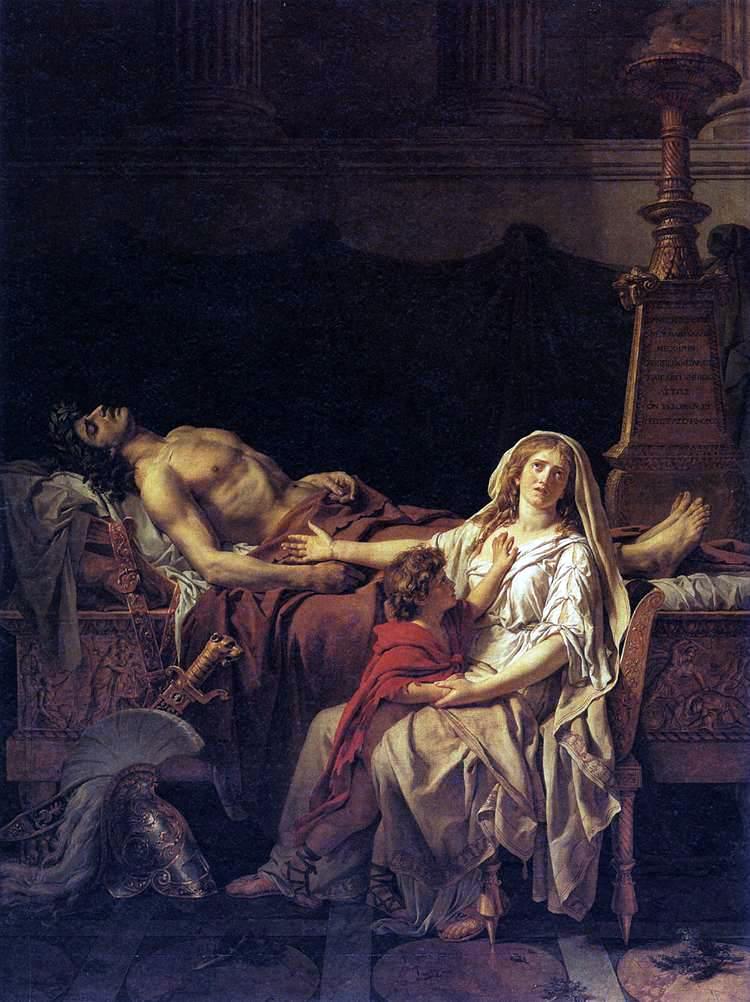
The Grief and Recriminations of Andromache over the Body of Hector Her Husband (1783) by Jacques-Louis David
Fight, Flight, or Freeze
In the third edition of his The Body Bears the Burden: Trauma, Dissociation, and Disease (2014), Robert Scaer looks at the cycle of arousal and rest that characterizes the function of our nervous system in response to crisis or danger. In simple terms, we can think of the fight or flight response which triggers different neurotransmitters to prepare for rapid response: in a resting state, our bodies are prepared for and more efficient at digesting and storing nutrients and also at processing and storing knowledge of facts and events (13). The fight/flight response puts us in a high-energy nervous state, raising blood-pressure and moving blood into our muscular system.
Such a shifting of biological resources is an essential survival tool. But when we experience prolonged arousal without release or resolution we can become locked in or frozen, establishing an unstable state that may look immobile but may actually be “rapid and exaggerated sympathetic/parasympathetic oscillation (15). To put it in other words: when we face a crisis situation we can neither fight nor flee, our “freeze” reaction is a parafunctional cycling through the same fight/flight and resting process over and over again. In this state, our minds can become “numb and dissociated” and our vascular and digestive systems suffer. So, if over the past year you’ve found yourself inexplicably tired, facing unanticipated digestive issues, out of breath with a racing heart while sitting still, you may have been showing the symptoms of your body encoding our trauma
As Scaer outlines (15-16), Animals often show remarkable responses to this freeze (a “discharge”) that can include convulsions and more in an instinctive attempt to restore “autonomic homeostasis” (16), that is, stability. Human beings, however, rarely show such ‘rests’ to discharge the trauma and reset the body. Such an inability to resolve the freeze moment, it seems, compounds the long term dangers of physical responses to trauma and the likelihood that memories of the events will incite similar physical responses, a return to a traumatized state. Scaer argues that many chronic diseases may be rooted in the reshaping of our brains by trauma and the inability of our conscious minds to distinguish between now and traumatizing events.
Hector’s last visit with his wife, Andromache, and infant son Astyanax, startled by his father’s helmet (Apulian red-figure vase, 370–360 BC)
Reading Hektor’s Trauma
I see so much of my sleepless nights, habitual doom scrolling, and somatic disarray in this description. And during these moments, I have wondered how this can change the way we approach Hektor both in a single moment and from the perspective of the whole narrative.
When we see Hektor before the walls of Troy, he is “coiled” like a snake (elissomenos) and he wouldn’t retreat because of his unquenchable heart. Note that I translate that participle clause ἄσβεστον ἔχων μένος causally. This is, of course, a significant choice, but I think a well-motivated one. This is the only time in Greek epic when menos—one’s energy, life force—is described as asbestos, “inextinguishable, unsatisfiable”. The adjective appears to mark extreme or powerful expressions of emotion as in describing the laughter of the gods at Hephaistos (1.599) or war cries of groups as they engage in battle (11.500, 11.530; 13.169; 13.450; 16.267). In the Odyssey, asbeston twice modifies kleos (4.584; 7.133). This word seems to describe extreme moments of pitch, or aggression with a sense of duration. But as Lorenzo Garcia argues in his Homeric Durability, asbestosmarks things that ultimately cannot endure: what the sound of a laugh or a war-cry share in common with Hektor’s menos is an unsustainable intensity. In addition, the adjective marks something that is public, shared, or heard by others. Here, the asbeston menos is something private, a massive, unsustainable thing somehow contained within a single person.
The simile compares Hektor to an animal coiled for attack; in describing his refusal to retreat, the narrative uniquely describes the energy driving him; the speech introduction that follows places him in a motif of deliberation over fighting or fleeing. Speeches introduced by the formula “He really glowered as he spoke to his own proud heart” (ὀχθήσας δ᾽ἄρα εἶπε πρὸς ὃν μεγαλήτορα θυμόν) are dramatic representations of deliberation—moments that happen in an instant but are unfolded in the time of performance to allow audiences to consider the inner workings of heroic minds. The simile of the serpent creates extra space and invites audiences to consider the space between the image of the coiled snake and Hektor’s actions: it is as much about how Hektor is the snake and how he is not.
For mortals, the moment of deliberation seems to be that very freeze before the selection of fight or flight: at 11.404-410, Odysseus, caught alone in battle worries about being overcome as the battle rages around him. At 17.90, Menelaos pauses in the defense of Patroklos’ body, afraid to face Hektor alone. At 18.5, Achilles is paralyzed by fear that something has happened to Patroklos and later at 20.143, Achilles finds himself perplexed at the sudden disappearance of Aeneas who has been rescued by the gods. At 21.552, Agenor the son of Antenor pauses mid-battle to decide to run or face Achilles.
The participle characterizing the speech, okhthêsas, moreover, expresses anger or resentment and may be an iterative of ekhthomai, that same root that gives us Greek words for hostility and enmity. Especially when combined with the asseverative particle ἄρα, this verb communicates an inward wrath at a choice with no good options. It is the coiling of anticipation, of loss, and of a loss of control. It is, I think, a formulaic marker for the process of navigating between fight and flight. In its pairing with the opening simile, it marks Hektor in that same moment, in an extended freeze. His resolution, however, contrasts with the other scenes: Hektor ends up acting contrary to his choice to stand.
Hektor’s menos, his anger, is a reflex of his loss of control and of his longing for something to be different. Andromache anticipates this when she speaks to him in book (6.407-409):
“Divine one, your menos will destroy you and you do not pity
Your infant child and my wretched fate, the one who will soon
Be your widow. For the Achaeans are on their way to kill you…”
Hektor’s drive to protect those he cares for most is the very thing that separates him from them, that unites them only in loss and longing. This calls to my mind the work of my friend, Emily Austin, who has written a book foregrounding the thematic importance of loss and longing (pothos) in the Iliad: it is the sudden absence that motivates Achilles’ menis. I think it is also the unconquerable fire that keeps Hektor from ever truly being still.
Thinking about the fight/flight/freeze complex as described by Scaer helps us confirm the poetic function of a Homeric formula: it also serves to invite audiences into a mind navigating a moment of crisis, of choice or judgment (hence Greek krisis) over running away or facing danger. In combination with a striking simile and a strange description of Hektor’s menos, this pattern also helps us see what can happen when the deliberation fails, when the freeze prolongs. Hektor’s menos is overloaded, it is too thoroughly interiorized, coiled inside him, breaking him from within.
Andromache looking down from the walls of Troy at Achilles dragging Hector’s corpse behind his chariot. Limestone, fragment of a sarcophagus, late 2nd century CE.
Hektor, Fighting and Fleeing
Almost 15 years ago, Elton Barker and I wrote an article about debates over fight or flight in the New Archilochus Poem and Homer. In it, we argued that both Homer and Archilochus were engaged in a tradition of poetic debate about the merits of fight or flight, transcending our narrow concepts of genre and operating ahierarchically, that is, prioritizing neither Homer nor Archilochus, but providing evidence of debate and reflection over time. I don’t think we’re wrong, still; but I do think that this debate is about more than drama and poets: it is about representing human emotion and cognition.
Broadly speaking, Scaer’s framework and my own experience makes me think that we need to rethink Hektor’s behavior throughout the epic and the depiction of Trojan responses to the war in general, allowing more richness to the emotive and cognitive content. There are thematic ties that tell a story of their own.
When Hektor speaks to Andromache in book 6, he anticipates the shame he worries about in book 22 and considers his wife’s suffering after his death. He expresses a characteristic fatalism when he dismisses Andromache to her weaving, saying, “I claim that there is no one who has escaped his fate, / whether a good person or a bad one, after they are born” (μοῖραν δ’ οὔ τινά φημι πεφυγμένον ἔμμεναι ἀνδρῶν, /οὐ κακὸν οὐδὲ μὲν ἐσθλόν, ἐπὴν τὰ πρῶτα γένηται, 6.488-489).
Perhaps it is too much to read into this passage to say that Hektor thinks flight is impossible (he does…), but it certainly helps explain his subsequent actions: keeping the Trojan army out on the field at night in book 8, breaking through the Greek fortifications despite a bad omen in book 12, and refusing to return to the defense of the city in book 18. When Polydamas calls for them to retreat, Hektor continues to insist Zeus is on their side and declares, “I will not flee him from the ill-sounding battle, but I will stand / against Achilles either to win great strength or to be taken myself. War is common ground and the one who kills is killed” (…οὔ μιν ἔγωγε / φεύξομαι ἐκ πολέμοιο δυσηχέος, ἀλλὰ μάλ’ ἄντην /στήσομαι, ἤ κε φέρῃσι μέγα κράτος, ἦ κε φεροίμην / ξυνὸς ᾿Ενυάλιος, καί τε κτανέοντα κατέκτα, 18.306-309).
When Hektor freezes in the choice to fight or flee in book 22, he knows there is no other option. In his speech, he often surprises modern audiences with a wish that he and Achilles could exchange pledges like young lovers and wishes neither would have to die even as he admits that shame would prevent him from retreat. As another friend Justin Arft has recently argued, Hektor “transitions from imagined mediation, to being unarmed, to being a woman, to intimate discourse, to he and Achilles in the place of lovers” (SCS 2021) and is flipping through cognitive schemas (patterns of behavior) trying to figure out what to do. It is as if Hektor has a handful of cards and is repeatedly flipping through them, looking for one that will change a fate he knows cannot be changed. He goes back through his own stories, perhaps stopping at his conversation with Andromache and thinking about what he loses, what he needs, and the absence of choices remaining to him. At the end, he returns to that deceptive idea, that fate alternates and he just might win the day (εἴδομεν ὁπποτέρῳ κεν Ὀλύμπιος εὖχος ὀρέξῃ, 130).
After not even a year yet in a society in trauma, I now see Hektor as someone whose response to the false hope of choice is to overcompensate, to come on too strong, and to engage in willful denial. He fights to extremes and then he flees excessively too. He is burdened by the weight of his past failures and the ultimate futility of his actions.
“Andromaque”, 1883 painting that can be seen in Rouen’s fine art museum in France.
The Trojans in Trauma
Of course, there’s not a single way to think about this moment. David Morris in his 2015 The Evil Hours notes that Freud theorized that war neuroses came from an internal conflict between self preservation and responsibility to honor and comrades (15). As Jonathan Shay adds in his Achilles in Vietnam, trauma undermines “the cohesion of consciousness” (1995,188). And this fragmentation has been born out by neurobiological studies since.
The additional thing to think about for Hektor and for us, is that the impact of trauma can be increased by duration. What if we think of the Trojan leader as coiled for nine years, as representing a people besieged, constantly poised between the need to fight and the desire for an impossible flight. The repeated suppression of the fight or flight choice, the prolonged freeze would be traumatizing neurobiologically. It would change the way Hektor’s mind and body worked.
I do want to be careful to say that I am not saying the Greeks would have seen it this way precisely, but rather that there is clearly a traditional marker through the collocation of simile, deliberative introduction, and the invitation to the audience to linger with Hektor for a moment (the freeze) that modern observers have seen as having both psychological and neurobiological components. Ancient audiences would have seen their own peers shaped and reshaped by similar traumas and their poems show evidence of understanding the long term impact experiences like isolation, betrayal, and helplessness can have on the working of human minds (think of Philoktetes, Ajax, Odysseus, and others like Klytemnestra and Medea in tragedy).
So, this is not a positivistic reading saying “this thing is definitely that” but more that our modern scientific discourse has outlined a space of behavior that traditional poetics found meaningful too and that the correlation between these observations may help us understand something about Hektor others have missed. But I think this is bigger than Hektor: it may be about the Trojans, a people besieged, as a whole.
In the traditional story of the Trojan War, the story of the horse seems all but ridiculous (ok, it is ridiculous). But what if we considered the Trojan willingness to accept a clear trap, to engage in such extreme denial, as a function of their collective trauma? We are no strangers to large parts of our population refusing to accept what others see as fact, in engaging in clearly self-destructive behavior because it adheres so much more closely to what they want to be true and reality causes them so much pain.
In Greek myth, trouble tends to run in families and cities, traveling from father to son and grandson until the whole line is used up. This too resounds with what we have learned over the past century. We know trauma can be passed down three generations. Large-scale studies of oppressed populations show greater evidence of trauma related behaviors (depression, suicide, drug use) in the grand-chhildren of those who suffered abuse and displacement than their peers. And these responses may be about more than the power of discourse and socialization. There’s growing evidence for the reshaping of DNA as a result of trauma. Our ancestors’ experiences may impact those parts of our DNA that inform our mental health and shape our responses to traumatic events in our lives.
(As a necessary aside, this makes it even harder to defend people who deny the justice of reparations on financial or ethical grounds. The legacy of past traumas are still shaping people today.)
Trauma impacts our physical health; it impedes learning and new memories; it alters how we respond to crisis; untreated, it deprives us of even instinctual advantages. The Iliad’s story of the Trojan War gives its audiences traumatized warriors and families on both sides. It shows people fraying then unraveling under the pressures of long term conflict. And it provides us with vignettes of men and women trying to make sense of the world as everything they know breaks down. When Hektor tries to face his death, but then runs, the traditional language and its images unfold a human mind at its most intense moment of crisis.
Over the past few years, I have often found myself arguing about what the humanities are, about what they are good for. A poem like the Iliad is not some timeless relic, a perfect object to be worshipped for the unmixed good it can bring. But it is a deeply complex inheritance, a poem that gives us the opportunity to move between what we know and see now and what others experienced thousands of years ago. By tracing out the story of Hektor’s mind and his body’s burden, we may find just a little help in learning how to carry our own.
“But what is this life of yours like now? I shall speak to you in this way so that I do not seem to be moved by hatred but by the pity which you have earned from no one.
A little while ago you entered the senate. Who from that great crowd of your many friends and companions hailed you? If this treatment has affected no other person in human memory, are you waiting for verbal abuse even though you have been rejected by the weightiest judgement of their silence?
What do you make of the fact that the seats emptied at your arrival, that all the former consuls who were signaled for death by you left their seats naked and abandoned when you sat down? With what feelings do you think you should accept this?”
Nunc vero quae tua est ista vita? Sic enim iam tecum loquar, non ut odio permotus esse videar, quo debeo, sed ut misericordia, quae tibi nulla debetur. Venisti paulo ante in senatum. Quis te ex hac tanta frequentia, tot ex tuis amicis ac necessariis salutavit? Si hoc post hominum memoriam contigit nemini, vocis exspectas contumeliam, cum sis gravissimo iudicio taciturnitatis oppressus? Quid, quod adventu tuo ista subsellia vacuefacta sunt, quod omnes consulares qui tibi persaepe ad caedem constituti fuerunt, simul atque adsedisti, partem istam subselliorum nudam atque inanem reliquerunt, quo tandem animo tibi ferendum putas?
“May the gods grant as much as you desire in your thoughts,
A husband and home, and may they give you fine likemindness,
For nothing is better and stronger than this
When two people who are likeminded in their thoughts share a home,
A man and a wife—this brings many pains for their enemies And joys to their friends. And the gods listen to them especially”
“And, really, justice is each person taking care of his own business and not meddling in too many things. We have heard this from many others and said it ourselves many times”
“Yes, we have said this.”
Then, I said, “so, then, justice runs the risk in some way of just being taking care of your own business?”
“To exact vengeance from someone was thought to be more important than not suffering at all. If oaths were ever taken in turn, were strong because each person was at a loss and had no power at all. But as soon as one of them had the advantage, he attached if he saw anyone unguarded: it was sweeter to take vengeance despite a pledge than to do so openly. It was thought generally to be safe and to have won a prize for intelligence, prevailing by deceit. Many wicked people become famous for being clever than good people do for being ingenuous. Men are ashamed by the latter but delight in the former.
To blame for all of these things the love of power and a love of honor. From both, they fell into a voluntary love of conflict. For those who were in charge of the state each claimed identities for themselves, some the equal rights of the masses, the others the wisdom of the aristocrats; while guarding the common goods in word, they were making them the contest’s prize, competing with one another to be pre-eminent, they dared the most terrible things—and they surpassed them with greater acts of vengeance too. They did not regard either justice or advantage for the city…”
what is life, and what pleasure is there, without golden Aphrodite?
let me die when I stop caring about these things:
secret love, and gentle gifts, and the bed.
things like these are the blooms of youth –
delicious to men and women alike.
but then old age comes bounding.
always it makes a man a disfigured thing, a base thing.
ugly cares press at his soul nonstop.
when he looks on the rays of the sun, no joy.
no, instead boys hate him,
and women, they scorn him.
such are the ways god made old age a pain in the ass.
LarryBenn has a B.A. in English Literature from Harvard College, an M.Phil in English Literature from Oxford University, and a J.D. from Yale Law School. Making amends for a working life misspent in finance, he’s now a hobbyist in ancient languages and blogs at featsofgreek.blogspot.com.
“Many scholars of Greek studies were not able to communicate what they could teach to their own people because they were unsure that they could share in Latin what they had learned from the Greeks. But I think that in style we have made such improvement that the Greeks do not defeat us even in abundance of words.
The great sickness and heavy pain of our fortune also compelled my mind to this work. If I could have discovered any greater relief, I would not have taken refuge in this most potent comfort. Indeed, I was incapable of enjoying this in any other way that not merely reading books but also writing a monograph on all of philosophy.
We most readily come to learn every part of a subject and all of its parameters when all the questions are explained by writing. And philosophy, moreover, is a certain kind of marvelous continuation and series of things where different ideas appear to be interwoven with each other and they all connect in some way and are bound together.”
Complures enim Graecis institutionibus eruditi ea quae didicerant cum civibus suis communicare non poterant, quod ilia quae a Graecis accepissent Latine dici posse diffiderent: quo in genere tantum profecisse videmur ut a Graecis ne verborum quidem copia vinceremur. Hortata etiam est ut me ad haec conferrem animi aegritudo fortunae magna et gravi commota iniuria; cuius si maiorem aliquam levationem reperire potuissem, non ad hanc potissimum confugissem, ea vero ipsa nulla ratione melius frui potui quam si me non modo ad legendos libros sed etiam ad totam philosophiam pertractandam dedissem. Omnes autem eius partes atque omnia membra tum facillume noscuntur cum totae quaestiones scribendo explicantur; est enim admirabilis quaedam continuatio seriesque rerum, ut alia ex alia nexa et omnes inter se aptae conligataeque videantur.




-Uffizi.jpg)