Poetic Fitness

Coleridge, Biographia Literaria (Chp. 1)

At school, (Christ’s Hospital,) I enjoyed the inestimable advantage of a very sensible, though at the same time, a very severe master, the Reverend James Bowyer. He early moulded my taste to the preference of Demosthenes to Cicero, of Homer and Theocritus to Virgil, and again of Virgil to Ovid. He habituated me to compare Lucretius, (in such extracts as I then read,) Terence, and above all the chaster poems of Catullus, not only with the Roman poets of the, so called, silver and brazen ages; but with even those of the Augustan aera: and on grounds of plain sense and universal logic to see and assert the superiority of the former in the truth and nativeness both of their thoughts and diction. At the same time that we were studying the Greek tragic poets, he made us read Shakespeare and Milton as lessons: and they were the lessons too, which required most time and trouble to bring up, so as to escape his censure. I learned from him, that poetry, even that of the loftiest and, seemingly, that of the wildest odes, had a logic of its own, as severe as that of science; and more difficult, because more subtle, more complex, and dependent on more, and more fugitive causes. In the truly great poets, he would say, there is a reason assignable, not only for every word, but for the position of every word; and I well remember that, availing himself of the synonymes to the Homer of Didymus, he made us attempt to show, with regard to each, why it would not have answered the same purpose; and wherein consisted the peculiar fitness of the word in the original text.

In our own English compositions, (at least for the last three years of our school education,) he showed no mercy to phrase, metaphor, or image, unsupported by a sound sense, or where the same sense might have been conveyed with equal force and dignity in plainer words. Lute, harp, and lyre, Muse, Muses, and inspirations, Pegasus, Parnassus, and Hippocrene were all an abomination to him. In fancy I can almost hear him now, exclaiming “Harp? Harp? Lyre? Pen and ink, boy, you mean! Muse, boy, Muse? Your nurse’s daughter, you mean! Pierian spring? Oh aye! the cloister-pump, I suppose!” Nay certain introductions, similes, and examples, were placed by name on a list of interdiction. Among the similes, there was, I remember, that of the manchineel fruit, as suiting equally well with too many subjects; in which however it yielded the palm at once to the example of Alexander and Clytus, which was equally good and apt, whatever might be the theme. Was it ambition? Alexander and Clytus!—Flattery? Alexander and Clytus!—anger—drunkenness—pride—friendship—ingratitude—late repentance? Still, still Alexander and Clytus! At length, the praises of agriculture having been exemplified in the sagacious observation that, had Alexander been holding the plough, he would not have run his friend Clytus through with a spear, this tried, and serviceable old friend was banished by public edict in saecula saeculorum. I have sometimes ventured to think, that a list of this kind, or an index expurgatorius of certain well-known and ever-returning phrases, both introductory, and transitional, including a large assortment of modest egoisms, and flattering illeisms, and the like, might be hung up in our Law-courts, and both Houses of Parliament, with great advantage to the public, as an important saving of national time, an incalculable relief to his Majesty’s ministers, but above all, as insuring the thanks of country attornies, and their clients, who have private bills to carry through the House.

Changing Nature and Isolation’s End

Philo, On Rewards and Punishments 89-90

“At that time, it seems likely that bears, lions, panthers and those animals in India—elephants and tigers—and however many other creates have unconquerable valor and strength will shift from loneliness and isolation to a shared life. From imitating herd animals they will slowly become tame in the presence of human beings.

After this, they will no longer coil in anger as before, but some will be flabbergasted and behave humbly as if before a leader or natural master and others will get happily excited, showing domesticated affection and love just like those little dogs who signal their giddiness with wagging tails. Then, too, the races of scorpions and snakes and the other creepy critters will leave their venom unused.”

τότε μοι δοκοῦσιν ἄρκτοι καὶ λέοντες καὶ παρδάλεις καὶ τὰ παρ᾿ Ἰνδοῖς, ἐλέφαντές τε καὶ τίγρεις, καὶ ὅσα ἄλλα τὰς ἀλκὰς καὶ τὰς δυνάμεις ἀήττητα μεταβαλεῖν ἐκ τοῦ μονωτικοῦ τε καὶ μονοτρόπου πρὸς τὸ σύννομον· κἀκ τοῦ πρὸς ὀλίγον μιμήσει τῶν ἀγελαίων ἡμερωθήσεται πρὸς τὴν ἀνθρώπου φαντασίαν, μηκέτι ὡς πρότερον ἀνερεθισθέντα, καταπλαγέντα δ᾿ ὡς ἄρχοντα καὶ φύσει δεσπότην εὐλαβῶς ἕξει, ἔνια δὲ καὶ τοῦ χειροήθους ἅμα καὶ φιλοδεσπότου τῇ παραζηλώσει, καθάπερ τὰ Μελιταῖα τῶν κυνιδίων ταῖς κέρκοις μεθ᾿ ἱλαρωτέρας κινήσεως προσσαίνοντα. τότε καὶ τὰ σκορπίων γένη καὶ ὄφεων καὶ τῶν ἄλλων ἑρπετῶν ἄπρακτον ἕξει τὸν ἰόν·

British Library, Sloane MS 1975, Folio 13r

Germanicus: Skinny Legs & Post-Mortem Revenge

Suetonius, Caligula (§3):

It is pretty well agreed that all of the virtues of body and mind were conjoined in Germanicus as they had been in no one else: exceptional form and fortitude, an intelligence excelling in both types of eloquence and learning, a singular benevolence and the marvelous, effective eagerness to garner people’s favor and deserve their love.

The thinness of his legs was less suited to his form, but that too was remedied by assiduous horse riding after meals. He often assaulted an enemy face to face. He even gave triumphal speeches, and among the other monuments of his studies, he left behind some Greek comedies. Both at home and abroad, to free and to federated cities, he went as a citizen without lictors. If he ever recognized the tombs of famous men anywhere, he would give sacrifices to their Manes. As he was about to bury the old and dispersed remains of those slain in the Varian disaster, he was the first to embark upon collecting them and carrying them with his own hand. Even to his detractors, whoever they were and for whatever cause he had acquired them, he was so gentle and kind that when Piso rescinded his decrees and violated his client-patron relations, he did not take it into his mind to be angry with him until he found out that he was being assailed by poisons and curses; and even then, he did not take it any farther than renouncing his friendship with Piso in the approved ancient manner, and entrusted the revenge, should anything befall him, to his domestics.

Omnes Germanico corporis animique virtutes, et quantas nemini cuiquam, contigisse satis constat: formam et fortitudinem egregiam, ingenium in utroque eloquentiae doctrinaeque genere praecellens, benivolentiam singularem conciliandaeque hominum gratiae ac promerendi amoris mirum et efficax studium. Formae minus congruebat gracilitas crurum, sed ea quoque paulatim repleta assidua equi vectatione post cibum. Hostem comminus saepe percussit. Oravit causas etiam triumphalis; atque inter cetera studiorum monimenta reliquit et comoedias Graecas. Domi forisque civilis, libera ac foederata oppida sine lictoribus adibat. Sicubi clarorum virorum sepulcra cognosceret, inferias Manibus dabat. Caesorum clade Variana veteres ac dispersas reliquias uno tumulo humaturus, colligere sua manu et comportare primus adgressus est. Obtrectatoribus etiam, qualescumque et quantacumque de causa nanctus esset, lenis adeo et innoxius, ut Pisoni decreta sua rescindenti, clientelas divexanti non prius suscensere in animum induxerit, quam veneficiis quoque et devotionibus impugnari se comperisset; ac ne tunc quidem ultra progressus, quam ut amicitiam ei more maiorum renuntiaret mandaretque domesticis ultionem, si quid sibi accideret.

Starting Fights with Doctors

Horace, Epistles 1.8

“Celsus Albinovanus: Hello! I hope this finds you well.

Muse, take this message to Nero’s friend and secretary,
Should he ask how I’m doing, tell him that even though I threatened
Many fine things, I don’t live rightly or pleasantly.

And this isn’t because hail ruined my vines or heat shrank my olives
Or because my flock is getting sick in a far-away field.
No, it’s that my mind is less well than any part of my body.

I don’t want to listen or learn about anything that relieves the disease.
I start fights with doctors; I fly into a rage with friends
Over why they want to get me out of this deadly funk.
I keep stalking what hurt me, I avoid anything I suspect will help.
I flit back and forth, wanting the Tibur in Rome and in Rome the Tibur.

After that, ask him if he’s well, how he and his stuff are,
How his standing is with the young man and his crew.
If he says “well”, first, rejoice! But then
Leave this reminder in his little ears:
“As you bear fortune, Celsus, we’ll bear you.”

Celso gaudere et bene rem gerere Albinovano
Musa rogata refer, comiti scribaeque Neronis.
si quaeret quid agam, dic multa et pulchra minantem
vivere nec recte nec suaviter; haud quia grando
contuderit vitis oleamque momorderit aestus,
nec quia longinquis armentum aegrotet in agris;
sed quia mente minus validus quam corpore toto
nil audire velim, nil discere, quod levet aegrum;
fidis offendar medicis, irascar amicis,
cur me funesto properent arcere veterno;
quae nocuere sequar, fugiam quae profore credam;
Romae Tibur amem ventosus, Tibure Romam.
Post haec, ut valeat, quo pacto rem gerat et se,
ut placeat iuveni percontare utque cohorti.
si dicet, “recte,” primum gaudere, subinde
praeceptum auriculis hoc instillare memento:
“ut tu fortunam, sic nos te, Celse, feremus.”

File:Rimini219.jpg
Fresco from “House of Sirico” Pompeii (Aeneas with Dr, Iapyx)

Sophomore Sophistry

Boswell, Life of Samuel Johnson:

The truth, however, is, that he loved to display his ingenuity in argument; and therefore would sometimes in conversation maintain opinions which he was sensible were wrong, but in supporting which, his reasoning and wit would be most conspicuous. He would begin thus: ‘Why, Sir, as to the good or evil of card-playing—’ ‘Now, (said Garrick,) he is thinking which side he shall take.’ He appeared to have a pleasure in contradiction, especially when any opinion whatever was delivered with an air of confidence; so that there was hardly any topick, if not one of the great truths of Religion and Morality, that he might not have been incited to argue, either for or against.

Flavio Biondo, On the Words of Roman Speech, (I):

There is a great dispute among the learned people of our time, and a contention in which I have often been involved, whether it is the maternal and as it were, among the rude and unlettered mass in our age vulgar idiom, or by the use of grammatical art, which we call Latin, that the Romans were accustomed to employ as their established mode of speaking.

Arguments are not lacking to those who either impugn or defend one side or the other of this debate. If I were to draw them into the fray, it would become apparent on what foundations each side rests, and there will be material for this dispute so tossed before the eyes of all that any fool ignorant of the laws of speaking, or, as the Florentines are in the habit of calling him, a market-stall judge, would not hesitate to bring forth his opinion easily and ex tempore.

Which I would yet maintain must be born by the judgment of the learned and most knowledgeable in Roman things if for no other reason than so that, when you and many others, the ornaments of the age in judgment, seem to dissent in turn, I alone, in a situation where such great men either entertain contradictions or feel uncertainly, would dare to affirm it for sure.

Magna est apud doctos aetatis nostrae homines altercatio, et cui saepenumero interfuerim contentio, maternone et passim apud rudem indoctamque multitudinem aetate nostra vulgato idiomate, an grammaticae artis usu, quod latinum appellamus, instituto loquendi more Romani orare fuerint soliti.

Nec desunt argumenta utramque vel impugnantibus vel defendentibus partem; quae si in medium adduxero, qualibus utrique nitantur fundamentis apparebit; eritque omnium oculis adeo subiecta huiusce disceptationis materies, ut quilibet iurisdicundi ignarus, sive, ut dicere Florentini solent, iudex emporinus, faciliter et ex tempore sententiam ferre non dubitet.

Quam tamen et docti et rerum romanarum callentissimi iudicio vel ea ratione servaverim ferendam, ne, cum tu pluresque alii, omnium iudicio saeculi ornamenta, invicem dissentire videamini, ego unus, in quo tales viri vel contraria sentiant vel addubitent, id ausim affirmare.

Sailing With Fortune to the Grave

Euripides, Trojan Women 102-105

“Sail following the stream, sail following fate,
Don’t set the prow of your life
Against the waves, sailing against fortune.”

πλεῖ κατὰ πορθμόν, πλεῖ κατὰ δαίμονα,
μηδὲ προσίστω πρῷραν βιότου
πρὸς κῦμα πλέουσα τύχαισιν.

510

“Don’t believe that anyone who is lucky is blessed
Before they’re dead.”

…τῶν δ᾽ εὐδαιμόνων
μηδένα νομίζετ᾽ εὐτυχεῖν, πρὶν ἂν θάνῃ.

1203-1206

“Any mortal is a fool who takes some pleasure
From imagining their good luck is safe: in its turns
Fortune’s like a crazed person leaping this way one day
And then another, no one ever keeps the same good luck.”

θνητῶν δὲ μῶρος ὅστις εὖ πράσσειν δοκῶν
βέβαια χαίρει: τοῖς τρόποις γὰρ αἱ τύχαι,
ἔμπληκτος ὡς ἄνθρωπος, ἄλλοτ᾽ ἄλλοσε
πηδῶσι, κοὐδεὶς αὐτὸς εὐτυχεῖ ποτε.

1247-1250

“I imagine it makes no difference to the dead
If they receive some rich funeral.
This is the source of silly pride for the living.”

δοκῶ δὲ τοῖς θανοῦσι διαφέρειν βραχύ,
εἰ πλουσίων τις τεύξεται κτερισμάτων:
κενὸν δὲ γαύρωμ᾽ ἐστὶ τῶν ζώντων τόδε.

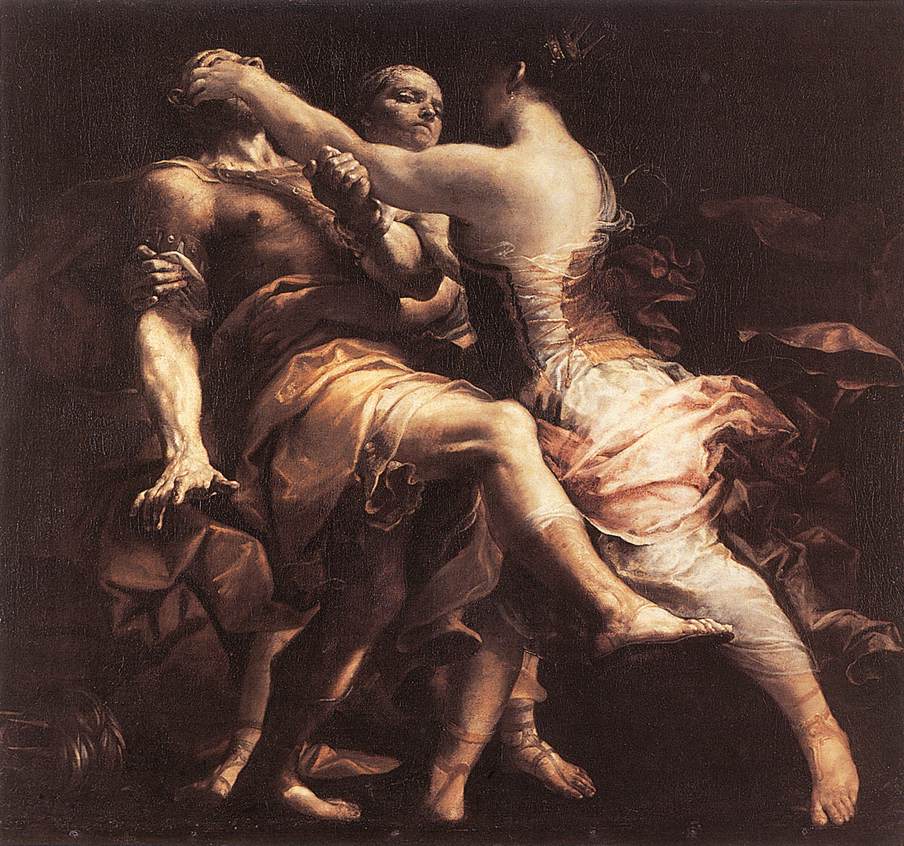
Hecuba Kills Polymestor, by Giuseppe Maria Crespi

Leaving, Forgetting Troy

Euripides, Trojan Women, 25-27

“I am leaving famous Ilion and my altars.
Whenever terrible isolation overtakes a city
The gods’ places turn sick and don’t want to receive worship”

λείπω τὸ κλεινὸν Ἴλιον βωμούς τ᾽ ἐμούς:
ἐρημία γὰρ πόλιν ὅταν λάβῃ κακή,
νοσεῖ τὰ τῶν θεῶν οὐδὲ τιμᾶσθαι θέλει.

357-360

“That famous lord of the Achaeans, Agamemnon
Will make me a wife harder to handle than Helen:
I will kill him. I will destroy his home
And take vengeance for my brothers and father…”

Ἑλένης γαμεῖ με δυσχερέστερον γάμον
ὁ τῶν Ἀχαιῶν κλεινὸς Ἀγαμέμνων ἄναξ.
κτενῶ γὰρ αὐτόν, κἀντιπορθήσω δόμους
ποινὰς ἀδελφῶν καὶ πατρὸς λαβοῦσ᾽ ἐμοῦ…

384-386

“Their army has earned this kind of praise:
Silence is better for shame, may my Muse
Never be a singer who recalls their terrible deeds.”

ἦ τοῦδ᾽ ἐπαίνου τὸ στράτευμ᾽ ἐπάξιον. —
σιγᾶν ἄμεινον τᾀσχρά, μηδὲ μοῦσά μοι
γένοιτ᾽ ἀοιδὸς ἥτις ὑμνήσει κακά.

395-399

“Listen how it is with Hektor’s mournful tale:
He died, leaving a reputation as the best man.
The coming of the Greeks made this happen.
If they had stayed home, his value would have stayed hidden.”

τὰ δ᾽ Ἕκτορός σοι λύπρ᾽ ἄκουσον ὡς ἔχει:
δόξας ἀνὴρ ἄριστος οἴχεται θανών,
καὶ τοῦτ᾽ Ἀχαιῶν ἵξις ἐξεργάζεται:
εἰ δ᾽ ἦσαν οἴκοι, χρηστὸς ὢν ἐλάνθανεν.

1165-66

“You fear a child this young? I can’t praise fear
When someone is frightened without examining why.”

βρέφος τοσόνδ᾽ ἐδείσατ᾽: οὐκ αἰνῶ φόβον,
ὅστις φοβεῖται μὴ διεξελθὼν λόγῳ.

Jean-Joseph Benjamin Constant, La mort d’Astyanax, 1868

Murofamy: More Rat Facts

Plutarch, Natural Phenomena 4 912 F

“Cargoes of salt on ships generate rats because of their frequent copulation.”

καὶ τὰ ἁληγὰ τῶν πλοίων πλείους τρέφει μῦς διὰ τὸ πολλάκις συμπλέκεσθαι.


Pliny, Natural History 44.116

“The smoke of a yew tree kills rodents.”

taxi arboris fumus necat mures.


Plutarch, Table Talk 5 685 E

“Salt-ferrying vessels produce an endless multitude of rats—as some people claim—because the female rats get pregnant without intercourse whenever they lick the salt.”

τὰ δ᾿ ἁληγὰ πλοῖα πλῆθος ἐκφύει μυῶν ἄπλετον, ὡς μὲν ἔνιοι λέγουσι, τῶν θηλειῶν καὶ Eδίχα συνουσίας κυουσῶν, ὅταν τὸν ἅλα λείχωσιν·


Aelian, On the Nature of Animals 17.17

“Amyntas in his work which he named Stages writes that in the Caspian land there are many herds of cattle and horses almost beyond counting. He adds this as well, that in some seasons an unconquerable plague of rats blights the land. He continues with evidence, saying that even though the rivers flow at that of year with a huge surge, the rats swim fearlessly and they even hold on to each other’s tales, biting down on one another, to form a bridge and they they cross the strait in this way.

After swimming into the farmland, he says, they grind down the roots of crops and swarm over trees and once they use their fruits for their meals they sever the branches too just because they are not able to eat them. For this reason, the Caspians—in order to ward off this invasion of rats and the ruin they bring—do not kill the predatory birds which come in turn, flying down from the clouds, and fulfill their nature by freeing the Caspians of this plague.

Caspian foxes are so numerous that they frequent both the sheepfolds in the country and they also appear in cities. By Zeus, a fox will show up in a house not to steal something or ruin it, but like some kind of pet. The Caspian foxes wag their tails just like pet dogs in our land.

The rats of the terrible plague afflicting the Caspians are almost the same in size when you look a them as the ikhneumenos of Egypt, but they are wild, and terrible, and they have teeth strong enough to cut and even eat metal. The rats in Teridon, Babylonia are like this too—and traders bring their skins to sell among the Persians. Indeed, these skins are soft and can be sewn together as a tunic to warm people. And they call them kandutanes, because it is dear to them.

Here is something amazing about these rats: if a pregnant female is caught and her fetus is removed, when the female fetus is dissected and examined, it also has a baby.”

᾽Αμύντας ἐν τοῖς ἐπιγραφομένοις οὕτως ὑπ᾽ αὐτοῦ Σταθμοῖς κατὰ τὴν γῆν τὴν Κασπίαν καὶ βοῶν ἀγέλας λέγει πολλὰς καὶ κρείττονας ἀριθμοῦ εἶναι καὶ ἵππων. ἐπιλέγει δὲ ἄρα καὶ ἐκεῖνο, ἐν ὡρῶν τισι περιτροπαῖς μυῶν ἐπιδημίας γίνεσθαι πλῆθος ἄμαχον· καὶ τὸ μαρτύριον ἐπάγει λέγων, τῶν ποταμῶν τῶν ἀεννάων σὺν πολλῶι τῶι ῥοίζωι φερομένων, τοὺς δὲ καὶ μάλα ἀτρέπτως ἐπινήχεσθαί τε αὐτοῖς καὶ τὰς οὐρὰς ἀλλήλων ἐνδακόντας ἕρμα τοῦτο ἴσχειν, καὶ τοῦ διαβάλλειν τὸν πόρον σύνδεσμόν σφισιν ἰσχυρότατον ἀποφαίνει τόνδε.

ἐς τὰς ἀρούρας δὲ ἀπονηξάμενοι, φησί, καὶ τὰ λήια ὑποκείρουσι καὶ διὰ τῶν δένδρων ἀνέρπουσι καὶ τὰ ὡραῖα δεῖπνον ἔχουσι καὶ τοὺς κλάδους δὲ διακόπτουσιν, οὐδὲ ἐκείνους κατατραγεῖν ἀδυνατοῦντες. οὐκοῦν ἀμυνόμενοι οἱ Κάσπιοι τὴν ἐκ τῶν μυῶν ἐπιδρομήν τε ἅμα καὶ λύμην φείδονται τῶν γαμψωνύχων, οἵπερ οὖν καὶ αὐτοὶ κατὰ νέφη πετόμενοι εἶτα αὐτοὺς ἀνασπῶσιν, καὶ ἰδίαι τινὶ φύσει τοῖς Κασπίοις ἀναστέλλουσι τὸν λιμόν. ἀλώπηκες δὲ αἱ Κάσπιαι, τὸ πλῆθος αὐτῶν τοσοῦτόν ἐστιν ὡς καὶ ἐπιφοιτᾶν οὐ μόνον τοῖς αὐλίοις τοῖς κατὰ τοὺς ἀγρούς, ἤδη γε μὴν καὶ ἐς τὰς πόλεις παριέναι. καὶ ἐν οἰκίαι ἀλώπηξ φανεῖται οὐ μὰ Δία ἐπὶ λύμηι οὐδὲ ἁρπαγῆι, ἀλλὰ οἷα τιθασός· καὶ ὑποσαίνουσί τε αἱ Κάσπιοι καὶ ὑπαικάλλουσι τῶν παρ᾽ ἡμῖν κυνιδίων <δίκην>.

οἱ δὲ μύες οἱ τοῖς Κασπίοις ἐπίδημον ὄντες κακόν, μέγεθος αὐτῶν ὅσον κατά γε τοὺς Αἰγυπτίων ἰχνεύμονας ὁρᾶσθαι, ἄγριοι δὲ καὶ δεινοὶ καὶ καρτεροὶ τοὺς ὀδόντας, καὶ διακόψαι τε καὶ διατραγεῖν οἷοί τε εἰσὶ καὶ σίδηρον. τοιοῦτοι δὲ ἄρα καὶ οἱ μύες οἱ ἐν τῆι Τερηδόνι τῆς Βαβυλωνίας (F 7) εἰσίν, ὧνπερ οὖν καὶ τὰς δορὰς οἱ τούτων κάπηλοι ἐς Πέρσας ἄγουσι φόρτον. εἰσὶ δὲ ἁπαλαί, καὶ συνερραμέναι χιτῶνές τε ἅμα γίνονται καὶ ἀλεαίνουσιν αὐτούς. καλοῦνται δὲ ἄρα οὗτοι κανδυτᾶνες, ὡς ἐκείνοις φίλον.

θαυμάσαι δὲ τῶν μυῶν τῶνδε ἄξιον ἄρα καὶ τοῦτο· ἐὰν ἁλῶι μῦς κύουσα, κἆιτα ἐξαιρεθῆι τὸ ἔμβρυον, αὐτῆς δὲ διατμηθείσης ἐκείνης εἶτα μέντοι καὶ αὐτὸ διανοιχθῆι, καὶ ἐκεῖνο ἔχει βρέφος.

Rats

Latin Learning: The Enemy of English Prose

Lord Chesterfield, Letters to His Son (September 27, 1748)

DEAR BOY: I have received your Latin “Lecture upon War,” which though it is not exactly the same Latin that Caesar, Cicero, Horace, Virgil, and Ovid spoke, is, however, as good Latin as the erudite Germans speak or write. I have always observed that the most learned people, that is, those who have read the most Latin, write the worst; and that distinguishes the Latin of gentleman scholar from that of a pedant. A gentleman has, probably, read no other Latin than that of the Augustan age; and therefore can write no other, whereas the pedant has read much more bad Latin than good, and consequently writes so too. He looks upon the best classical books, as books for school-boys, and consequently below him; but pores over fragments of obscure authors, treasures up the obsolete words which he meets with there, and uses them upon all occasions to show his reading at the expense of his judgment. Plautus is his favorite author, not for the sake of the wit and the vis comica of his comedies, but upon account of the many obsolete words, and the cant of low characters, which are to be met with nowhere else. He will rather use ‘olli’ than ‘illi’, ‘optume’ than ‘optima’, and any bad word rather than any good one, provided he can but prove, that strictly speaking, it is Latin; that is, that it was written by a Roman. By this rule, I might now write to you in the language of Chaucer or Spenser, and assert that I wrote English, because it was English in their days; but I should be a most affected puppy if I did so, and you would not understand three words of my letter. All these, and such like affected peculiarities, are the characteristics of learned coxcombs and pedants, and are carefully avoided by all men of sense.

Romulus’ Choice: Astronomy or Conquest

Ovid, Fasti 1.28-44

When the founder of the city was straightening out the calendar, he decreed that there be twice five months in the year. Ah Romulus, you knew arms a bit better than you knew the stars, and perhaps took greater care to conquer your neighbors. Yet, Caesar, there is a reason which moved him and he has a way to justify his error. The time which is enough for an infant to come forth from its mother’s womb he also decided was enough for the year. Through just so many months from the funeral of her husband will the wife keep up the mournful signs in her widowed home. The care of striped Quirinus saw all these things when he was giving the years’ regulations to his uneducated people. The first month belonged to Mars, the second to Venus. She was the starting point of the race, and he was its father. The third took its name from the old, the fourth from the young, and the crowd that followed was just noted by its number. But Numa didn’t skip over Janus or the ancient shades, and he added two months to the ancient ones.

Tempora digereret cum conditor Urbis, in anno

constituit menses quinque bis esse suo.

scilicet arma magis quam sidera, Romule, noras,

curaque finitimos vincere maior erat.               30

est tamen et ratio, Caesar, quae moverit illum,

erroremque suum quo tueatur habet.

quod satis est, utero matris dum prodeat infans,

hoc anno statuit temporis esse satis;

per totidem menses a funere coniugis uxor               35

sustinet in vidua tristia signa domo.

haec igitur vidit trabeati cura Quirini,

cum rudibus populis annua iura daret.

Martis erat primus mensis, Venerisque secundus;

haec generis princeps, ipsius ille pater:               40

tertius a senibus, iuvenum de nomine quartus,

quae sequitur, numero turba notata fuit.

at Numa nec Ianum nec avitas praeterit umbras,

mensibus antiquis praeposuitque duos.