“Everything is Laughter in The End”: An Epitaph

Anonymous epitaph for Democritus, Greek Anthology 7.56

“This was the source of Democritus’ laughter, as he would say immediately:
‘Did I not say, while laughing, that everything is laughter in the end?
For I too, after my boundless wisdom and ranks of
So many books, lie beneath a tomb as a joke.’ ”

῏Ην ἄρα Δημοκρίτοιο γέλως τόδε, καὶ τάχα λέξει·
„Οὐκ ἔλεγον γελόων· ‚Πάντα πέλουσι γέλως’;
καὶ γὰρ ἐγὼ σοφίην μετ’ ἀπείρονα καὶ στίχα βίβλων
τοσσατίων κεῖμαι νέρθε τάφοιο γέλως.”

By Antoine Coypel, 1692. Wikimedia Commons

Heroic Grief: Celebrating a New Book on the Iliad

Lucian, True History 2.20

“I was asking him next why he made his poem start with the “rage of Achilles”. He said that it just leapt into his head that way without any prior thought.”

ἐπεὶ δὲ ταῦτα ἱκανῶς ἀπεκέκριτο, πάλιν αὐτὸν ἠρώτων τί δή ποτε ἀπὸ τῆς μήνιδος τὴν ἀρχὴν ἐποιήσατο· καὶ ὃς εἶπεν οὕτως ἐπελθεῖν αὐτῷ μηδὲν ἐπιτηδεύσαντι.

Here’s a bit of something different: I’d like to talk about new book my a good friend. Emily Austin’s Grief and the Hero: The Futility of Longing in the Iliad was released a few months ago. As anyone who has published something during the pandemic knows, there’s not much room for something as simple as a book in all the noise.

But this is a book I think people should read. Now, I read a lot of books about Homer. It is not just a job, it is something I have done as a hobby since I first read Gregory Nagy’s The Best of the Achaeans  and Richard Martin’s The Language of Heroes as an undergraduate. I often ignored homework assignments in graduate school in favor of reading books like Donna Wilson’s Ransom and Revenge or Hilary Mackie’s Talking Trojans. See, before I started working on the Odyssey, I was all Iliad all the time.

D Schol. ad ll 1.1

“Sing the rage..” [People] ask why the poem begins from rage, so ill-famed a word. It does for two reasons. First, so that it might [grab the attention] of that particular portion of the soul and make audiences more ready for the sublime and position us to handle sufferings nobly, since it is about to narrate wars.

A second reason is to make the praises of the Greeks more credible. Since it was about to reveal the Greeks prevailing, it is not seemly to make it more worthy of credibility by failing to make everything contribute positively to their praise.”

Μῆνιν ἄειδε: ζητοῦσι, διὰ τί ἀπὸ τῆς μήνιδος ἤρξατο, οὕτω δυσφήμου ὀνόματος. διὰ δύο ταῦτα, πρῶτον μέν, ἵν’ ἐκ τοῦ πάθους †ἀποκαταρρεύσῃ† τὸ τοιοῦτο μόριον τῆς ψυχῆς καὶ προσεκτικωτέρους τοὺς ἀκροατὰς ἐπὶ τοῦ μεγέθους ποιήσῃ καὶ προεθίσῃ φέρειν γενναίως ἡμᾶς τὰ πάθη, μέλλων πολέμους ἀπαγγέλλειν· δεύτερον δέ, ἵνα τὰ ἐγκώμια τῶν ῾Ελλήνων πιθανώτερα ποιήσῃ. ἐπεὶ δὲ ἔμελλε νικῶντας ἀποφαίνειν τοὺς ῞Ελληνας, εἰκότως †οὐ κατατρέχει ἀξιοπιστότερον† ἐκ τοῦ μὴ πάντα χαρίζεσθαι τῷ ἐκείνων ἐπαίνῳ.

Everyone knows the Iliad starts with the “rage of Achilles”. What that rage means and how it shapes the poem is not so universally understood. My first Greek teacher and now friend of two decades, Leonard Muellner, wrote one of the best books on this topic. In his The Anger of Achilles: Mênis in Greek Epic, Lenny shows how Achilles’ anger has cosmic implications and is rooted in a thematic pattern shared by gods like Demeter and Zeus. He also notes that there may have been versions of the poem that put Achilles’ rage alongside Apollo’s

The proem according to Aristoxenus

Tell me now Muses who have Olympian Homes
How rage and anger overtook Peleus’ son
And also the shining son of Leto. For the king was enraged…”

῎Εσπετε νῦν μοι, Μοῦσαι ᾿Ολύμπια δώματ’ ἔχουσαι,
ὅππως δὴ μῆνίς τε χόλος θ’ ἕλε Πηλεΐωνα,
Λητοῦς τ’ ἀγλαὸν υἱόν· ὁ γὰρ βασιλῆι χολωθείς.

What I love about Emily Austin’s book is that she enters into a deep and ancient discussion and asks what seems like a simple question: what about the cause of rage? Starting from the premise that the absence of things, longing, what a Lacanian might call a “lack” (my words, not hers), Emily offers a reading of the epic that doesn’t countermand the importance of rage, but instead, decenters it, looking at how longing (pothê,) shapes the poem and its audiences expectations.

Here’s Emily talking about her book:

In Grief and the Hero, I set aside conversations about the Iliad’s composition and authorship, and instead consider the poem as narrative poetry. The heart of my book is Achilles’ experience of futility in grief. Rather than assuming that grief gives rise to anger, as most scholars have done, Grief and the Hero traces the origin of these emotions. Achilles’ grief for Patroklos is uniquely described with the word pothê, “longing.” By joining grief and longing, the Iliad depicts Achilles’ grief as the rupture of shared life—an insight that generates a new way of reading the epic. No action can undo the reality of his friend Patroklos’ death; but the experience of death drives Achilles to act as though he can achieve something restorative. Achilles’ cycles of weeping and vengeance-seeking bring home how those whom we have lost will never return to us, yet we are shaped by the life we shared with them. In Grief and the Hero, I uncover these affective dimensions of the narrative, which contribute to the epic’s lasting appeal. Loss, longing, and even revenge touch many human lives, and the insights of the Iliad have broad resonance.

I am not a disinterested party in this book. I read an early manuscript and recognized early on that this was an original contribution to an old debate. There is an urgency to longing and the absence of what we need to complete ourselves that motivates the actions of the poem and feeds the timeliness of this book. In a year of violence, disruption, and isolation, it is a perfect time to think about the causes of the things that set us apart.

Grief and the Hero provides a perfect complement to Muellner’s analysis of the thematic function of Achilles’ rage; it also functions as a corrective for many responses to Homer that shy away from the grand themes and the big stages of human life. There are a few dozen books about Homer I think a Homerist must read; there are only a handful I think everyone should try. Emily’s Grief and the Hero is now one of them.

Of course, I’m biased here. I’ve learned so much from talking to Emily about literature, loss and grief over the past few years that I am certainly not objective. But I asked a couple other friends for their thoughts too.

Alex Loney, Associate Professor, Wheaton College

Emily Austin has written a rare and welcome contribution to recent Homeric scholarship: a “robustly literary” meditation on grief and the Iliad. In her reading, the Iliad shows how anger born of grief is never satisfied. It cycles on, relentlessly forward. Peace that comes from vengeance is illusory, and the yawning chasm of loss can only be repaired by letting go.

Joe Goodkin, Singer, Songwriter, Homeric Bard

I have spent the better part of three years living inside the characters of the Iliad as I composed and now perform the Blues of Achilles, my first-person song cycle adaptation of the epic. I found Grief and the Hero exhaustingly resonant with what I’ve come to vividly understand as the core emotional arc of Achilles and those caught in his orbit. Grief and the Hero works for me on multiple levels: academic, creative, and, most importantly, human, so beautifully teasing out the most powerful and universal theme of the poem that I only began to fully discover and appreciate as I wrote my songs: the resolution of grief.

Justin Arft, Assistant Professor, University of Tennessee Knoxville

“In addition to providing a novel interpretation of the Iliad‘s narrative and applying close readings of phraseology and structures, Emily brings new depths to the character of Achilles that all subsequent interpretations will need to consider. Her approach is a perfect balance of careful scholarship and elegant interpretation.. She has challenged me to think about the human dimension of the stories.”

Those of us in academia have missed some minor things during the pandemic: book release parties, dinners to celebrate tenure, long talks away from loud conferences with friends. These are so insignificant compared to the losses of the past year that I feel bad even mentioning them. But loss is part of what makes us who we are.

Take a chance on a book; let’s make Emily’s year special.


and some epigrammatic humor to end the post

Palladas of Alexandria, Greek Anthology 9.169

“The Rage of Achilles has become the cause for me
a grammarian, of destructive poverty.
I wish the rage had killed me with the Greeks
before the hard hunger of scholarship killed me.”

Μῆνις ᾿Αχιλλῆος καὶ ἐμοὶ πρόφασις γεγένηται
οὐλομένης πενίης γραμματικευσαμένῳ.
εἴθε δὲ σὺν Δαναοῖς με κατέκτανε μῆνις ἐκείνη,
πρὶν χαλεπὸς λιμὸς γραμματικῆς ὀλέσει.


Psst…if you use this flyer you can get a discount

Money or The Muses?

Perhaps it will be the case that you’re called to be an artist. If so, take that fate upon yourself and bear it–its weight and its greatness.

–Rilke, Letters to a Young Poet

Crinagoras 9.234 (Greek Anthology)

“Tormented soul, how long will you put off
All your dreams except your dreams of riches?
Empty hopes wing you to the closest cold cloud.
Know this: things worth having don’t just come to man.
You must pursue the gifts of the Muses!
And as for your mind’s dim fancies,
Leave them to crazy people.”

ἄχρι τεῦ, ἆ δείλαιε, κεναῖσιν ἐπ᾽ ἐλπίσι, θυμέ,
πωτηθεὶς ψυχρῶν ἀσσοτάτω νεφέων,
ἄλλοις ἄλλ᾽ ἔπ᾽ ὄνειρα διαγράψεις ἀφένοιο;
κτητὸν γὰρ θνητοῖς οὐδὲ ἓν αὐτόματον.
Μουσέων ἀλλ᾽ ἐπὶ δῶρα μετέρχεο: ταῦτα δ᾽ ἀμυδρὰ
εἴδωλα ψυχῆς ἠλεμάτοισι μέθες.

Larry Benn has a B.A. in English Literature from Harvard College, an M.Phil in English Literature from Oxford University, and a J.D. from Yale Law School. Making amends for a working life misspent in finance, he’s now a hobbyist in ancient languages and blogs at featsofgreek.blogspot.com.

Homer, Inventor of Geography

Strabo, Geographica 1.1:

Let us take up and inspect more closely each of the things previously stated. First, that we have taken up correctly along with those before us (among whom is Hipparchus) in stating that Homer is the forefather of geographical study, as he not only outstrips all before and after him in his poetic excellence, but also in his knowledge of political life. Not only did he set himself eagerly about practical affairs with an eye to learning about them and transmitting the knowledge to future generations, but he also worked with an eye to learning about individual lands as well as the whole scope of the inhabited world on land and sea. For, even in his circuit of the globe, he did not arrive at a recollection of the farthest lands of the world.

He was the first to show that the world was as it were circled and bathed by the Ocean. Then, of the various lands, he gave some names and posed riddles about others with some little clues. He called by name Libya, Aethiopia, the Sidonians and the Eremboi (whom he referred to as the Arabs of the Caves), but he referred enigmatically to the peoples who lived near the risings and settings of the sun, saying that they were bathed by the ocean.

᾿Αναλαβόντες δὲ καθ’ ἕκαστον ἐπισκοπῶμεν τῶν εἰρημένων ἔτι μᾶλλον. καὶ πρῶτον ὅτι ὀρθῶς ὑπειλήφαμεν καὶ ἡμεῖς καὶ οἱ πρὸ ἡμῶν, ὧν ἐστι καὶ ῞Ιππαρχος, ἀρχηγέτην εἶναι τῆς γεωγραφικῆς ἐμπειρίας ῞Ομηρον, ὃς οὐ μόνον ἐν τῇ κατὰ τὴν ποίησιν ἀρετῇ πάντας ὑπερβέβληται τοὺς πάλαι καὶ τοὺς ὕστερον,  ἀλλὰ σχεδόν τι καὶ τῇ κατὰ τὸν βίον ἐμπειρίᾳ τὸν πολιτικόν, ἀφ’ ἧς οὐ μόνον περὶ τὰς πράξεις ἐσπούδασεν ἐκεῖνος, ὅπως ὅτι πλείστας γνοίη καὶ παραδώσει τοῖς ὕστερον ἐσομένοις, ἀλλὰ καὶ τὰ περὶ τοὺς τόπους τούς τε καθ’ ἕκαστα καὶ τοὺς κατὰ σύμπασαν τὴν οἰκουμένην γῆν τε καὶ θάλατταν· οὐ γὰρ ἂν μέχρι τῶν ἐσχάτων αὐτῆς περάτων ἀφίκετο τῇ μνήμῃ κύκλῳ περιιών.

Καὶ πρῶτον μὲν τῷ ὠκεανῷ περίκλυστον, ὥσπερ ἔστιν, ἀπέφαινεν αὐτήν· ἔπειτα δὲ τῶν χωρίων τὰ μὲν ὠνόμαζε τὰ δὲ ὑπῃνίττετο τεκμηρίοις τισί, Λιβύην μὲν καὶ Αἰθιοπίαν καὶ Σιδονίους καὶ ᾿Ερεμβούς, οὓς εἰκὸς λέγειν Τρωγλοδύτας ῎Αραβας, ῥητῶς λέγων, τοὺς δὲ πρὸς ταῖς ἀνατολαῖς καὶ δύσεσιν αἰνιττόμενος ἐκ τοῦ τῷ ὠκεανῷ κλύζεσθαι·

Some Useful Principles On Science and Fear

Some of Epicurus’ Maxims (taken from Diogenes Laertius‘ Lives of the Eminent Philosophers)

  1. “If fear of the skies or about death had never afflicted us—along with the ignoring of the limits of pain and desires—we never would have needed natural science”

Εἰ μηθὲν ἡμᾶς αἱ τῶν μετεώρων ὑποψίαι ἠνώχλουν καὶ αἱ περὶ θανάτου, μή ποτε πρὸς ἡμᾶς ᾖ τι, ἔτι τε τὸ μὴ κατανοεῖν τοὺς ὅρους τῶν ἀλγηδόνων καὶ τῶν ἐπιθυμιῶν, οὐκ ἂν προσεδεόμεθα φυσιολογίας.

  1. “It is not possible to eliminate fear about the most important things unless one understands the nature of everything—otherwise, we live fearing things we heard from myths. Therefore, it is not possible to enjoy unmixed pleasures without natural science.”

XII. Οὐκ ἦν τὸ φοβούμενον λύειν ὑπὲρ τῶν κυριωτάτων μὴ κατειδότα τίς ἡ τοῦ σύμπαντος φύσις, ἀλλ’ ὑποπτευόμενόν τι τῶν κατὰ τοὺς μύθους· ὥστε οὐκ ἦν ἄνευ φυσιολογίας ἀκεραίους τὰς ἡδονὰς ἀπολαμβάνειν.

  1. “There is no profit in making yourself secure against other people as long as you fear what happens above and below the earth or elsewhere in the endless universe.”

XIII. Οὐθὲν ὄφελος ἦν τὴν κατ’ ἀνθρώπους ἀσφάλειαν κατασκευάζεσθαι τῶν ἄνωθεν ὑπόπτων καθεστώτων καὶ τῶν ὑπὸ γῆς καὶ ἁπλῶς τῶν ἐν τῷ ἀπείρῳ.

Marble head of Epicurus, 2nd century A.D. copy of greek statue of the 1st half of the 3rd century B.C. MET Museum, Wikimedia Commons

More on the Pharmacology of Language

Gorgias, Defense of Helen 13-14

“The persuasion intrinsic to speech also shapes the mind as it pleases. We must first consider the narratives of astronomers who, by undermining one idea and developing another one, alter beliefs and make the incredible and invisible manifest to the eyes of belief. In turn, consider the necessary struggles in which one argument delights and persuades a great crowd when it has been written skillfully, even if it is spoken falsely. Finally, consider the rivalrous claims of philosophers which feature as well the speed of opinion that engenders volatility in the fidelity of a belief.”

 (13) ὅτι δ’ ἡ πειθὼ προσιοῦσα τῶι λόγωι καὶ τὴν ψυχὴν ἐτυπώσατο ὅπως ἐβούλετο, χρὴ μαθεῖν πρῶτον μὲν τοὺς τῶν μετεωρολόγων λόγους, οἵτινες δόξαν ἀντὶ δόξης τὴν μὲν ἀφελόμενοι τὴν δ’ ἐνεργασάμενοι τὰ ἄπιστα καὶ ἄδηλα φαίνεσθαι τοῖς τῆς δόξης ὄμμασιν ἐποίησαν· δεύτερον δὲ τοὺς ἀναγκαίους διὰ λόγων ἀγῶνας, ἐν οἷς εἷς λόγος πολὺν ὄχλον ἔτερψε καὶ ἔπεισε τέχνηι γραφείς, οὐκ ἀληθείαι λεχθείς· τρίτον <δὲ> φιλοσόφων λόγων ἁμίλλας, ἐν αἷς δείκνυται καὶ γνώμης τάχος ὡς εὐμετάβολον ποιοῦν τὴν τῆς δόξης πίστιν.

“The power of speech has the same logic regarding the disposition of the soul as that of the application of drugs to the natural function of bodies. For, just as certain drugs dispel certain afflictions from the body, and some end disease while others end life, so too are there stories that create grief and others that cause pleasure; some send us running, others make their audiences bold. Others still intoxicate and deceive the soul though some evil persuasion.”

 (14) τὸν αὐτὸν δὲ λόγον ἔχει ἥ τε τοῦ λόγου δύναμις πρὸς τὴν τῆς ψυχῆς τάξιν ἥ τε τῶν φαρμάκων τάξις πρὸς τὴν τῶν σωμάτων φύσιν. ὥσπερ γὰρ τῶν φαρμάκων ἄλλους ἄλλα χυμοὺς ἐκ τοῦ σώματος ἐξάγει, καὶ τὰ μὲν νόσου τὰ δὲ βίου παύει, οὕτω καὶ τῶν  λόγων οἱ μὲν ἐλύπησαν, οἱ δὲ ἔτερψαν, οἱ δὲ ἐφόβησαν, οἱ δὲ εἰς θάρσος κατέστησαν τοὺς ἀκούοντας, οἱ δὲ πειθοῖ τινι κακῆι τὴν ψυχὴν ἐφαρμάκευσαν καὶ ἐξεγοήτευσαν.


rhyme


Addictive Reading: Etymologies for Kirke and Pharmakon in the Suda

Some Words from the Suda

“Walled off”: This means “blocking”. As in the [unknown author’s line] “Because I have walled off my stomach, I am no longer susceptible to any drug.”

Ἀποτειχίζων: ἀποφράσσων. ἀποτειχίσας δὲ τὴν γαστέρα οὐδενὶ τῶν φαρμάκων ἔτι εἰμὶ ἁλώσιμος


Kirkê: This comes from “the woman who mixes [kirnôsa] the drugs. Or it is from kerkis [shuttle] from the verb kerkô. We call women who are especially subtle Kirkes.

Κίρκη: ἡ κιρνῶσα τὰ φάρμακα. ἢ παρὰ τὴν κερκίδα: κερκὶς δὲ παρὰ τὸ κρέκω. τὰς δὲ παιπαλώσεις γυναῖκας Κίρκας φαμέν.


“The oblivion of dogs”: [This is a proverb] for drugs that bring forgetfulness

Λήθην κυνῶν: λήθην ἐμποιούντων φαρμάκων.


Drug [Pharmakon]: this can mean persuasion, conversation: the etymology is said to be from bearing [pherein] the cure [akos]. Others claim that it comes from flowers.

Φάρμακον: παραμυθία, ὁμιλία, εἴρηται δὲ ἀπὸ τοῦ φέρειν τὴν ἄκεσιν: εἴρηται δὲ ἀπὸ τῶν ἀνθέων.


Circe and Odysseus, white-ground lekythos by the Athena Painter, ca. 490–480 BCE. From Eretria. National Archaeological Museum in Athens, 1133.

How Not to Remember the Dead

The Greek Anthology records fifty-one poems by the versatile Crinagoras of Mytilene (c. 1st century BC – 1st century AD). Here are 2 uncharitable epigrams of his regarding the tomb and decaying remains of one Eunicides:

7.380 (Greek Anthology)

Though the tomb’s been cut from a block of white marble,
And it’s been made fine with a mason’s straight rule,
It does not belong to a good man.
Do not appraise the dead, my friend, based on stone.
Stone is witless: this is how it covers
Even a corpse already turned black.
Here lies that limp rag, Eunicides,
Rotting away under the ashes.

7.401 (Greek Anthology)

The tomb atop his odious head
Crushes the bones of the reprobate
Who lies beneath the accursed dirt:
It crushes his jutting chest,
His foul-smelling row of teeth,
His legs bandaged like a slave’s,
And his hairless head as well.
Eunicides’ half-burnt remains, these,
And they’re still full of greenish pus.
Earth, you’ve made an unfortunate marriage;
Don’t now lie lightly, or even slightly,
On this misshapen man’s ashes.

7.380

εἰ καὶ τὸ σῆμα λυγδίνης ἀπὸ πλακὸς
καὶ ξεστὸν ὀρθῇ λαοτέκτονος στάθμῃ,
οὐκ ἀνδρὸς ἐσθλοῦ. μὴ λίθῳ τεκμαίρεο,
ὦ λῷστε, τὸν θανόντα. κωφὸν ἡ λίθος,
τῇ καὶ ζοφώδης ἀμφιέννυται νέκυς.
κεῖται δὲ τῇδε τὠλιγηπελὲς ῥάκος
Εὐνικίδαο, σήπεται δ᾽ ὑπὸ σποδῷ

7.401

τήνδ᾽ ὑπὸ δύσβωλον θλίβει χθόνα φωτὸς ἀλιτροῦ
ὀστέα μισητῆς τύμβος ὑπὲρ κεφαλῆς,
στέρνα τ᾽ ἐποκριόεντα, καὶ οὐκ εὔοδμον ὀδόντων
πρίονα, καὶ κώλων δούλιον οἰοπέδην,
ἄτριχα καὶ κόρσην, Εὐνικίδου ἡμιπύρωτα
λείψαν᾽, ἔτι χλωρῆς ἔμπλεα τηκεδόνος.
χθὼν ὦ δυσνύμφευτε, κακοσκήνευς ἐπὶ τέφρης
ἀνδρὸς μὴ κούφη κέκλισο, μηδ᾽ ὀλίγη.

This is an image by the surrealist photographer Hans Bellmer (1902-1975). It depicts the life-like (or rather, death-like) doll he built and set in poses before his camera.

Larry Benn has a B.A. in English Literature from Harvard College, an M.Phil in English Literature from Oxford University, and a J.D. from Yale Law School. Making amends for a working life misspent in finance, he’s now a hobbyist in ancient languages and blogs at featsofgreek.blogspot.com.

Tawdry Tuesday: Wanton Verse, Pure Heart. And Dicks for Sale (NSFW)

Hadrian, fr. II [A minor Latin Poet and a Major Roman Emperor]

“You were wanton in verse, but pure of thought”

Lascivus versu, mente pudicus eras.

 Martial, 12.97

“Even though your wife is a girl of a kind
A man would scarcely seek with inappropriate prayers
(rich, noble, erudite, chase, what a find!)
You bust your nut, Bassus, but on the hair
Of the the men you buy with your wife’s money.

And when to its mistress your dick is returned
Though it was for so many thousands bought
It is so limp that its full size cannot be earned
Even if by sweet whispers or soft strokings sought.

For once, have some shame or let’s go to court.
Bassus, you sold it—your dick ain’t yours.”

Uxor cum tibi sit puella qualem
votis vix petat improbis maritus,
dives, nobilis, erudita, casta,
rumpis, Basse, latus, sed in comatis,
uxoris tibi dote quos parasti.
et sic ad dominam reversa languet
multis mentula milibus redempta
ut nec vocibus excitata blandis
molli pollice nec rogata surgat.
sit tandem pudor aut eamus in ius.
non est haec tua, Basse: vendidisti.

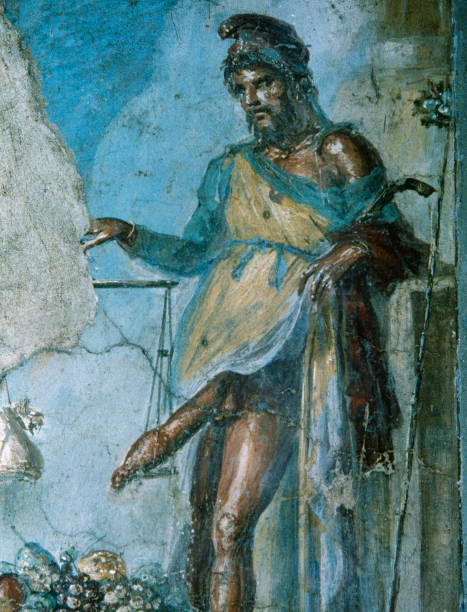
Image result for Priapus weighing penis pompeii
Wall-painting: Priapus weighing his phallus (Pompeii)

Palinurus Takes One for the Team

Cyril Connolly, The Unquiet Grave:

Harpies, Scylla, Charybdis, the Cyclops, Etna in eruption! Each one of the trials which the exiled pilot must have undergone could occasion an anxiety-neurosis or effort-syndrome in a man less well-balanced. One wonders how he reacted to Aeneas’ public account of them. Dido, we know, fell disastrously ‘in love” with Aeneas, and it is when he departs (Aeneas abandoning her after their cave-wedding), that Palinurus speaks again. The fleet has stolen out in the early morning and Dido has set alight her funeral pyre whose glow the sailors see, but Aeneas alone interprets rightly. At once a storm gets up.

But soon the Heav’ns with shadows were overspread;

A swelling Cloud hung hov’ring o’er their Head:

Livid it look’d (the threat’ning of a Storm),

Then Night and Horror Ocean’s Face deform.

The Pilot Palinunis ciy’d aloud,

‘What Gusts of Weather from that gath’ring Cloud

My Thoughts presage ; e’er yet the Tempest roars.

Stand to your Tackle, Mates, and stretch your Oars ;

Contract your swelling Sails, and luff to Wind’

The frighted Crew perform the Task assign’d.

Then, to his fearless Chief, ‘ Not Heav’n,’ said he,

‘ Tho’ Jove himself shou’d promise Italy

Can stem the Torrent of this raging Sea.

Mark how the shifting Winds from West arise,

And what collected Night involves the Skies

Nor can our shaken Vessels live at Sea,

Much less against the Tempest force their way;

’Tis fate diverts our Course ; and Fate we must obey.

Not far from hence, if I observ’d aright

The southing of the Stars and Polar Light,

Sicilia lies ; whose hospitable Shores

In safety we may reach with strugling oars.

The Course resolv’d, before the Western Wind

They scud amain; and make the Port assign’d

It seems clear that Palinurus who had led the fleet between Scylla and Charybdis, recognized that his storm could not be ridden out because he knew it followed on Aeneas’ betrayal of Dido. He also read the true meaning of the fire which they had seen and from that moment realized that was guilty of hubris and impiety; he was ‘not the Messiah’.

In Sicily Aeneas celebrates his arrival with elaborate games. In these — although they include various sailing contests — Palinurus himself does not join and lets the other pilots fight them out. One can imagine him brooding over the storm and his leader’s conduct while the noisy sport proceeds around him. Finally, to prevent the men leaving, the women set fire to the ships and four are destroyed. Here occurs an incident for which no scientific explanation is forthcoming, and which, if the narrator were Palinurus and not Viigil, we would be tempted to ascribe to a delusion of reference. Venus begs Neptune to guarantee that her beloved Aeneas and all his men will not be subjected to any more disasters and storms at sea by their enemy, Juno. Neptune agrees, but warns her that ‘In safety as thou prayest shall he reach the haven of Avernus. Only one shall there be whom, lost in the flood, thou shalt seek in vain; one life shall be given for many.’