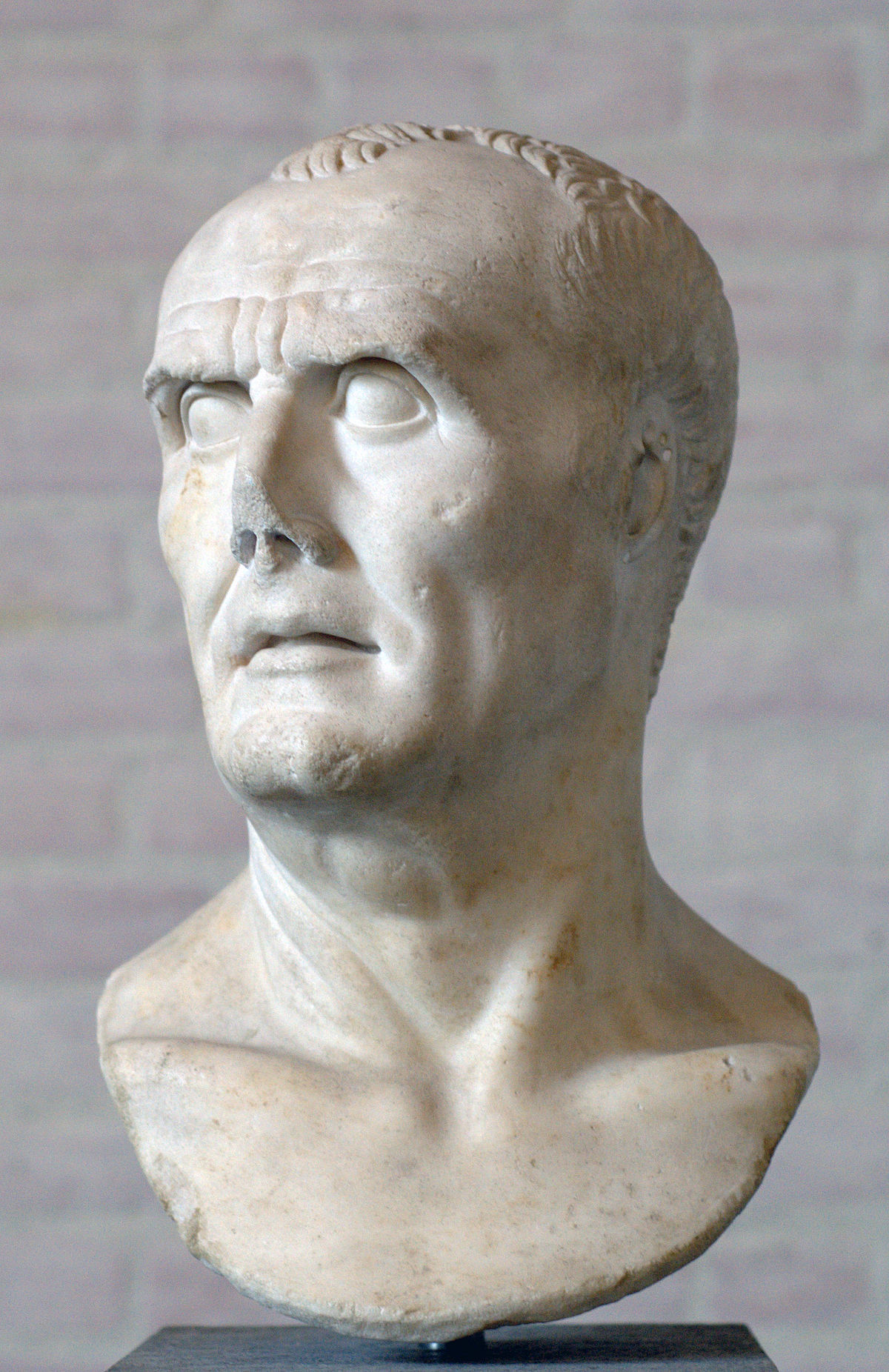
“Not so vile is the deed and saying of Caius Fimbria, but on their own they are both extremely bold. He planned that Scaevola would be slaughtered at the funeral of Gaius Marius. Once he learned that [Scaevola] had healed from his wound, he turned to accuse him in court.
There, when he was asked what he had to say against someone whose character couldn’t possibly be sufficiently praised, he said that he would claim the man had let the weapon wound him too easily. What an excess of insanity that accompanied the groan of a sick country!”
Non tam atrox C. Fimbriae est factum et dictum, sed si per se aestimetur, utrumque audacissimum. id egerat ut Scaevola in funere C. Marii iugularetur. quem postquam ex vulnere recreatum comperit, accusare apud populum instituit. interrogatus deinde quid de eo secus dicturus esset cui pro sanctitate morum satis digna laudatio reddi non posset, respondit obiecturum se illi quod parcius corpore telum recepisset. licentiam furoris aegrae rei publicae gemitu prosequendam!
“But, am I not a scholar? Why do you pursue scholarship? Servant, do you do this to be content? Do you do it to be safe? Do you do it to grasp nature and live in accordance with it? What stops you when you’re sick from having your principle align with nature? This is the test of the matter, the crucible for any philosopher. This is also a part of life, like a stroll, a voyage, a trip, the fever too! Do you read while walking? No! And you don’t read while having a fever. But if you walk well, you deliver the promise of one who walks.
If you have a fever, then do what one who has a fever should do. What does it mean to be sick well? Don’t blame god, or man. Don’t be undone by the things that happen. Await death bravely and correctly, and do what is given to you.”
“Generally, then, if one wants to examine it carefully, you will find Odysseus’ wandering to be an allegory. Homer has positioned Odysseus as some kind of an instrument of every kind of virtue and he has used him to philosophize, since he hated the wickedness which governs human life.
The land of the Lotus-eaters, a farm of exotic temptation, represents the temptation of pleasure through which Odysseus sailed in perfect control. He snuffs out the savage anger of each of us with the advice from his words as if cauterizing it. This anger is named the Cyclops, the one who steals away [hypoklôpôn] our faculties of reason.
What of this—does it not seem that Odysseus who ‘overcame the winds’ was the first to anticipate fair sailing through his knowledge of the stars? And he was superior to Kirkê’s drugs because he discovered a cure for addictive delicacies thanks to his deep wisdom.
And his intelligence extends even to Hades so that nothing in the underworld might go unexplored. Who listens to the Sirens and learns a diverse history of all time? Charybdis is an obvious name for luxury and endless drinking. Homer has allegorized manifold shamelessness in Skylla, which is why she would logically have a belt of dogs, guardians for her rapacity, daring, and pugnacity. The cattle of the sun are about controlling your eating—for he would not even allow starvation to be a compulsion to do injustice.
These stories were told mythically for their audiences, if someone delves into the allegorized wisdom, it will be the most useful to those who apprehend it.”
A former dean of mine once sent an email to the faculty announcing a large grant to the college by a local business, providing for endowed chairs in the liberal arts. He had the temerity to announce in the very same email that he was giving himself one of these chairs. And he had a chair made with an inscription. The following is a slightly more humble epigraph.
Constantinus of Sicily, Greek Anthology 15.13
“If you are wise, sit on me. But if you’ve tasted the muse
Only with the tip of your finger…..
Move far away and find a different seat.
I am a chair who bears the burden of men who seek wisdom.”
By chance a fox had seen a tragic mask:
What a sight, he has no brains inside!–he gasped.
To whomever fortune grants honor and glory,
It deprives of common sense, as in this story.
Personam tragicam forte vulpes viderat:
O quanta species, inquit, cerebrum non habet!
Hoc illis dictum est, quibus honorem et gloriam
Fortuna tribuit, sensum communem abstulit.
“In India, if an adult elephant is caught it is difficult to tame—it gets murderous from longing for freedom. If you bind it in chains too, it gets even more agitated and will not tolerate its master. But Indians try to pacify it with food and to soften it with a variety of pleasing items, making an effort to fill its stomach and delight its heart. But it remains angry with them and ignores them. What then do they devise and do? They encourage it with their native music and sing to a certain instrument they use. It is called a skindapsos. The instrument strikes the ears and enchants the animal—his anger softens and his spirit yields and bit by bit it pays attention to its food. At this point it is released from its chains and it waits, enthralled by the music, and it eats eagerly, like a guest in love with a banquet. The elephant will no longer leave because of his love of music.”
But now I should wrap up my letter. You ask, ‘Will it come to be thus without any little benefit?’ Fear not! It brings a little something. Well, why do I say ‘something’? It offers you a lot! What is it that I in my voice clearer than hand over as your lesson? ‘It is bad to live in necessity, but there is no necessity to live in necessity.’
So what if there isn’t? All over the many brief, easy roads to liberty lie open. Let us give thanks to the god that no one can be held here in life: we are allowed to stamp necessity underfoot. You say, ‘Epicurus said: what is another’s business to you?’ But this is truly my sentiment: I will continue to bring Epicurus to you, as those who swear upon words and don’t judge what is actually being said, but do it from the fact that they know that those things are best which are shared among us all. Farewell.
Sed iam debeo epistulam includere. ‘Sic’ inquis ‘sine ullo ad me peculio veniet?’ Noli timere: aliquid secum fert. Quare aliquid dixi? multum. Quid enim hac voce praeclarius quam illi trado ad te perferendam? ‘Malum est in necessitate vivere, sed in necessitate vivere necessitas nulla est.’ Quidni nulla sit? patent undique ad libertatem viae multae, breves faciles. Agamus deo gratias quod nemo in vita teneri potest: calcare ipsas necessitates licet. ‘Epicurus’ inquis ‘dixit: quid tibi cum alieno?’ Quod verum est meum est; perseverabo Epicurum tibi ingerere, ut isti qui in verba iurant nec quid dicatur aestimant, sed a quo, sciant quae optima sunt esse communia. Vale.
George Turnbull, Observations Upon Liberal Education
One exercise should be daily to write a page of English, and after that to examine every word by the grammar rules, and in every sentence they have composed, to oblige them to give an account of the English syntax and construction. Thus an habit would soon be acquired, and they would do it of course. All affected words and harsh transpositions should be noted; every phrase not used in good company exploded; harsh metaphors, which have neither a peculiar light or force, be discarded: Metaphors are a kind of embroidery, which do admirably on proper occasions, but shew a tawdry mind, if it scruples to appear, unless dressed in such finery. Another exercise should be obliging them to speak every day in unwritten thoughts on any subject in English. Let them read an oration in Tully or Livy; let them read it to themselves in Latin as often as they please, then shut the book, and speak the sense of it extempore in unpremeditated words. A little use will make it most agreeably easy: and what a habit is this for a man of quality? Begin with a fable of Phaedrus, thence to a short speech in an historian, you’ll be amazed how soon the would enter into the spirit of Cicero, and plead the cause of Ligarius with his ardour, and feel what they utter. This is the ambition I would have you pursue: afford to gentlemen this distinguishing, this necessary education, and become thus a nursery of state orators.
Plutarch, On Stoic Self-Contradiction [Moralia 1033d]
In this passage, Plutarch is criticizing stoics for talking about the importance of government and ruling even though most of them dedicated themselves to the private lives of reading, writing and lecturing.
“Chrysippus himself, at least in the fourth book of Concerning Ways of Life, thinks that there is no difference because the scholarly life and one of pleasure. I shill quote his very words: “All those who think that the scholarly life is of special importance for philosophers seem to me to go astray from the beginning because they believe that it is right to do this kind of thing for the sake of [having some] job or some other reason like this, [that it is right] to drag out an entire life this way.
This is, if it is examined clearly, [a life devoted to] pleasure. We must not overlook the core meaning of the many people who say this kind of thing clearly, nor the few who try to obscure it.” Who grew old in this scholarly life other than Chrysippos, Kleanthês, Diogenês, Zenô, and Antipater?”
“The Sirens were some Greek women with beautiful voices in ancient Greek myth who sat on some island and so delighted passers-by with their euphony that they stayed there until death. From the chest up they had the shape of sparrows but their lower halves were woman.
The mythographers claim that they were small birds with female faces who deceived passers-by, beguiling the ears of those who heard them with pornographic songs. And the song of pleasure has no end that is good, only death.
But the true story is this: there are certain places in the sea, narrowed between hills, which release a high song when the water is compressed into them. When people who sail by hear them they entrust their souls to the water’s swell and they die along with their ships.
The creatures who are called Sirens and Donkey-centaurs in Isaiah are some kind of demons who are foretold for abandoned cities which fall under divine wrath. The Syrians say they are swans. For after swans bathe, they fly from the water and sing a sweet melody in the air. This is why Job says, “I have become the Sirens’ brother, the companion of ostriches. This means that I sing my sufferings just like the ostriches.”
He calls the Sirens strouthoi, but he means what we call ostriches [strouthokamêmlos: “sparrow-camel”]. This is a bird which has the feet and neck of a donkey. There is a saying in the Epigrams “that chatter is sweeter than the Sirens’”. The Sirens were named Thelksiepeia, Peisinoê, and Ligeia. The Island they inhabited was called Anthemousa.”