“For this reason we must examine whether or not it is possible for the study of the philosophers to bring us [happiness].”
Quare hoc videndum est, possitne nobis hoc ratio philosophorum dare.
Aristotle, Eudemian Ethics, 2.1 (1219a25)
“Let the work of the mind be the performance of life—and what this means is using life and being awake (for sleep is some kind of a rest and cessation of life). As a result, since the work of the mind and its virtue are identical, then the work of virtue is an earnest life.
This, then, is the complete good, which is itself happiness. For it is clear from what we have argued—as we said that happiness was the best thing; the goals and the greatest of the goods are in the mind, but aspects of the mind are either a state of being or an action—it is clear that, since an action is better than a state and the best action is better than the best state, that the performance of virtue is the greatest good of the mind. Happiness, then, is the action of a good mind.”
ψυχή: can be translated into English as “spirit” or “soul” instead of “mind”. I avoided the former to sidestep the implication that Aristotle is making some kind of a mystical argument; I avoided the latter because it has such strong religious associations in English.
Seneca De Beneficiis 22
“A just reason for happiness is seeing that a friend is happy—even better, is to make a friend happy.”
iusta enim causa laetitiae est laetum amicum videre, iustior fecisse
“This is how he increases attention by creating expectation, which is a device one might use in a proem. For it is necessary that he acquire the goodwill of his audience for himself and attention for his speech so that they might welcome him as he speaks and they might internalize the things he says of the deeds and they might learn in what way Odysseus handled [everything] in general as he both praises himself but also demonstrates the number and strangeness of his experiences—this clarifies his purpose, from where he was present, and what he wants. This is why he begins the material of the longer narrative with “bringing me from Troy….”
“He always rushes to the action and steals
His audience to the story as if it is already known…”
semper ad eventum festinat et in medias res
non secus ac notas auditorem rapit
Dio Chrysostom, Oration 11.25-26
“For once he tried to describe the war which happened between the Achaians and Greeks, he did not begin from the beginning, but from wherever he chanced. This is what nearly all liars do, as they embellish and re-weave their tales, never wishing to speak in the order of events.
For, they are less than clear in this way; otherwise, they would be shown false by the tale itself. This can be seen happening now in the courts of law and other places where men lie with skill. But people who wish to show what has happened, as each thing occurred, report in this way: first thing first, second thing second and everything else in order.
This is one explanation for why Homer does not begin his poem naturally; another is that he wished to obscure the beginning and the end the most and to obtain the opposite belief about these things. This is why he does not dare to narrate the beginning and the end clearly, nor does he promise to say anything about them. If he does mention them at all it is in passing and brief and it his clear he is mixing it all up. For he does not dare nor was he able to address these things readily.
This is what happens with liars especially, when someone is saying many different things about a matter and going on about them, because they want to hide some part of it the most, they don’t speak in an organized way or appeal to their audience by ordering things in the same place but where they are most deceptive. This is because they are ashamed to lie and hesitate to proceed, especially when it is about something serious. For this reason, liars do not speak in a loud voice when they come to this moment. Some people stutter and speak unclearly; others act as if they don’t know the truth but heard this from others.
Whoever speaks something true does it fearing nothing. Nor then has Homer spoken about the abduction of Helen or even about the sack of the city simply or in a free manner. Instead, as I was saying, even though he was so very bold, he stumbled and swooned because he knew he was speaking the opposite to the truth and was lying about the very substance of his affair.”
In 1923 Rainer Maria Rilke published Sonnets to Orpheus, a sequence of poems dedicated to the mythical father of song. The poems are as beautiful and subtle as they are challenging.
A Platonic concept animates the third sonnet: namely, song’s audial aspect (I treat the word as interchangeable with “music”) should direct us to the art’s higher, pure form. In fact, it should move us beyond the world of appearances and reconcile us with fundamental reality.
And so Socrates says of song: “certainly it is useful in the search for the beautiful and the good” [Republic 531c]. Like geometry and astronomy, song should “compel contemplation of being itself” [Republic 526e].
With these lofty claims in mind, enjoy Rilke:
Sonnets to Orpheus: III
A god is able. But tell me, how could
a man follow him through the narrow lyre?
Man’s mind is conflict. At the meeting of two
heart-paths there is no temple to Apollo.
Song, as you teach it, is not desire,
not an instrument for reaching a goal.
Song is being. For a god, a simple thing.
But when will we be? When will he turn
the earth and the stars toward our being?
Song’s not there, youth, for when you fall in love,
though your voice forces your mouth open. Learn
to forget you sang that way. It will pass.
True singing is breath of another kind:
A breath about nothing. A flutter in the god. A wind.
Ein Gott vermags. Wie aber, sag mir, soll
ein Mann ihm folgen durch die schmale Leier?
Sein Sinn ist Zwiespalt. An der Kreuzung zweier
Herzwege steht kein Tempel für Apoll.
Gesang, wie du ihn lehrst, ist nicht Begehr,
nicht Werbung um ein endlich noch Erreichtes ;
Gesang ist Dasein. Für den Gott ein Leichtes.
Wann aber sind wir? Und wann wendet er
an unser Sein die Erde und die Sterne?
Dies ists nicht, Jüngling, daß du liebst, wenn auch
die Stimme dann den Mund dir aufstößt, – lerne
vergessen, daß du aufsangst. Das verrinnt.
In Wahrheit singen, ist ein andrer Hauch.
Ein Hauch um nichts. Ein Wehn im Gott. Ein Wind.
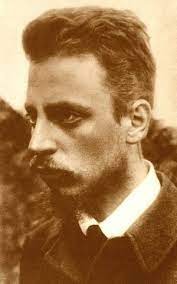
Rilke at 25 bore some resemblance to young Stalin.
“Against those in power, no one has enough defense
If a wicked adviser also enters the scene
His power and malice ruins their opposition.
An eagle carried a tortoise on high,
When he pulled his body in his armored home to hide,
And rested hidden untouched by any attack,
A crow came on a breeze flying near them:
“You have well seized a precious prize with your talons,
But, if I don’t show what you need to do,
It will pointlessly wear you out with its heavy weight.”
Promised a portion, the crow instructs the eagle to drop
The hard shell from the stars upon a cliff’s rock.
It would be easy to feed on the broken flesh!
The eagle followed up these wicked instructions
And also split the feast with her teacher.
Just so, the tortoise who was safe by nature’s gift.
Was ill-matched to those two and died a sad death.”
Contra potentes nemo est munitus satis;
si vero accessit consiliator maleficus,
vis et nequitia quicquid oppugnant, ruit.
Aquila in sublime sustulit testudinem:
quae cum abdidisset cornea corpus domo,
nec ullo pacto laedi posset condita,
venit per auras cornix, et propter volans
“Opimam sane praedam rapuisti unguibus;
sed, nisi monstraro quid sit faciendum tibi,
gravi nequiquam te lassabit pondere.”
promissa parte suadet ut scopulum super
altis ab astris duram inlidat corticem,
qua comminuta facile vescatur cibo.
inducta vafris aquila monitis paruit,
simul et magistrae large divisit dapem.
sic tuta quae naturae fuerat munere,
impar duabus, occidit tristi nece.
Here is the second half of the Paradoxographus Palatinus: Admiranda.This collection is extremely difficult to date and may hail from Byzantine Greece. As with some of the other paradoxographoi these are new translations, so corrections or questions are welcome.
11 “Artemidoros says that among the Liparitanoi fish are found by digging and that the people there use the dug fish unsparingly for snacking.”
12 “Andronikos says that in Hispania in some place pebbles are found strewn about with many angles, grown on their own—some are white and others are wax-colored; they give birth to pebbles like them.
I also used to have one of these for testing which was produced at my home which showed that the story was not a lie. He also says that there is a certain spring in Hispania which has water which is sweet and potable. If someone puts his hands in the water and holds them their for a short time he will find white salt embedded around his hands.”
14 “In Selasphoros an herb is found which when people use it in the spring there they rid themselves of yellow bile, but in the spring black bile, and phlegm if they use it in the winter. It leads out the portion of those which is unmixed of every other. [?]”
15 “Kallimachus says that in Thrace there are two rivers named Keron and Neleus. He adds that flocks who are there for grazing turn white from the Neleus, but those who take from both waters become multi-colored.”
18 “Athenaios says that there is a tree among the Persians which bears some kind of deadly fruit, which the Persians, when Kambyses led his army against Egypt, took to Egypt and planted in many places so that the Egyptians died when they encountered the fruit. The tree transforms the earth to endure the fruit unharmed and they call it Persaia because it was planted by the Persians”
19 “Theopompos says that in the land of the Agrioi of Thrace there is a river called Pontos which carries burning stones. When these are lit they do not burn as they are turned under the rapids but when they appear from under the water they reignite. Nothing that moves can endure the smell of these stones.”
20 “Antigonos says [of sheep intestines] that those of rams are voiceless, but those from females can sing. This fact has not escaped the poet, for he says “He stretching the seven strings from female sheep.”
The following two passages are from the Mirabilia ofApollonius the Paradoxographer (usually dated to the 2nd Century BCE, making him one of the earliest extant paradoxographers).
This plant makes you bigger [=BNJ 81 F17]
“Phularkhos writes in the eighth book of his Histories that near the Arabian Gulf there is a spring of water from which if anyone ever anoints their feet what transpires miraculously is that their penis becomes enormously erect. For some it never contracts completely, while others are put back in shape with great suffering and medical attention.”
“Phularkhos in book 20 of the Histories says that there is a white root imported from India which when [people] cut it and smear it over their feet with water, those who are smeared with it experience forgetfulness of sex and become similar to Eunuchs. For this reason still some apply it before they are fully adults and are not aroused for the rest of their life.”
“Phularkhos says that Sandrokottos, the king of the Indians, sent along with other gifts to Seleukos some drugs with erectile powers, the kind of which, when they are applied beneath feet of those who are going to have sex, give the the urge like birds, while some people lose their ability [for sex].”
“To be able to fuck a lot: mix fifty [pine nuts] with two measures of honey and seeds of pepper and drink it. To have an erection whenever you want: mix pepper with honey and rub it on your thing.”
It seems that the Roman people held straight from the beginning the same feeling toward Pompey which Aeschylus’ Prometheus directed toward Heracles when he was saved by him, saying:
To me, you are the dearest offspring of a detestable father.
For the Romans never took up such a firm and savage hatred of another general as they felt for Pompey’s father Strabo. While he lived, they feared his power in arms (for he was a most warlike man), and when he died after being struck by lightning, they dragged out his corpse from the couch and insulted it. Yet at the same time, no one of the Romans but Pompey received from the people such abiding goodwill that began so quickly, reached a pinnacle while his fortunes were good, and remained firm while his fortunes were low. The one cause of the hatred for Strabo was his insatiable eagerness for wealth; there were, however, many causes for Pompey’s being loved, such as his prudent mode of life, his bearing in arms, the persuasiveness of his speech, the faith in his character, his easiness in conversation, such that his requests were less grievous than anyone else’s, nor was anyone more pleasant in doing a good deed. In addition to all of his other charms there was in him a mode of giving without offense and of taking in a respectful way.
Giovanni Boccaccio, On the Downfalls of Famous Men (2.16):
The mortal condition is calamitous, to be sure: one minute you’re a king, the next minute a slave; one minute you shine with the most wonderful splendor, and the next you’re wasting away in disgusting squalor; one minute you’re issuing haughty commands, and the next you’re fawning over and begging for the most humble things. Why are you so greedy for lofty station, when you see ruin so thickly-packed all over? Why don’t you consider humble things, in which alone one can find stability? Why don’t you look at the things you should pity? Why do you not sharpen your eyes on your own health and safety?
If the other examples of fragile things failed, these Hebraic kings should have alone sufficed to show you. You will hardly see so many chains on the people, so many exiles, so many dishonorable deaths, so many shames, so many anxieties (which you think is the most unfortunate thing). If Amasias had remained among them and away from his victories, he would have survived in Lachish.
Thus too Oxias, had he been held back by common humility, would not have deserved to incur leprosy by tempting the divine. And Ozias, if he had been an unknown man of the people, would have been able to die under his country’s sky and with his paternal gods. Nor would Senacherib died in a temple, slain by his own sons eager for the throne. Thus Ioachaz, thus Ioachim, thus even most wretched Sedechias could have lived as private citizens, could have enjoyed time with their wives, could have raised and left behind sweet children, could have looked at the sky, and died free in their fatherland among the kisses and embraces of their families. And yet, each one found himself unable to stand firm when raised to the apex of power.
What does it matter to be raised to the point that I seem, am recognized as, and considered the greatest, when I am not well enough to fix my step and seem in that same lofty spot to be on a cliff or to be hurled with a precipitate fall. If you had any sense, when you see that there is nothing stable, nothing fixed, nothing firm except for humility, you would strive for it with all of your strength, and would place yourself entirely in its embrace. While you flee it foolishly, you make it so that you are not painfully afflicted by the fault of Fortune (just as you might complain of some loss), but by your own cowardice.
Mortalium profecto calamitosa conditio est: nunc regnas, nunc servis; nunc summo splendore prefulges, nunc turpi squalore tabescis; nunc superba iubes, nunc humiliata obsequeris et precaris. Quid celsorum locorum avida es, cum tam crebras assidue ruinas prospectes? Quid humilia non respicis, in quibus solis stabilitas posita? Quid tibi miseranda non prospicis? Quid oculos in tuam salutem non acuis? Si labilium rerum cetera cessent veritatis exempla, hi tantum reges hebrei suffecisse debuerant. Vix facile tot in plebe catenas, tot exilia, tot inhonestas mortes, tot dedecora, tot anxietates (quam tu infelicissimam putas) invenies. In qua si stetisset Amasias, uti absque victoriis, sic intrepidus vixisset in Lacis; sic et Ozias, plebeia humilitate detentus, non ausus divina temptare, lepram non meruisset incurrere; et Ozias, si popularis incognitus fuisset, sub celo patrio mori et patriis in laribus potuisset; nec a filiis regni cupidine Senacherib occisus cecidisset in templo. Sic Ioachaz, sic Ioachim, sic et miserrimus Sedechias privatus potuisset vivere, cum uxoribus oblectari, dulces alere ac superstites derelinquere natos, celum cernere et liber inter suorum oscula et amplexus in patria mori: et in regni fastigium sublimatus stare non potuit. Quid refert eo extolli ut videar et cognoscar et habear maximus, quo gradum figere non valens, ibidem conspiciar esse in pendulo aut prepeti deici casu? Heu si saperes, cum nil stabile, nil fixum, nil firmum preter humilitatem aspicias, quam totis viribus in illam tenderes, teque eius locares in sinu! Quod dum insipidal refugis, id agis ut non Fortune crimine, prout deiecta quereris, sed dolens tua ignavia affligaris.
Charles Dickens, David Copperfield (Chp. 16):
My stool was such a tower of observation, that as I watched him reading on again, after this rapturous exclamation, and following up the lines with his forefinger, I observed that his nostrils, which were thin and pointed, with sharp dints in them, had a singular and most uncomfortable way of expanding and contracting themselves—that they seemed to twinkle instead of his eyes, which hardly ever twinkled at all.
‘I suppose you are quite a great lawyer?’ I said, after looking at him for some time.
‘Me, Master Copperfield?’ said Uriah. ‘Oh, no! I’m a very umble person.’
It was no fancy of mine about his hands, I observed; for he frequently ground the palms against each other as if to squeeze them dry and warm, besides often wiping them, in a stealthy way, on his pocket-handkerchief.
‘I am well aware that I am the umblest person going,’ said Uriah Heep, modestly; ‘let the other be where he may. My mother is likewise a very umble person. We live in a numble abode, Master Copperfield, but have much to be thankful for. My father’s former calling was umble. He was a sexton.’
In an earlier post I talked about “threshold” theory and some of the very different beliefs Ancient Greeks and Romans had about suicide. This excerpt from Cicero touches upon some of the philosophical ideas about taking one’s own life while also reflecting in part on the group effect.While Hegesias’ arguments are extreme, they have some affinity with Epicurean doctrines against fearing death. In this formulation, however, the argument that death is preferable because it frees us from evils reaches a bit of an absurd conclusion. Diogenes Laertius provides an over of the Cyrenaic School.
Cicero, Tusculan Disputations 1.83-84
“Therefore, death removes us from evils not from goods, if we are seeking the truth. This, in fact, is argued by Hegesias the Cyrenaic so fully that it is said he was prohibited from speaking on these matters in schools because many people killed themselves after they heard him speak.
There is also an epigram attributed to Callimachus on the topic of Cleombrotus the Ambracian who, he says, even though nothing bad happened to him, he threw himself from the wall into the see after reading a book of Plato. From that book of Hegesias I mentioned—Starving to Death—there is a person who while in the process of leaving life by starvation is called back by his friends to whom he responds by listing the unpleasantries of human life.
I could do the same, although I will not go as far as he who thinks that there is no point for anyone to live at all. I am overlooking all others—is it still meaningful for me to continue on? I live deprived of the comfort and decoration of a family or of a public life and, certainly, if I had died previously, death would have saved me from evils not from good.”
A malis igitur mors abducit, non a bonis, verum si quaerimus. Et quidem hoc a Cyrenaico Hegesia sic copiose disputatur, ut is a rege Ptolemaeo prohibitus esse dicatur illa in scholis dicere, quod multi iis auditis mortem sibi ipsi consciscerent. Callimachi quidem epigramma in Ambraciotam Cleombrotum est, quem ait, cum ei nihil accidisset adversi, e muro se in mare abiecisse lecto Platonis libro. Eius autem, quem dixi, Hegesiae liber est, ᾽Αποκαρτερῶν, in quo a vita quidam per inediam discedens revocatur ab amicis, quibus respondens vitae humanae enumerat incommoda. Possem idem facere, etsi minus quam ille, qui omnino vivere expedire nemini putat. Mitto alios: etiamne nobis expedit? qui et domesticis et forensibus solaciis ornamentisque privati certe, si ante occidissemus, mors nos a malis, non a bonis abstraxisset.
Suda, pi 1471
“Hegesias is called the ‘death-persuader’
Πεισιθάνατος ὁ ῾Ηγησίας ἐλέγετο.
If you or someone you know feel alone, uncertain, depressed or for any reason cannot find enough joy and hope to think life is worth it, please reach out to someone. The suicide prevention hotline has a website, a phone number (1-800-273-8255), and a chat line. And if we can help you find some tether to the continuity of human experience through the Classics or a word, please don’t hesitate to ask.
“Morning appointment–my reason for leaving the city–
If you knew better, you would visit more ambitious homes.
I am no lawyer, no man prepared for harsh suits,
I am a lazy and aging friend of the Muses.
Sleep and leisure make me happy—the very things
Which Rome denied me. But I’ll go back if I can’t sleep here.”
Matutine cliens, urbis mihi causa relictae,
atria, si sapias, ambitiosa colas.
non sum ego causidicus nec amaris litibus aptus,
sed piger et senior Pieridumque comes;
otia me somnusque iuvant, quae magna negavit
Roma mihi: redeo, si vigilatur et hic.
12.80
“Callistratus praises everyone so he may not praise the worthy.
What good can he be when he doesn’t think anyone’s bad?
Ne laudet dignos, laudat Callistratus omnes.
cui malus est nemo, quis bonus esse potest?