“Abandoning the altar’s sheep-welcoming fire,
Leaping the Trojan’s leap with his feet
He marched toward them.”
This is the sort of leap Achilles made in Troy. For the people who have arranged the Troika claim that there is a place in Troy called “Achilles’ leap”, the place where he leaped from the ship. They say that he did this so violently, that water spurted up.”
“We must rebuke not only those sophists but also those who promise to teach political oratory—for these guys don’t care at all about the truth but instead think that it is an art because they get the greatest number of students thanks to the small size of their fee and the greatness of their pronouncements and then they get something from them.
They are so imperceptive and imagine everyone else to be that even though they write speeches worse than some of the untrained masses compose, they still guarantee that they will make their students the kinds of politicians who never leave out any of the possibilities in a matter.
Even worse, they don’t derive any of that power from their experiences or the talent of a student, but they say that they can train the knowledge of speaking as they would basic literacy—in reality, each of them believe that because of the insanity of their promises they will be objects of wonder and that people will think that training in their discipline is worth more than it is. In this, they have not even considered that the people who make arts great are not those who dare to boast about them, but those who have the ability to discover what the power of each art is on its own.”
“There is also the story that when the people of Mitylene allowed Pittacus to have half the land over which he fought in single combat, he would not take it. Instead, he assigned an equal portion to each man, saying that an “equal amount is greater than more”. For, since he took the measure of what was greater by fairness not by profit, he judged wisely. He believed that fame and safety would follow equality while gossip and fear followed greed, and they would have quickly reclaimed his gift.”
Cf. Diogenes Laertius, Lives of the Philosophers 1.75
“Then, the Mityleneans honored Pittakos powerfully and gave the rule of the state to him alone. During the ten years he held power, he also corrected the constitution and then surrendered power even though he lived ten years more. The Mityleneans gave him some land, but he donated it as sacred. The plot is called after his name even today. Sôsicrates says that he cut off a little bit for himself, saying that “half is greater than the whole.”
The idea of “half being greater than the whole” is likely proverbial, showing up as well in Hesiod’s Works and Days where the narrator uses it when he complains about how the judges act unfairly in their evaluation of cases (by taking bribes): “the fools don’t know how much greater the half is than the whole” νήπιοι, οὐδὲ ἴσασιν ὅσῳ πλέον ἥμισυ παντὸς.
Diodorus Siculus’ statement that “an equal part is greater than more” is probably a clever departure from the Hesiodic statement. Hesiod’s statement seems to be about greed (wanting more than your due), as glossed by Michael Apostolius:
13.77
“They don’t know how much greater the half is than the whole”: [this is a proverb used] for those who desire more and lose what they have.
A unifying theme between the two versions is that in early Greek culture that which is isos is not fair in terms of being equal but it possesses equity in terms of being proper to the recipient’s social status. So, Diodorus’ isos share can map out onto Hesiod’s “half” share.
Another proverbial moment for Pittakos:
Diodorus Siculus, History 9.12.3
“When Pittacus finally caught up with the poet Alcaeus, a man especially hateful to him who had mocked him savagely in his poems, he released him, remarking that forgiveness is a better choice than vengeance.”
“Some of them certainly corrupted people while others blasphemed the gods; there were those who gave speeches which would have been better unsaid and others who produced more audacity than good sense. But it may not be the best to say that if some people use the excuse of philosophy and become scoundrels who are no better than most people or, by Zeus, even more clever at doing evil, then we should dishonor philosophy, provided that philosophy is not doing these sorts of things. Instead, we must use these things as evidence against them, that they have failed at philosophy.
In the same way, it does not make oratory worse if some people use blandishment or abuse, but we must recognize in this that they are bad at rhetoric just as the other people fail at philosophy, they all use the excuse of the noblest action to furnish themselves with the opportunity to do evil.
It would be odd if we were to judge actions of cobblers and carpenters not from their mistakes but instead from examples where they did as well as humanly possible, but we evaluate oratory not just from its greatest accomplishments, but instead according to those who do the opposite of what oratory intends.”
Athenaeus, Deipnosophists Book 2 36a-d (=Adesp. com. fr. 101 and Eubulus fr. 93)
Mnêsitheos used to say, “the gods taught mortals
About wine because it is the greatest good
For those who use it correctly, and the opposite for those who don’t.
It gives sustenance to those who use it well,
Strength to their minds and their bodies.
It is also extremely useful for medicine,
Since it is mixed in with other drugs
And provides relief to those who have been wounded.
It also helps in daily gatherings it brings joy
To those who mix it and drink it wisely.
But to those who are excessive it brings outrage.
If you mix it evenly with water, it makes you crazy.
Unmixed, it paralyzes bodies.
“For this reason, Dionysus is called a doctor everywhere. The Pythia told some people to call Dionysus the “Healer”. Euboulos (fr. 93) has Dionysus saying this:
“I prescribe only three bowls of wine
For people of good sense. One is for health,
to drink first. The second is for
Sex and pleasure, and the third is for sleep—
Those who are wise drain that bowl and then
Go home. The fourth isn’t mine any more,
But it belongs to Hubris. And a fifth bowl leads to shouting;
A sixth bowl to street-parties; a seventh for brawls;
An eighth’s for getting arrested; the ninth makes dark bile.
And the tenth is madness to make you hurl […]
A lot of wine poured into a little bottle
Easily throws drunks down on their asses.”
Also, this is a possibility. Look, three drinks! (true story: a friend once ‘invented’ a drinking game which entailed a shot every time the chorus repeated. Not. A. Good. Idea.)
“And he is really lucky because even though the Greeks are witnesses of his lawbreaking and corruption, he has suffered no penalty. But even though many people as hold power in a single city are subject to oversight, Alcibiades, who is leader and collects funds from our allies, is not liable for anything he does.
No, instead, after doing the kinds of things he has, he was granted the same prize as Olympic victors and he treats it as a victory as if he had crowned the state with glory instead of dishonoring it. If you just look, you will find that people who have performed merely one of the acts that man has done many times have ruined their families. But that man who has fostered all kinds of excess has doubled his fortune.”
“Women know everything, even how Zeus married Hera.”
Homer has, “They traveled together to bed, avoiding their parents’ notice”. Aristokles in his work “On the Cults of Hermione”, provides something of an odd tale about the marriage of Zeus and Hera. For, as the story goes, Zeus was planning on having sex with Hera when he noticed that she was separated from the other gods. Because he did not want to be obvious and did not want to be seen by her, he changed his appearance into a cuckoo and was waiting on a mountain which was first called Thornax but is now just called Cuckoo.
Zeus made a terrible storm on that day and when Hera was going toward the mountain alone, she stopped at the very place where there is currently a temple to Hera Teleia. The cuckoo, flew down and sat on her lap when he saw her, shivering and freezing because of the weather. Hera saw the bird and pitied him and covered him with her cloak. Then Zeus suddenly transformed his appearance and grabbed a hold of Hera. Because she was refusing him due to their mother, he promised that he would marry her.
Among the Argives, who honor the goddess the most of all the Greeks, the cult image of Hera sits in the temple on a throne holding a scepter in one hand on which a cuckoo is seated.”
Pausanias (2.17.4) describes a statue in a temple to Hera outside of Corinth:
“The statue of Hera—extraordinarily huge—sits on a throne made of gold and ivory, a work of Polykleitos. She has a crown embossed with Graces and the Seasons and carries in one hand a pomegranate fruit and in the other a scepter. I must pass over the reason for the pomegranate, since the tale is protected by sacred rite. But people say that the cuckoo bird sitting on the scepter is Zeus: because he was in love with Hera when she was a maiden and turned himself into this bird which she hunted to have as a pet. I record this story as much as the others of the gods which I offer incredulously—but I record them still.”
Nandini: I was going to ask if you wanted to play a little game with me. I do this one midterm evaluation that asks every student to pick one thing they’d add to your course, one thing they’d drop, one thing they’d change, and one thing they’d keep the same. And I wondered if we could do that for “classics” as a field right now. What would we add that isn’t already happening?
Ethan: One thing that I would like to see is more courses that cover broader topics in antiquity, [like one we teach at UT-Austin] called “The Ancient Mediterranean World.” The first thing we talk about is how the idea of “the West” or “the Mediterranean” is extremely problematic because that spans multiple continents and multiple climates and multiple cultures … from Babylon, Sumer, Egypt, Israel, all the way up until Greece and Rome. And we end up forming links between all of those cultures. I think courses that help you see similarities and share experiences between cultures are super cool and underutilized in colleges in general.
Nandini: I love that. And I would add to your “add” that I would really love more training in grad school or at other levels to prepare us to do that kind of teaching [in keeping with recent interest in global antiquities]. I know it’s intimidating for any of us, after the depth of training we receive in a couple cultures, to branch out and feel like amateurs. I think it’s actually okay to be an amateur; I wish that we would embrace the fact that we’re always learning and we don’t need to stay forever within our dissertation fields. But I would love serious training on those cultural interactions really emphasized as part of the curriculum instead of [treated as] a throwaway option. [The same goes for interactions between antiquity and the present.] My students always love when we add some thought to the modern world — conversations about cultural interactions or appropriations or intersectionality with a classical twist. So I find that using Eidolon articles or bringing up modern angles is a great way to start or end discussion [that could also be better modelled in graduate school].
<We rave about Antigone in Fergusonand the brilliant discussions it’s generated in our classrooms, then move on to what we’d drop.>
Ethan: One thing I would drop is the idea that you need a fully complete resume to get into graduate school. And what I mean by that is a lot of professors, when a student comes to them with an interest in graduate school in classics, say, “Okay, you need four years of one language, three years of another. You need experience in this and this. … And it would also help to know either French or German or Italian.” And that can be severely limiting to students who didn’t have access to that sort of thing in high school. … If you put all of these qualifiers in, then it’s frankly impossible for a student who comes into college without any knowledge or practice in classics to go to graduate school … and become a professor or be a part of the field, right? And that can be severely limiting and it’s frankly not true. I mean, I was lucky to have a lot of high school experience in Latin, but I didn’t take any classics courses my freshman year … by the time I was doing advanced Greek, I was a second-semester junior. I didn’t have any German or French. And I got into a good program out of undergrad because I worked hard and I had a lot of confidence in myself and I had people tell me that I could do this — but I don’t think everyone has that. A lot of places, professors tend to gate-keep the field, whether intentionally or unintentionally.
Nandini: And even your saying that you “only” had a certain amount of Greek by your junior year is already amazing, right? Many people, especially ones who fall in love with classics late in their college career, might not have access to even one Greek class — but they could have so much to bring to the field. So I fully endorse that and I want to add for the record that you may have more Latin right now than I did by the time I became a professor. <They laugh; Nandini attended a public high school with no Latin program and stumbled into classics as an undergraduate.> But there’s a kind of virtue in coming to the field from a background that wasn’t about rigorous language training from the very beginning. I think that actually you sometimes have more insights or you can be a little more creative in your outlook.
So I totally agree with you and I would add, as a corollary, that I’d love to change our ideas of what expertise looks like, but also drop the expectation of total comprehensive synthetic knowledge of everything ever written on a particular author. Which is something that [we faculty often] perpetuate with the way that we do grad school reading lists and design exams and [compose] footnotes that last pages. It creates so much fear and intimidation. I mean, if you’re a Vergil scholar like me and you feel you need to read every one of the hundred thousand things ever written about a particular passage, you would never write a word. So I think that we need to start modifying that culture for sure.
Ethan: Also, to add onto that, letting students know that it’s okay to skim articles. Because I think this is one of the dirty secrets of academia, especially when you first get into graduate school. You have a thousand lines of Latin to read for one class, plus five or six articles and you’re not going to be able to physically do that with two or three other classes. And I think a lot of professors try and keep the secret that people skim … and that’s okay. You don’t have to read every single word of an article. If you can understand what the author is doing, the logic they’re using, and at least some of the references they’re making or some of the source material they’re citing, that’s good. And that’s especially good for a college student.
Nandini: Absolutely. And there’s this old ethos, or maybe it’s more an aesthetic, where [professors] would cultivate the aura of somebody who has completely memorized the entire classical corpus. They would sit in the front at lectures and trot out verbatim citations in the original language. There is something incredibly cool and wonderful about that and I love many of those people who can do that. But for a long time, that was what I thought was the only way to be good at this field. And the truth is that in our information age, where we can instantly call up any article or look up any text, that kind of memorization expertise is getting not outdated but replicated. Because as you say, it’s more important to know how to read than to have fully memorized every single thing, because you can always [look them up if you need]. Or if you have the skill set of designing a good argument and understanding where it needs evidence, and understanding how to critique the scholarship — if you have all that, that’s actually much more important than having a bunch of bibliography at the tip of your tongue.
Ethan: One thing we would change — do you want to go first on this one?
Nandini: I think this current digital age allows a lot more potential for conversations and collaborations across institutions. I’ve gotten so much during the pandemic from chatting with other BIPOC classicists or grad students at different programs than mine [often while] giving visiting talks from my living room. I really love the ability to move around so freely in terms of conversations and support networks. And so I guess I would just keep going in that direction. I think it’s really healthy [that WCC, AAACC, and other organizations] are building mentorship relationships that reach beyond your specific department. Because in some of my darkest times as an academic, when I felt bullied or harassed — and believe me, this happens in grad school, but it keeps happening; getting a job is not the end, getting tenure is not the end of microaggressions or gatekeeping — in those situations, it’s having friends outside of my institution that has really saved me. And I would wish that for anybody else in this field.
[Academia] can be very isolating, and there’s this false perception that everyone gets it except for you — that they all know what they’re doing and they’re all understanding that article or writing that paper perfectly on the first try. I think that we need to make [classics] a less lonely endeavor — we need to make it much more supportive, much more sociable. And we need to break those little monopolies on authority and power that are the academic department, and reward and compensate the time that people spend on [building relationships and support structures that cross institutional boundaries].
Ethan: Bouncing off of that … another thing I would change is broadening the requirements for the [undergraduate] major. So not necessarily saying, you need this many hours of Latin and this many hours of Greek, and this and that specific class. Because while it’s definitely helpful and while that could make you a potentially attractive candidate to graduate school, there are a lot of people who know [canonical authors] like Ovid and Vergil really well … People who are interested in something different like bioarchaeology or digital humanities are also super attractive to graduate school. … And that could be beneficial because it helps students develop skills to be competitive in and get jobs outside of academia too. Because if we’re trying to get students to come and get Ph.Ds in classics, then promise them all tenure-track jobs afterwards, then we’re kidding ourselves and them. So developing skills that can be attractive in other fields and other endeavors after the Ph.D is something that I would like to see.
Nandini: Absolutely — there’s no categorical difference between academic and “alt-ac” skills. There never has been nor is it healthy to act as though there is. We need to make sure that graduate school is always helping people develop skills for a [range of future job possibilities]. And we should start welcoming and rewarding different kinds of output … than just the standard dissertation. There’s this standard format that frankly is not even a book — [most dissertations] require years to become good books. We could encourage writing that’s a little less formulaic, a little less self-credentialing and boring, and start helping [grad students] make products that people [outside our narrow band of academia] actually want to read or use. We can reward more public-facing work, but also applied projects like digital humanities or commentaries or pedagogical projects or art installations or programs that are aimed at bringing more diverse students into classics. I think all of those things should count as end goals of your time in a Ph.D program … because obviously the model that we have is not working for all but a very few.
Last question — what would you keep the same?
Ethan: One thing I’d keep the same is the growth in discussions like this. Because as you said, for the longest time, [grad school was considered] this pipeline toward a job in academia … but that’s not realistic [for all]. That’s not saying that you shouldn’t pursue that goal, but you should also know about other options available to you. And I think this growing conversation has been super beneficial for graduates — it’s definitely been beneficial for me.
Nandini: I couldn’t agree more. And my answer for “what I would keep the same” is you. I just want to ring-structure back to the email that you sent me all those years ago [when you read my 2018 Eidolon piece about diversity in classics]. That really helped me at a time when I was feeling very isolated in a red state after the Trump election. I started writing publicly because I didn’t know what else to do with my time and frankly, digging deep into footnotes and spending time in the library on the commentaries started to feel less fulfilling intrinsically. I needed to figure out a way to reach out and reach more people. And so I started writing for Eidolon in a really dark place, but I had no anticipation of how much uplift I would get from people like you and how fulfilling it is now for me to watch you grow and change and do the great work you’re doing — and have this wonderful conversation with you. So thank you very much.
Ethan: When I encountered your article, I was also in a dark place. I was interning and we had just had a lecture where I had been singled out by someone. They had later asked me where I was from and when I told them Wisconsin, they did the classic, “Oh, well, where’s your family from?” It was a stressful time because I had been getting that a lot. And I read your article and feeling that someone understood what I was going through really helped me continue on in the field. So thank you for that.
Nandini: And turning back to ancient thought: to know that other people have dealt with [these questions of identity and belonging and path-finding] before, even if they didn’t look exactly like us — that gives me a sense of radical continuity and compassion across cultures and across generations and across space now too. So here’s to many more such conversations.
Relief found in Neumagen near Trier, a teacher with three discipuli (180-185 AD)
“Prometheus: Know that during the period of the Judean Judges, Prometheus was known among the Greeks as the one who invented academic philosophy. People say that he crafted human beings because he rendered those who were idiots capable of understanding philosophy.
And there was also Epimetheus, who invented the art of music and, in addition, Atlas, who first interpreted astronomy which is why they claim he “holds up the sky”. There is also Argos of many eyes because he was seen by many people, when he was really the one who first established technical knowledge. Then there was also a prophetess named the Sibyl.
When Pharaoh, who is also called Parakhô, was king in Egypt, then Kekrops was king in Athens among the Greeks. He was called Diphyes [“double-formed”] due to the size or because he established a law that women who were still virgins should be given in marriage to a single man, after he named them brides. Previously women of the land had sex like animals. For a woman was no man’s, but gave herself like a prostitute to anyone. No one knew whose son or daughter a child was—instead the mother used to claim and give the child to which ever man it seemed best to her to claim.
Kekrops did this because he came from Egypt and was ignorant of the law which Hephaestus had made when he ruled there before. For he claimed that it was because of this sinful intercourse that Athens was destroyed by the flood. After that point, the people who lived in Greece lived more prudently. Kekrops ruled for 40 years.”
The starkest of contrasts: an anonymous Hellenistic epigram depicting a grateful slave and his benevolent master, and an Athenian letter recounting a slave’s desperation and his master’s brutality.
Anonymous Epigram 7.179 (Greek Anthology)
Even now from under the earth, master,
I remain obedient to you.
Your kindness I haven’t forgotten:
Three times you saw me from sickness to health;
And now you’ve gone so far as to lay me
Under this sheltering stone, announcing:
Medes, a Persian.
You’ve done right by me.
For that, you’ll have willing slaves in your debt.
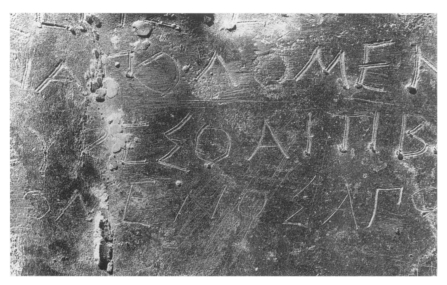
In 1972, excavation of the Athenian Agora turned up a unique c.4th-century-BC letter inscribed on a lead tablet: the speaker is an actual slave describing the actual conditions of bondage. (Presumably the letter was dictated to a scribe, and since it was found in a well, presumably it was never delivered.)
As in the fanciful epigram, δεσπότης (“master”) designates the man who command’s the slave’s life. But unlike the fictional δεσπότης whose kindness can never be repaid, the real δεσπότης is a man of limitless brutality.
The letter reads:
“Lesis sends a letter to Xenochles and his mother saying do not overlook that he’s dying in the forge, but come to his masters and find him something better. For I have been handed over to an entirely bad man: I’m dying from the whippings; I’m tied up; I’m horribly abused. And more, more!”
Lead tablet letter from the Athenian agora, c.4th BC. (quoted in Edward Harris, Democracy and the Rule of Law in Classical Athens, page 271)
Detail of lines 2-4 of the slave’s lead tablet letter. Reproduced from David Jordan’s “A Personal Letter Found in the Athenian Agora,” Hesperia: The Journal of the American School of Classical Studies at Athens, Vol. 69, No. 1 (Jan. – Mar., 2000), pp. 91-103.