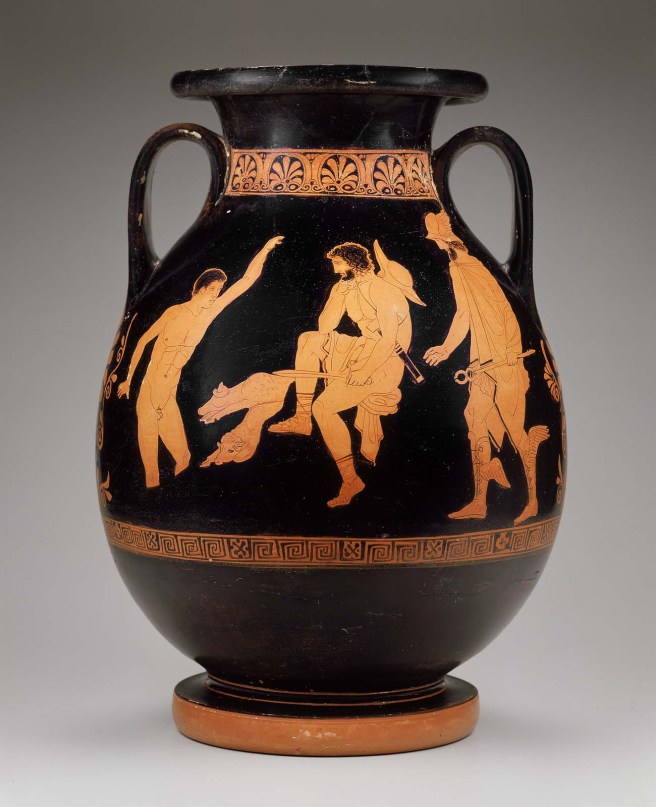
It is the right time of the year for raising the dead. A student paper on the Elpenor Pelike at the MFA in Boston drew my attention to the following passage.
Servius ad Aen. 6.107
“For this reason the place is named without joy since, as people claim, it would not have been there but for necromancy or spell-craft. For, Aeneas completed these sacred rites when Misenus was killed and Ulysses did it with the death of Elpenor.
This very scene Homer himself presented falsely from the detail of its location which he specifies along with the length of time of the journey. For he claims that Ulysses sailed for one night and came to the place where he completed these sacrifices. For this reason it is abundantly clear that he doesn’t mean the ocean but Campania.”
sine gaudio autem ideo ille dicitur locus, quod necromantia vel sciomantia, ut dicunt, non nisi ibi poterat fieri: quae sine hominis occisione non fiebant; nam et Aeneas illic occiso Miseno sacra ista conplevit et Vlixes occiso Elpenore. quamquam fingatur in extrema Oceani parte Vlixes fuisse: quod et ipse Homerus falsum esse ostendit ex qualitate locorum, quae commemorat, et ex tempore navigationis; dicit enim eum a Circe unam noctem navigasse et ad locum venisse, in quo haec sacra perfecit: quod de Oceano non procedit, de Campania manifestissimum est.
The relevant passages from the Odyssey don’t give any hint that Elpenor was intentionally killed for black magic. When Odysseus actually does summon the dead, now that gets a little dark.
Odyssey, 10.552–560
“I could not even lead my companions unharmed from there.
The youngest of my companions was a certain Elpênor,
He was neither especially brave in battle or composed in his thoughts.
He separated himself from the companions in Kirkê’s holy home
Because he needed some air; then he fell asleep because he was drunk.
When he heard the noise and trouble of our companions moving out,
He got up immediately and it completely escaped his thoughts
To climb down again by the long ladder—
So he fell straight from the roof and his neck
Shattered along his spine; then his spirit flew down to Hades.”
Nekuomanteia, glossed by Hesychius as nekromanteia (i.e. “necromancy”) is an alternate name for the Nekyuia, the parade of the dead in book 11 of the Odyssey. From the Greek Anthology: ᾿Εν τῷ Η ἡ τοῦ ᾿Οδυσσέως νεκυομαντεία· (3.8); Scholia to the Odyssey, Hypotheses: Λ. Νεκυομαντεία, ἢ, Νεκυία. Cf. Eustathius, Comm. Ad Od. 1.396.10
The metaphor of Eros as wind could be made quite elaborate, and it could be enriched by comparison with a tranquil state of affairs:
Ibycus Fr. 286
The rivers’ streams, in springtime,
Water Cydonian apple trees
Where there’s a pristine maidens’ garden
And the buds on grapevines swell
Under leafy shading shoots.
For me, desire has no season of repose.
Always under fiery lightning flashes
The Thracian North Wind, thanks to Cypris,
Sweeps down black and undaunted
In a scorching frenzy. Violent—
And it devours my heart from the root.
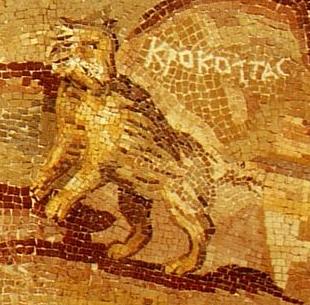
2 “Daliôn says in the first book of his Ethiopian Matters that there is an animal in Ethiopia called a krokotta. When that creature goes near backyards it hears people chattering, and especially the words/names of children. But when it goes out at night, it speaks words/names and the children who come out are devoured by it”
“[We should note the fact that] there is a creature in Ethiopia which is named krokottas which is like a combination of wolf and a dog, but it is more savage than both and is heavier in its face and at the end of its feet. It is also amazing for its boldness, and it is extremely capable compared to the rest in its teeth and its belly. For they also tear to pieces easily every type of bone and whatever they take up is consumed easily and their digestion is indescribable. In addition, while some of them have been described as imitating human language, we don’t believe it. Nevertheless, some have added that they call out people by name at night—and that they try to use a human voice in doing this—and then they gobble up whoever comes out as they fall upon them.”
“Hesitation is fear of future action. Agony is fear of failure and otherwise fear of worse outcomes. Shock is fear of an uncustomary surprise. Shame is fear of a bad reputation. A ruckus is fear pressing down with sound. Divine fright is fear of gods or divine power. Terror is fear of a terrible thing. A fright is fear that comes from a story.”
“Fear: flight or cowardice. Fear is expecting evil. These emotions are categorized as fear: terror, hesitation, shame, shock, commotion, anxiety. Terror is fear that brings dread. Hesitation is fear about future action. Shame is fear about a bad reputation. Shock is fear from an unusual thing. Commotion is fear from a striking sound. Anxiety is fear of an uncertain matter.”
“You wasted life, why wouldn’t you waste the afterlife?”
Modest Mouse, “Ocean Breathes Salty”
Phaedrus, Fabulae 4. 2
“Whoever is born unlucky not only leads a sad life
But is stalked by fate’s harsh sorrow in death too.
Cybele’s priests, the Gallia, on their begging tour
Used to lead an ass to drag around their baggage.
When he died thanks to work and beatings
They made tambourines of his stripped skin.
When some people asked what they did
to their own pet they said,
“He believed that he’d rest with his last breath
But look, he attracts new beatings in death!”
Qui natus est infelix, non vitam modo
tristem decurrit, verum post obitum quoque
persequitur illum dura fati miseria.
Galli Cybebes circum in questus ducere
asinum solebant, baiulantem sarcinas.
is cum labore et plagis esset mortuus,
detracta pelle sibi fecerunt tympana,
rogati mox a quodam, delicio suo
quidnam fecissent, hoc locuti sunt modo:
“Putabat se post mortem securum fore:
ecce aliae plagae congeruntur mortuo!”
Bibliothèque Nationale de France, lat. 3630, Folio 84r [from bestiary.ca]
Past mid-October, it is about time things start to get a bit creepy…
Aelian, On the Nature of Animals 1.51
“People say that the spine of a human corpse turns into a snake as the marrow decomposes. As the beast slips out, so the most savage creature is born from the mildest. In this way the remains of men who were once fine and noble rest and they have peace as their prize just as the soul too does of these kinds of men according to what is sung and hymned by the wise.
But the spines of evil men bring forth these kinds of things after life too. Well, the truth is that the story is either completely a myth or if these things prove trustworthy, then it seems to me that the evil man’s corpse has earned this reward of becoming the serpent’s father.”
Historia Augusta, Opellius Macrinus by Julius Capitolinus
“The lives of this emperors who did not last long, whether tyrants or Caesars, remain in obscurity to start with because there’s little in their private lives worth talking about. They would have never been known if they had not strived for power and we can’t say much about their reign since they didn’t rule long. Still, we will offer what has been uncovered in a range of historical materials.
These are details worth remembering! There’s no one who hasn’t done one thing or another each day of their life. A biographer’s task is to tell those details worth knowing. Junius Cordus certainly enjoyed published the lives of emperors he saw as somewhat obscure. But he didn’t achieve very much, since he uncovered very little and less worth recalling, confessing himself that he tracked down minor details about Trajan or Pius or Marcus like how often they went outside, how they varied their meals, when they changed their clothes, and when and who they promoted.
He filled his books with gossip by pursuing these questions and writing them up when, really, minor matters like this shouldn’t be recorded or only sparingly if habits can illuminate character. People want to know about character, but only partly so that the rest of the story can be gathered from it.”
Vitae illorum principum seu tyrannorum sive Caesarum qui non diu imperaverunt in obscuro latent, idcirco quod neque de privata eorum vita digna sunt quae dicantur, cum omnino ne scirentur quidem, nisi adspirassent ad imperium, et de imperio, quod non diu tenuerunt, non multa dici possunt. nos tamen ex diversis historicis eruta in lucem proferemus, et ea quidem quae memoratu digna erunt. non enim est quisquam qui in vita non ad diem quodcumque fecerit. sed eius qui vitas aliorum scribere orditur officium est digna cognitione perscribere. et Iunio quidem Cordo studium fuit eorum imperatorum vitas edere quos obscuriores videbat. qui non multum profecit; nam et pauca repperit et indigna memoratu, adserens se minima quaeque persecuturum, quasi vel de Traiano aut Pio aut Marco sciendum sit, quotiens processerit, quando cibos variaverit et quando vestem mutaverit et quos quando promoverit. quae ille omnia exsequendo libros mythistoriis replevit talia scribendo, cum omnino rerum vilium aut nulla scribenda sint aut nimis pauca, si tamen ex his mores possint animadverti, qui re vera sciendi sunt, sed ex parte, ut ex ea cetera colligantur.
“I praise the dancer from Asia, the one who moves
From the tips of her fingernails with devious positions,
Not because she shows every passion or because she throws
Her delicate hands delicately this way and that,
But because she knows how to dance around a worn out stump
And doesn’t try to flee its aging wrinkles.
She tongues it, kneads it, throws her hands around it–
And if she throws her leg over me, she raises my staff back from hell.”
While Lucian is surely messing with us here, I think there are many tomes of Homeric scholarship set aright through this one paragraph.
Lucian, True History 2.20
“Two or three days had not yet passed when I approached the poet Homer at a moment when we both had free time and I was investigated the rest of the matters about him, especially where he was from. For this is still examined by us to this day. He said that he was not ignorant that some people say he his from Khios and others say Smyrna while a majority claims he is Kolophonian. But he was saying that he is in fact Babylonian and was not called Homer among his people but Tigranes. Later on, after he was a hostage [homêreusas] among the Greeks he changed his nickname.
When I asked him about the lines which were considered spurious and whether they had been written by him, he was claiming they were all his. For this reason I started to believe that the grammarians Zenodotus and Aristarchus were guilty of the most close-minded logic. Since he had responded sufficiently on these matters, I was asking him next why he made his poem start with the “rage of Achilles”. He said that it just leapt into his head that way without any prior thought. Then I was eager to know that thing, whether he wrote the Odyssey before the Iliad as many claim. He denied this.”
Alexandra Paperno. Abolished Constellations, 2016. Installation view at the ‘Møenlight Sonata’, curated by René Block. Kunsthal 44Møen, Møen, Denmark, 2018. Courtesy Galerie Volker Diehl.
Only the famous Argo sailed through there
Returning from the visit with Aeetes.
The current hurdled the ship towards the rocks,
But Hera, who loved Jason, led them safe.
Tritonian Athena herself urged him to join the band of chiefs,
And he came among them a welcome comrade.
She herself too fashioned the swift ship;
And with her Argus, son of Arestor, wrought it by her counsels.
Wherefore it proved the most excellent of all ships,
That have made trial of the sea with oars.
Alexandra Paperno. Abolished Constellations, 2016. Installation view at the ‘Observatory’, curated by Simon Mraz. Special Astrophysical Observatory of the Russian Academy of Science and its campus at Lower Arkhyz, Russia, 2016. Photograph by Yuri Palmin.
Who invented the sky? The only way to answer this question would be like this — the first person who looked up and wondered. Socrates tells us in Plato’s Theaetetus (Plat. Theaet. 155d), μάλα γὰρ φιλοσόφου τοῦτο τὸ πάθος, τὸ θαυμάζειν: οὐ γὰρ ἄλλη ἀρχὴ φιλοσοφίας ἢ αὕτη, καὶ ἔοικεν ὁ τὴν Ἶριν Θαύμαντος ἔκγονον φήσας οὐ κακῶς γενεαλογεῖν, namely: “For this feeling of wonder shows that you are a philosopher, since wonder is the only beginning of philosophy, and he who said that Iris was the child of Thaumas made a good genealogy.” Iris was a messenger of the heavens, so the sky was never too far away for those who wonder. But philosophy arrives too late, and we’re looking at an earlier world, populated with gods, heroes and stars; a world that had already eclipsed in Plato’s time. Was it perhaps at the end of the Ice Age when the brain cortex of the first modern humans began articulating symbolic orders?
An answer is impossible to come by, but the stars in the sky have lived with us for a long time, and we could never unsee them. That is, paradoxically, until the modern age, when, after thousands of years of dreams and wonders, we launched ourselves into space, in an attempt to escape from the condition of being human. Out there we realized to our despair (and our newly discovered indifference too) that there was no such a thing as the sky; this was no transcendental space or a place at all, but rather, everything that is above the surface of the earth, a combination of atmospheric layers and the infinite void. The infinite is not even an adequate concept, for the physical concept of time has no relevance for the individual person, and no use except in space physics. With the conquest of heaven, a direct consequence of the space and arms race, the sky went dimmer, if not altogether silent. Yet the void remains.
But the history of the void, with its now missing stars and constellations, is not a history of physics, as much as a story of our puzzling earthly odyssey, as astronomer John C. Barentine tells us: “However old the constellations, it is safe to conclude that they have long journeyed with us on our path to becoming human.” Constellations are some of the oldest cultural inventions of humans, predating writing and social organization (what once was called civilization). Barentine continues: “The presumably oldest figures in existence, such as the Hunter and the Bull, refer to a time in human history before the emergence of settled agricultural communities. It is probably no coincidence that Orion and Taurus reflect themes in the oldest extant works of art: the human form and game animals.” Already at the time of the Neolithic revolution, 12,000 years ago, understanding cues in the sky about the seasonal calendar was crucial to the survival of early humans.
Alexandra Paperno. Abolished Constellations, 2016. Installation view at the ‘Observatory’, curated by Simon Mraz. Special Astrophysical Observatory of the Russian Academy of Science and its campus at Lower Arkhyz, Russia, 2016. Photograph by Yuri Palmin.
Our oldest accounts of constellations and stars date back to the Middle Bronze Age and the list of Sumerian names suggest they were drawn from an earlier source. In the Mesopotamian text “Prayer to the Gods of the Night” (1700 BC), we hear of the Arrow (the star Sirius), the Yoke (the star Arcturus), the Stars (the Pleiades star cluster), or the True Shepherd of Anu (Orion). Think about the long journey of Sirius, the brightest star in the night sky, known to Homer as the autumn star (Hom. Il. 5.1-5), and to Egyptians and Greeks as the “Dog star”. Its heliacal rise, connected with an extremely hot season at the end of summer, was known not only to Homer and Hesiod but to Aeschylus, Apollonius of Rhodes, Theognis, Eratosthenes, Nonnus and the folk tales about the star and its hot season survive as late as Anna Komnene’s Alexiad in the Byzantine period. Located in the constellation Canis Major, Sirius is still visible to the naked eye.
In the Shield of Achilles (Hom. Il. 18.478-608), provided by Hephaestus in the Iliad, and the first example of ekphrasis, Homer describes in its first layer, a number of constellations: Orion and the Bear, the star clusters of the Pleiades and the Hyades. A telling star-struck passage in the ekphrasis, ἥ τ᾽ αὐτοῦ στρέφεται καί τ᾽ Ὠρίωνα δοκεύει (Hom. Il. 18-488), “She turns about in the same spot and watches for Orion”, reappears in identical form in the Odyssey in a crucial moment, when the nymph Calypso is sending Odysseus from the island of Ogygia, and instructs him to keep on the left side the constellation of the Bear (Hom. Od. 5.270-277), without specifying whether he meant the Little Bear or the Great Bear, in what is the only passage in the epic that refers to stellar navigation. For seventeen days he sailed over the sea, and then on the eighteenth day the land of the Phaeacians appeared nearest to him.
Most of the constellations referred to in these passages have come down to us in Ptolemy’s Almagest, and survived unchallenged for some fourteen centuries, as the cosmological model underwent certain revisions (the geocentric model is of course completely debased, but the Homeric cosmology of the earth as a flat disk surrounded by an ocean and in between two layers of stars, is surprisingly similar to the current model of the Milky Way). The birth of the contemporary sky that begins with the Copernican revolution and ends with Trevor Paglen’s “The Last Pictures” (the sky as a junkyard of dead satellites), arrived also with discoveries of new stars and constellations, adding up to the 48 Ptolemaic constellations. But constellations are not discovered, they’re imaginary bodies. Ptolemy missed an entire quarter of the sky, and this information could only be added during the colonial voyages in the 16th century.
Our current knowledge of astrophysics insists on the standardization of stars and constellations for the sake of the photographic process, but in fact, tells us that not only are constellations imaginary, but they also serve no purpose whatsoever in astronomy. Why do we insist then on the star map? Russian painter Alexandra Paperno turned to the star maps at the beginning of her career in the early 2000s, not necessarily out of an interest in the vast cosmic space and our perception of the structure of the universe, but from a vantage point that resembles more an architecture of first principles, with primary and secondary qualities: What are pictorial spaces? What is an empty space? What are spaces generally? Living as we are, in a moment largely defined by hyper-metaphors of time such as acceleration, apocalypse and the instant, our relationship to space is tawdry and unimaginative; space is a site of incarceration.
Alexandra Paperno. Argo Navis (from ‘Abolished Constellations’ series), 2016. Ink on paper, 76×56 cm
But our living spaces have little to do with the Aristotelian metaphors of place around the line and the point, or the fixed abode or point of origin in the myth: Our spaces are devoured by multiple overlapping temporalities, and are embedded in a percolation of spatiotemporal continuity, like a crumpled handkerchief, to use a metaphor of Michel Serres, out of which a viscous substance oozes out that contains the present as debris. In the Star Maps (2003-2005), Paperno captures what Petrus Schaesberg called the misty uncertainty of the sky, following two central interrelated ideas: First, the scant appearance of the starry sky in the history of representation of space in general as we have received it from Western painting, and secondly, the Kantian notion of the sublime, as an aesthetic category beyond the senses. The modern pictorial space resembles the stellar void: It’s unarticulated, ambiguous but never absent.
During Paperno’s research on star maps, the realization that different astronomical atlases and maps contained different constellations in the early modern period, and a curious art historical reference, the minor constellations Sculptor and Pictor (included in the Star Maps), discovered by French astronomer Abbé Nicholas Louis de Lacaille in the 1750s, and located in the southern hemisphere, led to an amazing revelation: As astronomical societies were being modernized throughout the Western world, in 1922, the modern map of 88 constellations was adopted (it was agreed that no more constellations would be added) and then more than 50 constellations, some dating back to antiquity, but for the most part coined by American and European astronomers mapping the southern skies, were abolished for a variety of reasons. Some of these were considered inaccurate, ambiguous, too faint, or too large. Looking at earlier star maps, the Russian painter carefully recomposed the fifty-one constellations as single wooden panels (also executed on paper in a different iteration).
Many of these constellations are unfamiliar to us, with their Latin names, such as “Gladii Electorales Saxonici” (Crossed swords of the Electorate of Saxony, d. 1684, by Gottfried Kirch), “Machina Electrica” or “Officina Typographica” (Electricity Generator and Printshop, d. 1800 and 1801, by Johann Elert Bode), but the style of christening the stars gives us a lot of information about the ambitions of the Enlightenment era and the scientific revolutions. At the heart of Paperno’s project, however, there’s no stars as an object of contemplation but a void of knowledge and consciousness: How would it be possible to abolish something that in fact never existed? An international bureaucracy of knowledge dethroned an imaginary which, however impractical for modern science, was richly embedded in the fabric of our historicity, and the beginning of wonder, from an era when we began to search our yet unfinished destiny on earth.
Although the sky, or rather, the void, is alive and not static (our galaxy is not necessarily too privileged a location for sighting stars, being too far away from the center of star formations, a place where life would be impossible), all the Ptolemaic constellations survived into the modern map, with the exception of one: “Argo Novis”, known since early antiquity under different names. It was considered unwieldy by science as De Lacaille explained in 1763, from his observation point in Cape Town, South Africa (there he asserted the position of nearly 10,000 stars), that there were more than a hundred and sixty stars in it, and it was initially broken into three different constellations Carina, Pupis, and Vela; Pyxis Nautica was added later. The Argo Novis was not abolished, but dismantled. Yet the history of the constellation and its accompanying myth (we are unable to ascertain which came first), dates back to the earliest era of transmissions and transformations in the Near East.
Alexandra Paperno. Abolished Constellations, 2016. Installation view at the ‘Observatory’, curated by Simon Mraz. Special Astrophysical Observatory of the Russian Academy of Science and its campus at Lower Arkhyz, Russia, 2016. Photograph by Yuri Palmin.
A discoverer of constellations himself, Johann Elert Bode tells us in 1801: “This figure commemorates the famous ship of antiquity, which was built according to legend at the command of Minerva and Neptune in Thessaly from Argo, and it is that which the Greek hero Jason and the Argonauts used to collect the Golden Fleece from the place of the eastern shore of the Black Sea known as Colchis.” Argo Navis as a constellation appears first in a list by Eudoxus of Cnidus in the 4th century BC, and the ship was known to the author of the Odyssey. In a passage concerning the witchlike goddess Circe (Hom. Od. 12.69-72), as she is giving Odysseus instructions for his return voyage, she explains that the Sirens are located between Scylla and Charbydis, adding that there is only one seafaring ship that has ever passed through, and that is the Argo, with the intervention of Hera, who loved the argonaut Jason.
The ship was thought to be a variety of galley, an oceangoing craft with a shallow draft, low profile and long narrow hull (Barentine), and according to Eratosthenes, the constellation represented the first ship to sail the ocean, long before Jason’s time. A myth of the construction of the ship was relayed by Apollonius Rhodius in his Argonautica, claiming that its builder was Argus, under the supervision of Athena (Apollon. 1.109-114). The Argonautica, composed in the 3rd century AD, is the only surviving epic poem of the Hellenistic era, incorporating Apollonius Rhodius’ research into geography, Homeric literature and Greek ethnography. Its most enduring innovation upon the Greek epic is the possibility of love between a hero and a heroine, exemplified in the vivacious story of Jason and Medea, but the story was well known in a much earlier period, and the myth of the Argonauts underlies the Homeric epic as a memory source.
Jason’s father Aeson was removed from the throne by his brother Pelias, and Jason was then entrusted to the centaur Chiron. After his upbringing with the centaur, and learning of his true story, Jason set for Iolcus, and upon confronting Pelias, the king devised for him the toil of an impossibly difficult voyage, in order that he might lose his home-return among strangers or at sea, with a mission to find the Golden Fleece. Jason visited Hera at Dodona, and with her help, Athena would have the ship built from pine trees grown on Mount Pelion, and he assembled a crew with as many heroes as he could find, known as the Argonauts. At last they reached Colchis and presented their demand to King Aetes, but unwilling to part with his most prized possession, the king declared Jason would have to catch and subdue two fire-breathing bulls dedicated to Hephaestus and use the bulls to plow a stony field sacred to Ares.
Alexandra Paperno, Pictor, (from the Star Maps Series), 2003, mixed media on canvas, 150×120 cm
But there would be more: He would have to sow the field with dragon’s teeth and then slay the army of giants that would rise. Finally, after defeating the guardian dragon, the Fleece would be his. Jason was then enchanted with the king’s daughter Medea, and agreed to marry her in exchange for her help (she’s a skilled sorceress). With the fleece in hand, Jason, Medea and the Argonauts set off from Colchis, taking Absyrtus, the king’s only son, as a hostage. A Colchian vessel set off in pursuit of the Argo and easily overtook it, and sensing that the end was near, Medea killed Absyrtus, dropping pieces of the body overboard. As expected from an epic, the Argo was led off as a punishment and a number of storms were sent by Zeus, and then Jason is told they should seek ritual purification with Circe, the famous nymph living on the island of Aeaea, whom we know well from the Odyssey.
[The episode of Circe in the Odyssey is one of the main events in my parafiction, “The Charonion”]
In Book IV of the Argonautica, the Argonauts find Circe bathing in salt water, surrounded by wild animals. The goddess invites Jason, Medea and the Argonauts into her mansion, and without any further ado, they show her the bloody sword used to cut the body of Absyrtus, and Circe realizes quickly enough that they have come in order to be purified of murder. After the purification, Medea tells Circe of their toll in great details, but omits the murder of Absyrtus. Circe knows the truth and disapproves of their crime, but on account of her kinship with Medea, she promises to cause them no harm and orders them to depart from her island immediately. It seems as if after the visit to Aeaea, the Argonautica comes to a happy conclusion in Thessaly, but ambiguous accounts remain, telling of intrigues, murders, escapes and the rise of the ship to heaven as a constellation, or another version in which a beam from the Argo’s stern detaches and kills Jason instantly while he slept under a tree.
The long journey of the Argo Navis in the mythography, protracted, inconclusive, and ultimately unfinishable, always reminds me of the liminal space of Paperno’s Abolished Constellations. In its first argonautic expedition, the Argo Navis alongside the other fifty abolished constellations (let us name a few more: Keeper of Harvests, Pendulum Clock, Marble Sculpture, Tigris River), were displayed in 2016, at a derelict unconsecrated 8th century church linked to the now extinct Albanian-Scythian Christian community, in a scientific village home to the Special Astrophysical Observatory of the Russian Academy of Sciences and the Large Altazimuth Telescope (for several years the largest single primary optical reflecting telescope in the world, but now an anachronism) in Nizhny Arkhyz, perched on the mountains of the northern Caucasus. The panels were assembled as a grid construction that resembles an altarpiece, doubling up the sense of what is meant by heavenly. A heaven that has fallen, an abolished heaven.
It was an impenetrable site… A flight from Moscow to the resort town of Mineralnye Voda, followed by long bus journeys in the mountains, and an hour-long walk inside the terrain of Lower Arkhyz, in a frosty autumn, crossing small rivulets and mud passages, in order to arrive at an altarpiece to something that doesn’t exist anymore because in fact it was never real – the gods are dead. This speaks to Paperno’s notion of the ruin as a central notion in European civilization: The ruin is fresh because it was already ruined from the outset. Later on, the abolished constellations traveled to Berlin, where they were on show in a window storefront in a gallery space where it would be the last exhibition before its eventual folding up, or on the Danish island of Møn, a biosphere reserve in the Baltic sea, loosely connected to another island, Zealand, with irregular transportation.
Alexandra Paperno. Abolished Constellations, 2016. Installation view at the ‘Observatory’, curated by Simon Mraz. Special Astrophysical Observatory of the Russian Academy of Science and its campus at Lower Arkhyz, Russia, 2016. Photograph by Yuri Palmin.
In these precarious, remote, vanishing, half-real sites, the witness to the constellations, is forced to reflect on the irrational infinity of space as such, and in the words of Schaesberg discussing Paperno’s star maps: “Reflective moods inevitably set in when one contemplates the constellations, but Paperno’s overall concept of this series — including single stars, star maps, and constellations, not to mention still lifes with globes — conjures up the Thracian maid’s laughter when Thales of Miletus fell into the well, the epitome of disdain for astronomy’s endeavors, and hints at today’s amazing awareness that we human beings, in a remote corner of the boundless universe, are terribly alone.” These empty and half-empty interiors of the pictorial space, fragile and tense, make us dwell in a world of wonder: It is a world without nature, abandoned, and yet filled with our own specters.
In the spring of 2020, as the abolished constellations in their single individual panels, rested alone in a studio, in the center of Moscow, after their unlikely argonautic travels, still incomplete, the world closed down on us, and we became separated not only from each other, but also from our world, perhaps indefinitely. Unsure whether the purification of Circe would be enough to bring us from Aeaea to Thessaly, for the first time in our lifetimes, we wandered in the silent dark. And perhaps then we remembered the lives of those early humans, who spent long nights under the stars, around a bonfire, telling each other the stories of Jason and Odysseus, under different names, giving new names to Sirius and the Bear, as if they had never been named before. I then interrogated one of the abolished constellations, the “Machina Electrica” (d. 1800), hanging on my walls: Will the night sky still be there if we stopped looking? An answer came from the Odyssey, a year and a half later, on the shores of Seleucia Pieria, during a clear night: ἥ τ᾽ αὐτοῦ στρέφεται καί τ᾽ Ὠρίωνα δοκεύει / She turns about in the same spot and watches for Orion.
Alexandra Paperno. Grey Sun, 2003. ‘Self-Love Among the Ruins’ exhibition view, curated by Ekaterina Inozemtseva. Schusev State Museum of Architecture, Moscow, 2018. Courtesy Smart Art.
Bibliography
John C. Barentine, The Lost Constellations: A History of Obsolete, Extinct, or Forgotten Star Lore, Springer, Praxis Series, 2016
Margalit Finkelberg, “She turns about in the same spot and watches for Orion”: Ancient Criticism and Exegesis of Od. 5.274 = Il. 18.488”, Greek, Roman and Byzantine Studies 44 (2004), p. 231-244
Theodossiou, E., Manimanis, V. N., Mantarakis, P., & Dimitrijevic, M. S., “Astronomy and Constellations in the Iliad and Odyssey”, Journal of Astronomical History and Heritage, Vol. 14, No. 1, p. 22 – 30 (2011)
Alexandra Paperno & Katya Inozemtseva, “Self-Love Among the Ruins: A Conversation between Katya Inozemtseva & Alexandra Paperno”, in Alexandra Paperno. Self Love Among the Ruins, Ad Marginem Press, 2019, p. 6-23
Petrus Schaesberg, “Alexandra Paperno: Star Maps”, in Alexandra Paperno: Star Maps, National Center for Contemporary Arts Moscow, 2007, p. 5-14
Arie Amaya-Akkermans is a writer and art critic based in Istanbul. He’s also tweeting about Classics, continental philosophy, contemporary art and Turkey/Greece. He’s the co-editor of Perambulation.