The Kind of Monster Story We Need: Cyrene the Lion-Slayer

Akesandros of Cyrene (Jacoby 469) F4

“Akesandros tells the story in his Concerning Cyrene that when Eurypylos was king in Libya, Cyrene was taken by Apollo because there was a lion plaguing the land. Eurypylos put his kingship up as a prize for anyone who could kill a lion—and Cyrene killed the lion and gained the kingdom. Her children were Autoukhos and Aristaios. Phularkhos says that she came to Libya with a group, and when they went on a hunting expedition, she joined them too.”

᾽Ακέσανδρος δὲ ἐν τοῖς Περὶ Κυρήνης ἱστορεῖ, ἐπ᾽ Εὐρυπύλου βασιλεύοντος ἐν Λιβύηι ὡς ὑπὸ ᾽Απόλλωνος διακομισθείη ἡ Κυρήνη, λέοντος δὲ τὴν χώραν λυμαινομένου προθείη τὴν βασιλείαν ὁ Εὐρύπυλος ἆθλον τῶι ἀποκτενοῦντι τὸν λέοντα, τὴν δὲ(?) διαχρήσασθαι αὐτόν καὶ τὴν βασιλείαν λαβεῖν· παῖδας δὲ αὐτῆς γενέσθαι Αὐτοῦχον καὶ ᾽Αρισταῖον. φησὶ δὲ αὐτὴν Φύλαρχος (81 F 16) ἐλθεῖν μετὰ πλειόνων εἰς Λιβύην, τούτων δὲ ἐκπεμφθέντων ἐπὶ τὴν κυνηγίαν, τούτοις καὶ αὐτὴν συνεξελθεῖν.

This story is really exceptional in Greek myth and history for a couple of reasons. First, here we have a female beast-slayer who follows the classic pattern of killing a monster and gaining a kingdom. Second, while her children are mentioned–following a typical pattern of defining women by their offspring–her mate is not. There are some other sources on this figure.

Nonnos, Dionys. 13.300-301

“Cyrene, another deer-pursuing Artemis,
The lion-slaying nymph bore him, after sex with Phoibos.”

τόν ποτε Κυρήνη, κεμαδοσσόος ῎Αρτεμις ἄλλη,
Φοιβείῃ φιλότητι λεοντοφόνος τέκε νύμφη…

Related image

Meta-Classics Costume Idea: Paris as Menelaos

 In the Helen, Euripides pursues the version of events favored by Stesichorus and mentioned by Herodotus too: that Helen was replaced by a cloud-Helen (whom I call a Cylon). The fake-Helen went to Troy while the real one went to Egypt.

Apparently there was also a tradition that has Aphrodite pulling a Zeus-Amphitryon trick with Paris and Menelaos.

Nikias of Mallos, BNJ 60 F 2a [=Schol. V ad Od. 23.218]

“Priam’s child Alexander  left Asia and went to Sparta with the plan of abducting Helen while he was a guest there. But she, because of her noble and husband-loving character, was refusing him and saying that she would honor her marriage with the law and thought more of Menelaos. Because Paris was ineffective, the story is that Aphrodite devised this kind of a trick: she exchanged the appearance of Alexander for Menelaos’ character to persuade Helen in this way. For, because she believed that this was truly Menelaos, she was not reluctant to leave with him. After she went to the ship before him, he took her inside and left. This story is told in Nikias of Mallos’ first book”

᾽Αλέξανδρος ὁ Πριάμου παῖς ἀπὸ τῆς ᾽Ασίας κατάρας εἰς τὴν Λακεδαίμονα διενοεῖτο τὴν ῾Ελένην ξενιζόμενος ἁρπάσαι· ἡ δὲ γενναῖον ἧθος καὶ φίλανδρον ἔχουσα ἀπηγόρευε καὶ προτιμᾶν ἔλεγε τὸν μετὰ νόμου γάμον καὶ τὸν Μενέλαον περὶ πλείονος ἡγεῖσθαι. γενομένου δὲ τοῦ Πάριδος ἀπράκτου φασὶ τὴν ᾽Αφροδίτην ἐπιτεχνῆσαι τοιοῦτόν τι, ὥστε καὶ μεταβάλλειν τοῦ ᾽Αλεξάνδρου τὴν ἰδέαν εἰς τὸν τοῦ Μενελάου χαρακτῆρα, καὶ οὕτω τὴν ῾Ελένην παραλογίσασθαι· δόξασαν γὰρ εἶναι ταῖς ἀληθείαις τὸν Μενέλαον μὴ ὀκνῆσαι ἅμα αὐτῶι ἕπεσθαι, φθάσασαν δὲ αὐτὴν ἄχρι τῆς νεὼς ἐμβαλλόμενος ἀνήχθη. ἡ ἱστορία παρὰ Νικίαι †τῶι πρώτωι†.

Image result for Ancient Greek Vase Paris and Helen

This kind of doubling and uncertainty about identity is certainly at home in any discussion of Euripides’ Helen (well, at least the first third where no one knows who anybody is). But it is also apt for the Odyssey where Odysseus cryptically insists (16.204):

“No other Odysseus will ever come home to you”

οὐ μὲν γάρ τοι ἔτ’ ἄλλος ἐλεύσεται ἐνθάδ’ ᾿Οδυσσεύς,

Halloween is Next Week: Werewolf Week Returns

Last year, before Halloween, we got all excited about ancient Werewolves.  Last year, we also added some brain-eating in for good measure. This year, we are doing it all over again. We will talk about therapeutic treatments for lycanthropy, the ritual origins of some Greek beliefs, and a Roman ghost story from Petronius.  And, we have already mixed in some vampires (Lamia and Empousa) and a few posts on ghosts and fear.

But let’s start it all out with the oldest textual reference to werewolves in the western tradition:

Herodotus, Histories 4.105

“The Neuroi are Skythian culturally, but one generation before Darius’ invasion they were driven from their country by snakes. It happens that their land produces many snakes; and even more descended upon them from the deserted regions to the point that they were overwhelmed and left their own country to live with the Boudinoi.

These men may actually be wizards. For the Skythians and even the Greeks who have settled in Skythia report that once each year the Neurian men turn into wolves for a few days and then transform back into themselves again. People who say these things don’t persuade me, but they tell the tale still and swear to it when they do.”

Some Skythians were less civilized...
Some Skythians were less civilized…

Νευροὶ δὲ νόμοισι μὲν χρέωνται Σκυθικοῖσι. Γενεῇ δὲ μιῇ πρότερόν σφεας τῆς Δαρείου στρατηλασίης κατέλαβε ἐκλιπεῖν τὴν χώρην πᾶσαν ὑπὸ ὀφίων· ὄφις γάρ σφι πολλοὺς μὲν ἡ χώρη ἀνέφαινε, οἱ δὲ πλέονες ἄνωθέν σφι ἐκ τῶν ἐρήμων ἐπέπεσον, ἐς ὃ πιεζόμενοι οἴκησαν μετὰ  Βουδίνων τὴν ἑωυτῶν ἐκλιπόντες.

Κινδυνεύουσι δὲ οἱ ἄνθρωποι οὗτοι γόητες εἶναι. Λέγονται γὰρ ὑπὸ Σκυθέων καὶ ῾Ελλήνων τῶν ἐν τῇ Σκυθικῇ κατοικημένων ὡς ἔτεος ἑκάστου ἅπαξ τῶν Νευρῶν ἕκαστος λύκος γίνεται ἡμέρας ὀλίγας καὶ αὖτις ὀπίσω ἐς τὠυτὸ κατίσταται· ἐμὲ μέν νυν ταῦτα λέγοντες οὐ πείθουσι, λέγουσι δὲ οὐδὲν ἧσσον, καὶ ὀμνύουσι δὲ λέγοντες.

How and Wells’ Comment as follows on this passage (available on Perseus):

λύκος γίνεται. This earliest reference to the widespread superstition as to werewolves (cf. Tylor, P. C. i. 308 seq., and Frazer, Paus. iv. 189, for Greek parallels) is interesting, as the evidence is so emphatic. Others (e. g. Müllenhoff iii. 17) see in this story a reference to some festival like the Lupercalia.

Fear of Ghosts in Imperial Rome

Pliny, Natural History 27.98

“For treatment against night terrors and fear of ghosts it is suggested that a string of big teeth will help”

contra nocturnos pavores umbrarumque terrorem unus e magnis dentibus lino alligatus succurrere narratur.

Seneca, Moral Epistle 82.16

“Death should be hated more than it is customarily. For we believe many things about death. There has been a struggle among geniuses to increase its bad reputation. The world below is depicted as a prison and the region is oppressed by eternal night where:

“The huge guardian of death / laying upon half-eaten bones in his gory cave / horrifies the bloodless ghosts with eternal barking”*

Even if you can persuade someone that these are stories and that there is nothing there for the dead to fear, another fright comes over you. For they fear going to the underworld no less than they fear going nowhere.”

Mors contemni debet magis quam solet. Multa enim de illa credidimus. Multorum ingeniis certatum est ad augendam eius infamiam. Descriptus est carcer infernus et perpetua nocte oppressa regio, in qua

Ingens ianitor Orci

Ossa super recubans antro semesa cruento,

Aeternum latrans exsangues terreat umbras.

Etiam cum persuaseris istas fabulas esse nec quicquam defunctis superesse, quod timeant, subit alius metus. Aeque enim timent, ne apud inferos sint, quam ne nusquam.

*From Vergil’s Aeneid.

Image result for Ancient Roman Ghost

Sweettalking From Trees and Stone

Before facing Achilles, Hektor stops and talks to himself. He imagines taking off his armor, offering Achilles all their wealth and Helen back too. Then he reconsiders….

Il. 22 22.126-129

“There’s no way from oak nor stone
To sweet-talk him, the way that a young woman and a young man
or a young man and a young woman sweet talk one another.”

οὐ μέν πως νῦν ἔστιν ἀπὸ δρυὸς οὐδ’ ἀπὸ πέτρης
τῷ ὀαριζέμεναι, ἅ τε παρθένος ἠΐθεός τε
παρθένος ἠΐθεός τ’ ὀαρίζετον ἀλλήλοιιν.

Schol. Ad Il. 22.126 bT

”There’s no way from oak or stone to sweet-talk him” to describe  ridiculous ancient sayings: it is either from the generation of humans who were in the mountains, or it is because early people said they were ash-born or from the stones of Deukalion. Or it is about providing oracles, since Dodona is an oak and Pytho was a stone. Or it means to speak uselessly, coming from the leaves around trees and the waves around stones. Or it is not possible for him to describe the beginning of the human race.”

<οὐ μέν πως νῦν ἔστιν> ἀπὸ δρυὸς οὐδ’ ἀπὸ πέτρης / τῷ ὀαριζέμεναι: ληρώδεις ἀρχαιολογίας διηγεῖσθαι, ἢ ἀπὸ τοῦ τὸ παλαιὸν ὀρεινόμων ὄντων τῶν ἀνθρώπων ἐκεῖσε τίκτεσθαι ἢ ἐπεὶ μελιηγενεῖς λέγονται οἱ πρώην ἄνδρες καὶ <λαοὶ> ἀπὸ τῶν λίθων Δευκαλίωνος.  ἢ χρησμοὺς διηγεῖσθαι (Δωδώνη γὰρ δρῦς, πέτρα δὲ Πυθών). ἢ περιττολογεῖν, ἀπὸ τῶν περὶ τὰς δρῦς φύλλων καὶ περὶ τὰς πέτρας κυμάτων. ἢ οὐκ ἔστιν αὐτῷ τὴν ἀρχὴν τοῦ γένους διηγεῖσθαι τῶν ἀνθρώπων.

From M. L. West’s Commentary on Hesiod’s Theogony, many other suggestions:


Dabbling in the Occult: Odysseus, Necromancer

It is the right time of the year for raising the dead. A student paper on the Elpenor Pelike at the MFA in Boston drew my attention to the following passage.

Servius ad Aen. 6.107

“For this reason the place is named without joy since, as people claim, it would not have been there but for necromancy or spell-craft. For, Aeneas completed these sacred rites when Misenus was killed and Ulysses did it with the death of Elpenor.

This very scene Homer himself presented falsely from the detail of its location which he specifies along with the length of time of the journey. For he claims that Ulysses sailed for one night and came to the place where he completed these sacrifices. For this reason it is abundantly clear that he doesn’t mean the ocean but Campania.”

sine gaudio autem ideo ille dicitur locus, quod necromantia vel sciomantia, ut dicunt, non nisi ibi poterat fieri: quae sine hominis occisione non fiebant; nam et Aeneas illic occiso Miseno sacra ista conplevit et Vlixes occiso Elpenore. quamquam fingatur in extrema Oceani parte Vlixes fuisse: quod et ipse Homerus falsum esse ostendit ex qualitate locorum, quae commemorat, et ex tempore navigationis; dicit enim eum a Circe unam noctem navigasse et ad locum venisse, in quo haec sacra perfecit: quod de Oceano non procedit, de Campania manifestissimum est.

The relevant passages from the Odyssey don’t give any hint that Elpenor was intentionally killed for black magic. When Odysseus actually does summon the dead, now that gets a little dark.

Odyssey, 10.552–560

“I could not even lead my companions unharmed from there.
The youngest of my companions was a certain Elpênor,
He was neither especially brave in battle or composed in his thoughts.
He separated himself from the companions in Kirkê’s holy home
Because he needed some air; then he fell asleep because he was drunk.
When he heard the noise and trouble of our companions moving out,
He got up immediately and it completely escaped his thoughts
To climb down again by the long ladder—
So he fell straight from the roof and his neck
Shattered along his spine; then his spirit flew down to Hades.”

οὐδὲ μὲν οὐδ’ ἔνθεν περ ἀπήμονας ἦγον ἑταίρους.
᾿Ελπήνωρ δέ τις ἔσκε νεώτατος, οὔτε τι λίην
ἄλκιμος ἐν πολέμῳ οὔτε φρεσὶν ᾗσιν ἀρηρώς,
ὅς μοι ἄνευθ’ ἑτάρων ἱεροῖσ’ ἐν δώμασι Κίρκης,
ψύχεος ἱμείρων, κατελέξατο οἰνοβαρείων·
κινυμένων δ’ ἑτάρων ὅμαδον καὶ δοῦπον ἀκούσας
ἐξαπίνης ἀνόρουσε καὶ ἐκλάθετο φρεσὶν ᾗσιν
ἄψορρον καταβῆναι ἰὼν ἐς κλίμακα μακρήν,
ἀλλὰ καταντικρὺ τέγεος πέσεν· ἐκ δέ οἱ αὐχὴν
ἀστραγάλων ἐάγη, ψυχὴ δ’ ῎Αϊδόσδε κατῆλθεν.

Elpênor appears twice more in the epic: 11.51–80 (Odysseus meets Elpênor’s ghost when he summons the dead); 12.9-15 (Odysseus buries Elpênor).
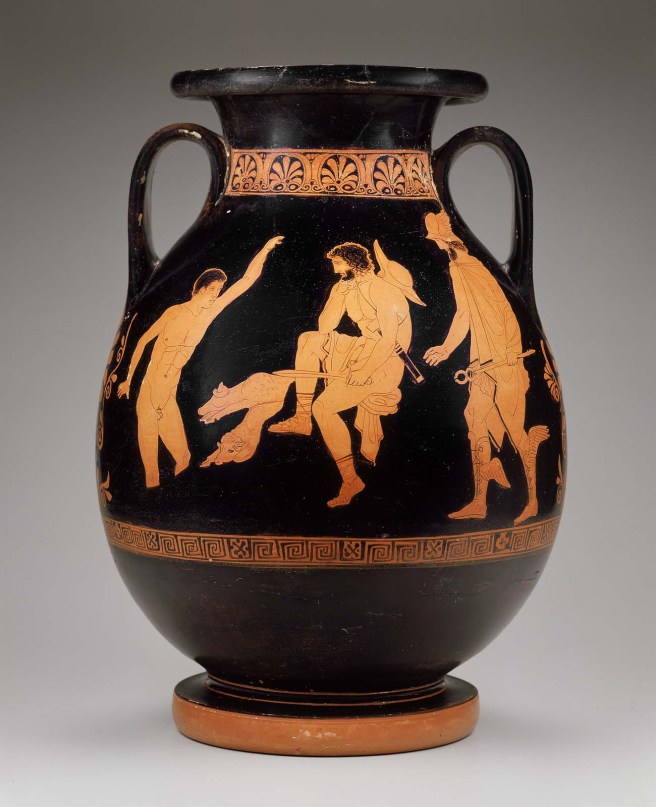
MFA Boston, Accession Number 34.79; Caskey-Beazley, Attic Vase Paintings (MFA), no. 111; Highlights: Classical Art (MFA), p. 070-071.

Nekuomanteia, glossed by Hesychius as nekromanteia (i.e. “necromancy”) is an alternate name for the Nekyuia, the parade of the dead in book 11 of the Odyssey. From the Greek Anthology: ᾿Εν τῷ Η ἡ τοῦ ᾿Οδυσσέως νεκυομαντεία· (3.8); Scholia to the Odyssey, Hypotheses: Λ. Νεκυομαντεία, ἢ, Νεκυία. Cf. Eustathius, Comm. Ad Od. 1.396.10

Love Blows

It was commonplace in Archaic Greek lyric to liken the frenzy of erotic desire to the violence of the wind:

Sappho Fr. 47

Eros shook my core
Like a mountain wind
Slamming into oaks.

Ἔρος δ’ ἐτίναξέ μοι
φρένας, ὠς ἄνεμος κὰτ ὄρος δρύσιν ἐμπέτων.

The metaphor of Eros as wind could be made quite elaborate, and it could be enriched by comparison with a tranquil state of affairs:

Ibycus Fr. 286

The rivers’ streams, in springtime,
Water Cydonian apple trees
Where there’s a pristine maidens’ garden
And the buds on grapevines swell
Under leafy shading shoots.

For me, desire has no season of repose.
Always under fiery lightning flashes
The Thracian North Wind, thanks to Cypris,
Sweeps down black and undaunted
In a scorching frenzy. Violent—
And it devours my heart from the root.

ἦρι μὲν αἵ τε Κυδώνιαι
μηλίδες ἀρδόμεναι ῥοᾶν
ἐκ ποταμῶν, ἵνα Παρθένων
κῆπος ἀκήρατος, αἵ τ᾿ οἰνανθίδες
αὐξόμεναι σκιεροῖσιν ὑφ᾿ ἕρνεσιν
οἰναρέοις θαλέθοισιν· ἐμοὶ δ᾿ ἔρος
οὐδεμίαν κατάκοιτος ὥραν·
†τε† ὑπὸ στεροπᾶς φλέγων
Θρηίκιος Βορέας ἀίσ-
σων παρὰ Κύπριδος ἀζαλέ-
αις μανίαισιν ἐρεμνὸς ἀθαμβὴς
ἐγκρατέως πεδόθεν †λαφύσσει†
ἡμετέρας φρένας.

The association of the erotic with wind persisted into the Hellenistic period, and in the epigram below wind embodies, rather than assails, the lover:

Anonymous (Greek Anthology 5.83)

If only I were wind
And you walked in the sun
Breasts exposed
And received me blowing.

εἴθ᾽ ἄνεμος γενόμην, σὺ δ᾽ ἐπιστείχουσα παρ᾽ ἀυγὰς
στήθεα γυμνώσαις, καί με πνέοντα λάβοις.

Palm tree at the hurricane, Blur leaf cause windy and heavy rain

Larry Benn has a B.A. in English Literature from Harvard College, an M.Phil in English Literature from Oxford University, and a J.D. from Yale Law School. Making amends for a working life misspent in finance, he’s now a hobbyist in ancient languages and blogs at featsofgreek.blogspot.com.

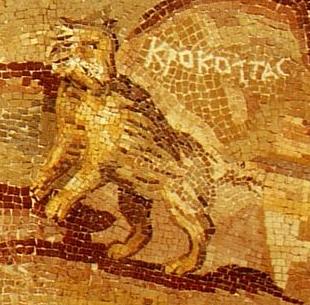
Krokotta: A Beast Worthy of October

Paradoxographus Vaticanus 2

2 “Daliôn says in the first book of his Ethiopian Matters that there is an animal in Ethiopia called a krokotta. When that creature goes near backyards it hears people chattering, and especially the words/names of children. But when it goes out at night, it speaks words/names and the children who come out are devoured by it”

Δαλίων φησίν, ἐν τῇ πρώτῃ τῶν Αἰθιοπικῶν ἐν τῇ Αἰθιοπίᾳ θηρίον γίνεσθαι κροκότταν καλούμενον· τοῦτο ἐρχόμενον πρὸς τὰς ἐπαύλεις κατακούειν τῶν λαλουμένων, καὶ μάλιστα τὰ ὀνόματα τῶν παιδίων. νυκτὸς δὲ ἐρχόμενον λαλεῖ τὰ ὀνόματα καὶ ἐξερχόμενα τὰ παιδία καταβιβρώσκονται ὑπ’ αὐτοῦ.

Photios adds the following horror:

“[We should note the fact that] there is a creature in Ethiopia which is named krokottas which is like a combination of wolf and a dog, but it is more savage than both and is heavier in its face and at the end of its feet. It is also amazing for its boldness, and it is extremely capable compared to the rest in its teeth and its belly. For they also tear to pieces easily every type of bone and whatever they take up is consumed easily and their digestion is indescribable. In addition, while some of them have been described as imitating human language, we don’t believe it. Nevertheless, some have added that they call out people by name at night—and that they try to use a human voice in doing this—and then they gobble up whoever comes out as they fall upon them.”

     ῞Οτι ὁ κατὰ τὴν Αἰθιοπίαν ὀνομαζόμενος κροκόττας ἐστὶ μὲν ὡς ἐκ λύκου καὶ κυνὸς σύνθετον, ἀμφοῖν δὲ ἀγριώτερον καὶ πολλῷ βαρύτερον ἀπό τε τοῦ προσώπου καὶ τῶν ἄκρων ποδῶν, ἀλκῇ δὲ θαυμαστόν, ὀδοῦσι δὲ καὶ κοιλίᾳ δυνατώτατον τῶν ἄλλων. Καὶ γὰρ κατάγνυσιν εὐπόρως πᾶν ὀστοῦ γένος, καὶ τὸ διαιρεθὲν εὐθέως δεδαπάνηται, καὶ περὶ τὰς πέψεις ἀδιήγητον. Τοῦτο δὲ καὶ μιμεῖσθαί τινες τὴν ἀνθρωπίνην διάλεκτον διηγούμενοι ἡμᾶς μὲν οὐ πείθουσιν· ἐκεῖνοι δὲ καὶ τοῦτο προστιθέασιν, ὡς καὶ ἐξ ὀνόματος κατὰ τὰς νύκτας καλοῦντες, τοὺς δὲ ὡς ἐπ’ ἀνθρώπου φωνῇ προσιόντας, οἱ δὲ ἀθρόον ἐπεισπίπτοντες κατεσθίουσιν.

The crocotta shows up elsewhere as well (Pliny, Aelian, etc).

A Typology of Fear for a Spooky Time of Year

Here are some passages to go with Seneca’s ruminations on the fear of death.)

Stobaeus 2.7.10c [=Diogenes Laertius 7.113]

“Hesitation is fear of future action. Agony is fear of failure and otherwise fear of worse outcomes. Shock is fear of an uncustomary surprise. Shame is fear of a bad reputation. A ruckus is fear pressing down with sound. Divine fright is fear of gods or divine power. Terror is fear of a terrible thing. A fright is fear that comes from a story.”

     ῎Οκνος δὲ φόβος μελλούσης ἐνεργείας· ἀγωνία δὲ φόβος διαπτώσεως καὶ ἑτέρως φόβος ἥττης· ἔκπληξις δὲ φόβος ἐξ ἀσυνήθους φαντασίας· αἰσχύνη δὲ φόβος ἀδοξίας· θόρυβος δὲ φόβος μετὰ φωνῆς κατεπείγων· δει-σιδαιμονία δὲ φόβος θεῶν ἢ δαιμόνων· δέος δὲ φόβος δεινοῦ· δεῖμα δὲ φόβος ἐκ λόγου.

Suda

“Fear: flight or cowardice. Fear is expecting evil. These emotions are categorized as fear: terror, hesitation, shame, shock, commotion, anxiety. Terror is fear that brings dread. Hesitation is fear about future action. Shame is fear about a bad reputation. Shock is fear from an unusual thing. Commotion is fear from a striking sound. Anxiety is fear of an uncertain matter.”

Φόβος: φυγή. καὶ ἡ δειλία. Φόβος δέ ἐστι προσδοκία κακοῦ. εἰς δὲ τὸν φόβον ἀνάγεται ταῦτα· δεῖμα, ὄκνος, αἰσχύνη, ἔκπληξις, θόρυβος, ἀγωνία. δεῖμα μὲν οὖν ἐστι φόβος δέος ἐμποιῶν, ὄκνος δὲ φόβος μελλούσης ἐνεργείας, αἰσχύνη δὲ φόβος ἀδοξίας, ἔκπληξις δὲ φόβος ἐκ φαντασίας ἀσυνήθους πράγματος, θόρυβος δὲ φόβος μετὰ κατεπείξεως φωνῆς· ἀγωνία δὲ φόβος ἀδήλου πράγματος.

Image result for Ancient Greek monster vase

New Beatings in Death

“You wasted life, why wouldn’t you waste the afterlife?”

Modest Mouse, “Ocean Breathes Salty”

Phaedrus, Fabulae 4. 2

“Whoever is born unlucky not only leads a sad life
But is stalked by fate’s harsh sorrow in death too.
Cybele’s priests, the Gallia, on their begging tour
Used to lead an ass to drag around their baggage.
When he died thanks to work and beatings
They made tambourines of his stripped skin.
When some people asked what they did
to their own pet they said,

“He believed that he’d rest with his last breath
But look, he attracts new beatings in death!”

Qui natus est infelix, non vitam modo
tristem decurrit, verum post obitum quoque
persequitur illum dura fati miseria.
Galli Cybebes circum in questus ducere
asinum solebant, baiulantem sarcinas.
is cum labore et plagis esset mortuus,
detracta pelle sibi fecerunt tympana,
rogati mox a quodam, delicio suo
quidnam fecissent, hoc locuti sunt modo:
“Putabat se post mortem securum fore:
ecce aliae plagae congeruntur mortuo!”

Bibliothèque Nationale de France, lat. 3630, Folio 84r [from bestiary.ca]