Lucretius to the CDC: Guess the Universal Pre-existing Condition?

Lucretius, De Rerum Natura 3.1076-1094

“Finally, what great and vile desire for life compels us
To quake so much amidst doubts and dangers?
Mortals have an absolute end to our lives:
Death cannot be evaded—we must leave.
Nevertheless, we move again and still persist—
No new pleasure is procured by living;
But while what we desire is absent, that seems to overcome
All other things; but later, when we have gained it, we want something else—
An endless thirst for life grips us as we gasp for it.
It remains unclear what fortune life will offer,
What chance may bring us and what end awaits.
But by extending life we do not subtract a moment
Of time from death nor can we shorten it
So that we may somehow have less time after our ends.

Therefore, you may continue as living as many generations as you want,
But that everlasting death will wait for you still,
And he will be there for no less a long time, the man who
Has found the end of life with today’s light, than the man who died
Many months and many years before.”

Denique tanto opere in dubiis trepidare periclis
quae mala nos subigit vitai tanta cupido?
certe equidem finis vitae mortalibus adstat
nec devitari letum pote, quin obeamus.
praeterea versamur ibidem atque insumus usque
nec nova vivendo procuditur ulla voluptas;
sed dum abest quod avemus, id exsuperare videtur
cetera; post aliud, cum contigit illud, avemus
et sitis aequa tenet vitai semper hiantis.
posteraque in dubiost fortunam quam vehat aetas,
quidve ferat nobis casus quive exitus instet.
nec prorsum vitam ducendo demimus hilum
tempore de mortis nec delibare valemus,
quo minus esse diu possimus forte perempti.
proinde licet quod vis vivendo condere saecla,
mors aeterna tamen nihilo minus illa manebit,
nec minus ille diu iam non erit, ex hodierno
lumine qui finem vitai fecit, et ille,
mensibus atque annis qui multis occidit ante.

Seneca, Letters to Lucilius, 1.1:

“Act thus, my Lucilius: justify yourself, collect and save all of the time which to this point has been taken off, or stolen, or simply slipped away. Persuade yourself that the matter stands as I write: some time is stolen from us, some is drawn off, and some just flows away. The most shameful loss, though, is the one which occurs through negligence. If you wish to take note, you will see that a large part of life slips away from those who act badly, the greatest portion slips away from those who do nothing, and all of life slips away from those who are busy doing something else. What person can you cite who places a price upon his time, who takes an account of the day, who understands that he is dying every day? We are deceived in this, that we look forward to death: a large part of it has already gone by, and whatever part of our lives is in the past is death’s property now. Therefore, act as you claim to do, and embrace every hour; thus it will happen that you weigh out less of tomorrow, if you throw your hand upon today.

Life runs away when it is delayed. All things, my Lucilius, are foreign to us: time alone is ours. Nature has granted us the possession of this one fleeting, slippery thing, from which she expels whoever wishes it. The stupidity of humans is so great that they allow the smallest, most worthless things (certainly, those which can be retrieved) to be added to their account when they have accomplished them, but no one thinks that he owes any debt when he receives time, though this is the one thing which no one is able to pay back readily.

You will perhaps ask how I act, I who deliver these precepts to you. I will confess honestly: as happens among the diligent partaker of luxury, I keep an account of the cost. I can not say that I have wasted nothing, but I can give an account of why and how I wasted it. I will explain the causes of my poverty. But it happens to me as to many who have been reduced to poverty through no fault of their own: all ignore him, no one helps him.

What then? I do not consider a man poor if whatever is left to him seems enough to him. I advise you, though to hold on to what is yours, and do it in good time. For, as the ancients say, ‘Parsimony is too late on the ground,’ for not only is the remaining portion at the bottom the smallest, but it is also the worst. Goodbye.”

Ita fac, mi Lucili: vindica te tibi, et tempus quod adhuc aut auferebatur aut subripiebatur aut excidebat collige et serva. Persuade tibi hoc sic esse ut scribo: quaedam tempora eripiuntur nobis, quaedam subducuntur, quaedam effluunt. Turpissima tamen est iactura quae per neglegentiam fit. Et si volueris attendere, magna pars vitae elabitur male agentibus, maxima nihil agentibus, tota vita aliud agentibus. [2] Quem mihi dabis qui aliquod pretium tempori ponat, qui diem aestimet, qui intellegat se cotidie mori? In hoc enim fallimur, quod mortem prospicimus: magna pars eius iam praeterit; quidquid aetatis retro est mors tenet. Fac ergo, mi Lucili, quod facere te scribis, omnes horas complectere; sic fiet ut minus ex crastino pendeas, si hodierno manum inieceris. [3] Dum differtur vita transcurrit. Omnia, Lucili, aliena sunt, tempus tantum nostrum est; in huius rei unius fugacis ac lubricae possessionem natura nos misit, ex qua expellit quicumque vult. Et tanta stultitia mortalium est ut quae minima et vilissima sunt, certe reparabilia, imputari sibi cum impetravere patiantur, nemo se iudicet quicquam debere qui tempus accepit, cum interim hoc unum est quod ne gratus quidem potest reddere.

[4] Interrogabis fortasse quid ego faciam qui tibi ista praecipio. Fatebor ingenue: quod apud luxuriosum sed diligentem evenit, ratio mihi constat impensae. Non possum dicere nihil perdere, sed quid perdam et quare et quemadmodum dicam; causas paupertatis meae reddam. Sed evenit mihi quod plerisque non suo vitio ad inopiam redactis: omnes ignoscunt, nemo succurrit. [5] Quid ergo est? non puto pauperem cui quantulumcumque superest sat est; tu tamen malo serves tua, et bono tempore incipies. Nam ut visum est maioribus nostris, ‘sera parsimonia in fundo est’; non enim tantum minimum in imo sed pessimum remanet. Vale.

Hieronymous Bosch, “Death and the Miser” 1494

and it keeps going……

The Worst Part of a Plague: Despair

Thucydides 2.48

“Let each person who understands something about this, whether a doctor or a private citizen, speak about what its likely origin was and whatever causes he believes likely of such a great change. I will only say what kind of a disease it was and how someone might recognize it and be able not to be ignorant about it if it should appear again. I will describe it clearly because I was sick myself and I watched others suffering from it too.”

  1.  λεγέτω μὲν οὖν περὶ αὐτοῦ ὡς ἕκαστος γιγνώσκει καὶ ἰατρὸς καὶ ἰδιώτης, ἀφ᾽ ὅτου εἰκὸς ἦν γενέσθαι αὐτό, καὶ τὰς αἰτίας ἅστινας νομίζει τοσαύτης μεταβολῆς ἱκανὰς εἶναι δύναμιν ἐς τὸ μεταστῆσαι σχεῖν: ἐγὼ δὲ οἷόν τε ἐγίγνετο λέξω, καὶ ἀφ᾽ ὧν ἄν τις σκοπῶν, εἴ ποτε καὶ αὖθις ἐπιπέσοι, μάλιστ᾽ ἂν ἔχοι τι προειδὼς μὴ ἀγνοεῖν, ταῦτα δηλώσω αὐτός τε νοσήσας καὶ αὐτὸς ἰδὼν ἄλλους πάσχοντας.

Thucydides, 2.51

“The most terrible feature of the sickness was the despair that came when anyone perceived they were getting sick. For when they fell into to this depression they surrendered much of their will and could not endure the thought of the disease. In addition people were dying like sheep, contracting the disease by caring for one another.

This caused the most fatalities. For if they were not willing to visit one another out of fear, then they died alone and many households vanished because they lacked anyone to care for them. But if they did go to visit, then they were still dying. This happened the most with those who still tried to be virtuous. Shame would not let them spare themselves as they went to visit their friends, even as the cries of the people dying were ending and the whole family was exhausted, overcome by the sickness.

But it was those who had survived who pitied the dying and the struggling because they understood what it was like and no longer had fear for themselves. The same person didn’t get sick a second time to the point of dying.”

[4] δεινότατον δὲ παντὸς ἦν τοῦ κακοῦ ἥ τε ἀθυμία ὁπότε τις αἴσθοιτο κάμνων (πρὸς γὰρ τὸ ἀνέλπιστον εὐθὺς τραπόμενοι τῇ γνώμῃ πολλῷ μᾶλλον προΐεντο σφᾶς αὐτοὺς καὶ οὐκ ἀντεῖχον), καὶ ὅτι ἕτερος ἀφ᾽ ἑτέρου θεραπείας ἀναπιμπλάμενοι ὥσπερ τὰ πρόβατα ἔθνῃσκον: καὶ τὸν πλεῖστον φθόρον τοῦτο ἐνεποίει. [5] εἴτε γὰρ μὴ ‘θέλοιεν δεδιότες ἀλλήλοις προσιέναι, ἀπώλλυντο ἐρῆμοι, καὶ οἰκίαι πολλαὶ ἐκενώθησαν ἀπορίᾳ τοῦ θεραπεύσοντος: εἴτε προσίοιεν, διεφθείροντο, καὶ μάλιστα οἱ ἀρετῆς τι μεταποιούμενοι: αἰσχύνῃ γὰρ ἠφείδουν σφῶν αὐτῶν ἐσιόντες παρὰ τοὺς φίλους, ἐπεὶ καὶ τὰς ὀλοφύρσεις τῶν ἀπογιγνομένων τελευτῶντες καὶ οἱ οἰκεῖοι ἐξέκαμνον ὑπὸ τοῦ πολλοῦ κακοῦ νικώμενοι. [6] ἐπὶ πλέον δ᾽ ὅμως οἱ διαπεφευγότες τόν τε θνῄσκοντα καὶ τὸν πονούμενον ᾠκτίζοντο διὰ τὸ προειδέναι τε καὶ αὐτοὶ ἤδη ἐν τῷ θαρσαλέῳ εἶναι: δὶς γὰρ τὸν αὐτόν, ὥστε καὶ κτείνειν, οὐκ ἐπελάμβανεν.

Edvard Munch, “Despair” 1894

Senators, Do Not Fail the Republic!

Cicero Philippic 3.14

“For this reason, Senators—by the gods almighty—take this opportunity offered to you and finally remember that you are the leaders of the most powerful council in the world. Give a sign to the Roman people that your response will not fail the Republic since they do insist that their own dedication will not fail you. You don’t need my warning!

No person is so foolish that they don’t understand that if we remain asleep at this moment we will have to live through a rule that is not only cruel and arrogant but ignoble and disgraceful too. You know this man’s arrogance, his friends, and his whole household. To serve shameful lusts, bullies, disgusting and irreverent thieves, those drunkards—well, that is the worst suffering married to the greatest dishonor.

But if—and the gods forbid this—if the final story of our Republic is being told, may we face it like noble gladiators when they fall with honor. Let us who were the leaders of the whole world and model for every people act so that we die with dignity rather than serve in disgrace. Nothing is more hateful than dishonor; nothing is more despicable than servitude. We were born into honor and freedom: let us keep them or die with dignity.

For too long we have hidden our thoughts. Now it is out in the open. Everyone is making what they think, what they want for each side clear. There are traitorous citizens—too many given the value of our Republic—but they are a mere few in comparison to those who know what’s right…”

14] Hanc igitur occasionem oblatam tenete, per deos immortalis, patres conscripti, et amplissimi orbis terrae consili principes vos esse aliquando recordamini! Signum date populo Romano consilium vestrum non deesse rei publicae, quoniam ille virtutem suam non defuturam esse profitetur. Nihil est quod moneam vos.

Nemo est tam stultus qui non intellegat, si indormierimus huic tempori, non modo crudelem superbamque dominationem nobis sed ignominiosam etiam et flagitiosam ferendam. Nostis insolentiam Antoni, nostis amicos, nostis totam domum. Libidinosis, petulantibus, impuris, impudicis, aleatoribus, ebriis servire, ea summa miseria est summo dedecore coniuncta.

Quod si iam—quod di omen avertant!—fatum extremum rei publicae venit, quod gladiatores nobiles faciunt, ut honeste decumbant, faciamus nos, principes orbis terrarum gentiumque omnium, ut cum dignitate potius cadamus quam cum ignominia serviamus. Nihil est detestabilius dedecore, nihil foedius servitute. Ad decus et ad libertatem nati sumus: aut haec teneamus aut cum dignitate moriamur.

Nimium diu teximus quid sentiremus; nunc iam apertum est. Omnes patefaciunt in utramque partem quid sentiant, quid velint. Sunt impii cives—pro caritate rei publicae nimium multi, sed contra multitudinem bene sentientium admodum pauci…

Oil painting on canvas, An Ideal Classical Landscape with Cicero and Friends, by Jacob More (Edinburgh 1740 ? Rome 1793), signed and dated: Rome, 1780.

Lingering Winter Cold? Here’s A Spice for the Elimination of Hardened Phlegm

Galen, De Simplicium Medicament. 12.55

Maker is an inner tree bark which comes from India, in regarding its flavor it is sufficiently sour, fragrant as well with a brief bitterness. But it also has a sweet smell similar to most Indian fragrances. The substance itself seems to come from a mixture, which is mostly of cold earth but a little bit of something warm and course—this is why it dries rather powerfully and gets sour and because of that mixes with the intestinal and dysenteric forces: it is in the third order of medicines which dry but it produces no different effect along the range of heat and cold*”

     [α′. Περὶ μάκερος.] Μάκερ φλοιός ἐστιν ἐκ τῆς ᾿Ινδικῆς κομιζόμενος, ἐν μὲν τῷ γεύεσθαι στρυφνὸς ἱκανῶς, μετά τινος βραχείας δριμύτητος ἀρωματιζούσης· ὀσμώμενος δὲ ἡδὺς ὁμοίως τοῖς πλείστοις ἀρώμασι τοῖς ᾿Ινδικοῖς. ἔοικεν οὖν καὶ αὐτὸς ἐκ μικτῆς οὐσίας συνεστάναι, τῆς πλείστης μὲν γεώδους ψυχρᾶς, ὀλίγης δέ τινος θερμῆς τε καὶ λεπτομεροῦς, ὅθεν ἰσχυρῶς ξηραίνει καὶ στύφει καὶ διὰ τοῦτο κοιλιακαῖς τε καὶ δυσεντερικαῖς μίγνυται δυνάμεσιν, ἐν μὲν τῇ τρίτῃ τάξει τῶν ξηραινόντων ὑπάρχων, ἐν δὲ τῇ κατὰ θερμότητα καὶ ψυχρότητα διαφορᾷ μηδέτερον ἐπιφανῶς ἐργαζόμενος.

*special thanks to the first comment for useful suggestions and addressing some of my very deep ignorance about Galen


Paulus 7.3.12

“Maker is a bark which comes from India, when dry in the third stage, it is in the middle of hot and cold. It is harsh and coarse. For this reason it works into the intestinal and dysenteric [regions].”

     Μάκερ φλοιόϲ ἐϲτιν ἐκ τῆϲ ᾿Ινδικῆϲ κομιζόμενοϲ, ξηραίνων μὲν κατὰ τὴν τρίτην τάξιν, μέϲοϲ δὲ κατὰ θερμότητα καὶ ψῦξιν· ἔϲτι δὲ καὶ ϲτυπτικὸϲ λεπτομερήϲ· ὅθεν κοιλιακοῖϲ τε καὶ δυϲεντερικοῖϲ ἁρμόττει.

Is this Walidda? Cf. Pliny the Elder Nat. Hist. 12.18

Aetius, 8.47.42

“These are [medicines] for the wealthy: “costos, amômos, and the one called maker, which is sufficiently hot with a sour taste. The Kurêneaic juice is useful for the elimination of hardened phlegm or something of the substances which accompany this, just like lasar is.”

ἔϲτι δὲ καὶ ταῦτα ἐπὶ μὲν τῶν πλουϲίων κόϲτοϲ καὶ ἄμωμον καὶ τὸ καλούμενον μάκερ, θερμαῖνον ἱκανῶϲ μετὰ  ϲτύψεωϲ καὶ ὁ Κυρηναικὸϲ δὲ ὀπὸϲ εἰϲ διαφόρηϲιν τῶν ϲκληρυνομένων φλεγμονῶν ἐπιτήδειοϲ ἤ τι τῶν μετ’ αὐτῶν, οἷόν ἐϲτι τὸ λάϲαρ.

Flower-01-KayEss-1.jpeg

Soul. Cold.

ψυχή, ἡ: soul, life

ψύχωσις: life-giving/generating

ψυχοανακάλυπτος: soul-baring, revealing

ψυχοκλέπτης: soul-thief

ψυχοκτόνος:soul-killing

ψυχοπλανής: soul-wandering

ψυχοπότης: soul drinker (drinking of life, i.e. blood)


ψῦχος, τό: cold

ψυχρία: cold

ψυχοκρασία: growing cold

ψυχολογία: frigid talking

ψυχροποιός: making cold

ψυχροπότης: cold drinker (one who drinks cold water)

ψυχρόσαρκος: with cold flesh

soulCOld1

cold 2

Snowy Mountain

Sorry But Aristotle Did Not Say This Thing about Snowflakes

The following quote has recently been attributed to Aristotle. As anyone who has read even a little bit by Aristotle can attest, this is about as far away from an Aristotelian sentiment as you can get.

Oh, Town and Country magazine, you fell for it. I get it. The quotation sounds kind of cool. It is inspiring in that insipid, soul-numbing way motivational posters start out as ‘neat’ and end up as part of a fevered nightmare.

As recently as 2012, this quotation was attributed anonymous (and this appears frequently). So, this one must have jumped attribution quite recently. Please, contact your local office of common sense and decency and let them know we cannot stand for this.

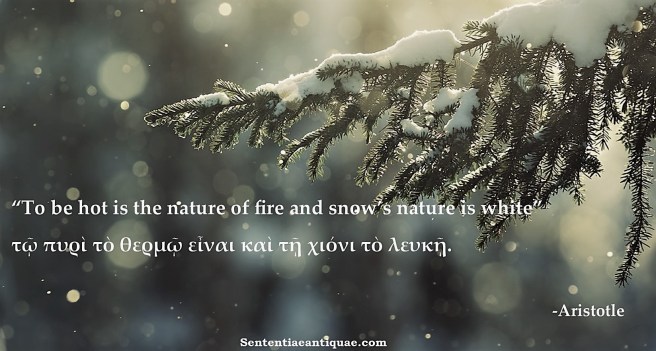
Here’s a real Aristotle quotation about snow:

Aristotle, Prior Analytics, 12b

“To be hot is the nature of fire and snow’s nature is white”

τῷ πυρὶ τὸ θερμῷ εἶναι καὶ τῇ χιόνι τὸ λευκῇ.


And here is a Pinterest version for you:

Snow istotle

Thick on A Winter’s Day

Homer, Iliad 12.277–289

So those two yelled out to encourage the Greeks to fight
And just as waves of snowfall thick on a winter’s day
When Zeus the master of all urges it to snow
On human beings, showing them what his weapons are like—
And he reins in the winds to pour it constantly
So that he covers the high mountains and the jutting cliffs
As well as the flowering meadows and men’s rich fields,
Snowing onto the harbors and the promontories of the gray sea,
Even as the wave resists it when it strikes. But everything else
Is covered beneath it whenever Zeus’ storm drives it on.
That’s how the stones fell thick from both sides,
Some falling against the Trojans, others from the Trojans
against the Greeks and a great din overwhelmed the whole wall.”

῝Ως τώ γε προβοῶντε μάχην ὄτρυνον ᾿Αχαιῶν.
τῶν δ’, ὥς τε νιφάδες χιόνος πίπτωσι θαμειαὶ
ἤματι χειμερίῳ, ὅτε τ’ ὤρετο μητίετα Ζεὺς
νιφέμεν ἀνθρώποισι πιφαυσκόμενος τὰ ἃ κῆλα·
κοιμήσας δ’ ἀνέμους χέει ἔμπεδον, ὄφρα καλύψῃ
ὑψηλῶν ὀρέων κορυφὰς καὶ πρώονας ἄκρους
καὶ πεδία λωτοῦντα καὶ ἀνδρῶν πίονα ἔργα,
καί τ’ ἐφ’ ἁλὸς πολιῆς κέχυται λιμέσιν τε καὶ ἀκταῖς,
κῦμα δέ μιν προσπλάζον ἐρύκεται· ἄλλά τε πάντα
εἴλυται καθύπερθ’, ὅτ’ ἐπιβρίσῃ Διὸς ὄμβρος·
ὣς τῶν ἀμφοτέρωσε λίθοι πωτῶντο θαμειαί,
αἱ μὲν ἄρ’ ἐς Τρῶας, αἱ δ’ ἐκ Τρώων ἐς ᾿Αχαιούς,
βαλλομένων· τὸ δὲ τεῖχος ὕπερ πᾶν δοῦπος ὀρώρει.

Schol. bT ad Il. 12. 279

“[The Poet] immediately specifies a winter day—for there is snow in the Spring too, but it isn’t deep.”

εὐθὺς χειμέριον παρέλαβε τὴν ἡμέραν· γίνονται μὲν γὰρ καὶ ἐν ἔαρι νιφάδες, ἀλλ’ οὐ πυκναί

Last Snowfall by Sophia Moran [from Wikimedia Commons]

Platonic Despotism

John Addington Symonds,

Renaissance in Italy: The Age of the Despots (Chp. 3)

What I have said about Italian despotism is no mere fancy picture. The actual details of Milanese history, the innumerable tragedies of Lombardy, Romagna, and the Marches of Ancona, during the ascendency of despotic families, are far more terrible than any fiction; nor would it be easy for the imagination to invent so perplexing a mixture of savage barbarism with modern refinement. Savonarola’s denunciations and Villani’s descriptions of a despot read like passages from Plato’s Republic, like the most pregnant of Aristotle’s criticisms upon tyranny. The prologue to the sixth book of Matteo Villani’s Chronicle may be cited as a fair specimen of the judgment passed by contemporary Italian thinkers upon their princes (Libro Sesto, cap. i.): ‘The crimes of despots always hinder and often neutralize the virtues of good men. Their pleasures are at variance with morality. By them the riches of their subjects are swallowed up. They are foes to men who grow in wisdom and in greatness of soul in their dominions. They diminish by their imposts the wealth of the peoples ruled by them. Their unbridled lust is never satiated, but their subjects have to suffer such outrages and insults as their fancy may from time to time suggest. But inasmuch as the violence of tyranny is manifested to all eyes by these and many other atrocities, we need not enumerate them afresh. It is enough to select one feature, strange in appearance but familiar in fact; for what can be more extraordinary than to see princes of ancient and illustrious lineage bowing to the service of despots, men of high descent and time-honored nobility frequenting their tables and accepting their bounties? Yet if we consider the end of all this, the glory of tyrants often turns to misery and ruin. Who can exaggerate their wretchedness? They know not where to place their confidence; and their courtiers are always on the lookout for the despot’s fall, gladly lending their influence and best endeavors to undo him in spite of previous servility. This does not happen to hereditary kings, because their conduct toward their subjects, as well as their good qualities and all their circumstances, are of a nature contrary to that of tyrants. Therefore the very causes which produce and fortify and augment tyrannies, conceal and nourish in themselves the sources of their overthrow and ruin. This indeed is the greatest wretchedness of tyrants.’

Anger and Masks of Injury

Seneca, De Ira 5-8

“Some one will be said to have spoken badly of you: think whether you did this first; think of how many people you talk about. Let us think, I say, that some are not offending us, but repaying us; that some are doing good for us, that others are forced to act, and some are just ignorant. There are those who do what they do willingly and with full understanding who attach us not for the injury itself: one is either seduced by the sweetness of his wit; other does it not to move against us but because he cannot pursue his own aims unless he moves through us.

Often praise, although it flatters, offends. Whoever reminds himself of how many times he has encountered false suspicion or how many good services fortune has disguised with masks of injury, or how many people he learned to love after hating them, he will not anger quickly. As you are offended each time, say to yourself quietly: “I have done this myself.”

And where would you encounter a judge this just? The one who desires everyone’s wife and believes that it is just enough a reason to love her that someone else has her refuses to have his own wife seen. The traitor has the harshest demands on loyalty and the perjurer is obsessed with lies himself. The devious lawyer despises any charge made against him and the man who thinks nothing of his own shame will not abide the temptation of others. We keep everyone else’s vices in clear view, but own own behind our backs.”

Dicetur aliquis male de te locutus; cogita an prior feceris, cogita de quam multis loquaris. Cogitemus, inquam, alios non facere iniuriam sed reponere, alios pro nobis facere, alios coactos facere, alios ignorantes, etiam eos, qui volentes scientesque faciunt, ex iniuria nostra non ipsam iniuriam petere; aut dulcedine urbanitatis prolapsus est, aut fecit aliquid, non ut nobis obesset, sed quia consequi ipse non poterat, nisi nos repulisset; saepe adulatio, dum blanditur, offendit. Quisquis ad se rettulerit, quotiens ipse in suspicionem falsam inciderit, quam multis officiis suis fortuna speciem iniuriae induerit, quam multos post odium amare coeperit, poterit non statim irasci, utique si sibi tacitus ad singula quibus offenditur dixerit: “Hoc et ipse commisi.” Sed ubi tam aequum iudicem invenies? Is qui nullius non uxorem concupiscit et satis iustas causas putat amandi, quod aliena est, idem uxorem suam aspici non vult; et fidei acerrimus exactor est perfidus, et mendacia persequitur ipse periurus, et litem sibi inferri aegerrime calumniator patitur; pudicitiam servulorum suorum adtemptari non vult qui non pepercit suae. Aliena vitia in oculis habemus, a tergo nostra sunt.


File:Bronze Cavalry Sports Mask Roman 2nd century CE.jpg
Roman Calvary Sports Mask, MET

Turtle-eaters and Their Homes

Strabo 16

“The Khelônophagoi live underneath turtle shells that are big enough to sail in too. Some of them, because a lot of seaweed is cast onto the shore and makes piles as high as hills, dig into them and live inside. They dispose of corpses as food for fish by allowing them to be drawn away in the high tides.

Three islands are situated in a row: they are named Turtle Island, Seal Island, and Hawk Island. The whole shoreline has palm-trees, olive trees, and laurels and this is not just in the straits but on the outside too. There is a certain Philip’s island, facing which, above the coastline, is a hunting preserve for elephants which is called Pythangelos’ Hunting Ground.

Next to this is Arsinoê which has a city and harbor and beyond these, to Deirê above which is another hunting preserve for elephants. The land right above Deirê is rich in aromatics: the first part part produces myrrh—and it is the land of the Fish-Eaters and Meat-Eaters—and it also produces persea and the Egyptian sykamin. Beyond this land is Likha, another hunting ground for elephants. Frequently there are pools of rain water in the region and when these dry, the elephants dig with their tusks and teeth and uncover water.

On that coast, there are two enormous lakes extending up as far as the Pytholaian headland. One of them has salt water and they call it a sea; the other is fresh and contains both hippopotamuses and crocodiles. It also has papyrus on its shores. People also find the Ibis around this lake. Starting near the Pytholaus, the people who live there have unblemished bodies….”

  1. Οἱ δὲ Χελωνοφάγοι τοῖς ὀστράκοις αὐτῶν σκεπάζονται μεγάλοις οὖσιν, ὥστε καὶ πλεῖσθαι ἐν αὐτοῖς· ἔνιοι δὲ τοῦ φύκους ἀποβεβλημένου πολλοῦ καὶ θῖνας ὑψηλὰς καὶ λοφώδεις ποιοῦντος, ὑπορύττοντες ταύτας ὑποικοῦσι. τοὺς δὲ νεκροὺς ῥίπτουσι τροφὴν τοῖς ἰχθύσιν, ἀναλαμβανομένους ὑπὸ τῶν πλημμυρίδων. τῶν δὲ νήσων τινὲς τρεῖς ἐφεξῆς κεῖνται, ἡ μὲν Χελωνῶν, ἡ δὲ Φωκῶν, ἡ δ᾿ Ἱεράκων λεγομένη· πᾶσα δ᾿ ἡ παραλία φοίνικάς τε ἔχει καὶ ἐλαιῶνας καὶ δαφνῶνας, οὐχ ἡ ἐντὸς τῶν στενῶν μόνον, ἀλλὰ καὶ τῆς ἐκτὸς πολλή. ἔστι δέ τις καὶ Φιλίππου νῆσος, καθ᾿ ἣν ὑπέρκειται τὸ Πυθαγγέλου καλούμενον τῶν ἐλεφάντων κυνήγιον· εἶτ᾿ Ἀρσινόη πόλις καὶ λιμήν, καὶ μετὰ ταῦτα ἡ Δειρή· καὶ τούτων ὑπέρκειται θήρα τῶν ἐλεφάντων. ἀπὸ δὲ τῆς Δειρῆς ἡ ἐφεξῆς ἐστιν ἀρωματοφόρος, πρώτη μὲν ἡ τὴν σμύρναν φέρουσα (καὶ αὕτη μὲν Ἰχθυοφάγων καὶ Κρεοφάγων), φύει δὲ καὶ περσέαν καὶ συκάμινον Αἰγύπτιον· ὑπέρκειται δὲ ἡ Λίχα θήρα τῶν ἐλεφάντων· πολλαχοῦ δ᾿ εἰσὶ συστάδες τῶν ὀμβρίων ὑδάτων, ὧν ἀναξηρανθεισῶν οἱ ἐλέφαντες ταῖς προβοσκίσι καὶ τοῖς ὀδοῦσι φρεωρυχοῦσι καὶ ἀνευρίσκουσιν ὕδωρ. ἐν δὲ τῇ παραλίᾳ ταύτῃ μέχρι τοῦ Πυθολάου ἀκρωτηρίου δύο λίμναι εἰσὶν εὐμεγέθεις· ἡ μὲν ἁλμυροῦ ὕδατος, ἣν καλοῦσι θάλατταν, ἡ δὲ γλυκέος, ἣ τρέφει καὶ ἵππους ποταμίους καὶ κροκοδείλους, περὶ τὰ χείλη δὲ πάπυρον· ὁρῶνται δὲ καὶ ἴβεις περὶ τὸν τόπον. ἤδη δὲ καὶ οἱ πλησίον τῆς ἄκρας τῆς Πυθολάουτὰ σώματα ὁλόκληροί
Related image
Silver Turtle Stater from Aigina