“I could end my letter at this place, except that I have put you in a bad place. It is impossible to hail Parthian nobility without a gift and it is not allowed for me to say goodbye to you without thanks. What then? I’ll take something from Epicurus: “getting rich is not an end of troubles for most people, but a change in them.”
I am not surprised by this. The problem isn’t in the money but in the mind. The very thing that makes poverty weigh heavy on us also makes wealth a burden. It doesn’t matter whether you put a sick person on a wooden bed or one of gold: wherever you move them, they take their sickness too!
So, it makes no difference at all whether a sick spirit rests in riches or poverty. The disease follows the person. Goodbye!”
Poteram hoc loco epistulam claudere, nisi te male instituissem. Reges Parthorum2 non potest quisquam salutare sine munere; tibi valedicere non licet gratis. Quid istic? Ab Epicuro mutuum sumam: “Multis parasse divitias non finis miseriarum fuit, sed mutatio.” Nec hoc miror. Non est enim in rebus vitium, sed in ipso animo. Illud, quod paupertatem nobis gravem fecerat, et divitias graves fecit. Quemadmodum nihil refert, utrum aegrum in ligneo lecto an in aureo conloces,—quocumque illum transtuleris, morbum secum suum transferet,—sic nihil refert, utrum aeger animus in divitiis an in paupertate ponatur. Malum illum suum sequitur. Vale.
opper engraving of Doctor Schnabel [i.e Dr. Beak], a plague doctor in seventeenth-century Rome, with a satirical macaronic poem (‘Vos Creditis, als eine Fabel, / quod scribitur vom Doctor Schnabel’) in octosyllabic rhyming couplets.
“A person of learning always has wealth on their own.
Simonides, who wrote exceptional lyric poems,
Thanks to this, lived more easily with poverty
He began to go around Asia’s noble cities
Singing the praise of victors for a set price.
Once he had done this to make a wealthier life
He planned to make a seaward journey home.
For it was on Ceos people claim he was born.
He climbed aboard a ship which an awful storm
And its advanced age caused to break apart in the sea.
Some grabbed their money-belts, others their valuable things,
Safeguards for their life. A rather curious man asked
“Simonides, you are saving none of your riches?”
He responded, “Everything that is mine is with me”
Few swam free, because most died weighed down by a drowning burden.
Then thieves arrived and seized whatever each man carried.
They left them naked. By chance, Clazomenae, that ancient city,
Was nearby. The shipwrecked men went that way.
There lived a man obsessed with the pursuit of poetry
Who had often read the poems of Simonides,
He was his greatest distant admirer.
Once he recognized Simonides from his speech alone
He greedily brought him home, and decorated him
With clothes, money, servants. The rest were carrying
Signs asking for food. When Simonides by chance
Would see these men he reported “I said that all my things
Were with me: and you lost everything you took.”
Homo doctus in se semper divitias habet.
Simonides, qui scripsit egregium melos,
quo paupertatem sustineret facilius,
circum ire coepit urbes Asiae nobiles,
mercede accepta laudem victorum canens.
Hoc genere quaestus postquam locuples factus est,
redire in patriam voluit cursu pelagio;
erat autem, ut aiunt, natus in Cia insula.
ascendit navem; quam tempestas horrida
simul et vetustas medio dissolvit mari.
Hi zonas, illi res pretiosas colligunt,
subsidium vitae. Quidam curiosior:
“Simonide, tu ex opibus nil sumis tuis?”
“Mecum” inquit “mea sunt cuncta.”Tunc pauci enatant,
quia plures onere degravati perierant.
Praedones adsunt, rapiunt quod quisque extulit,
nudos relinquunt. Forte Clazomenae prope
antiqua fuit urbs, quam petierunt naufragi.
Hic litterarum quidam studio deditus,
Simonidis qui saepe versus legerat,
eratque absentis admirator maximus,
sermone ab ipso cognitum cupidissime
ad se recepit; veste, nummis, familia
hominem exornavit. Ceteri tabulam suam
portant, rogantes victum. Quos casu obvios
Simonides ut vidit: “Dixi” inquit “mea
mecum esse cuncta; vos quod rapuistis perit.
Wreck of a small boat in Nea Artaki, Euboea, Greece
“But, you great shamepot, we follow you so that you feel joy,
As we collect honor for Menelaos and you, dog-face,
From the Trojans—you don’t shudder at this, you don’t care.”
“Wine-sod! Dog-eyes! You have the heart of a deer!
You never suffer to arm yourself to enter battle with the army
Nor to set an ambush with the best of the Achaeans.
That seems like death itself to you!”
Elsewhere in Homer, the insult is used primarily for women and it builds on basic Greek associations between women and dogs—dogs as animals of shame who are expected to be loyal.
Odyssey 4.154-146 [Helen speaking]
“…Telemachus, whom that man left when he was just born,
In his house, when the Achaeans went down to Troy
On account of dog-faced me, raising up their audacious war.”
But in the crown jewel of Greek mythology, Semonides’ “Diatribe against women”—which presents a lists of complaints about women categorized by different kinds of animals—emphasizes the inability of men to control female voices through the symbol of a dog. Note, as well, that violence is described as a regular reaction but is considered useless.
Semonides of Amorgos, fragment 7
“One women is from a dog, a sinful beast, a thorough mother—
She listens to everything and wants to know everything,
Lurking around everywhere and wandering
She barks even when she doesn’t see anyone.
She can’t stop this, not even if her husband threatens her
Nor if he is angry enough to bash her teeth
With a stone. You can’t change her by talking nicely either.
Even when she happens to be sitting among guests,
She keeps on an endless, impossible yapping.”
Franco, Cristina. 2014. Shameless: The Canine and the Feminine in Ancient Greece. Translated by Michael Fox. Berkeley and Los Angeles.
4: “In the ancient Greek imagination the figure of the dog seems, in fact, to be interwoven with the disparaging discourse on the nature of woman in afar from casual manner…Moreover, the dog appears as a paradigm for the base nature of women in two cornerstone texts of Greek misogyny” (referring to the creation of Pandora in Hesiod and Agamemnon’s comments on Clytemnestra in the Odyssey).
I have written about trauma and the Iliad in several posts. Last year, I provided an overview of work on psychology and Homer. Part of what I explain there is that there was resistance in much of the 20th century to applying modern psychological notions to Homer thanks in part to the work of “progressivists” like Bruno Snell who argued that early texts show a more primitive approach to human thought and emotion. It took two generations to upend such mistaken frameworks that both overestimated the ‘evolution’ of human neurobiology over a few thousand years and tragically underestimated the significance of different cultural and aesthetic categories.
To put it simply, oral poetry and epic in performance convey the depths of human thought and emotion in its full range. But they do it differently from what we see in modern art and literature. To put it in a more contested way: interpreters in the 19th and 20th centuries were motivated in part by a teleological worldview that positioned their understanding and aesthetics at the peak of human development. In order to justify their own beliefs–both about their superiority to earlier cultures and their supremacy over other contemporary peoples–-they had to simultaneously raise up the achievements of their ‘cultural forebears’ while also emphasizing how they have superseded their exemplary predecessors.
That’s too many words to introduce how things changed: in 1994, Jonathan Shay published his Achilles in Vietnam: Combat Trauma and the Undoing of Character and completely demolished the prohibition against talking about Homer in terms shared with modern psychology. His follow-up, Odysseus in America: Combat Trauma and the Trials of Character, was somewhat less heralded critically, but has been part of a cultural shift in the way people talk about Odysseus. I don’t think that Passolini’s The Returnor Epic: The Musical would characterize Odysseus the way they do without the larger cultural conversation about the trauma suffered by warriors and the literature about it.
One of the things that I worry about in my own book on Homer and psychology (now free in ebook form) is how we can talk about theories of mind and psychology in epic while only talking about warriors. Shay’s work is ground-breaking and arises from his clinical efforts with veterans, so it isn’t fair to criticize it for overlooking women, children, and enslaved people as well. But one of the powerful things about the Iliad and the Odyssey is how they show the impact of violence on entire communities.
This article is an important addition to the ongoing conversation for a few reasons. First, it takes Helen’s characterization seriously as “an abducted woman who lives in a war zone” (283). Second, it looks at Helen’s own speeches for evidence of trauma stress and sexual assault in the way she blames herself and engages in suicidal ideation. Third, it enters into a longstanding debate about Helen’s culpability and positionality that brings more range and depth to her character.
Murphy-Racette outlines her theoretical frameworks and potential objections to applying trauma studies to premodern texts in the first part of the paper, emphasizing, rightly, that “forms of trauma existed before modern theorizing” (285). In addition to post traumatic stress disorder, she also introduces studies from “continuous traumatic stress” which also helps us to frame Helen as someone who has not only survived harm but has suffered long term psychological strain from assault, the threat of violence, and the impact of a siege.
Much of the history of reflecting on Helen has not taken her experiences seriously. Countering this, Murphy-Racette suggest that “Helen faces multiple experiences that are potentially traumatizing: she is embroiled in a war, faces isolation and harassment from the Trojans, and is subject to sexual assault (see Roisman 2006.2, 7–8, 32)” (286). Murphey-Racette then analyzes Helen’s speeches in the Iliad to show the impact of sexual violence (3.399–412), the way Helen uses self-blame, which is a common response to sexual assault (e.g. 6.355–56) and how she engages in suicidal ideation (e.g.6.345–48). Murphy-Racette also takes a short detour to the Odyssey to suggest that her use of drugs there reflects an understanding of pharmacological responses to trauma.
From Pompeii’s newly excavated Black Room, a fresco depicting the meeting of Helen (here, in Greek, Elene) and Alexandros (prince Paris of Troy – Alexandros was his name as a foundling shepherd).
As Murphy-Racette states in her closing, this study is limited, but it provides an important example for taking the depiction of women in Homer more seriously. I find it entirely persuasive, with the caveat that these depictions are also ambiguous. Rather than insisting that this is the only way to understand Helen’s depiction, this argument makes it clear that the experiences and understanding of the audience must be taken into account when interpreting Homeric characters psychologically.
Just as audience members today who are unfamiliar with vulnerability, sexual violence, or the expectation of subordinating one’s desires to someone stronger may see Helen in one way, so too would ancient women and enslaved people have understood rather different motivations for Helen’s actions than those in traditional positions of power. This article is both a corrective for masculine-centered readings of the Iliad and a guide toward recuperating the experiences of ancient audience members.
Ancient audiences had intimate familiarity with war and violence. Many people in the world today do as well; but many of us, in something of a historical accident, are voyeurs through traditional media and social media to violence and sieges meted out upon powerless populations. Our response to Helen’s character is as much an indication of how we see ourselves and the world as is our response to suffering dealt out by the powerful to those who can choose only between losing more each day or dying. Homer doesn’t make make Helen a victim or a villain, but we do, just as we explain away the violence done in our names by turning the innocent and disenfranchised into threats of our own making.
Helen of Troy 1934 calendar print, by Henry Hintermeister
A short, incomplete bibliography on trauma and Homer
Christensen, Joel P.. The many-minded man: the « Odyssey », psychology, and the therapy of epic. Myth and Poetics; 2. Ithaca (N. Y.): Cornell University Pr., 2020.
Christensen, Joel P.. “ The Clinical Odyssey: Odysseus’s apologoi and narrative therapy.” Arethusa, vol. 51, no. 1, 2018, pp. 1-31. Doi: 10.1353/are.2018.0000
Horn, Fabian. “The psychology of aggression: Achilles’ wrath and Hector’s flight in Iliad 22.131-7.” Hermes, vol. 146, no. 3, 2018, pp. 277-289. Doi: 10.25162/hermes-2018-0023
Lesser, Rachel H.. Desire in the « Iliad »: the force that moves the epic and its audience. Oxford: Oxford University Pr., 2022.
Maiullari, Franco. “Andromache, a post-traumatic character in Homer.” Quaderni Urbinati di Cultura Classica, N. S., no. 113, 2016, pp. 11-27.
Nguyen, Kelly. “ Ocean Vuong, postmemories and the Vietnam War.” International Journal of the Classical Tradition, vol. 29, no. 4, 2022, pp. 430-448. Doi: 10.1007/s12138-021-00605-3
Pache, Corinne. “ weaving « nostos » in Homeric epic and in the twenty-first century.” Combat trauma and the ancient Greeks. Eds. Meineck, Peter and Konstan, David. New Antiquity. New York: Palgrave Macmillan, 2014. 67-85.
Shay, Jonathan. Odysseus in America: combat trauma and the trials of homecoming. New York: Scribner’s, 2002.
Sukava, Tyson. “ Singing a different body:anatomical descriptions in Chapman’s « Iliad ».” Mouseion, vol. 13, no. 1, 2016, pp. 7-34.
Tritle, Lawrence A.. “« Ravished minds » in the ancient world.” Combat trauma and the ancient Greeks. Eds. Meineck, Peter and Konstan, David. New Antiquity. New York: Palgrave Macmillan, 2014. 87-103.
Race, William H.. “Phaeacian therapy in Homer’s « Odyssey ».” Combat trauma and the ancient Greeks. Eds. Meineck, Peter and Konstan, David. New Antiquity. New York: Palgrave Macmillan, 2014. 47-66.
Russo, Joseph. “Re-thinking Homeric psychology: Snell, Dodds and their critics.” Quaderni Urbinati di Cultura Classica, N. S., no. 101, 2012, pp. 11-28.
Russo, J. A. and Simon, B.. “Homeric psychology and the oral epic tradition.” Journal of the History of Ideas, vol. XXIX, 1968, pp. 483-498.
Scodel, Ruth. “Homeric attribution of outcomes and divine causation.” Syllecta classica, vol. 29, 2018, pp. 1-27. Doi: 10.1353/syl.2018.0001
Shay, Jonathan. Achilles in Vietnam: combat trauma and the undoing of character. New York: Maxwell Macmillan, 1994.
Shay, Jonathan. Odysseus in America: combat trauma and the trials of homecoming. New York: Scribner’s, 2002.
Valle Salazar, Luca. “ the social psychology of Odysseus’ fake autobiographies (Od. 14 and 19).” Antichthon, vol. 57, 2023, pp. 1-17. Doi: 10.1017/ann.2023.9
“He also levied a tax of three on every thousand so that people, distressed by these charges, would note that families of equal wealth whose lives were modest and simple paid less to the public treasury and so repent from their behavior.
Both those who paid the taxes because of luxury and those who gave up their luxury because of the taxes were angry with him. For most people believe that hindering the display of their wealth deprives them of it and also that the display comes from their luxuries not their necessities.
This is what they say really surprised Ariston the philosopher, that those who possess superficial excess are thought to be luckier than those who are well-supplied with what is needed and useful.”
At Olympia. Plato claims in the Phaedrus that a metal Colossos was set up next to the dedication of the Kypselids at Olympia. But they claim that this from Kypselos himself and not the Kypselids. Agaklutos speaks about this in his On Olympia. “An ancient temple of Hera, dedicated by the Skillians. Those people are Eleians. Inside the temple is a gold colossus, a dedication from Kypselos of Korinth. For people say that Kypselos promised that if he should become tyrant of the Korinthians, then he would make everyone’s property sacred for ten years. Once he collected the taxes from this sacred assessment, he had the metal colossus created.”
Didymos, however, reports that Periander, his son, had the colossus made to restrain the luxury and audacity of the Korinthians. Theophrastus also reports in the second book of his Magic Moments, “while others spend funds on more masculine affairs, like raising an army and conquering enemies, as Dionysius the tyrant did. For he believed that it was necessary not only to waste others’ money but also his own in order to make sure that there would be no funds for plots against him. The pyramids of Egypt and the colossus of the Kypselids and all those kinds of things have similar or identical designs.
It is also reported that there was an an epigram on the colossus: “If I am not a colossus made of gold / then may the race of the Kypselids be wiped away.”
Apellas of Pontos, however, claims that he inscription was, “If I am not a solid-cold Colossus, may the race of Kypselids be completely destroyed”
“These well-known speeches have so many unclear and odd phrases that they barely make sense….”
Ipsae illae contiones ita multas habent obscuras abditasque sententias vix ut intellegantur– Cicero, Orator 9.31
“One could easily count the number of people who are able to understand all of Thucydides, and even these people need to rely on a commentary from time to time.”
“Now, we ourselves will not provide a discreditable length of arguments with noble words that we rule justly because we threw off the Persians or that we are attacking now because we were done wrong by you; nor do we think that you should think you are able to persuade us by claiming either that you did not campaign with the Lakedaimonians when you are their allies or that you did us no harm. No, we each should say what we think is possible to accomplish in truth, because we know that what is just is judged in human reasoning from equal compulsion: those who are in power do what they can and those who are weak allow it.”
Here are some translations of the last few phrases:
Rex Warner: “the strong do what they have the power to do and the weak accept what they have to accept”.
Benjamin Jowett: “the powerful exact what they can, and the weak grant what they must”.
Thomas Hobbes “They that have odds of power exact as much as they can, and the weak yield to such conditions as they can get”
The recent translation below, to my taste, does a much better job of not forcing a parallelism into the objects of the last two phrases
Johanna Hanink (How to Think aboutWar, 2019: 169): “We need to accomplish what we can on the basis of what we really think, each side fully aware that justice is only a factor in human decisions when the parties are on equal footing. Those in positions of power do what their power permits, while the weak have no choice but to accept it.”
The last phrases cause some fits because there is no clear object for the verb ξυγχωροῦσιν. Warner, Jowett, and Hobbes seem to have taken δυνατὰ with both πράσσουσι and ξυγχωροῦσιν. While Greek (and Thucydides) is certainly capable of implying this, I think Hanink’s translation is much better for this.
When I try to teach Greek prose analysis to students, I do what I learned from Hardy Hansen (yes, the Hardy Hansen): Kola kai kommata! Break the sentences into levels of subordination and try to find the rhythm and parallels. This speech is actually kind of simple on a structural level (for Thucydides). What makes it bedeviling are some of the individual phrases. I have moved a few phrases to show how the sense works:
I am really unsure if it is possible to convey the [forced?] antithesis between δίκαιαμὲν and δυνατὰ δὲ in English! (Or what about the repetition τὰ δυνατὰ…δυνατὰ δὲ ?). But, you know, Thucydides is trying to give an idea of the kinds of things people were likely to say….
Thucydides, 1.22
“In respect to however many speeches individuals made, either when they were about to start the war or were already in it, it is hard for me to replicate with precision what was said—and this applies both to the things I heard myself and those from people reported them to me from elsewhere. So the speeches are presented as each speaker would seem to speak most appropriately about the material at hand, and when I am able to, as close as possible to the total sense of what was actually said.”
5 years ago we debuted the 2nd episode of Reading Greek Tragedy Online
A reading and discussion of Sophocles’ Philoctetes. Tim Delap, Evelyn Miller, Paul O’Mahony, and Jack Whitam perform select scenes, with Joel Christensen (Brandeis) and Norman Sandridge (Howard) moderating the discussion. Reading Greek Tragedy Online is presented by the Center for Hellenic Studies, the Kosmos Society, and Out of Chaos Theatre.
Tim Delap (http://www.spotlight.com/5313-5614-0380) – Tim has performed several times in leading roles at the National Theatre and in the West End. He recently played Rochester in the critically-acclaimed Jane Eyre.
Evelyn Miller (https://www.spotlight.com/6297-8974-1880) – just finished playing Bianca in The Taming of the Shrew at Shakespeare’s Globe. Other recent credits include leading roles at the National Theatre and RSC. Evvy is an associate director of Actors From The London Stage.
Paul O’Mahony (http://www.spotlight.com/2458-3492-2766) – artistic director of Out of Chaos with whom he created the award winning Unmythable. He recently toured the US in their production of Macbeth and is currently working on two productions inspired by ancient culture. He has twice been a visiting artist at the CHS.
Norman Sandridge is Associate Professor of Classics at Howard University and a co-founder of Kallion Leadership. His “Sophocles’ Philoctetes: Causes of and Remedies for Dehumanization in a Leadership Role” has appeared in the SAGE series of business case studies on “Becoming a Leader in the Ancient World.”
Jack Whitam (http://www.spotlight.com/9494-0165-4393) has numerous credits with the RSC and has recently played Macbeth for the Guildford Shakespeare Company.
Life is pretty strange at the moment. To be honest, we wouldn’t have been going out that much anyway, owing to our second daughter being born just 2 months ago and our lack of sleep not being conducive to extensive exploration of the outside world.
But I like to think (and maybe I’m just kidding myself) that we would at least have ventured out for more than just our weekly supermarket trip. We were all set for celebrating new life, but now it feels even more precious and, indeed, precarious. We’re aware how fortunate we are to be able to stay inside and limit our contact while friends all over the world face significant peril.
Unable to explore the outside world, we have no option but to explore further the inner one. Life can often be solitary for an actor. Of course there are bouts of unemployment but even when acting in a play we’ll spend a significant amount of time working things out by ourselves: we learn and interpret lines, discover actions, develop a character’s playlist (and whatever exercises may form our particular technique), all (at least in part) on our own.
But we always get to share the result of that work with our fellow creative teammates. We are accustomed to working extremely closely (physically and emotionally) with others – our fellow cast members, directors, choreographers, stage managers, technical team, accent coaches, etc. For now, this traditional network of people meeting to create has been placed on hold. So how can we respond?
I suggested to Lanah at the Center for Hellenic Studies that we could start running readings of tragedy once a week to create opportunities for actors and academics to meet online and discover something together. I’ve been passionate about tragedy and its enduring impact since my time as a student, and I’ve devoted a significant portion of my career to exploring the connections between the ancient and modern worlds.
I was really delighted to hear from the CHS that Joel Christensen had been in touch with a similar proposal – and so our first international collaboration has been created. Last week we read scenes from Helen. This week it’s Sophocles’ Philoctetes (a man who knows a lot about isolation). I’ll be providing actors and directors to offer readings and their creative responses – I hope we’ll start to find new ways to use the medium to our advantage as I bring more artists into this project. Check out the CHS homepage for the livestream.
I’m especially intrigued to discover how we’ll use a computer screen as our ’empty space’. I also hope it can provide a fascinating resource for students and even a supportive testing ground for new translations of tragedy. We’ll be meeting at 3pm ET (which works well for my 2 month old), every Wednesday until we tell you otherwise. I hope you’re all staying safe and well.
Paul
Editor’s Note: The Second Reading went pretty well, check it out here:
Actors included: Tim Delap, Evelyn Miller, and Jack Whitam with commentary by Norman Sandridge from Howard University.
“Cato, since Rome was then already getting full of statues, would not allow one of himself. He said, “I would rather have people ask why there isn’t a statue of me rather than why there is one.” Indeed, these kinds of things do create envy and many believe that they owe gratitude to people who have not received them but that those who have taken them have oppressed them, as when people ask for payment for something they have done.
So, just as a person who has sailed passed the Syrtis and overturned his ship right near the channel has done nothing great nor worthy of awe, so to the man who has served in the treasury and guarded the public coffers but has done a poor job in other offices finds himself wrecked on a cliff near the sea. No, the best person is one who doesn’t want any of these kinds of things, avoiding and refusing them when needed.”
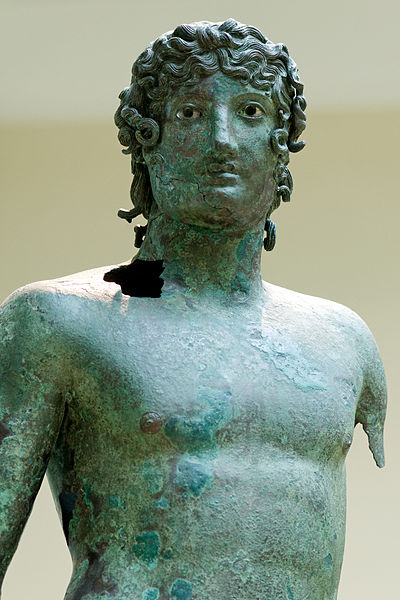
Bronze torso from an equestrian statue wearing a cuirass. MET
What to do with those toppled statues?
Diogenes Laertius, Lives of the Eminent Philosophers 5.5: Life of Demetrius (c. 350-280 BCE) 75 and 77
“Demetrios, the son of Phanostratos, from Phalerum. This guy was a student of Theophrastus. He was the lead of the city of Athens for ten years through his public speeches and was publicly awarded three hundred bronze statues for this, the vast majority of them had him on horse or chariot or with a pair of horse. He was supported so much that these statues were finished in not even 30 days.
“Although he was super famous among the Athenians, his light dimmed later on under the shadow of envy, which consumes everything. After he was indicted by some people on a charge carrying a penalty of death, he did not appear in court. When his opponents could not catch him in person, they took it out on his statues. Once they tore the statues down, they sold some, sank some in the sea, and broke others up for chamber pots. A single one is left on the Akropolis.”
Five years ago, a group of us got together and started reading Greek tragedies with actors and scholars and whoever else appeared. Over the next 3 years years, we aired 65 episodes, covering every tragedy, fragments, some comedies, original work, excerpts from epic, and eventually the Batrakhomuomakhia. We did a podcast about it and an interview a year or so later.
It was a transformative and uplifting experience that reshaped the way many of us thought about the relationship between performance and communities of support and interpretation. I am grateful for it and nostalgic in these darker days. We will be reposting the original notes for each session for the remainder of the year.
A week or so ago Paul O’Mahony pulled together a few people from the Center for Hellenic Studies (Lanah Koelle and Keith DeStone) with me and several members of the Kosmos Society (including Janet Ozsolak, Helene Emeriaud, Sarah Scott) with an idea: bringing together Hellenists and actors in isolation to do readings and discussions of Greek Tragedy during these strange times. We talked about how important it is to retain human contact and communication to stay sane, how the arts help us reflect on being human and how in these frightening times the humanities have no less a purchase on our imaginations and our needs than at any other.
We sketched out a basic plan to read a play a week and invite professional actors to read scenes together. And then we tried it out the next day. We recorded it rather than performing it live because we had no idea how well it would go. Here it is:
Designed by Paul O’Mahony with consultation from the Kosmos Society and Joel Christensen (me!)
Scenes include: Helen’s opening speech Helen and Teucer (l. 68-164) Menelaos speech (l.386-438) Menelaos and Old Woman (l.437-484) Menelaos and Helen meet (l.528-661) Menelaos and Helen plotting (l.1031-1093)
I hope you take some time to watch this and read along (we use this text). The conversation was unscripted and mostly unplanned–some of the comments about seeming and being and living at the edge of things or through mediated experiences struck me pretty hard.
We plan to do this on a weekly basis and are looking for experts in tragedy and actors who would like to participate. Please reach out! We hope to give people a chance to spend time thinking about Greek tragedy, engaging with one another, and meeting new people, learning new things.
For next week, we will be running the show live and opening it up to the public:

![opper engraving of Doctor Schnabel [i.e Dr. Beak], a plague doctor in seventeenth-century Rome, with a satirical macaronic poem (‘Vos Creditis, als eine Fabel, / quod scribitur vom Doctor Schnabel’) in octosyllabic rhyming couplets.](https://i0.wp.com/sententiaeantiquae.com/wp-content/uploads/2023/02/Paul_Furst_Der_Doctor_Schnabel_von_Rom_coloured_version.png?ssl=1)