“He put a large meat block on a burning fire
And placed on top of it the back of a sheep and a fat goat
And a slab of succulent hog, rich with fat.
As Automedon held them, Achilles cut.
Then he sliced them well into pieces and put them on spits
While the son of Menoitios, a godlike man, built up the fire.
But when the fire had burned up and the flame was receding,
He spread out the coal and stretched the spits over it.
Once he put the meat on the fire he seasoned it with holy salt.
When he cooked the meat and distributed it on platters,
Patroclus retrieved bread and placed it on a table
In beautiful baskets. Then Achilles gave out the meat.”
“Now recognize the wisdom of Oedipus:
If someone could cleave the branches from
A giant oak tree with a sharp-edged axe
And wreck its eye-catching beauty,
It would still weigh in about itself even though
It could no longer bear fruit
If it came face to face with a winter’s fire in the end
Or if set upon columns for some master,
It provides the labor for someone else’s walls,
Leaving its place deserted.
But you are the most timely healer and Paian
Honors your light.
You need a soft touch to work on
An open wound.
It is easy for cowards to shake up a state,
But it is hard indeed to make it stable again,
Unless the leaders suddenly have a god
For a pilot.”
“Now recognize the wisdom of Oedipus”: Pindar encourages Arkesilaos to examine his own riddle. For he wants him to consider the wisdom of Oedipus because he solved the riddle of the Sphinx. And he is riddling here, and he means this kind of thing. Some people were in revolt in Kyrene during Arkesilaos’ reign because they wanted to expel him from power. But because he was stronger than them, he sent them into exile from the country. Demophilos was among the rebels because he was an insurrectionist himself. He also went as exile into Thebes. Some people thought—since others claim that he gave money to Pindar for the victory ode—that Pindar was using the poem to reconcile him to Arkesilaos
“Wisdom to others”: This is about that wisdom from earlier, speaking concisely, and becoming and exemplar to others, which means a teacher. What he’s saying is I am showing many others about concision, how to explain things concisely.”
“I’ll be small for minor matters but big for big ones
and I will cultivate in my thoughts
The fate that comes to me, serving it by my own design.
So if god allows me wealth’s luxury
I have hope of finding fame’s height as well.
We know about Nestor and Lykian Sarpedon–
People’s legends, from famous songs which
The wise craftsmen assembled. And excellence blooms
In famous songs for all time. But it is easy for only a few to earn.”
Hypnos and Thanatos carrying the body of Sarpedon from the battlefield of Troy. Detail from an Attic white-ground lekythos, ca. 440 BC. British Museum D56
Pygmalion saw women misbehave all the time
and was so appalled by their vices–nature gave
the female soul so many–he lived without a wife,
a bachelor, his bed long without a partner.
All the while, with amazing skill he sculpted
some white ivory, and he gave it a shape
no woman could be born with. And then
he fell in love with his own creation.
A real woman’s face! You’d think she were alive
and, if not for reserve, desired arousal.
That’s how much art his art contains.
Pygmalion marvels. His heart revels
in the heat of a make-believe body.
Quas quia Pygmalion aevum per crimen agentes
viderat, offensus vitiis, quae plurima menti
femineae natura dedit, sine coniuge caelebs
vivebat thalamique diu consorte carebat.
Interea niveum mira feliciter arte
sculpsit ebur formamque dedit, qua femina nasci
nulla potest: operisque sui concepit amorem.
Virginis est verae facies, quam vivere credas,
et, si non obstet reverentia, velle moveri:
ars adeo latet arte sua. Miratur et haurit
pectore Pygmalion simulati corporis ignes.
Francisco de Goya, “Pygmalion and Galatea” c. 1815
“The god authorizes every outcome on his own expectations–
the god who races the winged eagle,
Outdoes the sea-dwelling dolphin and
Brings the arrogant mortals to their knees,
And then grants unaging glory to other people.
I need to escape the gnawing bite of bad gossip–
I have watched from afar while Archilochus,
That shit-talker, is pressed to helplessness
Thanks to hateful words.
Getting rich with luck
Is the best allotment of wisdom.”
Menekrates: “Musonius, that voice which made him music-mad and longing for Olympian and Pythian games, how was the tyrant’s voice? Some people who sailed to Lemnos were amazed by it, others mock it.”
Musonius: “Well, Menekrates, his voice really merits neither wonder nor mockery, since nature has made him moderately and unquestionably in tune. He speaks with a naturally open and deep voice, since his throat is deep, and when he sings he buzzes a little because of his throat shape. Nevertheless, the tones of his voice make him seem smoother if he does not try too hard, but relies instead on the melody, good accompaniment, and selecting the right time to walk, to stop, to move, and to nod his head along with the music. What is shameful is that a king appears to want success in these pursuits.”
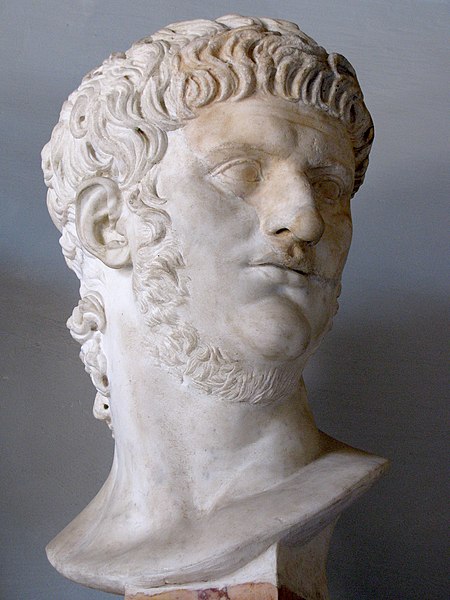
“He was mostly deranged by a desire for popularity and was an enemy to anyone who had any sway over the popular mob. Most believed that after all of his accomplishments on the stage he was going to compete among the Athletes at the next Olympian games. He was wrestling endlessly and he had watched the gymnastic contests all over Greece as a judge would, sitting on the ground of the stadium. If any competitors withdrew too far back, he would push them forth again with his own hand. Because he was alleged to have equaled Apollo in song and the Sun in chariot-driving, Nero planned to rival the deeds of Herakles too. People claim that a lion had been trained which he would be able to kill naked in the amphitheater in front of all the people with either a club or his arms’ embrace.”
Maxime autem popularitate efferebatur, omnium aemulus, qui quoquo modo animum vulgi moverent. Exiit opinio post scaenicas coronas proximo lustro descensurum eum ad Olympia inter athletas; nam et luctabatur assidue nec aliter certamina gymnica tota Graecia spectaverat quam brabeutarum more in stadio humi assidens ac, si qua paria longius recessissent, in medium manibus suis protrahens. Destinaverat etiam, quia Apollinem cantu, Solem aurigando aequiperare existimaretur, imitari et Herculis facta; praeparatumque leonem aiunt, quem vel clava vel brachiorum nexibus in amphitheatri harena spectante populo nudus elideret.
“He had a desire for eternal and endless fame, but it was ill-considered. Because of this he changed the names of many things and places from their ancient titles to something from his own name. So, he called the month of April Neroneus and planned to have Rome renamed Neropolis.”
Erat illi aeternitatis perpetuaeque famae cupido, sed inconsulta. Ideoque multis rebus ac locis vetere appellatione detracta novam indixit ex suo nomine, mensem quoque Aprilem Neroneum appellavit; destinaverat et Romam Neropolim nuncupare.
“Democrates the wrestler also had a foot ailment. When he went to a competition he stood in the arena, drew a circle around himself and dared his opponents to drag him over the line. Those who couldn’t, were defeated. He left crowned victor, having stood his ground strongly.”
“Friendship with a single smart person is better than many fools”
ἑνὸς φιλίη ξυνετοῦ κρέσσων ἀξυνέτων πάντων.
From Brill’s New Pauly, s.v. Democrates
[1] Attic orator of the 4th cent. BC from Aphidna
Attic orator of the 4th cent. BC from Aphidna, probably an older contemporary of Demosthenes [2] (about 338 BC he is called γέρων (gérōn; old man), cf. Stob. Floril. 3,22,43). As the descendant of Harmodius or Aristogeiton, he had a claim to free provisions in the Prytaneion (Hyp. 4,3). He belonged to the Pro-Macedonian party (Hyp. 4,2). He is also mentioned in Aeschin. Leg. 2,17 and Isaeus 6,22.
Father: That’s great, dear. We’re so happy for you. Tell us all about it.
Child: I’ve never felt this way about another person. I’m giddy with joy at the idea that we can be together forever!
Mother: Who is it? Do we know the family?
Child: I can’t wait for you to meet. I know you’ll love each other so much.
Father: Go ahead; describe your new love.
Child: I hope you will approve. Will you?
Mother: What do you mean? Of course we will approve.
Child: I mean… Well… I’ll just say it: It’s… a third declension.
Father: What?! I can’t believe it… our child falling in love with one of them?
Mother: Calm yourself, dear. I’m sure we can get our child to see reason.
Child: Reason? I’m in love!
Father: But see here, you know this is a shock to your mother and me. You must understand… Her family has been first declension for generations, and my own family has been second declension longer than anybody can remember.
Child: But we’re all NOUNS, right? Can’t we accept one another, no matter what declension we are?
Mother: Of course we’re all nouns, dear, but…
Child: And don’t we all have gender, number, and case?
Father: Yes, that all goes without saying, but the third declensions… Well…
They’re a DIFFERENT KIND of noun.
Child: But aren’t first and second declensions also different from one another in some ways?
Mother: Yes, of course we’re different in small ways, but we are compatible. It’s just… Well, you know what they say about third declensions… They’re… Well, they’re irregular.
Child: Are you prejudiced against the stem change? Is that it? Just because they have stems and endings a little bit different than yours doesn’t make them monsters.
Father: Yes, but a group that has all three genders is a bit tough for us traditionalists to handle.
Child: Don’t be hypocritical; what about some of my second declension uncles and aunts on your side who are masculine or feminine, depending on the context?
Father: Please, I told you not to mention them in polite company. Let’s not discuss that.
Child: And what about some of my first declension cousins who have what look like masculine endings, but are feminine? I won’t mention any names, but you know who they are. And now that I think about it, what about some of my cousins who are masculine first declensions (that’s your side Mom), who have what look like feminine plural endings? Do you call them irregular? Do you love them any less because of that little quirk?
Mother: Of course we love them, dear. They’re our family, bless their hearts. We accept them… But third declensions… I just don’t know. And what would our friends say?
Father: Now see here; we have known some third declensions, but never socialized with them, let alone become intimate with them. I just can’t imagine having them permanently in our lives. Would we invite them to the beach house? Imagine a bunch of them lying out there sunbathing – and
FULLY DECLINED – I don’t know if I could bear the sight. Sorry, I know that my saying this hurts you, but I’m only being honest.
Child: Well I love my third declension, and we’re going to marry and raise a family and be happy together for the rest of our lives, whether you like it or not.
Mother: You would have children with a third declension?
Child: I love my third declension, Momma! Don’t you remember what first love is like? Don’t you remember the thrill of first exploring all the cases of your beloved, both singular and plural? Remember when you first saw Daddy’s dative plural?
Mother: [sighs] You’re right. That gave me the shivers, in a wonderfully happy way. Yes, new love is a beautiful thing. And really, we all ARE nouns, aren’t we? And we should not let something like this break up our family.
Father: Yes, dear; you’re right, too. [sighs] I remember the thrill when your vocative first crossed my lips. What love! Our child is right; we must love everyone in our family, regardless of the status of their stems or endings. Love is love. Besides, our older children have already married within their own declensions, so I guess it wouldn’t be the end of the world if the youngest brings in someone different. Dear child, I’m sure we will learn to love your spouse. You have our blessings.
And they all lived happily ever after.
THE END.
Red-figure Lekythos: Eros Riding a Dolphin and Playing the Double Flutes (Auloi)
Daniel B. Levine (BA Minnesota 1975; PhD Cincinnati 1980) is University Professor of Classical Studies at the University of Arkansas, where he has taught Classical Studies, Humanities, Greek, and Latin since 1980. His publications include essays on Greek comedy, tragedy, and epic poetry, and modern literary receptions of ancient Greek and Roman literature, including works by Rita Mae Brown, V. T. Hamlin, and Michael Chabon. He has received teaching and service awards from the Society for Classical Studies, the Classical Association of the Middle West and South, and the University of Arkansas. He has directed 19 study abroad programs.
“You you speak at the magic moment,
Interweaving many ideas but briefly,
Then fewer people will carp at your words,
Since awful excess blunts urgent expectation,
And your peers are secretly annoyed
At reports of other people’s success.
But even though envy is stronger than pity.
Don’t ignore the good things. Direct your crew
With a just hand and use no false anvil
To forge your tongue.”