The Future of Classics, From “Below”

Editor’s note: While Dani Bostick may be best known to our readers for her ‘discoveries’ of fake Latin, she is also a Latin teacher who is deeply passionate about the future of our field.

What is the future of Classics? During the Future of Classics Panel at the SCS-AIA annual meeting, Joy Connolly presented a dire picture. “We’ve got to decide what we want our field to be, because the field as it is is not attracting sufficient students to justify our continued existence.”

The future of Classics depends on a more expansive “we” that extends beyond the traditional boundaries of post-secondary institutions and includes classicists in a position to identify and remedy longstanding problems in the field. At the Future of Classics Panel, an audience member brought up this exact point, “There’s an elephant in the room that we’ve barely talked about. And that is the future of Latin in the high schools and the schools of our country. And I think it’s indicative of us as college professors that we really haven’t talked about this. We’re in our ivory tower. The real challenge is in the schools.”

Despite this reality, discussions about just and inclusive Classics have been limited to post-secondary problems and solutions. It is critical that we provide a vision for Classics that involves a clear, actionable road-map for greater inclusivity and equity. And, it is equally critical that solutions involve Classicists beyond the traditional confines of post-secondary institutions. It is time to de-silo the academy and stop viewing secondary education as a self-contained, distinct (and, yes, also inferior) subsection of the field. There is no future for a version of Classics that works top-down, designed by its academic elite without concern for or coordination with teachers of the more than 200,000 Latin students in American K-12 schools.

Secondary schools represent a tremendous opportunity, but they are also the epicenter of longstanding, structural injustices in the field, and, more broadly, American public education. The American Classical League and National Latin Exam do not include demographic information in their reports, but we know that in 2018 of the 6,647 students took the Advanced Placement Latin exam only 223 were black. Compared with predominantly white schools, schools with a high proportion of minority students receive less funding and offer a more restricted range of classes. There are plenty of Latin programs, however, that are homogeneous oases of elitism despite the cultural and socioeconomic diversity of their schools. Most explanations for this disproportionality have been reductive and fail to address underlying institutional failures. Instead, students are blamed for their own exclusion when the consequences of resource discrimination are attributed to lack of interest or ability. Educators are blamed when the problem of underrepresentation is reduced to a question personality or pedagogy. 

There is no legitimate reason why Latin programs at the secondary level remain segregated spaces, immune to broader efforts to promote equity in schools. But one cause is clear. “The field as it is” is exclusionary by design, the direct result of discriminatory practices that have deprived African American students of educational opportunities for centuries. The attitudes behind these practices still persist in 2019 as Classics continue to be appropriated as weapon of exclusion and a signifier of the superiority of a select few. Recently, the author of a New Criterion commentary asserted that the difficulty of learning classical languages has protected the field from “shrieking harpies” and “politicized deformations.” In The Catholic Thing, David Warren proposed a Latin newspaper called “Briefs to Princes” that would be “a little elitist island of sanity and spiritual calm.” It would be written in Latin because “anything that could be read by almost anyone would be too dangerous.” Proponents of this brand of elitism attempt to trivialize calls for inclusivity by branding them a  “slow-motion surrender to the forces of faddishness.” 

Advocacy for equal educational opportunities is not a fad. It should be our common goal. Instead, the elitism of Classics is actively maintained at the secondary level through coded messaging, inadequate instructional material, ineffective pedagogical practices, and institutional complicity. When I tell people I teach Latin, the three most common responses I receive are decontextualized morphology (“Amo, amas amat…”); comments that frame the main value of Classics as college and career preparation (“That is great for future doctors and lawyers! And SAT scores!”); and, misguided, inaccurate platitudes about the origins of civilization (“Ancient Rome is the foundation of the world!”). Even inside of the field, Latin is intentionally marketed as a social differentiator in promotional flyers, material provided by professional organizations, information on the websites of post-secondary institutions, and entire classes. These messages are an invitation to Latin for some students and a “Do Not Enter” sign for others.

Secondary teaching materials reinforce these exclusionary narratives. The majority of secondary textbooks provide an unnecessarily narrow– and often inaccurate– glimpse into ancient Roman life by centering the experience of elite, fair-skinned people. Worse, many resources promote ideas that have been eradicated from other subject areas. Here are just two examples. In Ecce Romani Davus is relieved after he is purchased by a benevolent master in an anecdote that overtly perpetuates an antebellum trope used to justify the institution of slavery. Cambridge, another popular text, frames the objectification and exploitation of an enslaved woman as a source of comic relief.* The narrative even casts in a humorous light the jealousy of her enslaver’s wife, a heartbreaking scenario reminiscent of Harriet A. Jacobs’ personal experience, described in her 1835 autobiography, Incidents in the Life of a Slave Girl.** Textbooks are rife with problematic content that prioritizes nostalgia over actual history, a larger trend poet Regie Gibson identified in the context of American history. 

Too many stakeholders accept and even defend this system and resulting segregation in the name of ‘rigor,’ sending the offensive message that marginalized students are not only unable to learn Latin, but that their presence in the Latin classroom hinders the academic progress of their more privileged peers. As long as the academy remains silent, these troubling mindsets and racialized barriers will persist.

There are many secondary Latin teachers committed to making sure students of all academic, cultural, and socioeconomic backgrounds have equal access to their programs. We are doing this work by creating alternate materials and challenging problematic narratives in existing materials so that our students feel seen in the curriculum; amplifying the perspectives and experiences of our students; and, updating our pedagogical practices so that privilege is not a prerequisite for success. We are doing this work in the absence of clear leadership and without the benefit of collaboration with our colleagues in other corners of the field. Our efforts can remedy problems in individual schools, but will do little to correct long-standing, institutional failures without action-oriented leadership from the academy.

Although secondary teachers are the front lines of the battle against discrimination and exclusivity in the field, this scourge has been presented as an exclusively post-secondary problem that post-secondary Classicists alone will solve. By the time students arrive to college campuses, many have already received the message that Classics are for affluent white students. If post-secondary classes like Princeton’s much-maligned Latin 110 lack diversity, it is a symptom of a much larger problem. Underrepresentation at the post-secondary level is just one result of a racialized system that restricts access to Classics and informs perceptions about the field even among students who have never set foot in a Latin classroom.

For too long, the academy has ignored secondary teachers as a logical resource for bringing about systemic, pervasive change. If Classical Studies today belongs to all of humanity, then it is our most basic duty to make sure that students have equal access to Classics. We cannot do this as a segmented, factionalized field. We must work together.

Here are some ways the academy can start to bring about a more expansive future of Classics and eradicate longstanding, institutional injustices:

1) Formally denounce systems, practices, policies, and rhetoric that deny children access to Classics, especially where programs are currently available and do not reflect the demographics of their schools and communities.

2) Establish and disseminate anti-racist expectations for secondary Classics. Set the explicit expectation that all children should be afforded the opportunity to study Classics in schools where programs exist.

3) Investigate the problem. Who studies Latin? Disproportional access is an open secret. Currently, the College Board is the only source of easily accessible information on racial disparities in secondary Classics. Since only a small fraction of Latin students take the AP Latin exam, most of the evidence we have for this problem is anecdotal.  It is time to define the problem in a more formal way. The Joint Committee on the Classics in American Education (an initiative of the SCS and ACL) should lead the way on this.

4) Share power with secondary teachers. If we condemn elitism and exclusion, there should not be elitism and exclusion when it comes to identifying and solving problems embedded in the field.


Footnotes

* “Caecilius ancillam spectat. ancilla est pulchra. ancilla ridet. ancilla Caecilium delectat. venalicius quoque ridet. ‘Melissa cenam optimam coquit,’ inquit venalicius. ‘Melissa linguam latinam discit. Melissa est docta et pulchra. Melissa…’ ‘satis! satis!’ clamat Caecilius. Caecilius Melissam emit et ad villam revenit. Melissa Grumoniem delectat. Melissa Quintum delectat. eheu! ancilla Metellam non delectat.”

Caecilius watches a slave woman. The slave woman is beautiful. The slave woman laughs. The enslaved woman pleases Caecilium. The slave seller also laughs. “Melissa cooks the best dinner,” says the slave seller. Melissa is learning Latin. Melissa is educated and beautiful. Melissa…” “Enough! Enough!” shouts Caecilius. Caecilius buys Melissa and returns to the house. Melissa pleases Grumio. Melissa pleases Quintus. The slave woman does not please Metella.

**Instead of making light of Jacobs’ ordeal, Teaching Tolerance suggests this question in a lesson for middle and high school students: “To what extent did the prevalence of sexual assault on the plantation contradict the white supremacist vision? To what extent did it align with that vision?”

 BNF, Français 1537, fol. 27v[1] 

Dani Bostick teaches high school Latin and an occasional micro-section of ancient Greek in Virginia where she lives with her husband, children, and muppet-like dogs. She has published many collections of Latin mottoes online, has a strong presence as an activist for survivors of sexual violence on twitter, and is available to write, speak, or rabble-rouse.

Women’s History Month, Week 1

A Round-up of our first week of posts for Women’s History Month

Women Authors:

The Fragments of Hedyle

The Fragments of Phintys the Pythagorean: Part 1 and Part 2

Cleobulina’s Riddles

Poems by Nossis: Part 1 and Part 2

Two Poems by Erinna

The Poems of Anyte of Tegea

The First Hexameter Song and the Fragments of Boio

The Poems of Moero

A List of Women Authors from the Ancient World


Cultural Issues:

A Funerary Inscription for the 12 Year old Girl

Odysseus’ Sister and Names for In-laws

A Physician’s Notes on the Lives and Deaths of Women

The Names of the Fates and their Domains

The Phrasikleia Inscription: A Tomb Instead of a Marriage

Moirai

A List of Women Authors from the Ancient World

I am reposting this list for International Women’s day.

Most of the evidence for these authors has been collected only in Wikipedia. We can probably do better by adding more information from ancient sources and modern ‘scholarly’ texts. I have been translating the fragments of some for the website and linking as appropriate

I received a link to the following in an email from my undergraduate poetry teacher the amazing poet and translator Olga Broumas. The post is on tumblr on a page by DiasporaChic, bit the original author who has already won my admiration is Terpsikeraunos.

*denotes comments I have added with this re-post

** denotes names I have added

Calliope

Women in ancient Greece and Rome with surviving works or fragments


PHILOSOPHY

Aesara of Lucania: “Only a fragment survives of Aesara of Lucania’s Book on Human Nature, but it provides a key to understanding the philosophies of Phintys, Perictione, and Theano II as well. Aesara presents a familiar and intuitive natural law theory. She says that through the activity of introspection into our own nature – specifically the nature of a human soul – we can discover not only the natural philosophic foundation for all of human law, but we can also discern the technical structure of morality, positive law, and, it may be inferred, the laws of moral psychology and of physical medicine. Aesara’s natural law theory concerns laws governing three applications of moral law: individual or private morality, laws governing the moral basis of the institution of the family, and, laws governing the moral foundations of social institutions. By analyzing the nature of the soul, Aesara says, we will understand the nature of law and of justice at the individual, familial, and social levels.” – A History of Women Philosophers: Volume I: Ancient Women Philosophers, 600 B.C.-500 A.D., by M.E. Waith

*Wikipedia on Aesara

Melissa: “Melissa (3rd century BC)[1][2] was a Pythagorean philosopher…Nothing is known about her life. She is known only from a letter written to another woman named Cleareta (or Clearete). The letter is written in a Doric Greek dialect dated to around the 3rd century BC.[2] The letter discusses the need for a wife to be modest and virtuous, and stresses that she should obey her husband.[2] The content has led to the suggestion that it was written pseudonymously by a man.[2] On the other hand, the author of the letter does not suggest that a woman is naturally inferior or weak, or that she needs a man’s rule to be virtuous.[1]” –Wikipedia

Perictione (I and II): “Two works attributed to Perictione have survived in fragments: On the Harmony of Women and On Wisdom. Differences in language suggest that they were written by two different people. Allen and Waithe identify them as Perictione I and Perictione II. Plato’s mother was named Perictione, and Waithe argues that she should be identified as the earlier Perictione, suggesting that similarities between Plato’s Republic and On the Harmony of Women may not be the result of Perictione reading Plato, but the opposite–the son learning philosophy from his mother. On the Harmony of Women, however, is written in Ionic prose with occasional Doric forms. This mixed dialect dates the work to the late fourth or third centuries BC. The reference in On the Harmony of Women to women ruling suggests the Hellenistic monarchies of the third century BC or later. On Wisdom is written in Doric and is partly identical with a work by Archytas of the same name. This work should be dated later, to the third or second centuries BC. Both the dates of the works and their dialects mean Perictione as the mother of Plato could not have written them. We then have two Pythagorean texts, attributed to otherwise unknown women named Perictione who should be dated perhaps one hundred years apart.” –Women Writers of Ancient Greece and Rome: An Anthology, by I.M. Plant

*N.B. This account leaves out the the basic narrative from Diogenes Laertius, that Plato’s father Ariston raped his mother Perictione.

Phintys: “Phintys (or Phyntis, Greek: Φίντυς; 4th or 3rd century BC) was a Pythagorean philosopher. Nothing is known about her life, nor where she came from. She wrote a work on the correct behavior of women, two extracts of which are preserved by Stobaeus.” –Wikipedia

*Note, Stobaeus (4.32.61a) calls her the daughter of  Kallikrates the Pythagorean (Φιντύος τᾶς Καλλικράτεος θυγατρὸς Πυθαγορείας). Here are some of her fragments on the prudence befitting women: part 1 and part 2.

Ptolemais of Cyrene: “Ptolemais is known to us through reference to her work by Porphyry in his Commentary on the Harmonics of Ptolemy. He tells us that she came from Cyrene and gives the title of her work, The Pythagorean Principles of Music, which he quotes. She is the only known female musical theorist from antiquity. Her dates cannot be known for sure. She clearly preceded Porphyry, who was born about AD 232; Didymus, who is also quoted by Porphyry, knew Ptolemais’ work and may even have been Porphyry’s source for it. This Didymus is probably the one who lived in the time of Nero, giving us a date for Ptolemais of the first century AD or earlier…One of the problems in dealing with this text is that it is in quotation. Porphyry does not clearly distinguish between the text he quotes from Ptolemais and his own discussion of the issues raised…A second issue is the problem of the accuracy of the quotation. Porphyry says in the introduction to fragment 4 that he has altered a few things in the quotation for the sake of brevity. We should not assume that this is the only quotation to have suffered from editing. On the other hand, where he quotes the same passage twice (fragment 3 is repeated almost verbatim in fragment 4) his consistency is encouraging. Ptolemais’ extant work is a catechism, written as a series of questions and answers. She discusses different schools of thought on harmonic theory, distinguishing between the degree to which they gave importance to theory and perception. Her text prefers the approach of Aristoxenus to that of the Pythagoreans, thus she should not be thought a Pythagorean, despite the title of her work.” –Women Writers of Ancient Greece and Rome: An Anthology, by I.M. Plant

**Theano the Pythagorean (I have collected her words here)

“When Theano the Pythagorean philosopher was asked what eros is, she said ‘the passion of a soul with spare time.’ ”

Θεανὼ ἡ πυθαγορικὴ φιλόσοφος ἐρωτηθεῖσα τί ἐστιν ἔρως ἔφη· ” πάθος ψυχῆς σχολαζούσης.”

“While Theano was walking she showed her forearm and some youth when he saw it said “Nice skin”. She responded, “it’s not communal”.

Θεανὼ πορευομένη ἔξω εἶχε τὸν βραχίονα· νεανίσκος δέ τις ἰδὼν εἶπε· ” καλὸν τὸ δέμας·” ἡ δὲ ἀπεκρίνατο· ” ἀλλ’ οὐ κοινόν.”

Continue reading “A List of Women Authors from the Ancient World”

“What Kinds of Things Are Roses”: More Poems from Nossis

Earlier this week I posted some fragments from Nossis. Here are some more. I noted in the earlier post that while Nossis leaves us the most lines of any woman poet from Ancient Greece other than Sappho, she is barely known.

Greek Anthology, 6. 265

“Reverent Hera, who often comes down
From the sky to gaze upon your fragrant Lakinian home.
Take the linen robe which Theophilos, the daughter of Kleokha
Wove for you with the help of her noble daughter Nossis.”

Ἥρα τιμήεσσα, Λακίνιον ἃ τὸ θυῶδες
πολλάκις οὐρανόθεν νεισομένα καθορῇς,
δέξαι βύσσινον εἷμα, τό τοι μετὰ παιδὸς ἀγαυᾶς
Νοσσίδος ὕφανεν Θευφιλὶς ἁ Κλεόχας.

6.138

“These weapons the Brettian men hurled down from their unlucky shoulders
As they were overcome by the hands of the fast-battling Lokrians.
They are dedicated here singing the Lokrians glory in the temple of the gods.
They don’t long at all for the hands of the cowards they abandoned.”

Ἔντεα Βρέττιοι ἄνδρες ἀπ᾿ αἰνομόρων βάλον ὤμων,
θεινόμενοι Λοκρῶν χερσὶν ὕπ᾿ ὠκυμάχων,
ὧν ἀρετὰν ὑμνεῦντα θεῶν ὑπ᾿ ἀνάκτορα κεῖνται,
οὐδὲ ποθεῦντι κακῶν πάχεας, οὓς ἔλιπον.

7.414

“Pass by me, give an honest laugh, and speak over me
A loving word. I am Rhintho from Syracuse,
A minor nightingale of the Muses. But from my tragic
Nonsense poems, I made my own ivy crown.”

Καὶ καπυρὸν γελάσας παραμείβεο, καὶ φίλον εἰπὼν
ῥῆμ᾿ ἐπ᾿ ἐμοί. Ῥίνθων εἴμ᾿ ὁ Συρακόσιος,
Μουσάων ὀλίγη τις ἀηδονίς· ἀλλὰ φλυάκων
ἐκ τραγικῶν ἴδιον κισσὸν ἐδρεψάμεθα.

Greek Anthology, 5.170

“There is nothing sweeter than love: all other blessings
Take second place. I even spit honey from my mouth.
This is what Nossis says. Whomever Kypris has not kissed,
Does not understand her flowers, what kinds of things roses are.”

Ἅδιον οὐδὲν ἔρωτος· ἃ δ᾽ ὄλβια, δεύτερα πάντα
ἐστίν· ἀπὸ στόματος δ᾽ ἔπτυσα καὶ τὸ μέλι.
τοῦτο λέγει Νοσσίς· τίνα δ᾽ ἁ Κύπρις οὐκ ἐφίλασεν,
οὐκ οἶδεν τήνας τἄνθεα, ποῖα ῥόδα.

Greek Anthology, 9.604

“This frame has the picture of Thaumareta. The painter
Caught the form and the age of the soft-glancing woman well.
Your house dog, the little puppy, would paw at you if she saw this,
Believing that she was looking down at the lady of her home.”

Θαυμαρέτας μορφὰν ὁ πίναξ ἔχει· εὖ γε τὸ γαῦρον
τεῦξε τό θ᾿ ὡραῖον τᾶς ἀγανοβλεφάρου.
σαίνοι κέν σ᾿ ἐσιδοῖσα καὶ οἰκοφύλαξ σκυλάκαινα,
δέσποιναν μελάθρων οἰομένα ποθορῆν.

Rising and Evolving: Classical Studies in the News

The the Notes & Comments Article from the March 2019 Issue of New Criterion (“Decline and Fall: Classics Edition.”) presents not a moment of original thought or convincing argumentation. Instead, it is an intellectually lazy but rhetorically effective collection of fear-mongering and base-rallying. I say “rhetorically” effective because it plies the right phrases and plays the right notes to get the right people riled up about an attack on their culture they just can’t wait to complain about abide.

The essay’s first rhetorical aim is to incense and by incensing reaffirm a sense of community and belonging which is so ephemeral and hard for this embattled audience to maintain. Its second (or perhaps coterminous) aim is to inspire response and rage from its targets and those aligned from them in hopes of a juvenile opportunity to say “Look, these are savage maniacs. Hypocrites. Not (really serious) people.” Those who are targeted and attacked can do nothing about the first aim. The rhetoric is to belittle, dehumanize, and marginalize the ideas (and people) found threatening.

The thing that is important about this piece, the Quillette piece (and its ongoing tweetstorm), the Breitbart coverage, and the ongoing plunge of the participants of Novae Famae into that whitest of darknesses, is that they are all over-reactions to cultural change–they are examples of white fragility. But in doubling down on certain values and ideas, in rhetorically crafting this whitest of universes, these voices have the potential to do more than simply join a Trumpian paroxysm of sub-literate protest. They cause emotional harm to those already marginalized; they prey upon those who feel isolated and feed on their worst inclinations; they further polarize and by polarizing obscure pathways to truth; and through their deceptions and misconceptions they lay the groundwork for violence (emotional and otherwise).

My friends, these reactions are not a sign of the progressive vision of the future of Classics losing. I know it feels like it and this noise hurts. But this whitegasm of fury is a sign of fear. International coverage of the SCS is a sign of a shifting battleground, of a desperate search for a win, of an attempt to grab some territory before all is lost. They are attacking Eidolon, and Sarah Bond, Rebecca Futo Kennedy and Dan-el Padilla Peralta on the message boards and these articles because they represent the future and because they represent what they fear.

This is what intellectualized racism and misogyny looks and sounds like. Who gets attacked matters because we are not dealing with strategic masterminds: they tip their hand every time they make up a juvenile nickname. They fear women. They fear people who aren’t white. They fear the changing field. They fear challenges to a ‘traditional field’ because it is a metonym for a changing world. We can ignore them to take their power away. (And I am not doing a good job of that). We can show how foolish and frightened they are. But we must keep doing the work that we do in aligning our values and beliefs with the way we work in the world. We must support our colleagues. We must speak out where we can. But above all, we must just keep doing what we do.

They are attacking because they are losing.

Continue reading “Rising and Evolving: Classical Studies in the News”

Give Your Money to The Sportula

Publilius Syrus, 78

“Generosity even devises an excuse for giving”

Benignus etiam causam dandi cogitat.

I am just going to get straight to it. This is a request for money. Not for me. Not for this site. There isn’t going to be a prolonged funding drive and there won’t be any cool canvas tote bags. But this is a plea for money.

I am asking you to support The Sportula. If you don’t know what The Sportula is, you probably have not been active on Classics Twitter for the past year or so, but it is, in my ever so humble opinion, one of the most original, important, and socially minded initiatives to develop in the disciplines of Classical Studies in a generation. It is a collective of graduate students who provide microgrants “ to economically marginalized undergraduates in Classics.” It is original because no one has done it before; it is important because it addresses an overlooked set of needs traditional fellowships and grants can rarely touch; and it is socially minded because it directly addresses issues of equity and inclusion that plague our field.

Big Heart

I don’t want to make this about me (although I will shortly). But Erik and I have never asked for money. We have run this site for the past eight years without support from anyone. We can do this because we are both lucky enough to have full-time, renewable, long-term employment in the fields of classics. If the founders of The Sportula are not inspiration enough for you, but you have ever been amused, educated, enraged, or otherwise distracted from the horrors of life by this website or its twitter feed, please give some money.

If you missed Amy Pistone’s virtual 5K, you can can donate through Go-Fund Me with a single payment; you can become a patron through Patreon and donate a small amount every month; or you can donate through the book auction book on by the phenomenal and dauntless Dr. Liv Yarrow. The twitter feed for our site has alone 23 thousand followers: if every one gave a single dollar a month, we could fund the next generation of Classics alone.

And let me be clear about this. I do not actually know the founders or directors of the Sportula. I have never even exchanged an email with them. But I believe so deeply in what they do and think that it is evidence not merely of great minds but also of great souls that I will gladly make some noise for them.

If we lived in a more perfect world, all students would have the financial means to attend school, buy books, get to class, pay rent. If we lived in a better world, the inability to do any of this would not be tied to historical, structural, and institutional racisms and prejudice. But we do not live in that world. That’s why we need revolutionary vision, a DIY aesthetic, and the courage to ask for help and give it whenever capable. This is why we need The Sportula.


Dicta Catonis 15

“Remember to tell the tale of another’s kindness many times
But whatever kind deed you do for others, keep quiet.”

Officium alterius multis narrare memento;
at quaecumque aliis benefeceris ipse, sileto.


Ok, here’s a story. As I have talked about before, I didn’t come from much money, but I could cut some corners and bend some rules here and there and I didn’t realize how much of that success depended on my race, gender, and sexual orientation until much later in life. The point is, despite this, funding and living in graduate school was hard. In 2001, I started at NYU on a stipend of 13,000.00 dollars a year with no health insurance. I hustled a bit: I worked in the Dean’s office; I was an editorial assistant for the Classical World; I took every tutoring job I could find; and then I taught every summer course they’d give me.

But even with long days which afforded just barely enough time to finish course work, my financial support was a shell game that required credit cards, student loans, and some willful denial. All this fell apart in my fourth year of graduate school when there was an electrical fire that burned out my apartment. I lost everything. No, I did not have renter’s insurance. No, I did not have savings. I had the clothes on my back, a cat who survived the fire (and needed $900.00 in medical treatment, thank you MBNA America), and an equally broke fiancee in dental school. Oh, and 18 thousand dollars in credit card debt. Those years of cutting corners had caught up.

My department bought me a new computer so I could continue my dissertation the very next day. When the red cross assistance turned out to be $200.00 dollars, some graduate student friends raised over 700 dollars at a party so my roommate and I could buy stuff for a renovated place. That was the community I had and it filled me with joy and well-being.

But I still had to face the fact that I was financially insolvent. My future wife and I were able to take out even more student loans (at 6.9% interest, a damn sight better than the 29% APR my credit card had ballooned to after I failed on my monthly payments). I was lucky enough to get a job in the last good year on the market in 2007—but even then we struggled for a few years (starting salary for a Homerist in 2007, 52K a year). I just paid off my final student loan this year at age 40.

When I think back on this ‘success story’, I don’t see a good plan or smart decisions, I see a series of close misses and dumb luck. We got health insurance as part of a graduate student union deal my second year: this meant I could have shoulder surgery. What if something had happened earlier or the insurance company had denied a pre-existing condition? What if there had been one fewer class for me to teach in the summer? What if I had gotten sick? What if I had been robbed while paying my rent for half a year in cash? (This happened to a classmate. And yes, I paid cash to my shady orthodontist land-lord in exchange for never facing a rent increase.) What if I had been arrested and had to pay legal fees (it was NYC, there were reasons)? What if I had not gotten a job right away or not had a supportive partner to help me bear the burden?

And all of these questions come after the question, what if I had been born looking like someone who isn’t me? As human beings, we have an insistent and necessary capability for denial—I mean, we walk around every day acting like we are not going to die and all. But this also means that we deny the essential precarity that attends each of our lives and take credit for the fact that bad shit does not happen every day. This is not a true view of the world. People slip on sidewalks and get concussions; people get cancer; people get treated like shit by other people; shit happens and too much of it is out of our control.

The Sportula is a force of good in the universe, designed and aimed at exerting just a little bit of corrective control. Microgrants may seem minor, but when you can’t make ends meet and need just a little help, they are the thing. This work is small in the every day, but aggregated over time it is transformative. The Sportula is that group of friends who threw a party for a kid whose apartment burned down. But they do it every day for people they don’t know.

Please, give some money to The Sportula. They make me believe in the basic goodness of humankind.


Seneca, De Beneficiis 4

“All generosity hurries—it is characteristic of one who does something willingly to do it quickly. If someone comes to help slowly or drags it out day by day, he does not do it sincerely. And he has thus lost the two most important things: time and a sign of his willing friendship. To be slowly willing is a sign of being unwilling.”

Omnis benignitas properat, et proprium est libenter facientis cito facere; qui tarde et diem de die extrahens profuit, non ex animo fecit. Ita duas res maximas perdidit, et tempus et argumentum amicae voluntatis; tarde velle nolentis est.

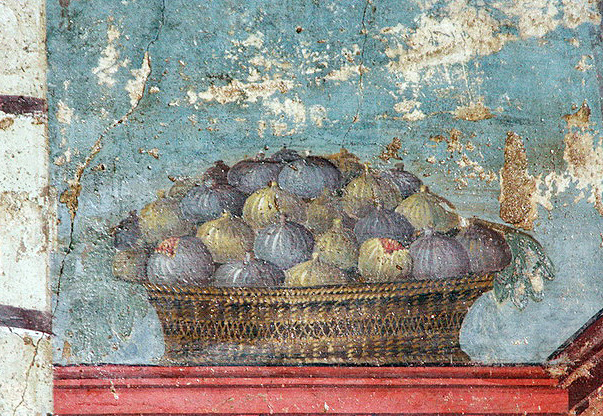
Figs in a basket, Fresco (Pompeii)

What’s a Slave’s Life Worth?

The Odyssey follows the slaughter of the suitors with the mutilation and murder of slaves: the torture of the goatherd Melanthios (Od. 22.474–477) and the hanging of twelve slave women (Od. 22.463–73). But it also considers the death of the older slave Eurykleia on multiple occasions. We first hear about her in book 1:

Homer, Odyssey 1.428-433

“And with him Eurykleia carried the burning torches.
She knew proper things, the daughter of Ops, the son of Peisênor
whom Laertes bought to be among his possessions
when she was just a girl and he paid a price worth 20 oxen.
And he used to honor her equal to his dear wife in his home
but he never had sex with her and he was avoiding his wife’s anger.”

τῷ δ’ ἄρ’ ἅμ’ αἰθομένας δαΐδας φέρε κεδνὰ ἰδυῖα
Εὐρύκλει’, ῏Ωπος θυγάτηρ Πεισηνορίδαο,
τήν ποτε Λαέρτης πρίατο κτεάτεσσιν ἑοῖσι,
πρωθήβην ἔτ’ ἐοῦσαν, ἐεικοσάβοια δ’ ἔδωκεν,
ἶσα δέ μιν κεδνῇ ἀλόχῳ τίεν ἐν μεγάροισιν,
εὐνῇ δ’ οὔ ποτ’ ἔμικτο, χόλον δ’ ἀλέεινε γυναικός·

So, it seems, Eurykleia’s life is ‘dear’—in the archaic English meaning of having a high price—since she was worth so many oxen and Laertes honored her equal to his wife without having sex with her. Despite so high a price—or perhaps because of it—her life is risked several times in the epic. The moment that has always stuck with me comes from the famous recognition of the scar scene. While this scene has garnered a lot of attention for the way the scar triggers a story and communicates Odysseus’ identity, there have been relatively few comments about the violence imminent in the scene.

Homer, Odyssey 19.466-490

“The old woman, as she took it in the flat part of her hands,
recognized the scar as she felt it, and she dropped the foot.
His shin fell onto the basin and the bronze clanged,
then it tilted to one side and water sloshed out onto the ground.
Joy and pain overtook her mind at once and
both of her eyes filled with tears as her strong voice got stuck inside.
She touched his beard and then addressed Odysseus.
“You really are Odysseus, dear child.
I did not recognize you before, before I examined my lord all over.”

And then she would have gotten Penelope’s attention too
with her eyes because she wanted to tell her
that her dear husband was here.
But she was not able to turn or to notice anything
because Athena had turned her mind elsewhere.
But Odysseus closed his hand on her throat with his right hand
and with his left hand he drew her close and said,

“Auntie, why do you want to ruin me?
You fed me yourself on your own breast.
Now after suffering many pains I have returned
in the twentieth year to my fatherland.
But since you have recognized me and a god put it in your mind
be silent lest anyone else in the home learn it.
For I will speak this out and it will be completed,
If the god subdues the haughty suitors under me
I will not leave you even though you were my nurse,
when I kill all the other slave women in my home.”

τὴν γρηῦς χείρεσσι καταπρηνέσσι λαβοῦσα
γνῶ ῥ’ ἐπιμασσαμένη, πόδα δὲ προέηκε φέρεσθαι·
ἐν δὲ λέβητι πέσε κνήμη, κανάχησε δὲ χαλκός,
ἂψ δ’ ἑτέρωσ’ ἐκλίθη· τὸ δ’ ἐπὶ χθονὸς ἐξέχυθ’ ὕδωρ.
τὴν δ’ ἅμα χάρμα καὶ ἄλγος ἕλε φρένα, τὼ δέ οἱ ὄσσε
δακρυόφιν πλῆσθεν, θαλερὴ δέ οἱ ἔσχετο φωνή.
ἁψαμένη δὲ γενείου ᾿Οδυσσῆα προσέειπεν·
“ἦ μάλ’ ᾿Οδυσσεύς ἐσσι, φίλον τέκος· οὐδέ σ’ ἐγώ γε
πρὶν ἔγνων, πρὶν πάντα ἄνακτ’ ἐμὸν ἀμφαφάασθαι.”
ἦ, καὶ Πηνελόπειαν ἐσέδρακεν ὀφθαλμοῖσι,
πεφραδέειν ἐθέλουσα φίλον πόσιν ἔνδον ἐόντα.
ἡ δ’ οὔτ’ ἀθρῆσαι δύνατ’ ἀντίη οὔτε νοῆσαι·
τῇ γὰρ ᾿Αθηναίη νόον ἔτραπεν. αὐτὰρ ᾿Οδυσσεὺς
χείρ’ ἐπιμασσάμενος φάρυγος λάβε δεξιτερῆφι,
τῇ δ’ ἑτέρῃ ἕθεν ἄσσον ἐρύσσατο φώνησέν τε·
“μαῖα, τίη μ’ ἐθέλεις ὀλέσαι; σὺ δέ μ’ ἔτρεφες αὐτὴ
τῷ σῷ ἐπὶ μαζῷ· νῦν δ’ ἄλγεα πολλὰ μογήσας
ἤλυθον εἰκοστῷ ἔτεϊ ἐς πατρίδα γαῖαν.
ἀλλ’ ἐπεὶ ἐφράσθης καί τοι θεὸς ἔμβαλε θυμῷ,
σίγα, μή τίς τ’ ἄλλος ἐνὶ μεγάροισι πύθηται.
ὧδε γὰρ ἐξερέω, καὶ μὴν τετελεσμένον ἔσται·
εἴ χ’ ὑπ’ ἐμοί γε θεὸς δαμάσῃ μνηστῆρας ἀγαυούς,
οὐδὲ τροφοῦ οὔσης σεῦ ἀφέξομαι, ὁππότ’ ἂν ἄλλας
δμῳὰς ἐν μεγάροισιν ἐμοῖς κτείνωμι γυναῖκας.”

This theme is internalized later when Eurykleia threatens her own life.When she tries to tell Penelope in book 23 that Odysseus is actually present, she offers to wager her life on the truth of the statement when Penelope doubts her.

Homer, Odyssey 23.75-79

“…I wanted to tell you myself
but he took me with his hands at my throat
and would not allow me to speak thanks to the cleverness of his mind.
So, follow me. But I will wager myself over this to you:
If I have deceived you, kill me with the most pitiful death”

….ἔθελον δὲ σοὶ αὐτῇ
εἰπέμεν· ἀλλά με κεῖνος ἑλὼν ἐπὶ μάστακα χερσὶν
οὐκ εἴα εἰπεῖν πολυκερδείῃσι νόοιο.
ἀλλ’ ἕπευ· αὐτὰρ ἐγὼν ἐμέθεν περιδώσομαι αὐτῆς,
αἴ κέν σ’ ἐξαπάφω, κτεῖναί μ’ οἰκτίστῳ ὀλέθρῳ.”

For me, Eurykleia’s willingness to wager her life is indication of an internalized oppression created by the experience of slavery. But the specific value of her initial price is interesting too. This probably complicates matters, but there is little in the Homeric poems set at a worth of 20 oxen. The price comes up again during the slaughter of the suitors. Eurymachus tries to offer Odysseus recompense and sets the price for each suitor at 20 oxen (in addition to payment for all the food and drink).

Homer, Odyssey 21.54–59

“But now, even though it is ordained by fate, spare your people.
And in exchange we will gather about the land as payment
As much as was drunk up and eaten in your halls,
And each man will bring a payment worth twenty oxen,
Which we will pay in bronze and gold, until your heart
Softens—before this, there is no blame for being angry.”

νῦν δ’ ὁ μὲν ἐν μοίρῃ πέφαται, σὺ δὲ φείδεο λαῶν
σῶν· ἀτὰρ ἄμμες ὄπισθεν ἀρεσσάμενοι κατὰ δῆμον,
ὅσσα τοι ἐκπέποται καὶ ἐδήδοται ἐν μεγάροισι,
τιμὴν ἀμφὶς ἄγοντες ἐεικοσάβοιον ἕκαστος,
χαλκόν τε χρυσόν τ’ ἀποδώσομεν, εἰς ὅ κε σὸν κῆρ
ἰανθῇ· πρὶν δ’ οὔ τι νεμεσσητὸν κεχολῶσθαι.”

Post-script: An average ox seems to cost around $3000.00 right now. So, in modern ox-dollars, Eurykleia was valued at $60,000. This seems a little off to me. According to Beef Magazine (which is a real thing) a good bull on average can run more like $7500, placing Eurykleia at $150,000. I do not print any of this to make light of the selling of human beings (because, when we leave the abstract, this is all really horrifying), but instead, rather, to give a really relative view of what her–and the suitors–economic value might be in today’s terms. The range is basically luxury car to cheap apartment. This is, alternatively, the price acceptable for a good slave, but not worth the life of an offending suitor. In both cases the economic equivalence for any human life is, to put it simply, dehumanizing.

Related image

Decolonizing a Myth Class

This post is an explanatory (and exploratory) framework for a website I have started for a course on Classical Mythology. This website is developing as the central ‘text’ of my Classical Mythology Course at Brandeis University. The website and the following discussion are intended as adaptive and evolving responses to teaching Greek myth. 


Since the events of the most recent SCS Annual Meeting and its subsequent coverage, I have been thinking a lot about the state of the discipline of Classical Studies and what I can do (as well as what I must do) based on the various roles I play within the field and the University. I have been listening carefully to what people like Joy Connolly, Yurie Hong, and Rebecca Futo Kennedy have to say about the measures we can institute now, in the medium term, and in the long term; I have also seriously contemplated what Classicists of color have to say about themselves and the field—learning a lot in particular from Dan-El Padilla Peralta, Nandini Pandey, Jackie Murray (through her deep and powerful interview with Scott Lepisto on Itinera), Mathura Umachandran, Yung In Chae, and my own student Helen Wong, whose critique of my department’s focus on “Western Civilization” has been eating away at me for months now.

Through conversations with some of these generous people as well as other friends and colleagues (including Suzanne Lye, Amy Pistone, Kelly Dugan, Tara Mulder, Caitlin Gillespie, Robyn LeBlanc, Hilary Lehmann, Curtis Dozier, Justin Arft), I have clarified for myself that my actions must be commensurate with the roles I play. But they also must be made with the help of and participation of others. (And this is why I am trying to name everyone I have spoken to and listened to about these issues: none of us will change our fields alone; none of us is in this alone.) Envisioning and creating a community is essential, especially when the odds can seem so long and the voices eager to dismiss the need for change so many.

For me, this means trying to align my values with my actions over several separate domains: my ‘scholarship’, my work as a midcareer reader and editor, my role as department chair and in university governance, my mentorship of students at the graduate and undergraduate level, and, finally, but not of least importance, my role as an instructor. While these roles naturally influence each other, the classroom is a place where I know I can take direct and immediate action.

I am going to be working with my department to alter our curriculum, and to change the language of our mission (to align with what we actually do), and to reconsider the way we train graduate students. And I will likely write some posts here and there to talk about these efforts. But, for now, let’s talk about Classical Mythology.


Diversity, Equity and Inclusion

I have had training at two institutions for what was called “Affirmative Action Advocacy” at one and “Diversity, Equity, and Inclusion” at the other. For the most part, my training has not been about creating inclusive classroom spaces or diversifying our disciplines; instead it has been about the workplace and hiring practices. At Brandeis University, I have learned a lot from training in our Office of Diversity, Equity and Inclusion over the past few years, and I think that the basic distinctions plotted by each category are useful both for understanding the manifold character of problems in our field and for adapting our classrooms.

Diversity is something most people can understand to an extent: it means creating and valuing a space that has people from different backgrounds, religions, language groups, genders, sexual orientations and identities, and abilities. But diversity alone can be no more sophisticated than collecting baseball cards if we do not recognize that because of structural and institutional prejudices (racism, sexism, ableism, and on…) the individuals who are representative of diversity do not start with the same knowledge, skills, or emotional stances towards education.

Equity means making the effort on institutional and individual bases to redress the unequal starting points (and this often gets some people riled up because equity is about achieving fair outcomes, but not about giving everyone the same thing). And Inclusion means modifying the space to accommodate the different abilities and perspectives of our community.

I have taken the trouble of spelling this out in part because there is much opportunity for confusion and in order to make my starting point clear. A good exercise before engaging in this activity is to take a self-test for implicit bias. I also think that Robin D’Angelo’s  “White Fragility” is an essential read. In addition, check out Amy Pistone’s round-up of a SCS workshop “Centering the Margins: Creating Inclusive Syllabi” (with Suzanne Lye, Yurie Hong, Robyn LeBlanc, and Rebecca Kennedy).


What is Decolonizing?

Decolonizing is a process with philosophical underpinnings in the middle 20th century which seeks to de-center the works of European colonial authorities, to recenter global voices which have been marginalized from our history and literature, and to re-frame the past by listening to the voices of those marginalized by their bodies and class. Decolonizing also means reading the work of scholars who have been traditionally marginalized from our fields and re-introducing non-canonical subjects as a historical corrective.

For literature courses and history courses, this process has been ongoing as curricula have change to be more inclusive and re-analyze the past from perspectives outside Europe and the United states. But this movement is not just about changing the content of our courses; it is also about the way we run our courses and treat the people who take them. Such a movement has, of course, been ongoing and has created its own series of backlashes from the staid and deceptive work of Harold Bloom to the more aggressive onslaught of Who Killed Homer.

The various disciplines of Classics have been slow to respond to this movement outside of various forms of reception studies because Classical Studies has been so thoroughly identified with Europe and, as Rebecca Kennedy has shown in a pretty convincing twitter thread, was intentionally weaponized as part of “Western Civilization” to justify and enforce colonialism, slavery and their associated horrors. As Cate Bonesho has recently argued, part of our disciplinary inheritance is denying connections with the Ancient Near East; and as the reactions to Martin Bernal’s Black Athena reveal, our field has mobilized to defend the centrality of European exceptionalism within the last generation.

So, the first question is: can you decolonize the classics? Can we decolonize a tool of colonialism? While the answer is complicated, I think we certainly can: courses that have focused on sexuality and gender, slavery, race and ethnicity, and non-canonical texts have sought to do this in their own way. But what about a myth course?


Decolonizing a Myth Class

There are, I think, two chief aspects of dealing with a Classical Mythology course. One has to do with the courses’ intention; the other has to do with its content. Some institutions and instructors may decide to go the way of Eva M. Thury’s and Margaret Devinney’s excellent Introduction to Mythology: Contemporary Approaches to Classical and World Myths (Oxford, 4th Edition). This book focuses on kinds of narratives across cultures (tricksters, heroes, creation stories) and does an admirable job of integrating major scholarly approaches with clear tellings of the myths involved.

The problem with this text is that it is a little expensive, the publisher puts out new editions with some frequency (changing page numbers, undermining the used book market), and the authors can’t sidestep the fact that the process of canonization in Europe has preserved sophisticated versions of the Greek and Roman narratives and, further, that our aesthetic and academic expectations have been shaped by the canon. I taught using this book for many years and found that the aesthetic inheritance of Greek and Roman materials causes students to ‘marginalize’ material from other traditions in their reception. (That said, I would recommend trying out this book to anyone who is starting a myth course from scratch)

Additional considerations when choosing how to teach a myth class include: the competence of the instructor and the curricular/educational intention behind the class. Let’s take up the second thing first. When I teach myth I always start with a discussion of why it is important to teach a myth course. I introduce what I see as the different methods (Edith Hamilton-style anthology vs. literature based deep context) and an overview of why we might even teach myth.

In the process of introducing the course, I explain that one longstanding reason for teaching myth is “cultural literacy”, namely that since so much of “western culture” is shaped or informed by Classical Myth, one needs to be conversant in it to ‘decode’ it. I trouble this notion from the moment I introduce it, emphasizing that (1) there is no single Classical Mythology (anthologies like Hamilton’s select and present narratives from different periods and social contexts erratically) and (2) “western” reception of that non-singular mythology is uneven and spectacularly strange. Artists and authors revel in the odd and obscure: any course of study set up to provide someone with cultural literacy would be a banal trudge through disconnected detail rendered for erudite allusion.

Yes, I tell my students, a Mythology course can function to educate us about elements used in the creation of the “Western Canon” and can thus be indispensable in mounting a critique of it. But I position my myth course as being about storytelling and the way that cultural discourse functions to shape the way we view the world and what we think our roles in it can be. In approaching myth this way, I start with a healthy dose of cognitive science and psychology on how stories shape the brain and our perception of the world; I also include information on the definition of discourse and ideology from perspectives informed by sociology, linguistics, anthropology, and post-modern theory. As such, I argue, myth should be taught with cultural contexts in mind and with an emphasis on the way stories are altered for specific needs and how they function to enforce and explore dominant ideologies.

Understanding how myth is part of how we see the world and how we are initiated into the act of understanding it, I tell my students, is part of developing a personal “user’s manual” for the human brain. Any deep well of traditional storytelling presented within the right framework can help us achieve this knowledge—any body of narrative from Mesoamerican, South Asian, African, East Asian to modern science fiction can contribute to the same ends. Cultural distance, indeed, helps us appreciate how storytelling shapes us. And instructor competence is critical in unpacking and reshaping the reception of myth.


Basic Principles of the Class

Much of what follows reflects what I do in many of my courses. But I have benefited a lot from talking with Kelly P. Dugan who was kind enough to share her syllabus for a myth course with me.

Transparency

One principle central to my ‘decolonizing’ of a myth course is transparency about what our goals are in the course and what my basic principles are in teaching it. While I do believe deeply that other storytelling traditions could do the same work, I cannot fully decolonize my myth course (that is, integrate other storytelling traditions into it) because of my own competences and because of the particular advantage myths from Greece and Rome present: anyone who speaks a European language or is engaged with the popular culture wielded as its own form of discourse by these language groups comes with a familiarity in the basic narrative patterns, assumptions, and aesthetics which are embedded in them. Introducing greater justice and equity in our culture means tackling these forces and assumptions head-on. From the foundational narrative of the triumph of patriarchy to the adoption of “the hero’s journey” as a dominant narrative paradigm, the traditions of Greek storytelling continue to have powerful (and often harmful) effects on our world.

On one test of decolonizing the curriculum, then, my approach is an abject failure: but this is, I think, a fate and a challenge all Classical Studies curricula must face head on: our subjects are products and producers of a racist paradigm. We can, I believe, start the hard work of transforming this paradigm on multiple fronts. Within the framework of a course on myth, I think this means we need to focus on the stories and how they functioned within their cultural contexts and also how they are ‘re-purposed’ as ideological tools in different contexts.

Rather than replicate some of the problems of an anthologized myth course which elides cultural differences, I teach an almost entirely ‘Archaic Greek’ myth course which traces the ‘teleologically’ minded cosmic history generalized through Panhellenism in the 6th and 5th Centuries BCE. I pay particular attention to providing studies with multiforms or allomorphs (terms I privilege over ‘variant’, which reifies the idea that there is a ‘master’ narrative from which other traditions diverge) and also to contextualizing these multiforms within particular places, periods, and expectations. I also heavily emphasize that the process of Panhellenization is one of ideological force, defining ‘Greekness’ by exclusion primarily through the creation of a unified other. In addition, I take every opportunity to reiterate the pluralism of “Greekness” (different dialects, peoples, polities, values) and the multicultural origins of much of what we have received as Greek.

The primary content of my course, then, is not particularly remarkable—I use Hesiod, the Homeric Hymns, and the Homeric epics with supplementary material drawn from Apollodorus, Ovid, Greek poets, and fragments I have translated on my own. I have begun the secondary step of decolonizing by providing students not just with the multiform traditions from ancient Greece but also to modern critical responses from diverse scholars (where possible).


Affordability and Accessibility

The biggest step I have recently taken is the creation of a website which uses only free sources for the core readings in the course. Rather than expect students to purchase a large selection of books, I have found appropriate alternatives online and have supplemented with my own translations where necessary (most of them from this website). I have created this space as an evolving and open course for others to use if they see fit and for even those outside of the academy to use as a starting point for researching Greek myth. Each class day has a brief summary, a list of authors who are discussed in the course that day, links to the open source translations, links to blog posts with additional information, and links to articles. There is a page for resources for researching Greek myth; there is also room for adding material by and for students. I am still working on ways to include my powerpoint slides on the website; for now, all slides are available on the University LMS for students. Since the LMS is clunky and not available outside the Brandeis community it is important to me that course material be made fully public.


Responsiveness

Developing new materials and responses to myth over time requires a level of knowledge I could not hope to attain on my own. Students have a large range of knowledge and experiences and bring a lot to the course. I encourage students to share links and material with me and I will integrate their work (when they do it and if they wish it) into the course over time. Sometimes this means I have to have difficult conversations in class about why Sparta is less than cool or why Jordan Peterson is a dangerous ideologue, but these are important moments in helping students develop a more sophisticated understanding of how to handle material from the ancient world. Even though I spend a the bulk of the course on Early Greek material, I use the last few weeks of the course to highlight how ‘Greek’ material is adapted to new contexts (and how different ‘Roman’ material is) and how storytelling functions as myth in modern genres like fantasy, horror, and science fiction.


Course policies

An essential pedagogical understanding is that students bring different experiences, learning modalities, and skills to the course. Some will have a strong grasp of the concept of discourse; others will know myriad details of myth which escape me (as happens every semester). I believe that a course must be created in such a way as to allow all students to succeed in attaining its stated goals. Many students are new to college and need to work or have other reasons for not being able to attend all classes: all students can make up any class or missed quiz by completing extra credit.

Because students have different responses to exams and come with different preparation for studying, I have an adaptive grading process. This means that all exams can be made up to full credit (in addition students can earn ‘extra’ credit at any time in the course by writing responses to supplementary material posted on line). This also means providing students with plenty of extra time for exams and assignments and honoring all accommodation needs without creating obstacles. Finally, the course’s activities need to be aligned with its goals: the course starts out lecture heavy to help create a common ground, but I increasingly move toward discussion and workshops. The final assessments are student-designed projects that allow them to work and rework ancient narrative structures. (In earlier versions of the course I have had some success in bringing storytellers to class and having students retell myths in their own words.)


Some Future Plans

I teach this course every other year. In addition to updating course materials and continually adding in the work of underrepresented authors and linking to comparative myths in other traditions (a particular weakness of the current format), I need to improve the accessibility of the course. I will eventually create audio versions of each class; but I also need to work with my campus accessibility services to make sure that the powerpoints and website material can work for students of varied abilities. One of the reasons I chose to use wordpress instead of my campus LMS for the material beyond opening up the course to the world at large is that the wordpress site populates to mobile devices fairly well.

In general, however, I hope to benefit from students and researchers who care enough about myth to add to the material on the website. I look forward to any comments and additions and will integrate them as I can. Please email me (joel@brandeis.edu) if you would like to be able to add supplementary material directly or if you have any advice for uploaded the powerpoint slides to the website. I am also profoundly unvisual and have an (unjustifiable) antipathy towards video. I would be particularly grateful, then, for links to appropriate, useful, humorous or otherwise significant video clips. Finally, I would like to integrate more material about reception, but this is another one of my weaknesses.

Farnese Sarcophagus from Isabella Stewart Gardener Museum

Bellum Incivile: Manicula’s Associate Procures Pictures of Private Parts

Another text tentatively attributed to Caesar was discovered along with the fragments of the De Silvis and an appendix to De Bello Gallico. This is almost surely from the lost Bellum Incivile.

C. Julius Caesar (?), Bellum Incivile. Edited by Dani Bostick

6.3 Whenever Manicula found himself in the midst of scandal, money was often paid by his associate D. Pecker to buy off accusations. For even prior to his nefarious consulship, Manicula had associated with people of such a kind and conducted his business in such a way that many reports of his offences and delinquency became widespread. For this reason, D. Pecker made many payments to conceal Manicula’s misdeeds. It is said that evidence of them is kept under lock and key.

6.3 Cum contumelia in Maniculam iaceretur, pecunia ne accusaretur saepe a comite D. Vellicatore data est. Nam etiam ante nefarium consulatum cum talibus hominibus vixerat negotiaque ita transegerat Manicula ut multae famae de eius delictis ac peccatis dispergerentur. Qua de causa D. Vellicator multam pecuniam qua scelera eius celarentur pendebat. Quorum testimonia scripta ac alia indicia sub clavi servari dicitur.

6.8 After D. Pecker obtained images of the intimate regions of a wealthy man named J. Bezos, who made his fortune doing business in the cloud, he threatened to publish them in order to silence Bezos who had discovered information unfavorable to Pecker’s company.  It ended up, however, that D. Pecker’s plan seemed more shameful than the images themselves.

6.8 Imagines verendorum locupletis J. Bezi, qui negotiando in caelo maximam pecuniam lucrifecit, adeptus, D. Vellicator minabatur se imagines verandorum volgo elaturum apertissimeque ostenturum ut J. Bezum certiorem de suae societatis probris factum comprimeret. Effecit tamen ut consilium D. Vellicatoris foedius imaginibus ipsis videretur.

slave


Non-Elite Latin for the Classroom

The following is a thoroughly masterful and fascinating introduction to using non-elite Latin in teaching by Brandon Conley.

Introduction

This is a brief introduction to non-elite Latin texts, intended for use in the classroom as a supplement to the more traditional Latin readings. For the majority of the following texts, knowledge of Latin equivalent to the first two to three semesters at the college level is advised, though several are suitable for first-year courses.

Firstly, what is non-elite Latin? Generally speaking, non-elite Latin comprises the texts produced outside of Rome’s powerful, exclusive literary circles, the arbiters of linguistic prestige—the ‘literati,’ so to speak. Other terms are often used to describe these texts, such as non-literary or non-standard. These definitions often, but not always, apply, and regularly more than one can be used to describe the same text. For example, we wouldn’t use ‘non-standard’ to describe an epitaph written for a freedwoman in Dacia that adheres to the linguistic standards of classical Latin (its adherence makes it, in fact, standard), but we could describe it as both non-elite and non-literary. The texts here can be standard or not (though most contain non-standard forms), as well as literary or not (though most aren’t). But they are all non-elite by virtue of the statuses, locations, and linguistic conventions of their authors.

nelatin

Reading non-elite texts, with few exceptions, presents a set of challenges different from those of classical Latin. Linguistic features are more prone to diachronic and geographic change than the comparatively change-resistant classical standards. Spellings can be phonetic, colloquial, learned conventions, or intentionally archaic for effect. Morphology and syntax often differ widely as well, as in the increased usage of the indicative or the expanded role of the accusative (at the expense of the ablative, regularly). Vocabulary can be geographically specific, and differences in semantic value between non-elite and classical Latin are not uncommon.

Some of these features are discussed below to aid in reading. Efforts were made to add punctuation, etc., for ease of reading and approachability to students. Spellings are often left in their non-standard forms, though to aid in reading, many words are edited using brackets or parentheses; for particularly problematic spellings, a classical form of the word is added in parentheses. Texts (and translations, where available) are taken from the sources linked, with modifications (unless otherwise noted).

Exercises in non-elite Latin are often exercises in editing, critical reading, and emendation, as many of the texts are damaged or difficult to interpret. Reading these texts presents a practical opportunity to discuss textual editing as a scholarly process.

Lastly, accessibility is paramount. Students, instructors, and independent scholars often lack access to the databases and publications in which many non-elite texts are presented. All of the texts presented below are freely available online. At the end of this document, however, the recommended reading list contains mostly sources that are not open access.

Feel free to add, remove, edit, scream at, or pour coffee on the text—though should you choose to pour the coffee, print it first.

Spelling

Motives for the spellings can be any number of things, from a widespread phonetic change to a local scribe’s misspelling. Often, unsurprisingly and necessarily, there is considerable debate on the causes of the spellings. Likewise, we must resist, often with great difficulty, tendencies to generalize non-standard spellings as broader linguistic features without the presence of more evidence.

These are some of the most common differences in spelling between non-elite and classical Latin.

Word-initial and Intervocalic Aspirate, h-, /h/ (habeo, hic, mihi, ): The initial and intervocalic aspirate /h/ had disappeared from most speech varieties by the imperial period, and from all eventually (with the exception of a select few prescriptive grammarians, perhaps). Hence, it is often omitted in non-elite texts, with resulting forms such as abes, mi, and ic.

Word-final -m, /m/ (dicam, amicum, etc.): -m was not pronounced (as /m/, at least) at the end of a word in spoken Latin, even before the time of Cicero; consider, for example, the impact this had in classical poetry in the process of elision. It is omitted from spelling with great frequency in non-elite texts, and can often cause confusion for first-time readers.

The v/b Shift, /w/ à /β/ (cf. the v in Spanish): this is a simplification of the process, but essentially the glide /w/ of classical pronunciation became increasingly pronounced as a bilabial fricative. This change is represented in non-standard spellings by the replacement of Latin v for b (e.g. dibi, classical divi, “gods”), as writers considered b to more closely represent the sound.

xs for x (dixsit,): there are potentially a few, if separate, factors that motivated this spelling. In short, an s was added after x due to the differing phonetic qualities of x as it was written (by itself, not representing /ks/). This is a common spelling feature, but generally not a problematic one for reading.

Assimilation and Weakening: a widespread trend in non-elite spellings is the simplification of consonant clusters, often through assimilation (i.e. one sound in the cluster ‘absorbs’ another sound) or weakening leading to loss. These can result in either a different letter being used to represent the altered sound (imveni, inveni) or the complete loss of a consonant (nuc, cf. nunc; meses, cf. menses). A notable loss, in cosul, is even reflected in standardized inscriptions in the abbr. cos. Loss is also quite common with consonants preceding the semivowel /j/, i (aiuto, cf. adiuto, “I help”).

Doubling of letters and reduction of doubled letters (faccio, facio; anis, cf. annis): multiple operations are at work, including the strengthening, weakening, and shortening of consonants, gemination and degemination, as well as the general tendency to eliminate letters that are not reflected in speech. Though not all spellings of these types can be ascribed to changes in pronunciation. For reading purposes, the doubling of letters (e.g. faccio) is usually not problematic. The absence of doubled letters can be problematic, though, as the non-standard forms frequently resemble other words with standard spellings (e.g. annis, dat/abl pl. ‘years,’ but anis, dat/abl pl. ‘rings’; or suum ‘own’, but sum ‘I am’).

Deletion: Vowels and consonants are regularly deleted in medial positions. Unstressed vowels are most commonly deleted (aspros, cf. asperos; copla, cf. copula), reducing the number of syllables in a word. This trend is not entirely unusual even in literary Latin.

Often duplicate vowels are reduced to one letter (serus, seruus; tus, cf. tuus).

Voiced and Devoiced Consonant Switching: switching in both directions is common, and the motives vary. The use of t for d and vice versa are perhaps the most common in the texts below (ed, set, at, ). Sometimes they are even used interchangeably in the same document. There is considerable doubt that these spellings reflected wider speech patterns.

Other Orthographic Consonant Substitutions: k is regularly used for c (karissimo), as is, to a lesser extent, q before u (mequm, quravit). These generally do not pose problems for readers.

e/i Representation: the writing of e for i and vice versa is one of the most commonly found spelling deviations from classical standards. Spellings of this type sometimes, though not always, reflect a widespread phonetic change in Latin speech well into the imperial period, whereby the vowels long e /e:/ and short i /i/ merged into a single vowel, /ẹ/. Both letters were used with little consistency to represent this phoneme. Another motive was the tendency for /e/ and /i/ to become a semivowel /j/ after a consonant (vinia as two syllables, rather than vinea). Occasionally, e was even used to represent ī /i:/. Some examples: sene, nese, dicet, ube, ibe, and signabet.

u/o Representation: another very common set of vowel substitutions, o is frequently used in place of u. The majority of instances occur in final syllables of the nominative and accusative singular; -us and -um become -os and -om, respectively. While another widespread vowel merger (similar to e/i) occurred very late in the imperial period, whereby ō /o:/ and u /u/ merged to a closed o /ọ/, the great majority of non-elite texts from the Roman Empire likely do not reflect this process. The use of o for u is far more likely to be an orthographic remnant (a ‘relic’, perhaps) of the old Latin spelling, which reflects the original o-stem. As mentioned above, there is also a strong stylistic tendency against writing the consecutive vowels uu, and o often replaces the second one. Examples: servos, mortuos, novom, salvom.

ei for i (tibei, ubei, etc.): the use of the vowels ei for classical i occurs regularly, and is an archaism of spelling, either for style or by learned inheritance, rather than an indication of pronunciation. It is a remnant of a popular spelling in old Latin which did reflect speech; the original diphthong /ei/ underwent a change to /i:/.

Monophthongization: ae /ae/ à e /ɛ/: other diphthongs disappear as well, but ae to e is present most frequently in the texts. Examples: que, quae; Cecilius, cf. Caecilius; and equum, cf. aequum. These can be problematic, as evidenced by the final example equum (potentially confused for the classical ‘horse’).

Morphology and Syntax

While there are numerous morphological and syntactic differences from classical Latin, they rarely impede reading to the extent of spelling differences. For example, a Latin student might recognize that the ‘incorrect’ verb tense is used in a conditional, but meaning can still be deduced. As such, only a few points will be mentioned here; see the recommended readings for further discussion.

Accusatives with Prepositions: there is plenty of evidence to support the convincing notion that the accusative became the default case for prepositional phrases. Most notably, cum, de, pro and in regularly take accusatives (even in instances in which the classical ‘ablative of place where’ would be expected). The situation is further complicated by the status of word-final -m, which made the ablative and accusative cases sound identical in speech in some instances, and the omission of which in writing can make a word appear ablative, though a writer originally had in mind an accusative. Advice for readers is to expect accusatives with prepositions which would otherwise be unexpected in classical Latin.

Analogy and Paradigm Leveling: analogy was a productive process in Latin, and in non-elite texts it occurs often in verbal and nominal morphology. Forth declension nouns in classical Latin sometimes use the more regular endings of the second declension in non-elite texts (an ongoing process that eventually saw the near-complete elimination of the fourth declension). Verbal constructions are leveled as well, for example in posso (“I can”) being given a common -o 1st singular ending in place of the standard possum.

Indicative or Infinitive: in instances where classical Latin would employ a subjunctive, such as in an indirect question, it is not uncommon in non-elite texts to see an indicative or an infinitival construction.

The conjunctions et and sed: a number of texts rely heavily on these conjunctions, including them where syntactically unnecessary or where other conjunctions would be more appropriate for clarity. One must not always take these literally or strictly when reading.

Vocabulary

Reading any different author or genre of Latin usually requires familiarization with new vocabulary, and non-elite texts are no exception. Cicero’s surviving works, for example, do not contain inventories of materials or equipment, and in the texts that do contain these, some words will be new to readers. In some instances, however, things are more complicated. Loanwords or local words with limited attestation are common, and their meanings are uncertain; the ostraka found at Bu Njem, for example, contain several Punic words. The texts below were chosen with these considerations in mind, though it will perhaps be necessary to look up some military terms, for example.

Keep reading for some phenomenal texts….

Continue reading “Non-Elite Latin for the Classroom”