Revising The Future of the Past

Livy, Ab Urbe Condita 4.25

“An epidemic in that year provided a break from other problems.”

Pestilentia eo anno aliarum rerum otium praebuit.

Today Nandini Pandey has a smart piece out in Eidolon (“Classics After Coronavirus“) where she asks a group of people who see different perspectives of Classical Studies to think about what impact COVID-19 will have on the future of these disciplines. (And it is smart not because she asked me to write something for it, but because she got a group of really smart other people to write thoughtfully in the midst of a crises: check out the article for good prognostications by Joy Connolly, Sarah Bond, Amy Pistone, Del A. Maticic, Scott Lepisto, Michelle Bayouth, Mira Seo and Shelley P. Halley”).

It’s no secret around my house that I think about these things a lot. Really, I am one or two turns in life away from being straight-up prepper. And I may be breaking a little alarmist here, but I worry that COVID-19 is merely a dress-rehearsal for the ravages of climate change, which may well include new pandemics in additional to destabilized weather. Even more frightening, old pandemics and viruses could find new life our changing environment.

At least, this is what science fiction says: archaeologists in Connie Willis’ Doomsday Book resurrect the boubonic plague while plying their craft. It’s not all bad: Greg Bear’s Darwin’s Radio presents an ancient retrovirus that hastens the next stage in human evolution. But, really, apart from that, it gets pretty bad: the worst usually comes when man conspires with nature as in the famous apocalypse of Stephen King’s The Stand or the vampire trilogy by Justin Cronin (The Passage, The Twelve, and The City of Mirrors) which centers, gulp, around academics playing with life and death in places like Cambridge, MA and New York City.

My point is not that we should keep hoarding toilet paper and hand sanitizer, but that I think my comments in the Eidolon piece do not go nearly far enough because, as I think Scott Lepisto is starting to say, we need radical change fast and we’re not talking about Classics. If there is a silver lining in this shitberg our current leadership is piloting straight towards, it is that we might just get hurt enough to change our ways, to avoid the worst of what could come.

Or, well, that’s what I say so I can sleep tonight. At the end of it, the fact is that we are more likely to see a civilization shifting cataclysm now than five years ago. And we should be thinking about what that means for the way we talk about the past.

So here’s a re-post from last year.

*     *     *     *

In the final book of Liu Cixin’s Remembrance of Earth’s Past trilogy, Death’s End, when faced with an unstoppable extinction-level event, Cheng Xin and Ai AA go to the distant edge of the solar system to try to preserve some artifacts of human existence from the encroachment of two-dimensional space. When they reach the isolated moon bunker where many of the objects are stored, they come upon miles of inscriptions in the surface rock. Previous plans to preserve human knowledge had included etching human history and knowledge into the stone. Teams of scientists and data specialists could devise no method which ensured as long a future as the multilingual inscriptions in space.

Any system of encoding and preserving knowledge—whether we are talking of raw, binary data or language—relies upon two challenges for legibility in the future. The first is a ‘key’—some type of instruction that might indicate to readers unfamiliar with language or code how to make meaning out of signs. The second challenge is medium—how do the materials which encode the information respond to the passage of time and elements.

Encrypted digital data in every form faces the danger of significant loss under even the best of conditions; changing software and computational paradigms can make accessing extant data even more difficult. The decryption of preserved digital data relies on the end-user being able to access functional hardware and manipulate the same original data protocol. Despite the ability to extend human life centuries through hibernation and the technology to create space ships which traveled at the speed of light, the humans of Cixin’s universe can find no better way to preserve the past than cold, alien stone.

The survival of the past into the future is something of a motif in science fiction, thanks to its longue durée perspective. Just in the past year, I have read of the ‘classicist’ in Adrian Tchaikovksy’s Children of Time series, a figure whose knowledge of the past and ability to use ancient programs makes him central to the survival of the human race. In many cases, such as the works of Isaac Asimov, the Earth we know and the past we cherish is entirely forgotten or mostly unsalvageable. But for every novel that imagines the preservation of knowledge over time—like Neal Stephenson’s Anathem—we have the more stark reality to deal with of strange re-uses of our reconstructed past as in Ada Palmer’s Terra Incognota series or generations of lost knowledge over time, as in Walter Miller Jr.’s classic, A Canticle for Leibowitz.

“The prophecy which was given to the Thessalians was ordering them to consider “the hearing of a deaf man; the sight of the blind.”

ὁ μὲν γὰρ Θετταλοῖς περὶ Ἄρνης δοθεὶς χρησμὸς ἐκέλευε φράζειν: “κωφοῦ τ᾿ ἀκοὴν τυφλοῖό τε δέρξιν”  Plutarch, Obsolesence Of Oracles (Moralia 432)

A widely linked recent article alleges that the human race has around 30 years left, that by 2050 climate change will create a systems collapse that will end human civilization as we currently know it. Similar reports diverge at whether the extinction event that is the Anthropocene will also eradicate the human species or just result in a cruel, apocalyptic contraction. Even if we find the political will to radically change our behavior over the next few years, we are looking at the almost certain probability of widespread government collapses, severe famine and death in the ‘global south’, and widespread conflicts over resources.

Continue reading “Revising The Future of the Past”

Gender, Smell and Lemnos: More Misogyny from Greek Myth

A proverb from the Suda

“By a Lemnian Hand: [meaning] cruelly and lawlessly. This is from a story: for they say that the women in Lemnos allegedly killed their husbands because they weren’t having sex with them”

Λημνίᾳ χειρί: ὠμῇ καὶ παρανόμῳ. ἀπὸ τῆς ἱστορίας· φασὶ γὰρ τὰς ἐν Λήμνῳ γυναῖκας τοὺς ἄνδρας αὐτῶν ἀνελεῖν αἰτιωμένας, ὅτι αὐταῖς οὐκ ἐμίγνυντο.

A few years ago I was looking up some odd word or another in the work of the lexicographer Hesychius (ok, to be honest, I was looking up words for feces and was looking at κοκκιλόνδις· παιδὸς ἀφόδευμα; kokkilondis: “a child’s excrement”). I found the following words which are pretty much absent from all modern lexica.

Kikkasos: the sweat flowing from between the thighs

κίκκασος· ὁ ἐκ τῶν παραμηρίων ἱδρὼς ῥέων.

Kikkê: Sex. Or the bad smell [that comes] from genitals

κίκκη· συνουσία. ἡ ἀπὸ τῶν αἰδοίων δυσοσμία

Obviously, the specificity of these two lexical items is amusing. But their very existence perplexed me a bit. Where did they come from? How were they used? (They don’t actually appear anywhere but in Hesychius.) After some contemplation and a little restraint, I can only conclude that the words emerge from a generally misogynistic context which also considered sex in some way unclean.

The story that I kept thinking of was that of the Lemnian women—it is one of the few connections I could make between sex and bad smells. It is also one of my least favorite myths because it echoes modern misogynistic taboos which marginalize and alienate female bodies. So, I almost didn’t write this post. But I do think that it is worth making these connections, however uncomfortable they are.

Here are two versions of the Lemnian women tale.

Apollodorus, 1.114

“Jason was the captain of the ship as they disembarked and neared Lemnos. The island then happened to be bereft of men and was ruled by Hypsipyle, Thoas’ daughter, for the following reason. The Lemnian women used not to honor Aphrodite. She cast a terrible smell upon them and, for this reason, their husbands acquired spear-won women from Thrace and slept with them.

Because they were dishonored, the Lemnian women slaughtered their fathers and husbands. Hypsipyle alone spared her father Thoas by hiding him. After they landed on the women-controlled island, they slept with the women. Hypsipyle gave birth to sons after sleeping with Jason: Eunêos and Nebrophonos.”

οὗτοι ναυαρχοῦντος ᾿Ιάσονος ἀναχθέντες προσίσχουσι Λήμνῳ. ἔτυχε δὲ ἡ Λῆμνος ἀνδρῶν τότε οὖσα ἔρημος, βασιλευομένη δὲ ὑπὸ ῾Υψιπύλης τῆς Θόαντος
δι’ αἰτίαν τήνδε. αἱ Λήμνιαι τὴν ᾿Αφροδίτην οὐκ ἐτίμων· ἡ δὲ αὐταῖς ἐμβάλλει δυσοσμίαν, καὶ διὰ τοῦτο οἱ γήμαντες αὐτὰς ἐκ τῆς πλησίον Θρᾴκης λαβόντες
αἰχμαλωτίδας συνευνάζοντο αὐταῖς. ἀτιμαζόμεναι δὲ αἱ Λήμνιαι τούς τε πατέρας καὶ τοὺς ἄνδρας φονεύουσι· μόνη δὲ ἔσωσεν ῾Υψιπύλη τὸν ἑαυτῆς πατέρα κρύψασα
Θόαντα. προσσχόντες οὖν τότε γυναικοκρατουμένῃ τῇ Λήμνῳ μίσγονται ταῖς γυναιξίν. ῾Υψιπύλη δὲ ᾿Ιάσονι συνευνάζεται, καὶ γεννᾷ παῖδας Εὔνηον καὶ Νεβρο-φόνον.

Image result for Jason argonauts greek vase

Schol ad. Pind. P4 88b

“The story goes like this: Because the Lemnian women had carried out the honors for Aphrodite improperly, the goddess inflicted a bad smell upon them: for this reason, men turned them away. They all worked together and killed their husbands in a plot. Then the Argonauts, as they were travelling to Skythia, arrived in in Lemnos; when they found that the island was bereft of men, they slept with the women and then left. The sons who were born from them went to Sparta in search of their fathers and, once they were accepted among the Lakonians, they became citizens there and settled in Sparta.

ἱστορία τοιαύτη· ταῖς Λημνίαις γυναιξὶν ἀσεβῶς διακειμέναις περὶ τὰς τῆς ᾿Αφροδίτης τιμὰς ἡ θεὸς δυσοσμίαν προσέπεμψε, καὶ οὕτως αὐτὰς οἱ ἄνδρες ἀπεστράφησαν· αἱ δὲ συνθέμεναι πρὸς ἑαυτὰς ἐξ ἐπιβουλῆς τοὺς ἄνδρας ἀνεῖλον. τηνικαῦτα δὲ οἱ ᾿Αργοναῦται τὸν εἰς Σκυθίαν στελλόμενοι πλοῦν προσωρμίσθησαν τῇ Λήμνῳ, καὶ εὑρόντες ἔρημον ἀρσένων τὴν νῆσον συνελθόντες ταῖς γυναιξὶν ἀπηλλάγησαν. οἱ δὲ φύντες ἐξ αὐτῶν ἦλθον εἰς Λακεδαίμονα κατὰ ζήτησιν τῶν πατέρων, καὶ προσδεχθέντες παρὰ Λάκωσι καὶ πολιτευσάμενοι συνέθεντο ἐπιθέσθαι τῇ Σπάρτῃ…

This tale seems to combine with a larger treatment of Lemnos as clear from the proverb above and this one:

A proverb from Zenobius (4.91)

“A Lemnian evil”: A proverb which they say comes from the lawless acts committed against husbands by the women of Lemnos. Or it derives from the story of the women who were abducted from Attica by the Pelasgians and settled in Lemnos. Once they gave birth, they taught their sons the ways and the language of the Athenians. They honored each other and ruled over those who descended from Thracians. Then the Pelasgians, because they were angry over this, killed them and their mothers. Or the proverb derives from the bad smell of the Lemnian women.”

Λήμνιον κακόν: παροιμία, ἣν διαδοθῆναι φασὶν ἀπὸ τῶν παρανομηθέντων εἰς τοὺς ἄνδρας ἐν Λήμνῳ ὑπὸ τῶν γυναικῶν. ῍Η διὰ τὸ τὰς ἁρπαγείσας ὑπὸ Πελασγῶν ἐκ τῆς ᾿Αττικῆς γυναῖκας εἰς Λῆμνον ἀπαχθῆναι· ἃς ἀποτεκούσας τρόπους τε τῶν ᾿Αθηναίων διδάξαι τοὺς παῖδας καὶ γλῶτταν· τούτους δὲ τιμωρεῖν ἀλλήλοις καὶ τῶν ἐκ τῶν Θρᾳσσῶν γεγενημένων ἐπικρατεῖν· τοὺς δὲ Πελασγοὺς ἐπὶ τούτῳ ἀχθομένους κτεῖναι αὐτοὺς καὶ τὰς μητέρας αὐτῶν. ῍Η διὰ τὴν δυσωδίαν τῶν Λημνιάδων γυναικῶν τὴν παροιμίαν διαδοθῆναι.

The story of the Lemnian crimes (Lêmnia Erga) is told by Herodotus (6.137-138): the Pelasgians were driven out of Attic and took Lemnos; then they got their revenge by abducting Athenian women during a festival. When the sons of these women grew up, they frightened the native Pelasgians and they were all killed.

In the major tales, it is clear that the women are not completely at fault, but they are the ones who seem to suffer the most. Within the broader narrative of the Argonaut tale, especially, we can see how women are defined by their bodies as loci of sexual interest or disinterest, the ability to produce children, and anxiety that they might not remain subordinate to male desire. The casual detail of the Pelasgian tale is especially harrowing.

A List of Women Authors from Ancient Greece and Rome for International Women’s Day

In our now annual tradition, we are re-posting this list with more names and updated links. Most of the evidence for these authors has been collected only in Wikipedia. I have added new translations over the past year and a new group of philosophers to the list this year. Always happy to have new names and links suggested.

I originally received a link to the core list in an email from my undergraduate poetry teacher, the amazing poet and translator Olga Broumas. The post is on tumblr on a page by DiasporaChic, bit the original author is Terpsikeraunos.

*denotes comments I have added with this re-post

** denotes names I have added

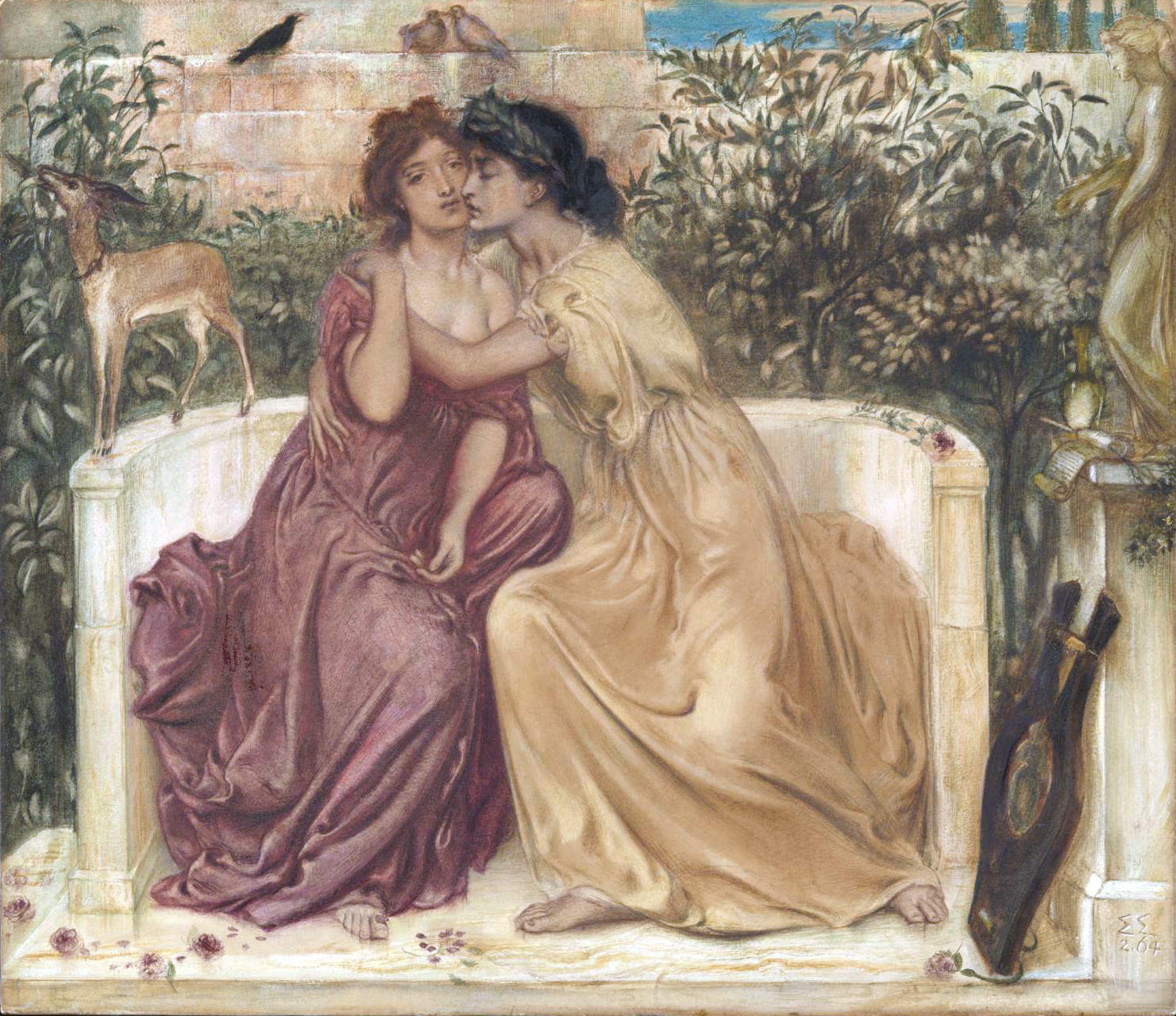
Sappho and Erinna in a Garden at Mytilene by Simeon Solomon
Women in ancient Greece and Rome with surviving works or fragments


PHILOSOPHY

Here is a list of Women philosophers with testimonia and fragments (with French translations and commentary).

Aesara of Lucania: “Only a fragment survives of Aesara of Lucania’s Book on Human Nature, but it provides a key to understanding the philosophies of Phintys, Perictione, and Theano II as well. Aesara presents a familiar and intuitive natural law theory. She says that through the activity of introspection into our own nature – specifically the nature of a human soul – we can discover not only the natural philosophic foundation for all of human law, but we can also discern the technical structure of morality, positive law, and, it may be inferred, the laws of moral psychology and of physical medicine. Aesara’s natural law theory concerns laws governing three applications of moral law: individual or private morality, laws governing the moral basis of the institution of the family, and, laws governing the moral foundations of social institutions. By analyzing the nature of the soul, Aesara says, we will understand the nature of law and of justice at the individual, familial, and social levels.” – A History of Women Philosophers: Volume I: Ancient Women Philosophers, 600 B.C.-500 A.D., by M.E. Waith

*Wikipedia on Aesara

A translation of her work

**Aspasia of Miletus: wikipedia entry

**Axiothea of Phlius: wikipedia entry

**Bistala

**Damo: daughter of Pythagoras and Theano. wikipedia entry

**Deino of Croton: A student of Pythagoras.

A translation of Diogenes Laertius’ account.

**Diotima: wikipedia entry

**Eurydice: cf. Plutarch Conj. praec. 145a and e

**Hipparchia of Maronea: wikipedia entry

A translation of Diogenes Laertius’ account

**Klea: Cf.  Plut. Mul. virt. 242 ef

**Lasthenia of Mantinea: wikipedia entry

**Leontion: an Epicurean philosopher

Melissa: “Melissa (3rd century BC)[1][2] was a Pythagorean philosopher…Nothing is known about her life. She is known only from a letter written to another woman named Cleareta (or Clearete). The letter is written in a Doric Greek dialect dated to around the 3rd century BC.[2] The letter discusses the need for a wife to be modest and virtuous, and stresses that she should obey her husband.[2] The content has led to the suggestion that it was written pseudonymously by a man.[2] On the other hand, the author of the letter does not suggest that a woman is naturally inferior or weak, or that she needs a man’s rule to be virtuous.[1]” –Wikipedia

**Myia of Samos: wikipedia article

Perictione (I and II): “Two works attributed to Perictione have survived in fragments: On the Harmony of Women and On Wisdom. Differences in language suggest that they were written by two different people. Allen and Waithe identify them as Perictione I and Perictione II. Plato’s mother was named Perictione, and Waithe argues that she should be identified as the earlier Perictione, suggesting that similarities between Plato’s Republic and On the Harmony of Women may not be the result of Perictione reading Plato, but the opposite–the son learning philosophy from his mother. On the Harmony of Women, however, is written in Ionic prose with occasional Doric forms. This mixed dialect dates the work to the late fourth or third centuries BC. The reference in On the Harmony of Women to women ruling suggests the Hellenistic monarchies of the third century BC or later. On Wisdom is written in Doric and is partly identical with a work by Archytas of the same name. This work should be dated later, to the third or second centuries BC. Both the dates of the works and their dialects mean Perictione as the mother of Plato could not have written them. We then have two Pythagorean texts, attributed to otherwise unknown women named Perictione who should be dated perhaps one hundred years apart.” –Women Writers of Ancient Greece and Rome: An Anthology, by I.M. Plant

*N.B. This account leaves out the the basic narrative from Diogenes Laertius, that Plato’s father Ariston raped his mother Perictione.

A translation of a fragment attributed to Perictione here.

Phintys: “Phintys (or Phyntis, Greek: Φίντυς; 4th or 3rd century BC) was a Pythagorean philosopher. Nothing is known about her life, nor where she came from. She wrote a work on the correct behavior of women, two extracts of which are preserved by Stobaeus.” –Wikipedia

*Note, Stobaeus (4.32.61a) calls her the daughter of Kallikrates the Pythagorean (Φιντύος τᾶς Καλλικράτεος θυγατρὸς Πυθαγορείας). Here are some of her fragments on the prudence befitting women: part 1 and part 2.

Ptolemais of Cyrene: “Ptolemais is known to us through reference to her work by Porphyry in his Commentary on the Harmonics of Ptolemy. He tells us that she came from Cyrene and gives the title of her work, The Pythagorean Principles of Music, which he quotes. She is the only known female musical theorist from antiquity. Her dates cannot be known for sure. She clearly preceded Porphyry, who was born about AD 232; Didymus, who is also quoted by Porphyry, knew Ptolemais’ work and may even have been Porphyry’s source for it. This Didymus is probably the one who lived in the time of Nero, giving us a date for Ptolemais of the first century AD or earlier…One of the problems in dealing with this text is that it is in quotation. Porphyry does not clearly distinguish between the text he quotes from Ptolemais and his own discussion of the issues raised…A second issue is the problem of the accuracy of the quotation. Porphyry says in the introduction to fragment 4 that he has altered a few things in the quotation for the sake of brevity. We should not assume that this is the only quotation to have suffered from editing. On the other hand, where he quotes the same passage twice (fragment 3 is repeated almost verbatim in fragment 4) his consistency is encouraging. Ptolemais’ extant work is a catechism, written as a series of questions and answers. She discusses different schools of thought on harmonic theory, distinguishing between the degree to which they gave importance to theory and perception. Her text prefers the approach of Aristoxenus to that of the Pythagoreans, thus she should not be thought a Pythagorean, despite the title of her work.” –Women Writers of Ancient Greece and Rome: An Anthology, by I.M. Plant

A new translation of her fragment

**Theano the Pythagorean (I have collected her words here)

“When Theano the Pythagorean philosopher was asked what eros is, she said ‘the passion of a soul with spare time.’ ”

Θεανὼ ἡ πυθαγορικὴ φιλόσοφος ἐρωτηθεῖσα τί ἐστιν ἔρως ἔφη· ” πάθος ψυχῆς σχολαζούσης.”

“While Theano was walking she showed her forearm and some youth when he saw it said “Nice skin”. She responded, “it’s not communal”.

Θεανὼ πορευομένη ἔξω εἶχε τὸν βραχίονα· νεανίσκος δέ τις ἰδὼν εἶπε· ” καλὸν τὸ δέμας·” ἡ δὲ ἀπεκρίνατο· ” ἀλλ’ οὐ κοινόν.”

**Timycha of Sparta: wikipedia entry

Continue reading “A List of Women Authors from Ancient Greece and Rome for International Women’s Day”

“What Kinds of Things Are Roses”: More Poems from Nossis

Yesterday I posted some fragments from Nossis. Here are some more.

Greek Anthology, 6. 265

“Reverent Hera, who often comes down
From the sky to gaze upon your fragrant Lakinian home.
Take the linen robe which Theophilos, the daughter of Kleokha
Wove for you with the help of her noble daughter Nossis.”

Ἥρα τιμήεσσα, Λακίνιον ἃ τὸ θυῶδες
πολλάκις οὐρανόθεν νεισομένα καθορῇς,
δέξαι βύσσινον εἷμα, τό τοι μετὰ παιδὸς ἀγαυᾶς
Νοσσίδος ὕφανεν Θευφιλὶς ἁ Κλεόχας.

6.138

“These weapons the Brettian men hurled down from their unlucky shoulders
As they were overcome by the hands of the fast-battling Lokrians.
They are dedicated here singing the Lokrians glory in the temple of the gods.
They don’t long at all for the hands of the cowards they abandoned.”

Ἔντεα Βρέττιοι ἄνδρες ἀπ᾿ αἰνομόρων βάλον ὤμων,
θεινόμενοι Λοκρῶν χερσὶν ὕπ᾿ ὠκυμάχων,
ὧν ἀρετὰν ὑμνεῦντα θεῶν ὑπ᾿ ἀνάκτορα κεῖνται,
οὐδὲ ποθεῦντι κακῶν πάχεας, οὓς ἔλιπον.

7.414

“Pass by me, give an honest laugh, and speak over me
A loving word. I am Rhintho from Syracuse,
A minor nightingale of the Muses. But from my tragic
Nonsense poems, I made my own ivy crown.”

Καὶ καπυρὸν γελάσας παραμείβεο, καὶ φίλον εἰπὼν
ῥῆμ᾿ ἐπ᾿ ἐμοί. Ῥίνθων εἴμ᾿ ὁ Συρακόσιος,
Μουσάων ὀλίγη τις ἀηδονίς· ἀλλὰ φλυάκων
ἐκ τραγικῶν ἴδιον κισσὸν ἐδρεψάμεθα.

Greek Anthology, 5.170

“There is nothing sweeter than love: all other blessings
Take second place. I even spit honey from my mouth.
This is what Nossis says. Whomever Kypris has not kissed,
Does not understand her flowers, what kinds of things roses are.”

Ἅδιον οὐδὲν ἔρωτος· ἃ δ᾽ ὄλβια, δεύτερα πάντα
ἐστίν· ἀπὸ στόματος δ᾽ ἔπτυσα καὶ τὸ μέλι.
τοῦτο λέγει Νοσσίς· τίνα δ᾽ ἁ Κύπρις οὐκ ἐφίλασεν,
οὐκ οἶδεν τήνας τἄνθεα, ποῖα ῥόδα.

Greek Anthology, 9.604

“This frame has the picture of Thaumareta. The painter
Caught the form and the age of the soft-glancing woman well.
Your house dog, the little puppy, would paw at you if she saw this,
Believing that she was looking down at the lady of her home.”

Θαυμαρέτας μορφὰν ὁ πίναξ ἔχει· εὖ γε τὸ γαῦρον
τεῦξε τό θ᾿ ὡραῖον τᾶς ἀγανοβλεφάρου.
σαίνοι κέν σ᾿ ἐσιδοῖσα καὶ οἰκοφύλαξ σκυλάκαινα,
δέσποιναν μελάθρων οἰομένα ποθορῆν.

Fish-Eaters, Meat-Eaters and Bread: Dehumanizing Structures in the Odyssey

Homer, Odyssey 8.221-222

“I say that I am much better than the rest,
However so many mortals now eat bread on the earth.”

τῶν δ’ ἄλλων ἐμέ φημι πολὺ προφερέστερον εἶναι,
ὅσσοι νῦν βροτοί εἰσιν ἐπὶ χθονὶ σῖτον ἔδοντες.

Schol. B ad Od. 8.222 ex

“Who eat bread…” He says this because there are some races who don’t eat bread. Indeed, some are called locust eaters and fish-easters, like the Skythian race and the Massagetae are called meat-eaters. Some of the locust-eaters, after seeing bread, used to believe it was shit.”

σῖτον ἔδοντες] εἶπε τοῦτο διά τινα γένη, οἵτινες οὐκ ἤσθιον σῖτον. διὸ καὶ ἀκριδοφάγοι τινὲς καὶ ἰχθυοφάγοι ἐκαλοῦντο, ὡς καὶ τὸ Σκυθικὸν καὶ Μασσαγετικὸν κρεοφάγοι καλοῦνται. τινὲς γὰρ τῶν ἀκριδοφάγων ἰδόντες ἄρτον κόπρον εἶναι ἐνόμιζον. B.

Cf. Schol. T ad 16.784

“The poet also does not show heroes eating fish or birds, but still Odysseus’ companions do try to under compulsion. Generally, the poet avoids this kind of habit because of its triviality, but he has [heroes] eat roasted meat.”

οὐδὲ γὰρ ἰχθύσι χρωμένους εἰσήγαγεν ἢ ὄρνισιν, ἀλλ’ ὅμως δι’ ἀνάγκην καὶ τοῖς τοιούτοις ἐπεχείρουν οἱ ᾿Οδυσσέως ἑταῖροι (cf. δ 368. μ 331)· καθόλου γὰρ τὴν τοιαύτην χρῆσιν διὰ τὸ μικροπρεπὲς παρῃτήσατο, κρέασι δὲ ὀπτοῖς χρῆσθαι αὐτούς φησιν.

Eusth. Comm. I Ad Hom. Od. 1.293

“Those who eat grain/bread.” This is perhaps said regarding the difference of other mortals who are not these kind of people—the kind of sort the story claims that the long-lived Aethiopians are too. These people, after they saw bread, compared it to shit. There were also those who lived from eating locusts and others who lived off fish. For this reason they are called locust-eaters and fish eaters. The Skythian race and the Masssegetic people who live primarily off meat do not wish to eat grain.”

Τὸ δὲ σῖτον ἔδοντες, πρὸς διαστολὴν ἴσως ἐῤῥέθη ἑτέρων βροτῶν μὴ τοιούτων. ὁποίους καὶ τοὺς μακροβίους Αἰθίοπας ἡ ἱστορία φησίν. οἳ ἄρτον ἰδόντες κόπρῳ αὐτὸν εἴκασαν. ἦσαν δὲ καὶ οἱ ἐξ ἀκρίδων ζῶντες καὶ οἱ ἐξ ἰχθύων. οἳ καὶ ἀκριδοφάγοι διατοῦτο καὶ ἰχθυοφάγοι ἐκαλοῦντο. τὸ δὲ Σκυθικὸν φῦλον καὶ τὸ Μασσαγετικὸν κρέασι διοικονομούμενον οὐδ’ αὐτὸ ἐθέλει σιτοφαγεῖν.

Strabo, Geographica 16.4.12

“In a close land to [the Aethiopians] are people darker-skinned than the rest and shorter and the shortest-lived, the locust-eaters. They rarely see more than forty years because their flesh is rife with parasites. They live on locusts who arrive in the spring carried by the strong winds that blow into these places. After throwing burning logs into trenches and kindling them a little, they overshadow the locusts with smoke and they call. They pound them together with salt and use them as cakes for their food.”

Πλησιόχωροι δὲ τούτοις εἰσὶ μελανώτεροί τε τῶν ἄλλων καὶ βραχύτεροι καὶ βραχυβιώτατοι ἀκριδοφάγοι· τὰ γὰρ τετταράκοντα ἔτη σπανίως ὑπερτιθέασιν, ἀπο-
θηριουμένης αὐτῶν τῆς σαρκός· ζῶσι δ’ ἀπὸ ἀκρίδων, ἃς οἱ ἐαρινοὶ λίβες καὶ ζέφυροι πνέοντες μεγάλοι συνελαύνουσιν εἰς τοὺς τόπους τούτους· ἐν ταῖς χα-ράδραις δὲ ἐμβαλόντες ὕλην καπνώδη καὶ ὑφάψαντες μικρὸν … ὑπερπετάμεναι γὰρ τὸν καπνὸν σκοτοῦνται καὶ πίπτουσι· συγκόψαντες δ’ αὐτὰς μεθ’ ἁλμυρίδος μάζας ποιοῦνται καὶ χρῶνται.

Strabo’s passage is, from a modern perspective, fairly racist (and more so even than the Eustathius). I don’t believe that the Odyssey’s formulaic line carries the same force, however. For Homer, people who eat bread are those who cultivate the earth and have to work (they don’t live easy lives like the gods). People who don’t eat the fruit of the earth are marauders and monsters.

The Odyssey’s ethnographic frame develops structures that insist to be fully human, one must (1) live in a city and (2) have recognizable laws and institutions, and (3) cultivate the earth. Creatures who don’t do these things are marginalized and dehumanized either through their behavior (the suitors and sailors) or through actual deformity (the Cyclopes, Kikones, and, well, pretty much most of the women in the poem). So, while the epic itself is not clearly racist in the modern sense, it supplies and deploys frameworks by which other human beings may be marginalized and dehumanized.

Image result for Ancient Vase Odyssey odysseus

Dictatorships, Tyrants, and Kings

Hannah Arendt, Personal responsibility Under a Dictatorship 36

“Politically, the weakness of the argument has always been that those who choose the lesser evil forget very quickly that they chose evil.”

Call witnesses or live in a dictatorship.

Cicero, Letters to Quintus 19

“We have no small hope in our elections, but it is still uncertain. There is some suspicion of a dictatorship. We have peace in public but it is the calm of an old and tired state, not one giving consent.”

erat non nulla spes comitiorum sed incerta, erat aliqua suspicio dictaturae, ne ea quidem certa, summum otium forense sed senescentis magis civitatis quam acquiescentis

Philo, On Dreams 12.78

“Indeed, just as frightened horses raise their necks up high, in the same way all those devotees of empty glory raise themselves above everything else, above cities, laws, ancestral custom, and the affairs of individual citizens. As they move from demagoguery to dictatorship, they subdue some of their neighbors as they try to make themselves superior and upright–and then they plan to enslave however so many minds remain naturally free and unenslaved.”

τῷ γὰρ ὄντι καθάπερ οἱ γαῦροι τῶν ἵππων τὸν αὐχένα μετέωρον ἐξάραντες, ὅσοι θιασῶται τῆς κενῆς δόξης εἰσίν, ἐπάνω πάντων ἑαυτοὺς ἱδρύουσι, πόλεων, νόμων, ἐθῶν πατρίων, τῶν παρ᾿ ἑκάστοις πραγμάτων· εἶτα ἀπὸ δημαγωγίας ἐπὶ δημαρχίαν βαδίζοντες καὶ τὰ μὲν τῶν πλησίον καταβάλλοντες, τὰ δὲ οἰκεῖα διανιστάντες καὶ παγίως ὀρθοῦντες, ὅσα ἐλεύθερα καὶ ἀδούλωτα φύσει φρονήματα,

Zonaras, 7.13

“So, the dictatorship, as has been reported, was pretty much the same thing as a kingship, except that the dictator could not go on horseback…”

ἦν μὲν οὖν, ὡς εἴρηται, ἡ δικτατορία κατά γε τὴν ἐξουσίαν τῇ βασιλείᾳ ἰσόρροπος, πλὴν ὅτι μὴ ἐφ᾿ ἵππον ἀναβῆναι…

Cicero, Letters to Atticus

“This is no minor stink of dictatorship…”

et est non nullus odor dictaturae

Hannah Arendt, Personal responsibility Under a Dictatorship 45

“The dividing line between those who want to think and therefore have to judge by themselves, and those who do not, strikes across all social and cultural or educational differences. In this respect, the total moral collapse of respectable society during the Hitler regime may teach us that under such circumstances those who cherish values and hold fast to moral norms and standards are not reliable: we now know that moral norms and standards can be changed overnight, and that all that then will be left is the mere habit of holding fast to something. Much more reliable will be the doubters and skeptics, not because skepticism is good or doubting wholesome, but because they are used to examine things and to make up their own minds. Best of all will be those who know only one thing for certain: that whatever else happens, as long as we live we shall have to live together with ourselves.”

From the Suda:

“Tyrannos: The poets before the Trojan War used to name kings (basileis) tyrants, but later during the time of Archilochus, this word was transferred to the Greeks in general, just as the sophist Hippias records. Homer, at least, calls the most lawless man of all, Ekhetos, a king, not a tyrant. Tyrant is a a name that derives from the Tyrrenians because these men were quite severe pirates.* None of the other poets uses the name tyrant in any of their works. But Aristotle in the Constitution of the Cumaeans says that tyrants were once called aisumnêtai, because this name is a bit of a euphemism.”

Τύραννος: οἱ πρὸ τῶν Τρωϊκῶν ποιηταὶ τοὺς βασιλεῖς τυράννους προσηγόρευον, ὀψέ ποτε τοῦδε τοῦ ὀνόματος εἰς τοὺς Ἕλληνας διαδοθέντος κατὰ τοὺς Ἀρχιλόχου χρόνους, καθάπερ Ἱππίας ὁ σοφιστής φησιν. Ὅμηρος γοῦν τὸν πάντων παρανομώτατον Ἔχετον βασιλέα φησί, καὶ οὐ τύραννον. προσηγορεύθη δὲ τύραννος ἀπὸ Τυρρηνῶν: χαλεποὺς γὰρ περὶ λῃστείας τούτους γενέσθαι. οὐδεὶς δὲ οὐδὲ ἄλλος τῶν ποιητῶν ἐν τοῖς ποιήμασιν αὐτοῦ μέμνηται τὸ τοῦ τυράννου ὄνομα. ὁ δὲ Ἀριστοτέλης ἐν Κυμαίων πολιτείᾳ τοὺς τυράννους φησὶ τὸ πρότερον αἰσυμνήτας καλεῖσθαι. εὐφημότερον γὰρ ἐκεῖνο τὸ ὄνομα. ὅτι καὶ ἕτεροι ἐτυράννησαν, ἀλλ’ ἡ τελευταία καὶ μεγίστη κάκωσις πάσαις ταῖς πόλεσιν ἡ Διονυσίου τυραννὶς ἐγένετο.

For Aristotle’s distinctions, see Politics, book 3 (1285a)

*According to Louise Hitchcock and Aren Maeir (“Yo-ho, Yo-ho: A Seren’s Life For me.” World Archaeology 46:4, 624-640) the Philistines used the word seren to mean leader; this word may have been related to Hittite tarwanis and was possibly circulated by the ‘sea peoples’. Greek tyrannos may have developed from this. Chaintraine notes that the etymology of turannos is unclear but that it may be related to Etruscan turan or Hittite tarwana.

Etymologicum Magnum

“This is likely formed from Tursennians*. Or it derives from Gyges who was from a Turran city in Lykia, and he was the first one who was a tyrant. Others claim it is from truô [“to distress, wear out, afflict”], that it was truanos and that the rho and nu switched places through pleonasm. Ancients used to use the word Turannos for kings. There was a time when they used a call the tyrant ‘king’.

Τύραννος: ῎Ητοι ἀπὸ τῶν Τυρσηνῶν· ὠμοὶ γὰρ οὗτοι· ἢ ἀπὸ Γύγου, ὅς ἐστιν ἀπὸ Τύρρας πόλεως Λυκιακῆς, τυραννήσαντος πρῶτον. ῎Αλλοι δὲ ἀπὸ τοῦ τρύω, τὸ καταπονῶ, τρύανος· καὶ ὑπερβιβασμῷ τοῦ ρ, τύραννος, κατὰ πλεονασμὸν τοῦ ν. Τύραννον δὲ οἱ ἀρχαῖοι καὶ ἐπὶ βασιλέως ἔτασσον· ἔσθ’ ὅτε δὲ καὶ τὸν τύραννον βασιλέα ἔλεγον.

*A name for Etruscans

s.v. Αἰσυμνητήρ

“An aisiomêtês is one who has proper plans. A tyrant is the opposite.”

ὁ αἰσιομήτης, ὁ αἴσια βουλευόμενος· ὁ γὰρ τύραννος τοὐναντίον.

What’s the difference between a king and a tyrant?

s.v. Βασιλεύς

“For, a king must truly do noble things. One who does evil, he’s a tyrant.”

δεῖ γὰρ ἀληθῶς βασιλέα καλοποιεῖν· ὁ δὲ κακοποιῶν, τύραννος

Etymologicum Gudianum

“Tyranny: It differs from a kingship and a tyrant is different from a king. For a kingship is something that exercises power according the law. But a tyranny is a force without reason, following its own law. A king is someone who rules according to just laws; but a tyrant, who can never rule justly nor without the boundaries of the law, he steps outside of the laws.”

Tyrannos: from some tyrant, the one who first ruled badly, from the city of Tyre. It means two things: a kind and the man as a tyrant.”

Τυραννὶς, βασιλείας διαφέρει, καὶ τύραννος βασιλέως· βασιλεῖα μὲν γάρ ἐστι κατὰ νόμους ἄρχουσα ἐξουσία τίς· τυραννὶς δὲ ἡ ἄλογος ἐξουσία, αὐτωνομίᾳ χρωμένη· βασιλεύς ἐστιν ὁ κατὰ νόμους δικαίους ἄρχων· τύραννος δὲ, ὁ μήτε δικαίως ἄρχων, μήτε νομίμως, ἀλλὰ καὶ τοὺς νόμους ἐκπατῶν.

Τύραννος, ἀπὸ τυράννου τινὸς, πρώτου κακῶς διακειμένου, ἀπὸ Τύρου τῆς πόλεως· σημαίνει δὲ δύο, τὸν βασιλέα καὶ τὸν ἄνθρωπον τύραννον.

Image result for ancient greek tyrant

Aristotle, Politics 1285a

“Citizens guard their kings with arms; foreigners protect tyrants. This is because kings rule according to the law and with willing citizens while tyrants rule the unwilling. As a result, kings have guards from their subjects and tyrants keep guards against them.”

οἱ γὰρ πολῖται φυλάττουσιν ὅπλοις τοὺς βασιλεῖς, τοὺς δὲ τυράννους ξενικόν: οἱ μὲν γὰρ κατὰ νόμον καὶ ἑκόντων οἱ δ᾽ ἀκόντων ἄρχουσιν, ὥσθ᾽ οἱ μὲν παρὰ τῶν πολιτῶν οἱ δ᾽ ἐπὶ τοὺς πολίτας ἔχουσι τὴν φυλακήν.

The Illegal, Murderous Rapist: Herodotus Subtweets a Tyrant

Herodotus 3.80

“Otanês was first urging the Persians to entrust governing to the people, saying these things: “it seems right to me that we no longer have a monarchy. For it is neither pleasing nor good. For you all know about the arrogance of Kambyses and you were a party to the insanity of the Magus. How could monarchy be a fitting thing when it permits an unaccountable person to do whatever he pleases? Even if you put the best of all men into this position he might go outside of customary thoughts. For hubris is nurtured by the fine things present around him, and envy is native to a person from the beginning.

The one who has these two qualities possesses every kind of malice. For one who is overfilled does many reckless things, some because of arrogance and some because of envy. Certainly, it would be right for a man who is a tyrant at least to have no envy at all, since he has all the good things. Yet he becomes the opposite of this towards his citizens: for he envies those who are best around him and live, and he takes pleasure in the worst of the citizens—he is the best at encouraging slanders.

He becomes the most disharmonious of all people—for if you admire him only moderately, then he is upset because you do not support him ardently. But if someone supports him excessively, he is angry at him for being a toady. The worst things are still to be said: he overturns traditional laws, he rapes women, and kills people without reason.”

᾿Οτάνης μὲν ἐκέλευε ἐς μέσον Πέρσῃσι καταθεῖναι τὰ πρήγματα, λέγων τάδε· «᾿Εμοὶ δοκέει ἕνα μὲν ἡμέων μούναρχον μηκέτι γενέσθαι· οὔτε γὰρ ἡδὺ οὔτε ἀγαθόν. Εἴδετε μὲν γὰρ τὴν Καμβύσεω ὕβριν ἐπ’ ὅσον ἐπεξῆλθε, μετεσχήκατε δὲ καὶ τῆς τοῦ μάγου ὕβριος. Κῶς δ’ ἂν εἴη χρῆμα κατηρτημένον μουναρχίη, τῇ ἔξεστι ἀνευθύνῳ ποιέειν τὰ βούλεται; Καὶ γὰρ ἂν τὸν ἄριστον ἀνδρῶν πάντων στάντα ἐς ταύτην τὴν ἀρχὴν ἐκτὸς τῶν ἐωθότων νοημάτων στήσειε. ᾿Εγγίνεται μὲν γάρ οἱ ὕβρις ὑπὸ τῶν παρεόντων ἀγαθῶν, φθόνος δὲ ἀρχῆθεν ἐμφύεται ἀνθρώπῳ. Δύο δ’ ἔχων ταῦτα ἔχει πᾶσαν κακότητα· τὰ μὲν γὰρ ὕβρι κεκορημένος ἔρδει πολλὰ καὶ ἀτάσθαλα, τὰ δὲ φθόνῳ. Καίτοι ἄνδρα γε τύραννον ἄφθονον ἔδει εἶναι, ἔχοντά γε πάντα τὰ ἀγαθά· τὸ δὲ ὑπεναντίον τούτου ἐς τοὺς πολιήτας πέφυκε· φθονέει γὰρ τοῖσι ἀρίστοισι περιεοῦσί τε καὶ ζώουσι, χαίρει δὲ τοῖσι κακίστοισι τῶν ἀστῶν, διαβολὰς δὲ ἄριστος ἐνδέκεσθαι.

᾿Αναρμοστότατον δὲ πάντων· ἤν τε γὰρ αὐτὸν μετρίως θωμάζῃς, ἄχθεται ὅτι οὐ κάρτα θεραπεύεται, ἤν τε θεραπεύῃ τις κάρτα, ἄχθεται ἅτε θωπί. Τὰ δὲ δὴ μέγιστα ἔρχομαι ἐρέων· νόμαιά τε κινέει πάτρια καὶ βιᾶται γυναῖκας κτείνει τε ἀκρίτους.


Image result for medieval manuscript manuscript
Image from here

The Shoot That Rises from the Fire

Herodotus, Persian Wars Book 8.55

“I will now explain why I have told this story. There is in the Akropolis  an olive tree and a little salt pond inside the shrine of the one called the Earth-born Erekhtheus. The story among the Athenians is that after Poseidon and Athena struggled for the land they put these there as commemoration.

That olive tree was burned along with the temple by the barbarians. Yet, on the day after it burned, when some of the Athenians who were ordered to go there to sacrifice arrived at the temple, they saw a new shoot about as long as a cubit already growing from the trunk. They then told this story.”

Τοῦ δὲ εἵνεκεν τούτων ἐπεμνήσθην, φράσω. ἔστι ἐν τῇ ἀκροπόλι ταύτῃ Ἐρεχθέος τοῦ γηγενέος λεγομένου εἶναι νηός, ἐν τῷ ἐλαίη τε καὶ θάλασσα ἔνι, τὰ λόγος παρὰ Ἀθηναίων Ποσειδέωνά τε καὶ Ἀθηναίην ἐρίσαντας περὶ τῆς χώρης μαρτύρια θέσθαι. ταύτην ὦν τὴν ἐλαίην ἅμα τῷ ἄλλῳ ἱρῷ κατέλαβε ἐμπρησθῆναι ὑπὸ τῶν βαρβάρων· δευτέρῃ δὲ ἡμέρῃ ἀπὸ τῆς ἐμπρήσιος Ἀθηναίων οἱ θύειν ὑπὸ βασιλέος κελευόμενοι ὡς ἀνέβησαν ἐς τὸ ἱρόν, ὥρων βλαστὸν ἐκ τοῦ στελέχεος ὅσον τε πηχυαῖον ἀναδεδραμηκότα. οὗτοι μέν νυν ταῦτα ἔφρασαν.

As few years ago I posted this passage as wildfires burned through Attica. As with most non-US and non-Trump related disasters, these fires went under-reported). The recent coverage of the conflagration that is claiming Australia right now is even worse in the US. Part of it is our own myopia and narcissism; the rest is that we are in deep denial that we have crossed some pretty terrible lines. Our hearts are with our friends, colleagues, and everyone else affected by this.

Image result for australia fires

As Harper’s Magazine reports, severe fires are likely to be the rule rather than the exception thanks to our use of resources, lack of preparedness and global warming. This last year saw another season of devastation in the Western US, costing $163 million just to suppress. We can donate to help those affected, but in the long term we need to act to elect leaders who will acknowledge that we are hastening our own doom and we must hold accountable corporations that put short-term profit ahead of all else.

The passage above is from the part of Herodotus’ Histories after the Athenians have abandoned the city and retreated to Salamis to wage the war from the sea. This move is one of the most critical decisions of the Persian Wars, one that, arguably, is far more radical and important that the Spartan stand at Thermopylae. There is a simple beauty in the shoot growing from the burnt tree. But it is a beauty available only in hindsight and not to those who lost their lives before the story was told. The promise of new growth offers little solace to the dead and their bereaved families.

Image result for australia fires

The promise of new life from destruction is central to one of my favorite similes from Homer as well.

Homer, Odyssey 5.488-493

“Just as when someone hides a firebrand in black ash
On the farthest edge of the wilderness where there are no neighbors
And saves the seed of fire when there is no other way to kindle it,
Just so Odysseus covered himself in leaves. Then Athena
Poured sleep over his eyes so he might immediately rest
From his exhausting toil, once she closed his dear lashes.”

ὡς δ’ ὅτε τις δαλὸν σποδιῇ ἐνέκρυψε μελαίνῃ
ἀγροῦ ἐπ’ ἐσχατιῆς, ᾧ μὴ πάρα γείτονες ἄλλοι,
σπέρμα πυρὸς σῴζων, ἵνα μή ποθεν ἄλλοθεν αὕοι,
ὣς ᾿Οδυσεὺς φύλλοισι καλύψατο. τῷ δ’ ἄρ’ ᾿Αθήνη
ὕπνον ἐπ’ ὄμμασι χεῦ’, ἵνα μιν παύσειε τάχιστα
δυσπονέος καμάτοιο, φίλα βλέφαρ’ ἀμφικαλύψας.

The fire in this simile–that promise of life, the seed of the future–is a domesticated fire, one controlled and contingent on human relationships. It is a symbol for human potential to create and in its dormancy suppresses the urge to destroy. The promise of life and regrowth is contingent on the conditions that give life to begin with. We have the ability to make our lives together better or worse. We will never rid ourselves of all risk and disaster, but we can make the decision not to rush headlong into it. When I posted these passages a few years back, I was hopeful, somehow, that something might arise out of them. I am unsure that Herodotus’ historic view or Homer’s heroic vision can encapsulate what we’re facing at all: an unmaking of the world as we know it. This is primordial.

Hesiod Theogony 853-867

“When Zeus filled with strength and took his weapons,
That thunder, lightning, and the shining thunderbolt,
He leapt down from Olympos and attacked. He burned
All the divine heads of the terrible beast around him.
Once Zeus overcame him, slamming him down with his fists,
He fell, bent back, and the great Earth gasped beneath him.
Flame rose up from the thunder-beaten god
On the tops of the mountain ridges in the dry places
where he was struck and the great Earth burned beneath
because of the unbearable force and it melted there—
the way tin melts when fired with skill in the well-made channels
or the way iron—which is the strongest thing of all—
contracts when overcome by bright fire on mountain ridges
only to melt in the rich earth under Hephaistos’s hands—
that’s how the Earth melts in the glare of the burning fire”

Ζεὺς δ’ ἐπεὶ οὖν κόρθυνεν ἑὸν μένος, εἵλετο δ’ ὅπλα,
βροντήν τε στεροπήν τε καὶ αἰθαλόεντα κεραυνόν,
πλῆξεν ἀπ’ Οὐλύμποιο ἐπάλμενος· ἀμφὶ δὲ πάσας
ἔπρεσε θεσπεσίας κεφαλὰς δεινοῖο πελώρου.
αὐτὰρ ἐπεὶ δή μιν δάμασε πληγῇσιν ἱμάσσας,
ἤριπε γυιωθείς, στονάχιζε δὲ γαῖα πελώρη·
φλὸξ δὲ κεραυνωθέντος ἀπέσσυτο τοῖο ἄνακτος
οὔρεος ἐν βήσσῃσιν † ἀιδνῆς παιπαλοέσσης
πληγέντος, πολλὴ δὲ πελώρη καίετο γαῖα
αὐτμῇ θεσπεσίῃ, καὶ ἐτήκετο κασσίτερος ὣς
τέχνῃ ὑπ’ αἰζηῶν ἐν ἐυτρήτοις χοάνοισι
θαλφθείς, ἠὲ σίδηρος, ὅ περ κρατερώτατός ἐστιν,
οὔρεος ἐν βήσσῃσι δαμαζόμενος πυρὶ κηλέῳ
τήκεται ἐν χθονὶ δίῃ ὑφ’ ῾Ηφαίστου παλάμῃσιν·
ὣς ἄρα τήκετο γαῖα σέλαι πυρὸς αἰθομένοιο.

Here at the end of Hesiod’s Theogony, Zeus uses his overwhelming force and intelligence to face an existential challenge: the destructive potential of the universe contained within one figure, Typhoios (an elemental threat reflecting Zeus’ own surpassing power). Zeus brings order to the kosmos by subduing Typhoios and, in part thanks to this, gets to reign as king, father of gods and men. We don’t live in a poem of the gods; we can’t hope for myths to save our future. We need to do things now.

Or, we can just throw in with the reckless plutocrats and embrace that old Freudian death drive and keep on spending and burning until we’re all dead….

Anonymous, Greek Anthology, 7.704

“When I’m dead, the earth can be fucked by fire.
It means nothing to me since I’ll be totally fine.”

Ἐμοῦ θανόντος γαῖα μιχθήτω πυρί·
οὐδὲν μέλει μοι· τἀμὰ γὰρ καλῶς ἔχει.

This is the voice that says only the now matters, that this quarter’s profits are more important than sustainability and justice, that today’s ends justify any kinds of means. Unsurprisingly, it is attributed to the Roman Emperors Tiberius and Nero:

Suda tau 552 [cribbing Dio Cassius]

“And Tiberius uttered that ancient phrase, “when I am dead, the earth can be fucked with fire”, and he used to bless Priam because he died with his country and his palace.”

τοῦτο δὲ τὸ ἀρχαῖον ἐφθέγξατο· ἐμοῦ θανόντος γαῖα μιχθήτω πυρί. καὶ τὸν Πρίαμον ἐμακάριζεν, ὅτι μετὰ τῆς πατρίδος καὶ τῆς βασιλείας ἀπώλετο.

Kidnapping and Theft

Antiphanes, fr. 75 (=Athenaeus 490a)

“But I will tell you clearly:
If you know anything about the kidnapping of my child,
You need to tell me quickly before you’re hanged.”

ἀλλ᾿ ἐγὼ σαφῶς φράσω·
τῆς ἁρπαγῆς τοῦ παιδὸς εἰ ξύνοισθά τι,
ταχέως λέγειν χρὴ πρὶν κρέμασθαι.

Philo, On the Special Laws 339

“The penalty for kidnapping and enslaving those from another country should be whatever the court will charge, but for those who kidnap and enslave their own people the penalty should be death without any appeal. For these people are your relatives, neighbors not far off from blood at a greater distance”

δίκη δ᾿ ἔστω κατὰ μὲν τῶν ἑτεροεθνεῖς ἀνδραποδισαμένων, ἣν ἂν τιμήσηται τὸ δικαστήριον, κατὰ δὲ τῶν τοὺς ὁμοφύλους πρὸς τῷ ἀνδραποδίσασθαι καὶ πεπρακότων θάνατος ἀπαραίτητος· ἤδη γὰρ οὗτοί γε συγγενεῖς εἰσιν οὐ πόρρω τῶν ἀφ᾿ αἵματος κατὰ μείζονα περιγραφὴν γειτνιῶντες.

Euripides, Children of Herakles 813–817

“This man who does not respect the people who listen to his words
Nor feel shame at his own cowardice when he’s a general,
Does not dare to come near a brave spear
But he’s the worst. Does a man like this
Come here to enslave the children of Herakles?”

ὁ δ᾿ οὔτε τοὺς κλύοντας αἰδεσθεὶς λόγων
οὔτ᾿ αὐτὸς αὑτοῦ δειλίαν στρατηγὸς ὢν
ἐλθεῖν ἐτόλμησ᾿ ἐγγὺς ἀλκίμου δορός,
ἀλλ᾿ ἦν κάκιστος· εἶτα τοιοῦτος γεγὼς
τοὺς Ἡρακλείους ἦλθε δουλώσων γόνους;

A new report shows the Trump administration was prepared to separate 26,000 children from their parents, despite knowing it couldn’t keep track of them.”

kidnap
From Woodhouse Greek-English Dictionary

“What Kinds of Things Are Roses”: More Poems from Nossis

Earlier this year I posted some fragments from Nossis. Here are some more.

Greek Anthology, 6. 265

“Reverent Hera, who often comes down
From the sky to gaze upon your fragrant Lakinian home.
Take the linen robe which Theophilos, the daughter of Kleokha
Wove for you with the help of her noble daughter Nossis.”

Ἥρα τιμήεσσα, Λακίνιον ἃ τὸ θυῶδες
πολλάκις οὐρανόθεν νεισομένα καθορῇς,
δέξαι βύσσινον εἷμα, τό τοι μετὰ παιδὸς ἀγαυᾶς
Νοσσίδος ὕφανεν Θευφιλὶς ἁ Κλεόχας.

6.138

“These weapons the Brettian men hurled down from their unlucky shoulders
As they were overcome by the hands of the fast-battling Lokrians.
They are dedicated here singing the Lokrians glory in the temple of the gods.
They don’t long at all for the hands of the cowards they abandoned.”

Ἔντεα Βρέττιοι ἄνδρες ἀπ᾿ αἰνομόρων βάλον ὤμων,
θεινόμενοι Λοκρῶν χερσὶν ὕπ᾿ ὠκυμάχων,
ὧν ἀρετὰν ὑμνεῦντα θεῶν ὑπ᾿ ἀνάκτορα κεῖνται,
οὐδὲ ποθεῦντι κακῶν πάχεας, οὓς ἔλιπον.

7.414

“Pass by me, give an honest laugh, and speak over me
A loving word. I am Rhintho from Syracuse,
A minor nightingale of the Muses. But from my tragic
Nonsense poems, I made my own ivy crown.”

Καὶ καπυρὸν γελάσας παραμείβεο, καὶ φίλον εἰπὼν
ῥῆμ᾿ ἐπ᾿ ἐμοί. Ῥίνθων εἴμ᾿ ὁ Συρακόσιος,
Μουσάων ὀλίγη τις ἀηδονίς· ἀλλὰ φλυάκων
ἐκ τραγικῶν ἴδιον κισσὸν ἐδρεψάμεθα.

Greek Anthology, 5.170

“There is nothing sweeter than love: all other blessings
Take second place. I even spit honey from my mouth.
This is what Nossis says. Whomever Kypris has not kissed,
Does not understand her flowers, what kinds of things roses are.”

Ἅδιον οὐδὲν ἔρωτος· ἃ δ᾽ ὄλβια, δεύτερα πάντα
ἐστίν· ἀπὸ στόματος δ᾽ ἔπτυσα καὶ τὸ μέλι.
τοῦτο λέγει Νοσσίς· τίνα δ᾽ ἁ Κύπρις οὐκ ἐφίλασεν,
οὐκ οἶδεν τήνας τἄνθεα, ποῖα ῥόδα.

Greek Anthology, 9.604

“This frame has the picture of Thaumareta. The painter
Caught the form and the age of the soft-glancing woman well.
Your house dog, the little puppy, would paw at you if she saw this,
Believing that she was looking down at the lady of her home.”

Θαυμαρέτας μορφὰν ὁ πίναξ ἔχει· εὖ γε τὸ γαῦρον
τεῦξε τό θ᾿ ὡραῖον τᾶς ἀγανοβλεφάρου.
σαίνοι κέν σ᾿ ἐσιδοῖσα καὶ οἰκοφύλαξ σκυλάκαινα,
δέσποιναν μελάθρων οἰομένα ποθορῆν.