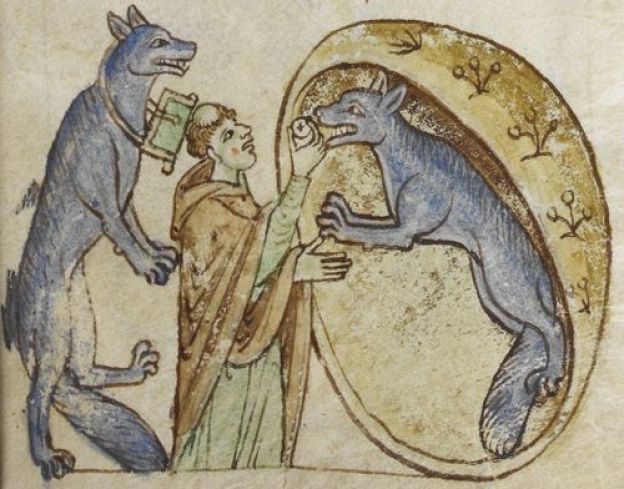
full speed down a lykanthropic rabbit-hole in the annual tradition.
Did the Wolf Win or Lose this Fight?
Here are the sources I’ve gathered in rough chronological order. Most of the material is mentioned in the Oxford Classical Dictionary, although the entry says nothing about the medical texts.
Herodotus’ Histories: A Description of the Neuri, a tribe near the Skythians who could turn into wolves and back.
Plato’s Republic: Lycanthropy is used as a metaphor for the compulsive behavior of tyrants.
Pliny the Elder’s Natural History: Pliny describes the origins of ideas about lycanthropy and blames the traditions on the credulity of the Greeks!
Petronius’ Satyricon: A character tells the story of a companion transforming into a wolf at night and back at day.
Pausanias’ Geography of Greece: Like Pliny, Pausanias tells the story of the human sacrifice performed by Lykaon as an origin of lycanthropic narratives.
Augustine of Hippo, City of God: St. Augustine (5th Century CE) gives an account similar to Pliny’s, but attributes it to Varro.
Michael Psellus, Poemata 9.841:An 11th century CE monk wrote a book of didactic poems about medicine. His description of lycanthropy is clearly influenced by the Greek medical treatises.
What I have learned from these texts:
The early Greek tradition is harmonious with some structural aspects of Greek myth. Lycanthropy is related to sacrilegious eating–in a system where what you eat communicates who you are, human flesh is taboo (monsters eat it). In the Greek lycanthropic tradition, this is non mono-directional. Werewolves who abstain from human flesh can turn back again.
The later ‘folkloric’ tradition (e.g. Petronius) is separate from this structural logic. in the earlier tradition, men transform for 9-10 years (in something of a purificatory period). The other tradition has shorter periods (nightly) that don’t correlate with sacrilege: Petronius’ werewolf doesn’t eat human flesh (that we know of).
The moon-association may be a later accretion on the tradition. All of the medical texts associate werewolves with the night; the Roman texts agree. The lunar cycle may be implied in the Petronius tale (where the transformation happens when the light is almost as bright as day) or in the later medical texts vis a vis the connection with menstrual cycles.
There is one hint of a dog-bite being associated with lycanthropy, but no foundational notion that you contract lycanthropy from a werewolf. In addition, there are no specific suggestions or methods for how to kill a werewolf.
Thrasymachus: While I like the alliteration, I don’t think *donum* works here.
As a “trick”—in this sense—isn’t really a deceit (more like a joke), and as the “treat” is something trifling (not a *gift*, which carries a sense of formality), I am wondering on something like “nugas nucesve,” “jests or nuts.”
While nuces were strewn at wedding and festivals (I’m thinking of the throwing of small bits of candy at bar mitzvahs, etc.), they were also children’s playthings, which captures, I think the idea of “treat,” as something given informally, even anonymously, and without expectation of return
In discussing tales of Diomedes’ companions being turned into birds, Augustine in De Civitate Dei (City of God) discusses werewolves (18.17, the full text):
“In order to make this seem more likely, Varro reports other fantastic tales concerning the infamous witch Circe, who transformed Odysseus’ companions into beasts, and concerning the Arcadians, who were by chance transformed when they swam across a certain lake in which they were turned into wolves. Then, they lived as wolves in the same region. If they did not eat human flesh, then they would be returned to human form after swimming across the same lake again.
And he also specifies that a certain Demanaetus tasted of the sacrifice which the Arcadians used to make to the Lycaean god, after the child was burned on the altar, and that he transformed into a wolf and, once he became a man again, competing in boxing at the Olympian games and achieved a victory. Varro does not believe for this reason that Pan or Jupiter were given the name “Lykaios” in Arcadia for any other reason than their ability to turn men into wolves, since they did not believe that this could happen except through divine power. As you know, a wolf is called lykos in Greek, and this is where the name Lykaian comes from. Varro adds that the Roman Luperci arose from their own mysteries similarly.
But what can we who talk about these things say about this kind of deceit by the devil’s forces?”
Augustine goes on to object to these tales and discuss Apuleius’ Golden Ass. I started translating this, but it is a bit of a Halloween buzzkill..
No Room For Werewolves in this city…
[XVII] Hoc Varro ut astruat, commemorat alia non minus incredibilia de illa maga famosissima Circe, quae socios quoque Vlixis mutauit in bestias, et de Arcadibus, qui sorte ducti tranabant quoddam stagnum atque ibi conuertebantur in lupos et cum similibus feris per illius regionis deserta uiuebant. Si autem carne non uescerentur humana, rursus post nouem annos eodem renatato stagno reformabantur in homines.
Denique etiam nominatim expressit quendam Demaenetum gustasse de sacrificio, quod Arcades immolato puero deo suo Lycaeo facere solerent, et in lupum fuisse mutatum et anno decimo in figuram propriam restitutum pugilatum sese exercuisse et Olympiaco uicisse certamine. Nec idem propter aliud arbitratur historicus in Arcadia tale nomen adfictum Pani Lycaeo et Ioui Lycaeo nisi propter hanc in lupos hominum mutationem, quod eam nisi ui diuina fieri non putarent. Lupus enim Graece *lu/kos dicitur, unde Lycaei nomen apparet inflexum. Romanos etiam Lupercos ex illorum mysteriorum ueluti semine dicit exortos.
Sed de ista tanta ludificatione daemonum nos quid dicamus…
Cicero calls lots of people monsters (immanis, belva, monstrum) but his favorite beast to burden is Marcus Antonius. Here is a sampling of the monstrous things he says about him.
Philippic 4.1
“Your affair, Romans, is not with a criminal and evil man, but with a twisted, enormous beast who should be overcome now that he has fallen in a trap.
Non est vobis res, Quirites, cum scelerato homine ac nefario, sed cum immani taetraque belua quae, quoniam in foveam incidit, obruatur.
Philippic 7.27
“Beware lest you allow this twisted and pestilential beast who has been constrained by labors.”
taetram et pestiferam beluam ne inclusam et constrictam dimittatis cavete.
Philippic 13. 21
“Who was ever such a barbarian, such a beast, such an animal?”
Quis tam barbarus umquam, tam immanis, tam ferus?
Philippic 13.28
“But who can bear this most twisted beast, or how could they? What exists in Antonius apart from lust, cruelty, immaturity, and arrogance?”
Hanc vero taeterrimam beluam quis ferre potest aut quo modo? Quid est in Antonio praeter libidinem, crudelitatem, petulantiam, audaciam?
Philippic 8.13
“Since you were also accustomed to complain about a person, what do you think you would do about a beast?”
Quin etiam de illo homine queri solebas: quid te facturum de belua putas?
“For treatment against night terrors and fear of ghosts it is suggested that a string of big teeth will help”
contra nocturnos pavores umbrarumque terrorem unus e magnis dentibus lino alligatus succurrere narratur.
Seneca, Moral Epistle 82.16
“Death should be hated more than it is customarily. For we believe many things about death. There has been a struggle among geniuses to increase its bad reputation. The world below is depicted as a prison and the region is oppressed by eternal night where:
“The huge guardian of death / laying upon half-eaten bones in his gory cave / horrifies the bloodless ghosts with eternal barking”*
Even if you can persuade someone that these are stories and that there is nothing there for the dead to fear, another fright comes over you. For they fear going to the underworld no less than they fear going nowhere.”
Mors contemni debet magis quam solet. Multa enim de illa credidimus. Multorum ingeniis certatum est ad augendam eius infamiam. Descriptus est carcer infernus et perpetua nocte oppressa regio, in qua
Ingens ianitor Orci
Ossa super recubans antro semesa cruento,
Aeternum latrans exsangues terreat umbras.
Etiam cum persuaseris istas fabulas esse nec quicquam defunctis superesse, quod timeant, subit alius metus. Aeque enim timent, ne apud inferos sint, quam ne nusquam.
“Trimalchio turned to Niceros and said: “You used to be more pleasant company—I don’t know why you are now so quiet and subdued. If you want to make me happy, please tell us what happened to you.
Niceros, excited at his friend’s request, replied: “May all profit escape me, if I cannot deflate your joy—when I see how you are. Nevertheless, may happiness be ours, even if I am afraid that these scholars will laugh at me. Let them look on: I will tell the story nonetheless, what difference is it to me? It is better to tell a joke than be one.”
Once he had uttered these words, he began the following tale:
‘When I was a slave, we were living in a narrow street where the home of Gavus is now. There is was where the gods decided I would fall in love with the wife of Terence the Innkeeper. You do remember Melissa from Tarentum—that most beautiful little package? By god, I loved her less for her body and sexcapades than I did for her fine morals. She didn’t deny me anything I sought. She made a penny, I got half! I put everything I had into her lap, and I was never cheated.
Her husband passed away at the inn one day. As you can imagine, I risked Skylla and Charybdis so I could get to her: for, as they say, Friends are present in times of need.
By chance, my master was visiting Capua in pursuit of some business. I took my chance and compelled a guest to accompany me to the fifth milestone. He was a soldier and as strong as Orcus. We blundered off around the time of the cock’s crow while the moon was shining as bright as midday. We went among the graves and my friend went among the stones to defecate. I sat singing and counting gravemarkers. And then, as I looked for my companion, he appeared and placed all his clothes near the road.
My breath nearly jumped out my nose—I was standing like a corpse. But he pissed around his clothes and suddenly became a wolf! Don’t you dare imagine I am joking, that I am lying. I make up nothing for such an inheritance as this! But, back to what I started to say, after he turned into a wolf, he began to howl and fled into the forest. At first, I didn’t remember where I was: then I went to gather up his clothes, but they had transformed into stones! What could I do but die from fear?
I drew my sword and struck all the shadows before me until I made it to my girlfriend’s home. I entered as pale as a ghost with sweat rushing down to my groin, my eyes nearly dead. I could hardly regain myself. My Melissa was at first surprised because I had gone out so late. And then she said “I wish you had come earlier, you could have helped us: a wolf entered the house and loosed more blood from the ship than a butcher! He escaped, but he didn’t laugh: an older slave tore his throat with a spear.”
Once I heard these words, I could not sleep any longer. At first light I fled the home of Gaius like an angry landlord. But once I came to the place where his clothing had turned into stone, I found nothing but blood. Honestly, I went home and my soldier was lying like a bull on his bed as a doctor was tending to his neck. I knew that he was a shapeshifter* then, and I wouldn’t have been able to share a meal with him even if you threatened to kill me. Let these men believe what they want about this, but if I am lying, let the gods hate me.”
*”shapeshifter”: Latin, versipellis (lit. “pelt-changer”) is used several times for form-changing in Latin literature. Often, this example and that of Pliny EN 8.80 (cf. LSJ s.v.) are translated as “werewolf”. I chose the more general sense.
[LXI] … Trimalchio ad Nicerotem respexit et: “Solebas, inquit, suavius esse in convictu; nescio quid nunc taces nec muttis. Oro te, sic felicem me videas, narra illud quod tibi usu venit.” Niceros delectatus affabilitate amici: “Omne me, inquit, lucrum transeat, nisi iam dudum gaudimonio dissilio, quod te talem video. Itaque hilaria mera sint, etsi timeo istos scolasticos ne me rideant. Viderint: narrabo tamen, quid enim mihi aufert, qui ridet? satius est rideri quam derideri.”
Haec ubi dicta dedit talem fabulam exorsus est:
“Cum adhuc servirem, habitabamus in vico angusto; nunc Gavillae domus est. Ibi, quomodo dii volunt, amare coepi uxorem Terentii coponis: noveratis Melissam Tarentinam, pulcherrimum bacciballum. Sed ego non mehercules corporaliter aut propter res venerias curavi, sed magis quod benemoria fuit. Si quid ab illa petii, nunquam mihi negatum; fecit assem, semissem habui; in illius sinum demandavi, nec unquam fefellitus sum. Huius contubernalis ad villam supremum diem obiit. Itaque per scutum per ocream egi aginavi, quemadmodum ad illam pervenirem: nam, ut aiunt, in angustiis amici apparent.
[LXII] “Forte dominus Capuae exierat ad scruta scita expedienda. Nactus ego occasionem persuadeo hospitem nostrum, ut mecum ad quintum miliarium veniat. Erat autem miles, fortis tanquam Orcus. Apoculamus nos circa gallicinia; luna lucebat tanquam meridie. Venimus inter monimenta: homo meus coepit ad stelas facere; sedeo ego cantabundus et stelas numero. Deinde ut respexi ad comitem, ille exuit se et omnia vestimenta secundum viam posuit. Mihi anima in naso esse; stabam tanquam mortuus. At ille circumminxit vestimenta sua, et subito lupus factus est. Nolite me iocari putare; ut mentiar, nullius patrimonium tanti facio. Sed, quod coeperam dicere, postquam lupus factus est, ululare coepit et in silvas fugit. Ego primitus nesciebam ubi essem; deinde accessi, ut vestimenta eius tollerem: illa autem lapidea facta sunt. Qui mori timore nisi ego? Gladium tamen strinxi et umbras cecidi, donec ad villam amicae meae pervenirem. In larvam intravi, paene animam ebullivi, sudor mihi per bifurcum volabat, oculi mortui; vix unquam refectus sum. Melissa mea mirari coepit, quod tam sero ambularem, et: ‘Si ante, inquit, venisses, saltem nobis adiutasses; lupus enim villam intravit et omnia pecora tanquam lanius sanguinem illis misit. Nec tamen derisit, etiamsi fugit; senius enim noster lancea collum eius traiecit’. Haec ut audivi, operire oculos amplius non potui, sed luce clara Gai nostri domum fugi tanquam copo compilatus; et postquam veni in illum locum, in quo lapidea vestimenta erant facta, nihil inveni nisi sanguinem. Vt vero domum veni, iacebat miles meus in lecto tanquam bovis, et collum illius medicus curabat. Intellexi illum versipellem esse, nec postea cum illo panem gustare potui, non si me occidisses. Viderint quid de hoc alii exopinissent; ego si mentior, genios vestros iratos habeam.”
The Lamia (or, just Lamia to her friends) is one of the figures from Greek myth who seems like a frightening monster but really is a particular distillation of misogyny. She is often called a Greek ‘vampire’ along with Empousa. Unlike the latter, however, Lamia is specifically associated with killing children.
Diodorus Siculus, 20.40
“At the rock’s root there was a very large cave which was roofed with ivy and bryony in which the myths say the queen Lamia, exceptional for her beauty, was born. But, because of the beastliness of her soul, they say that her appearance has become more monstrous in the time since then.
For, when all her children who were born died, she was overwhelmed by her suffering and envied all the women who were luckier with their children. So she ordered that the infants be snatched from their arms and killed immediately. For this reason, even in our lifetime, the story of that women has lingered among children and the mention of her name is most horrifying to them.
But, whenever she was getting drunk, she would allow people to do whatever pleased them without observation. Because she was not closely watching everything at that time, the people in that land imagined that she could not see. This is why the myth developed that she put her eyes into a bottle, using this story a metaphor for the carelessness she enacted in wine, since that deprived her of sight.”
The story of why Lamia killed children gets a little more depressing in the Fragments of the Greek Historians
Duris, BNJ 76 F17 [= Photios s.v. Lamia]
“In the second book of his Libyan History, Duris reports that Lamia was a fine looking woman but after Zeus had sex with her, Hera killed the children she bore because she was envious. As a result she was disfigured by grief and would seize and kill the children of others.”
Elsewhere, the evidence of narratives about Lamia are rather limited. She becomes just another negative, female monster.
Suda, Lambda 85
“Lamia: a monster. The name comes from having a gaping throat, laimia and lamia. Aristophanes: “It has the smell of a seal, the unwashed balls of a Lamia.” For testicles are active—and he is making a fantasy image of Lamia’s balls, since she is female.”
“There is a crag rising up over the ground on which the Delphians claim that a woman stood singing oracles, named Hêrophilê but known as Sibyl. There is the earlier Sibyl, the one I have found to be equally as old as the others, whom the Greeks claim is the daughter of Zeus and Lamia, the daughter of Poseidon. She was the first woman to sing oracles and they say that she was named Sibyl by the Libyans. Hêrophilê was younger than here, but she was obviously born before the Trojan War since she predicted Helen in her oracles, that was raised up in Sparta as the destruction for Asia and Europe and that Troy would be taken by the Greeks because of her.”
“Foremost he differed from previous authors in this, by which I mean how he took on a subject that was not a single thread nor one divided in many different and also disconnected parts. And then, because did not include mythical material in his work and he did not use his writing for the deception and bewitchment of many, as every author before him did when they told the stories of certain Lamiai rising up from the earth in groves and glens and of amphibious Naiads rushing out of Tartaros, half-beasts swimming through the seas and then joining together in groups among humans, and producing offspring of mortals and gods, demigods—and other stories which seem extremely unbelievable and untrustworthy to us now.”
Mormô, in the genitive Mormous, declined like Sappho. There is also the form Mormôn, genitive Mormonos. Aristophanes says “I ask you, take this Mormo away from me”. This meant to dispel frightening things. For Mormo is frightening. And again in Aristophanes: “A Mormo for courage”. There is also a mormalukeion which they also call a Lamia. They were also saying frightening things like this.”
Plutarch, De Curiositate [On Being a Busybody] 516a
“Now, just as in the myth they say that Lamia sleeps at home, putting her eyes set aside in some jar, but when she goes out she puts them back in and peers around, in the same way each of us puts his curiosity, as if fitting in an eye, into meanness towards others. But we often stumble over our own mistakes and faults because of ignorance, since we fail to secure sight or light for them.
For this reason, a busybody is rather useful to his enemies, since he rebukes and emphasizes their faults and shows them what they should guard and correct, even as he overlooks most of his own issues thanks to his obsession with everyone else. This is why Odysseus did not stop to speak with his mother before he inquired from the seer about those things for which he had come to Hades. Once he had made his inquiry, he turned to his own mother and also the other women, asking who Tyro was, who beautiful Khloris was, and why Epikaste had died.”
“But in Italy they also believe that the gaze of a wolf is harmful—specifically that it will take the voice from any man they see first. Africa and Egypt have wolves that are slow and small, while the colder climates produce fierce and wild animals. We ought to believe with certainty that accounts of men turning into wolves and then back to themselves again are false; or we should be prepared to believe all the tales that are fantastic from as many generations.
Nevertheless, since the tale is popular enough that it has earned the curse-term “versepellis”, I will explain its origin. Euanthes, not unknown among Greek authors, reports that the Arcadians hold that a member of a family of a certain Anthus is selected by lot, transported to a certain lake in the region, and, after he hangs his clothes on an oak tree, he crosses the lake and enters the desert where he turns into a wolf and joins with others of his kind for nine years.
If he keeps himself from humans for this period of time, he returns to the same lake and once he has crossed it regains his form, except that nine years of age have accumulated. Fabius adds to this tale that he also regains his clothing. It is amazing how far Greek gullibility will go! There is no lie so shameful that it will lack partisans.
Similarly, the author Apollas who wrote the Olympionics, claims that Demaenetus of Parrhasia, when the Arcadians were still performing human sacrifices to Jupiter Lycaeus, sampled the entrails of a child who had been sacrificed, and transformed into a wolf. That same man transformed back 10 years later, became an athlete, and returned to the Olympic games as a victor.
It is also believed that there is a thin tip of hair on the tail of this animal which acts as an aphrodisiac—when the animal is caught, it has no force unless it is plucked while the animal is still alive.”
Sed in Italia quoque creditur luporum visus esse noxius vocemque homini, quem priores contemplentur, adimere ad praesens. inertes hos parvosque Africa et Aegyptus gignunt, asperos trucesque frigidior plaga. homines in lupos verti rursusque restitui sibi falsum esse confidenter existimare debemus aut credere omnia quae fabulosa tot saeculis conperimus. unde tamen ista vulgo infixa sit fama in tantum, ut in maledictis versipelles habeat, indicabitur.
Euanthes, inter auctores Graeciae non spretus, scribit Arcadas tradere ex gente Anthi cuiusdam sorte familiae lectum ad stagnum quoddam regionis eius duci vestituque in quercu suspenso tranare atque abire in deserta transfigurarique in lupum et cum ceteris eiusdem generis congregari per annos VIIII. quo in tempore si homine se abstinuerit, reverti ad idem stagnum et, cum tranaverit, effigiem recipere, ad pristinum habitum addito novem annorum senio. id quoque adicit, eandem recipere vestem.
mirum est quo procedat Graeca credulitas! nullum tam inpudens mendacium est, ut teste careat. item Apollas, qui Olympionicas scripsit, narrat Demaenetum Parrhasium in sacrificio, quod Arcades Iovi Lycaeo humana etiamtum hostia facebant, immolati pueri exta degustasse et in lupum se convertisse, eundem X anno restitutum athleticae se exercuisse in pugilatu victoremque Olympia reversum.
quin et caudae huius animalis creditur vulgo inesse amatorium virus exiguo in villo eumque, cum capiatur, abici nec idem pollere nisi viventi dereptum.
It is the right time of the year for raising the dead. A student paper on the Elpenor Pelike at the MFA in Boston drew my attention to the following passage.
Servius ad Aen. 6.107
“For this reason the place is named without joy since, as people claim, it would not have been there but for necromancy or spell-craft. For, Aeneas completed these sacred rites when Misenus was killed and Ulysses did it with the death of Elpenor.
This very scene Homer himself presented falsely from the detail of its location which he specifies along with the length of time of the journey. For he claims that Ulysses sailed for one night and came to the place where he completed these sacrifices. For this reason it is abundantly clear that he doesn’t mean the ocean but Campania.”
sine gaudio autem ideo ille dicitur locus, quod necromantia vel sciomantia, ut dicunt, non nisi ibi poterat fieri: quae sine hominis occisione non fiebant; nam et Aeneas illic occiso Miseno sacra ista conplevit et Vlixes occiso Elpenore. quamquam fingatur in extrema Oceani parte Vlixes fuisse: quod et ipse Homerus falsum esse ostendit ex qualitate locorum, quae commemorat, et ex tempore navigationis; dicit enim eum a Circe unam noctem navigasse et ad locum venisse, in quo haec sacra perfecit: quod de Oceano non procedit, de Campania manifestissimum est.
The relevant passages from the Odyssey don’t give any hint that Elpenor was intentionally killed for black magic. When Odysseus actually does summon the dead, now that gets a little dark.
Odyssey, 10.552–560
“I could not even lead my companions unharmed from there.
The youngest of my companions was a certain Elpênor,
He was neither especially brave in battle or composed in his thoughts.
He separated himself from the companions in Kirkê’s holy home
Because he needed some air; then he fell asleep because he was drunk.
When he heard the noise and trouble of our companions moving out,
He got up immediately and it completely escaped his thoughts
To climb down again by the long ladder—
So he fell straight from the roof and his neck
Shattered along his spine; then his spirit flew down to Hades.”
Nekuomanteia, glossed by Hesychius as nekromanteia (i.e. “necromancy”) is an alternate name for the Nekyuia, the parade of the dead in book 11 of the Odyssey. From the Greek Anthology: ᾿Εν τῷ Η ἡ τοῦ ᾿Οδυσσέως νεκυομαντεία· (3.8); Scholia to the Odyssey, Hypotheses: Λ. Νεκυομαντεία, ἢ, Νεκυία. Cf. Eustathius, Comm. Ad Od. 1.396.10
“Phanodikos says that Daidalos—on account of the aforementioned reasons—went on a ship as he was fleeing and when those who were pursuing him drew near, he spread wide a piece of cloth for gaining the help of the winds and escaped them in this way. When they got back, those who were following him said he had escaped them with wings.”
Phanodicos Deliacon Daedalum propter supradictas causas fugientem navem conscendisse et, cum imminerent qui eum sequebantur, intendisse pallium ad adiuvandum ventos et sic evasisse: illos vero qui insequebantur reversos nuntiasse pinnis illum evasisse.
Palaephatus, On Unbelievable Things 12
“People claim that Minos imprisoned Daidalos and Ikaros, his son, for a certain reason, but that Daidalos, after he fashioned wings as prosthetics for both of them, flew off with Ikaros. It is impossible to think that a person flies, even one who has prosthetic wings. What it really means, then, is the following kind of thing.
Daidalos, when he was in prison, escaped through a small window and hauled down his son too; once he got on a boat, he left. When Minos found out, he sent ships to pursue him. Then they understood that they were being pursued and there was a furious and driving wind, they seemed to be flying. And while they were sailing with the Kretan wind, they flipped over into the sea. While Daidalos survived onto land, Ikaros died. This is why the sea there is named Ikarion for him. His father buried him after he was tossed up by the waves.”
In one of my favorite modern pieces, the poet Jack Gilbert explores the theme of flying and falling in “Failing And Flying” (from 2005’s wonderful Refusing Heaven) where he begins and ends with a meditation on Icarus. The sentiments seem apt (the text comes from poetryfoundation.org):
Everyone forgets that Icarus also flew.
It’s the same when love comes to an end,
or the marriage fails and people say
they knew it was a mistake, that everybody
said it would never work. That she was
old enough to know better. But anything
worth doing is worth doing badly.
Like being there by that summer ocean
on the other side of the island while
love was fading out of her, the stars
burning so extravagantly those nights that
anyone could tell you they would never last.
Every morning she was asleep in my bed
like a visitation, the gentleness in her
like antelope standing in the dawn mist.
Each afternoon I watched her coming back
through the hot stony field after swimming,
the sea light behind her and the huge sky
on the other side of that. Listened to her
while we ate lunch. How can they say
the marriage failed? Like the people who
came back from Provence (when it was Provence)
and said it was pretty but the food was greasy.
I believe Icarus was not failing as he fell,
but just coming to the end of his triumph.