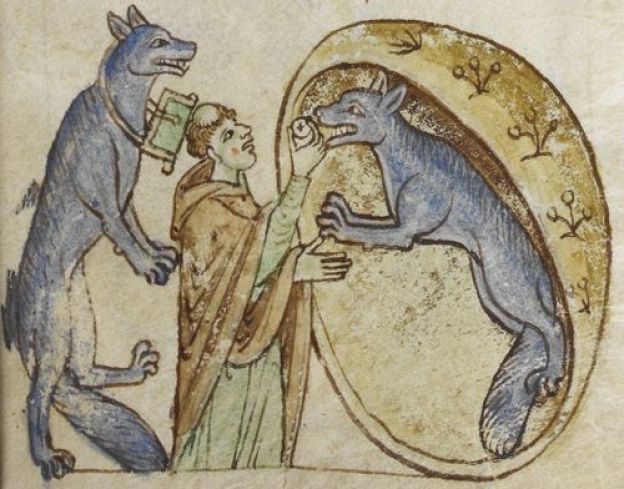
Werewolf Week, Religious Returns: St. Augustine on Lycanthropy

In discussing tales of Diomedes’ companions being turned into birds, Augustine in De Civitate Dei (City of God) discusses werewolves (18.17, the full text):

“In order to make this seem more likely, Varro reports other fantastic tales concerning the infamous witch Circe, who transformed Odysseus’ companions into beasts, and concerning the Arcadians, who were by chance transformed when they swam across a certain lake in which they were turned into wolves. Then, they lived as wolves in the same region. If they did not eat human flesh, then they would be returned to human form after swimming across the same lake again.

werewolf-histories

And he also specifies that a certain Demanaetus tasted of the sacrifice which the Arcadians used to make to the Lycaean god, after the child was burned on the altar, and that he transformed into a wolf and, once he became a man again, competing in boxing at the Olympian games and achieved a victory. Varro does not believe for this reason that Pan or Jupiter were given the name “Lykaios” in Arcadia for any other reason than their ability to turn men into wolves, since they did not believe that this could happen except through divine power. As you know, a wolf is called lykos in Greek, and this is where the name Lykaian comes from. Varro adds that the Roman Luperci arose from their own mysteries similarly.

But what can we who talk about these things say about this kind of deceit by the devil’s forces?”

Augustine goes on to object to these tales and discuss Apuleius’ Golden Ass. I started translating this, but it is a bit of a Halloween buzzkill..

No Room For Werewolves in this city...
No Room For Werewolves in this city…

[XVII] Hoc Varro ut astruat, commemorat alia non minus incredibilia de illa maga famosissima Circe, quae socios quoque Vlixis mutauit in bestias, et de Arcadibus, qui sorte ducti tranabant quoddam stagnum atque ibi conuertebantur in lupos et cum similibus feris per illius regionis deserta uiuebant. Si autem carne non uescerentur humana, rursus post nouem annos eodem renatato stagno reformabantur in homines.

Denique etiam nominatim expressit quendam Demaenetum gustasse de sacrificio, quod Arcades immolato puero deo suo Lycaeo facere solerent, et in lupum fuisse mutatum et anno decimo in figuram propriam restitutum pugilatum sese exercuisse et Olympiaco uicisse certamine. Nec idem propter aliud arbitratur historicus in Arcadia tale nomen adfictum Pani Lycaeo et Ioui Lycaeo nisi propter hanc in lupos hominum mutationem, quod eam nisi ui diuina fieri non putarent. Lupus enim Graece *lu/kos dicitur, unde Lycaei nomen apparet inflexum. Romanos etiam Lupercos ex illorum mysteriorum ueluti semine dicit exortos.

Sed de ista tanta ludificatione daemonum nos quid dicamus…

A Ghost Story from Petronius for Werewolf Week

Earlier  we saw how Plato makes being a tyrant equivalent to a type of lycanthropy. The Romans were also into that kind of thing. One of our oldest werewolf tales comes from Petronius’ Satyricon (61-62):

“Trimalchio turned to Niceros and said: “You used to be more pleasant company—I don’t know why you are now so quiet and subdued. If you want to make me happy, please tell us what happened to you.

Niceros, excited at his friend’s request, replied: “May all profit escape me, if I cannot deflate your joy—when I see how you are. Nevertheless, may happiness be ours, even if I am afraid that these scholars will laugh at me. Let them look on: I will tell the story nonetheless, what difference is it to me? It is better to tell a joke than be one.”

werewolf

Once he had uttered these words, he began the following tale:

‘When I was a slave, we were living in a narrow street where the home of Gavus is now. There is was where the gods decided I would fall in love with the wife of Terence the Innkeeper. You do remember Melissa from Tarentum—that most beautiful little package? By god, I loved her less for her body and sexcapades than I did for her fine morals. She didn’t deny me anything I sought. She made a penny, I got half! I put everything I had into her lap, and I was never cheated.

Her husband passed away at the inn one day. As you can imagine, I risked Skylla and Charybdis so I could get to her: for, as they say, Friends are present in times of need.

By chance, my master was visiting Capua in pursuit of some business. I took my chance and compelled a guest to accompany me to the fifth milestone. He was a soldier and as strong as Orcus. We blundered off around the time of the cock’s crow while the moon was shining as bright as midday. We went among the graves and my friend went among the stones to defecate. I sat singing and counting gravemarkers. And then, as I looked for my companion, he appeared and placed all his clothes near the road.

My breath nearly jumped out my nose—I was standing like a corpse. But he pissed around his clothes and suddenly became a wolf! Don’t you dare imagine I am joking, that I am lying. I make up nothing for such an inheritance as this! But, back to what I started to say, after he turned into a wolf, he began to howl and fled into the forest. At first, I didn’t remember where I was: then I went to gather up his clothes, but they had transformed into stones! What could I do but die from fear?

I drew my sword and struck all the shadows before me until I made it to my girlfriend’s home. I entered as pale as a ghost with sweat rushing down to my groin, my eyes nearly dead. I could hardly regain myself. My Melissa was at first surprised because I had gone out so late. And then she said “I wish you had come earlier, you could have helped us: a wolf entered the house and loosed more blood from the ship than a butcher! He escaped, but he didn’t laugh: an older slave tore his throat with a spear.”

Once I heard these words, I could not sleep any longer. At first light I fled the home of Gaius like an angry landlord. But once I came to the place where his clothing had turned into stone, I found nothing but blood. Honestly, I went home and my soldier was lying like a bull on his bed as a doctor was tending to his neck. I knew that he was a shapeshifter* then, and I wouldn’t have been able to share a meal with him even if you threatened to kill me. Let these men believe what they want about this, but if I am lying, let the gods hate me.”

*”shapeshifter”: Latin, versipellis (lit. “pelt-changer”) is used several times for form-changing in Latin literature. Often, this example and that of Pliny EN 8.80 (cf. LSJ s.v.) are translated as “werewolf”. I chose the more general sense.

[LXI] … Trimalchio ad Nicerotem respexit et: “Solebas, inquit, suavius esse in convictu; nescio quid nunc taces nec muttis. Oro te, sic felicem me videas, narra illud quod tibi usu venit.” Niceros delectatus affabilitate amici: “Omne me, inquit, lucrum transeat, nisi iam dudum gaudimonio dissilio, quod te talem video. Itaque hilaria mera sint, etsi timeo istos scolasticos ne me rideant. Viderint: narrabo tamen, quid enim mihi aufert, qui ridet? satius est rideri quam derideri.”

Haec ubi dicta dedit talem fabulam exorsus est:

“Cum adhuc servirem, habitabamus in vico angusto; nunc Gavillae domus est. Ibi, quomodo dii volunt, amare coepi uxorem Terentii coponis: noveratis Melissam Tarentinam, pulcherrimum bacciballum. Sed ego non mehercules corporaliter aut propter res venerias curavi, sed magis quod benemoria fuit. Si quid ab illa petii, nunquam mihi negatum; fecit assem, semissem habui; in illius sinum demandavi, nec unquam fefellitus sum. Huius contubernalis ad villam supremum diem obiit. Itaque per scutum per ocream egi aginavi, quemadmodum ad illam pervenirem: nam, ut aiunt, in angustiis amici apparent.

[LXII] “Forte dominus Capuae exierat ad scruta scita expedienda. Nactus ego occasionem persuadeo hospitem nostrum, ut mecum ad quintum miliarium veniat. Erat autem miles, fortis tanquam Orcus. Apoculamus nos circa gallicinia; luna lucebat tanquam meridie. Venimus inter monimenta: homo meus coepit ad stelas facere; sedeo ego cantabundus et stelas numero. Deinde ut respexi ad comitem, ille exuit se et omnia vestimenta secundum viam posuit. Mihi anima in naso esse; stabam tanquam mortuus. At ille circumminxit vestimenta sua, et subito lupus factus est. Nolite me iocari putare; ut mentiar, nullius patrimonium tanti facio. Sed, quod coeperam dicere, postquam lupus factus est, ululare coepit et in silvas fugit. Ego primitus nesciebam ubi essem; deinde accessi, ut vestimenta eius tollerem: illa autem lapidea facta sunt. Qui mori timore nisi ego? Gladium tamen strinxi et umbras cecidi, donec ad villam amicae meae pervenirem. In larvam intravi, paene animam ebullivi, sudor mihi per bifurcum volabat, oculi mortui; vix unquam refectus sum. Melissa mea mirari coepit, quod tam sero ambularem, et: ‘Si ante, inquit, venisses, saltem nobis adiutasses; lupus enim villam intravit et omnia pecora tanquam lanius sanguinem illis misit. Nec tamen derisit, etiamsi fugit; senius enim noster lancea collum eius traiecit’. Haec ut audivi, operire oculos amplius non potui, sed luce clara Gai nostri domum fugi tanquam copo compilatus; et postquam veni in illum locum, in quo lapidea vestimenta erant facta, nihil inveni nisi sanguinem. Vt vero domum veni, iacebat miles meus in lecto tanquam bovis, et collum illius medicus curabat. Intellexi illum versipellem esse, nec postea cum illo panem gustare potui, non si me occidisses. Viderint quid de hoc alii exopinissent; ego si mentior, genios vestros iratos habeam.”

Vergil, Master of All Speech

Macrobius, Saturnalia 5.1:

“The nature of orators is not, however, simple and unified: this one may flow and abound, but another might affect to speak briefly and concisely. One who is slight, dry, and sober loves a certain frugality of speech, but another luxuriates in rich, florid, and splendid speech. In this great difference among them all, Vergil alone is found to have conflated eloquence from every type. Avienus responded, ‘I would like if you could teach these diverse modes with the examples of individuals.’ Eusebius then said, ‘There are four modes of speech: the copious, in which Cicero is the master; the brief, in which Sallustius reigns supreme; the dry, which is ascribed to Fronto; and the thick and florid, in which Pliny the Younger once gloried, but in which our Symmachus yields to none of the ancients. But you will find these four types together in Vergil alone.”

Image result for macrobius

Oratorum autem non simplex nec una natura est: sed hic fluit et redundat, contra ille breviter et circumcise dicere adfectat: tenuis quidam et siccus et sobrius amat quandam dicendi frugalitatem, aliud pingui et luculenta et florida oratione lascivit. In qua tanta omnium dissimilitudine unus omnino Virgilius invenitur qui eloquentiam ex omni genere conflaverit. Respondit Avienus: Apertius vellem me has diversitates sub personarum exemplis doceres. Quattuor sunt, inquit Eusebius, genera dicendi: copiosum, in quo Cicero dominatur: breve, in quo Salustius regnat: siccum, quod Frontoni ascribitur: pingue et floridum in quo Plinius Secundus quondam et nunc nullo veterum minor noster Symmachus luxuriatur. Sed apud unum Maronem haec quattuor genera repperies.


Werewolf Week In Rome: Don’t Look a Wolf in the Eyes!

Here is the rather famous account of Werewolves from Pliny the Elder’s Natural History 8.34) (for the full text: see Perseus). The Latin text on Perseus is incorrect, but fortunately Lacus Curtius is there to save the day.

wolfboys

Pliny, NH 8.34 80-83

“But in Italy they also believe that the gaze of a wolf is harmful—specifically that it will take the voice from any man they see first. Africa and Egypt have wolves that are slow and small, while the colder climates produce fierce and wild animals. We ought to believe with certainty that accounts of men turning into wolves and then back to themselves again are false; or we should be prepared  to believe all the tales that are fantastic from as many generations.

Nevertheless, since the tale is popular enough that it has earned the curse-term “versepellis”, I will explain its origin. Euanthes, not unknown among Greek authors, reports that the Arcadians hold that a member of a family of a certain Anthus is selected by lot, transported to a certain lake in the region, and, after he hangs his clothes on an oak tree, he crosses the lake and enters the desert where he turns into a wolf and joins with others of his kind for nine years.

If he keeps himself from humans for this period of time, he returns to the same lake and once he has crossed it regains his form, except that nine years of age have accumulated. Fabius adds to this tale that he also regains his clothing. It is amazing how far Greek gullibility will go! There is no lie so shameful that it will lack partisans.

Similarly, the author Apollas who wrote the Olympionics, claims that Demaenetus of Parrhasia, when the Arcadians were still performing human sacrifices to Jupiter Lycaeus, sampled the entrails of a child who had been sacrificed, and transformed into a wolf. That same man transformed back 10 years later, became an athlete, and returned to the Olympic games as a victor.

It is also believed that there is a thin tip of hair on the tail of this animal which acts as an aphrodisiac—when the animal is caught, it has no force unless it is plucked while the animal is still alive.”

Sed in Italia quoque creditur luporum visus esse noxius vocemque homini, quem priores contemplentur, adimere ad praesens. inertes hos parvosque Africa et Aegyptus gignunt, asperos trucesque frigidior plaga. homines in lupos verti rursusque restitui sibi falsum esse confidenter existimare debemus aut credere omnia quae fabulosa tot saeculis conperimus. unde tamen ista vulgo infixa sit fama in tantum, ut in maledictis versipelles habeat, indicabitur.

Euanthes, inter auctores Graeciae non spretus, scribit Arcadas tradere ex gente Anthi cuiusdam sorte familiae lectum ad stagnum quoddam regionis eius duci vestituque in quercu suspenso tranare atque abire in deserta transfigurarique in lupum et cum ceteris eiusdem generis congregari per annos VIIII. quo in tempore si homine se abstinuerit, reverti ad idem stagnum et, cum tranaverit, effigiem recipere, ad pristinum habitum addito novem annorum senio. id quoque adicit, eandem recipere vestem.

mirum est quo procedat Graeca credulitas! nullum tam inpudens mendacium est, ut teste careat. item Apollas, qui Olympionicas scripsit, narrat Demaenetum Parrhasium in sacrificio, quod Arcades Iovi Lycaeo humana etiamtum hostia facebant, immolati pueri exta degustasse et in lupum se convertisse, eundem X anno restitutum athleticae se exercuisse in pugilatu victoremque Olympia reversum.

quin et caudae huius animalis creditur vulgo inesse amatorium virus exiguo in villo eumque, cum capiatur, abici nec idem pollere nisi viventi dereptum.

A Costume to Scare the Cicero Right Out of You

Inspired by a rather amusing collection of Classics-themed Halloween costumes, I have been wondering what might put the scare into ancient Greeks and Romans. One answer was easy. Well, if you trust what Marcus says in his speeches…

Cicero calls lots of people monsters (immanis, belva, monstrum) but his favorite beast to burden is Marcus Antonius. Here is a sampling of the monstrous things he says about him.

Philippic 4.1

“Your affair, Romans, is not with a criminal and evil man, but with a twisted, enormous beast who should be overcome now that he has fallen in a trap.

Non est vobis res, Quirites, cum scelerato homine ac nefario, sed cum immani taetraque belua quae, quoniam in foveam incidit, obruatur.

Philippic 7.27

“Beware lest you allow this twisted and pestilential beast who has been constrained by labors.”

taetram et pestiferam beluam ne inclusam et constrictam dimittatis cavete.


Philippic 13. 21

“Who was ever such a barbarian, such a beast, such an animal?”

Quis tam barbarus umquam, tam immanis, tam ferus?


Philippic 13.28

“But who can bear this most twisted beast, or how could they? What exists in Antonius apart from lust, cruelty, immaturity, and arrogance?”

 Hanc vero taeterrimam beluam quis ferre potest aut quo modo? Quid est in Antonio praeter libidinem, crudelitatem, petulantiam, audaciam?


Philippic 8.13

“Since you were also accustomed to complain about a person, what do you think you would do about a beast?”

 Quin etiam de illo homine queri solebas: quid te facturum de belua putas?

Image result for Ancient Roman sculpture Marcus Antonius
Pssst…how do you say “trick or treat” in Latin?

The Child-Killing Lamia: What’s Really Scary on Halloween is Misogyny

This is the second post about ancient Greek Vampires. The first looked at the Empousa. 

Lucian, Lover of Lies 2

“…these are various and disturbing tales, able to rattle the minds of children who still fear Mormo and Lamia.”

πάνυ ἀλλόκοτα καὶ τεράστια μυθίδια παίδων ψυχὰς κηλεῖν δυνάμενα ἔτι τὴν Μορμὼ καὶ τὴν Λάμιαν δεδιότων.

The Lamia (or, just Lamia to her friends) is one of the figures from Greek myth who seems like a frightening monster but really is a particular distillation of misogyny. She is often called a Greek ‘vampire’ along with Empousa. Unlike the latter, however, Lamia is specifically associated with killing children.

Diodorus Siculus, 20.40

“At the rock’s root there was a very large cave which was roofed with ivy and bryony in which the myths say the queen Lamia, exceptional for her beauty, was born. But, because of the beastliness of her soul, they say that her appearance has become more monstrous in the time since then.

For, when all her children who were born died, she was overwhelmed by her suffering and envied all the women who were luckier with their children. So she ordered that the infants be snatched from their arms and killed immediately. For this reason, even in our lifetime, the story of that women has lingered among children and the mention of her name is most horrifying to them.

But, whenever she was getting drunk, she would allow people to do whatever pleased them without observation. Because she was not closely watching everything at that time, the people in that land imagined that she could not see. This is why the myth developed that she put her eyes into a bottle, using this story a metaphor for the carelessness she enacted in wine, since that deprived her of sight.”

 περὶ δὲ τὴν ῥίζαν αὐτῆς ἄντρον ἦν εὐμέγεθες, κιττῷ καὶ σμίλακι συνηρεφές, ἐν ᾧ μυθεύουσι γεγονέναι βασίλισσαν Λάμιαν τῷ κάλλει διαφέρουσαν· διὰ δὲ τὴν τῆς ψυχῆς ἀγριότητα διατυπῶσαί φασι τὴν ὄψιν αὐτῆς τὸν μετὰ ταῦτα χρόνον θηριώδη. τῶν γὰρ γινομένων αὐτῇ παίδων ἁπάντων τελευτώντων βαρυθυμοῦσαν ἐπὶ τῷ πάθει καὶ φθονοῦσαν ταῖς τῶν ἄλλων γυναικῶν εὐτεκνίαις κελεύειν ἐκ τῶν ἀγκαλῶν ἐξαρπάζεσθαι τὰ βρέφη καὶ παραχρῆμα ἀποκτέννειν. διὸ καὶ καθ᾿ ἡμᾶς μέχρι τοῦ νῦν βίου παρὰ τοῖς νηπίοις διαμένειν τὴν περὶ τῆς γυναικὸς ταύτης φήμην καὶ φοβερωτάτην αὐτοῖς εἶναι τὴν ταύτης προσηγορίαν. ὅτε δὲ μεθύσκοιτο, τὴν ἄδειαν διδόναι πᾶσιν ἃ βούλοιντο ποιεῖν ἀπαρατηρήτως. μὴ πολυπραγμονούσης οὖν αὐτῆς κατ᾿ ἐκεῖνον τὸν χρόνον τὰ γινόμενα τοὺς κατὰ τὴν χώραν ὑπολαμβάνειν μὴ βλέπειν αὐτήν· καὶ διὰ τοῦτ᾿ ἐμυθολόγησάν τινες ὡς εἰς ἄρσιχον ἐμβάλοι τοὺς ὀφθαλμούς, τὴν ἐν οἴνῳ συντελουμένην ὀλιγωρίαν εἰς τὸ προειρημένον μέτρον μεταφέροντες, ὡς τούτου παρῃρημένου τὴν ὅρασιν.

Euripides, fr. 472m (=Diodorus Siculus 20.41.6)

“Who does not know my name, most hateful to men,
The Lamia, a Libyan by birth?”

τίς τοὐ<μὸν ὄ>νομα τοὐπονείδιστον βροτοῖς
οὐκ οἶδε Λαμίας τῆς Λιβυστικῆς γένος;

The story of why Lamia killed children gets a little more depressing in the Fragments of the Greek Historians

Duris, BNJ 76 F17 [= Photios s.v. Lamia]

“In the second book of his Libyan History, Duris reports that Lamia was a fine looking woman but after Zeus had sex with her, Hera killed the children she bore because she was envious. As a result she was disfigured by grief and would seize and kill the children of others.”

ταύτην ἐν τῆι Λιβύηι Δοῦρις ἐν δευτέρωι Λιβυκῶν ἱστορεῖ γυναῖκα καλὴν γενέσθαι, μιχθέντος δ᾽ αὐτῆι Διὸς ὑφ᾽ ῞Ηρας ζηλοτυπουμένην ἃ ἔτικτεν ἀπολλύναι· διόπερ ἀπὸ τῆς λύπης δύσμορφον γεγονέναι καὶ τὰ τῶν ἄλλων παιδία ἀναρπάζουσαν διαφθείρειν.

Elsewhere, the evidence of narratives about Lamia are rather limited. She becomes just another negative, female monster.

Suda, Lambda 85

“Lamia: a monster. The name comes from having a gaping throat, laimia and lamia. Aristophanes: “It has the smell of a seal, the unwashed balls of a Lamia.” For testicles are active—and he is making a fantasy image of Lamia’s balls, since she is female.

Λάμια: θηρίον. ἀπὸ τοῦ ἔχειν μέγαν λαιμόν, λαίμια καὶ λάμια. ᾿Αριστοφάνης· φώκης δ’ εἶχεν ὀσμήν, λαμίας ὄρχεις ἀπολύτους. δραστικοὶ γὰρ οἱ ὄρχεις. εἰδωλοποιεῖ δέ τινας ὄρχεις λαμίας· θῆλυ γάρ.

Unlike Empousa and some others, Lamia is interestingly integrated in some other genealogical traditions.

Schol. G ad Ap. Rhodes 4.825-831

“Stesichorus says in his Skylla, regarding her form, that Skylla is the daughter of Lamia.”

Στησίχορος δὲ ἐν τῇ Σκύλλῃ †εἶδός τινος† Λαμίας τὴν Σκύλλαν φησὶ θυγατέρα εἶναι.

Pausanias on Phocis, 12

“There is a crag rising up over the ground on which the Delphians claim that a woman stood singing oracles, named Hêrophilê but known as Sibyl. There is the earlier Sibyl, the one I have found to be equally as old as the others, whom the Greeks claim is the daughter of Zeus and Lamia, the daughter of Poseidon. She was the first woman to sing oracles and they say that she was named Sibyl by the Libyans. Hêrophilê was younger than here, but she was obviously born before the Trojan War since she predicted Helen in her oracles, that was raised up in Sparta as the destruction for Asia and Europe and that Troy would be taken by the Greeks because of her.”

XII. Πέτρα δέ ἐστιν ἀνίσχουσα ὑπὲρ τῆς γῆς· ἐπὶ ταύτῃ Δελφοὶ στᾶσάν φασιν ᾆσαι τοὺς χρησμοὺς γυναῖκα ὄνομα Ἡροφίλην, Σίβυλλαν δὲ ἐπίκλησιν. τὴν δὲ πρότερον γενομένην, ταύτην ταῖς μάλιστα ὁμοίως οὖσαν ἀρχαίαν εὕρισκον, ἣν θυγατέρα Ἕλληνες Διὸς καὶ Λαμίας τῆς Ποσειδῶνός φασιν εἶναι, καὶ χρησμούς τε αὐτὴν γυναικῶν πρώτην ᾆσαι καὶ ὑπὸ τῶν Λιβύων Σίβυλλαν λέγουσιν ὀνομασθῆναι. ἡ δὲ Ἡροφίλη νεωτέρα μὲν ἐκείνης, φαίνεται δὲ ὅμως πρὸ τοῦ πολέμου γεγονυῖα καὶ αὕτη τοῦ Τρωικοῦ, καὶ Ἑλένην τε προεδήλωσεν ἐν τοῖς χρησμοῖς, ὡς ἐπ᾿ ὀλέθρῳ τῆς Ἀσίας καὶ Εὐρώπης τραφήσοιτο ἐν Σπάρτῃ, καὶ ὡς Ἴλιον ἁλώσεται δι᾿ αὐτὴν ὑπὸ Ἑλλήνων.

Dionysus of Halicarnassus, On Thucydides 6

“Foremost he differed from previous authors in this, by which I mean how he took on a subject that was not a single thread nor one divided in many different and also disconnected parts. And then, because did not include mythical material in his work and he did not use his writing for the deception and bewitchment of many, as every author before him did when they told the stories of certain Lamiai rising up from the earth in groves and glens and of amphibious Naiads rushing out of Tartaros, half-beasts swimming through the seas and then joining together in groups among humans, and producing offspring of mortals and gods, demigods—and other stories which seem extremely unbelievable and untrustworthy to us now.”

πρῶτον μὲν δὴ κατὰ τοῦτο διήλλαξε τῶν πρὸ αὐτοῦ συγγραφέων, λέγω δὲ κατὰ τὸ λαβεῖν ὑπόθεσιν μήτε μονόκωλον παντάπασι μήτ᾿ εἰς πολλὰ μεμερισμένην καὶ ἀσυνάρτητα κεφάλαια· ἔπειτα κατὰ τὸ μηδὲν αὐτῇ μυθῶδες προσάψαι, μηδ᾿ εἰς ἀπάτην καὶ γοητείαν τῶν πολλῶν ἐκτρέψαι τὴν γραφήν, ὡς οἱ πρὸ αὐτοῦ πάντες ἐποίησαν, Λαμίας τινὰς ἱστοροῦντες ἐν ὕλαις καὶ νάπαις ἐκ γῆς ἀνιεμένας, καὶ Ναΐδας ἀμφιβίους ἐκ Ταρτάρων ἐξιούσας καὶ διὰ πελάγους νηχομένας καὶ μιξόθηρας, καὶ ταύτας εἰς ὁμιλίαν ἀνθρώποις συνερχομένας, καὶ ἐκ θνητῶν καὶ θείων συνουσιῶν γονὰς ἡμιθέους, καὶ ἄλλας τινὰς ἀπίστους τῷ καθ᾿ ἡμᾶς βίῳ καὶ πολὺ τὸ ἀνόητον ἔχειν δοκούσας ἱστορίας.

There is another variant name–she might get her own entry some day

Suda, s.v.Μορμώ 

Mormô, in the genitive Mormous, declined like Sappho. There is also the form Mormôn, genitive Mormonos. Aristophanes says “I ask you, take this Mormo away from me”. This meant to dispel frightening things. For Mormo is frightening. And again in Aristophanes: “A Mormo for courage”. There is also a mormalukeion which they also call a Lamia. They also frightening things this.

Μορμώ: λέγεται καὶ Μορμώ, Μορμοῦς, ὡς Σαπφώ. καὶ Μορμών, Μορμόνος. Ἀριστοφάνης: ἀντιβολῶ σ’, ἀπένεγκέ μου τὴν Μορμόνα. ἄπο τὰ φοβερά: φοβερὰ γὰρ ὑπῆρχεν ἡ Μορμώ. καὶ αὖθις Ἀριστοφάνης: Μορμὼ τοῦ θράσους. μορμολύκειον, ἣν λέγουσι Λαμίαν: ἔλεγον δὲ οὕτω καὶ τὰ φοβερά.

 In some traditions, Lamia became proverbial

Plutarch, De Curiositate [On Being a Busybod y] 516a

“Now, just as in the myth they say that Lamia sleeps at home, putting her eyes set aside in some jar, but when she goes out she puts them back in and peers around, in the same way each of us puts his curiosity, as if fitting in an eye, into meanness towards others. But we often stumble over our own mistakes and faults because of ignorance, since we fail to secure sight or light for them.

For this reason, a busybody is rather useful to his enemies, since he rebukes and emphasizes their faults and shows them what they should guard and correct, even as he overlooks most of his own issues thanks to his obsession with everyone else. This is why Odysseus did not stop to speak with his mother before he inquired from the seer about those things for which he had come to Hades. Once he had made his inquiry, he turned to his own mother and also the other women, asking who Tyro was, who beautiful Khloris was, and why Epikaste had died.”

Lamia is not well-attested in art and myth

νῦν δ’ ὥσπερ ἐν τῷ μύθῳ τὴν Λάμιαν λέγουσιν οἴκοι μὲν εὕδειν τυφλήν, ἐν ἀγγείῳ τινὶ τοὺς ὀφθαλμοὺς ἔχουσαν ἀποκειμένους, | ἔξω δὲ προϊοῦσαν ἐντίθεσθαι καὶ βλέπειν, οὕτως ἡμῶν ἕκαστος ἔξω καὶ πρὸς ἑτέρους τῇ κακονοίᾳ τὴν περιεργίαν ὥσπερ ὀφθαλμὸν ἐντίθησι, τοῖς δ’ ἑαυτῶν ἁμαρτήμασι καὶ κακοῖς πολλάκις περιπταίομεν ὑπ’ ἀγνοίας, ὄψιν ἐπ’ αὐτὰ καὶ φῶς οὐ ποριζόμενοι. διὸ καὶ τοῖς ἐχθροῖς ὠφελιμώτερός ἐστιν ὁ πολυπραγμονῶν· τὰ γὰρ ἐκείνων ἐλέγχει καὶ προφέρεται καὶ δείκνυσιν αὐτοῖς ἃ δεῖ φυλάξασθαι καὶ διορθῶσαι, τῶν δ’ οἴκοι τὰ πλεῖστα παρορᾷ διὰ τὴν περὶ τὰ ἔξω πτόησιν. ὁ μὲν γὰρ ᾿Οδυσσεὺς (λ 84 sqq.) οὐδὲ τῇ μητρὶ διαλεχθῆναι πρότε- ρον ὑπέμεινεν ἢ πυθέσθαι παρὰ τοῦ μάντεως, ὧν ἕνεκ’ ἦλθεν εἰς ῞Αιδου, πυθόμενος δὲ οὕτω πρός τε ταύτην ἔτρεψεν αὑτόν, καὶ τὰς ἄλλας γυναῖκας ἀνέκρινε, τίς ἡ Τυρὼ καὶ τίς ἡ καλὴ Χλωρὶς καὶ διὰ τί ἡ ᾿Επικάστη ἀπέθανεν…

Image result for Ancient Greek Lamia vase
Skylla, relative of Lamia. More Misogyny.

Some other misogynistic tales from myth with telling variants

The Lemnian Women and their Terrible Smell

The Privileging of Klytemnestra’s Infamy

The Terrible Tale of Asclepius’ Two Mothers

Pretty Much Everything about Medea

Kassandra’s Prophecy and Life

Kassandra’s Children

The Death of Hecuba

Helen and Iphigenia

The Aeneid is Homeric Fanfiction: A Comparison

Macrobius, Saturnalia 5.2:

“What about the fact that every work of Vergil was formed as if from some Homeric looking glass? For, there is a storm described with wonderful imitation (anyone who wishes may compare the verses of each author), and Venus was used in place of Nausicaa, the daughter of Alcinous. Dido herself, however, also recalls the image of the king Alcinous hosting his dinner. Scylla and Charybdis and Circe are appropriately mentioned, and the Strophades are employed in place of the flocks of the Sun. But in place of the consultation of the dead, Vergil has drawn up a descent to them with the accompaniment of a priestess. There, Palinurus corresponds to Elpenor, and Dido’s hostility corresponds to Ajax’s, and the warnings of Anchises correspond to the admonitions of Tiresias. Now, the battles of the Iliad and the description of the wounds not without the perfection of learning, and the double enumeration of the allies and the fabrication of arms and the variety of the games and the pact made and broken between the kings and the spy mission by night and the embassy carrying back a repulse from Diomedes after the example of Achilles, and the lamentation for Pallas as for Patroclus, and the conflict between Drances and Turnus modeled after that of Achilles and Agamemnon (for in both cases one was thinking of his own, the other of the public welfare), the single combat of Aeneas and Turnus as that of Achilles and Hector, and the captives given to the shades of the dead (there for Patroclus, here for Pallas).”

Image result for aeneid

Quid, quod et omne opus Virgilianum velut de quodam Homerici opus speculo formatum est? Nam et tempestas mira imitatione descripta est (versus utriusque qui volet conferat), ut Venus in Nausicaae locum Alcinoi filiae succesit, ipsa autem Dido refert speciem regis Alcinoi convivium celebrantis. Scylla quoque et Charybdis et Circe decenter attingitur, et pro Solis armentis Strophades insulae finguntur. At pro consultatione inferorum descensus ad eos cum comitatu sacerdotis inducitur. Ibi Palinurus Elpenori, sed et infesto Aiaci infesta Dido et Tiresiae consiliis Anchisae monita respondent. Iam praelia Iliadis et vulnerum non sine disciplinae perfectione descriptio et enumeratio auxiliorum duplex et fabricatio armorum et ludicri certaminis varietas ictumque inter reges et ruptum foedus et speculatio nocturna et legatio reportans a Diomede repulsam Achillis exemplo, et super Pallante ut Patroclo lamentatio, et altercatio ut Achillis et Agamemnonis ita Drancis et Turni, utrobique enim alter suum alter publicum commodum cogitabat, pugna singularis Aeneae atque Turni ut Achillis et Hectoris, et captivi inferiis destinati ut illic Patrocli hic Pallantis

Master Latin and Greek, Then Go to College

Thomas Jefferson to James Madison, May 8th 1784:

“I have a tender legacy to leave you on my departure. I will not say it is the son of my sister, tho her worth would justify my resting it on that ground; but it is the son of my friend, the dearest friend I knew, who, had fate reversed our lots, would have been a father to my children. He is a boy of fine dispositions, and sound masculine talents. I was his preceptor myself as long as I staid at home, and when I came away I placed him with Mr. Maury. On his breaking up his school I desired Mr. Short to dispose of him, but Mr. Short I expect will go with me to Europe. I have no body then but you to whose direction I could consign him with unlimited confidence. He is nearly master of the Latin, and has read some Greek. I beleive he is about 14. years of age. I would wish him to be employed till 16. in completing himself in latin, Greek, French, Italian and Anglosaxon. At that age I mean him to go to the college.”

Image result for thomas jefferson

Exploring Gender and Sexuality in Antiquity: The Trial and Consciousness of Callon

[Editorial note: We are happy to have this guest post by Cassie Garison who reached out to us after our recent reposting of intersex stories from ancient Greece and Rome. Cassie brings us a story we did not know and a fine discussion of ancient representations of the relationship between biological gender and the social performance of sex].

A note on translation: “sex-change” today is not a politically correct term to refer to people who choose to get gender affirmation surgery. However, I will use this language as it is a quite literal translation and a literal description of what is happening. In both cases that I will describe there was not agency or intent on behalf of those in reference, and they bear little similarity to those modern instances where there is.  There are also inconsistencies in the language of the translated excerpts, for instance when Tiresias or Callon are labelled men or women. However, gender and sex are not the synonymous, and when referring to anatomical features of the body (albeit even these are not binary in any shape or form) I will use the terms male and female. The language that the translators use to describe gender and sexuality are outdated.

Callon, a figure written into the ancient histories of Diodorus Siculus, demonstrates a unique and at times awkward telling, one that defies historical precedents and does not fit neatly into any known ancient systems. This account is critical to consider even in a contemporary context as it enlightens the way humans are prone and accustomed to projecting their anachronistic understanding of gender and sexuality on the queer body. It demonstrates both the limits of language and the influence of groups in power on history and written accounts. The closest figure to Callon comes in the more well-known in the mythological account of the well-known figure of Tiresias.

In Ovid’s Metamorphoses, Tiresias struck two mating snakes with his stick, separating them. Spectacularly, Tiresias’s body changed, in this moment, from male to female. He[1] lived as female for seven years, until the eighth year when he stumbled upon the same pair of copulating snakes and, again, struck them with his stick with the hope that he would again change sex. He transforms, and “from man was turned to woman”(Ovid Met. 3.326). This mythological story is invoked and revisited by numerous ancient and modern authors alike, appearing on Sophocles, Homer, Petronius, Lord Alfred Tennyson, T.S. Eliot, Virginia Woolf,[2] and many more. Each time this story is iterated it is interpreted through a different lens, each time speaking differently to how Tiresias’s gender and sex cohere and flex.

Although Tiresias existed within only one body and consciousness, he possessed, at separate points, what are considered opposing binary sexual features. Despite his movement between binaries, Tiresias demonstrated an overarching understanding of what it is to live within the body of both male and female. When Jove and Saturn called upon Tiresias to tell them who—male or female—experienced more sexual pleasure, Tiresias responded that the female does, taking the side of Jove. Thus, Juno responded by taking away Tiresias’ physical sight, and Jove, disagreeing with this reaction, gave Tiresias the power to see the future (Ov. Met. 3.335-339). Thus one form of sight was taken away, and another was given, and Tiresias is redirected into both a mythological or oracular paradigm.

Similarly, in a story told by Diodorus Siculus[3], a figure name Callon[4] demonstrates a parallel depiction as a result of an unintentional and unpredictable change of defining sexual features[5]. Although this is a historical account—opposed to Tiresias’s literary mythology—the two are comparable in that both stories were passed down through oral history, then arrived on the page within the narrative bias ancient authors. They both highlight ideals and perceptions of gender, sex, and social construct within Ancient society through the author’s portrayal of events.

The story begins in Book 32 of The Bibliotheca Historica when a tumor appears on the genitals of Callo (their name before[6] the change of sex), described as a married woman from Epidaurus. This tumor causes excruciating pain, and no physician wanted to risk treating it. Then an apothecary stepped up to the task, facilitating the alteration (this translation is from Lacius Curtius):

He cut into the swollen area, whereupon a man’s privates were protruded, namely testicles and an imperforate penis. While all the others stood amazed at the extraordinary event, the apothecary took steps to remedy the remaining deficiencies. First of all, cutting into the glans he made a passage into the urethra, and inserting a silver catheter drew off the liquid residues. Then, by scarifying the perforated area, he brought the parts together.

τοῖς λειπομένοις μέρεσι τῆς πηρώσεως. τὸ μὲν οὖν πρῶτον τὸ αἰδοῖον ἄκρον ἐπιτεμὼν συνέτρησεν εἰς τὸν οὐρητῆρα, καὶ καθεὶς ἀργυροῦν καυλίσκον ταύτῃ τὰ περιττώματα τῶν ὑγρῶν ἐξεκόμιζε, τὸν δὲ σεσυριγγωμένον τόπον ἑλκώσας συνέφυσε.

Following this moment, Callon instantly must adjust and adopt a new social role in response to their newly-emerged male genitalia (Diodorus Siculus, 32.11):

After achieving a cure in this manner he demanded double fees, saying that he had  received a female invalid and made her into a healthy young man. Callo laid aside her loom-shuttles and all other instruments of woman’s work, and taking in their stead the garb and status of a man changed her name (by adding a single letter, N, at the end) to Callon.

καὶ τοῦτον τὸν τρόπον ὑγιοποιήσας διπλοῦν ἀπῄτει τὸν μισθόν· ἔφη γὰρ αὑτὸν παρειληφέναι γυναῖκα νοσοῦσαν, καθεστακέναι δὲ νεανίσκον ὑγιαίνοντα. ἡ δὲ Καλλὼ τὰς μὲν ἐκ τῶν ἱστῶν κερκίδας καὶ τὴν ἄλλην τῶν γυναικῶν ταλασιουργίαν ἀπέθετο, μεταλαβοῦσα δὲ ἀνδρὸς ἐσθῆτα καὶ τὴν ἄλλην διάθεσιν μετωνομάσθη Κάλλων, ἑνὸς στοιχείου ἐπὶ τῷ τέλει τοῦ Ν προστεθέντος.

This shift parallels the way that Tiresias’s physical sex-change redirects his social projection and performance, establishing mental and social expectations in direct response to genitalia. Female appearing genitalia are aligned with the actions of womanhood, and male actions are aligned with the performance of manhood, with little room for fluctuation of that binary principle. This is a principle that still governs much of today’s understandings of gender and sexuality.

Callon, before this physical and social shift, was a priestess of Demeter, and after this moment of alteration, “because she had witnessed things not to be seen by men she was brought to trial for impiety.” (Diodorus.Siculus 22.11)  Just as Tiresias has his sight taken away for possessing the knowledge and sight of what it is to live within both the body of male and female, Callon is brought to trial for impiety for having seen sacred rituals exclusive to females when they are no longer socially labelled as female, but still never truly was able to fulfill the proscribed role of an Ancient Greek male.

The physical descriptors of Callon’s body explain the effect and complications of Callon’s portrayal as portentous and prosecuted. Callon’s sight and experience are implicitly more than either male or female, even if they are only regarded as one or the other at any given time. They possess a double consciousness in result of the ambiguous genitalia and unstable body, rooted in the very fact that their body calls to question, multiple times, how tethered gendered performance is to sex.

This instability forces them to exist outside any normative variations of male and female projectiles within Ancient Greece, even the most extreme variations[7]. The manner of physical change—unprompted and unexplainable other than to attribute to divine agency— undoubtedly plays a large role in Callon’s mythic classification, in tandem with their inability to fit neatly within any gendered projectile, their fluctuating societal perception, and the Diodorus Siculus’s inability to find language that properly tethers Callon to a position in society.

Diodorus Siculus inducts the story as mythic separately from the actual telling of Callon. He situates the text directly after the sex-change of Herais (Diodorus.Siculus.XXXII.9), a change with similar anomalous conditions yet varying social implications.[8] Following these two stories, Diodorus Siculus injects his own lens for a reader to interpret the previous recordings (Diodorus, Siculus. 32.11):

Likewise in Naples and a good many other places sudden changes of this sort are said to have occurred. Not that the male and female natures have been united to form a truly bisexual type, for that is impossible, but that Nature, to mankind’s consternation and mystification, has through the bodily parts falsely given this impression. And this is the reason why we have considered these shifts of sex worthy of record, not for the entertainment, but for the improvement most our readers. For many men, thinking such things to be portents, fall into superstition, and not merely isolated individuals, but even nations and cities.

῾Ομοίως δ’ ἐν τῇ Νεαπόλει καὶ κατ’ ἄλλους τόπους πλείονας ἱστοροῦνται γεγονέναι τοιαῦται περιπέτειαι, οὐκ ἄρρενος καὶ θηλείας φύσεως εἰς δίμορφον τύπον δημιουργηθείσης, ἀδύνατον γὰρ τοῦτο, ἀλλὰ τῆς φύσεως διὰ τῶν τοῦ σώματος μερῶν ψευδογραφούσης εἰς ἔκπληξιν καὶ ἀπάτην τῶν ἀνθρώπων. διόπερ καὶ ἡμεῖς τὰς περιπετείας ταύτας ἀναγραφῆς ἠξιώσαμεν, οὐ ψυχαγωγίας ἀλλ’ ὠφελείας ἕνεκα τῶν ἀναγινωσκόντων. πολλοὶ γὰρ τέρατα τὰ τοιαῦτα νομίζοντες εἶναι δεισιδαιμονοῦσιν, οὐκ ἰδιῶται μόνον ἀλλὰ καὶ ἔθνη καὶ πόλεις.

Diodorus Siculus invokes a deep mythological history, particularly by referencing the trope of the δίμορφον τύπον,  the “bisexual type.” This strings the events he has recorded into a chain of mythological dual-sexed beings. Some of these instances include the mythological narratives such as Hermaphroditus, the child of Polycritus, and the sleeping herms.[9] He poses these sex-changes as not isolated instances, but as a part of a larger theme of sexual ambiguity and transitivity. Nature, Diodorus Siculus believes, is this cause of these abnormalities, and therefore they must be regarded as indicative of something larger than just the instance, thus transcending their own context and the details of their existence.

The language used to describe Callon’s physical features provides critical clues to how Callon lived into adulthood and had to uphold binary roles for a sex and gender which their genitalia most closely resembled. Those functioning outside the gender and sexual binary were present within mythological accounts frequently, yet in historical accounts babies born with “ambiguous genitalia” were frequently exposed.[10]  This made it even more remarkable and incidental that Callon survived to adulthood, qualifying that Callon’s genitalia would have not been regarded as hindering their ability to marry and function domestically. The complication arises, however, in that the primary function of marriage and the oikos, or household, in Ancient Greek society was the product of a lineage for the male side of the family.[11]

Ancient Greek society, similarly to our contemporary society, was organized primarily by a system of opposing binaries that extended toward governing the gender and sex system. There was The Good and The Bad, citizen and non-citizen, male and female, among many others, all of which repelled and aligned accordingly.[12] However, there was room for transgression of these seemingly rigid binaries under certain circumstances if there was a pre-established system for these deviations For instance, the mythological idea of the demigod transgressed the binary of mortal and immortal. Within the medical realm, there were liminalities of this kind as well. Illness was considered neither to fall under good or bad, but to form a sort of triangulation in relation to the two, essentially because they had the potential to be balanced or remedied.[13] These liminalities reverberate into the description of Callon’s body, and permeate particularly the manner in which Callon has to participate in sexual intercourse. Before the change of sex, Callon’s genitals were described as such     (Diodorus Siculus, 32.11):

Now the orifice with which women are provided had in her case no opening, but beside the so‑called pecten she had from birth a perforation through which she  excreted the liquid residues.

αὕτη τὸν ἐπὶ τῆς φύσεως ἀποδεδειγμένον ταῖς γυναιξὶ πόρον ἄτρητον εἶχεν, παρὰ δὲ τὸν καλούμενον κτένα συριγγωθέντος τόπου ἐκ γενετῆς τὰς περιττώσεις τῶν ὑγρῶν ἐξέκρινεν.

Due to this, Siculus finds it necessary to describe how they engaged in sexual intercourse (Diodorus Siculus. 32.11):

On reaching maturity she became the wife of a fellow citizen. For two years she lived with him, and since she was incapable of intercourse as a woman, was obliged to submit to unnatural embraces.

εἰς δὲ τὴν ἀκμὴν τῆς ἡλικίας παραγενομένη συνῳκίσθη τινὶ τῶν πολιτῶν. διετῆ μὲν οὖν χρόνον συνεβίωσε τἀνδρί, τὴν μὲν γυναικείαν ἐπιπλοκὴν οὐκ ἐπιδεχομένη, τὴν δὲ παρὰ φύσιν ὁμιλίαν ὑπομένειν ἀναγκαζομένη.

There were power dynamics linked to Ancient Greek sexual encounters, and projected upon those engaging in certain behaviors. Due to Callon’s inability to engage in vaginal intercourse as they were expected to, they would have been forced to engage in anal intercourse, a practice of sex considered to be dirty, shameful, and deficient.[14]  They were able only to engage in intercourse in the fashion typical to a passive homosexual male, one that was not conducive to reproduction.[15] Although, oddly enough, aside from this inability to perform as a sexually normative female, Callon was still able to marry a man and fulfill that social and domestic facet of female-tethered performance,[16] albeit their inability to reproduce due to the implications of their ambiguous genitalia.

Even after the change of sex, Callon would have existed outside the normative gender-associated sexual performance of a male. Callon additionally cannot be assimilated into any previously established systems of sexual deviance, for instance, Eunuchs, the Orphean system of pederasty, homosexual behavior among the elite.[17] This speaks to both the importance of sexual activity to gender performance and to how Callon would have been perceived. Here the instance deviates from Tiresias, who was described as being able to enjoy sex as a man and woman—Callon, can have sex neither as a traditional and expected man or woman but as a passive role of the system, limited to a certain number of deviations outside of reproductive purpose.[19]

The physical and biological differences that the Ancient Greeks drew between male and female bodies bled inevitably into how the constructs of man and women formed and were expected to function. In classic description, males/men are portrayed as the agents of their own body, and in Greek and Roman thought were the considered “qualitative essence of a person,” capable of logical thought and possessing a sort of bodily hardness and structure. [20]

Females/women, on the other hand, are portrayed as the antithesis of this. They lack control over their own bodies. In tales such as the paradigmatic image of Pandora, female bodies are seen as possessing a “lovely exterior” which serves as a “deceptive disguise to conceal a corrupt and destructive interior.”[21] Callon is expected to uphold both of these roles at different periods of time, strung between two repellent binaries. Callon, however, would have been rendered outside of the binary in that they were neither male or female, good or evil, but instead as a neutral alternative in a system of binaries.

Diodorus Siculus narrates that Callon was expected immediately to shift from upholding the standards of one binary to that of another, without any sort of previous conditioning or socializing, as contemporary theory would define it. Callon puts down their weaving equipment—a symbolic facet of woman’s work that exemplifies the idea of a woman being domestic, loyal, and occupied in a controlled and moderated setting.[22]

Thus, taking up the garb and title of a man is undoubtedly an immediate thrust from one end of the binary to the other, with no social opportunity for in between. Callon’s body is deemed as defining the conditions of what is around them, and albeit they never exactly have the physicality of either a male or a female, they are forced to assume to social roles and labels of both and neither, consecutively and concurrently.

Central to this experience is Callon’s trial for impiety, which punishes them for existing outside of the established binary by no fault of their own. Callon fits much better into a mythological system of δίμορφον τύπον (Diodorus Siculus. 32.12), hence their experience, downfall, and mystification, which developed parallel to that of Tiresias. They actually fit quite neatly into mythological tradition, and are denoted by Diodorus Siculus to have been thought to have served as a portent in the sense that their existence indicated more than itself, and served as a greater predictor of fate. Other instances of the δίμορφον τύπον that Callon can be strung with include the mythological figures Hermaphroditus and Iffus.[23] There was no way to attain a medical explanation for the instance of Callon, and the only dominant paradigms for ambiguous genitalia in adults existed within mythological-literary models.

Thus, even Diodorus Siculus, struggles to handle Callon’s narration within the text. Diodorus Siculus does not demonstrate the pronoun usage to deal with the sex-change that he is describing, consistently using the Ancient Greek female pronoun, to address Callon throughout the passage, both before and after the sex-change. This is unusual considering that within the passage Diodorus Siculus conveys the name change, garb change, and performance change of Callon in response to their body, affirming them in other ways. Yet Diodorus Siculus does not present them with masculine pronouns when depicting them at any point, remaining partial to the feminine, even when Callon was put on trial for being a male who had seen events exclusive to females. Foxhall notes that “gender was constantly performed but almost never critically articulated,”[24] in ways retrospectively providing a reason for Diodorus Siculus’s lack of ability to handle this case with both gendered nuance and accuracy, exacting the binds and customs of his own era and understanding of the instance.

Applying contemporary gender theory to the ancient world is both a dangerous and powerful tool. It is dangerous in that one must constantly be wary of overwriting instances of history with our own connotations, denotations, stigmas and associations. It is powerful because as time passes we continue to let new and fresh understandings of the world and human complications live within anachronistic functions of language and time.

But on either side, they are tools to speculate about the lives of those before us and our own deep lineages and histories, especially in a society that is so prone to erase those unlike them. Above all, this research calls highlights the role that ancient authors and their social contexts have in preserving some experiences and voices and not others.


Cassie Garison lives in Lancaster, Pennsylvania and is a poet and a classicist. Cassie’s poems have appeared or are forthcoming in River Styx, The Penny Dreadful, Nimrod International, Hobart, and others. Cassie’s classics related research and writing focuses on Gender & Sexuality in Ancient Greece and Rome.


Click on “More” for Bibliography and notes

Continue reading “Exploring Gender and Sexuality in Antiquity: The Trial and Consciousness of Callon”

Needful Tales: Intersex Stories from Ancient Greece and Rome

The New York Times reports that the current US administration is trying to narrowly define gender in order to strip transgender people of federal protections. Here are some ancient intersex stories we posted over the summer. Human beings have known that gender is not simply binary and is not simply about how we are born for a very long time.

Here are short tales from: Phlegon of Tralles’ On Marvels

6 Also in Antioch near the Maiander river there was an intersex person, when Antipater who was the Athenians and Marcus Vinicius and Titus Statilus Taurus were consuls. The person was called Kourbinus. As a maiden of famous parents when she was thirteen she was suited by many because of her beauty.

After her parents chose the suitor they wanted, they appointed the day for the marriage But the girl shouted out as she was about to leave the house when the most severe amount of pain over took her.

Those near her lifted her up and were taking care of her because she had pains in her guts and twisting within them. This pain remained for three days straight and her suffering made everyone confused, since they could not give her relief from the toils at night or day.

Even though the doctors in the city applied every type of healing to her they found no cause for the suffering. On the fourth day near dawn, the pains greatly increased and, as she shouted out with a terrible groan, suddenly the masculine parts descended from her and a girl became a man.

After some time, he was taken to Rome to be presented to Claudius Caesar. And he, on account of the fame, had an altar erected for Zeus the Defender of Evils on the Capitoline.”

Καὶ ἐν ᾿Αντιοχείᾳ δὲ τῇ πρὸς Μαιάνδρῳ ποταμῷ ἐγένετο ἀνδρόγυνος, ἄρχοντος ᾿Αθήνησιν ᾿Αντιπάτρου, ὑπατευόντων ἐν ῾Ρώμῃ Μάρκου Βινικίου καὶ Τίτου Στατιλίου Ταύρου, τοῦ Κουρβίνου ἐπικληθέντος.

παρθένος γὰρ γονέων ἐπισήμων τρισκαιδεκαέτις ὑπάρχουσα ὑπὸ πολλῶν ἐμνηστεύετο, οὖσα εὐπρεπής. ὡς δ’ ἐνεγυήθη ᾧ οἱ γονεῖς ἐβούλοντο, ἐνστάσης τῆς ἡμέρας τοῦ γάμου προϊέναι τοῦ οἴκου μέλλουσα αἰφνιδίως πόνου ἐμπεσόντος αὐτῇ σφοδροτάτου ἐξεβόησεν.

ἀναλαβόντες δ’ αὐτὴν οἱ προσήκοντες ἐθεράπευον ὡς ἀλγήματα ἔχουσαν κοιλίας καὶ στρόφους τῶν ἐντός· τῆς δὲ ἀλγηδόνος ἐπιμενούσης τρισὶν ἡμέραις ἑξῆς ἀπορίαν τε πᾶσι τοῦ πάθους ποιοῦντος, τῶν πόνων οὔτε νυκτὸς οὔτε ἡμέρας ἔνδοσιν λαμβανόντων, καίτοι πᾶσαν μὲν θεραπείαν αὐτῇ προσφερόντων <τῶν> ἐν τῇ πόλει ἰατρῶν, μηδεμίαν δὲ τοῦ πάθους δυναμένων αἰτίαν εὑρεῖν, τῇ τετάρτῃ τῶν ἡμερῶν περὶ τὸν ὄρθρον μείζονα τῶν πόνων ἐπίδοσιν λαμβανόντων, σὺν μεγάλῃ οἰμωγῇ ἀνακραγούσης, ἄφνω αὐτῇ ἀρσενικὰ μόρια προέπεσεν, καὶ ἡ κόρη ἀνὴρ ἐγένετο.

μετὰ δὲ χρόνον εἰς ῾Ρώμην ἀνηνέχθη πρὸς Κλαύδιον Καίσαρα· ὁ δὲ τούτου ἕνεκα τοῦ σημείου ἐν Καπετωλίῳ Διὶ ᾿Αλεξικάκῳ ἱδρύσατο βωμόν.


7 “There was also in Mêouania, an Italian city, in the home of Agrippina Augusta, an intersex person when Dionysodorus was archon in Athens and in Rome Decimus Junius Silanos Torquatos and Quintus Aterius Atonius were consuls.

The girl’s name was Philôtis and she was Smyrnaian in origin. When the time of her marriage came and she had been promised by her parents to a man, male genitals appeared on her and she became a man.”

᾿Εγένετο καὶ ἐν Μηουανίᾳ, πόλει τῆς ᾿Ιταλίας, ἐν ᾿Αγριππίνης τῆς Σεβαστῆς ἐπαύλει ἀνδρόγυνος, ἄρχοντος ᾿Αθήνησιν Διονυσοδώρου, ὑπατευόντων ἐν ῾Ρώμῃ Δέκμου ᾿Ιουνίου Σιλανοῦ Τορκουάτου καὶ Κοΐντου ῾Ατερίου ᾿Αντωνίνου.

Φιλωτὶς γάρ τις ὀνόματι παρθένος, Σμυρναία τὸ γένος, ὡραία πρὸς γάμον ὑπὸ τῶν γονέων κατεγγεγυημένη ἀνδρί, μορίων αὐτῇ προφανέντων ἀρρενικῶν ἀνὴρ ἐγένετο.


8 “There was also another intersex person in the same time period in Epidaurus, a child of poor parents who was called Sumpherousa first but was named Sumpherôn when he became a man. He spent his life gardening.”

Καὶ ἄλλος δέ τις ἀνδρόγυνος κατὰ τοὺς αὐτοὺς χρόνους ἐγένετο ἐν ᾿Επιδαύρῳ, γονέων ἀπόρων παῖς, ὃς ἐκαλεῖτο πρότερον Συμφέρουσα, ἀνὴρ δὲ γενόμενος ὠνομάζετο Συμφέρων, κηπουρῶν δὲ τὸν βίον διῆγεν.


9 “In Laodikeia there was also a Syrian women named Aitêtê who changed her form when she was already living with her husband and then changed her name to Aitêtos once she became a man. This was when Makrinos was archon in Athens and Lucius Lamia Aelianos and Sextus Carminius Veterus were consuls. I even saw him myself.”

Καὶ ἐς Λαοδίκειαν δὲ τῆς Συρίας γυνή, ὀνόματι Αἰτητή, συνοικοῦσα τῷ ἀνδρὶ ἔτι μετέβαλε τὴν μορφὴν καὶ μετωνομάσθη Αἰτητὸς ἀνὴρ γενόμενος, ἄρχοντος ᾿Αθήνησιν Μακρίνου, ὑπατευόντων ἐν ῾Ρώμῃ Λουκίου Λαμία Αἰλιανοῦ καὶ <Σέξτου Καρμινίου> Οὐέτερος. τοῦτον καὶ αὐτὸς ἐθεασάμην.

A note on translation. I was a bit dissatisfied with the translations available from the LSJ for ἀνδρόγυνος so I chose the modern “intersex”.

androgunos

Hermaphroditus was a figure of ritual in the ancient world

The story of Teiresias, Phlegon of Tralles, On Marvels 4

“Hesiod—along with Dikaiarkhos, Klearkhos, Kallimakhos and some others—relates these things about Teiresias. When Teiresias the son of Euêros in Arcadia was a young man he saw snakes copulating, he wounded one and immediately changed his form. He changed into a woman from a man and then had sex with a man.

But after Apollo prophesied to him that, if he saw snakes copulating again and wounded one in the same way, he would be as he was before, Teiresias took care to do the things which were prophesied by the god and thus regained his older form.

When Zeus was fighting with Hera and saying that in sex a wife surpassed her husband in the pleasures of intercourse—even while Hera was claiming the opposite—it seemed right to them to send for Teiresias because he had tried out both ways. When they questioned him, he responded that if there were ten portions, a man took pleasure in one and a woman took pleasure in ten.

In her rage over this, Hera took out his eyes and made him blind. But Zeus gave him the gift of prophecy and to live for seven generations.”

῾Ιστορεῖ δὲ ῾Ησίοδος καὶ Δικαίαρχος καὶ Κλέαρχος καὶ Καλλίμαχος καὶ ἄλλοι τινὲς περὶ Τειρεσίου τάδε. Τειρεσίαν τὸν Εὐήρους ἐν ᾿Αρκαδίᾳ [ἄνδρα ὄντα] ἐν τῷ ὄρει τῷ ἐν Κυλλήνῃ ὄφεις ἰδόντα ὀχεύοντας τρῶσαι τὸν ἕτερον καὶ παραχρῆμα μεταβαλεῖν τὴν ἰδέαν· γενέσθαι γὰρ ἐξ ἀνδρὸς γυναῖκα καὶ μιχθῆναι ἀνδρί.

 τοῦ δὲ ᾿Απόλλωνος αὐτῷ χρήσαντος ὡς, ἐὰν τηρήσας ὀχεύοντας ὁμοίως τρώσῃ τὸν ἕνα, ἔσται οἷος ἦν, παραφυλάξαντα τὸν Τειρεσίαν ποιῆσαι τὰ ὑπὸ τοῦ θεοῦ ῥηθέντα καὶ οὕτως κομίσασθαι τὴν ἀρχαίαν φύσιν.

 Διὸς δὲ ἐρίσαντος ῞Ηρᾳ καὶ φαμένου ἐν ταῖς συνουσίαις πλεονεκτεῖν τὴν γυναῖκα τοῦ ἀνδρὸς τῇ τῶν ἀφροδισίων ἡδονῇ, καὶ τῆς ῞Ηρας φασκούσης τὰ ἐναντία, δόξαι αὐτοῖς μεταπεμψαμένοις ἔρεσθαι τὸν Τειρεσίαν διὰ τὸ τῶν τρόπων ἀμφοτέρων πεπειρᾶσθαι. τὸν δὲ ἐρωτώμενον ἀποφήνασθαι, διότι μοιρῶν οὐσῶν δέκα τὸν ἄνδρα τέρπεσθαι τὴν μίαν, τὴν δὲ γυναῖκα τὰς ἐννέα.

 τὴν δὲ ῞Ηραν ὀργισθεῖσαν κατανύξαι αὐτοῦ τοὺς ὀφθαλμοὺς καὶ ποιῆσαι τυφλόν, τὸν δὲ Δία δωρήσασθαι αὐτῷ τὴν μαντικὴν καὶ βιοῦν ἐπὶ γενεὰς ἐπτά.

The tale occurs most famously in book 3 of Ovid’s Metamorphoses (339-510).  But, as this fragment indicates, we have fragments of a Hesiodic version as well. Apollodorus also reports the version favored by Pherecydes and Callimachus–that Teiresias was blinded after seeing Athena naked.

What is a little different about this version is the presence of Apollo and the claim that Zeus lengthened Teiresias’ life as part of his ‘reward’. This second part helps to explain Tiresias’ presence from the birth of Dionysus to the fall of Thebes with the Epigonoi.

The Sex-change of Caenus

Phlegon, On Amazing Things 5 [Ovid tells a version of this tale.]

5 “Others tell the story that in the land of the Lapiths the king Elatos had a daughter whose name was Kainis. After Poseidon had sex with her he promised to make her into whatever she wanted. She said she wanted to be changed into a man who was invulnerable. When Poseidon did this—as was right—he changed her name to Kaineus.”

Οἱ αὐτοὶ ἱστοροῦσιν κατὰ τὴν Λαπίθων χώραν γενέσθαι ᾿Ελάτῳ τῷ βασιλεῖ θυγατέρα ὀνομαζομένην Καινίδα.

ταύτῃ δὲ Ποσειδῶνα μιγέντα ἐπαγγείλασθαι ποιήσειν αὐτῇ ὃ ἂν ἐθέλῃ, τὴν δὲ ἀξιῶσαι μεταλλάξαι αὐτὴν εἰς ἄνδρα ποιῆσαί τε ἄτρωτον. τοῦ δὲ Ποσειδῶνος κατὰ τὸ ἀξιωθὲν ποιήσαντος μετονομασθῆναι Καινέα.

This story is older than Ovid and Phlegon. It is detailed in the fragments of Akousilaus, perhaps alluded to in Homer, definitely indicated by Apollonius Rhodes, and present even in Plato. While the sex-change narrative remains an important element, the main feature of Kaineus’ tale is his hubris–because of his invulnerability he asks to be made into a god.

Akousilaus FGrH 2 fr. 22 [=P.Oxy. 13, 1611, fr. 1, col. 2, 38-96]

“Poseidon has sex with Kainê of Elatos. Then—for it was not right for him [sic] to have children with him nor anyone else—Poseidon turned him into an invulnerable man, who had the greatest strength of the men at that time. Whenever anyone tried to strike him with iron or bronze, [the attacker] was completely defeated.

Then [Kaineus] became king of the Lapiths and was warring with the Centaurs. After he set up his javelin in the agora he was asking to be included in the number of the gods. This was not pleasing to the gods. And when Zeus saw him doing this, he threatened him and raised the Centaurs against him. They struck him straight down into the earth and placed a stone above as assign. Then he died.”

«Καινῆιδὲ τῆι ᾽Ελάτου μίσγεται ΙΙοσειδῶν. ἔπειτα – οὐ γὰρ ἦν αὐτῶι ἱερὸν παῖδας τεκέν οὐτ᾽ ἐξ ἐκείνου οὐτ᾽ ἐξ ἄλλου οὐδενός – ποιεῖ αὐτὸν Ποσειδέων ἄνδρα ἄτρωτον, ἰσχὺν ἔχοντα μεγίστην τῶν ἀνθρώπων τῶν τότε, καὶ ὅτε τις αὐτὸν κεντοίη σιδήρωι ἢ χαλκῶι, ἡλίσκετο μάλιστα χρημάτων. καὶ γίγνεται βασιλεὺς οὗτος Λαπιθέων καὶ τοῖς Κενταύροις πολεμέεσκε. ἔπειτα στήσας ἀκόν[τιον ἐν ἀγορᾶι θεὸν ἐκέλευεν ἀριθμεῖν. θεοῖ]σι δ᾽ οὐκ ἦεν [ἀρεστόν, καὶ] Ζεὺς ἰδὼν αὐτὸν ταῦτα ποιοῦντα ἀπειλεῖ καὶ ἐφορμᾶι τοὺς Κενταύρους, κἀκεῖνοι αὐτὸν κατακόπτουσιν ὄρθιον κατὰ γῆς καὶ ἄνωθεν πέτρην ἐπιτιθεῖσιν σῆμα, καὶ ἀποθνήσκει.»

In this account, Poseidon seems to be changing Kaineus because of his inability to have children. This makes it rather clear what women are good for from this cultural perspective. In addition, it is interesting that Kaineus as an intersex figure is involved in the war between the Lapiths and Centaurs, a conflict which has its origins in a rapes at a wedding and is often seen as a reflection of the civilized Lapiths struggling against the primitive and violent urges of the Centaurs.

But, as can be seen from the relief below which dates to the early Archaic period, the punishment of Kaineus is a primary motif of the story tradition. In a way, if the sex-change and rape were equally ancient, this is a tale about a women who is raped ultimately being punished for surviving and thriving and exacting retribution for her suffering.

D Scholia ad Il. 264

“Kaineus was a son of Elatos and king of the Lapiths. He was a very beautiful virgin girl before. But after Poseidon had sex with her, she asked to be changed from a young woman into a man. And he became invulnerable, and the most excellent of those alive at the time. And after he stuck his javelin into the middle of the agora, he demanded to be entered into the number of the gods for this reason.

Zeus was annoyed by this request and he arranged the following type of payback from him for impiety. For, even though he was invincible, he made him less while he was fighting the Centaurs. For they were hurling and striking him with pines and oak trees and they drove him into the ground. Apollonius recalls this in the Argonautica saying this, “For the singers used to report the fame that Kaineus was killed by Centaurs, when he alone from the rest of the best drove them, they surged back. They were not strong enough to repel him nor to kill him, but he went under the earth, unbroken, unbent, pummeled by the striking force of powerful pines.”

Καινέα τε. Καὶ τὸν Καινέα. ὁ δὲ Και-
νεὺς ᾿Ελάτου μὲν παῖς, Λαπίθων δὲ βα-
σιλεὺς, πρότερον ἦν παρθένος εὐπρεπής.
μιγέντος δὲ αὐτῇ Ποσειδῶνος, αἰτησα-
μένη μεταβαλεῖν εἰς ἄνδρα ἡ νεᾶνις, ἄ-
τρωτος γίγνεται, γενναιότατος τῶν καθ’
αὑτὸν ὑπάρξας· καὶ δή ποτε πήξας ἀ-
κόντιον ἐν τῷ μεσαιτάτῳ τῆς ἀγορὰς,
θεοῖς τοῦτο προσέταξεν ἀριθμεῖν. δι’ ἣν
αἰτίαν ἀγανακτήσας ὁ Ζεὺς, τιμωρίαν
τῆς ἀσεβείας παρ’ αὐτοῦ εἰσεπράξατο.
μαχόμενον γὰρ αὐτὸν τοῖς Κενταύροις
καὶ ἄτρωτον ὄντα ὑποχείριον ἐποίησε.
βάλλοντες γὰρ αὐτὸν οἱ προειρημένοι δρυ-
σί τε καὶ ἐλάταις, ἤρεισαν εἰς γῆν.
μέμνηται δὲ αὐτοῦ καὶ ᾿Απολλώνιος ἐν
τοῖς ᾿Αργοναυτικοῖς λέγων οὕτως· Καινέα
γὰρ τὸν πρόσθεν ἐπικλείουσιν ἀοιδοὶ Κεν-
ταύροισιν ὀλέσθαι, ὅτε σφέας οἶος ἀπ’
ἄλλων ῎Ηλασ’ ἀριστήων· οἱ δ’ ἔμπαλιν
ὁρμηθέντες, Οὔτε μιν ἀγκλῖναι προτέρω
σθένον, οὔτε δαΐξαι· ᾿Αλλ’ ἄῤῥηκτος,
ἄκαμπτος ἐδύσσατο νειόθι γαίης, Θεινό-
μενος στιβαρῆσι καταΐγδην ἐλάτῃσιν.

This story is held up as a wistful impossibility by Plato in the laws. This passage is, well, upsetting.

Plato’s Laws 944d-c

“What then would be the right punishment for someone who has thrown away this kind of a power of a defensive weapon for the opposite? For it is not possible for a person to do the opposite of what they say the god did when he changed the Thessalian Kaineus from a women into a man. For one who throws away his shield, the opposite of this transformation, changing from a man into a women, in some way would be the best of all punishments for this.”

ζημία δὴ τῷ τὴν τοιαύτην ἀμυντηρίων ὅπλων εἰς τοὐναντίον ἀφέντι δύναμιν τίς ἄρα γίγνοιτ᾿ ἂν πρόσφορος; οὐ γὰρ δυνατὸν ἀνθρώπῳ δρᾷν τοὐναντίον <ἢ> ὥς2 ποτε θεόν φασι δρᾶσαι, Καινέα τὸν Θετταλὸν ἐκ γυναικὸς μεταβαλόντα εἰς ἀνδρὸς φύσιν ἦν γὰρ ἂν ἀνδρὶ ῥιψάσπιδι τρόπον τινὰ πρέπουσα πασῶν Εμάλιστα ἡ ᾿κείνῃ τῇ γενέσει ἐναντία γένεσις, εἰς γυναῖκα ἐξ ἀνδρὸς μεταβαλοῦσα, τιμωρία τούτῳ γενομένη.