When I’m Dead, Y’all Can Go Screw

CW: Profanity.

Anonymous, Greek Anthology, 7.704

“When I’m dead, the earth can be fucked by fire.
It means nothing to me since I’ll be totally fine.”

Ἐμοῦ θανόντος γαῖα μιχθήτω πυρί·
οὐδὲν μέλει μοι· τἀμὰ γὰρ καλῶς ἔχει.

This statement is no less potent or poignant now than 2500 years ago. It signals the vampiric and internally apocalyptic solipsisms of the powerful and the elite. But it also engages with a universal human denial and naive narcissism that allows us to ignore and exacerbate global warming and to throw other people’s children into cages while we cherish our own. This is the voice that says only the now matters, that this quarter’s profits are more important than sustainability and justice, that today’s ends justify any kinds of means.

Unsurprisingly, it is attributed to the Roman Emperors Tiberius and Nero.

Suda tau 552 [cribbing Dio Cassius]

“And Tiberius uttered that ancient phrase, “when I am dead, the earth can be fucked with fire”, and he used to bless Priam because he died with his country and his palace.”

τοῦτο δὲ τὸ ἀρχαῖον ἐφθέγξατο· ἐμοῦ θανόντος γαῖα μιχθήτω πυρί. καὶ τὸν Πρίαμον ἐμακάριζεν, ὅτι μετὰ τῆς πατρίδος καὶ τῆς βασιλείας ἀπώλετο.

Tragicorum Graecorum Fragmenta
From Tragicorum Graecorum Fragmenta

Here’s one explanation:

Appendix Proverbiorum 2.56

“When I am dead, the earth can be fucked by fire.” Note that this [proverb is used] to express that it isn’t necessary to think or worry about the future

᾿Εμοῦ θανόντος γαῖα μιχθήτω πυρί: ὅτι οὐ δεῖ περὶ τῶν μελλόντων φροντίζειν ἢ δεδιέναι.

The saying seems to predate the Roman Emperors, however. Cicero riffs on this sentiment.

Cicero, De Finibus 3.64

“In turn, they believe that the universe is ruled by the will of the gods and that it is like a city or state shared by humans and gods and that everyone of us is a member of this universe. This is the reason that it is natural for us to put shared good before the personal. Truly, just as the laws prefer the safety of the collective over that of individuals, so too a good and wise person, obedient to the laws and not ignorant of his civic duty, pursues the advantage of the collective over that of an individual or himself.

A traitor to a state need not be hated more than one who undermines common advantage or safety on account of his own. This is why the person who faces death for the republic must be praised, because it bestows glory upon us to care more for our country than ourselves. And this is why it seems an inhuman and criminal voice when people say that they don’t care if all of everything burns when they are dead—as it is typically construed with that common Greek verse—and it is also certain true that we must care for those who will live in the future for their own sake.”

Mundum autem censent regi numine deorum eumque esse quasi communem urbem et civitatem hominum et deorum, et unumquemque nostrum eius mundi esse partem; ex quo illud natura consequi ut communem utilitatem nostrae anteponamus. Ut enim leges omnium salutem singulorum saluti anteponunt, sic vir bonus et sapiens et legibus parens et civilis offici non ignarus utilitati omnium plus quam unius alicuius aut suae consulit. Nec magis est vituperandus proditor patriae quam communis utilitatis aut salutis desertor propter suam utilitatem aut salutem. Ex quo fit ut laudandus is sit qui mortem oppetat pro re publica, quod deceat cariorem nobis esse patriam quam nosmet ipsos. Quoniamque illa vox inhumana et scelerata ducitur eorum qui negant se recusare quo minus ipsis mortuis terrarum omnium deflagratio consequatur (quod vulgari quodam versu Graeco pronuntiari solet), certe verum est etiam iis qui aliquando futuri sint esse propter ipsos consulendum.

Here’s a more genteel variation on the sentiment:

A note about the translation: I use the English profane “fuck” for mikhthênai here for two reasons. First, mignumi is often used in periphrases or euphemism for sex. Second, I think the speaker is effecting a dismissive and aggressively narcissistic stance towards the world which will exist after his death. Such narcissism and self-absorption is so perverse and twisted and yet so utterly common as to demand obscenity and plunge us all into the painfully profane. Third, as my students, and unfortunately my children, can attest, I am profane in real life. This is in part a class issue (I lack certain refinements) but it is also part character (my slight discomfort at class mobility and playing the professional role is expressed through this minor, adolescent rebelliousness).

But, there’s also the zeitgeist. There have been  complaints  over the years about profanity coming from this website and twitter account. While I understand that language use can be harmful and seem inapposite, I fear that I am insufficiently sympathetic to complaints about vulgar or profane language. We are living in a perverse and obscene time. Effective language, a man once said, is when the sound is an echo of the sense.

Seneca gets the same sense, but makes it a bit more active in his Medea.

Seneca, Medea 426–428

“…The only rest
Is if I see the whole world uprooted along with my ruin.
Let everything depart with me. It is pleasing to destroy while you die.”

…Sola est quies,
mecum ruina cuncta si video obruta;
mecum omnia abeant. trahere, cum pereas, libet.

Thanks to @mwiik and @ericvonotter for this.

https://twitter.com/ericvonotter/status/1160589899667517442?s=20

One House Has Fallen, But More Should

Plautus,  Captives 484

“I knew right away it was done through conspiracy”

…sciui extemplo rem de compecto geri


Dionysius of Halicarnassus, Demosthenes 3

“Someone would have to have no perception or tolerate anything if he still hands himself over to people who want to do wrong and take the blame himself for their conspiracy and evil.”

 ἢ γὰρ ἀναίσθητος ἢ καρτερώτατός ἐστιν, ὅστις ἐξαμαρτάνειν ἑαυτὸν ἔτι παρέξει τοῖς βουλομένοις καὶ τῆς ἑτέρων ἐπιβουλῆς τε καὶ κακίας αὐτὸς ὑποσχήσει τὰς αἰτίας.

Ovid, Metamorphosis 1.240-244

“One house has fallen, but more than a single house
Ought to follow. Fierce Fury rules as far as the earth expands.
You should consider this a conspiracy of crime. Let them all quickly pay
The consequences they’ve earned. That’s what’s right, I say.”

occidit una domus, sed non domus una perire
digna fuit: qua terra patet, fera regnat Erinys.
in facinus iurasse putes! dent ocius omnes,
quas meruere pati, (sic stat sententia) poenas.


Dio Cassius, Roman History 46.8

“You always envy the stronger man; you always mock the prominent one, slander the honored, and blackmail the powerful. You hate all good people the same and you pretend to love only those you hope to use to do some evil.”

φθονεῖς ἀεὶ τῷ κρείττονι, βασκαίνεις ἀεὶ τὸν προήκοντα, διαβάλλεις τὸν προτετιμημένον, συκοφαντεῖς τὸν δεδυνημένον, καὶ μισεῖς μὲν τοὺς ἀγαθοὺς ὁμοίως πάντας, προσποιῇ δὲ δὴ φιλεῖν ἐκείνους μόνους δι᾿ ὧν ἂν κακουργήσειν τι προσδοκήσῃς.

Nero 1.JPG
Bust of Nero in the Capitoline Museum, By cjh1452000 – Own work, CC BY-SA 3.0, 


The Ninth Gate: Movie Hell

There are no good movies about books and bibliomaniacs. Occasionally, some lover of the written word will be featured as a character in a film, but the delight in books as aesthetic objects or repositories of wisdom or even simply as a source of pleasure is relegated to the triviality of being merely incidental to the plot. (In Beauty and the Beast, Belle could have easily been an enthusiast for anything other than books; indeed, their stories really serve only as a counterpoint to the boredom of her quiet and provincial life.) Of course, the truly bookish movie would likely be a total failure. Undoubtedly the topic lacks sufficiently broad commercial appeal to make it palatable for studio executives, and those who already have a pronounced proclivity for books would just as soon read a book about books rather than watch a film.

It was with this understanding that Joel convinced me to watch one of the most execrable films in our apparently infinite treasury of media products, The Ninth Gate. Though he live-Tweeted my reactions to the movie, I nevertheless thought it worthwhile to set down some more articulate and continuous thoughts on the movie and its relation to reading culture more generally.

The plot is straightforward enough, and even for one paying as little attention as I did, it is entirely predictable after a few minutes. Totally lacking in energy or commitment to the project, Johnny Depp plays the rare book collector (detective and evaluator?) Dean Corso. He is hired by the ultra-wealthy Satan enthusiast Boris Balkan to determine the authenticity of his copy of The Nine Gates of the Kingdom of Shadows, a manual written in the 17th century by Aristide Torchia or, as rumor has it, the devil himself. Though there are three copies remaining in the world, it is rumored that only one is authentic – that is, only one of them has the power to summon the devil himself.

Each of these books possesses nine engravings supposedly crafted by Aristide Torchia, but Corso learns in comparing them that three of the engravings in each copy are not only different from the corresponding engravings in the other copies, but are in fact the work of Lucifer. As you might expect, the owners of these copies are mysteriously murdered as Corso pursues his line of inquiry, and Corso himself is nearly killed a few times, saved only by a combination of stout plot armor and the intervention of a mysterious (and obviously supernatural) green eyed woman. No surprise, Balkan had the owners of the other copies murdered, and attempted after collecting the nine true engravings to summon the devil and pledge his loyalty to the dark lord, only to accidentally burn himself to death. Corso then locates the last authentic engraving and goes to carry out the ritual himself.

As a film, it’s a total flop. If Balkan were going to resort to murder anyway, why not just murder the owners of the texts in the first place? The pacing is horrible, and the fights are worse than what a few kids could stage with a cell phone camera and a YouTube account.

Corso’s growing obsession with the authentic book is the main thread of the thinly-worn plot, and it is in effect simply a re-tooling of the Faust tale. He is an expert book collector, and in the opening minutes of the movie we see that he is able to score extremely rare editions of coveted works with little effort. While Faust summoned the devil out of boredom with the earthly disciplines he had mastered and in order to pursue more knowledge, Corso becomes obsessed with the rarest book in the world, and the attainment of the goal leads him to the devil.

What this suggests about bibliomaniacs and book culture is clear enough. In an age where science has created weapons which could annihilate all of human civilization within minutes, the dread specter of occult knowledge still has a tenacious grip on the collective mind. There’s something about all of those old tomes bound in leather, with mysteriously horrific engravings and (most mysterious of all) their impenetrable arcana locked in the secret vault of a dead language.

I suspect that the cultural associations of Latin have much to do with its frequent recurrence in movies like this. Indeed, we may only think that the devil speaks Latin because he did such a damn good job of it in Marlowe’s Tragedy of Dr. Faustus. Perhaps it makes sense that, in an age when learned doctors were apparently eager to summon the devil, and when all learned doctors knew Latin, that the devil might find it expedient for his business prospects to trudge through a grammar or two. Nevertheless, the idea that Latin is uniquely suited to spells and incantations is in fact entirely arbitrary, a sheer historical accident. One would expect that the devil exists in a kind of supralinguistic state, but even then, there is no reason for him or his demonic posse to speak and respond to Latin beyond the fact that Latin was widely employed by the Catholic Church. I strongly suspect that in places which were under not just the spiritual but also the linguistic influence of the Greek Orthodox Church there is no strongly pronounced association between demonic communication and the Latin language. The sole merit of the movie is that the production team had the decency to use grammatically functional Latin, and not the strange medley of Latin-like words which one sees most frequently either on screen or inked to someone’s skin.

Yet, as I think over the movie, it occurs to me that it really isn’t about bibliomania. Corso hardly seems like an enthusiastic intellectual, and did not appear to do much reading beyond the strict requirements of his job. Moreover, Hollywood apparently conceives of rare books as things which are regularly manhandled by any interested party. Throughout the movie, Corso carries the book with him everywhere (even through the rain), and it is rarely handled without a lit cigarette and/or drink in hand. Even reasonably rare but uninteresting books put together by second-rate hacks are guarded more carefully than this in archival rooms, but the book possibly written by the devil himself can be carted around like the latest James Patterson you picked up at the airport. (Then again, they may be rough equivalents.)

And so, you have here a movie that isn’t really about books or book lovers, and certainly has no appeal for anyone who is into cinema. I only made it through because Joel put me to it and seemed to be amused by my criticisms, and his cat kept me more or less distracted for the last horrific hour. Maybe one day Hollywood will give us a movie about bibliomania, but for now we just have to settle for the devil. I’d rather read anyway.

2019-08-10_16-39-01

The Gardens of Adonis – Trifling Pleasures

Erasmus, Adagia 1.4:

Ἀδώνιδος κῆποι, that is ‘the Gardens of Adonis’ used to be said of trifling and unprofitable things which were suited only to the brief pleasure of the moment. Pausanius notes that the gardens of Adonis were once among the little delights, teeming with lettuce and fennel, in which seeds used to be placed in a pot, and for that reason it came to be used proverbially against worthless and trifling fools who were born for insipid pleasures. Included in thus bunch are singers, sophists, bawdy poets, gluttons, and others of that sort. There were however two gardens sacred to Venus on account of Adonis, her love who was snatched away at the first bloom of his youth and turned into a flower. Plato makes mention of these in his Phaedrus: :

Ὁ νοῦν ἔχων γεωργός, ὧν σπερμάτων κήδοιτο καὶ ἔγκαρπα βούλοιτο γενέσθαι, πότερα σπουδῇ ἂν θέρους εἰς Ἀδώνιδος κήπους ἀρῶν χαίροι θεωρῶν καλοὺς ἐν ἡμέραισιν ὀκτὼ γιγνομένους, ἢ ταῦτα μὲν δὴ παιδιᾶς τε καὶ ἑορτῆς χάριν δρώῃ ἄν, ὅτε καὶ ποιοῖ,

that is ,

‘will a farmer in his right mind, who has concern for his seeds and wants them one day to bear fruit, sow them with zeal in the gardens of Adonis during the summer, and does he rejoice to see them made beautiful within the space of eight days, or will he do those things (if ever) rather as a joke, for the sake of merriment?’

Similarly, Plutarch, in his commentary entitled Περὶ τοῦ βραδέως ὑπὸ θείου τιμωρουμένου, that is, ‘About One Punished Late by the Gods,’

Ἀλλὰ μικρός τις καὶ κενόσπουδος ὁ θεός ἐστιν ὥστε μηδὲν ἡμῶν ἐχόντων θεῖον ἐν αὑτοῖς μηδὲ προσόμοιον ἁμωσγέπως ἐκείνῳ καὶ διαρκὲς καὶ βέβαιον, ἀλλὰ φύλλοις, ὡς Ὅμηρος ἔφη, παραπλησίως ἀπομαραινομένων παντάπασι καὶ φθινόντων ἐν ὀλίγῳ, ποιεῖσθαι λόγον τοσοῦτον, ὥσπερ αἱ τοὺς Ἀδώνιδος κήπους ἐπ᾿ ὀστράκοις τισὶ τιθηνούμεναι καὶ θεραπεύουσαι γυναῖκες, ἐφημέρους ψυχὰς ἐν σαρκὶ τρυφερᾷ καὶ βίου ῥίζαν ἰσχυρὰν οὐ δεχομένῃ βλαστανούσας, εἶτα ἀποσβεννυμένας ἀεὶ ὑπο τῆς τυχούσης προφάσεως,

that is

‘He is a capricious god concerned with trifles who (though we have nothing divine in us nor anything which approaches his image and which might remain fixed and unchanged forever, but instead after the manner of leaves – as Homer says – droop in every respect and die in a short time) has such care for us, much as women who tend the gardens of Adonis which flourish for a few days and minister to the souls which endure for a brief period in our weak flesh, receiving no solid root of life and soon snuffed out by any chance accident.’

Theophrastus recounts in Idyll 8

Πὰρ δ᾿ ἁπαλοὶ κᾶποι πεφυλαγμένοι ἐν ταλαρίσκοις,

Ἀργυρέοις,

that is,

‘There are soft gardens preserved in shining baskets.’

The proverb is also given this way,

Ἀκαρπότερος τῶν Ἀδώνιδος κήπων,

that is,

‘Less fruitful than the gardens of Adonis.’

In a not dissimilar mode, Isaeus, mentioned in Philostratus, calls juvenile pleasures Ταντάλου κήπους, ‘the gardens of Tantalus’, because they are so similar to shades and dreams, and do not fill up the human mind, but rather provoke it. Similarly, Pollux used to call the speech of the sophist Athenodorus ‘the gardens of Tantalus’ because it was so juvenile and trifling, making a large pretense to be something when it was in fact nothing.”

The Gardens of Adonis (1888) by John Reinhard Weguelin

Adonis Horti.iv

Ἀδώνιδος κῆποι, id est Adonidis horti, de rebus leviculis dicebatur parumque frugiferis et ad brevem praesentemque modo voluptatem idoneis. Pausanias testatur Adonidis hortos olim in deliciis fuisse, lactucis potissimum ac feniculis frequentes, in quibus semina haud aliter atque in testa deponi consueverint, eoque rem in proverbium abiisse contra futiles ac nugones homines et voluptatibus ineptis natos ; cujusmodi sunt cantores, sophistae, poetae lascivi, cuppediarii atque id genus alii. Erant autem ii horti Veneri sacri propter Adonidem ejus amasium primo aetatis flore praereptum atque in florem conversum. Horum mentionem facit Plato in Phaedro : Ὁ νοῦν ἔχων γεωργός, ὧν σπερμάτων κήδοιτο καὶ ἔγκαρπα βούλοιτο γενέσθαι, πότερα σπουδῇ ἂν θέρους εἰς Ἀδώνιδος κήπους ἀρῶν χαίροι θεωρῶν καλοὺς ἐν ἡμέραισιν ὀκτὼ γιγνομένους, ἢ ταῦτα μὲν δὴ παιδιᾶς τε καὶ ἑορτῆς χάριν δρώῃ ἄν, ὅτε καὶ ποιοῖ; id est Num agricola qui sapiat semina quae curae haberet quaeque cuperet aliquando fructum adferre, aetatis tempore summo studio in Adonidis hortos mittet gaudetque spectare eos intra dies octo jam pulchros effectos, an ea quidem per lusum ac festi gratia faciet, si quando tamen fecerit ? Item Plutarchus in commentario, cui titulus Περὶ τοῦ βραδέως ὑπὸ θείου τιμωρουμένου, id est De eo, qui a numine sero punitur : Ἀλλὰ μικρός τις καὶ κενόσπουδος ὁ θεός ἐστιν ὥστε μηδὲν ἡμῶν ἐχόντων θεῖον ἐν αὑτοῖς μηδὲ προσόμοιον ἁμωσγέπως ἐκείνῳ καὶ διαρκὲς καὶ βέβαιον, ἀλλὰ φύλλοις, ὡς Ὅμηρος ἔφη, παραπλησίως ἀπομαραινομένων παντάπασι καὶ φθινόντων ἐν ὀλίγῳ, ποιεῖσθαι λόγον τοσοῦτον, ὥσπερ αἱ τοὺς Ἀδώνιδος κήπους ἐπ᾿ ὀστράκοις τισὶ τιθηνούμεναι καὶ θεραπεύουσαι γυναῖκες, ἐφημέρους ψυχὰς ἐν σαρκὶ τρυφερᾷ καὶ βίου ῥίζαν ἰσχυρὰν οὐ δεχομένῃ βλαστανούσας, εἶτα ἀποσβεννυμένας ἀεὶ ὑπο τῆς τυχούσης προφάσεως, id est Immo morosior quispiam et levicularum rerum curiosus est deus, qui cum nihil habeamus divinum in nobis, neque quod ullo modo ad illius similitudinem accedat quodque constet ac stabile perpetuumque sit, quin magis foliorum ritu, quemadmodum ait Homerus, undequaque marcescamus intereamusque brevi, tantam nostri curam habeat non aliter quam mulieres, quae Adonidis hortos ad dies pauculos vernantes in testulis quibusdam nutriunt foveatque animas brevi duraturas in carne tenera et solidam vitae radicem non recipiente suppullulantes ac mox ad quamvis occasionem interituras. Meminit et Theocritus Idyllio Θ :

Πὰρ δ᾿ ἁπαλοὶ κᾶποι πεφυλαγμένοι ἐν ταλαρίσκοις,

Ἀργυρέοις,

id est

Adsunt et teneri calathis candentibus horti,

Servati.

Effertur paroemia etiam hoc modo, Ἀκαρπότερος τῶν Ἀδώνιδος κήπων, id est Infructuosior Adonidis hortis. Non dissimili figura Isaeus apud Philostratum juveniles voluptates appellat Ταντάλου κήπους, quod umbris ac somniis persimiles sint nec expleant hominis animum sed irritent potius. Similiter Pollux sophistae Athenodori dictionem appellabat Tantali hortos, quod juvenilis esset ac levis, speciem prae se ferens, quasi esset aliquid, cum nihil esset.

All In On Literary Life

Leon Battista Alberti,
On the Advantages and Disadvantages of Literature (Part VI):

“Yet, although the authority and reasoning of many stood against me, yet in some way it seemed that the case of literature stood otherwise. Yet I entertained an opinion of this sort, that, while those most erudite of men might judge for their own reasons that there were many disadvantages attending upon literature, and while they might think that the study of literature was to be subordinated to that of all other studies, I nevertheless thought that literature should take priority over all else. From that point, I so dedicated myself to the understanding of literature, that nothing could be declared splendid in literature which I did not seek in both my mind and my will – nothing which I did not pursue with my labors, with my care, with my nightly vigils, and nothing which I did not cultivate with the greatest diligence and reverence.”

Image result for leon battista alberti

Mihi vero quamvis multorum auctoritas rationesque obstarent, tamen nescio quo pacto de litteris aliter videbatur: erat enim eiusmodi apud me opinio ut, dum illi viri eruditissimi suis rationibus multa litteris incommoda adiudicarent, ego esse litteras censerem longe iucundissimas, dumque ceteris omnibus disciplinis illi cultum litterarum postponendum putarent, ego litteras rebus omnibus preponendas ducerem. Denique ita me cognitioni litterarum dedicaram omnino, ut nihil in litteris preclarum esse diceretur quod illud animo et voluntate non appeterem, quod laboribus, cura atque vigiliis non prosequerer, quodve summa diligentia et observantia quantum possem non excolerem.

It’s Thursday: An Eternal Death Awaits, No Matter What

Lucretius, De Rerum Natura 3.1076-1094

“Finally, what great and vile desire for life compels us
To quake so much amidst doubts and dangers?
Mortals have an absolute end to our lives:
Death cannot be evaded—we must leave.

Nevertheless, we move again and still persist—
No new pleasure is procured by living;
But while what we desire is absent, that seems to overcome
All other things; but later, when we have gained it, we want something else—

An endless thirst for life grips us as we gasp for it.
It remains unclear what fortune life will offer,
What chance may bring us and what end awaits.
But by extending life we do not subtract a moment
Of time from death nor can we shorten it
So that we may somehow have less time after our ends.

Therefore, you may continue as living as many generations as you want,
But that everlasting death will wait for you still,
And he will be there for no less a long time, the man who
Has found the end of life with today’s light, than the man who died
Many months and many years before.”

Denique tanto opere in dubiis trepidare periclis
quae mala nos subigit vitai tanta cupido?
certe equidem finis vitae mortalibus adstat
nec devitari letum pote, quin obeamus.
praeterea versamur ibidem atque insumus usque
nec nova vivendo procuditur ulla voluptas;
sed dum abest quod avemus, id exsuperare videtur
cetera; post aliud, cum contigit illud, avemus
et sitis aequa tenet vitai semper hiantis.
posteraque in dubiost fortunam quam vehat aetas,
quidve ferat nobis casus quive exitus instet.
nec prorsum vitam ducendo demimus hilum
tempore de mortis nec delibare valemus,
quo minus esse diu possimus forte perempti.
proinde licet quod vis vivendo condere saecla,
mors aeterna tamen nihilo minus illa manebit,
nec minus ille diu iam non erit, ex hodierno
lumine qui finem vitai fecit, et ille,
mensibus atque annis qui multis occidit ante.

Illustration for article titled Ancient Roman funeral masks made from wax were freakishly lifelike
Ancient Roman Funeral Masks

Regretting a Life in Literature

Leon Battista Alberti,
On the Advantages and Disadvantages of Literature (Part V):

“I had often heard a great number of the most serious and most erudite men recalling those things about the study of literature which could not unjustly drive anyone away from literature and the desire of learning. Among their other many and various convictions which they adduced, they confessed openly that they were certainly not those sorts of people (though they had achieved much in the realm of literature) who, if their time were returned to them, would not think that it more profitable to undertake any other mode of life than to return to literature.

From this opinion, it was not only far from my opinion that I judged that they especially who left no time untouched by literature spoke otherwise than they truly felt, but it also happened that I judged them blameworthy for this. It seemed beyond their duty if these learned men were deterring the youth from literature, or if intelligent men were pursuing those things which they knew were hardly becoming. Thus it happened that, when I would question a large number of the educated with some diligence, it was clear that in almost all cases their very mind was dissociated from the study of literature, to which they had been in the greatest degree devoted.”

Related image

Sepe audiveram plerosque gravissimos eruditissimosque viros de studiis litterarum ea referentes que non iniuria possent a litteris discendique cupiditate ununquenque avertere. Ceteras enim inter persuasiones, quas quidem multas ac varias adducebant, palam profitebantur se minime illos esse, quanquam litteris profecissent, qui, si tempora restituerentur, non quidvis aliud vite genus subire quam ad litteras redire commodius ducerent.

Qua ego sententia esse eos presertim qui nullum tempus vacuum litteris pretermitterent a mea tantum opinione aberat, ut non modo aliter quam sentirent dicere illos arbitrarer, sed eosdem etiam propemodum inculpandos existimarem. Nam preter officium videbatur si docti deterrerent iuvenes a litteris, vel si prudentes viri ea sequerentur que parum conducere intelligerent. Ea re fiebat, diligentius plurimos litteratos cum percunctarer, tum in omnibus fere hunc ipsum animum comperire alienum videlicet a studiis litterarum, quibus essent maximopere dediti.

If You’re Sad and Have the Urge, Eat Hellebore and Take a Purge!

Robert Burton, The Anatomy of Melancholy:

“Black hellebore, that most renowned plant, and famous purger of melancholy, which all antiquity so much used and admired, was first found out by Melanpodius a shepherd, as Pliny records, lib. 25. cap. 5 who, seeing it to purge his goats when they raved, practised it upon Elige and Calene, King Praetus’ daughters, that ruled in Arcadia, near the fountain Clitorius, and restored them to their former health. In Hippocrates’s time it was in only request, insomuch that he writ a book of it, a fragment of which remains yet.

[…]

Cornelius Celsus only remaining of the old Latins, lib. 3. cap. 23, extol and admire this excellent plant; and it was generally so much esteemed of the ancients for this disease amongst the rest, that they sent all such as were crazed, or that doted, to the Anticyrae, or to Phocis in Achaia, to be purged, where this plant was in abundance to be had. In Strabo’s time it was an ordinary voyage, Naviget Anticyras [let him sail to Anticyra]; a common proverb among the Greeks and Latins, to bid a dizzard or a mad man go take hellebore; as in Lucian, Menippus to Tantalus, Tantale desipis, helleboro epoto tibi opus est, eoque sane meraco, thou art out of thy little wit, O Tantalus, and must needs drink hellebore, and that without mixture. Aristophanes in Vespis, drink hellebore, &c. and Harpax in the Comoedian, told Simo and Ballio, two doting fellows, that they had need to be purged with this plant. When that proud Menacrates ὀ ζεὺς, had writ an arrogant letter to Philip of Macedon, he sent back no other answer but this, Consulo tibi ut ad Anticyram te conferas [I advise you to go to Anticyra], noting thereby that he was crazed, atque ellebore indigere, had much need of a good purge.”

hellebore

Resistance to Imperial Command

Liber Pontificalis

(cited by Gibbon, Decline and Fall XLIX)

“Therefore, the pious man, looking back upon the profane order of that prince, armed himself against the emperor as if against an enemy, rejecting his heresy, writing to take care of the Christians everywhere, because such an impiety had arisen. The people of Pentapolis were all moved, and the armies of the Venetians resisted the order of the emperor, saying that they would never descend to the murder of the pope, but would fight in a manly fashion in his defense.”

Respiciens ergo pius vir profanam principis jussionem, jam contra Imperatorem quasi contra hostem se armavit, renuens haeresim ejus, scribens ubique se cavere Christianos, eo quod orta fuisset impietas talis. Igitur permoti omnes Pentapolenses, atque Venetiarum exercitus contra Imperatoris jussionem restiterunt; dicentes se nunquam in ejusdem pontificis condescendere necem, sed pro ejus magis defensione viriliter decertare

Tyrants in the Stacks: Pisistratus, the First Librarian?

Aulus Gellius, Attic Nights 7.17

17: Who was the first of all to provide books for the public to read; and what quantity of books were in Athenian public libraries before the Persian invasions?

Pisistratus the tyrant is said to have been the first to make books of liberal disciplines available to be read publicly in Athens. Afterwards, the Athenians themselves increased the collection eagerly and carefully. But later when Xerxes became master of Athens and the city was burned except for the citadel, he stole the entire collection and took it to Persia. Many years later, King Seleucus, who was nicknamed Nicanor, made sure that all of these books were returned to Athens.

At a later date, a great number of books—nearly seven hundred thousand volumes, were either collected or published in Egypt under the Ptolemaic kings; but these books were all burned in our first Alexandrian War during the sack of the city—this wasn’t done on purpose or by any orders, but accidentally by the auxiliary regiment.”

 XVII. Quis omnium primus libros publice praebuerit legendos; quantusque numerus fuerit Athenis ante clades Persicas librorum in bibliothecis publicorum.

1 Libros Athenis disciplinarum liberalium publice ad legendum praebendos primus posuisse dicitur Pisistratus tyrannus. Deinceps studiosius accuratiusque ipsi Athenienses auxerunt; sed omnem illam postea librorum copiam Xerxes Athenarum potitus urbe ipsa praeter arcem incensa abstulit asportavitque in Persas. 2 Eos porro libros universos multis post tempestatibus Seleucus rex, qui Nicanor appellatus est, referendos Athenas curavit. 3 Ingens postea numerus librorum in Aegypto ab Ptolemaeis regibus vel conquisitus vel confectus est ad milia ferme voluminum septingenta; sed ea omnia bello priore Alexandrino, dum diripitur ea civitas, non sponte neque opera consulta, sed a militibus forte auxiliaris incensa sunt.


[The War mentioned here is likely 48 CBE; the Library at Alexandria was rebuilt by 41 BCE. It was burned again in 272 CE and abandoned by the end of the 4th century CE]

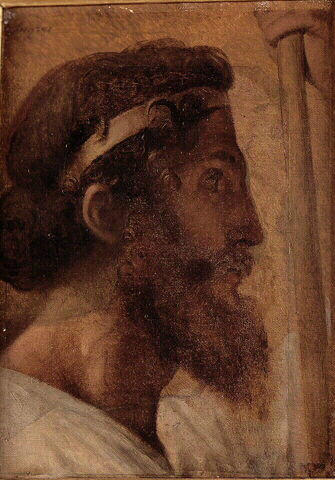
Ingres - Pisistratus head and left hand of Alcibiades, 1824-1834.jpg
From here