In honor of the correct outcome, here’s how they all died, according to tradition.
Valerius Maximus, Memorable Words and Deeds 9.12
“Aeschylus did not meet a willing death, but it is worth mentioning because of its novelty. As he was leaving the walls where he was staying in Italy, he stopped in a sunny spot. An eagle who was flying above him carrying a tortoise was tricked by his shining skull—for he had no hair—and it dropped it on him as if he were a stone so that it might eat the flesh from the broken shell. By that strike, the origin and font of a better type of tragedy was extinct.”
[….]
“But Euripides’ death was a bit more savage. As he was returning from dinner with Archelaus to the place where he was staying in Macedonia, he died, lacerated by the bites of dogs. Such a genius did not merit this cruel fate.”
[…]
“When Sophocles was extremely old, and he had entered a tragedy competition, he was agitated for too long over the uncertain outcome of the vote, but when he was the winner by a single vote, his joy was the cause of his death.”
Aeschyli vero poetae excessus quem ad modum non voluntarius sic propter novitatem casus referendus. in Sicilia moenibus urbis, in qua morabatur, egressus aprico in loco resedit. super quem aquila testudinem ferens elusa splendore capitis—erat enim capillis vacuum—perinde atque lapidi eam illisit, ut fractae carne vesceretur, eoque ictu origo et principium <per>fectioris tragoediae exstinctum est.
Sed atrocius aliquanto Euripides finitus est: ab Archelai enim regis cena in Macedonia domum hospitalem repetens, canum morsibus laniatus obiit: crudelitas fati tanto ingenio non debita.
Sophocles ultimae iam senectutis, cum in certamen tragoediam demisisset, ancipiti sententiarum eventu diu sollicitus, aliquando tamen una sententia victor causam mortis gaudium habuit.
Some lines from the Gnomologium Vaticanum
404
“When Menander was asked what the difference was between Sophokles and Euripides he said that Sophokles makes people feel pleasure while Euripides makes his audience feel anger.”
“When he was asked why he made people with noble characters and Euripides made those of base ones, Sophokles answered “Because I make people how they should be and he makes people as they are.”
“Celsus Albinovanus: Hello! I hope this finds you well.
Muse, take this message to Nero’s friend and secretary,
Should he ask how I’m doing, tell him that even though I threatened
Many fine things, I don’t live rightly or pleasantly.
And this isn’t because hail ruined my vines or heat shrank my olives
Or because my flock is getting sick in a far-away field.
No, it’s that my mind is less well than any part of my body.
I don’t want to listen or learn about anything that relieves the disease.
I start fights with doctors; I fly into a rage with friends
Over why they want to get me out of this deadly funk.
I keep stalking what hurt me, I avoid anything I suspect will help.
I flit back and forth, wanting the Tibur in Rome and in Rome the Tibur.
After that, ask him if he’s well, how he and his stuff are,
How his standing is with the young man and his crew.
If he says “well”, first, rejoice! But then
Leave this reminder in his little ears:
“As you bear fortune, Celsus, we’ll bear you.”
Celso gaudere et bene rem gerere Albinovano
Musa rogata refer, comiti scribaeque Neronis.
si quaeret quid agam, dic multa et pulchra minantem
vivere nec recte nec suaviter; haud quia grando
contuderit vitis oleamque momorderit aestus,
nec quia longinquis armentum aegrotet in agris;
sed quia mente minus validus quam corpore toto
nil audire velim, nil discere, quod levet aegrum;
fidis offendar medicis, irascar amicis,
cur me funesto properent arcere veterno;
quae nocuere sequar, fugiam quae profore credam;
Romae Tibur amem ventosus, Tibure Romam.
Post haec, ut valeat, quo pacto rem gerat et se,
ut placeat iuveni percontare utque cohorti.
si dicet, “recte,” primum gaudere, subinde
praeceptum auriculis hoc instillare memento:
“ut tu fortunam, sic nos te, Celse, feremus.”
Recently, my dearest Marrasio, when among some of the most distinguished youths dedicated to humanistic study, I praised Homer in the highest terms and said that it was not only in his great works (which usually offer a field for even the mediocre orator or poet), but even in the war of the frogs and mice which he devised as a young man, he showed how much power of intellect he possessed, they entreated me with prayers and force to translate the Batrachomyomachia into Latin and – if it was not possible in verse – to at least render it into prose. And so, since I could in no way resist their pleading, I set about translating it free from all metrical concern. But when I had translated only a few verses, the speech seemed to me so rough and poorly composed that none of it appeared to be sweet or elegant or even to sound like Homer. And so I changed my plan and called upon the Muses to give me a little bit of inspiration and to sprinkle my lips, if not with the sacred waters of Parnassus, at least with the drops of that fountain of Gaius, about which you recently wrote so many delightful elegies. And if suddenly, I would become a poet from a crow (as he said), I promised a whole hecatomb to them.
On the next night, I dreamt that I was taken up on the Muses’ lap and then submerged in the fountain of Gaius, and for that reason when I woke up a little later, I rushed with swiftness of mind to writing and I rendered this little work into our own language. If anything seems elegant in it, attribute it to Homer, the most excellent of all poets, especially in those waves with which you say that your own poems are drenched. But if you come upon anything inept, you can be sure that it was mine.
But I joke too much. It does not escape me that Plutarch thought that these things did not seem to be the work of Homer, because he thought that it would redound to the praise of this most renowned poet if nothing were ascribed to his authorship but those two outstanding poems, of in one of which he sang about the Trojan War, and in the other of which he sand the wanderings of Ulysses. And for that reason, he denied that the Margites was composed by Homer. He made no mention of the Hymns, but I do not see why the opinion of those who ascribe these poems to Homer cannot be true. For if our own Vergil wrote the Culex, the Copa, and some other things for the sake of exercising his talent so that he could finally sing about pastors, fields, and horrid wars, what wonder is it that Homer played around with this kind of work before the Trojan War, especially since the elegance of the language seems hardly discordant with the tone of that noble work. For although it seems laudable to write great things, it is hardly absurd to exercise oneself in small matters, and indeed, ‘I am not doubtful in my mind to say in words how great it is and to add honor to small things.’ For, as the most excellent poet writes, ‘in a small thing, there is labor but no small glory.’
But this should hardly seem amazing to us, if we consider what kind of controversy about this work there is among the learned, since we see that there are so many different opinions about the birth, life, and country of Homer himself. If you consult Ephorus about his fatherland, he says he was Cumaean; if you look to Pindar, the prince of the lyric poets, he will say he’s Smyrnaean now and Chian another time; if you ask Antimachus and Nicander, they will think that he comes from Colophon; if you go to Aristarchys and Dionysius Thrax, they will hardly hesitate to say that he is Athenian; and though Simonides says he’s from Chios, and Aristotle says the same, there are those who grant that he may be from Cyrpus, Salamis, or Argos. Similarly, there are just as many different opinions about when he was born or who his parents were, that it would be more to the point to affirm nothing about Homer than to offer any opinions about him.
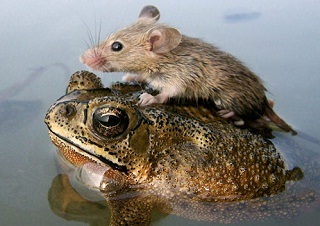
“Was this the ride that began the crab-claw clips?”
Nuper, suavissime Marrasi, quom apud quosdam praestantissimos iuvenes studiis humanitatis mirifice deditos Homerum summopere laudassem dixissemque eum non solum in rebus magnis, quae mediocri oratori vel poetae maximum orationis campum praestare solent, verum etiam in eo bello quod adolescens de ranis muribusque finxit quantum iam ingenio valeret ostendisse, et precibus et vi a me exegerunt ut id in Latinum converterem ac, si non valerem versu, saltem id, quoquo modo possem, soluta oratione transferrem. Itaque, cum eorum studiis nullo pacto obsistere quirem, liber omni pede id traducere aggressus sum; sed, cum perpaucos transtulissem versus, ita ea oratio incondita et incomposita mihi visa est, ut nihil suave, nihil elegans, nihil denique Homericum resonare videretur. Itaque mutato consilio, Musas invocavi, ut mihi aliquantulum aspirarent meaque labra si non Parnasi sacris undis, saltem lymphis illius Gaii fontis, de quo nuper quam plures suavissimos elegos edidisti, aspergerent. Ac si repente ex corvo (ut inquit ille) poeta prodirem, eis hecatombem pollicitus sum. Proxima deinde nocte in somnis mihi visum est Musarum gremio sublatum in Gaio fonte esse demersum, quamobrem paulo post experrectus, alacri animo ad scribendum accessi et hoc opusculum in nostram linguam transtuli. In quo si quid elegans visum fuerit, tum Homero, omnium poetarum praestantissimo, tuo maxime illis undis, quibus tua carmina uda esse dicis, attribuito; sin autem aliquid ineptum offenderis, id a me editum esse credas. Sed iam diu tecum iocor. Non tamen me latet videri Plutarcho haec Homero non esse tribuenda, putavit enim, ut arbitror, hanc clarissimi poetae summam fore laudem, si nihil illius nomine inscriberetur praeter illa duo egregia poemata, quorum altero bellum Troianum, altero Ulixis varios errores cecinit. Itaque et hoc et Margitem Homeri esse negavit; de Hymnis vero nullam fecit mentionem, sed non video cur sententia eorum qui haec Homero ascribunt vera esse non possit. Nam si noster Maro Culicem, Copam nonnullaque alia exercendi ingenii gratia scripsit, ut tandem pastores, agros horrendaque bella caneret, quid mirum Homerum hoc opere bello Troiano praelusisse, praesertim quom verborum elegantia ab illo praeclaro opere minime dissentire videatur? Quamvis enim laudabile sit res magnas scribere,in parvis tamen aliquando se exercere haud absurdum est, et enim “non sum animi dubius verbis ea dicere magnum / quam sit et angustis hunc addere rebus honorem”. Nam, ut inquit praestantissimus poeta, “in tenui labor at tenuis non gloria”. Sed minime mirum nobis videri debet, si de hoc opere inter doctos aliquod certamen sit, quom de genere, de vita, de patria denique ipsius Homeri tam varias sententias esse videamus. Nam si ab Ephoro patriam quaeras, Cumaeum esse dicet; si a Pindaro omnium liricorum principe, tum Smyrnaeum tum Chium asseverabit; si ab Antimacho et Nicandro, Colophonium censebunt; sin autem ab Aristarcho et Dionysio Thracio, haud dubitabunt Atheniesem dicere; demum quom Simonides Chium, Aristoteles item fuisse scribat, non desunt qui eum ex Cypro, Salaminium aut Argivum esse concedant, qua item tempestate quibusve parentibus fuerit, tam variae sententiae sunt, ut satius sit de eo nihil affirmare quam tam diversas de eo opiniones proferre.
“While I should tell all the tales, in no age
Has anyone been sent to a more horrible place so far from their home.
For this reason, let your wisdom overlook someone in sorrow
Who does not do so much of what you ask in your words.
I still confess that if my wounds could heal
Then they could heal only with your orders.
But I fear that you pointlessly labor to help me
And that your aid will not heal my sick ruin.
I do not claim these things because I have special wisdom,
But I am more familiar with myself than a doctor.
Despite all this, your willing kindness has come to me
Just when I needed something good.”
persequar ut cunctos, nulli datus omnibus aevis
tam procul a patria est horridiorve locus.
quo magis ignoscat sapientia vestra dolenti
qui facit ex dictis, non ita multa, tuis.
nec tamen infitior, si possint nostra coire
vulnera, praeceptis posse coire tuis.
sed vereor ne me frustra servare labores
nec iuver admota perditus aeger ope.
nec loquor haec, quia sit maior prudentia nobis,
sed sum quam medico notior ipse mihi.
ut tamen hoc ita sit, munus tua grande voluntas
ad me pervenit consuliturque boni.
Thomas Nashe, To the Gentlemen Students of Both Universities
But least I might seeme with these night crowes “Nimis curiosus in aliena republica,” I’le turne backe to my first text, of studies of delight, and talke a little in friendship with a few of our triviall translators. It is a common practise now a daies amongst a sort of shifting companions, that runne through every arte and thrive by none, to leave the trade of “Noverint,” whereto they were borne, and busie themselves with the indevors of Art, that could scarcelie latinize their necke-verse if they should have neede; yet English Seneca read by candle light yeeldes manie good sentences, as “Bloud is a begger,” and so foorth: and, if you intreate him faire in a frostie morning, he will affoord you whole Hamlets, I should say handfulls of tragical speaches.
But O griefe! “tempus edax rerum,” what’s that will last alwaies? The sea exhaled by droppes will in continuance be drie, and Seneca let bloud line by line and page by page, at length must needes die to our stage: which makes his famisht followers to imitate the Kidde in Aesop, who, enamored with the Foxes newfangles, forsooke all hopes of life to leape into a new occupation; and these men renowncing all possibilities of credit or estimation, to intermeddle with Italian translations: wherein how poorelie they have plodded (as those that are neither provenzall men nor are able to distinguish of Articles,) let all indifferent Gentlemen that have travailed in that tongue discerne by their twopenie pamphlets: and no mervaile though their home-born mediocritie be such in this matter; for what can be hoped of those, that thrust Elisium into hell, and have not learned so long as they have hued in the spheares, the just measure of the Horizon without an hexameter.
It is extremely curious to me to find that from my earliest years, whatever stuff I might be writing myself, or whatever nonsense I might be thinking, I never liked a bad book — and even began very early indeed to rank the good ones at their true value. I sometimes disliked, or did not value, a good one — yet never without some right cause. Both Virgil and Milton were too rhetorical and parasitical for me; Sophocles I found dismal, and in subject disgusting, Tacitus too hard, Terence dull and stupid beyond patience ; — but I loved my Plato from the first line I read — knew my Ethics for what they were worth, (which is not much) and detested with all my heart and wit the accursed and rascally Rhetoric, — which my being compelled to work at gave me a mortal contempt for the whole University system, which little helped my Oxford labours in general.
The quantity of that work which my being able already so to judge of all these books meant, must have been considerable, and partly accounts for my having no spare energy for the pursuit of such English history as the buildings of Oxford and its within-walk district ought to have provoked me, and pleaded with me, to know. If any of my tutors had only had the sense to stop off the books I did not like, see that I mastered the dialects of those I did, and taken two or three summer afternoon walks with me to Godstow and Abingdon, telling me what the places meant, I count that it would have saved me good seven years of strong life, spent in finding out for myself what I might have been told in a summer term.
*[From manuscript, deleted in published edition, but found in The Works of John Ruskin (Library Edition) Vol. XXXV]
Thomas Nashe, To the Gentlemen Students of Both Universities:
Who ever my private opinion condemneth as faultie, Master Gascoigne is not to bee abridged of his deserved esteeme, who first beate the path to that perfection which our best Poets have aspired too since his departure; whereto he did ascend by comparing the Italian with the English, as Tullie did “Graeca cum Latinis.” Neither was Master Turbervile the worst of his time, although in translating he attributed too much to the necessitie of rime. And in this page of praise, I cannot omit aged Arthur Golding, for his industrious toile in Englishing Ovids Metamorphosis, besides manie other exquisite editions of Divinitie, turned by him out of the French tongue into our own.
Master Phaer likewise is not to be forgot in regard of his famous Virgil, whose heavenly verse had it not bin blemisht by his hautie thoghts England might have long insulted in his wit, and “corrigat qui potest” have been subscribed to his workes. But fortune the Mistres of change with a pitying compassion respecting Master Stanihursts praise, would that Phaer shoulde fall that hee might rise, whose heroicall Poetrie infired, I should say inspired, with an hexameter furie, recalled to life whatever hissed barbarisme hath bin buried this hundred yeare; and revived by his ragged quill such carterlie varietie, as no hodge plowman in a countrie but would have held as the extremitie of clownerie; a patterne whereof, I will propounde to your judgements, as neere as I can, being parte of one of his descriptions of a tempest, which is thus:
Then did he make heavens vault to rebounde, with rounce robble hobble
Of ruffle raffe roaring, with thwick thwack thurlery bouncing.
Which strange language of the firmament never subject before to our common phrase, makes us that are not used to terminate heavens moveings, in the accents of any voice, esteeme of their triobulare interpreter, as of some Thrasonical huffe snuffe, for so terrible was his stile, to all milde eares, as would have affrighted our peaceable Poets, from intermedling hereafter with that quarrelling kinde of verse; had not sweete Master France, by his excellent translation of Master Thomas Watsons sugred Amintas, animated their dulled spirits to such high witted endevors.
But I knowe not how, their over timerous cowardise, hath stoode in awe of envie, that no man since him durst imitate any of the worste, of those Romane wonders in english, which makes me thinke that either the lovers of medocritie are verie many, or that the number of good Poets, are very small: and in trueth, (Master Watson except, whom I mentioned before) I knowe not almost any of late dayes that hath shewed himselfe singular in any speciall Latin Poem, whose Amintas, and translated Antigone may march in equipage of honour with any of our ancient Poets.
“This thing alone had to be mourned the most,
This lamented: how when anyone would give up
when they realized they had contracted the disease
As condemned to die, they would stretch out with a sad heart,
Surrendering their spirit while considering the rites of the dead.
For the spread of that greedy sickness did not stop
Even for a single moment from one to another,
Thick together as woolly flocks and horned heads—
That’s the reason why grave was piling on grave.
Whoever was reluctant to see their own sick,
For this very excessive love of life and fear of death
They were punished eventually with a foul and evil end,
As deserters without help, paid back for their neglect.
But those who stayed to help faced contagion too,
And the suffering which shame compelled them to meet.
The pleading voice of the weary mixed with cries of complaint.
Well, the best kinds of souls met death like this.
…Then some falling upon others, fighting to bury their masses
Of dead, worn out by tears and grief as they returned.
They surrendered to their beds for the better part.
No one could be found anywhere who was untouched by the disease
By the death, by the sorrow of times like these.”
Illud in his rebus miserandum magnopere unum
aerumnabile erat, quod ubi se quisque videbat
implicitum morbo, morti damnatus ut esset,
deficiens animo maesto cum corde iacebat,
funera respectans animam amittebat ibidem.
quippe etenim nullo cessabant tempore apisci
ex aliis alios avidi contagia morbi,
lanigeras tamquam pecudes et bucera saecla;
idque vel in primis cumulabat funere funus.
nam quicumque suos fugitabant visere ad aegros,
vitai nimium cupidos mortisque timentis
poenibat paulo post turpi morte malaque,
desertos, opis expertis, incuria mactans.
qui fuerant autem praesto, contagibus ibant
atque labore, pudor quem tum cogebat obire
blandaque lassorum vox mixta voce querellae.
optimus hoc leti genus ergo quisque subibat.
. . . . . . .
inque aliis alium, populum sepelire suorum
certantes; lacrimis lassi luctuque redibant;
inde bonam partem in lectum maerore dabantur.
nec poterat quisquam reperiri, quem neque morbus
nec mors nec luctus temptaret tempore tali.
One must think differently about grief, to be sure, differently from the Stoics, who call themselves manly men because they don’t want to be seen to feel pain, if they are – as I said above – understood correctly. While they produce a resplendent speech ornamented with magnificent words, they seem to abandon and forget about nature and the matter at hand. For that reason, Dionysius of Heraclea argued against them in the most excellent way. He had been a student of Zeno, and had drunk deep of the learning of the Stoics, but finally when his kidneys were racked with pain, he said that everything he learned in the Stoa was a lie, while his fellow student Cleanthes stood nearby and called Zeno back from hell with this line: Do you hear this under the earth, Amphiaraus?
Aliter profecto, aliter quam Stoici, qui etiam propterea quod dolere videri nolunt se appellant masculos, aliter, inquam, de dolore, si recte, ut supra dixi, interpretantur, sentiendum est. Afferunt enim praeclaram duntaxat quandam magnificisque ornatam verbis orationem, rem autem ipsam ac naturam deserere obliviscique videntur. Quapropter et Dionysius ille Heracleotes optime illos arguit. Cum enim fuisset Zenonis discipulus Stoicorumque disciplinam imbibisset, tandem vero renum vexaretur doloribus, falsa illa esse omnino quae in porticu didicisset asserebat, astante etiam atque acclamante condiscipulo eius Cleanthe Zenonemque ipsum tragico versu ab inferis excitante: ‘Audisne haec sub terra, Amphiaraè abdite?”
“But as soon as pleasure, spent, comes to its goal
And bodies lie thoroughly exhausted with the mind
When it gets annoying and you prefer to have touched no girl
And you seem unlikely to touch one again for a while,
Then gather in your mind whatever faults are in her flesh
And hold each of her imperfections in your eyes.
Perhaps someone else will consider them small—as they are,
But what is no advantage alone aids in numbers.
A viper slays a giant bull will a small bite;
A boar is often held by a hound of no great size.
Make sure you fight with such a number: collect your judgments,
A mountain will grow from so much sand.”
At simul ad metas venit finita voluptas,
Lassaque cum tota corpora mente iacent,
Dum piget, et malis nullam tetigisse puellam,
Tacturusque tibi non videare diu,
Tunc animo signa, quaecumque in corpore menda est,
Luminaque in vitiis illius usque tene.
Forsitan haec aliquis (nam sunt quoque) parva vocabit,
Sed, quae non prosunt singula, multa iuvant.
Parva necat morsu spatiosum vipera taurum:
A cane non magno saepe tenetur aper.
Tu tantum numero pugna, praeceptaque in unum
Contrahe: de multis grandis acervus erit.
Homeric Hymn to Aphrodite, 168–176
“But when the shepherds gather back to the fold
Their cattle and strong sheep from the blooming meadows,
Then over Anchises she was pouring sweet sleep
Gently and she wrapped her shining cloths around her.
Once clothed well over her entire body, the shining goddess
Stood near the bed, and her head touched the well-made roof,
And the immortal beauty shone from her cheeks
As it does from well-crowned Kytherea.
And she woke him from sleep and spoke his name:
“Get up, Dardanian. Why do you still stretch out in deep sleep?…”








#/media/File:Palermo-trionfo-della-morte-bjs.jpg)
