I’m Not A Dictator, But…

Augustus, Res Gestae 30

“Even though the Roman people and the senate offered me the dictatorship when I was absent and there too, during the consulship of Marcellus and Lucius Arruntius, I did not accept it.

I did not refuse the control of the grain supply when there was the most severe scarcity. I did this in such a way that after a few days I relieved the people of the fear and peril they found themselves at my own cost. I also did not accept the consulship when it was offered to me for a year or forever.”

 (Dictatura)m et apsent(i et praesenti a populo et senatu Romano mihi oblatam2) | (M. Marce)llo e(t) L. Ar(runtio consulibus non accepi. Non recusavi in Summa) | (frumenti p)enuri(a c)uratio(ne)m an(nonae, qu)am ita ad(ministravi, ut intra) | (paucos die)s metu et per(i)c(lo praesenti populu)m univ(ersum meis im-)ǁ (pensis liberarem). § Con(sulatum tum dat)um annuum e(t perpetuum non) | (accepi.) |

Αὐτεξούσιόν μοι ἀρχὴν καὶ ἀπόντι καὶ παρόντι | διδομένην (ὑ)πό. τε τοῦ δήμου καὶ τῆς συνκλήτου | Μ(άρκ)ωι (Μ)αρκέλλωι καὶ Λευκίωι 5Ἀρρουντίωι ὑπάτοις ǁ ο(ὐκ ἐδ)εξάμην. § Οὐ παρῃτησάμην ἐν τῆι μεγίστηι | (τοῦ) σ(είτ)ου σπάνει τὴν ἐπιμέλειαν τῆς ἀγορᾶς, ἣν οὕ|(τως ἐπετήδευ)σα, ὥστ᾿ ἐν ὀλίγαις ἡμέρα(ις το)ῦ παρόντος | φόβου καὶ κι(νδ)ύνου ταῖς ἐμαῖς δαπάναις τὸν δῆμον | ἐλευθερῶσα(ι). Ὑπατείαν τέ μοι τότε 10δι(δ)ομένην καὶ ǁ ἐ(ν)ιαύσιον κα(ὶ δ)ι(ὰ) βίου οὐκ ἐδεξάμην.

Vatican:
Augustus of Prima Porta (inv. 2290)

Reading Like a Scholar (i.e. Like a Boss)

Celio Calcagnini, Letter to Tommaso Calcagnini:

“For my part, whatever I read, whatever I think, I store it in the storehouses of my mind as if I were about to bring it forth for the use of human activity. And since I think that it is too difficult to excerpt everything separately, I put many things into a commentary, or write it separately on a little sheet. But in the margin, I make compendious notes, separate from the text, of everything which seems worth of some notice. If any of these things really stand out as particularly capital or excellent, I place them in the peak (or one might say the crown) of the margin. From this practice springs some utility, allowing me to reconsider several volumes within the space of an hour and a half. I once tried to wrangle Pliny’s Natural History into an epitome, since I always burned with wondrous desire for that author. But undoubtedly I acted the fool, because I ended up copying out almost everything in Pliny.”

CALCAGNINI CELIO

Ego profecto quicquid lego, quicquid meditor, ita omne in arcanis animi recondo, quasi mox ad usum humanarum actionum expositurus. Et quoniam arduum nimis reor omnia seorsum excerpere, multa sane in commentarium refero, aut seorsum in pagella exscribo. Sed in margine compendiose omnia, quae digna sunt aliqua animadversione, sepono: quod siqua praestant, quasi coryphaea et optimatia in summa marginis coronide. Hinc ea mihi utilitas nascitur, ut vel sesquihora multa possim volumina recognoscere. Tentavi aliquando Plinii Naturalem Historiam in epitomen revocare, quando eius autoris mira semper cupidine exarsi: sed rem sine controversia ridiculam feci, qui omnem ferme Plinium exscripserim.

Chief Minister of Bullsh*t

Cicero, Letters to Atticus 92 (4.18) October or November 54

You may ask me “how are you handling these things?” By god, pretty damn well and I love myself for doing so. My friend, we have not only lost the marrow and blood of a just state, but we’ve lost its decoration and facade too.

There is no Republic where I might find happiness or comfort. You may ask, “Can you really take this well?” Yes. That’s it. I recall how well the state thrived when I was governing it and the gratitude it gave me. No grief touches me at all at seeing one person capable of everything. Those who were upset that I had any power are wrecked by it.

No, I have many things to bring me solace. But I do not move from where I am, instead I return to that way of life which is most natural, to my books and my research.”

Dices ‘tu ergo haec quo modo fers?’ belle mehercule et in eo me valde amo. amisimus, mi Pomponi, omnem non modo sucum ac sanguinem sed etiam colorem et speciem pristinae civitatis. nulla est res publica quae delectet, in qua acquiescam. ‘idne igitur’ inquies ‘facile fers?’ id ipsum. recordor enim quam bella paulisper nobis gubernantibus civitas fuerit, quae mihi gratia relata sit. nullus dolor me angit unum omnia posse; dirumpuntur ii qui me aliquid posse doluerunt. multa mihi dant solacia, nec tamen ego de meo statu demigro, quaeque vita maxime est ad naturam, ad eam me refero, ad litteras et studia nostra.

Carved bust of Cicero 

* Peacocks! * Pythagoras! * Homer! * Ennius! * (Featuring the Loser Euphorbus)

Cornutus, Commentary on Persius 6.10:

Thus writes Ennius in the beginning of his Annals, where he says that in a dream he saw Homer claiming that he had once been a peacock, and that his soul had been transferred from there into Ennius according to the doctrine of Pythagoras, who said that human souls, through a process of palingenesis (that is, a repeated birth) are able to enter new bodies as they leave their old ones behind. He used the phrase ‘the fifth’ in accordance with the opinion that the soul of Pythagoras was moved into a peacock, from the peacock to Euphorbius, from Euphorbius to Homer, and from Homer to Ennius. Or, to be sure, he said ‘the fifth’ because Ennius was named Quintus.

A large presence of the peacock in Roman mosaics

sic Ennius in Annalium suorum principio, ubi se dicit vidisse in somnis Homerum dicentem fuisse quondam pavonem et ex eo translatam in se animam esse secundum Pytagorae philosophi definitionem, qui dicit animas humanas per palingenesiam, id est per iteratam generationem, exeuntes de corporibus in alia posse corpora introire. ideo autem, “quintus” dixit propter eam opinionem quae dicit animam Pytagorae in pavonem translatam, de pavone vero ad Euphorbium, de Euphorbio ad Homerum, de Homero autem ad Ennium. vel certe quod cognomento Ennius dicitur.

Sidelined from Writing by Pain

Fronto to Praecilius Pompeianus [Ad Amicos, i. 15 (Naber, p. 184).]

“In the intervening period, the neuritis overtook me even more powerful than usual, and it has lasted longer and been harder to bear than is typical. I am not able to pay any attention to letters that need to be written and read when my limbs hurt so much. And I have not as yet dared to expect so much from myself.

When those magnificent specimens of philosophers make the claim that the wise man would still be happy even if he were trapped in the Bull of Phalaris, it is easier for me to believe that he could be happy than he would be able to think carefully about some introduction or turn a pithy phrase all while roasting within the brass.”

Interea nervorum dolor solito vehementior me invasit, et diutius ac molestius solito remoratus est. Nec possum ego membris cruciantibus operam ullam litteris scribendis legendisque impendere; nec umquam istuc a me postulare ausus sum. Philosophis etiam mirificis hominibus dicentibus, sapientem virum etiam in Phalaridis tauro inclusum beatum nihilominus fore, facilius crediderim beatum eum fore quam posse tantisper amburenti in aheno prohoemium meditari aut epigrammata scribere.

What’s up with the bull? Check out the story here.

Image from here

Have We Tried Using Bay Leaves on Coronavirus?

From the annals of quack cures not to tell presidents about….

Pliny, Natural History 23. 157

“Some people have suggested using ten berries in a drink against scorpion stings. You can use the same to relieve a relaxed uvula: gargle quarter pound of berries or leaves reduced in three measure of water when it is still warm. To treat a headache, use an uneven number of berries crushed and warmed in oil. The leaves of the delphic bay, once pounded, may stop the spread of the plague if you smell them: this works even better when they are burned.”

quidam adversus scorpionum ictus decem bacas dari iubent potu, item et in remedio uvae iacentis quadrantem pondo bacarum foliorumve decoqui in aquae sextariis tribus ad tertias, eam calidam gargarizare et in capitis dolore inpari numero bacas cum oleo conterere et calfacere.  laurus Delphicae folia trita olfactaque subinde pestilentiae contagia prohibent, tanto magis si et urantur.

There’s a new version of Perseus using the Scaife viewer: check out the passages here.

Murofamy: More Rat Facts

Plutarch, Natural Phenomena 4 912 F

“Cargoes of salt on ships generate rats because of their frequent copulation.”

καὶ τὰ ἁληγὰ τῶν πλοίων πλείους τρέφει μῦς διὰ τὸ πολλάκις συμπλέκεσθαι.


Pliny, Natural History 44.116

“The smoke of a yew tree kills rodents.”

taxi arboris fumus necat mures.


Plutarch, Table Talk 5 685 E

“Salt-ferrying vessels produce an endless multitude of rats—as some people claim—because the female rats get pregnant without intercourse whenever they lick the salt.”

τὰ δ᾿ ἁληγὰ πλοῖα πλῆθος ἐκφύει μυῶν ἄπλετον, ὡς μὲν ἔνιοι λέγουσι, τῶν θηλειῶν καὶ Eδίχα συνουσίας κυουσῶν, ὅταν τὸν ἅλα λείχωσιν·


Aelian, On the Nature of Animals 17.17

“Amyntas in his work which he named Stages writes that in the Caspian land there are many herds of cattle and horses almost beyond counting. He adds this as well, that in some seasons an unconquerable plague of rats blights the land. He continues with evidence, saying that even though the rivers flow at that of year with a huge surge, the rats swim fearlessly and they even hold on to each other’s tales, biting down on one another, to form a bridge and they they cross the strait in this way.

After swimming into the farmland, he says, they grind down the roots of crops and swarm over trees and once they use their fruits for their meals they sever the branches too just because they are not able to eat them. For this reason, the Caspians—in order to ward off this invasion of rats and the ruin they bring—do not kill the predatory birds which come in turn, flying down from the clouds, and fulfill their nature by freeing the Caspians of this plague.

Caspian foxes are so numerous that they frequent both the sheepfolds in the country and they also appear in cities. By Zeus, a fox will show up in a house not to steal something or ruin it, but like some kind of pet. The Caspian foxes wag their tails just like pet dogs in our land.

The rats of the terrible plague afflicting the Caspians are almost the same in size when you look a them as the ikhneumenos of Egypt, but they are wild, and terrible, and they have teeth strong enough to cut and even eat metal. The rats in Teridon, Babylonia are like this too—and traders bring their skins to sell among the Persians. Indeed, these skins are soft and can be sewn together as a tunic to warm people. And they call them kandutanes, because it is dear to them.

Here is something amazing about these rats: if a pregnant female is caught and her fetus is removed, when the female fetus is dissected and examined, it also has a baby.”

᾽Αμύντας ἐν τοῖς ἐπιγραφομένοις οὕτως ὑπ᾽ αὐτοῦ Σταθμοῖς κατὰ τὴν γῆν τὴν Κασπίαν καὶ βοῶν ἀγέλας λέγει πολλὰς καὶ κρείττονας ἀριθμοῦ εἶναι καὶ ἵππων. ἐπιλέγει δὲ ἄρα καὶ ἐκεῖνο, ἐν ὡρῶν τισι περιτροπαῖς μυῶν ἐπιδημίας γίνεσθαι πλῆθος ἄμαχον· καὶ τὸ μαρτύριον ἐπάγει λέγων, τῶν ποταμῶν τῶν ἀεννάων σὺν πολλῶι τῶι ῥοίζωι φερομένων, τοὺς δὲ καὶ μάλα ἀτρέπτως ἐπινήχεσθαί τε αὐτοῖς καὶ τὰς οὐρὰς ἀλλήλων ἐνδακόντας ἕρμα τοῦτο ἴσχειν, καὶ τοῦ διαβάλλειν τὸν πόρον σύνδεσμόν σφισιν ἰσχυρότατον ἀποφαίνει τόνδε.

ἐς τὰς ἀρούρας δὲ ἀπονηξάμενοι, φησί, καὶ τὰ λήια ὑποκείρουσι καὶ διὰ τῶν δένδρων ἀνέρπουσι καὶ τὰ ὡραῖα δεῖπνον ἔχουσι καὶ τοὺς κλάδους δὲ διακόπτουσιν, οὐδὲ ἐκείνους κατατραγεῖν ἀδυνατοῦντες. οὐκοῦν ἀμυνόμενοι οἱ Κάσπιοι τὴν ἐκ τῶν μυῶν ἐπιδρομήν τε ἅμα καὶ λύμην φείδονται τῶν γαμψωνύχων, οἵπερ οὖν καὶ αὐτοὶ κατὰ νέφη πετόμενοι εἶτα αὐτοὺς ἀνασπῶσιν, καὶ ἰδίαι τινὶ φύσει τοῖς Κασπίοις ἀναστέλλουσι τὸν λιμόν. ἀλώπηκες δὲ αἱ Κάσπιαι, τὸ πλῆθος αὐτῶν τοσοῦτόν ἐστιν ὡς καὶ ἐπιφοιτᾶν οὐ μόνον τοῖς αὐλίοις τοῖς κατὰ τοὺς ἀγρούς, ἤδη γε μὴν καὶ ἐς τὰς πόλεις παριέναι. καὶ ἐν οἰκίαι ἀλώπηξ φανεῖται οὐ μὰ Δία ἐπὶ λύμηι οὐδὲ ἁρπαγῆι, ἀλλὰ οἷα τιθασός· καὶ ὑποσαίνουσί τε αἱ Κάσπιοι καὶ ὑπαικάλλουσι τῶν παρ᾽ ἡμῖν κυνιδίων <δίκην>.

οἱ δὲ μύες οἱ τοῖς Κασπίοις ἐπίδημον ὄντες κακόν, μέγεθος αὐτῶν ὅσον κατά γε τοὺς Αἰγυπτίων ἰχνεύμονας ὁρᾶσθαι, ἄγριοι δὲ καὶ δεινοὶ καὶ καρτεροὶ τοὺς ὀδόντας, καὶ διακόψαι τε καὶ διατραγεῖν οἷοί τε εἰσὶ καὶ σίδηρον. τοιοῦτοι δὲ ἄρα καὶ οἱ μύες οἱ ἐν τῆι Τερηδόνι τῆς Βαβυλωνίας (F 7) εἰσίν, ὧνπερ οὖν καὶ τὰς δορὰς οἱ τούτων κάπηλοι ἐς Πέρσας ἄγουσι φόρτον. εἰσὶ δὲ ἁπαλαί, καὶ συνερραμέναι χιτῶνές τε ἅμα γίνονται καὶ ἀλεαίνουσιν αὐτούς. καλοῦνται δὲ ἄρα οὗτοι κανδυτᾶνες, ὡς ἐκείνοις φίλον.

θαυμάσαι δὲ τῶν μυῶν τῶνδε ἄξιον ἄρα καὶ τοῦτο· ἐὰν ἁλῶι μῦς κύουσα, κἆιτα ἐξαιρεθῆι τὸ ἔμβρυον, αὐτῆς δὲ διατμηθείσης ἐκείνης εἶτα μέντοι καὶ αὐτὸ διανοιχθῆι, καὶ ἐκεῖνο ἔχει βρέφος.

Rats

Have You Tried Stabbing the Coronavirus?

Pliny the Elder, Natural History 34.151

“There are other medicinal applications of iron beyond surgery. For when a circle is drawn around both adults and infants—or of they carry a sharp iron weapon with them—it is useful against poisonous drugs. Iron nails which have been taken out of tombs are useful protections against nightmares if they are hammered down before a threshold.

A small penetration with an iron weapon which has wounded a man is effective against sudden side and chest pains. Some afflictions are treated by cauterization, especially true for the bite of a rabid dog, since even when the disease has advanced and those afflicted are starting to exhibit fear of water, they experience relief at cauterization. The drinking of water which has been heated with burning iron is good for many symptoms, but especially for dysentery.”

XLIV. Medicina e ferro est et alia quam secandi. namque et circumscribi circulo terve circumlato mucrone et adultis et infantibus prodest contra noxia medicamenta, et praefixisse in limine evulsos sepulchris clavos adversus nocturnas lymphationes, pungique leviter mucrone, quo percussus homo sit, contra dolores laterum pectorumque subitos, qui punctionem adferant. quaedam ustione sanantur, privatim vero canis rabidi morsus, quippe etiam praevalente morbo expaventesque potum usta plaga ilico liberantur. calfit etiam ferro candente potus in multis vitiis, privatim vero dysentericis.

Bodleian Library, MS. Ashmole 1462, Folio 16r

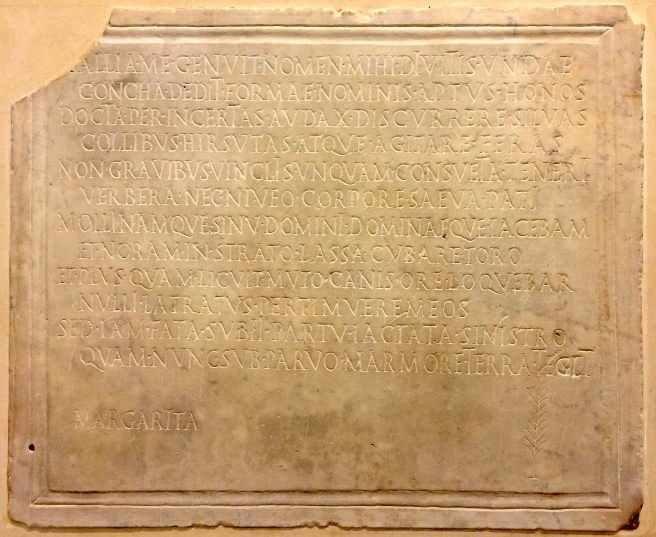
“What is Written Here is Brief”: Some Roman Memorials for Memorial Day

Some Archaic Latin Inscriptions from the Loeb Classical Library (the LCL numbers are first, translations are mine). There are earlier poetic epitaphs on this site as well, even legendary ones

Epitaphs 14 [CIL 1861]

“Here lies the sweet clown and slave of Clulius
Protogenes, who created many moments of happiness for people with his joking”

Protogenes Cloul[i] | suavis heicei situst | mimus
plouruma que | fecit populo soueis | gaudia nuges.

15 [CIL 1202]

“This monument was erected for Marcus Caecilius
We give you thanks, Friend, since you stopped by this home.
May you have good fortune and be well. Sleep without worry.”

Hoc est factum monumentum | Maarco Caicilio. |
Hospes, gratum est quom apud | meas restitistei seedes. |
Bene rem geras et valeas, | dormias sine qura.

18 [CIL 1211]

“Friend, what is written here is brief—stop and read it all.
This is the unattractive tomb of an attractive woman.
Her parents named her Claudia
She loved her own husband with her whole heart.
She had two sons and leaves one of them
On the earth, but placed the other beneath it.
[She was] charming in conversation; but proper in behavior.
She safeguarded her house. She made wool. I have said it all. Go.”

Hospes, quod deico paullum est; asta ac pellege.
Heic est sepulcrum hau pulcrum pulcrai feminae.
Nomen parentes nominarunt Claudiam.
Suom mareitom corde deilexit souo.
Gnatos duos creavit, horunc alterum
in terra linquit, alium sub terra locat.
Sermone lepido, tum autem incessu commodo.
Domum servavit, lanam fecit. Dixi. Abei.

39 [CIL 1219]

“Here are the bones of Pompeia the first daughter
Fortune promises a lot to many but makes a guarantee for no one.
Live for all days and all hours. For nothing is yours wholly.
Salvius and Heros donated this.”

Primae | Pompeiae | ossua heic.|
Fortuna spondet | multis, praestat nemini;
vive in dies | et horas, nam proprium est nihil. |
Salvius et Heros dant.

Image result for ancient roman epitaph

The Idle Vanity of Knowing Classical Passages

George Eliot, Middlemarch:

“Certainly this affair of his marriage with Miss Brooke touched him more nearly than it did any one of the persons who have hitherto shown their disapproval of it, and in the present stage of things I feel more tenderly towards his experience of success than towards the disappointment of the amiable Sir James. For in truth, as the day fixed for his marriage came nearer, Mr. Casaubon did not find his spirits rising; nor did the contemplation of that matrimonial garden scene, where, as all experience showed, the path was to be bordered with flowers, prove persistently more enchanting to him than the accustomed vaults where he walked taper in hand. He did not confess to himself, still less could he have breathed to another, his surprise that though he had won a lovely and noble-hearted girl he had not won delight,—which he had also regarded as an object to be found by search. It is true that he knew all the classical passages implying the contrary; but knowing classical passages, we find, is a mode of motion, which explains why they leave so little extra force for their personal application.

Poor Mr. Casaubon had imagined that his long studious bachelorhood had stored up for him a compound interest of enjoyment, and that large drafts on his affections would not fail to be honored; for we all of us, grave or light, get our thoughts entangled in metaphors, and act fatally on the strength of them. And now he was in danger of being saddened by the very conviction that his circumstances were unusually happy: there was nothing external by which he could account for a certain blankness of sensibility which came over him just when his expectant gladness should have been most lively, just when he exchanged the accustomed dulness of his Lowick library for his visits to the Grange. Here was a weary experience in which he was as utterly condemned to loneliness as in the despair which sometimes threatened him while toiling in the morass of authorship without seeming nearer to the goal. And his was that worst loneliness which would shrink from sympathy. He could not but wish that Dorothea should think him not less happy than the world would expect her successful suitor to be; and in relation to his authorship he leaned on her young trust and veneration, he liked to draw forth her fresh interest in listening, as a means of encouragement to himself: in talking to her he presented all his performance and intention with the reflected confidence of the pedagogue, and rid himself for the time of that chilling ideal audience which crowded his laborious uncreative hours with the vaporous pressure of Tartarean shades.”

Image result for scholar reading