“How I wish that you had invited me to that most sumptuous feast on the Ides of March! We would now have no little scraps if you had. But now you have with them such difficulty in preventing that divine benefit which you bestowed upon the Republic from exciting some complaint. But, though it is hardly right, I am on occasion angry with you, because it was by you – a noble man indeed – it was by you and by your good service that this pest [Marc Antony] was led away and still lives. Now you have left behind more trouble for me alone than for everyone else.”
Quam vellem ad illas pulcherrimas epulas me Idibus Martiis invitasses! reliquiarum nihil haberemus. at nunc cum iis tantum negoti est ut vestrum illud divinum <in> rem publicam beneficium non nullam habeat querelam. quod vero a te, viro optimo, seductus est tuoque beneficio adhuc vivit haec pestis, interdum, quod mihi vix fas est, tibi subirascor; mihi enim negoti plus reliquisti uni quam praeter me omnibus.
He [Petrarch] was one of the world’s great letter-writers. “I can’t stop writing letters unless I stop living,” he said. He put a high value on his messages. When one was ready, a secretary was put to copying it, and woe to him if he erred or blotted! He could not bear to have his missives disregarded. He wrote to Laelius: “You’ve been idle about answering my letters. Well, dukes and monarchs answer them.” A letter was mislaid; the whole house was in a turmoil for a day while everyone hunted it in vain. “It was sweet to write, sweeter to read over, and very bitter to remember.”
The contents are extremely varied, in both substance and in style. Some are cheery anecdotes of daily life, comic incidents, news of his doings, his friends, his garden, his reading. Some are reflections on current events, and some political exhortations to Emperors and Popes. Many are moral essays, satires, portraits, having little to do with the concerns of his correspondent. Indeed, they may have been written with no correspondent in mind, and have been sent off when a messenger turned up on his way to some city where a friend dwelt. Most of them are deliberately literary in character and style. The writer was looking beyond the immediate addressee to the ultimate recipient, posterity.
For the modern reader, temporary posterity, his work has many faults. He is often intolerably garrulous, repetitive, sententious, obtuse. Some of his letters of consolation, recommending stoic insensibility, must have caused angry tears to flow. He even tells Philippe de Cabassoles that the death of his brother should be rather an occasion for rejoicing than grief. He stuffs his letters with quotations from the Roman classics, which fortunately are easy to skip. But of course such quotations were more honored and less accessible then than now.
[Morris Bishop, Petrarch and His World (Indiana University Press, 1963) p. 280]
When several years earlier I had, for the kingdom of heaven, separated myself from home, from my parents, from my sister, from my relations, and – what is more difficult than this – from the habit of taking finer food, and as I was heading as a soldier to fight for Jerusalem, I found that I missed the library which I had created in Rome with the utmost zeal and labor. After depriving myself of sleep for several nights, and after the tears which the recollection of my past sings brought to my eyes, I took Plautus up in my hands. If ever I returned to myself and began to read the Prophets, their unrefined speech made my hair stand on end. And because I could not see the light with my blind eyes, I thought it was not the fault of those eyes, but of the sun. Thus while the ancient serpent deceived me, a fever spread through my marrow in the middle of Lent and waged war upon my exhausted body. And without any rest (which seems also incredible to say), it ate away at my wretched limbs to such a degree that I could barely cling to my bones. My funeral was being prepared, and the vital heat of my soul, with my whole body now freezing, remained beating only in my lukewarm little heart.
Suddenly, I was taken in spirit and dragged to the seat of a judge. There was so much light, so much shining from the clarity of those standing around, that I threw myself to the floor and did not dare to glance up. When asked about my condition, I responded that I was a Christian. And he who was presiding as judge said, ‘You lie! You are a Ciceronian, not a Christian. For where your treasure is, there too is your heart (Matth. 6.21).’ There I stood silent, and amidst my lashings, I thought over that little verse: “Who will grant anything to you in Hell?” (Ps. 6.6)
It starts with Cicero and ends with searing pain!
Cum ante annos plurimos domo, parentibus sorore, cognatis, et quod his difficilius est, consuetudine lautioris cibi, propter coelorum me regna castrassem, et Jerosolymam militaturus pergerem, Bibliotheca, quam mihi Romae summo studio ac labore confeceram, carere omnino non poteram. Itaque miser ego lecturus Tullium, jejunabam. Post noctium crebras vigilias, post lacrymas, quas mihi praeteritorum recordatio peccatorum ex imis visceribus eruebat, Plautus sumebatur in manus . Si quando in memetipsum reversus, Prophetas legere coepissem, sermo horrebat incultus; et quia lumen caecis oculis non videbam, non oculorum putabam culpam esse, sed solis. Dum ita me antiquus serpens [al. hostis] illuderet, in media ferme Quadragesima medullis infusa febris, corpus invasit exhaustum: et sine ulla requie (quod dictu quoque incredibile sit) sic infelicia membra depasta est, ut ossibus vix haererem. Interim parantur exequiae, et vitalis animae calor, toto frigescente jam corpore, in solo tantum tepente pectusculo palpitabat: Cum subito raptus in spiritu, ad tribunal judicis pertrahor; ubi tantum luminis, et tantum erat ex circumstantium claritate fulgoris, ut projectus in terram, sursum aspicere non auderem. Interrogatus de conditione, Christianum me esse respondi. Et ille qui praesidebat: Mentiris, ait, Ciceronianus es, non Christianus: ubi enim thesaurus tuus, ibi et cor tuum (Matth. 6. 21). Illico obmutui, et inter verbera (nam caedi me jusserat) conscientiae magis igne torquebar, illum mecum versiculum reputans: “In inferno autem quis confitebitur tibi” (Ps. 6. 6)
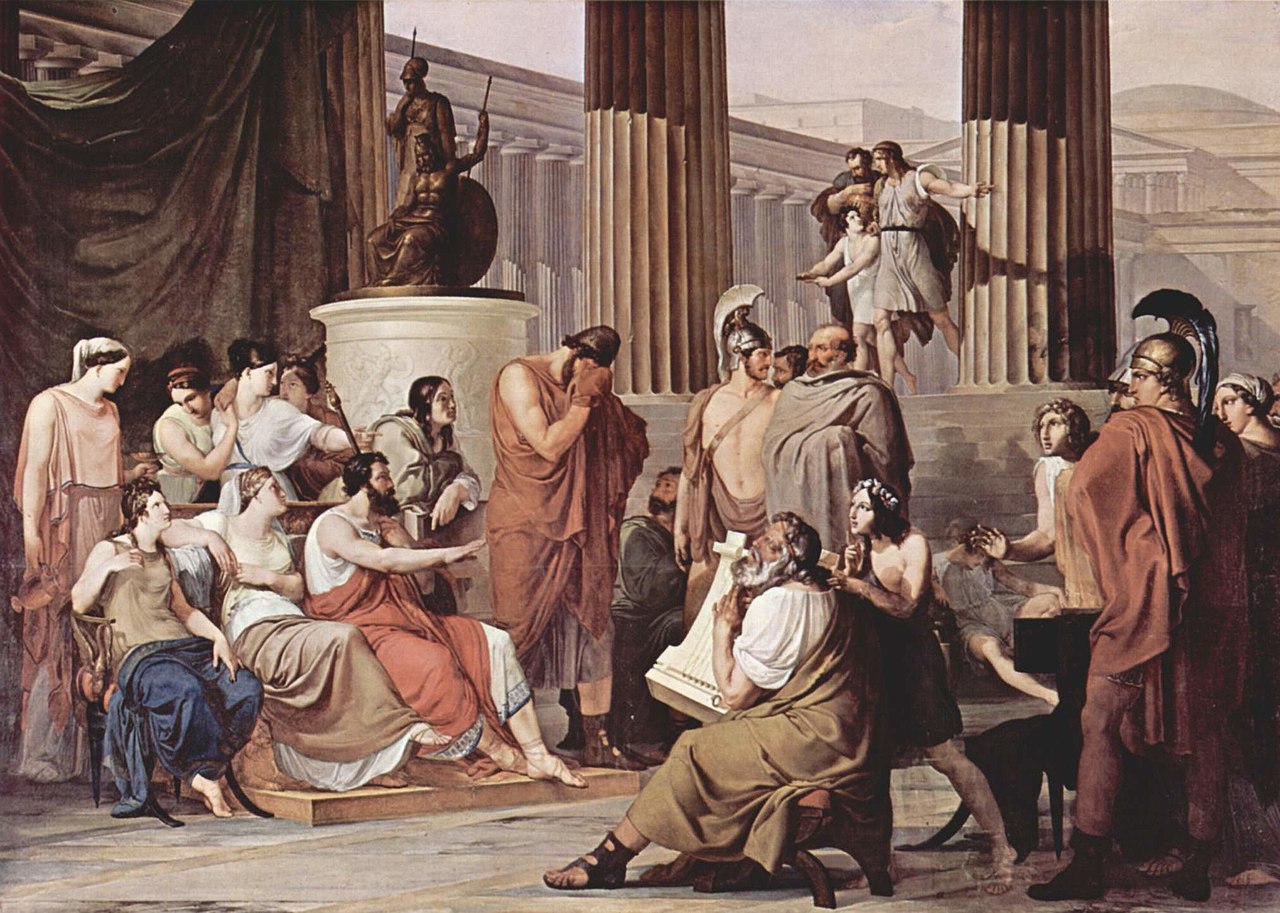
“At that time, poets spent their time among kings, and even earlier Anacreon found himself at the court of Polycrates of Samos, and both Aeschylus and Simonides went to Syracuse to visit Hiero. Philoxenus spent time with Dionysius, who was later tyrant in Sicily, while both Antagoras of Rhodes and Aratus of Soli kept company with Antigonus when he ruled the Macedonians. Either Hesiod and Homer happened not to chance upon any kings, or they willingly despised them; Hesiod would have done so from his innate rusticity and aversion to traveling, while Homer spent a lot of time abroad and set the aid accruing to him from the wealth of the powerful at less than the good opinion from the people, since we find even among Homer that Demodocus spent time in the court of Alcinous, and Agamemnon left behind a poet with his wife. There is a grave not far from the gates, on which there is a depiction of a soldier standing next to a horse: I don’t know who it is, but Praxiteles carved both the horse and the soldier.”
Francesco Hayez, Odysseus at the Court of Alcinous
They say that Simonides of Ceos and Pausanias the Spartan were once at a dinner party together, and when Pausanias urged Simonides to say something wise, that man of Ceos laughed and said, ‘Remember that you are just human.’ Pausanias paid little heed to this thought then, and set it down as essentially worthless, perhaps because he was already blinded by his eagerness for Medizing, or perhaps it is just as likely that he was carried away by the wine. But when it happened that he was in the Bronze House of Athena, struggling with hunger and about to die in the most wretched way possible, he remembered what old Simonides had said and cried out three times, ‘O stranger from Ceos, your advice was a great thing to have, but in my folly I thought that it was nothing.’
Petrarch, On His Own and Many Other People’s Ignorance (IV):
If I’m not mistaken, I have read all of Aristotle’s Ethics, and I even heard some of them in lectures. But before my ignorance was uncovered for all to see, I had seemed to understand a thing or two, and even appeared more learned than a few of these guys. But I did not, as was proper, find myself become a better person. I often complained to myself and others that in reality there was no fulfillment of that promise, which Aristotle himself had professed at the beginning of his Ethics, that we learn that whole branch of philosophy not for the sake of knowledge, but so that we can become good. To be sure, I see that old Aristotle defined, distinguished, and handled the subject of virtue well, and considered what was proper to virtue and what proper to vice. Since I learned all of that, I know a little bit more than I used to; but my mind is the same, my will is the same, and I am the same.
For it is one thing to know and another to love; one thing to understand and another to will. He teaches – I don’t deny it! – what virtue is. But the goads to virtue, the torches of words by which the mind if urged and inflamed to love of virtue and hatred of vice – reading Aristotle doesn’t have any of this, or has very little of it. If you want any of that stuff, you will find it in our authors, especially in Cicero and Seneca, and (though you might think it wild) even in Horace, who might have a rough pen, but is actually pretty delightful when you look at his thought.
What good will it do to know what virtue is if it isn’t loved once recognized? What good will the understanding of sin do if it isn’t shirked when recognized? I mean goddammit, if your will is depraved, the difficulty of virtue and the licentious ease of vice can impel a lazy and nodding soul into a worse state whenever it notes them. But one shouldn’t wonder if he is a bit sparing in exciting and straightening souls to virtue, since he once called Socrates, the father of ethical philosophy, a “morality merchant,” if I may use his words. And if we can trust Cicero, Aristotle even despised Socrates, though it seems that Socrates reciprocated the sentiment.**
** [This is a little hard to credit, given that Aristotle was born fifteen years after Socrates’ death. Cicero discusses enmity between Isocrates and Aristotle, so this is just a howler from half-digested reading.]
“And finally, when Aristotle is born, tell him that I hate him!”
Omnes morales, nisi fallor, Aristotilis libros legi, quosdam etiam audivi, et antequam hec tanta detegeretur ignorantia, intelligere aliquid visus eram, doctiorque his forsitan nonnunquam, sed non — qua decuit — melior factus ad me redii, et sepe mecum et quandoque cum aliis questus sum illud rebus non impleri, quod in primo Ethicorum philosophus idem ipse prefatus est, eam scilicet philosophie partem disci, non ut sciamus, sed ut boni fiamus. Video nempe virtutem ab illo egregie diffiniri et distingui tractarique acriter, et que cuique sunt propria, seu vitio, seu virtuti. Que cum didici, scio plusculum quam sciebam; idem tamen est animus qui fuerat, voluntasque eadem, idem ego.
Aliud est enim scire atque aliud amare, aliud intelligere atque aliud velle. Docet ille, non infitior, quid est virtus; at stimulos ac verborum faces, quibus ad amorem virtutis vitiique odium mens urgetur atque incenditur, lectio illa vel non habet, vel paucissimos habet. Quos qui querit, apud nostros, precipue Ciceronem atque Anneum, inveniet, et, quod quis mirabitur, apud Flaccum, poetam quidem stilo hispidum, sed sententiis periocundum.
Quid profuerit autem nosse quid est virtus, si cognita non ametur? Ad quid peccati notitia utilis, si cognitum non horretur? Imo hercle, si voluntas prava est, potest virtutum difficultas et vitiorum illecebrosa facilitas, ubi innotuerit, in peiorem partem pigrum nutantemque animum impellere. Neque est mirari si in excitandis atque erigendis ad virtutem animis sit parcior, qui parentem philosophie huius Socratem «circa moralia negotiantem», ut verbo eius utar, irriserit, et, si quid Ciceroni credimus, contempserit; quamvis eum ille non minus.
Let savage Amor break up my lazy hours of sleep, and let me not be the only burden upon my bed! Let my girlfriend wreck me with no one there to stop it. One may be enough, but if she isn’t, then two! I can handle it. My limbs are slender but not without their strength, and my body lacks mass but not sinews. Besides, the pleasure will add fuel for my strength. No girl has been fooled by my effort. Often I have consumed the time of the night lasciviously, only to wake up perfectly useful and strong in the morning.
Lucky is the one whom the mutual contests of Venus ruin! May that be the cause of my death! Let the soldier offer up his chest to the adverse slings and arrows and buy his eternal name with blood! Let the miser look for his fortune; let the sailor drink up with his treacherous mouth the waters which he wore out by ploughing. But let it fall to me to waste away in the motion of Venus, and when I die, let me go slack in the middle of the work. Then someone may say at my funeral, “At least your death was suited to your life!”
at mihi saevus amor somnos abrumpat inertes,
simque mei lecti non ego solus onus!
me mea disperdat nullo prohibente puella—
si satis una potest, si minus una, duae!
sufficiam—graciles, non sunt sine viribus artus;
pondere, non nervis corpora nostra carent;
et lateri dabit in vires alimenta voluptas.
decepta est opera nulla puella mea;
saepe ego lascive consumpsi tempora noctis,
utilis et forti corpore mane fui.
felix, quem Veneris certamina mutua perdunt!
di faciant, leti causa sit ista mei!
Induat adversis contraria pectora telis
miles et aeternum sanguine nomen emat.
quaerat avarus opes et, quae lassarit arando,
aequora periuro naufragus ore bibat.
at mihi contingat Veneris languescere motu,
cum moriar, medium solvar et inter opus;
atque aliquis nostro lacrimans in funere dicat:
‘conveniens vitae mors fuit ista tuae!’
It seems when we hear a skylark singing as if sound were running forward into the future, running so fast and utterly without consideration, straight on into futurity. And when we hear a nightingale, we hear the pause and the rich, piercing rhythm of recollection, the perfect past. The lark may sound sad, but with the lovely lapsing sadness that is almost a swoon of hope. The nightingale’s triumph is a pæan, but a death-pæan.
So it is with poetry. Poetry is, as a rule, either the voice of the far future, exquisite and ethereal, or it is the voice of the past, rich, magnificent. When the Greeks heard the Iliad and the Odyssey, they heard their own past calling in their hearts, as men far inland sometimes hear the sea and fall weak with powerful, wonderful regret, nostalgia; or else their own future rippled its time-beats through their blood, as they followed the painful, glamorous progress of the Ithacan. This was Homer to the Greeks: their Past, splendid with battles won and death achieved, and their Future, the magic wandering of Ulysses through the unknown.
With us it is the same. Our birds sing on the horizons. They sing out of the blue, beyond us, or out of the quenched night. They sing at dawn and sunset. Only the poor, shrill, tame canaries whistle while we talk. The wild birds begin before we are awake, or as we drop into dimness, out of waking. Our poets sit by the gateways, some by the east, some by the west. As we arrive and as we go out our hearts surge with response. But whilst we are in the midst of life, we do not hear them.
I was once with Sophocles when someone asked him, ‘O Sophocles, how do things stand with you in the old love-making line? Can you still lie with a woman?’ Sophocles responded, ‘Ah man, you should sing a song of triumph for me – for indeed, I have most gladly fled from love as though I had gotten away from a cruel and raving master.’ It seemed to me at the time that he had spoken well on the subject, and I think so no less even today. Indeed, we are granted a certain peace and freedom from such concerns in old age. When our desires relent and finally cease to draw us out, then indeed does Sophocles’ saying come true, and we are entirely freed from many a raving master. But respecting these things, and our relationships with our friends, my dear Socrates, there is one cause to consider – not old age, but rather the person’s character. If they have their lives well-ordered and are easily contented, then old age is a moderate burden. But to a man of the opposite character, both old age and youth happen to be burdensome affairs.
Among the friends of Cosimo, to whose personal influence at Florence the Revival of Learning owed a vigorous impulse, Niccolo de’ Niccoli claims our earliest attention.The part he took in promoting Greek studies has been already noticed, and we have seen that his private library formed the nucleus of the Marcian collection. Of the eight hundred volumes bequeathed to his executors, the majority had been transcribed by his own hand; for he was assiduous in this labour, and plumed himself upon his skill in cursive as well as printed character. His whole fortune was expended long before his death in buying manuscripts or procuring copies from a distance. ‘If he heard of any book in Greek or Latin not to be had in Florence, he spared no cost in getting it; the number of the Latin books which Florence owes entirely to his generosity cannot be reckoned.
Great, therefore, must have been the transports of delight with which he welcomed on one occasion a manuscript containing seven tragedies of Sophocles, six of Æschylus, and the ‘Argonautica’ of Apollonius Rhodius. Nor was he only eager in collecting for his own use. He lent his books so freely that, at the moment of his death, two hundred volumes were out on loan and, when it seemed that Boccaccio’s library would perish from neglect, at his own cost he provided substantial wooden cases for it in the Convent of S. Spirito.
We must not, however, conclude that Niccolo was a mere copyist and collector. On the contrary, he made a point of collating the several MSS. of an author on whose text he was engaged, removed obvious errors, and suggested emendations, helping thus to lay the foundations of modern criticism. His judgment in matters of style was so highly valued that it was usual for scholars to submit their essays to his eyes before they ventured upon publication. Thus Leonardo Bruni sent him his ‘Life of Cicero,’ calling him ‘the censor of the Latin tongue.’ Notwithstanding his fine sense of language, Niccolo never appeared before the world of letters as an author. His enemies made the most of this reluctance, averring that he knew his own ineptitude, while his friends referred his silence to an exquisite fastidiousness of taste. It may have been that he remembered the Tacitean epigram on Galba—omnium consensu capax imperii nisi imperâsset—and applied it to himself.
Certainly his reserve, in an age noteworthy for arrogant display, has tended to confer on him distinction. The position he occupied at Florence was that of a literary dictator. All who needed his assistance and advice were received with urbanity. He threw his house open to young men of parts, engaged in disputations with the curious, and provided the ill-educated with teachers. Foreigners from all parts of Italy and Europe paid him visits: ‘the strangers who came to Florence at that time, if they missed the opportunity of seeing him at home, thought they had not been in Florence.’ The house where he lived was worthy of his refined taste and cultivated judgment; for he had formed a museum of antiquities—inscriptions, marbles, coins, vases, and engraved gems. There he not only received students and strangers, but conversed with sculptors and painters, discussing their inventions as freely as he criticised the essays of the scholars. It is probable that the classicism of Brunelleschi and Donatello, both of whom were among his intimate friends, may be due in part at least to his discourses on the manner of the ancients. Pliny, we know, was one of his favourite authors; for, having heard that a complete codex of the ‘Natural Histories’ existed at Lübeck, he left no stone unturned till it had been transferred to Florence.