
Laughing with Homer
This is a continuation of my substack on the Iliad. All proceeds from the substack are donated to classics adjacent non-profits on a monthly basis. Last year this substack provided over $2k in charitable donations.
Just in case you missed it, I will be running a three-session course on Homer and the nature of storytelling for the 92nd Street Y’s Roundtable in August.
Over a year ago I posted a bit from Plato’s Ion, discussing the proposition that there is something about laughter that is alien to the expectations of Homeric performance. In doing so, I perhaps was not specific enough in focusing just on Homer. There was an entire tradition of epic parody that was predicated on people knowing epic forms and norms. Athenaeus, in his Deipnosophists, has one of his speakers trace the founding of parody to the iambic poet Hipponax:
Polemon, in the twelfth book of his To Timaios, writes about his studies on the authors of parody “I would call Boeiotos and Euboios word-smiths since they play deftly with multiple meanings and they surpass the poets who preceded them in earlier generations. But it must be admitted that the founder of this genre was Hipponax, the iambic poet. For he writes as follows in hexameter:
“Muse, tell me the tale the sea-swallowing
Stomach-slicing, son of Eurymedon, who eats without order,
How he died a terrible death thanks to a vile vote
in the public council along the strand of the barren sea.”Parody is also accredited to Epicharmus of Syracuse in some of his plays, Cratinus the Old Comic poetry in his play The Sons of Eunêos, and also to Hegemon of Thasos, whom they used to call “Lentil Soup”, as he says himself.”
Πολέμων δ’ ἐν τῷ δωδεκάτῳ τῶν πρὸς Τίμαιον περὶ τῶν τὰς παρῳδίας γεγραφότων ἱστορῶν τάδε γράφει ‘καὶ τὸν Βοιωτὸν δὲ καὶ τὸν Εὔβοιον τοὺς τὰς παρῳδίας γράψαντας λογίους ἂν φήσαιμι διὰ τὸ παίζειν ἀμφιδεξίως καὶ τῶν προγενεστέρων ποιητῶν ὑπερέχειν ἐπιγεγονότας. εὑρετὴν μὲν οὖν τοῦ γένους ῾Ιππώνακτα φατέον τὸν ἰαμβοποιόν. λέγει γὰρ οὗτος ἐν τοῖς ἑξαμέτροις
Μοῦσά μοι Εὐρυμεδοντιάδεα τὴν ποντοχάρυβδιν,
τὴν ἐν γαστρὶ μάχαιραν, ὃς ἐσθίει οὐ κατὰ κόσμον,
ἔννεφ’, ὅπως ψηφῖδι κακὸν οἶτον ὀλεῖται
βουλῆι δημοσίηι παρὰ θῖν’ ἁλὸς ἀτρυγέτοιο.κέχρηται δὲ καὶ ᾿Επίχαρμος ὁ Συρακόσιος ἔν τισι τῶν δραμάτων ἐπ’ ὀλίγον καὶ Κρατῖνος ὁ τῆς ἀρχαίας κωμῳδίας ποιητὴς ἐν Εὐνείδαις καὶ τῶν κατ’ αὐτὸν ῾Ηγήμων ὁ Θάσιος, ὃν ἐκάλουν Φακῆν. λέγει γὰρ οὕτως.
There were many forms of epic parody between the performance of Homeric epics and when Athenaeus composed his work: Animal epic, like that of the Batrakhomuomahkia, gastronomic parody, like that of Matro of Pitane, or the work of Hegemon the parodist. We have evidence for the performance of parody at competitions in the 4th century BCE.

There’s a sense of secondariness to parody that leads most reasonable thinkers to insist that parody follows the original. How can something be mocked if it does not already exist? But this common sense believe doesn’t accord either with the way epic developed in performance or with human behavior. Thanks to fragments from Panyasis or Aristeas we know that archaic epic could be ‘unheroic’ and more fantastic. We also know from early Greek art that there was little off limits: consider the Oedipus parody vases that show absurd figures and masturbating monsters.
But could it be funny? Howard Clarke sums it up thus: “the Odyssey has more laughs than the Iliad, 23 to 11. But the Iliad has more smiles, 14 ” (1969, 246). There’s laughter in Homer, but there’s general agreement that there’s a cruel streak to it. Joseph William Hewitt puts things a bit more starkly (1928, 437):
Neither Iliad nor Odyssey contain much of what we might call healthy, happy laughter. The sinister elements predominate heavily. One of these is scorn, aroused by a prophet’s warning or by what is thought to be a beggar’s braggadocio ” or bluff. The giggling of the maidens in the palace of Odysseus was inspired by scorn of the helpless beggar.6 There is also cruel scorn of an opponent’s weakness, a laugh of exultation over a fallen foe.’ Such laughter has a basis that is perfectly intelligible and, to a considerable degree, justifiable. Laughter often comes with the relief from tension.
One might wonder what a definition of happy and healthy laughter could be in a time of war, but that’s a different question altogether. Anyone who has been a teenager (or has watched Goodfellas) knows that laughter can be sinister, harmful. Humor, like most human reactions, is rife with opportunities for misunderstanding
When Hewitt identifies the relief from tension, I think he is probably thinking of that striking passage in Iliad 2 where there Achaeans laugh at Odysseus’ abuse of Thersities, “even though their aggrieved” (οἳ δὲ καὶ ἀχνύμενοί περ ἐπ’ αὐτῷ ἡδὺ γέλασσαν, 2.170). That concessive phrase gives Homerists interpretive fits because we don’t know at what they are aggrieved. The passage gets stranger too because the generic Achaean conversation insists that while Odysseus has done numberless good things (ὢ πόποι ἦ δὴ μυρί’ ᾿Οδυσσεὺς ἐσθλὰ ἔοργε, 272) this is the best thing he has done by far (νῦν δὲ τόδε μέγ’ ἄριστον ἐν ᾿Αργείοισιν ἔρεξεν, 274).
There’s certainly an edge to Homeric laughter. The two passages that always stick out for me are near the beginning and end of the Iliad. In the first, the gods laugh at Hephaestus as he limps around the Olympian party (1.595-600). It seems a cruel response to someone with a disability, but the laughter may have multiple purposes. It is certainly a relief from tension—Hera and Zeus were arguing dangerously prior to Hephaestus’ comic play—and it may rely as much on the role Hephaestus adopts as a cup-bearer as on his physical abilities. Even a physically able blacksmith god delivering drinks during a feast could seem inapposite when that role is usually reserved for a younger, more attractive servant/lover (as in Ganymede).
Humor often functions as a type of social control, laughing-at enforces cultural norms as a replacement for or prelude to violence. But sometimes bad luck is funny too. The second example is from the end of the funeral games when Ajax son of Oileus:
“Ajax then slipped while running, for Athena sabotaged him,
In that place where the manure from the loud bulls who had been killed
When swift-footed Achilles sacrificed them for Patroklos.
His mouth and nose filled with bull shit when he fell.
Much-enduing Odysseus took the bowl because he was first
And shining Ajax was awarded the bull
Because he came second. And he stood with his hands
On its horns and addressed the Achaeans while spitting out manure:
‘Fools, the goddess sabotaged me, that one who before
Always stood like a mother on Odysseus’ side, helping him.”
So he spoke, and everyone laughed sweetly at him.ἔνθ’ Αἴας μὲν ὄλισθε θέων, βλάψεν γὰρ ᾿Αθήνη,
τῇ ῥα βοῶν κέχυτ’ ὄνθος ἀποκταμένων ἐριμύκων,
οὓς ἐπὶ Πατρόκλῳ πέφνεν πόδας ὠκὺς ᾿Αχιλλεύς·
ἐν δ’ ὄνθου βοέου πλῆτο στόμα τε ῥῖνάς τε·
κρητῆρ’ αὖτ’ ἀνάειρε πολύτλας δῖος ᾿Οδυσσεύς,
ὡς ἦλθε φθάμενος· ὃ δὲ βοῦν ἕλε φαίδιμος Αἴας.
στῆ δὲ κέρας μετὰ χερσὶν ἔχων βοὸς ἀγραύλοιο
ὄνθον ἀποπτύων, μετὰ δ’ ᾿Αργείοισιν ἔειπεν·
ὢ πόποι ἦ μ’ ἔβλαψε θεὰ πόδας, ἣ τὸ πάρος περ
μήτηρ ὣς ᾿Οδυσῆϊ παρίσταται ἠδ’ ἐπαρήγει.
῝Ως ἔφαθ’, οἳ δ’ ἄρα πάντες ἐπ’ αὐτῷ ἡδὺ γέλασσαν
There are several funny things here: first, the physical and visual humor of a man slipping in dung and getting it all over his face. Second, I can’t help but find the fact that his prize for coming in second is another bull. Perhaps a promise of eternal bullshit. Third, there are metapoetic/traditional resonances at play. Athena is antagonistic against Ajax in the stories of the homecomings because he rapes Kassandra. The Odyssey makes it very clear: Ajax dies because of sacrilege; but Odysseus, favored by Athena, makes it home. I also suspect that there’s meaning in calling Achilles swift-footed here, when he is overseeing the race and witnessing a man who professes to be slow in the Odyssey defeating a younger hero in madcap fashion.
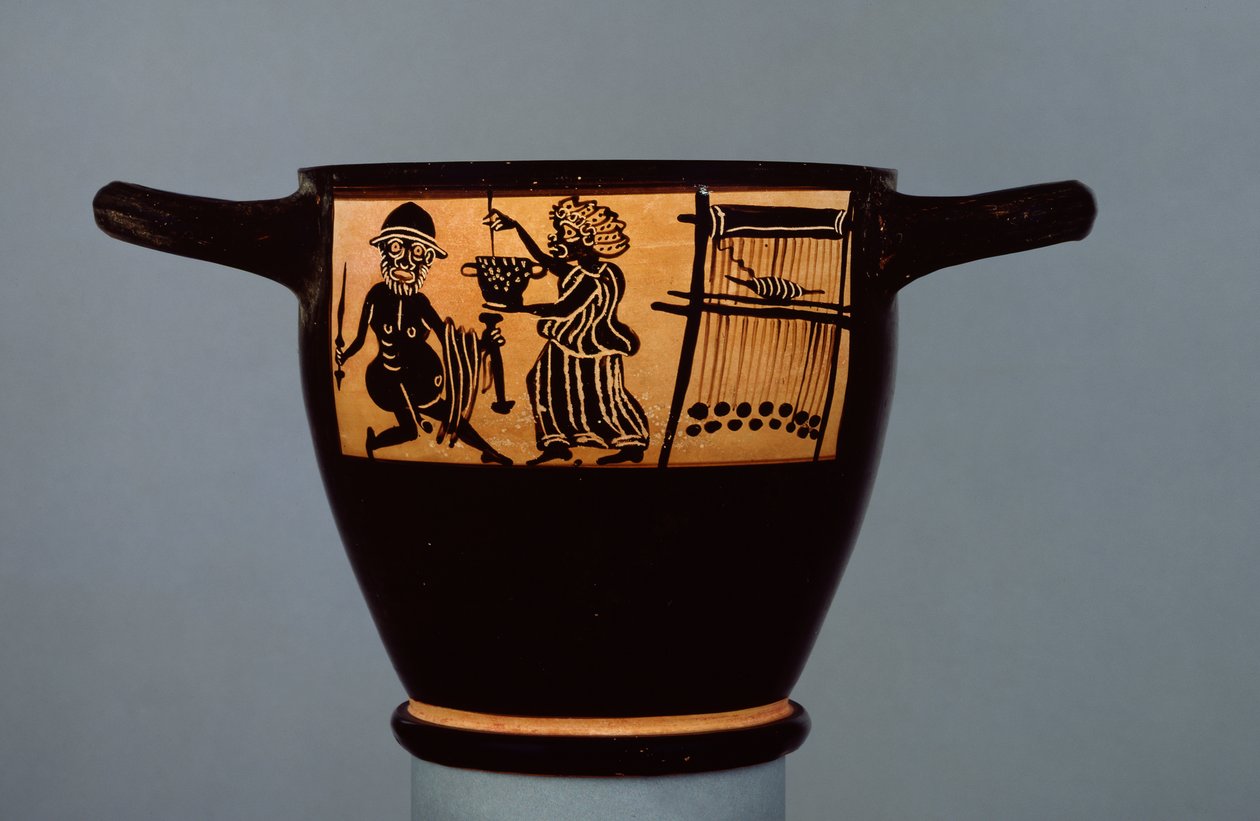
There is, then, something judgmental about the humor. We might even imagine an ethical consideration. What we laugh at tells us something about what we value and who we are. How we use humor also helps us understand harsher, meaner emotions. These scenes strike me as well as being about watching and judging things. Each scene capitalizes upon the metatheatrical effect of being external audiences witnessing internal audiences having unpredictable responses. The Olympian laughter papers over an irreconcilable difference; Thersites’ beating is a reassertion of a political order—the laughter seals his place as a scapegoat. And Ajax’s ill-luck foreshadows some of the concerns that pace the Odyssey: that tenuous relationship between who we are, what we do, and the fate that takes us.
I started thinking about this again, in part, after reading through Oliver Thomas’ “The Mocking Homer of the Exegetical Scholia to the Iliad” (2022). While some of the framing of the question—e.g. what “kind of person” made the Iliad—differs from how I would put it, there’s real value in looking at how earlier interpreters understood the tone of the Homeric narrator. Thomas traces specific words in the scholia, starting with a case study of διασύρει. The first discussion, of whether Homer or Hektor are really mocking Paris (according to Plutarch and Eustathius) is a good introduction to the problem of narrative frames. The scholia seem much clearer on the ethical import of mocking Thersites, however. Surprising in the article is the degree to which some ancient scholars saw the depiction of Hektor as one of biting mockery.
Most valuable in the piece, for thinking about how ancient scholarship may have reshaped the Homeric poems, is the penultimate section where Thomas discusses the evidence for ancient critics like Aristonicus and Zoilos objecting to lines on the grounds that there were too silly or comedic, following earlier scholars like Aristotle who try to separate between the comic and the tragic. Thomas ends by rightly noting the tension between what these critics assert and what a majority of other comments show. Homeric poetry may not be farce, but it is engaged with a wide array of human experiences and emotions. Tears, violence, and range without laughter lack that ring of truth that makes art so moving.

Short Bibliography
n.b. this is not exhaustive. please let me know if there are other articles to include.
Benson, R. D. (2021). Homeric Epithets that Seem to Be Humorously Ironic. Arion: A Journal of Humanities and the Classics, 29(1), 35–62. https://doi.org/10.2307/arion.29.1.0035
Brown, Christopher G.. “Ares, Aphrodite, and the laughter of the gods.” Phoenix, vol. XLIII, 1989, pp. 283-293.
Caleb M. X. Dance, ‘Laughing with the gods : the tale of Ares and Aphrodite in Homer, Ovid, and Lucian’, Classical World, 113.4 (2019-2020) 405-434. Doi: 10.1353/clw.2020.0037
Clarke, Howard W.. “The humor of Homer.” The Classical Journal, vol. LXIV, 1969, pp. 246-252.
Colakis, Marianthe. “The Laughter of the Suitors in ‘Odyssey.’” The Classical World 79, no. 3 (1986): 137–41. https://doi.org/10.2307/4349839.
Guidorizzi, Giulio. “The laughter of the suitors: a case of collective madness in the Odyssey / transl. by Lowell Edmunds.” Poet, public, and performance in ancient Greece. Eds. Edmunds, Lowell, Wallace, Robert W. and Bettini, Maurizio. Baltimore (Md.): Johns Hopkins University Pr., 1997. 1-7.
Halliwell, F. Stephen (2008). Greek laughter: a study in cultural psychology from Homer to early Christianity. Cambridge ; New York: Cambridge University Pr.
Halliwell, Stephen. “Imagining divine laughter in Homer and Lucian.” Greek laughter and tears : antiquity and after. Eds. Alexiou, Margaret and Cairns, Douglas. Edinburgh Leventis Studies; 8. Edinburgh: Edinburgh University Pr., 2017. 36-53.
Hewitt, Joseph William. “Homeric Laughter.” The Classical Journal 23, no. 6 (1928): 436–47. http://www.jstor.org/stable/3289782.
Hoffer, Stanley E.. “Telemachus’ « laugh » (Odyssey 21.105): deceit, authority, and communication in the bow contest.” American Journal of Philology, vol. 116, no. 4, 1995, pp. 515-531.
Hunt, W. Irving. “Homeric Wit and Humor.” Transactions of the American Philological Association (1869-1896) 21 (1890): 48–58. https://doi.org/10.2307/2935808.
Konstan, David. “Laughing at ourselves: gendered humor in ancient Greece.” Laughter, humor, and the (un)making of gender: historical and cultural perspectives. Eds. Foka, Anna and Liliequist, Jonas. New York: Palgrave Macmillan, 2015. 13-29.
Donald E. Lavigne, ‘Bad Kharma: a « fragment » of the « Iliad » and iambic laughter’, Aevum Antiquum, N. S., 8. (2008) 115-138. Doi: 10.1400/210042
Levine, Daniel B.. Γέλῳ ἔκθανον. Laughter and the demise of the suitors. Univ. of Cincinnati, 1980.
Levine, Daniel B. “Homeric Laughter and the Unsmiling Suitors.” The Classical Journal 78, no. 2 (1982): 97–104. http://www.jstor.org/stable/3297058.
Levine, Daniel B. “Penelope’s Laugh: Odyssey 18.163.” The American Journal of Philology 104, no. 2 (1983): 172–78. https://doi.org/10.2307/294290.
Mason, H. A. “Fine Comedy in the ‘Iliad.’” The Cambridge Quarterly 9, no. 1 (1979): 17–38. http://www.jstor.org/stable/42965298.
Minchin, Elizabeth. “From gentle teasing to heavy sarcasm: instances of rhetorical irony in Homer’s « Iliad ».” Hermes, vol. 138, no. 4, 2010, pp. 387-402.
Miralles, Carles. “Laughter in the Odyssey.” Laughter down the centuries. 1. Eds. Jäkel, Siegfried and Timonen, Asko. Annales Universitatis Turkuensis. Ser. B, Humaniora; 208 – Annales Universitatis Turkuensis. Ser. B, Humaniora; 208. Turku: Turun Yliopisto, 1994; 1994. 15-22.
Shorey, Paul. “Homeric Laughter.” Classical Philology 22, no. 2 (1927): 222–23. http://www.jstor.org/stable/263522.
Siegfried Jäkel, ‘The phenomenon of laughter in the Iliad’, in Laughter down the centuries. 1, ed. by Siegfried Jäkel and Asko Timonen, Annales Universitatis Turkuensis. Ser. B, Humaniora, 208 – Annales Universitatis Turkuensis. Ser. B, Humaniora, 208 (Turku: Turun Yliopisto, 1994; 1994), pp. 23-27.
Sikes, E. E. “The Humour of Homer.” The Classical Review 54, no. 3 (1940): 121–27. http://www.jstor.org/stable/703172.
