If Only I Could Read Homer!

Edward Gibbon, The Decline and Fall of the Roman Empire, LXVI:

“The most learned Italians of the fifteenth century have confessed and applauded the restoration of Greek literature, after a long oblivion of many hundred years. Yet in that country, and beyond the Alps, some names are quoted; some profound scholars, who in the darker ages were honorably distinguished by their knowledge of the Greek tongue; and national vanity has been loud in the praise of such rare examples of erudition. Without scrutinizing the merit of individuals, truth must observe, that their science is without a cause, and without an effect; that it was easy for them to satisfy themselves and their more ignorant contemporaries; and that the idiom, which they had so marvellously acquired was transcribed in few manuscripts, and was not taught in any university of the West. In a corner of Italy, it faintly existed as the popular, or at least as the ecclesiastical dialect. The first impression of the Doric and Ionic colonies has never been completely erased: the Calabrian churches were long attached to the throne of Constantinople: and the monks of St. Basil pursued their studies in Mount Athos and the schools of the East. Calabria was the native country of Barlaam, who has already appeared as a sectary and an ambassador; and Barlaam was the first who revived, beyond the Alps, the memory, or at least the writings, of Homer. He is described, by Petrarch and Boccace, as a man of diminutive stature, though truly great in the measure of learning and genius; of a piercing discernment, though of a slow and painful elocution. For many ages (as they affirm) Greece had not produced his equal in the knowledge of history, grammar, and philosophy; and his merit was celebrated in the attestations of the princes and doctors of Constantinople. One of these attestations is still extant; and the emperor Cantacuzene, the protector of his adversaries, is forced to allow, that Euclid, Aristotle, and Plato, were familiar to that profound and subtle logician.  In the court of Avignon, he formed an intimate connection with Petrarch, the first of the Latin scholars; and the desire of mutual instruction was the principle of their literary commerce. The Tuscan applied himself with eager curiosity and assiduous diligence to the study of the Greek language; and in a laborious struggle with the dryness and difficulty of the first rudiments, he began to reach the sense, and to feel the spirit, of poets and philosophers, whose minds were congenial to his own. But he was soon deprived of the society and lessons of this useful assistant: Barlaam relinquished his fruitless embassy; and, on his return to Greece, he rashly provoked the swarms of fanatic monks, by attempting to substitute the light of reason to that of their navel. After a separation of three years, the two friends again met in the court of Naples: but the generous pupil renounced the fairest occasion of improvement; and by his recommendation Barlaam was finally settled in a small bishopric of his native Calabria. The manifold avocations of Petrarch, love and friendship, his various correspondence and frequent journeys, the Roman laurel, and his elaborate compositions in prose and verse, in Latin and Italian, diverted him from a foreign idiom; and as he advanced in life, the attainment of the Greek language was the object of his wishes rather than of his hopes. When he was about fifty years of age, a Byzantine ambassador, his friend, and a master of both tongues, presented him with a copy of Homer; and the answer of Petrarch is at one expressive of his eloquence, gratitude, and regret. After celebrating the generosity of the donor, and the value of a gift more precious in his estimation than gold or rubies, he thus proceeds: ‘Your present of the genuine and original text of the divine poet, the fountain of all inventions, is worthy of yourself and of me: you have fulfilled your promise, and satisfied my desires. Yet your liberality is still imperfect: with Homer you should have given me yourself; a guide, who could lead me into the fields of light, and disclose to my wondering eyes the spacious miracles of the Iliad and Odyssey. But, alas! Homer is dumb, or I am deaf; nor is it in my power to enjoy the beauty which I possess. I have seated him by the side of Plato, the prince of poets near the prince of philosophers; and I glory in the sight of my illustrious guests. Of their immortal writings, whatever had been translated into the Latin idiom, I had already acquired; but, if there be no profit, there is some pleasure, in beholding these venerable Greeks in their proper and national habit. I am delighted with the aspect of Homer; and as often as I embrace the silent volume, I exclaim with a sigh, Illustrious bard! with what pleasure should I listen to thy song, if my sense of hearing were not obstructed and lost by the death of one friend, and in the much-lamented absence of another. Nor do I yet despair; and the example of Cato suggests some comfort and hope, since it was in the last period of age that he attained the knowledge of the Greek letters.'”

Myth: Shaping Our Minds Through Pleasure and Fear

Strabo, Geography 1.2.8

“For every illiterate and uneducated person is in some way a child and delights in the same way in stories—similar as well is the case of a person educated moderately. For this person is not ruled by reason, and this is the custom from childhood. Since the marvelous is not only sweet but also frightening, there is a need for both types for children and those in the next age. We use the sweet stories to encourage children and the the frightening ones to discourage them. The Lamia, for example, is a story like this, as is that of Ephialtes and Mormolukê.

Many of those who live in cities are compelled toward certain action by incitements of myths when they hear the poets praising the mythical courageous deeds—the deeds of Herakles or Theseus—or the honors accorded from the gods or when they see Zeus in a picture, or cult image, or images signaling the mythical tale in some way. To discourage them, they have tales whenever there are punishments from the gods and fears or threats or things they have received through some tale or unexpected punishment even if they believe it has happened to other people.

For it is not possible to persuade the mass of women and every kind of common person by reason with philosophy and to encourage them to piety, and righteousness, and fidelity; but it is necessary to do this through fear. And that is not [possible] without myth-making and wonder. For the lighting, aegis, trident, torches, dragons, thyrsis-shaking, weapons of the gods, the myths and all the ancient theology, these are all things those who found states use as bogeymen for childish minds.

This was myth-making and it was a good support for the commonwealth and the political arrangement of life and the inquiry of the way things really are; the ancients pursued their childhood’s education into their later years and they supposed that every age could become sufficiently prudent through poetry. In later years, the writing of history and then philosophy entered our consciousness. But these work only for the few; poetry is more useful to the public and can fill the theaters. The poetry of Homer supersedes: but the first historians and natural philosophers were myth-makers as well.”

καὶ ἰδιώτης δὲ πᾶς καὶ ἀπαίδευτος τρόπον τινὰ παῖς ἐστι φιλομυθεῖ τε ὡσαύτως: ὁμοίως δὲ καὶ ὁ πεπαιδευμένος μετρίως: οὐδὲ γὰρ οὗτος ἰσχύει τῷ λογισμῷ, πρόσεστι δὲ καὶ τὸ ἐκ παιδὸς ἔθος. ἐπεὶ δ᾽ οὐ μόνον ἡδὺ ἀλλὰ καὶ φοβερὸν τὸ τερατῶδες, ἀμφοτέρων ἐστὶ τῶν εἰδῶν χρεία πρός τε τοὺς παῖδας καὶ τοὺς ἐν ἡλικίᾳ: τοῖς τε γὰρ παισὶ προσφέρομεν τοὺς ἡδεῖς μύθους εἰς προτροπήν, εἰς ἀποτροπὴν δὲ τοὺς φοβερούς: ἥ τε γὰρ Λάμια μῦθός ἐστι καὶ ἡ Γοργὼ καὶ ὁ Ἐφιάλτης καὶ ἡ Μορμολύκη.

οἵ τε πολλοὶ τῶν τὰς πόλεις οἰκούντων εἰς μὲν προτροπὴν ἄγονται τοῖς ἡδέσι τῶν μύθων, ὅταν ἀκούωσι τῶν ποιητῶν ἀνδραγαθήματα μυθώδη διηγουμένων, οἷον Ἡρακλέους ἄθλους ἢ Θησέως, ἢ τιμὰς παρὰ θεῶν νεμομένας, ἢ νὴ Δία ὁρῶσι γραφὰς ἢ ξόανα ἢ πλάσματα τοιαύτην τινὰ περιπέτειαν ὑποσημαίνοντα μυθώδη: εἰς ἀποτροπὴν δέ, ὅταν κολάσεις παρὰ θεῶν καὶ φόβους καὶ ἀπειλὰς ἢ διὰ λόγων ἢ διὰ τύπων ἀοράτων τινῶν προσδέχωνται, ἢ καὶ πιστεύωσι περιπεσεῖν τινας.

οὐ γὰρ ὄχλον γε γυναικῶν καὶ παντὸς χυδαίου πλήθους ἐπαγαγεῖν λόγῳ δυνατὸν φιλοσόφῳ καὶ προσκαλέσασθαι πρὸς εὐσέβειαν καὶ ὁσιότητα καὶ πίστιν, ἀλλὰ δεῖ καὶ διὰ δεισιδαιμονίας: τοῦτο δ᾽ οὐκ ἄνευ μυθοποιίας καὶ τερατείας. κεραυνὸς γὰρ καὶ αἰγὶς καὶ τρίαινα καὶ λαμπάδες καὶ δράκοντες καὶ θυρσόλογχα τῶν θεῶν ὅπλα μῦθοι καὶ πᾶσα θεολογία ἀρχαϊκή: ταῦτα δ᾽ ἀπεδέξαντο οἱ τὰς πολιτείας καταστησάμενοι μορμολύκας τινὰς πρὸς τοὺς νηπιόφρονας.

τοιαύτης δὲ τῆς μυθοποιίας οὔσης καὶ καταστρεφούσης εἰς τὸ κοινωνικὸν καὶ τὸ πολιτικὸν τοῦ βίου σχῆμα καὶ τὴν τῶν ὄντων ἱστορίαν, οἱ μὲν ἀρχαῖοι τὴν παιδικὴν ἀγωγὴν ἐφύλαξαν μέχρι τῶν τελείων ἡλικιῶν, καὶ διὰ ποιητικῆς ἱκανῶς σωφρονίζεσθαι πᾶσαν ἡλικίαν ὑπέλαβον: χρόνοις δ᾽ ὕστερον ἡ τῆς ἱστορίας γραφὴ καὶ ἡ νῦν φιλοσοφία παρελήλυθεν εἰς μέσον. αὕτη μὲν οὖν πρὸς ὀλίγους, ἡ δὲ ποιητικὴ δημωφελεστέρα καὶ θέατρα πληροῦν δυναμένη, ἡ δὲ δὴ τοῦ Ὁμήρου ὑπερβαλλόντως: καὶ οἱ πρῶτοι δὲ ἱστορικοὶ καὶ φυσικοὶ μυθογράφοι.

Medusa Bernini 1638/1648
Bernini’s Medusa

Inanes esse mutosque: To Speak With(Out) Vergil’s Voice

Fr. 3 Seneca the Elder ( Donat. Vita Vergilii, 29.)

“Seneca reports that Julius Montanus was in the habit of saying that he would have stolen certain things from Vergil if he could have his voice, and comportment, and dramatic ability. [He added] that the same verses sounded beautifuly when Vergil was reciting but without him they were meaningless and mute.”

3. Et Seneca tradidit Iulium Montanum poetam solitum dicere involaturum se Vergilio quaedam, si et vocem posset et os et hypocrisin; eosdem enim versus ipso pronuntiante bene sonare, sine illo inanes esse mutosque.

Image result for medieval manuscript portrait vergil
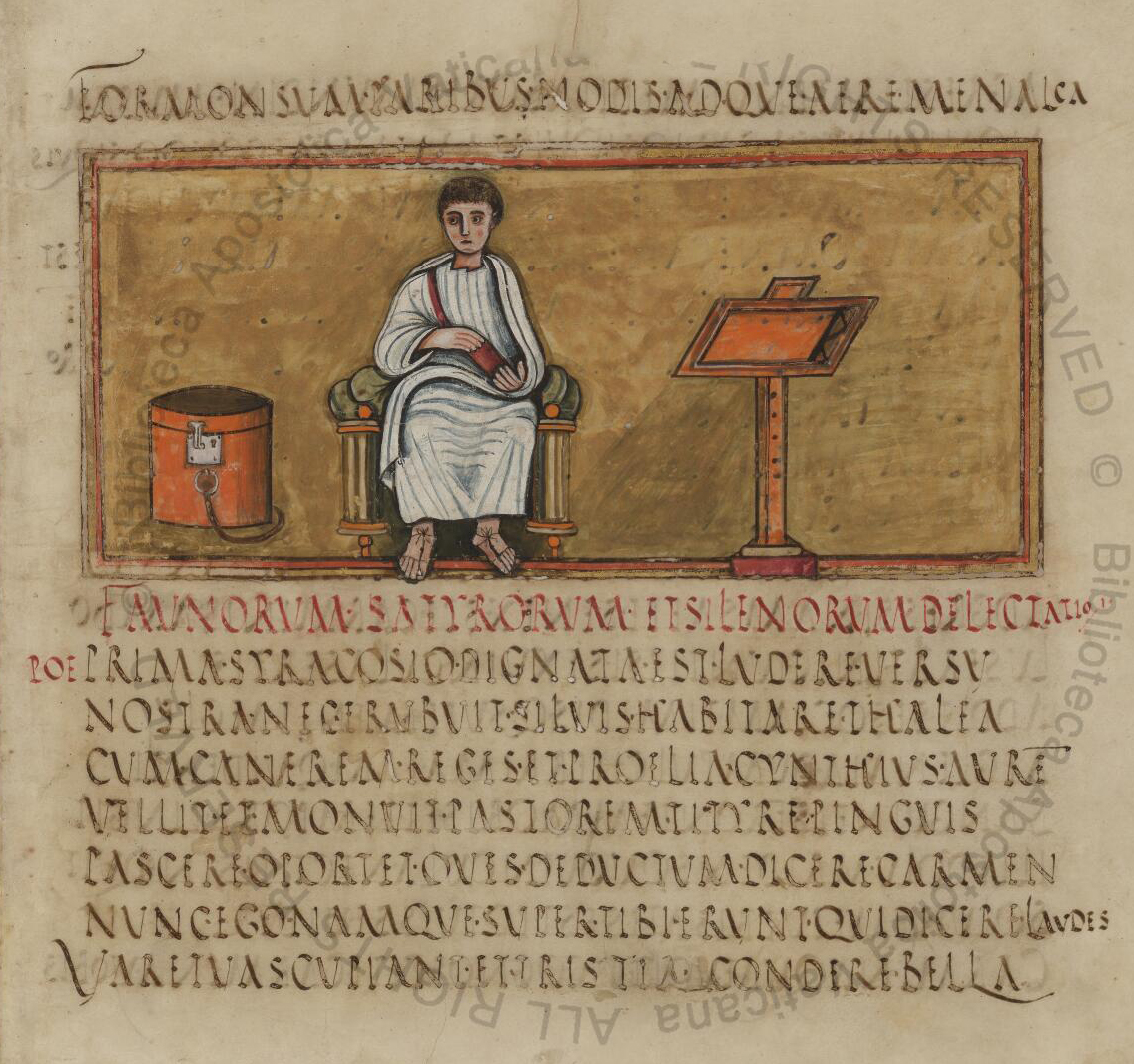
The Vergilius Romanus

Let Poets Be Our Teachers

Strabo Geography 1.2.3

“[Eratosthenes] said that the poet arranges everything for delighting the mind and not for education. Quite the opposite—ancients used to say that poetry was the first philosophy which integrates us into life from youth and teaches our characters, informs our experiences, and our actions in a pleasurable way.

The scholars of our day claim that the poet is the only wise person. For this reason too, the cities of Greece educate their children at the earliest stages through poetry, not only of course for the sake of entertaining them, but for nurturing wisdom as well. Indeed, for this reason too, music teachers who instruct those who play strings, lyre, and pipes help to shape their character. For these teachers say that they are also reformers of their ways. It is not only common to hear Pythagoreans making such claims, but even Aristoxenos asserts this, and Homer said that the singers were the wisest people of his day.”

Ποιητὴν γὰρ ἔφη πάντα στοχάζεσθαι ψυχαγωγίας, οὐ διδασκαλίας. τοὐναντίον δ’ οἱ παλαιοὶ φιλοσοφίαν τινὰ λέγουσι πρώτην τὴν ποιητικήν, εἰσάγουσαν εἰς τὸν βίον ἡμᾶς ἐκ νέων καὶ διδάσκουσαν ἤθη καὶ πάθη καὶ πράξεις μεθ’ ἡδονῆς· οἱ δ’ ἡμέτεροι καὶ μόνον ποιητὴν ἔφασαν εἶναι τὸν σοφόν. διὰ τοῦτο καὶ τοὺς παῖδας αἱ τῶν ῾Ελλήνων πόλεις πρώτιστα διὰ τῆς ποιητικῆς παιδεύουσιν, οὐ ψυχαγωγίας χάριν δήπουθεν ψιλῆς, ἀλλὰ σωφρονισμοῦ· ὅπου γε καὶ οἱ μουσικοὶ ψάλλειν καὶ λυρίζειν καὶ αὐλεῖν διδάσκοντες μεταποιοῦνται τῆς ἀρετῆς ταύτης· παιδευτικοὶ γὰρ εἶναί φασι καὶ ἐπανορθωτικοὶ τῶν ἠθῶν. ταῦτα δ’ οὐ μόνον παρὰ τῶν Πυθαγορείων ἀκούειν ἐστὶ λεγόντων, ἀλλὰ καὶ ᾿Αριστόξενος οὕτως ἀποφαίνεται. καὶ ῞Ομηρος δὲ τοὺς ἀοιδοὺς σωφρονιστὰς εἴρηκε.

Later

“But the nature of the poet is yoked to that of the human being—therefore, one cannot be a good poet unless first established as a good person.”

ἡ δὲ ποιητοῦ συνέζευκται τῇ τοῦ ἀνθρώπου, καὶ οὐχ οἷόν τε ἀγαθὸν γενέσθαι ποιητὴν μὴ πρότερον γενηθέντα ἄνδρα ἀγαθόν.

The Construction and Destruction of Troy in Cite de Dieu / Orosius Master
The Construction and Destruction of Troy, Orosius Master (c. 15th Century CE)

Love Born from a Glance

Erasmi, Adagia 1.179: Amor ex aspectu

Love from a glance:

Ἐκ τοῦ εἰσορᾶν γὰρ γίγνεται ἀνθρώποις ἐρᾶν

that is,

“From a glance, love is born in mortals.”

This proverb is a senarius claiming that the eyes foster the most potent love. The unknown is not loved, and mutual love is born from intimacy. The eyes are especially prone to falling in love, for they are in effect the peculiar throne of the soul. The poets say that Cupid makes his camp in the eyes, from which he hurls his darts. Vergil mentions this adage when he says,

‘As I saw, as I perished, as a wicked error took me away.’

Again in the Georgics, he writes

‘The woman burns by seeing.’

Similarly, in Terence, Charea begins to burn ineffectually when he saw a maiden. Juvenal, in place of a prodigy, relates of the blind lover:

‘Who was never burning from seeing a girl.’

We read that certain philosophers, including Democritus, took out his eyes as though they were the authors of all his suffering. For this reason it is characteristic of pious men to recall that it is hardly safe even to see that which one is not allowed to desire. Diogenianus makes note of this proverb.”

Related image

Ex aspectu nascitur amor.lxxix

Amor ex aspectu

Ἐκ τοῦ εἰσορᾶν γὰρ γίγνεται ἀνθρώποις ἐρᾶν

, id est :

Amor ex videndo nascitur mortalibus.

Senarius proverbialis admonens oculos amorem potissimum conciliare. Non enim amatur incognitum, ex convictu nascitur amor mutuus. Et oculi praecipue sunt ad amandum illices. In his enim peculiaris animi sedes. Et in his aiunt poetae Cupidinem excubantem sua jacula mittere. Maro velut indicavit adagium cum ait :

Ut vidi, ut perii, ut me malus abstulit error.

Rursum in Georgicis : Uritque vidende / Femina. Item apud Terentium Chaerea visa dumtaxat virgine, quam impotenter coepit ardere. Juvenalis prodigii loco refert de caeco amante :

Qui nunquam visae flagrabat amore puellae.

Legimus, philosophos quosdam, et inter hos Democritum, sibimet oculos ademisse, tanquam omnium malarum cupiditatum auctores. Quapropter piorum hominum est meminisse, haudquaquam esse tutum videre, quod non licet concupiscere. Proverbii meminit Diogenianus.

The Abbreviated Plans of Humans and Gods: A Fragment for Valentine’s Day

Sophocles, fr. 941 [=Stobaeus 4, 20.6]

“Children, the Cyprian is certainly not only the Cyprian
But she is a being of many names.
She is Hades. She is immortal life.
She is mad insanity. She is desire undiluted.
She is lamentation. In her is everything
Earnest, peaceful, all that leads to violence
She seeps into the organs of everything
In which life resides. Who is ever sated by the goddess?
She enters into the fishes’ swimming race,
She is in the four-limbed tribe on the land
And guides her wing among the birds.

Among beasts, mortals, among the gods above.
Whom of the gods has she not thrown three times?
If it is right for me—if it is right to speak the truth,
She rules Zeus’ chest without a spear or iron
The Cyprian certainly cuts short
All the best plans of humans and gods.”

ὦ παῖδες, ἥ τοι Κύπρις οὐ Κύπρις μόνον,
ἀλλ᾿ ἐστὶ πολλῶν ὀνομάτων ἐπώνυμος.
ἔστιν μὲν Ἅιδης, ἔστι δ᾿ ἄφθιτος βίος,
ἔστιν δὲ λύσσα μανιάς, ἔστι δ᾿ ἵμερος
ἄκρατος, ἔστ᾿ οἰμωγμός. ἐν κείνῃ τὸ πᾶν
σπουδαῖον, ἡσυχαῖον, ἐς βίαν ἄγον.
ἐντήκεται γάρ †πλευμόνων† ὅσοις ἔνι
ψυχή· τίς οὐχὶ τῆσδε τῆς θεοῦ βορός;
εἰσέρχεται μὲν ἰχθύων πλωτῷ γένει,
χέρσου δ᾿ ἔνεστιν ἐν τετρασκελεῖ γονῇ,
νωμᾷ δ᾿ ἐν οἰωνοῖσι τοὐκείνης πτερόν.
* * *
ἐν θηρσίν, ἐν βροτοῖσιν, ἐν θεοῖς ἄνω.
τίν᾿ οὐ παλαίουσ᾿ ἐς τρὶς ἐκβάλλει θεῶν;
εἴ μοι θέμις—θέμις δὲ—τἀληθῆ λέγειν,
Διὸς τυραννεῖ πλευμόνων ἄνευ δορός,
ἄνευ σιδήρου· πάντα τοι συντέμνεται
Κύπρις τὰ θνητῶν καὶ θεῶν βουλεύματα.

Image result for Ancient Greek Aphrodite vase
Birth of Aphrodite, Metropolitan Museum of Art

My Friends Are the Enemies of My Studies

Mark Pattison, Isaac Casaubon:

“The diary begins again to echo with groans over time running to waste. He tells Lipsius that he is driven to do his translation of Polybius as the sheets pass through the press, ‘from want of time. The greater part of my day is wasted upon wretched nothings in this busy capital, busy because all the men have nothing to do.’ Day after day the entry in the diary is, ‘This day, too, my friends have made me lose! amici studiorum meorum inimici.‘ [My friends are the enemies of my studies.]‘ Aug. 3, 1601, O woe, O wretchedness, all study is at an end for me, how much of each day do I spend in reading, each day do I say, a whole week is gone, a whole month, and I can hardly get to look at a book.’ The wailngs of Montpellier are revived, but upon a greater stage. Being a sort of court pensioner, Casaubon too is part of the court. He has to wait upon the king; to wait, a good deal, upon Rosny; upon various grands seigneurs, a little in his own affairs, much in those of his friends. He began to experience the annoyances which await one who is supposed to stand well with men in power. ‘This morning my friends ad proceres me rapuerunt negotiorum suorum causa!’ [They took me away to see some aristocrats for the sake of their advancing their own affairs.]”

Image result for medieval scholar

Sinister Letters and Sore Feet

Anonymous Parodic Epic fr. 3-7 (Brandt)

Poverty, be brave and endure the foolish talkers.
For a multitude of sweets and pleasureless hunger overwhelm you.
Whomever the Muses taught their letters backward
Walked having chilblains under his feet
Hermokaikoxanthos prayed to father Zeus:
“Oh man-slayer: how many mortals have you assigned to Hell?”

τέτλαθι δὴ πενίη καὶ ἀνάσχεο μωρολογούντων·
ὄψων γὰρ πλῆθός σε δαμᾷ καὶ λιμὸς ἀτερπής.
οὓς ἐδίδαξαν ἀριστερὰ γράμματα Μοῦσαι
ἔστειχε δ’ ἔχων ὑπὸ ποσσὶ χίμεθλα
῾Ερμοκαϊκόξανθος ἐπευξάμενος Διὶ πατρί·
ὦ βροτολοιγέ, πόσους σὺ <βρο>τῶν ῎Αιδι προΐαψας;

The “backward letters” above (ἐδίδαξαν ἀριστερὰ γράμματα) is more precisely “left-side letters”, with either the pejorative sense of Latin sinister or just a general notion of wrongness. I took the comic lines below as inspiration.

Theognetus, fr. 1.7-8

“Wretch, you learned your letters backwards.
Your books have turned your life upside down.”

ἐπαρίστερ’ ἔμαθες, ὦ πόνηρε, γράμματα·
ἀνέστροφέν σου τὸν βίον τὰ βιβλία.

Suda

“Right-hand of the lord”: this phrase means influence coming from on high and good action in the holy writings. For the ancients used to call right-hand things prudent but left-hand things foolish. Sophocles writes: “You never walked to the left because of your mind, son of Telamôn.”

Δεξιὰ κυρίου: ἡ ἄνωθεν ῥοπὴ καὶ ἡ ἀγαθὴ ἐνέργεια παρὰ τῇ θείᾳ γραφῇ. Δεξιὰ ἔλεγον οἱ παλαιοὶ τὰ συνετά, ἀριστερὰ δὲ τὰ μωρά. Σοφοκλῆς· οὔποτε γὰρ φρένοθέν γ’ ἐπ’ ἀριστερά, παῖ Τελαμῶνος ἔβης.

Image result for ancient greek boustrophedon writing
Boustrophedon Style from the 5th Century BCE

Werewolves and Sun-Worship

Giovanni Boccaccio, Genealogia Deorum Gentilium 1.5:

“The younger authors, being fond of novelty, called Pan ‘Lyceus.’ Others scrapped the name of Pan altogether, and simply called him ‘Lyceus’. There are a few even who call Jupiter ‘Lyceus’, thinking that it is due either to the intercession of Nature or of Jupiter that wolves were removed from the flocks which rarely saw them. It seemed that he merited the name from the flight of the wolves, since the word lycos in Greek means ‘wolf’. Augustine writes, in his City of God, that it Jupiter was called ‘Lyceus’ for another reason, namely the frequent mutation of humans into wolves, which happened in Arcadia. They used to think that this was impossible without some divine power bringing it about.

It seems that Macrobius took up his idea that Pan was not Jupiter but the Sun by reasoning along these lines: since the Sun is the father of mortal life, and because at sunrise wolves usually abandon their attacks against the flocks and return to the wolves, the ancients called the Sun ‘Lyceus’ in commemoration of his service.”

Image result for ancient werewolves

Homer’s Tales and The Narrative Animal

Strabo, Geography 1.2.7-8

Homer tells precisely of not merely the neighboring lands and Greece itself—as Eratosthenes has claimed—but many other places farther afield too and he tells his myths better than those who followed him. For he does not offer every tale for wonder only, but also to contribute to knowledge—especially in the wanderings of Odysseus—he allegorizes, provides warnings, and delights [his audiences]. This is something [Eratosthenes] is really wrong about when he asserts that the poet and his interpreters are fools. This is a subject worth speaking on to a much greater extent.”

The first point is that it is not only poets who used myths, but cities and lawmakers did too for the sake of their usefulness, once they noted the native disposition of the story-oriented animal. For Humans love to learn; loving stories is a prelude to this. This is why children start by listening and making a common ground in stories.

The reason for this is that story/myth is a novel-kind-of-thought [to them] which helps them thing not about what they already know but about different kinds of things too. To children we are obliged to hold out such enticements, in order that in riper years, when the mind is powerful, and no longer needs such stimulants, it may be prepared to enter on the study of actual realities.

There is sweetness in novelty and what someone does not already know, This is the very thing that also creates a love-of-learning. Whenever something amazing and ominous is present, it nurtures pleasure, which is a magic charm for learning. In the early years it is necessary to use these types of attractions, but when age increases toward the study of things as they really are, then the understanding has advanced and no longer requires flatteries.”

᾿αλλ᾽ οὐδὲ τὰ σύνεγγυς μόνον, ὥσπερ Ἐρατοσθένης εἴρηκε, καὶ τὰ ἐν τοῖς Ἕλλησιν, ἀλλὰ καὶ τῶν πόρρω πολλὰ λέγει καὶ δι᾽ ἀκριβείας Ὅμηρος καὶ μᾶλλόν γε τῶν ὕστερον μυθολογεῖται, οὐ πάντα τερατευόμενος, ἀλλὰ καὶ πρὸς ἐπιστήμην ἀλληγορῶν ἢ διασκευάζων ἢ δημαγωγῶν ἄλλα τε καὶ τὰ περὶ τὴν Ὀδυσσέως πλάνην, περὶ ἧς πολλὰ διαμαρτάνει τούς τ᾽ ἐξηγητὰς φλυάρους ἀποφαίνων καὶ αὐτὸν τὸν ποιητήν: περὶ ὧν ἄξιον εἰπεῖν διὰ πλειόνων.

καὶ πρῶτον ὅτι τοὺς μύθους ἀπεδέξαντο οὐχ οἱ ποιηταὶ μόνον, ἀλλὰ καὶ αἱ πόλεις πολὺ πρότερον καὶ οἱ νομοθέται τοῦ χρησίμου χάριν, βλέψαντες εἰς τὸ φυσικὸν πάθος τοῦ λογικοῦ ζῴου: φιλειδήμων γὰρ ἅνθρωπος, προοίμιον δὲ τούτου τὸ φιλόμυθον. ἐντεῦθεν οὖν ἄρχεται τὰ παιδία ἀκροᾶσθαι καὶ κοινωνεῖν λόγων ἐπὶ πλεῖον.

αἴτιον δ᾽, ὅτι καινολογία τίς ἐστιν ὁ μῦθος, οὐ τὰ καθεστηκότα φράζων ἀλλ᾽ ἕτερα παρὰ ταῦτα: ἡδὺ δὲ τὸ καινὸν καὶ ὃ μὴ πρότερον ἔγνω τις: τοῦτο δ᾽ αὐτό ἐστι καὶ τὸ ποιοῦν φιλειδήμονα. ὅταν δὲ προσῇ καὶ τὸ θαυμαστὸν καὶ τὸ τερατῶδες, ἐπιτείνει τὴν ἡδονήν, ἥπερ ἐστὶ τοῦ μανθάνειν φίλτρον. κατ᾽ ἀρχὰς μὲν οὖν ἀνάγκη τοιούτοις δελέασι χρῆσθαι, προϊούσης δὲ τῆς ἡλικίας ἐπὶ τὴν τῶν ὄντων μάθησιν ἄγειν, ἤδη τῆς διανοίας ἐρρωμένης καὶ μηκέτι δεομένης κολάκων.

Jerome Bruner, Actual Minds, Possible Worlds. Cambridge: Harvard University Press, 1986.

123: “The most general implication is that a culture is constantly in process of being recreated as it is interpreted and renegotiated by its members. In this view, a culture is as much a forum for negotiating meaning and for explicating action as it is a set of rules or specifications for action. Indeed, every culture maintains specialized institutions or occasions for intensifying this “forum-like” feature. Storytelling, theater, science, even jurisprudence are all techniques for intensifying this function—ways of exploring possible worlds out of the context of immediate need. Education is (or should be) one of the principal forums for performing this function—though it is often timid in doing so. It is the forum aspect of a culture that gives its participants a role in constantly making and remaking the culture…”

Bern Le Hunte and Jan A. Golembiewski. “Stories Have the Power to Save Us: A Neurological Framework for the Imperative to Tell Stories.” Arts and Social Sciences Journal 5.2 (2014) 73-76.

73: “The claim that stories have the power to save us is audacious, yet it is one that can be validated by neuroscience. This article demonstrates that the brain is hard-wired to process stories in a most fundamental way, indicating the evolutionary priority that storytelling has had in human development, and the importance it has in forging a future humanity.”

Edmund Wilson. “On Free Will and How the Brain is Like a Colony of Ants.” Harper’s September 2014, 49-52.

51: “The final reason for optimism is the human necessity for confabulation, which offers more evidence of a material basis to consciousness. Our minds consist of storytelling.”

Jonathan Gottschalk. The Storytelling Animal: How Stories Make Us Human. Boston: Mariner Books, 2012.

58: “The psychologist and novelist Keith Oakley calls stories the flight simulators of human social life.”

Mark Turner. The Literary Mind: The Origins of Thought and Language. Oxford: 1996.

4-5:  “narrative imagining—story—is the fundamental instrument of thought. Rational capacities depend upon it. It is our chief means of looking into the future, of predicting, of planning, and of explaining. It is a literary capacity indispensable to human cognition generally. This is the first way in which the mind is essentially literary.”

[Large Figures on the North Porch, Chartres Cathedral]
A story waiting to be told…