Performing Prophecies

Schol. bT ad Hom. Il. 2.350 ex

“Odysseus properly, as he speaks to the public, offers the prophecy of Kalkhas to please the people, since he was hateful to the sons of Atreus but sweet to the masses. Nestor, because he is trying to please the king, offers the signs of the king of the gods. For this reason Odysseus is praised by the Greeks but Nestor is praised by the king.”

οἰκείως ὁ μὲν ᾿Οδυσσεὺς δημοχαριστικῶς δημηγορῶν τοῦ Κάλχαντος προβάλλεται τὴν μαντείαν, ὃς ἦν τοῖς ᾿Ατρείδαις ἐχθρός, τῷ δὲ πλήθει γλυκύς· ὁ δὲ Νέστωρ τῷ βασιλεῖ χαριζόμενος τὰ τοῦ βασιλέως τῶν θεῶν προβάλλεται· διὸ ὁ μὲν παρὰ τῶν ῾Ελλήνων, ὁ δὲ Νέστωρ παρὰ τοῦ βασιλέως ἐγκωμιάζεται

Homer, Iliad 2.299–330 (Odysseus) (Full text on the Scaife Viewer)

“Endure, friends, and wait some time so we may learn,
Whether Kalkhas prophesied truly or not.
For we all know this well in our minds: you were all
Witnesses, at least those of you the fates of death have not carried off.
On that day long ago when the ships of the Achaeans gathered
At Aulis preparing troubles for Priam and the Trojans:
We were all around the sacred altars along a spring
Completing sacrifices to the immortal gods
Under a beautiful plane tree from where the sparkling water issued.
A great omen appeared there: a serpent with a deep-red back,
Terrible, which the Olympian himself sent to the light,
Crept up from under the altar and moved toward the plane tree.
There were newborn sparrow-chicks, immature ones
Were peering out under the leaves on the topmost bow.
There eight of them but the mother who bore them made it nine.
Then the serpent gulped them all down as they tweeted pitifully.
Their mother hopped around mourning over her dear offspring.
Well, he coiled up and grabbed her by the wing as she cried over them.
When it had swallowed the sparrow’s children and her too.
Then the god who exposed the serpent made it disappear—
The son of crooked-minded Kronos made it into stone.
We all stood in awe at the thing that happened,
That’s how terrible the portents of the gods were over our sacrifices.
Kalkhas immediately addressed us, offering his interpretation:
“Why are you silent, you long-haired Achaeans?
The great counsellor Zeus has shown us this sign:
Late coming, late completed, and its’ fame will never die.
Just as it ate up the sparrow’s children and her too,
Eight of them and the mother who bore them was the ninth,
So too we will war here for that many years
And in the tenth we will take the wide-wayed city.”
That’s how Kalkhas interpreted. Now all these things are being completed.”

τλῆτε φίλοι, καὶ μείνατ’ ἐπὶ χρόνον ὄφρα δαῶμεν
ἢ ἐτεὸν Κάλχας μαντεύεται ἦε καὶ οὐκί.
εὖ γὰρ δὴ τόδε ἴδμεν ἐνὶ φρεσίν, ἐστὲ δὲ πάντες
μάρτυροι, οὓς μὴ κῆρες ἔβαν θανάτοιο φέρουσαι·
χθιζά τε καὶ πρωΐζ’ ὅτ’ ἐς Αὐλίδα νῆες ᾿Αχαιῶν
ἠγερέθοντο κακὰ Πριάμῳ καὶ Τρωσὶ φέρουσαι,
ἡμεῖς δ’ ἀμφὶ περὶ κρήνην ἱεροὺς κατὰ βωμοὺς
ἕρδομεν ἀθανάτοισι τεληέσσας ἑκατόμβας
καλῇ ὑπὸ πλατανίστῳ ὅθεν ῥέεν ἀγλαὸν ὕδωρ·
ἔνθ’ ἐφάνη μέγα σῆμα· δράκων ἐπὶ νῶτα δαφοινὸς
σμερδαλέος, τόν ῥ’ αὐτὸς ᾿Ολύμπιος ἧκε φόως δέ,
βωμοῦ ὑπαΐξας πρός ῥα πλατάνιστον ὄρουσεν.
ἔνθα δ’ ἔσαν στρουθοῖο νεοσσοί, νήπια τέκνα,
ὄζῳ ἐπ’ ἀκροτάτῳ πετάλοις ὑποπεπτηῶτες
ὀκτώ, ἀτὰρ μήτηρ ἐνάτη ἦν ἣ τέκε τέκνα·
ἔνθ’ ὅ γε τοὺς ἐλεεινὰ κατήσθιε τετριγῶτας·
μήτηρ δ’ ἀμφεποτᾶτο ὀδυρομένη φίλα τέκνα·
τὴν δ’ ἐλελιξάμενος πτέρυγος λάβεν ἀμφιαχυῖαν.
αὐτὰρ ἐπεὶ κατὰ τέκνα φάγε στρουθοῖο καὶ αὐτήν,
τὸν μὲν ἀρίζηλον θῆκεν θεὸς ὅς περ ἔφηνε·
λᾶαν γάρ μιν ἔθηκε Κρόνου πάϊς ἀγκυλομήτεω·
ἡμεῖς δ’ ἑσταότες θαυμάζομεν οἷον ἐτύχθη.
ὡς οὖν δεινὰ πέλωρα θεῶν εἰσῆλθ’ ἑκατόμβας,
Κάλχας δ’ αὐτίκ’ ἔπειτα θεοπροπέων ἀγόρευε·
τίπτ’ ἄνεῳ ἐγένεσθε κάρη κομόωντες ᾿Αχαιοί;
ἡμῖν μὲν τόδ’ ἔφηνε τέρας μέγα μητίετα Ζεὺς
ὄψιμον ὀψιτέλεστον, ὅου κλέος οὔ ποτ’ ὀλεῖται.
ὡς οὗτος κατὰ τέκνα φάγε στρουθοῖο καὶ αὐτὴν
ὀκτώ, ἀτὰρ μήτηρ ἐνάτη ἦν ἣ τέκε τέκνα,
ὣς ἡμεῖς τοσσαῦτ’ ἔτεα πτολεμίξομεν αὖθι,
τῷ δεκάτῳ δὲ πόλιν αἱρήσομεν εὐρυάγυιαν.
κεῖνος τὼς ἀγόρευε· τὰ δὴ νῦν πάντα τελεῖται.

2.350–356 (Nestor)

“I say that the over-powering son of Kronos assented
On that day when the Argives took to the fast-faring ships
Bringing murder and death to the Trojans,
Showing clear and favorable signs by flashing lightning.
So let no one be compelled to return home,
Because each one has taken a Trojan wife to bed
As payback for Helen’s writhing and moans.”

φημὶ γὰρ οὖν κατανεῦσαι ὑπερμενέα Κρονίωνα
ἤματι τῷ ὅτε νηυσὶν ἐν ὠκυπόροισιν ἔβαινον
᾿Αργεῖοι Τρώεσσι φόνον καὶ κῆρα φέροντες
ἀστράπτων ἐπιδέξι’ ἐναίσιμα σήματα φαίνων.
τὼ μή τις πρὶν ἐπειγέσθω οἶκον δὲ νέεσθαι
πρίν τινα πὰρ Τρώων ἀλόχῳ κατακοιμηθῆναι,
τίσασθαι δ’ ῾Ελένης ὁρμήματά τε στοναχάς τε.

Ilias Kodex.jpg
Iliad Codex

Dabbling in the Occult: Odysseus, Necromancer

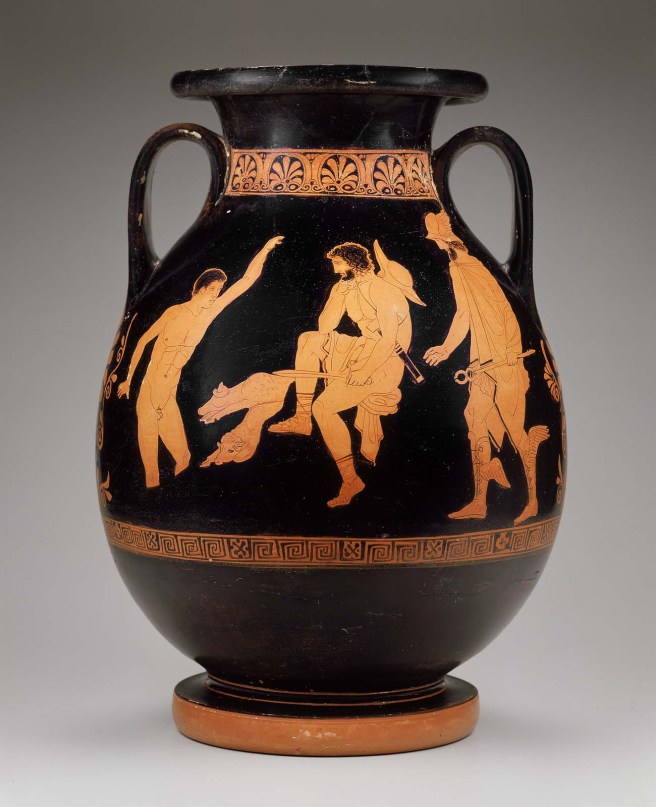
It is the right time of the year for raising the dead. A few years back, a student paper on the Elpenor Pelike at the MFA in Boston drew my attention to the following passage.

Servius ad Aen. 6.107

“For this reason the place is named without joy since, as people claim, it would not have been there but for necromancy or spell-craft. For, Aeneas completed these sacred rites when Misenus was killed and Ulysses did it with the death of Elpenor.

This very scene Homer himself presented falsely from the detail of its location which he specifies along with the length of time of the journey. For he claims that Ulysses sailed for one night and came to the place where he completed these sacrifices. For this reason it is abundantly clear that he doesn’t mean the ocean but Campania.”

sine gaudio autem ideo ille dicitur locus, quod necromantia vel sciomantia, ut dicunt, non nisi ibi poterat fieri: quae sine hominis occisione non fiebant; nam et Aeneas illic occiso Miseno sacra ista conplevit et Vlixes occiso Elpenore. quamquam fingatur in extrema Oceani parte Vlixes fuisse: quod et ipse Homerus falsum esse ostendit ex qualitate locorum, quae commemorat, et ex tempore navigationis; dicit enim eum a Circe unam noctem navigasse et ad locum venisse, in quo haec sacra perfecit: quod de Oceano non procedit, de Campania manifestissimum est.

The relevant passages from the Odyssey don’t give any hint that Elpenor was intentionally killed for black magic. When Odysseus actually does summon the dead, now that gets a little dark.

Odyssey, 10.552–560

“I could not even lead my companions unharmed from there.
The youngest of my companions was a certain Elpênor,
He was neither especially brave in battle or composed in his thoughts.
He separated himself from the companions in Kirkê’s holy home
Because he needed some air; then he fell asleep because he was drunk.
When he heard the noise and trouble of our companions moving out,
He got up immediately and it completely escaped his thoughts
To climb down again by the long ladder—
So he fell straight from the roof and his neck
Shattered along his spine; then his spirit flew down to Hades.”

οὐδὲ μὲν οὐδ’ ἔνθεν περ ἀπήμονας ἦγον ἑταίρους.
᾿Ελπήνωρ δέ τις ἔσκε νεώτατος, οὔτε τι λίην
ἄλκιμος ἐν πολέμῳ οὔτε φρεσὶν ᾗσιν ἀρηρώς,
ὅς μοι ἄνευθ’ ἑτάρων ἱεροῖσ’ ἐν δώμασι Κίρκης,
ψύχεος ἱμείρων, κατελέξατο οἰνοβαρείων·
κινυμένων δ’ ἑτάρων ὅμαδον καὶ δοῦπον ἀκούσας
ἐξαπίνης ἀνόρουσε καὶ ἐκλάθετο φρεσὶν ᾗσιν
ἄψορρον καταβῆναι ἰὼν ἐς κλίμακα μακρήν,
ἀλλὰ καταντικρὺ τέγεος πέσεν· ἐκ δέ οἱ αὐχὴν
ἀστραγάλων ἐάγη, ψυχὴ δ’ ῎Αϊδόσδε κατῆλθεν.

Elpênor appears twice more in the epic: 11.51–80 (Odysseus meets Elpênor’s ghost when he summons the dead); 12.9-15 (Odysseus buries Elpênor).

MFA Boston, Accession Number 34.79; Caskey-Beazley, Attic Vase Paintings (MFA), no. 111; Highlights: Classical Art (MFA), p. 070-071.

Nekuomanteia, glossed by Hesychius as nekromanteia (i.e. “necromancy”) is an alternate name for the Nekyuia, the parade of the dead in book 11 of the Odyssey. From the Greek Anthology: ᾿Εν τῷ Η ἡ τοῦ ᾿Οδυσσέως νεκυομαντεία· (3.8); Scholia to the Odyssey, Hypotheses: Λ. Νεκυομαντεία, ἢ, Νεκυία. Cf. Eustathius, Comm. Ad Od. 1.396.10

A Hope for Better Days to Come

Vergil, Aeneid 1.203

“Perhaps someday it will bring pleasure to recall these things.”

forsan et haec olim meminisse iuvabit.

Servius, Commentary on Vergil’s Aeneid 1.203

“And many report that “it will please” does not mean “it will bring pleasure” but it will be of some use”

et multi ‘iuvabit’ non delectabit, sed usus erit tradunt.

Seneca, EM 58.5-6

“If someone beset by troubles should say, “Perhaps someday it will bring pleasure to recall these things,” then let this person fight with their whole spirit. We are conquered if we yield; if we push back against our grief, we prevail.”

In ipsis positus difficultatibus dicat: Forsan et haec olim meminisse iuvabit. Toto contra ille pugnet animo; vincetur, si cesserit, vincet, si se contra dolorem suum intenderit.

Macrobius, Saturnalia 5.6-8

[comparing Vergil to Homer]

Hom. Od 12.208-12

“Friends, we are in no way unfamiliar with troubles:
This is indeed no greater a suffering than that time
When the Kyklops trapped us in his cave with violent force.
But we got out of there too thanks to my courage, planning,
And wit, and I think you will some how remember these things.”

Ulysses reminds his companions of only one reason for their pain while Aeneas reminds them of the results of two catastrophes in order to urge them to have hope for release from their current troubles. Ulysses is pretty indirect in saying “I think you will somehow remember these things” while Aeneas is clearer when he says “Perhaps someday it will bring pleasure to recall these things”.

But what your poet also adds here is a stronger kind of reassurance when he asks people not only to think of a time when they survived but to have hope as well for happiness in the future by promising that following their current labors they will find not only a safe home but a kingdom.”

ὦ φίλοι, οὐ γάρ πώ τι κακῶν ἀδαήμονές εἰμεν·
οὐ μὲν δὴ τόδε μεῖζον ἔπι κακόν, ἠ᾿ ὅτε Κύκλωψ
εἴλει ἐνὶ σπῆϊ γλαφυρῷ κρατερῆφι βίηφν·
ἀλλὰ καὶ ἔνθεν ἐμῇ ἀρετῇ βουλῇ τε νόῳ τε
ἐκφύγομεν, καί που τῶνδε μνήσεσθαι ὀΐω.

    1. Vlixes ad socios unam commemoravit aerumnam: hic ad sperandam praesentis mali absolutionem gemini casus hortatur eventu. deinde ille obscurius dixit,

. . . καί που τῶνδε μνήσεσθαι ὀΐω.

hic apertius,

. . . forsan et haec olim meminisse iuvabit.

    1. ‘Sed et hoc quod vester adiecit solacii fortioris est. suos enim non tantum exemplo evadendi, sed et spe futurae felicitatis animavit, per hos labores non solum sedes quietas sed et regna promittens.

Homer, Odyssey 15.398-401

“As we two drink and dine in this shelter
Let us take pleasure as we recall one another’s terrible pains.
For a man finds pleasure even in pains later on
After he has suffered so very many and survived many too.”

νῶϊ δ’ ἐνὶ κλισίῃ πίνοντέ τε δαινυμένω τε
κήδεσιν ἀλλήλων τερπώμεθα λευγαλέοισι
μνωομένω· μετὰ γάρ τε καὶ ἄλγεσι τέρπεται ἀνήρ,
ὅς τις δὴ μάλα πολλὰ πάθῃ καὶ πόλλ’ ἐπαληθῇ.

Theognis, 1047-1048

“For now, let us take pleasure in drinking, and telling fine tales
The gods can worry over whatever will happen in the future.”

νῦν μὲν πίνοντες τερπώμεθα, καλὰ λέγοντες·
ἅσσα δ᾿ ἔπειτ᾿ ἔσται, ταῦτα θεοῖσι μέλει.

Schol. BQ ad Od. 15.399 ex

“Let us take pleasure in one another’s pains”—for a person among afflictions delights in terrible narratives and in hearing another person tell his own troubles.”

κήδεσιν ἀλλήλων τερπώμεθα] καὶ ἐν ταῖς δειναῖς διηγήσεσι τέρπεται ἀνὴρ ὢν ἐν θλίψεσι καὶ ἀκούων ἑτέρου λέγοντος τὰ ἑαυτοῦ ἄλγεα.

Shepherd of Hermas, Parables 4

“One who changes their ways must torture their own soul and become resolutely humble in every act and afflict themself with many varied afflictions.”

ἀλλὰ δεῖ τὸν μετανοοῦντα βασανίσαι τὴν ἑαυτοῦ ψυχὴν καὶ ταπεινοφρονῆσαι ἐν ἁπάσῃ τῇ πράξει αὐτοῦ ἰσχυρῶς καὶ θλιβῆναι ἐν πολλαῖς θλίψεσι καὶ ποικίλαις

https://commons.wikimedia.org/wiki/File:Terracotta_Aeneas_MAN_Naples_110338.jpg

Four Years of Presidential Memories: Κ᾿[α]π ε᾿φη[φ]ε, A Future Scholion on #Covfefe

In a distant future, scholars laboring over dead languages and the confluence of allusions in the CET (Corpus Electronicum Pipiatorum) make learned guesses on the possible meanings contained within a mysterious neologism #cavfefe:

Κ᾿ <ά>π ε᾿φη[φ]ε [sc. κε μὴ…τοῦτο]: “would that he had not said it”
or Κ᾿ <ά>π ε᾿φη[φ]ε = κ<αὶ> ἀπ<έ>φη<να>: “And I declared…”

Ex. The lexical item often appears with references to speakers in a position of political or intellectual authority who are making official statements regarding an immutable truth. Vide Eur. Suppl. 335-7 where Theseus speaks:

“The words that I said were right, Mother.
And I have also declared [K’apephênamên] my opinion on the matter,
Of the kinds of councils over which he tripped.”

Θη. ἐμοὶ λόγοι μέν, μῆτερ, οἱ λελεγμένοι
ὀρθῶς ἔχουσ’ ἐς τόνδε κἀπεφηνάμην
γνώμην ὑφ’ οἵων ἐσφάλη βουλευμάτων.

Cf. Anth. Graec. 9.366

“Many people are worse” declared Bias of Priêne.
„Τοὺς πλέονας κακίους” δὲ Βίας ἀπέφηνε Πριηνεύς.

Cf. Diogenes Laertius, Lives of the Distinguished Philosophers

“[Plato] claimed that there are two origins of everything, god and matter, which he also called the mind and the cause.”

3.69 δύο δὲ τῶν πάντων ἀπέφηνεν ἀρχάς, θεὸν καὶ ὕλην, ὃν καὶ νοῦν προσαγορεύει καὶ αἴτιον.

Many contemporaries puzzled over the meaning. Proposals included scribal error (which we bar based on the lectio difficilior), a coded, but ungrammatical wish, a desire for an implement to brew a now extinct stimulant, and, as typical of those barbarous times, invocations of the occult.

https://twitter.com/SegoAG/status/869894608880357377

https://twitter.com/ArmandDAngour/status/869853138966204417

Four Years of Precious Memories: The Way of Kings, To Love and Hate Without Reason

Homer, Odyssey 4.687–693

“Did they not hear from you, when they were children,
What kind of a man Odysseus was among your parents,
He did nothing unfair nor said anything [unfair]
Among the people? This is the right of divine kings—
They can hate some people and love another.”

ὑμετέρων τὸ πρόσθεν ἀκούετε, παῖδες ἐόντες,
οἷος ᾿Οδυσσεὺς ἔσκε μεθ’ ὑμετέροισι τοκεῦσιν,
οὔτε τινὰ ῥέξας ἐξαίσιον οὔτε τι εἰπὼν
ἐν δήμῳ; ἥ τ’ ἐστὶ δίκη θείων βασιλήων·
ἄλλον κ’ ἐχθαίρῃσι βροτῶν, ἄλλον κε φιλοίη.

Scholia PQ ad. Hom. Od. 4.691

“this is the way of kings, to hate one person but love another. Etc. This line is presented gnomically about kings, because they hate some people but love another. This is not strictly applicable to Odysseus. Therefore line must be taken for use in this particular situation.”

ἥτ’ ἐστὶ δίκη] ὥσπερ τρόπος ἐστὶ τῶν βασιλέων τὸ ἄλλον μὲν μισεῖν, ἄλλον δὲ φιλεῖν. Καὶ ἄλλως. γνωμικὸς ὁ στίχος περὶ τῶν βασιλέων λεγόμενος, ὅτι τοὺς μὲν μισοῦσι, τοὺς δὲ φιλοῦσιν· ὅπερ οὐ προσῆν ᾿Οδυσσεῖ. καὶ αὐτὸν οὖν κατ’ ἰδίαν προενεκτέον τὸν στίχον. P.Q.

Image result for medieval manuscript evil king
Royal_ms_20_a_ii_f005r_detail from British Library

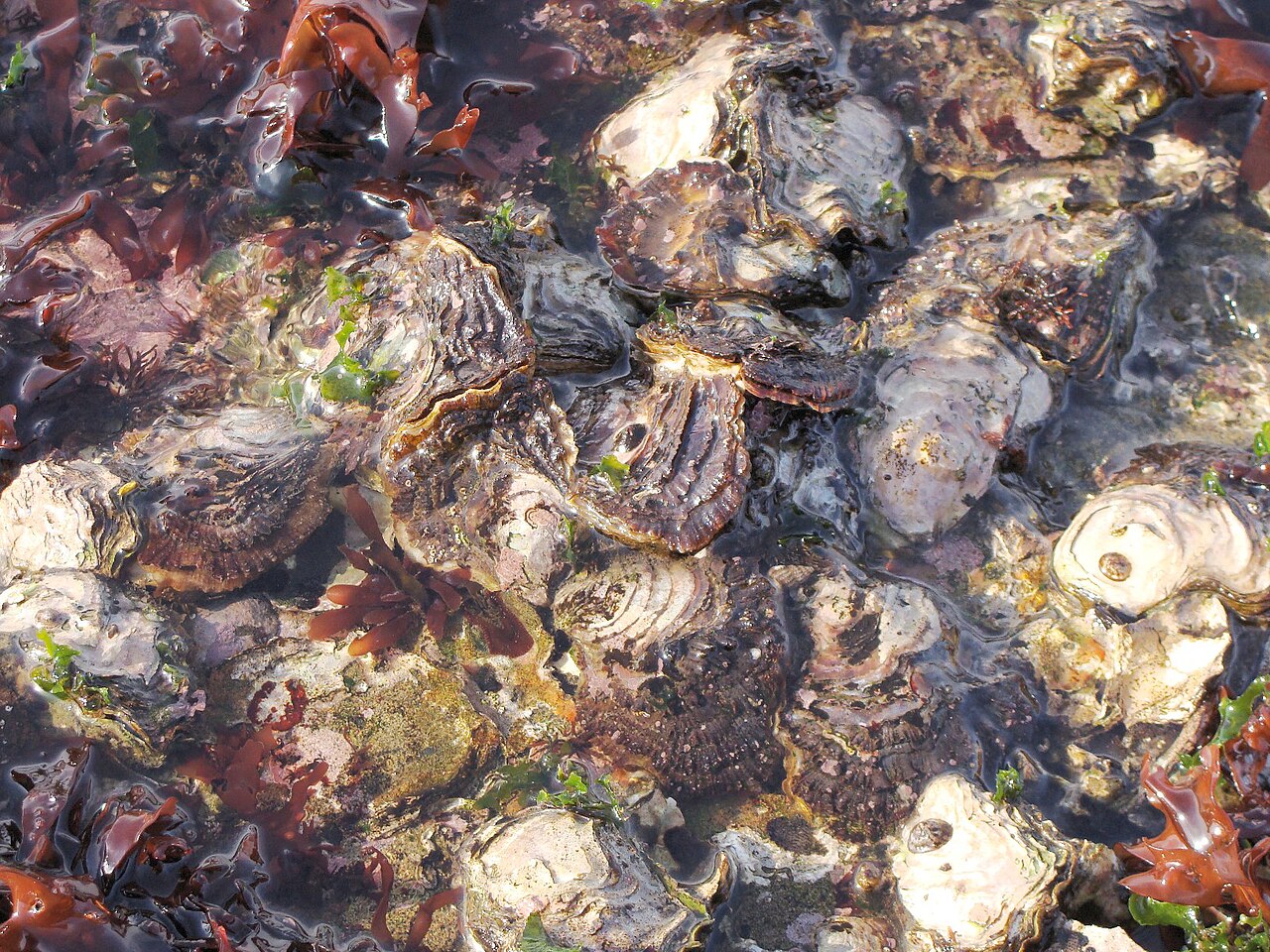
Patroklos Talking About Oysters

Schol A. ad Il. 16.747a

This man would feed many by seeking oysters. He uses this word “oyster” only once. It is a kind of marine shellfish. See the Separatists on this. For they claim that the poet of the Iliad does not present heroes using fish at food, while the Odyssey poet does. But it is clear that, if he did not present them as using them, they knew it, from the fact that Patroklos talks about oysters. Note how the poet tends to avoid the trivial. And surely, he does not show people eating greens. But, nevertheless, he does say “The enslaved women using shit to fertilize his great property”

πολλοὺς ἂν κορέσειεν ἀνὴρ <ὅδε τήθεα διφῶν>: ὅτι ἅπαξ εἴρηκε τήθεα. ἔστι δὲ εἶδος τῶν θαλασσίων ὀστρέων. πρὸς τοὺς Χωρίζοντας φασὶ γὰρ ὅτι ὁ τῆς ᾿Ιλιάδος ποιητὴς οὐ παρεισάγει τοὺς ἥρωας χρωμένους ἰχθύσιν, ὁ δὲ τῆς ᾿Οδυσσείας (cf. δ 368. μ 331). φανερὸν δὲ ὅτι, εἰ καὶ μὴ παράγει χρωμένους, ἴσασιν, ἐκ τοῦ τὸν Πάτροκλον ὀνομάζειν τήθεα. νοητέον δὲ τὸν ποιητὴν διὰ τὸ μικροπρεπὲς παρῃτῆσθαι. καὶ μὴν οὐδὲ λαχάνοις παρεισάγει χρωμένους. ἀλλ’ ὅμως φησὶ „δμῶες ᾿Οδυσσῆος τέμενος μέγα κοπρήσοντες” (ρ 299).

Schol T ad 16.784

“The poet also does not show heroes eating fish or birds, but still Odysseus’ companions do try to under compulsion. Generally, the poet avoids this kind of habit because of its triviality, but he has [heroes] eat roasted meat.”

οὐδὲ γὰρ ἰχθύσι χρωμένους εἰσήγαγεν ἢ ὄρνισιν, ἀλλ’ ὅμως δι’ ἀνάγκην καὶ τοῖς τοιούτοις ἐπεχείρουν οἱ ᾿Οδυσσέως ἑταῖροι (cf. δ 368. μ 331)· καθόλου γὰρ τὴν τοιαύτην χρῆσιν διὰ τὸ μικροπρεπὲς παρῃτήσατο, κρέασι δὲ ὀπτοῖς χρῆσθαι αὐτούς φησιν.

Suda, 477 Tau

“têthea: Oysters. Know that the ancients also ate these even though they do not provide much pleasure or nourishment.”

Τήθεα: ὄστρεα. ἰστέον ὅτι καὶ τούτοις ἐχρῶντο οἱ παλαιοί, καίτοι τῆς τούτων ἐδωδῆς οὐ πολὺ ἐχούσης τὸ ἡδὺ καὶ ὠφέλιμον.

Ostreidae ja 20090114.JPG


The Consent of the Damned: Homeric Scholia and the Lotus-Eaters

In Odysseus’ tale of his wanderings he recounts how he saved his men from the temptations of the land of the Lotus-Eaters

Odyssey 9.82-97

“From there for nine days I was carried by ruinous winds
over the fish-bearing sea. On the tenth we came to the land
of the Lotus-Eaters where they eat the florid food.
There we disembarked to the shore and we drew water;
soon my companions made dinner around the swift ships.
But after we had shared the food and drink
I sent out companions to go and discover
whatever men there were who ate the fruit of the earth.
I chose two men and sent a herald as a third.
They went and met the Lotus-eating men.
The Lotus-Eaters didn’t bring any harm to my companions,
but they gave them their lotus to share.
Whoever ate the honey-sweet fruit of the lotus
no longer wished to report back or return home,
but just longed to stay there among the Lotus-eating men
to wait and pluck the lotus, forgetting his homecoming.”

ἔνθεν δ’ ἐννῆμαρ φερόμην ὀλοοῖσ’ ἀνέμοισι
πόντον ἐπ’ ἰχθυόεντα• ἀτὰρ δεκάτῃ ἐπέβημεν
γαίης Λωτοφάγων, οἵ τ’ ἄνθινον εἶδαρ ἔδουσιν.
ἔνθα δ’ ἐπ’ ἠπείρου βῆμεν καὶ ἀφυσσάμεθ’ ὕδωρ,
αἶψα δὲ δεῖπνον ἕλοντο θοῇς παρὰ νηυσὶν ἑταῖροι.
αὐτὰρ ἐπεὶ σίτοιό τ’ ἐπασσάμεθ’ ἠδὲ ποτῆτος,
δὴ τότ’ ἐγὼν ἑτάρους προΐην πεύθεσθαι ἰόντας,
οἵ τινες ἀνέρες εἶεν ἐπὶ χθονὶ σῖτον ἔδοντες,
ἄνδρε δύω κρίνας, τρίτατον κήρυχ’ ἅμ’ ὀπάσσας.
οἱ δ’ αἶψ’ οἰχόμενοι μίγεν ἀνδράσι Λωτοφάγοισιν•
οὐδ’ ἄρα Λωτοφάγοι μήδονθ’ ἑτάροισιν ὄλεθρον
ἡμετέροισ’, ἀλλά σφι δόσαν λωτοῖο πάσασθαι.
τῶν δ’ ὅς τις λωτοῖο φάγοι μελιηδέα καρπόν,
οὐκέτ’ ἀπαγγεῖλαι πάλιν ἤθελεν οὐδὲ νέεσθαι,
ἀλλ’ αὐτοῦ βούλοντο μετ’ ἀνδράσι Λωτοφάγοισι
λωτὸν ἐρεπτόμενοι μενέμεν νόστου τε λαθέσθαι.

The scholia present reactions to this passage that are not altogether alien from some arguments in the debate about drug enforcement and addiction.

One scholiast quotes Heraclitus the Paradoxographer with approval, noting that this scene is about how the wise man can resist pleasure.

Schol. T ad. Od. 9 89

“From Herakleitos. If someone wishes to examine Odysseus’ wanderings precisely, he will find an allegorical tale. For he has set up Odysseus as something of a vehicle of every kind of virtue through which he has philosophized. And then he resists the vices that corrupt human life: the land of the Lotus-eaters represents pleasure, a land of foreign corruption which Odysseus masterfully passes by, and then he settles the wild heart of each man with either chastisement or persuasion.”

ἐκ τοῦ ῾Ηρακλείτου. καθόλου δὲ τὴν ᾿Οδυσσέως πλάνην εἴ τις ἀκριβῶς ἐθέλει σκοπεῖν, ἠλληγορημένην εὑρήσει. πάσης γὰρ ἀρετῆς καθάπερ ὄργανόν τι τὸν ᾿Οδυσσέα παραστησάμενος ἑαυτῷ διὰ τοῦτο πεφιλοσόφηκεν, ἐπειδήπερ τὰς ἐκνεμομένας τὸν ἀνθρώπινον βίον ἤχθηρε κακίας, ἡδονὴν μέν γε τὸ Λωτοφάγων χωρίον, ξένης γεωργὸν ἀπολαύσεως, ἣν ᾿Οδυσσεὺς ἐγκρατῶς παρέπλευσε, τὸν δ’ ἄγριον ἑκάστου θυμὸν ὡσπερεὶ καυτηρίῳ τῇ παραινέσει τῶν λόγων ἐπήρωσε.

Another commentator actually speaks of the Lotus-eaters as just men. This author implies that Odysseus’ men choose to take the drugs. Therefore, the blame is on them.

Schol. Q ad Od. 9.92

“Because they are righteous men, the [Lotus-eaters] do not restrain anyone by force, but by persuasion. For in the word “they were devising” it is clear that the ruin which attends these men does not happen without their consent. For, because the Lotus-eaters are righteous men, they were detaining no one by force but they were bewitching them with words alone.”

οὐδ’ ἄρα Λωτοφάγοι] δίκαιοι ὄντες ἄνδρες βίᾳ τινι οὐ κατεῖχον, ἀλλὰ πειθοῖ. τὸ δὲ “μήδοντο” δηλοῖ ὅτι οὐχ ἑκούσιος ἦν ἐκείνων ὁ γενόμενος ὄλεθρος. καὶ γὰρ οἱ Λωτοφάγοι δίκαιοι ὄντες βίᾳ οὐδένα κατεῖχον, ἀλλὰ τῷ λόγῳ μόνῳ ἔθελγον. Q.

And another comment explains that the men who partake of the lotus don’t actually forget their homecoming, but they merely stop worrying about it. Because, you know, it is their fault.

Schol. HQ ad Od. 9.97

“They forgot their homecoming” This follows from their nature, as it happens with the irrational animals, that the Lotus brings them forgetfulness and because of pleasure they spurn their homecoming. The sentiment is similar to the Iliad’s “they forgot their rushing valor”—they did not really forget it, but they stopped fostering it.”

νόστου τε λαθέσθαι] ἀκολούθως τῇ φύσει, ὡς ἐπὶ ἀλόγων ζῴων, οὐχ ὡς μέντοι τοῦ λωτοῦ λήθην ἐμποιοῦντος, ἀλλὰ διὰ τὴν ἡδονὴν καταφρονούντων τοῦ νόστου. ὅμοιον δέ ἐστι τῷ “λάθοντο δὲ θούριδος ἀλκῆς” (Il. ο, 322.). οὐ γὰρ ἐπελάθοντο, ἀλλὰ κατημέλησαν.

In these three cases, drug addiction is treated as an individual responsibility and not as either a biological challenge [e.g. addiction as a disease] or a social problem [an act of oblivion in a society with no collective meaning or sense of belonging].

(Maybe they were all on drugs anyway)

Ancient Greek may not have had a word for the concept of addiction.

How Many Angels on the Head of a Pin? How Many Oarsmen on Achilles’ Ships?

Scholia T ad Homer Iliad 16.170

“Achilles, dear to Zeus, had fifty ships which he led to Troy. In each of the ships there were fifty companions at the benches.” How, people ask, is it that the Poet who typically augments Achilles elsewhere, diminishes him in this passage? Is it because there is no excellence in numbers?

Aristarchus, however, says that there are fifty rowers [only] because of the phrase “on the benches”, meaning sailors as support crew. Dionysus, still, claims that the greatest number of rowers possible was 120 and that most ships had between these two numbers, so that the average amount was 86 men.”

πεντήκοντ᾽ ἦσαν νῆες θοαί, ἧισιν ᾽Αχιλλεὺς ἐς Τροίην ἡγεῖτο διίφιλος· ἐν δὲ ἑκάστηι πεντήκοντ᾽ ἔσαν ἄνδρες ἐπὶ κληῖσιν ἑταῖροι] πῶς, φασίν, ἐν ἅπασιν αὔξων ᾽Αχιλλέα τούτωι μειοῖ; τινὲς μὲν οὖν, ὅτι οὐκ ἐν πλήθει ἡ ἀρετή … ᾽Αρίσταρχος δέ φησιν ν̄ ἐρέτας εἶναι διὰ τὸ ῾ἐπὶ κληῖσιν᾽ ἢ ναύτας πρὸς ὑπηρεσίαν. Διονύσιος δὲ τὸν μέγιστον ἀριθμὸν ρ̄κ̄ τιμᾶι, τὸ δὲ λοιπὸν ἐν τῶι μεταξὺ τούτων ἄγεσθαι, ὡς φθάνειν πάσας ἀπὸ π̄ε̄ ἀνδρῶν.

Ah, another case study of that “morbus Graecorum”

Seneca, De Brevitate Vitae 13

“It would be annoying to list all the people who spent their lives pursuing board games, ball games, or sunbathing. Men whose pleasures are so busy are not at leisure. For example, no one will be surprised that those occupied by useless literary studies work strenuously—and there is great band of these in Rome now too.

This sickness used to just afflict the Greeks, to discover the number of oarsmen Odysseus possessed, whether the Iliad was written before the Odyssey, whether the poems belong to the same author, and other matters like this which, if you keep them to yourself, cannot please your private mind; but if you publish them, you seem less learned than annoying.”

Persequi singulos longum est, quorum aut latrunculi aut pila aut excoquendi in sole corporis cura consumpsere vitam. Non sunt otiosi, quorum voluptates multum negotii habent. Nam de illis nemo dubitabit, quin operose nihil agant, qui litterarum inutilium studiis detinentur, quae iam apud Romanos quoque magna manus est. Graecorum iste morbus fuit quaerere, quem numerum Ulixes remigum habuisset, prior scripta esset Ilias an Odyssia, praeterea an eiusdem essent auctoris, alia deinceps huius notae, quae sive contineas, nihil tacitam conscientiam iuvant sive proferas, non doctior videaris sed molestior.

Lenormant Relief, c. 410 BCE

The Right To Criticize the King: The Iliad and Freedom of Speech

Homer, Iliad 9.32-34

“After a while, Diomedes good-at-the warcry, addressed them:
“I will fight with you first because you are being foolish, son of Atreus,
Which is right, Lord, in the assembly. So don’t get angry at all.”

ὀψὲ δὲ δὴ μετέειπε βοὴν ἀγαθὸς Διομήδης·
᾿Ατρεΐδη σοὶ πρῶτα μαχήσομαι ἀφραδέοντι,
ἣ θέμις ἐστὶν ἄναξ ἀγορῇ· σὺ δὲ μή τι χολωθῇς.

Schol. T ad Il. 9.32b ex

[“I will fight with you first”] “It is clear that he is also criticizing the rest of the Greeks because they are consenting to the retreat through their silence. For he says the fight in opposition to the speech.”

ex. σοὶ πρῶτα μαχήσομαι: δῆλον ὡς καὶ τοῖς ἄλλοις μέμφεται ὡς συναινοῦσι τῇ φυγῇ διὰ τοῦ σιωπᾶν. μάχην δέ φησι τὴν ἐναντίωσιν τοῦ λόγου. T

Schol. A ad Il. 9.33b ex

[“which is right in the assembly, lord”] This is the custom, in a democracy. It is established in the agora because it is the custom to speak with freedom of speech [parrêsia] in the assembly.

D | Nic. ἣ θέμις <ἐστίν, ἄναξ, ἀγορῇ>: ὡς νόμος ἐστὶν—ἐν δημοκρατίᾳ. | ἐπὶ δὲ τὸ ἀγορῇ στικτέον, ὡς νόμος ἐστὶν ἐκκλησίας μετὰ παρρησίας λέγειν.

Schol. bT ad Il. 9.33 ex

[“don’t get angry at all”] this is an anticipatory warning, since he is about to criticize him more severely than he has been reproached at anytime, [alleging that it is right] to speak against kings during assemblies. He asks him to set anger aside because he believes it is right to accept advantageous truth and he is clarifying the purpose of what is said—that it is not to insult.

ex. ἣ θέμις ἐστίν, ἄναξ, <ἀγορῇ· σὺ δὲ μή τι χολωθῇς>: προδιόρθωσις, ἐπειδὴ σφοδρότερον αὐτοῦ μέλλει καθάπτεσθαι ὡς ἐφιεμένου μὴ ἄλλοτε, ἐν δὲ ταῖς ἐκκλησίαις ἀντιλέγειν τοῖς βασιλεῦσιν. προπαραιτεῖται δὲ τὴν ὀργήν, ἀξιῶν δέξασθαι τὴν πρὸς τὸ συμφέρον ἀλήθειαν καὶ δηλῶν ὡς τοῖς εἰρημένοις, οὐκ αὐτῷ ἀπέχθεται

Image result for ancient greek political assembly
Painting of Perikles by Philipp von Foltz

Testing a Goddess, Fooling the Scholia

After Athena reveals herself to Odysseus when he has arrived in Ithaka, he takes a moment to imply that she wasn’t very helpful during a period of his life. Oh, and he questions whether or not she’s just messing with him about the whole Ithaka thing. A scholiast takes issue with the authenticity of the passage. Modern editions retain it.

Odyssey, 13.316-328

“But after we sacked Priam’s high city
And went in our ships, a god scattered the Achaians,
And I no longer saw you, daughter of Zeus, I did not notice
You coming aboard my ship so you might ward some pain from me.
But always as I wandered I kept an expectant heart
That the gods would release me from evil—
Until that day when in the rich land of the Phaeacian people
You encouraged me with words and led me into the city yourself.
Now I beg you by your father—for I do not think
I have come to beautiful Ithaca, but I have turned up
In some other land. I think you are mocking me
When you say this so you might deceive my mind.”

αὐτὰρ ἐπεὶ Πριάμοιο πόλιν διεπέρσαμεν αἰπήν,
βῆμεν δ’ ἐν νήεσσι, θεὸς δ’ ἐκέδασσεν ᾿Αχαιούς,
οὔ σ’ ἔτ’ ἔπειτα ἴδον, κούρη Διός, οὐδ’ ἐνόησα
νηὸς ἐμῆς ἐπιβᾶσαν, ὅπως τί μοι ἄλγος ἀλάλκοις.
ἀλλ’ αἰεὶ φρεσὶν ᾗσιν ἔχων δεδαϊγμένον ἦτορ
ἠλώμην, εἷός με θεοὶ κακότητος ἔλυσαν·
πρίν γ’ ὅτε Φαιήκων ἀνδρῶν ἐν πίονι δήμῳ
θάρσυνάς τ’ ἐπέεσσι καὶ ἐς πόλιν ἤγαγες αὐτή.
νῦν δέ σε πρὸς πατρὸς γουνάζομαι· —οὐ γὰρ ὀΐω
ἥκειν εἰς ᾿Ιθάκην εὐδείελον, ἀλλά τιν’ ἄλλην
γαῖαν ἀναστρέφομαι· σὲ δὲ κερτομέουσαν ὀΐω
ταῦτ’ ἀγορευέμεναι, ἵν’ ἐμὰς φρένας ἠπεροπεύῃς· —
εἰπέ μοι εἰ ἐτεόν γε φίλην ἐς πατρίδ’ ἱκάνω.”

Schol. HQ ad Od. 13. 320-323

“These lines are inauthentic. First, instead of “my thoughts” it has “his thoughts”, which is third person and the poet always pays attention to the difference in these things. The second problem is that [Odysseus] attributes his rescue to the gods when Athena is present. The third and fourth are because he did not know that the goddess appeared to him among the Phaeacians and that she has not encouraged him, but rather the opposite.”

ἀλλ’ αἰεὶ φρεσὶν ᾗσιν ἔχων] νοθεύονται δ′ στίχοι. ὁ μὲν πρῶτος ὅτι ἀντὶ τοῦ ἐμῇσιν ἔχει τὸ ᾗσιν, ὅπερ ἐστὶ τρίτου προσώπου, τηροῦντος ἀεὶ τοῦ ποιητοῦ τὴν ἐν τούτοις διαφοράν· ὁ δεύτερος ὅτι ᾿Αθηνᾶς παρούσης θεοῖς ἀνατίθησι τὴν σωτηρίαν· ὁ δὲ τρίτος καὶ τέταρτος ὅτι οὐκ ἐγίνωσκεν ὡς ἡ φανεῖσα αὐτῷ παρὰ Φαίαξι θεὰ ἦν, ὅτι οὐκ ἐθάρσυνεν, ἀλλὰ τοὐναντίον

A geometric oinochoe in Munich once alleged to show Odysseus