The Arrow Flight of Songs

Henry W. Longfellow “The Arrow and the Song”,

I breathed a song into the air
It fell to earth, I knew not where;
For who has sight so keen and strong
That it can follow the flight of song?

Horace, Ars Poetica 347

“The string does not always return the sound that the hand and mind desire”.

neque chorda sonum reddit quem volt manus et mens.

Homer, Odyssey 21.407-409

“Just as a man who knows both lyre and song
easily stretches a string on a new peg
as he attaches the twisted sheep-gut to both sides
just so, without haste, Odysseus strung the great bow”

ὡς ὅτ’ ἀνὴρ φόρμιγγος ἐπιστάμενος καὶ ἀοιδῆς
ῥηϊδίως ἐτάνυσσε νέῳ περὶ κόλλοπι χορδήν,
ἅψας ἀμφοτέρωθεν ἐϋστρεφὲς ἔντερον οἰός,
ὣς ἄρ’ ἄτερ σπουδῆς τάνυσεν μέγα τόξον ᾿Οδυσσεύς.

Pindar, Olympian 2, 83-88

“Many are the swift arrows
Within the quiver
Under my arm—
They speak to those who understand,
But they lack interpreters
In every direction. Wise is the one who knows many things
by nature…”

…. πολλά μοι ὑπ’
ἀγκῶνος ὠκέα βέλη
ἔνδον ἐντὶ φαρέτρας
φωνάεντα συνετοῖσιν· ἐς δὲ τὸ πὰν ἑρμανέων
χατίζει. σοφὸς ὁ πολλὰ εἰδὼς φυᾷ·

Schol. Ad Pin. Ol. 2

“Swift arrows”: these are an allegory for poems from an archery metaphor. The quiver is his mind; the arrows are words.”

A ὠκέα βέλη: ἀλληγορεῖ ἀπὸ τῶν τόξων μεταφέρων ἐπὶ τὰ ποιήματα· φαρέτρα μὲν γὰρ ἡ διάνοια, βέλη δὲ οἱ λόγοι.

Image result for ancient greek archery vase


What Does it Mean to Have an Oral Homer?

The ‘modern’ Homeric ‘Question’ simmered for many centuries before it received its most clear articulation at the end of the 18th century when Wolf, who had been working on an edition of the Homeric text, published his Prolegomena.  He was one of the first to argue persuasively for the oral derivation of the Homeric poems. In the (declining) style of the time, Wolf published in Latin.

The full Latin text is available from Google books and on the Homer Multitext Project website. A fine translation was published in English in 1985/1988 by Anthony Grafton, Glenn W. Most, and James E. G. Zetzel.

Friedrich Augustus Wolf, Prolegomena ad Homerum (1795) section 23

“But what if the suspicion of a few scholars is likely, that these and the other compositions of those days were not written down but were first created by poets using memory and circulated as songs and then were ‘published’ widely by the singing of rhapsodes who were trained by their particular discipline to learn them? And if because of this, before they were fixed in writing, what if many changes naturally occurred either intentionally or by chance?

What if, for this reason itself, as soon as they began to be written, they exhibited many divergences and soon added new ones from the hasty adjustments by those who were eager to polish them and to align them with the best laws of the poetic art and their own custom And what if then this whole creation and series of two eternal songs are not of a single poet whom we are used to crediting for his genius but more from the dedication of a more polished time and thanks to the collected efforts of many—that the very songs from which the Iliad and the Odyssey were composed did not have a single author and this can be argued from likely propositions and reasons? What if, I ask, we must take up a belief different from the popular one about all of this, what then will it mean to restore the ancient gleam and original form to these poems?”

At vero, si nonnullorum probabilis est suspicio , haec et reliqua Carmina illorum temporum nullis litterarum mandata notis, sed primum a poetis memoriter facta et cantu edita, tum per rhapsodos, in iis ediscendis propria arte occupatos, canendo divulgata esse; ex quo, antequam scripto velut figerentur, plura in iis vel consilio vel casu immutari necesse esset; si hanc ipsam ob causam, statim ut scribi coepta sunt, multas diversitates habuerunt, mox novas subinde adsciverunt temeritate et coniecturis eorum, qui ea certatim expolire, et ad optimas leges poeticae artis ad suamque consuetudinem loquendi corrigere studebant; si denique totum hunc contextum ac seriem duorum perpetuorum Carminum non tam eius, cui eam tribuere consuevimus, ingenio, quam sollertiae politioris aevi et multorum coniunctis studiis deberi, neque adeo ipsas docdd, ex quibus Ilias et Odyssea compositae sunt, unum omnes auctorem habere, verisimilibus argumentis et rationibus effici potest; si, inquam, aliter de his omnibus, ac vulgo fit, existimandum est: quid tum erit, his Carminibus pristinum nitorem et germanam formam suam restituere?

Prolegomena

Poets: Gardeners of the Mind

Simonides, fr. 6.3

“Simonides said that Hesiod is a gardener while Homer is a garland-weaver—the first planted the legends of the heroes and gods and then the second braided together them the garland of the Iliad and the Odyssey.”

GNOMOL. VAT. GR. 1144 (= Hesiod. T 18d Jac): Σιμωνίδης τὸν ῾Ησίοδον κηπουρὸν ἔλεγε, τὸν δὲ ῞Ομηρον στεφανηπλόκον, τὸν μὲν ὡς φυτεύσαντα τὰς περὶ θεῶν καὶ ἡρώων μυθολογίας, τὸν δὲ ὡς ἐξ αὐτῶν συμπλέξαντα τὸν᾿Ιλιάδος καὶ Οδυσσείας στέφανον.

κηπολόγος: “teaching in the garden”

κηποποιία: “garden making”

κηποτάφιον: “a garden grave”

κηποτύρρανος: “tyrant of the garden”

κηπουργός: “garden worker”

κηποφύλαξ: “guardian of the garden”
Od. 24. 336–339

“But, come, if I may tell you about the trees through the well-founded orchard
The ones which you gave to me—when I was a child I asked you about each
As I followed you through the garden. We traced a path through them
And you named and spoke about each one.”

εἰ δ’ ἄγε τοι καὶ δένδρε’ ἐϋκτιμένην κατ’ ἀλῳὴν
εἴπω, ἅ μοί ποτ’ ἔδωκας, ἐγὼ δ’ ᾔτευν σε ἕκαστα
παιδνὸς ἐών, κατὰ κῆπον ἐπισπόμενος· διὰ δ’ αὐτῶν
ἱκνεύμεσθα, σὺ δ’ ὠνόμασας καὶ ἔειπες ἕκαστα.

Alex Purves (2010:228) retraces these steps as Odysseus “taking an imaginary walk through the orchard in his mind just as [Elizabeth] Minchin has suggested that Homer takes a cognitive walk through the Peloponnese in order to recount the Catalogue of Ships (2001: 84-7).”

Plato, Ion

“For poets certainly tell us that they bring us songs by drawing from the honey-flowing springs or certain gardens and glades of the Muses just like bees. And because they too are winged, they also speak the truth.”

Λέγουσι γὰρ δήπουθεν πρὸς ἡμᾶς οἱ ποιηταί, ὅτι ἀπὸ κρηνῶν μελιρρύτων ἢ ἐκ Μουσῶν κήπων τινῶν καὶ ναπῶν δρεπόμενοι τὰ μέλη ἡμῖν φέρουσιν ὥσπερ αἱ
μέλιτται. καὶ αὐτοὶ οὕτω πετόμενοι, καὶ ἀληθῆ λέγουσι.

Image result for medieval manuscript gardening
The Mysterious Garden, from a miniature medieval manuscript, Guillaume de Machaut: Poetical Work

his video is pure genius:

“Do you ever grow anything in the garden of your mind?”

Anger is Better than Indifference (for Lovers)

Catullus, Carmen 83

“Lesbia talks a lot of shit about me when her husband is around
This brings the greatest pleasure to that fool.
Ass, do you know nothing? She would be sound
If she forgot us in silence—but she rants and she squawks.
She not only remembers me but—a thing sharper to touch,
She’s enraged: it’s like this, she’s burning and talks.”

Lesbia mi praesente viro mala plurima dicit:
haec illi fatuo maxima laetitia est.
mule, nihil sentis? si nostri oblita taceret,
sana esset: nunc quod gannit et obloquitur,
non solum meminit, sed, quae multo acrior est res,
irata est. hoc est, uritur et loquitur.

As I have mentioned before, Catullus is the author who first drew me into classics when I was in high school. I loved the variety in his poems, the vitality, and the inappropriateness of some of his ‘subjects’. I can only imagine what would have happened had I been born but a bit later into a world in which the Latin AP was only Caesar and Vergil…

This poem has stuck with me for years as the most drastic version of the gap between passion (negative or positive) and indifference.

Book of Hours, MS S.7 fol. 5v - Images from Medieval and Renaissance Manuscripts - The Morgan Library & Museum
Book of Hours, MS S.7 fol. 5v

Aristotle Against the Machine

Aristotle, Poetics 1454a

“Clearly, the resolution of the plots should come from the plot itself and not, as in the Medea, from some divine contrivance or as in the Iliad during the rush to the ships (Il. 2.155). The divine device should instead be used for events that are outside the drama either for those that come before what people could know or those that come later which require prophecy and revelation—since we allow that the gods may see everything. There should be nothing illogical in the events, unless it comes from outside the tragedy itself as in Sophocles’ Oedipus.”

φανερὸν οὖν ὅτι καὶ τὰς λύσεις τῶν μύθων ἐξ αὐτοῦ δεῖ τοῦ μύθου συμβαίνειν, καὶ μὴ ὥσπερ ἐν τῇ Μηδείᾳ ἀπὸ μηχανῆς καὶ ἐν τῇ ᾿Ιλιάδι τὰ περὶ τὸν ἀπόπλουν. ἀλλὰ μηχανῇ χρηστέον ἐπὶ τὰ ἔξω τοῦ δράματος, ἢ ὅσα πρὸ τοῦ γέγονεν ἃ οὐχ οἷόν τε ἄνθρωπον εἰδέναι, ἢ ὅσα ὕστερον, ἃ δεῖται προαγορεύσεως καὶ ἀγγελίας· ἅπαντα γὰρ ἀπο-δίδομεν τοῖς θεοῖς ὁρᾶν. ἄλογον δὲ μηδὲν εἶναι ἐν τοῖς πράγμασιν, εἰ δὲ μή, ἔξω τῆς τραγῳδίας, οἷον τὸ ἐν τῷ Οἰδίποδι τῷ Σοφοκλέους.

Aristotle, Poetics 1460a26

“Narratives ought to prefer likely events, even if impossible, to improbable possible ones. Stories should not be made from illogical parts: in the best case, they should contain nothing illogical, unless it comes from outside the plot itself as when Oedipus is not aware how Laios died, instead of in the play itself, as when they report the events at Delphi in the Elektra or when the silent man comes from Tegea to Mysia in the Mysians. To say that otherwise the plot would be wrecked is ridiculous—it isn’t right to set up these sorts of events from the beginning. If a poet does this, and there is a more logical option available, it is strange. Even those illogical events in the Odyssey when Odysseus is put ashore [asleep by the Phaeacians] would have been manifestly intolerable if a lesser poet had created it. In the poem now, Homer softens and erases the strangeness with his other good traits.”

προαιρεῖσθαί τε δεῖ ἀδύνατα εἰκότα μᾶλλον ἢ δυνατὰ ἀπίθανα· τούς τε λόγους μὴ συνίστασθαι ἐκ μερῶν ἀλόγων, ἀλλὰ μάλιστα μὲν μηδὲν ἔχειν ἄλογον, εἰ δὲ μή, ἔξω τοῦ μυθεύματος, ὥσπερ Οἰδίπους τὸ μὴ εἰδέναι πῶς ὁ Λάιος ἀπέθανεν, ἀλλὰ μὴ ἐν τῷ δράματι, ὥσπερ ἐν ᾿Ηλέκτρᾳ οἱ τὰ Πύθια ἀπαγγέλλοντες ἢ ἐν Μυσοῖς ὁ ἄφωνος ἐκ Τεγέας εἰς τὴν Μυσίαν ἥκων. ὥστε τὸ λέγειν ὅτι ἀνῄρητο ἂν ὁ μῦθος γελοῖον· ἐξ ἀρχῆς γὰρ οὐ δεῖ συνίστασθαι τοιούτους. †ἂν δὲ θῇ καὶ φαίνηται εὐλογωτέρως ἐνδέχεσθαι καὶ ἄτοπον† ἐπεὶ καὶ τὰ ἐν ᾿Οδυσσείᾳ ἄλογα τὰ περὶ τὴν ἔκθεσιν ὡς οὐκ ἂν ἦν ἀνεκτὰ δῆλον  ἂν γένοιτο, εἰ αὐτὰ φαῦλος ποιητὴς ποιήσειε· νῦν δὲ τοῖς ἄλλοις ἀγαθοῖς ὁ ποιητὴς ἀφανίζει ἡδύνων τὸ ἄτοπον.

Image result for Medieval manuscript deus ex machina
George Whiter, Deus Ex Machina

Inanes esse mutosque: To Speak With(Out) Vergil’s Voice

Fr. 3 Seneca the Elder ( Donat. Vita Vergilii, 29.)

“Seneca reports that Julius Montanus was in the habit of saying that he would have stolen certain things from Vergil if he could have his voice, and comportment, and dramatic ability. [He added] that the same verses sounded beautifuly when Vergil was reciting but without him they were meaningless and mute.”

3. Et Seneca tradidit Iulium Montanum poetam solitum dicere involaturum se Vergilio quaedam, si et vocem posset et os et hypocrisin; eosdem enim versus ipso pronuntiante bene sonare, sine illo inanes esse mutosque.

Image result for medieval manuscript portrait vergil
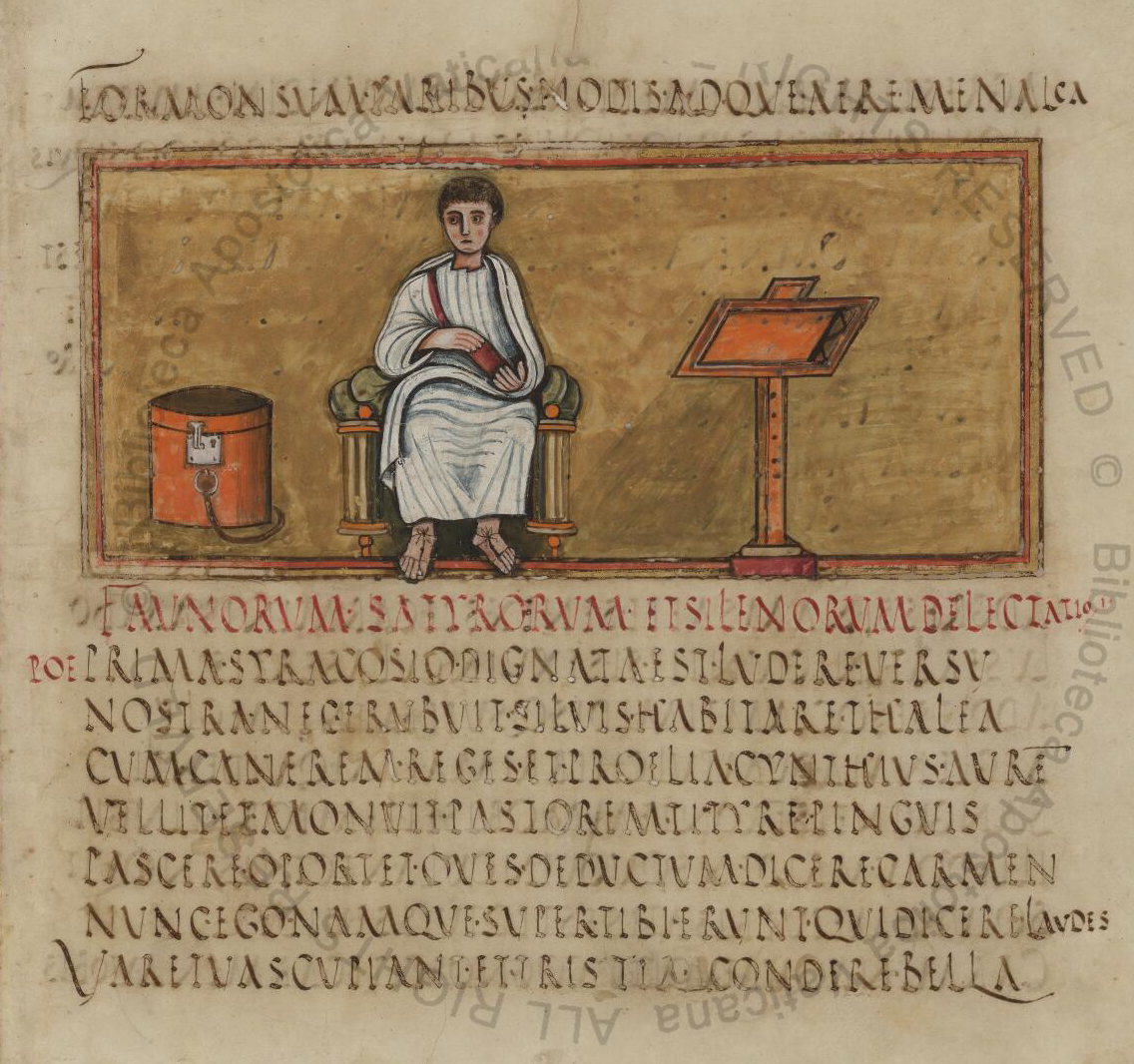
The Vergilius Romanus

Let Poets Be Our Teachers

Strabo Geography 1.2.3

“[Eratosthenes] said that the poet arranges everything for delighting the mind and not for education. Quite the opposite—ancients used to say that poetry was the first philosophy which integrates us into life from youth and teaches our characters, informs our experiences, and our actions in a pleasurable way.

The scholars of our day claim that the poet is the only wise person. For this reason too, the cities of Greece educate their children at the earliest stages through poetry, not only of course for the sake of entertaining them, but for nurturing wisdom as well. Indeed, for this reason too, music teachers who instruct those who play strings, lyre, and pipes help to shape their character. For these teachers say that they are also reformers of their ways. It is not only common to hear Pythagoreans making such claims, but even Aristoxenos asserts this, and Homer said that the singers were the wisest people of his day.”

Ποιητὴν γὰρ ἔφη πάντα στοχάζεσθαι ψυχαγωγίας, οὐ διδασκαλίας. τοὐναντίον δ’ οἱ παλαιοὶ φιλοσοφίαν τινὰ λέγουσι πρώτην τὴν ποιητικήν, εἰσάγουσαν εἰς τὸν βίον ἡμᾶς ἐκ νέων καὶ διδάσκουσαν ἤθη καὶ πάθη καὶ πράξεις μεθ’ ἡδονῆς· οἱ δ’ ἡμέτεροι καὶ μόνον ποιητὴν ἔφασαν εἶναι τὸν σοφόν. διὰ τοῦτο καὶ τοὺς παῖδας αἱ τῶν ῾Ελλήνων πόλεις πρώτιστα διὰ τῆς ποιητικῆς παιδεύουσιν, οὐ ψυχαγωγίας χάριν δήπουθεν ψιλῆς, ἀλλὰ σωφρονισμοῦ· ὅπου γε καὶ οἱ μουσικοὶ ψάλλειν καὶ λυρίζειν καὶ αὐλεῖν διδάσκοντες μεταποιοῦνται τῆς ἀρετῆς ταύτης· παιδευτικοὶ γὰρ εἶναί φασι καὶ ἐπανορθωτικοὶ τῶν ἠθῶν. ταῦτα δ’ οὐ μόνον παρὰ τῶν Πυθαγορείων ἀκούειν ἐστὶ λεγόντων, ἀλλὰ καὶ ᾿Αριστόξενος οὕτως ἀποφαίνεται. καὶ ῞Ομηρος δὲ τοὺς ἀοιδοὺς σωφρονιστὰς εἴρηκε.

Later

“But the nature of the poet is yoked to that of the human being—therefore, one cannot be a good poet unless first established as a good person.”

ἡ δὲ ποιητοῦ συνέζευκται τῇ τοῦ ἀνθρώπου, καὶ οὐχ οἷόν τε ἀγαθὸν γενέσθαι ποιητὴν μὴ πρότερον γενηθέντα ἄνδρα ἀγαθόν.

The Construction and Destruction of Troy in Cite de Dieu / Orosius Master
The Construction and Destruction of Troy, Orosius Master (c. 15th Century CE)

Life and the Great Game: Some Ancient Passages on Spectacles

Homer, Odyssey 8.147-8

“For as long as he lives, a man has no greater glory
than that which he wins with his own hands and feet”

οὐ μὲν γὰρ μεῖζον κλέος ἀνέρος, ὄφρα κεν ᾖσιν,
ἢ ὅ τι ποσσίν τε ῥέξῃ καὶ χερσὶν ἑῇσιν.

Diogenes Laertius, Life of Pythagoras 8.1

“Sosikrates in his Successions writes that when Pythagoras was asked by Leon the Tyrant of Plius what he was, he said “A philosopher”. And he was in the custom of comparing life to the Great Games because while some go there to compete, others go there to make money, even as some of the best go to watch. In the same way, in life, some grow up in servile positions, Pythagoras used to say, hunting for fame and profit while the philosopher hunts for the truth. That’s enough of that.”

Σωσικράτης δ᾿ ἐν Διαδοχαῖς φησιν αὐτὸν ἐρωτηθέντα ὑπὸ Λέοντος τοῦ Φλιασίων τυράννου τίς εἴη, φιλόσοφος, εἰπεῖν. καὶ τὸν βίον ἐοικέναι πανηγύρει· ὡς οὖν εἰς ταύτην οἱ μὲν ἀγωνιούμενοι, οἱ δὲ κατ᾿ ἐμπορίαν, οἱ δέ γε βέλτιστοι ἔρχονται θεαταί, οὕτως ἐν τῷ βίῳ οἱ μὲν ἀνδραποδώδεις, ἔφη, φύονται δόξης καὶ πλεονεξίας θηραταί, οἱ δὲ φιλόσοφοι τῆς ἀληθείας. καὶ τάδε μὲν ὧδε.

Tertullian, De Spectaculis

“This will be enough regarding the stained origin of games in idolatry”
Sed haec satis erunt ad originis de idololatria reatum.

102v
“How many ways have we shown that nothing which has to do with these games pleases god!”

Quot adhuc modis probavimus, nihil ex his quae spectaculis deputantur placitum deo esse!

Plutarch, Progress in Virtue 79F

Once when Aeschylus was watching a boxing match at the Isthmian games, one of the men was hit and the audience screamed out. He elbowed Ion of Chios and said, “Do you see what training is like? The man who was hit stays silent and the spectators yell!”

Αἰσχύλος μὲν γὰρ Ἰσθμοῖ θεώμενος ἀγῶνα πυκτῶν, ἐπεὶ πληγέντος τοῦ ἑτέρου τὸ θέατρον ἐξέκραγε, νύξας Ἴωνα τὸν Χῖον “ὁρᾷς,” ἔφη, “οἷον ἡ ἄσκησίς ἐστιν; ὁ πεπληγὼς σιωπᾷ, οἱ δὲ θεώμενοι βοῶσιν.”

Pindar, Nem. 4.6

“The story of deeds lives longer than deeds themselves”

ῥῆμα δ’ ἐργμάτων χρονιώτερον βιοτεύει

Cicero, De Senectute 58

“Let others have weapons, horses, spears, fencing-foils, ball games, swimming competitions, races, and leave to the old men dice and knucklebones for games. Or let that go too since old age can be happy without it.”

Sibi habeant igitur arma, sibi equos, sibi hastas, sibi clavam et pilam, sibi natationes1 atque cursus; nobis senibus ex lusionibus multis talos relinquant et tesseras; id ipsum ut2 lubebit, quoniam sine eis beata esse senectus potest.

Lucretius, De Rerum Natura 4.973-984

“And whenever people for many days in a row
Have given endless attention to games, we see that many
Have stopped actually absorbing these things with their senses
Even though there are paths still open in the mind
By which the representations of things may enter.
For many days in this way the same things are seen
Before their eyes and they stay awake so that they might seem
To see dancers moving their gentle limps
Or brush with their ears the liquid song of the lyre
And the talking chords, and to sense again that same concord
And the wild spectacular with its bright scene.”

Et quicumque dies multos ex ordine ludis
adsiduas dederunt operas, plerumque videmus,
cum iam destiterunt ea sensibus usurpare,
relicuas tamen esse vias in mente patentis,
qua possint eadem rerum simulacra venire.
per multos itaque illa dies eadem obversantur
ante oculos, etiam vigilantes ut videantur
cernere saltantis et mollia membra moventis,
et citharae liquidum carmen chordasque loquentis
auribus accipere, et consessum cernere eundem
scenaique simul varios splendere decores.

Horace, Epistles 1.19.48-9

“Sport tends to give rise to heated strife and anger, anger in turns brings savage feuds and war to the death”.

ludus enim genuit trepidum certamen et iram, ira truces inimicitias et funebre bellum.

Xenophanes, Fragment 2. 16-19

“Swiftness of feet—the thing honored most in all of man’s acts of strength in the contest—could never make a city governed well.”

οὐδὲ μὲν εἰ ταχυτῆτι ποδῶν, τόπερ ἐστὶ πρότιμον,
ῥώμης ὅσσ’ ἀνδρῶν ἔργ’ ἐν ἀγῶνι πέλει,
τούνεκεν ἂν δὴ μᾶλλον ἐν εὐνομίηι πόλις εἴη·

Image result for Ancient Greek athletic competitions

Surpassing the Signs of All Others

Homer, Odyssey 8.186-200

“So he spoke, and stripping off his cloak he grabbed a discus,
Larger and wider, not a little heavier than the ones
Which the Phaeacians where throwing among one another.
He turned around and whirled it from his strong hand
And the stone boomed. Then the oar-wielding Phaeacians
Leapt to the ground, those men famous for their ships,
At the hurl of the stone. Then it flew past all of their markers,
Swiftly hurling it from his hand. Then Athena set the boundary
After taking on the form of a man, and she spoke a word and called out:

“Even a blind person, friend, could find this marker
As he felt all around, since it is not at all mixed in with the others—
No, it is first by far. Be happy at this competition–
None of the Phaeacians will come close or surpass it.”

So much-enduring Odysseus said and he laughed
Taking pleasure in the fact that he had a real friend in the game.”

ἦ ῥα, καὶ αὐτῷ φάρει ἀναΐξας λάβε δίσκον
μείζονα καὶ πάχετον, στιβαρώτερον οὐκ ὀλίγον περ
ἢ οἵῳ Φαίηκες ἐδίσκεον ἀλλήλοισι.
τόν ῥα περιστρέψας ἧκε στιβαρῆς ἀπὸ χειρός·
βόμβησεν δὲ λίθος· κατὰ δ’ ἔπτηξαν ποτὶ γαίῃ
Φαίηκες δολιχήρετμοι, ναυσικλυτοὶ ἄνδρες,
λᾶος ὑπὸ ῥιπῆς· ὁ δ’ ὑπέρπτατο σήματα πάντων,
ῥίμφα θέων ἀπὸ χειρός· ἔθηκε δὲ τέρματ’ ᾿Αθήνη
ἀνδρὶ δέμας εἰκυῖα, ἔπος τ’ ἔφατ’ ἔκ τ’ ὀνόμαζε·

“καί κ’ ἀλαός τοι, ξεῖνε, διακρίνειε τὸ σῆμα
ἀμφαφόων, ἐπεὶ οὔ τι μεμιγμένον ἐστὶν ὁμίλῳ,
ἀλλὰ πολὺ πρῶτον. σὺ δὲ θάρσει τόνδε γ’ ἄεθλον·
οὔ τις Φαιήκων τόν γ’ ἵξεται οὐδ’ ὑπερήσει.”

ὣς φάτο, γήθησεν δὲ πολύτλας δῖος ᾿Οδυσσεύς,
χαίρων οὕνεχ’ ἑταῖρον ἐνηέα λεῦσσ’ ἐν ἀγῶνι.

Schol. VT ad Od. 8.192 ex

“Signs, footprints. For many were hurling the discus previously. The signs are the impressions left by the discuses”

σήματα] σημεῖα. τινὲς δὲ, βήματα. V. πολλοὶ γὰρ προεδίσκευσαν. σήματα δὲ τὰ πηγνύμενα τοῖς δίσκοις. T.


Red-Figure Kylix, MFA Boston

Some Truth and Beauty for A Scatographic Week

Sometimes in our paroxysms of surprise and despair–our shitgasms, if you will--we lose sight of all those reasons for wonder and delight. One of the more insidious things about the current news cycle and the nihilistic solipsism of our current presidency is that we are given such little time to pause–each day brings new and justified reasons for anxiety and, to tell the truth, rage.

As a tonic, here are (1) the most beautiful lyric poem ever written (Sappho fr. 16), (2) a list of love-compounds, and (3) completely subjective aesthetic pronouncements about the beauty of Ancient Greek

Some say a force of horsemen, some say infantry
and others say a fleet of ships is the loveliest
thing on the dark earth, but I say it is
the one you love

It is altogether simple to make this understood
since she whose beauty outmatched all,
Helen, left her husband
a most noble man

And went sailing to Troy
Without a thought for her child and dear parents
[Love] made her completely insane
And led her astray

This reminds me of absent Anactoria

I would rather watch her lovely walk
and see the shining light of her face
than Lydian chariots followed by
infantrymen in arms

Οἰ μὲν ἰππήων στρότον, οἰ δὲ πέσδων,
οἰ δὲ νάων φαῖσ’ ἐπὶ γᾶν μέλαιναν
ἔμμεναι κάλλιστον, ἐγὼ δὲ κῆν’ ὄτ-
τω τις ἔραται

πά]γχυ δ’ εὔμαρες σύνετον πόησαι
πά]ντι τ[οῦ]τ’· ἀ γὰρ πολὺ περσκέθοισα
κά]λλος ἀνθρώπων Ἐλένα [τὸ]ν ἄνδρα
τὸν πανάριστον
/ [κρίννεν ἄρ]ιστον

καλλίποισ’ ἔβας ‘ς Τροίαν πλέοισα
/ ὂσ τὸ πὰν] σέβασ τροΐα[σ ὄ]λεσσ[ε,
κωὐδὲ παῖδος οὐδὲ φίλων τοκήων
πάμπαν ἐμνάσθη, ἀλλὰ παράγαγ’ αὔταν
οὐκ ἀέκοισαν
/ πῆλε φίλει]σαν

Κύπρις· εὔκαμπτον γὰρ ἔφυ βρότων κῆρ
] κούφως τ . . . οη . . . ν
κἄμε νῦν Ἀνακτορίας ὀνέμναι-
σ’ οὐ παρεοίσας

/ Ὠροσ. εὔκ]αμπτον γαρ [ἀεὶ τὸ θῆλυ]
αἴ κέ] τισ κούφωσ τ[ὸ πάρον ν]οήσῃ.
οὐ]δὲ νῦν, Ἀνακτορί[α, τ]ὺ μέμναι
δὴ] παρειοῖσασ,

τᾶς κε βολλοίμαν ἔρατόν τε βᾶμα
κἀμάρυχμα λάμπρον ἴδην προσώπω
ἢ τὰ Λύδων ἄρματα κἀν ὄπλοισι
πεσδομάχεντας.

Attested compounds from the LSJ 1902:

φιλαλεξάνδρος: philaleksandros, “Alexander-lover”

φιλαλήθης: philalêthês, “lover of truth”

φιλαναγνώστης: philanagnôstês, “love of reading”

φιλαμαρτήμων: philamartêmôn, “lover of sin”

φιλανθής: philanthês, “flower-lover”

φιλαπεχθημοσύνη: philapekhthêmosunê, “fond of making enemies”

φίλαυτος: philautos, “self-lover”

φιλέρημος: philerêmos, “lover of solitude”

φίλερις: phileris, “lover of conflict”

φιληδονία: philêdonia, “lover of pleasure”

φιλόβιβλιος: philobiblios, “book-lover”

φιλοβόρβορος: philoborboros, “lover of dirt”

φιλόγλυκυς: philoglukus, “sweet-lover”

φιλογύνης: philogunês, “woman-lover”

φιλοδένρος: philodendros, “tree-lover”

φιλόδροσος: philodrosos, “lover of dew”

φιλοζωία: philozôia, “lover of life”

φιλόθακος: philothakos, “lover of sitting”

φιλοιφής: philoiphês, “lover of sexual intercourse”

φιλόκενος: philokenos, “lover of emptiness”

φιλόκηπος: philokêpos, “lover of gardens”

φιλόκροτος: philokrotos, “lover of noise”

φιλοκύων: philokuôn, “lover of dogs”

φιλόλογος: philologos, “lover of words”

φιλόλουτρος: philoloutros, “lover of baths”

φιλομαθής: philomathês, “lover of learning”

φιλόμαστος: philomastos, “breast-loving”

φιλόμβρος: philombros, “rain-loving”

φιλόμηρος: philomêros, “Homer-loving”

φιλομήτωρ: philomêtôr, “mother-loving”

φιλονέος: philoneos, “youth-loving”

φιλομόχθηρος: philomokhthêros, “loving bad men”

φιλομύθος: philomuthos, “story-lover”; also “fond of talking”

φιλόξενος: philoksenos: “Stranger-lover”

φιλοπενθής: philopenthês, “grief-lover”

φιλοπλάκουντος: philoplakountos, “cake-lover”

φιλοπολύγελως: philopolugelôs, “lover of great laughter”

φιλοπόνος: philoponos, “work-lover”

φιλοπόρνος: philopornos, “lover of harlots”

φιλοπρεπής: philoprepês, “lover of propriety

φιλορρώθων: philorrôthôn, “nose-lover”

φιλορχηστής: philorkhêstês, “dance-lover”

Palaiophron posted this last year.

Basil Gildersleeve, Hellas and Hesperia

“No lover can avoid the catalogue of the charms of his mistress. Petrarch is eloquent in sonnet and canzone on the subject of Laura’s eyes. Shall our mistress lack eyes? Again, your true lover is sublimely indifferent to the fact that the audience is utterly unacquainted with the object of his adoration, and so even after many years of close communion with Greek, I was capable in 1869 of holding forth ecstatically on its physical charms, for I am enough of a heathen to recognize in physical beauty the only true incentive of love. It is the physical beauty of Greek that constitutes its intimate attraction, that redeems, for instance, the tedious obviousnesses of the old man eloquent, and I could still rhapsodize, as I did forty years ago, on the sequences of vowels and the combinations of consonants, the concert of mute and liquid, the clear-cut outline of every word in Greek, clear and sharp as the sky-line of the mountains of Greece, as the effigies on Greek coins. I could still wax lyrical about the paradigm of the Greek verb. The Greek verb is, indeed, a marvel.

‘Flexible and exact, simple in its means, abundant in its applications, with varying tones for colorless statement, for eager wish, for purpose, for command, now despatching the past with impatient haste, now unrolling it in panoramic procession, but bringing forth its treasure of vowels and diphthongs to mark the striving of the will, the thought, the desire, toward the future,’ and so on and so on. Perhaps discourse like this might rouse the curiosity of the student and win here and there a friend for Greek. The teacher can never know whether shall prosper either this or that. I remember to have read in Gogol’s ‘Dead Souls’ a eulogy of Russian that would have Inspired me, if I had been endowed with ample leisure, to attempt the acquisition of that difficult idiom. But I am not quite sure that this unverifiable laudation Is the right way to lend vitality to the study. ‘The king’s daughter is all glorious within.’ But he that is without remains cold as a rule. The love of a language from this point of view is a matter of individual experience, a business to be transacted under four eyes only, and as much of the physical beauty of a language depends on the pronunciation, it may be well to relegate the whole thing to the realm of ‘fancy,’ that admirable old word for love. I will, therefore, waive the whole subject of the perfection of the Greek language, both in Its form and Its function, the wealth of its vocabulary, and the flexibility of its syntax, and limit myself to a few remarks on the relation of Greek to our daily life.”

petrarch1