Love And Loss: Nothing Says “Happy Valentine’s Day” Like Epitaphs!

Brandon Conley does it again! A timeless (and endless) respite from the sappy Romance of the season


  1. AE 1983 0040

D(is) M(anibus). Memoriae Publicies Septimines L(ucius) Sammonius Adiutor coniug(i) pientissim(a)e et animules amantissimes

“To the spirits of the dead. Lucius Sammonius Adiutor (made this) for the memory of Publicia Septimina, his most faithful wife and most loving soul.”

Romancouple

  1. AE 1982 0106

D(is) M(anibus) Iucundis[sim]a Priscia[no con]iugi am[antiss]imo b(ene) [m(erenti) fecit]

“To the spirits of the dead. Iucundissima made this for her well-deserving, most loving husband, Priscianus.”


  1. CIL 6.18817

Animae sanctae colendae d(is) m(anibus) s(acrum). Furia Spes L(ucio) Sempronio Firmo coniugi carissimo mihi. Ut cognovi puer puella obligati amori pariter. Cum quo vixi tempori minimo et quo tempore vivere debuimus a manu mala diseparati sumus. Ita peto vos manes sanctissimae commendat[um] habeatis meum ca[ru]m et vellitis huic indulgentissimi esse horis nocturnis ut eum videam et etiam me fato suadere vellit ut et ego possim dulcius et celerius aput eum pervenire.

“To a sacred and worshipped spirit: a sacred thing to the spirits of the dead. Furia Spes (made this) for her dearest husband, Lucius Sempronius Firmus. When we met as boy and girl, we were joined in love equally. I lived with him for a short while, and in a time when we should have lived together, we were separated by an evil hand.

So I ask you, most sacred spirits, to protect my dear husband entrusted to you, and that you be willing to be most accommodating to him in the nightly hours, so I may have a vision of him, and so he might wish that I persuade fate to allow me to come to him more sweetly and quickly.”

adiutor

  1. CIL 3.10501

Clausa iacet lapidi coniunx pia cara Sabina. Artibus edocta superabat sola maritum vox ei grata fuit pulsabat pollice c(h)ordas. Set (sed) cito rapta silpi (silet)…

“My beautiful, faithful wife, Sabina, lies enclosed in stone. Skilled in the arts, she alone surpassed her husband. Her voice was pleasing (as) she plucked the strings with her thumb. But suddenly taken, now she is silent.”


  1. CIL 3.00333

Dis Manibus Flaviae Sophene [Ge]nealis Caesaris Aug(usti) [se]rvos verna dispens(ator) [ad] frumentum carae coniugi et amanti bene merenti fecit [vix(it)] an(nis) XXXII m(ensibus) VII

//

[Φλ]αβία Σόφη γυνὴ Γενεάλ/[ιος] Καίσαρος δούλου οἰκο/νόμου ἐπὶ τοῦ σείτου / [ζή]σασα κοσμίως ἔτη [λβ] / [μῆ]νας ζ χαῖρε

“To the spirits of the dead. For Flavia Sophe. Genialis, home-born slave of Caesar Augustus, keeper of the grain supply, made this for his loving, dear, well-deserving wife. She lived 32 years, 7 months.”


  1. AE 1982 0988.

Iulia Cecilia vicxit annis XLV cui Terensus marit(us) fek(it) dom(um) et(e)r(nalem) f(eci)t

“Julia Caecilia lived 45 years, for whom her husband Terensus made this. He made her an eternal home.”


  1. CIL 13.01983 (EDCS-10500938)

D(is) M(anibus) et memoriae aetern(ae) Blandiniae Martiolae puellae innocentissimae quae vixit ann(os) XVIII m(enses) VIIII d(ies) V. Pompeius Catussa cives Sequanus tector coniugi incomparabili et sibi benignissim(a)e quae mecum vixit an(nos) V m(enses) VI d(ies) XVIII sine ul(l)a criminis sorde. Viv(u)s sibi et coniugi ponendum curavit et sub ascia dedicavit. Tu qui legis vade in Apol(l)inis lavari quod ego cum coniuge feci. Vellem si ad(h)uc possem

“To the spirits of the dead and the eternal memory of Blandinia Martiola, a most innocent girl who lived 18 years, 9 months, 5 days. Pompeius Catussa, a Sequani citizen and plasterer, (made this) for his incomparable and most kind wife, who lived with me 5 years, 6 months, 18 days without any transgressions. While alive, he saw to the building and dedicated this, while under construction, to himself and his wife. You who read this, go and bathe in the bath of Apollo, which I did with my wife. I wish I were still able to do it.”


  1. CIL 06.15346

Hospes quod deico paullum est. Asta ac pellege. Heic est sepulcrum hau(d) pulcrum pulcrai feminae. Nomen parentes nominarunt Claudiam. Suom mareitum corde deilexit souo. Gnatos duos creavit horunc (horum-ce) alterum in terra linquit alium sub terra locat. Sermone lepido tum autem incessu commodo domum servavit lanam fecit dixi abei

“Stranger, what I say is short. Stand and read over it. This is the hardly beautiful tomb of a beautiful woman. Her parents called her Claudia. She loved her husband with all her heart. She had two sons, one of whom she leaves on earth, the other she placed under it. With pleasant conversing but respectable gait she cared for her home and made wool. I have spoken. Move along.”


  1. CIL 06.20307

Iulio Timotheo qui vixit p(lus) m(inus) annis XXVIII vitae innocentissim(a)e decepto a latronibus cum alumnis n(umero) VII. Otacilia Narcisa co(n)iugi dulcissimo

“For Julius Timotheus, who lived around 28 years of a most innocent life, cheated by bandits along with his 7 fostered children. Otacilia Narcisa (made this) for her sweetest husband.”

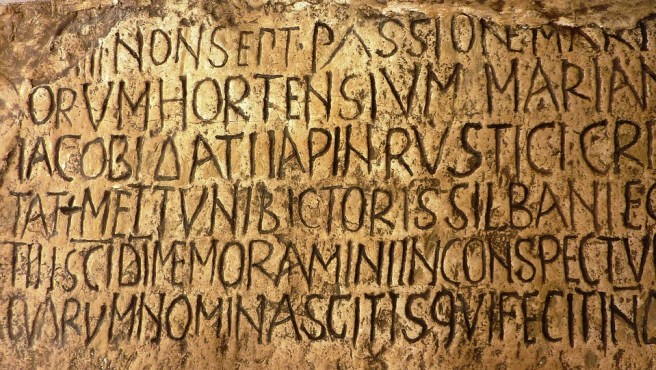
Image result for roman epitaph
This is from the Johns Hopkins Archaeological Museum

Non-Elite Latin for the Classroom

The following is a thoroughly masterful and fascinating introduction to using non-elite Latin in teaching by Brandon Conley.

Introduction

This is a brief introduction to non-elite Latin texts, intended for use in the classroom as a supplement to the more traditional Latin readings. For the majority of the following texts, knowledge of Latin equivalent to the first two to three semesters at the college level is advised, though several are suitable for first-year courses.

Firstly, what is non-elite Latin? Generally speaking, non-elite Latin comprises the texts produced outside of Rome’s powerful, exclusive literary circles, the arbiters of linguistic prestige—the ‘literati,’ so to speak. Other terms are often used to describe these texts, such as non-literary or non-standard. These definitions often, but not always, apply, and regularly more than one can be used to describe the same text. For example, we wouldn’t use ‘non-standard’ to describe an epitaph written for a freedwoman in Dacia that adheres to the linguistic standards of classical Latin (its adherence makes it, in fact, standard), but we could describe it as both non-elite and non-literary. The texts here can be standard or not (though most contain non-standard forms), as well as literary or not (though most aren’t). But they are all non-elite by virtue of the statuses, locations, and linguistic conventions of their authors.
nelatin

Reading non-elite texts, with few exceptions, presents a set of challenges different from those of classical Latin. Linguistic features are more prone to diachronic and geographic change than the comparatively change-resistant classical standards. Spellings can be phonetic, colloquial, learned conventions, or intentionally archaic for effect. Morphology and syntax often differ widely as well, as in the increased usage of the indicative or the expanded role of the accusative (at the expense of the ablative, regularly). Vocabulary can be geographically specific, and differences in semantic value between non-elite and classical Latin are not uncommon.

Some of these features are discussed below to aid in reading. Efforts were made to add punctuation, etc., for ease of reading and approachability to students. Spellings are often left in their non-standard forms, though to aid in reading, many words are edited using brackets or parentheses; for particularly problematic spellings, a classical form of the word is added in parentheses. Texts (and translations, where available) are taken from the sources linked, with modifications (unless otherwise noted).

Exercises in non-elite Latin are often exercises in editing, critical reading, and emendation, as many of the texts are damaged or difficult to interpret. Reading these texts presents a practical opportunity to discuss textual editing as a scholarly process.

Lastly, accessibility is paramount. Students, instructors, and independent scholars often lack access to the databases and publications in which many non-elite texts are presented. All of the texts presented below are freely available online. At the end of this document, however, the recommended reading list contains mostly sources that are not open access.

Feel free to add, remove, edit, scream at, or pour coffee on the text—though should you choose to pour the coffee, print it first.

Spelling

Motives for the spellings can be any number of things, from a widespread phonetic change to a local scribe’s misspelling. Often, unsurprisingly and necessarily, there is considerable debate on the causes of the spellings. Likewise, we must resist, often with great difficulty, tendencies to generalize non-standard spellings as broader linguistic features without the presence of more evidence.

These are some of the most common differences in spelling between non-elite and classical Latin.

Word-initial and Intervocalic Aspirate, h-, /h/ (habeo, hic, mihi, ): The initial and intervocalic aspirate /h/ had disappeared from most speech varieties by the imperial period, and from all eventually (with the exception of a select few prescriptive grammarians, perhaps). Hence, it is often omitted in non-elite texts, with resulting forms such as abes, mi, and ic.

Word-final -m, /m/ (dicam, amicum, etc.): -m was not pronounced (as /m/, at least) at the end of a word in spoken Latin, even before the time of Cicero; consider, for example, the impact this had in classical poetry in the process of elision. It is omitted from spelling with great frequency in non-elite texts, and can often cause confusion for first-time readers.

The v/b Shift, /w/ à /β/ (cf. the v in Spanish): this is a simplification of the process, but essentially the glide /w/ of classical pronunciation became increasingly pronounced as a bilabial fricative. This change is represented in non-standard spellings by the replacement of Latin v for b (e.g. dibi, classical divi, “gods”), as writers considered b to more closely represent the sound.

xs for x (dixsit,): there are potentially a few, if separate, factors that motivated this spelling. In short, an s was added after x due to the differing phonetic qualities of x as it was written (by itself, not representing /ks/). This is a common spelling feature, but generally not a problematic one for reading.

Assimilation and Weakening: a widespread trend in non-elite spellings is the simplification of consonant clusters, often through assimilation (i.e. one sound in the cluster ‘absorbs’ another sound) or weakening leading to loss. These can result in either a different letter being used to represent the altered sound (imveni, inveni) or the complete loss of a consonant (nuc, cf. nunc; meses, cf. menses). A notable loss, in cosul, is even reflected in standardized inscriptions in the abbr. cos. Loss is also quite common with consonants preceding the semivowel /j/, i (aiuto, cf. adiuto, “I help”).

Doubling of letters and reduction of doubled letters (faccio, facio; anis, cf. annis): multiple operations are at work, including the strengthening, weakening, and shortening of consonants, gemination and degemination, as well as the general tendency to eliminate letters that are not reflected in speech. Though not all spellings of these types can be ascribed to changes in pronunciation. For reading purposes, the doubling of letters (e.g. faccio) is usually not problematic. The absence of doubled letters can be problematic, though, as the non-standard forms frequently resemble other words with standard spellings (e.g. annis, dat/abl pl. ‘years,’ but anis, dat/abl pl. ‘rings’; or suum ‘own’, but sum ‘I am’).

Deletion: Vowels and consonants are regularly deleted in medial positions. Unstressed vowels are most commonly deleted (aspros, cf. asperos; copla, cf. copula), reducing the number of syllables in a word. This trend is not entirely unusual even in literary Latin.

Often duplicate vowels are reduced to one letter (serus, seruus; tus, cf. tuus).

Voiced and Devoiced Consonant Switching: switching in both directions is common, and the motives vary. The use of t for d and vice versa are perhaps the most common in the texts below (ed, set, at, ). Sometimes they are even used interchangeably in the same document. There is considerable doubt that these spellings reflected wider speech patterns.

Other Orthographic Consonant Substitutions: k is regularly used for c (karissimo), as is, to a lesser extent, q before u (mequm, quravit). These generally do not pose problems for readers.

e/i Representation: the writing of e for i and vice versa is one of the most commonly found spelling deviations from classical standards. Spellings of this type sometimes, though not always, reflect a widespread phonetic change in Latin speech well into the imperial period, whereby the vowels long e /e:/ and short i /i/ merged into a single vowel, /ẹ/. Both letters were used with little consistency to represent this phoneme. Another motive was the tendency for /e/ and /i/ to become a semivowel /j/ after a consonant (vinia as two syllables, rather than vinea). Occasionally, e was even used to represent ī /i:/. Some examples: sene, nese, dicet, ube, ibe, and signabet.

u/o Representation: another very common set of vowel substitutions, o is frequently used in place of u. The majority of instances occur in final syllables of the nominative and accusative singular; -us and -um become -os and -om, respectively. While another widespread vowel merger (similar to e/i) occurred very late in the imperial period, whereby ō /o:/ and u /u/ merged to a closed o /ọ/, the great majority of non-elite texts from the Roman Empire likely do not reflect this process. The use of o for u is far more likely to be an orthographic remnant (a ‘relic’, perhaps) of the old Latin spelling, which reflects the original o-stem. As mentioned above, there is also a strong stylistic tendency against writing the consecutive vowels uu, and o often replaces the second one. Examples: servos, mortuos, novom, salvom.

ei for i (tibei, ubei, etc.): the use of the vowels ei for classical i occurs regularly, and is an archaism of spelling, either for style or by learned inheritance, rather than an indication of pronunciation. It is a remnant of a popular spelling in old Latin which did reflect speech; the original diphthong /ei/ underwent a change to /i:/.

Monophthongization: ae /ae/ à e /ɛ/: other diphthongs disappear as well, but ae to e is present most frequently in the texts. Examples: que, quae; Cecilius, cf. Caecilius; and equum, cf. aequum. These can be problematic, as evidenced by the final example equum (potentially confused for the classical ‘horse’).

Morphology and Syntax

While there are numerous morphological and syntactic differences from classical Latin, they rarely impede reading to the extent of spelling differences. For example, a Latin student might recognize that the ‘incorrect’ verb tense is used in a conditional, but meaning can still be deduced. As such, only a few points will be mentioned here; see the recommended readings for further discussion.

Accusatives with Prepositions: there is plenty of evidence to support the convincing notion that the accusative became the default case for prepositional phrases. Most notably, cum, de, pro and in regularly take accusatives (even in instances in which the classical ‘ablative of place where’ would be expected). The situation is further complicated by the status of word-final -m, which made the ablative and accusative cases sound identical in speech in some instances, and the omission of which in writing can make a word appear ablative, though a writer originally had in mind an accusative. Advice for readers is to expect accusatives with prepositions which would otherwise be unexpected in classical Latin.

Analogy and Paradigm Leveling: analogy was a productive process in Latin, and in non-elite texts it occurs often in verbal and nominal morphology. Forth declension nouns in classical Latin sometimes use the more regular endings of the second declension in non-elite texts (an ongoing process that eventually saw the near-complete elimination of the fourth declension). Verbal constructions are leveled as well, for example in posso (“I can”) being given a common -o 1st singular ending in place of the standard possum.

Indicative or Infinitive: in instances where classical Latin would employ a subjunctive, such as in an indirect question, it is not uncommon in non-elite texts to see an indicative or an infinitival construction.

The conjunctions et and sed: a number of texts rely heavily on these conjunctions, including them where syntactically unnecessary or where other conjunctions would be more appropriate for clarity. One must not always take these literally or strictly when reading.

Vocabulary

Reading any different author or genre of Latin usually requires familiarization with new vocabulary, and non-elite texts are no exception. Cicero’s surviving works, for example, do not contain inventories of materials or equipment, and in the texts that do contain these, some words will be new to readers. In some instances, however, things are more complicated. Loanwords or local words with limited attestation are common, and their meanings are uncertain; the ostraka found at Bu Njem, for example, contain several Punic words. The texts below were chosen with these considerations in mind, though it will perhaps be necessary to look up some military terms, for example.

Keep reading for some phenomenal texts….

Continue reading “Non-Elite Latin for the Classroom”

A Curse from Teos: Woe for the Drug-Makers!

SGDI 15632 (Teos, c. 475 BCE; from Buck, Greek Dialects: Ionic Inscriptions, 3)

“Who ever should make deadly drugs for the Teian community or for an individual, destroy him and his family. Whoever stops the importation of grain into the Teian land or repels it as it is being imported either with skill or device and on sea or on land, destroy him and his family.”

Tean

Aristotle (On Plants) and Galen (varia) define deleterious medicines (δηλητήρια φάρμακα) as those that are fatal to human beings, such as poisonous venom or substances coming from hemlock (or concentrations of opium, henbane etc.). Of course, such things are weaponized fairly early in human history as this threatening inscription above from Teos illustrates.

Scholia bT ad Il. 1.594

“[The Sintian men}: Philokhoros says that because they were Pelasgians they were called this because after they sailed to Brauron they kidnapped the women who were carrying baskets. For they call “harming” [to blaptein] sinesthai.

But Eratosthenes says that they have this name because they are wizards who discovered deadly drugs. Porphyry says that they were the first people to make weapons, the things which bring harm to men. Or, because they were the first to discover piracy.”

Σίντιες ἄνδρες] Φιλόχορός φησι Πελασγοὺς αὐτοὺς ὄντας οὕτω προσαγορευθῆναι, ἐπεὶ πλεύσαντες εἰς Βραυρῶνα κανηφόρους παρθένους ἥρπασαν· σίνεσθαι δὲ τὸ βλάπτειν λέγουσιν. ᾽Ερατοσθένης δέ, ἐπεὶ γόητες ὄντες εὗρον δηλητήρια φάρμακα. ὁ δὲ Πορφύριος, ἐπεὶ πρῶτοι τὰ πολεμιστήρια ἐδημιούργησαν ὅπλα, ἃ πρὸς βλάβην ἀνθρώπων συντελεῖ· ἢ ἐπεὶ πρῶτοι ληιστήρια ἐξεῦρον.

Herodian, 3. 5

“He also gave them some deadly drugs to give to him in secret if they were able to persuade some of the cooks or waiters, even though [Albinus’] friends were suspicious and advising him to safeguard himself against a deceptively clever adversary.”

ἔδωκε δὲ αὐτοῖς καὶ δηλητήρια φάρμακα, ὅπως τινὰς πείσαιεν, εἰ δυνηθεῖεν, ἢ τῶν ὀψοποιῶν ἢ τῶν πρὸς ταῖς κύλιξι, λαθεῖν καὶ ἐπιδοῦναι αὐτῷ <καίτοι> ὑποπτευόντων τῶν περὶ αὐτὸν φίλων καὶ4 συμβουλευόντων αὐτῷ φυλάττεσθαι ἄνδρα 6ἀπατεῶνα σοφόν τε πρὸς ἐπιβουλήν·

Image result for ancient greek Teos
A coin from Teos

“I’m Kind of a Big Deal”: Augusuts’ Res Gestae on Pirates, Slaves, Consuls and Priests

Res Gestae 25 (Column V)

“I cleared the sea of pirates. The nearly thirty thousand slaves who fled their masters in the war and carried arms against the Republic, I captured and handed over to their masters to be punished. All of Italy willingly swore an oath to me and requested me as leader in the war at Actium in which I prevailed. They swore the same oath to me in the provinces of Gaul, Hispania, Africa, Sicily and Sardinia. More than seven hundred senators were among those who marched under my banners at the time and among those eighty-three served as consul and 170 have been priests either before or after as of the day on which this is written.”

Mare pacavi a praedonibus. Eo bello servorum qui fugerant a dominis suis et arma contra rem publicam ceperant triginta fere millia capta dominis ad supplicium sumendum tradidi. Iuravit in mea verba tota Italia sponte sua, et me belli quo vici ad Actium ducem depoposcit; iuraverunt in eadem verba provinciae Galliae, Hispaniae, Africa, Sicilia, Sardinia. Qui sub signis meis tum militaverint fuerunt senatores plures quam DCC, in iis qui vel antea vel postea consules facti sunt ad eum diem quo scripta sunt haec LXXXIII, sacerdotes circiter CLXX

Θάλασσαν πειρατευομένην ὑπὸ ἀποστατῶν δούλων εἰρήνευσα· ἐξ ὧν τρεῖς που μυριάδας τοῖς  δεσπόταις εἰς κόλασιν παρέδωκα. § Ὤμοσεν εἰς τοὺς ἐμοὺς λόγους ἅπασα ἡ Ἰταλία ἑκοῦσα κἀ18 μὲ πολέμου, ὧι ἐπ᾽ Ἀκτίωι ἐνείκησα, ἡγεμόνα ἐξῃτήσατο. Ὤμοσαν εἰς τοὺς αὐτοὺς λόγους ἐπαρ20 χεῖαι Γαλατία Ἱσπανία Λιβύη Σικελία Σαρδῶ. Οἱ ὑπ᾽ ἐ21 μαῖς σημέαις τότε στρατευσάμενοι ἦσαν συνκλητικοὶ πλείους ἑπτακοσίων· ἐν αὐτοῖς οἳ ἢ πρότερον ἢ  μετέπειτα ἐγένοντο ὑπατοι εἰς ἐκείνην τὴν ἡμέραν, ἐν ἧι ταῦτα γέγραπται, ὀγδοήκοντα τρεἲς, ἱερεἲς 1 πρόσπου ἑκατὸν ἑβδομήκοντα

As always, the full text has been made available by the indefatigable Lacus Curtius.

The Senate Loved Augustus for His Virtue, Clemency, Justice and Piety. Truly.

Yesterday we posted a bit from Ovid’s Tristia where he appears to be a little less than sincere in his lament from exile. Today, here’s a bit from the man who allegedly exiled him–Augustus Caesar–which I do wish were a little more ironic. The full Greek and Latin texts are drawn from the Loeb and made available online by Lacus Curtius.

“In my sixth and seventh consulships [28-27 BCE], after I had ended the civil wars and had achieved power over everything by universal consensus, I returned the state from my control to the guidance of the senate and Roman people. For this, the senate decreed that I would be named Augustus: the door posts of my house were decorated with laurel; a public crown was put up over my doorway, and a golden shield was dedicated in the Curia Julia, whose inscription declared that the senate and people of Rome gave it to me to recognize my virtue, clemency, justice and piety. After that moment, I stood apart from all other men in authority, but I had no more power than those who were my associates in any magistracy.”

In consulatu sexto et septimo, postquam bella civilia exstinxeram, per consensum universorum potitus rerum omnium, rem publicam ex mea potestate in senatus populique Romani arbitrium transtuli. Quo pro merito meo senatus consulto Augustus appellatus sum et laureis postes aedium mearum vestiti publice coronaque civica super ianuam meam fixa est et clupeus aureus in curia Iulia positus, quem mihi senatum populumque Romanum dare virtutis clementiaeque et iustitiae et pietatis caussa testatum est per eius clupei inscriptionem. Post id tempus auctoritate omnibus praestiti, potestatis autem nihilo amplius habui quam ceteri qui mihi quoque in magistratu conlegae fuerunt.

34 Ἑν ὑπατείαι ἔκτηι καὶ ἑβδόμηι μετὰ τὸ τοὺς ἐνφυλίους ζβέσαι με πολέμους κατὰ τὰς εὐχὰς τῶν ἐμῶν πολειτῶν ἐνκρατὴς γενόμενος πάντων τῶν πραγμάτων, ἐκ τῆς ἐμῆς ἐξουσίας εἰς τὴν τῆς συν κλήτου καὶ τοῦ δήμου τῶν Ῥωμαίων μετήνεγκα κυριήαν. Ἐξ ἧς αἰτίας δόγματι συνκλήτου Σεβαστὸς προσηγορεύθην καὶ δάφναις δημοσίαι τὰ πρόπυλά μου ἐστέφθη, ὅ τε δρύινος στέφανος ὁ διδόμενος ἐπὶ σωτηρίᾳ τῶν πολειτῶν ὑπεράνω τοῦ πυλῶ2 νος τῆς ἐμῆς οἰκίας ἀνετέθη, ὅπλον τε χρυσοῦν ἐν τῶι βουλευτηρίωι ἀνατεθὲν ὑπό τε τῆς συνκλήτου καὶ τοῦ δήμου τῶν Ῥωμαίων διὰ τῆς ἐπιγραφῆς ἀρετὴν καὶ ἐπείκειαν καὶ δικαιοσύνην καὶ εὐσέβειαν ἐμοὶ μαρτυρεῖ. Ἀξιώμὰτι πάντων διήνεγκα, § ἐξουσίας δὲ οὐδέν τι πλεῖον ἔσχον τῶν συναρξάντων μοι.

I Saved the Republic! Augustus, Res Gestae, 1-2

Augustus composed (or had composed?) his public accomplishments before his death and they were published on his mausoleum and temples soon thereafter. We have Latin and Greek versions from  the Temple to Rome and Augustus in Ancyra (Modern Turkey).

(The Full text in Greek, English and Latin from the 1924 Loeb is made available by Lacus Curtius. A simpler Latin text is on The Latin Library.)

“1 When I was nineteen I raised an army on my own counsel and at my own expense, with which I restored the republic, then best by the oppression of a faction, to freedom. In recognition of this, the senate enrolled me in its order with honorific decrees during the consulship of Gaius Pansa and Aulus Hirtius, granting me as well the consular place in the declaration of opinion and they also gave me military command [imperium]. The senate ordered me, along with the consuls, to ensure that the Republic suffer no injury. When, in the same year, both consuls died in war, the People elected me consul and a triumvir, because I preserved the state.

2 I drove the men who murdered my father [Julius Caesar] into exile as a punishment for their crime according to legitimate legal judgments. And later when they waged war on the Republic, I defeated them twice.”

[1] Annos undeviginti natus exercitum privato consilio et privata impensa comparavi, per quem rem publicam a dominatione factionis oppressam in libertatem vindicavi. [Ob quae] senatus decretis honorificis in ordinem suum me adlegit, C. Pansa et A. Hirtio consulibus, consularem locum sententiae dicendae tribuens, et imperium mihi dedit. Res publica ne quid detrimenti caperet, me propraetore simul cum consulibus providere iussit. Populus autem eodem anno me consulem, cum cos. uterque bello cecidisset, et triumvirum rei publicae constituendae creavit.

Qui parentem meum trucidaverunt, eos in exilium expuli iudiciis legitimis ultus eorum facinus, et postea bellum inferentis rei publicae vici bis acie

1 Ἐτῶν δεκαεννέα ὢν τὸ στράτευμα ἐμῆι γνώμηι καὶ ἐμοῖς ἀναλώμασιν ἡτοίμασα, δι᾽ οὗ τὰ κοινὰ πράγματα ἐκ τῆς τῶν συνομοσαμένων δουλήας ἠλευθέρωσα. Ἐφ᾽ οἷς ἡ σύνκλητος ἐπαινέσασά  με ψηφίσμασι προκατέλεξε τῆι βουλῆι Γαϊωι Πάνσᾳ  Αὔλωι Ἱρτίωι ὑπάτοις, ἐν τῆι τάξει τῶν ὑπατικῶν 7 ἅμα τὸ συμβουλεύειν δοῦσα, ῥάβδους τ᾽ ἐμοὶ ἔδωκεν. Περὶ τὰ δημόσια πράγματα μή τι βλαβῆι, ἐμοὶ μετὰ τῶν ὑπάτων προνοεῖν ἐπέτρεψεν ἀντὶ στρατηγοῦ ὄντι. § Ὀδὲ δῆμος τῶι αὐτῶι ἐνιαυτῶι, ἀμφοτέρων τῶν ὑπάτων πολέωι πεπτωκότων, ἐμὲ ὕπατον ἀπέδειξεν καὶ τὴν τῶν τριῶν ἀνδρῶν ἔχοντα ἀρχὴν ἐπὶ τῆι καταστάσει τῶν δημοσίων πρα γμάτων εἵλατο.

2 Τοὺς τὸν πατέρα τὸν ἐμὸν φονεύσαντας ἐξώρισα κρίσεσιν ἐνδίκοις τειμωρησάμενος αὐτῶν τὸ 17 ἀσέβημα καὶ μετὰ ταῦτα αὐτοὺς πόλεμον ἐπιφέροντας τῆι πατρίδι δὶς ἐνείκησα παρατάξει.

The Vanquished Boeotians: Little Piggies or Stubborn Trees?

The Athenians defeated the Boeotians in 507 BCE after over a decade of an alliance with the Plataeans (also Boeotians). This was the beginning of over a century of trouble between the two cities, marked by Theban submission to Persia in 479 BCE. The Athenians set up an inscription to mark their victory:

IG I3 501 Dedicatory Inscription on the Acropolis after the defeat of the Boiotians and Chalkidians: cf. Herodotus 5.77 for a quotation of it:

“Sons of the Athenians with iron bonds extinguished
Their pride with their deeds in war
When they subdued the Boiotian and Chalkidian peoples
And then dedicated these horses as a tithe for Pallas Athena.”

[δεσμοῖ ἐν ἀχνύεντι(?) σιδερέοι ἔσβεσαν ῾ύβ]ριν
παῖδε[ς ᾿Αθεναίον ἔργμασιν ἐμ πολέμο]
[ἔθνεα Βοιοτôν καὶ Χαλκιδέον δαμάσαντες]
/ τôν Jίππος δ̣[εκάτεν Παλλάδι τάσδ’ ἔθεσαν

For the rest of the century, they had many unkind things to say about their neighbors to the north.

Aristotle, Rhetoric 1407a

“And Perikles compared the Samians to children because, while they accept the vote, they cry about it. The Boiotians, he claimed, were most like oak trees: since oak trees knock against each other and break and the Boiotians were always fighting one another.”

καὶ ἡ Περικλέους εἰς Σαμίους, ἐοικέναι αὐτοὺς τοῖς παιδίοις ἃ τὸν ψωμὸν δέχεται μέν, κλαίοντα δέ, καὶ εἰς Βοιωτούς, ὅτι ὅμοιοι τοῖς πρίνοις· τούς τε γὰρ πρίνους ὑφ’ αὑτῶν κατακόπτεσθαι, καὶ τοὺς Βοιωτοὺς πρὸς ἀλλήλους μαχομένους.


And a scholiast to Pindar reports why the epinician poet was worried about being called a pig (Schol. In Pind. Ol. 6.90):

“If we avoid the insult ‘Boiotian pig”: He uses this because the Boiotians were called ‘pigs’ due to their ancient rustic and vulgar nature. Pindar also refers to this in his dithryambs when he writes “there was a time when the Boiotian tribe was called “piggy” “. Kratinos, the comedian adds, These men are “Swine-men”….”

“εἰ φεύγομεν, Βοιωτίαν ὗν”: ὅτι διὰ τὴν ἀγροικίαν καὶ τὴν ἀναγωγίαν τὸ παλαιὸν οἱ Βοιωτοὶ ὗες ἐκαλοῦντο· καθάπερ καὶ αὐτὸς ἐν τοῖς διθυράμβοις (fr. 83)
ἦν ὅτε σύας τὸ Βοιώτιον ἔθνος ἔλεγον. καὶ Κρατῖνος (fr. 310 K.)· οὗτοι δ’ εἰσὶν Συοβοιωτοὶ, κρουπεζοφόρον γένος ἀνδρῶν.

Felix Dies Natalis — Sententiae Antiquae: A Pu Pu Platter from our Infancy


This site and its twitter feed is three years old today.  We have passed from diapers (nappies in the UK!) and a liquid diet to full sentences and a different kind of liquid diet. Here are some quotations from our first few months.


The first post we ever put up:


Homer, Iliad 22.304-5

“May I not die without a fight and without glory but after doing something big for men to come to learn about”

μὴ μὰν ἀσπουδί γε καὶ ἀκλειῶς ἀπολοίμην,

ἀλλὰ μέγα ῥέξας τι καὶ ἐσσομένοισι πυθέσθαι.


A good one for Halloween:

Seneca, De clementia 1.1.6

“No one can wear a mask for very long; affectation soon returns to true nature”

nemo enim potest personam diu ferre, ficta cito in naturam suam recidunt

And this made an appearance again in our aggregation of Seneca quotes.


A reminder to carpere diem, but in Greek:

Semonides, Fragment 3

“We have ample time to be dead yet we live our few years badly”

πολλὸς γὰρ ἥμιν ἐστι τεθνάναι χρονος

ζῶμεν δ᾿ ἀριθμῷ παῦρα κακῶς ἔτεα


One of our many lines about friendship:

Sallust, Catilinae coniuratio 20.4

“Wanting the same thing and also not wanting the same thing: this, ultimately, is true friendship”

idem velle atque idem nolle, ea demum firma amicitia est


Proof that U2 plagiarizes:

Martial, Epigrams 12.46.2

“I can’t live with you or without you”

nec tecum possum vivere nec sine te


A necessary does of humility:

Heraclitus, Fragment 40

“Knowing much doesn’t teach you how to think.”

πολυμαθίη νόον ἔχειν οὐ διδάσκει.


Existential Angst:

Pindar, Pythian 8.95

“What is a person? What is not a person? Man is a dream of a shadow”

τί δέ τις; τί δ’ οὔ τις; σκιᾶς ὄναρ / ἄνθρωπος.


Pithy Rumsfeldian Response:

Tacitus, Agricola 30.4


“Every unknown is overblown”

omne ignotum pro magnifico est


Because we still don’t understand this:

Pisander, fr. 9 (Hesychius 683)

“You can’t reason with Centaurs”

νοῦς οὐ παρὰ Κενταύροισι


Because to err is human:


Cicero, Philippics 12.5

“All men make mistakes; but it is fools who persist in them”

cuiusvis hominis est errare; nullius nisi insipientis perseverare in errore


This is for Cicero and Seneca who came to unhappy ends:

Sophocles, Electra 1007-8

“Death isn’t the most hateful thing. Worse is when someone wants to die but cannot.”

οὐ γὰρ θανεῖν ἔχθιστον, ἀλλ᾽ ὅταν θανεῖν
χρῄζων τις εἶτα μηδὲ τοῦτ᾽ ἔχῃ λαβεῖν.


A rejected motto:

Ovid, Ars Amatoria 1.159

“Trivialities occupy fickle minds”

para leves capiunt animos


From a quotable but less well-known sage:

Publilius Syrus, Sententiae M.54

“A bad plan is one that can’t be changed”

malum est consilium quod mutari non potest


The eternal troll of anonymous wit:


CIL IV, 1904

“I am amazed, wall, that you have not fallen in ruins,
you who bear the weight of so many boring inscriptions.”

admiror, paries, te non cecidisse ruinis,
qui tot scriptorum taedia sustineas.


Something that may or may not be true about quotation:

Horace, Ars Poetica 309

“The origin and source of good writing is good judgment”.

scribendi recte sapere est et principium et fons.


As good a way to start as to end:

Parmenides, fr. 6.16


“The path of all things goes backwards.”

…πάντων δὲ παλίντροπός ἐστι κέλευθος.


Thanks to everyone who has read, commented and retweeted over the past three years!

Πόλλ’ ἀγαθὰ γένοιτό ὑμῖν!

Share this:

Like this:

Like Loading…

Roman Epitaphs B808:The Dead Taunt the Living

~ Leave a comment


“[Hey,] you who are reading this epitaph, remember that you too will be dead.”


Qui legis hunc titulum, mortalem te esse memento.


The deceased’s fitting reminder to the curious, perhaps smug, onlooker. One could find epitaphs scattered around Rome and its environs.