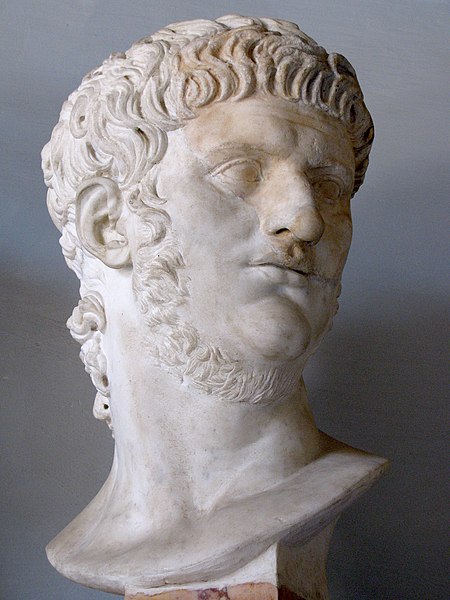
“Lucius Orbilius Pupillus from Beneventum, made an orphan because of the death of his parents who were both murdered on the same day by the deceit of their enemies, first worked as an attendant for magistrates. After that, he served as an assistant in Macedonia and later he was in the cavalry. After he was done with the military, he returned to his studies which he had not touched much since he was a boy. Once he taught for a while in his own country, he went to Rome when he was fifty in the Consulship of Caesar where he taught to greater fame than profit. In some book he admits that he was poor and lived under tiles when he was really old.
He also wrote a book, entitled On Unreasoning which is full of complaints about insults which professors receive either because of the negligence or arrogance of parents. He was, moreover, of a bitter nature not only in respect to his fellow scholars, whom he attacked at every chance, but also towards his students, which is what Horace means when he calls him “the abuser” and Domitius Martius writes about: “The people Orbilius murdered with a stick or a leather whip.”
He did not avoid laying in to men of the highest classes: when he was still unknown and he was speaking to a full courtroom and was asked by the opposing lawyer, Varro, what he did and what his career was, he said that he moves hunchbacks from the son into the shade. This is because Murena was a hunchback,
Orbilius lived to almost one hundred years and his memory failed almost completely, as Bibaculus’ line instructs: “Where is Orbilius now, that vacuum of learning.” His statue is on display at Beneventum, on the left side of the Capitol building in a seated position and holding a Greek cloak with two boxes of books next to him. He left a son named Orbilius, another grammar teacher himself.”
L Orbilius Pupillus Beneventanus, morte parentum, una atque eadem die inimicorum dolo interemptorum, destitutus, primo apparituram magistratibus fecit; deinde in Macedonia corniculo, mox equo meruit; functusque militia, studia repetit, quae iam inde a puero non leviter attigerat; ac professus diu in patria, quinquagesimo demum anno Romam consule Cicerone transiit docuitque maiore fama quam emolumento. Namque iam persenex pauperem se et habitare sub tegulis quodam scripto fatetur. Librum etiam, cui est titulus Περὶ ἀλογίας, edidit continentem querelas de iniuriis, quas professores neglegentia aut ambitione parentum acciperent. Fuit autem naturae acerbae, non modo in antisophistas, quos omni occasione laceravit, sed etiam in discipulos, ut et Horatius significat “plagosum” eum appellans, et Domitius Marsus scribens:
Si quos Orbilius ferula scuticaque cecidit.
Ac ne principum quidem virorum insectatione abstinuit; siquidem ignotus adhuc cum iudicio frequenti testimonium diceret, interrogatus a Varrone diversae partis advocato, quidnam ageret et quo artificio uteretur, gibberosos se de sole in umbram transferre respondit; quod Murena gibber erat. Vixit prope ad centesimum aetatis annum, amissa iam pridem memoria, ut versus Bibaculi docet:
Orbilius ubinam est, litterarum oblivio?
Statua eius Beneventi ostenditur in Capitolio ad sinistrum latus marmorea habitu sedentis ac palliati, appositis duobus scriniis. Reliquit filium Orbilium, et ipsum grammaticum professorem.
“A ruler’s first duty is to save the state itself. This is saved no less in refraining from what is not fitting than from pursuing what is fitting. But the one who shirks or overreaches is no longer a king or a ruler, but in fact becomes a demagogue or a despot. He fills the subjects with hatred and contempt. While the first problem seems to come from being too lenient or a concern for humanity, the second comes from self-regard and harshness.”
“Even though I have recorded these things faithfully, I do recognize that some things have probably escaped me. And if, although I have applied great thought and effort trying to compose a continuous and clear history of the lives of the best philosophers and rhetoricians, I did not obtain my goal, I have suffered much the same kind of thing as those who love madly and obsessively. For they, when they see the one they love and witness her overwhelming beauty in real life, they look down, too weak and dazed to gaze upon the one they desire.”
Menekrates: “Musonius, that voice which made him music-mad and longing for Olympian and Pythian games, how was the tyrant’s voice? Some people who sailed to Lemnos were amazed by it, others mock it.”
Musonius: “Well, Menekrates, his voice really merits neither wonder nor mockery, since nature has made him moderately and unquestionably in tune. He speaks with a naturally open and deep voice, since his throat is deep, and when he sings he buzzes a little because of his throat shape. Nevertheless, the tones of his voice make him seem smoother if he does not try too hard, but relies instead on the melody, good accompaniment, and selecting the right time to walk, to stop, to move, and to nod his head along with the music. What is shameful is that a king appears to want success in these pursuits.”
“He was mostly deranged by a desire for popularity and was an enemy to anyone who had any sway over the popular mob. Most believed that after all of his accomplishments on the stage he was going to compete among the Athletes at the next Olympian games. He was wrestling endlessly and he had watched the gymnastic contests all over Greece as a judge would, sitting on the ground of the stadium. If any competitors withdrew too far back, he would push them forth again with his own hand. Because he was alleged to have equaled Apollo in song and the Sun in chariot-driving, Nero planned to rival the deeds of Herakles too. People claim that a lion had been trained which he would be able to kill naked in the amphitheater in front of all the people with either a club or his arms’ embrace.”
Maxime autem popularitate efferebatur, omnium aemulus, qui quoquo modo animum vulgi moverent. Exiit opinio post scaenicas coronas proximo lustro descensurum eum ad Olympia inter athletas; nam et luctabatur assidue nec aliter certamina gymnica tota Graecia spectaverat quam brabeutarum more in stadio humi assidens ac, si qua paria longius recessissent, in medium manibus suis protrahens. Destinaverat etiam, quia Apollinem cantu, Solem aurigando aequiperare existimaretur, imitari et Herculis facta; praeparatumque leonem aiunt, quem vel clava vel brachiorum nexibus in amphitheatri harena spectante populo nudus elideret.
“He had a desire for eternal and endless fame, but it was ill-considered. Because of this he changed the names of many things and places from their ancient titles to something from his own name. So, he called the month of April Neroneus and planned to have Rome renamed Neropolis.”
Erat illi aeternitatis perpetuaeque famae cupido, sed inconsulta. Ideoque multis rebus ac locis vetere appellatione detracta novam indixit ex suo nomine, mensem quoque Aprilem Neroneum appellavit; destinaverat et Romam Neropolim nuncupare.
“Because his country was a tyranny was ruled harshly under Nearchus, he set up a conspiracy against the tyrant. But when he was discovered and was compelled by Nearchus under torture to divulge who was aiding him, he said, “if only I were as in control of my body as I were my tongue.” The tyrant attacked him even more with torture for this, but Zeno withstood it for some time.
After this exchange, because he wanted to be freed from the torture and also to pay back Nearchus, he made the following plan. When the pain of the torture was at its greatest peak, he pretend that he was about to die because of the pain and yelled out, “Stop, I will tell you everything.” Once they stopped, he asked him to come close to hear what he said alone since many of the things which were about to be said he would prefer to keep secret.
When the tyrant approached happily and brought his ear near Zeno’s mouth, Zeno grabbed the tyrant’s ear with his teeth and clamped down. Even though his attendants rushed up and were serving up everything kind of pain to the tortured man to loosen the bite, he sank his teeth in further. Finally, when they could not conquer the man’s bravery, they stabbed him until he released his teeth. By this plan he found freedom from his pains and obtained what payback their was from the tyrant.”
In the other version of this story, Zeno of Elea bites off his own tongue
From the Suda
“Zeno, the son of Teleutagoros, Elean, one of the philosophers who lived in the same time as Pythagoras and Democritus during the 78th Olympiad. He was a student of Xenophanes or Parmenides. He wrote Disagreements, and Explanation of Empedokles and Against the Philosophers on Nature. They say that he invented dialectic, and that Empedokles invented rhetoric. Some say that he was caught trying to kill the tyrant Nearkhos—although some say it was Diomedon. When he was being questioned by him, he bit down on his own tongue, cut it off, and spat it at the Tyrant. Then he was thrown into a mortar and ground down into a mush.”
Diogenes Laertius tells the same story as Diodorus:
Diogenes Laertius, Lives of the Philosophers 9.26
“When he was interrogated about his conspirators and the arms he was bringing to Liparas, he informed on all the friends of the tyrant because he wished to isolate that man. Then, telling him that he could tell him something about these things to his ear only, he bit down on [Nearchus’] ear and would not let go until he was stabbed to death, suffering the same fate as the tyrannocide Aristogeiton.”
“He pursued the liberal arts of both languages most seriously. He was a follower of Messala Corvinus when it came to Latin oratory, a man whom he had observed while an adolescent. But he used to confuse his style with such excessive affectation and officiousness that he was considered more effective as an extemporaneous speaker than a prepared one.
He also wrote a lyric poem which had the title “A Lament on the Death of Lucius Caesar.” When he composed Greek poems, he imitated Euphorion, Rhianus, and Parthenius, those poets whose writing he liked most of all, and he placed their portraits in the public libraries among the older, famous authors. For this reason, many of the learned men of the time were in a competition dedicating many books about these men to Tiberius.
Still, he took the greatest care in knowledge of the stories of myth, to the point of absurdity and silliness. For he even used to quiz the grammarians, a class of men whom, as I said, he was really preoccupied with, posing questions like: “Who was the mother of Hecuba?” “What name did Achilles have among the girls?” “What were the Sirens accustomed to singing?”
LXX. Artes liberales utriusque generis studiosissime coluit. In oratione Latina secutus est Corvinum Messalam, quem senem adulescens observarat. Sed adfectatione et morositate nimia obscurabat stilum, ut aliquanto ex tempore quam a cura praestantior haberetur. Composuit et carmen lyricum, cuius est titulus “Conquestio de morte L. Caesaris.” Fecit et Graeca poemata imitatus Euphorionem et Rhianum et Parthenium, quibus poetis admodum delectatus scripta omnium et imagines publicis bibliothecis inter veteres et praecipuos auctores dedicavit; et ob hoc plerique eruditorum certatim ad eum multa de his ediderunt.3Maxime tamen curavit notitiam historiae fabularis usque ad ineptias atque derisum; nam et grammaticos, quod genus hominum praecipue, ut diximus, appetebat, eius modi fere quaestionibus experiebatur: “Quae mater Hecubae, quod Achilli nomen inter virgines fuisset, quid Sirenes cantare sint solitae.”
“But, just as two men strive over boundary stones,
As they hold their yardsticks in hand in a shared field
and they struggle over a fair share of the limited earth,
So did the fortifications separate them.
But over them still they struck one another
On their oxhide circles and winged shields.”
As some already know, I am a Homerist by practice and training, which means I have spent the better part of the past 20 years, reading, thinking, and writing about the Homeric epics. After all this, I am still regularly surprised by how much I don’t understand and often shocked by the fact that I have spent so many years doing just this, re-reading, being surprised, and then trying to learn something new.
The truth is, there was a time when I had little regard for the Homeric epics. I started reading them because I wanted to understand the ‘literature’ that followed them. About the same time I started reading Homer in the original, which was transformative on its own, I read both epics again in translation. The oceanic gap between the experience of the Greek and the translations rattled my confidence in my own aesthetic judgments (and in the act of translation).
But the difference between Homeric phraseology and Vergil (the Latin author with whom I had the most familiarity at the time) was striking: nearly every line of Homer is a self-contained unit of sense. Rather than being hypotactic (subordinating and delaying meaning), Homeric poetry is paratactic, building by adding. It is useful to know the language and stories of the Iliad before you start reading; but it is not necessary for enjoyment: the epic constructs itself in front of you as it tells its tale.
The simile above is one of the first things that I carried around with me everyday once I started reading Homeric Greek (I eventually made investigating it into a senior thesis). It is such a small, nearly forgettable moment. But its simplicity belies a compact and complex representation of the way Homeric poetry works and why it still matters.
In the middle of the battle over the walls the Greek have constructed against the resurgent Trojan defenders, the warring sides are compared to two men fighting over measuring their share of a common field. Even to this day, this comparison seems so disarmingly true as it reduces the grand themes of the struggles between Trojans and Greek, Agamemnon and Achilles, to that of two men over shared resources. The Iliad, at one level, is all about scarcity: scarcity of goods, of women, of honor, of life-time, and, ultimately, the scarcity of fame.
This simile works through metonymy to represent not just the action on the field of battle at this moment, but the conditions that prompt the greater conflict and those that constrain human life. It leaps through time and space and indicates how this poem differs from simple myths. The normal mortals who love this poem aren’t kings or demigods; we live small, sometimes desperate lives, the conditions of which are improved or exacerbated by how well we work together to make fair shares of our public goods.
The scholiast’s comments above, then, are doubly laughable. If I am reading them right (and the verb καταφρονοῦσιν without an object can be annoying), the commentator is imagining that these men in the simile are struggling over this small bit of land because they are poor and that wealthier men would not bother. Not only is this a tragic misunderstanding of human nature (wait tables or tend bar for only a few weeks and you will discover that the good tippers are not the wealthiest ones), but it is a poor reading of the epic, where the wealthiest and most powerful men alive are more than happy to keep fighting and ensuring that their people die.
The point of the simile is that it provides a meeting point between the actors of the poem and the worlds of the audiences; the line that separates imaginative story in the audience’s minds from the lives they live becomes permeable and the hero meets the mortal in the shared experience. This is how the world becomes a part of the story and how it also shapes the poem.
Right after this, there’s another simile.
Iliad 12.427-438
“Many were struck across their flesh by pitiless bronze
Whenever they turned and bared their backs
As they struggled, although many were also struck through their shields.
The towers and walls were decorated everywhere with the blood
Of men from both sides, from Trojans and Achaeans.
Yet, they still could not force the Achaians to flee—
No, it held as when an honest weaving woman holds
The balance and draws out the weight and the wool on both sides
to make them equal so she might earn some wretched wage for her children.
So the battle and the war was stretched even on each side
Until Zeus gave the glory over to Hektor
Priam’s son, who first broke through the wall of the Achaeans.”
“The equal balance of those fighting, [Homer] compared to the beam of a loom, again. For nothing is so precisely similar to an even balance. And the one weighing this out is not the mistress of the household—for she does not often trouble this much for so small an equal bit—nor is it one of the household maids—for they would not seek to make so precise a measure since they are fed by the household’s master and do not risk their nourishment if they mess up on the loom weights—but it is a woman for hire who must provide what is needed for living by the effort of her hands.”
This passage has long moved me too because, as with the earlier simile, the great ‘epic’ themes and images of war were reduced to something simple, daily, and completely understandable. Even in the ancient world where many members of the audiences probably had considerably more experience of violence than we do and where most aristocratic audience members would certainly have nothing but contempt for working for a living, many probably heard a crucial echo of their own lives in this surprising comparison.
I also appreciate the way that the scholiasts here home in on how dire this woman’s position is, making the dubious but nonetheless striking claim that the household servants led less precarious lives than the woman of the simile who draws the weight so precisely because her pay—and the lives of her children—depend upon it. In a crucial way, this simile evokes the same sense of scarcity as that of the men on the field—but it adds that an all too familiar anxiety from the precarity that emerges when one lives constantly with the sense of how scarce those things we value are.
It may seem a stretch, but the image of the weaving woman evokes for me the creative power of women presented elsewhere in Homer–Helen weaves the story of her own kleos,Penelope weaves shroud whose images are never revealed. In a way, the tension prepared by the woman’s hands within the simile is a comparison for the balance of war and a metaphor for an act of creation. The epic’s plot and the audience’s experience are similarly drawn out in the narrator’s hands.
Indeed, the scarcity and precarity evoked by this simile and the one that precedes it extends the transitional moment begun with the image of the farmers to create anticipatory tension in the audience. At the epic’s middle, before we move from book 12 to 13 and to the slaughter of the Achaeans at the ships, the balance hangs ever briefly before it breaks. Hektor surges through the Achaean fortification: the balance of action fails just as the balance of the plot will too—the story of Achilles’ withdrawal will now translate into the slaughter he asked Zeus to precipitate leading to the death of Patroklos, Hektor and, ultimately, Achilles too.
These similes stand at the middle of the poem and convey the sense of tension at the passing of this moment and the spinning of the tale itself. The nameless men and the nameless woman stand in contrast to the named heroes who will suffer and die in the following books. But they are also vehicles moving between the lives of the audiences and the heroes’ deeds marking off the small stakes for which all are struggling and the limited life by which we are all constrained.
“Following the capture of Perusia, [Augustus] turned his mind to vengeance on many people—facing those who were trying to beg forgiveness or make an excuse with one response: “you must die.”
Some authors record that three hundred people from both orders were picked out from the war-prisoners and slaughtered like sacrificial animals at the altar built to Divine Julius on the Ides of March. There are those who report that he turned to war with a specific plan, namely to trap his secret adversaries and those whom fear rather than willingness constrain and, once the model of Lucius Antonius* was offered, to pay the bonuses promised to veterans once he had conquered his enemies and liquidated their assets.”
Perusia capta in plurimos animadvertit, orare veniam vel excusare se conantibus una voce occurrens “moriendum esse.” Scribunt quidam trecentos ex dediticiis electos utriusque ordinis ad aram Divo Iulio exstructam Idibus Martiis hostiarum more mactatos. Exstiterunt qui traderent conpecto eum ad arma isse, ut occulti adversarii et quos metus magis quam voluntas contineret, facultate L. Antoni ducis praebita, detegerentur devictisque iis et confiscatis promissa veteranis praemia solverentur.
*Lucius (Marcus Antonius’ brother) had been a target of the siege at Perusia. Octavian [Augustus] let him live and sent him to serve as governor in what is now Spain.
Augustus as Pontifex Maximus, A Righteous and Religious Man
“It is difficult to explain everything and not really necessary. But I do want to make this one thing clear, that his generosity was not offered at advantageous moments or with specific calculation. This can be evaluated from the events and times themselves, because he never ministered to those in power but always rushed to help those in need.”
Difficile est omnia persequi et non necessarium. Illud unum intellegi volumus, illius liberalitatem neque temporariam neque callidam fuisse. Id ex ipsis rebus ac temporibus iudicari potest, quod non florentibus se venditavit, sed afflictis semper succurrit
Marcus Aurelius, Meditations 6.47
“So one thing is worth much: to keep on living with truth and justice and in good will even among liars and unjust men”
“These facts are as accurate details about Plato as we are able to gather in our laborious research of the things said about him. Speusippus, an an Athenian son of Eurymedon, took over for him. He was from the deme of Myrrhinos and was the son of Plato’s sister, Pôtônê.
Speusippos was the leader of the school for eight years, and he began after the 108th Olympiad. He had statues of the Graces dedicated in the Museion which Plato built in the Academy. Although he remained an adherent to Plato’s theories, he was not like him at all in his character. For he was quick to anger and easily induced by pleasures. People say that he threw a little dog into a well in a rage and he went to Macedonia to the marriage of Kassander thanks to pleasure.
Two women, Lastheneia of Mantinea and Aksiothea of Phlios, were students of Plato who are said to have heard Speusippus speak. Writing at the time, Dionysus says mockingly: “It is possible to evaluate your wisdom from your Arcadian girl of a student.” And, while Plato made everyone who came to him exempt from tuition, you “send everyone a bill and take money from the willing and unwilling alike!”