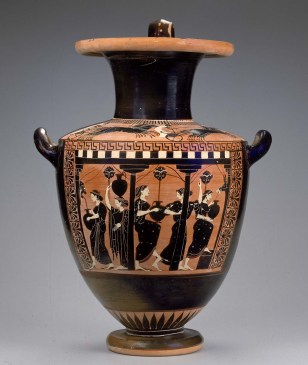
“Posidonios of Apamea records the story of [Athenion] which I am going to lay out even though it is rather long, so that we may examine carefully all men who claim to be philosophers, and not merely trust in their shabby robes and unkempt beards. For, as Agathon says (fr. 12):
If I tell the truth, I won’t make you happy.
But if I am to make you happy, I will say nothing true.
Since the truth, they say, is dear to us, I will tell the whole story about this man.”
Diogenes Laertius, Lives of the Philosophers 5.2: Theophrastus 41-42
“[Theophrastus] died an old man, eighty-five years old, when he had recently retired. And this is my epigram about him:
This saying was never uttered to any mortal untrue:
Wisdom’s bow breaks when it is left unused
As long as he worked, Theophrastus was well
But once he relaxed, he immediately fell.
People report that when Theophrastus was asked by his students if he had anything to advise them, he said, “I can’t advise anything other than this: Life makes many pleasures seem real through their reputation. At the moment when we begin to live, we die! There’s nothing as useless as the love of glory.
Goodbye and may you be lucky. Give up my way of life because it requires great toil or stand to it well, for great reputation will be yours. There’s more disappointment in life than profit. But since I can’t advise you any longer, make it your business to investigate what is right to do.”
Depiction of Theophrastus on the facade of the historical building of the University of Athens. Painted in the 19th century by the Bavarian painter Karl Ral and the Polish Edward Lebietski. Date 22 May 2022, 17:01:54
“I write to you while staying that that very home of Scipio Africanus, now that I have given my due to his memory and the altar that I believe is the grave of so great a man. I am certain that his spirit returned to the sky it came from, not because he led enormous armies–for irate Cambyses also had armies and he used his rage well–but thanks to his exceptional moderation and his dutifulness.
I judge this quality to be more admirable than the fact that left his country while he was defending it. For either Scipio had to stay in Rome, or Rome could be free. He said, “I wish to limit the laws in no way, nor to undermine our customs. Let the law be equal for all citizens. My country: use the good I have done without me. I have been responsible for your freedom and I will also be its test. I leave as an exile, if I have grown beyond what is good for you.”
How can I but admire this greatness of spirit that guided him to depart voluntarily into exile and unburden the state? Circumstances were drawn to a point where either freedom would abuse Scipio or Scipio would abuse freedom.”
In ipsa Scipionis Africani villa iacens haec tibi scribo adoratis manibus eius et ara, quam sepulchrum esse tanti viri suspicor. Animum quidem eius in caelum, ex quo erat, redisse persuadeo mihi, non quia magnos exercitus duxit, hos enim et Cambyses furiosus ac furore feliciter usus habuit, sed ob egregiam moderationem pietatemque, quam magis in illo admirabilem iudico, cum reliquit patriam, quam cum defendit; aut Scipio Romae esse debebat aut Roma in libertate. “Nihil,” inquit, “volo derogare legibus, nihil institutis. Aequum inter omnes cives ius sit. Utere sine me beneficio meo, patria. Causa tibi libertatis fui, ero et argumentum; exeo, si plus quam tibi expedit, crevi.”
Quidni ego admirer hanc magnitudinem animi, qua in exilium voluntarium secessit et civitatem exoneravit? Eo perducta res erat, ut aut libertas Scipioni aut Scipio libertati faceret iniuriam
“Scipio Africanus the Elder”. The Roman general Scipio earned the surname Africanus after his victory at the Battle of Zama, which ended the Second Punic War in 202 BC. This bust of Scipio Africanus the Elder is at the National Museum in Naples, Italy.
“Who was the hero Eunostos in Tanagra and why is entering his grove forbidden to women? Eunostos was the son of Kêphisos and Skias, but they say that his name comes from the nymph Eunosta who raised him. He was good-looking and just and no less wise and austere. They claim that one of the daughters of Kolônos, Okhna, who was Eunostos’ cousin, was in love with him. Eunostos, however, refused her when she approached him and, after insulting her, went to tell her brothers all about it.
The girl got there first and and pleaded with her brothers Ekhemos, Leôn, and Boukolos to kill Eunostos because he had raped her. They caught him by surprised and killed him and then Elieius imprisoned them. Then, Okhna changed her mind and was mourning terribly because she simultaneously wanted to be free of the pain from her love and she pitied her brothers.
So, she told Elieus the whole truth and he told Kolônos. By his judgment, the brothers were exiled and Ekhna threw herself from a cliff, as Myrtis the lyric poet from Anthedon records. This is why it is forbidden for women to enter or to even approach the shrine and grove of Eunostos—and why when there were often earthquakes, droughts, or different signs the people of Tanagra investigated and made a big deal of a woman nearing that place in secret.”
“Septicia as well, the mother of Ariminum’s Trachali, because she was angry with her sons, married Publicius who was already old, even though she could no longer have children, as an insult against them. Then she took both of them out of her will. When they appealed to him, the divine Augustus criticized both the woman’s marriage and her final allotments. He ordered that the sons have their mother’s inheritance and the dowry since she had not begun the marriage for the purpose of having children.
If Fairness herself were to judge this affair, could she have come up with a more just or more substantial opinion? You spurn the children you bore, make a sterile marriage, make a mess of a final will because of your malicious spirit, and you don’t blush to hand all your wealth over to a man whose body you climb under even when it has already been laid out like a corpse? So, since you acted like this, you are struck by divine lightning even among the damned!”
Septicia quoque, mater Trachalorum Ariminensium, irata filiis, in contumeliam eorum, cum iam parere non posset, Publicio seni admodum nupsit, testamento etiam utrumque praeteriit. a quibus aditus divus Augustus et nuptias mulieris et suprema iudicia improbavit: nam hereditatem maternam filios habere iussit, dotem, quia non creandorum liberorum causa coniugium intercesserat, virum retinere vetuit. si ipsa Aequitas hac de re cognosceret, potuitne iustius aut gravius pronuntiare? spernis quos genuisti, nubis effeta, testamenti ordinem malevolo animo confundis, neque erubescis ei totum patrimonium addicere cuius pollincto iam corpori marcidam senectutem tuam substravisti. ergo dum sic te geris, ad inferos usque caelesti fulmine adflata es.
Here’s an anecdote that is chilling and a bit upsetting. CW: it contains misogyny as well as reference to suicide clusters. In general, this reminded me of the suicide clusters in Silicon Valley discussed widely a few years ago. But–and I think this is more important–it also points to groups of suicide as an attempt to wrest agency in response to desperation, a lack of agency, and marginalization.
Aulus Gellius, Varia Historia 15.10
“In his first of the books On the Soul, Plutarch included the following tale when he was commenting on maladies which afflict human minds. He said that there were maiden girls of Milesian families who at a certain time suddenly and without almost any clear reason made a plan to die and that many killed themselves by hanging.
When this became more common in following days and there was no treatment to be found for the spirits of those who were dedicated to dying, The Milesians decreed that all maidens who would die by hanging their bodies would be taken out to burial completely naked except for the rope by which they were hanged. After this was decreed, the maidens did not seek suicide only because they were frightened by the thought of so shameful a funeral.”
Plutarchus in librorum quos περὶ ψυχῆς inscripsit primo cum de morbis dissereret in animos hominum incidentibus, virgines dixit Milesii nominis, fere quot tum in ea civitate erant, repente sine ulla evidenti causa voluntatem cepisse obeundae mortis ac deinde plurimas vitam suspendio amississe. id cum accideret in dies crebrius neque animis earum mori perseverantium medicina adhiberi quiret, decrevisse Milesios ut virgines, quae corporibus suspensis demortuae forent, ut hae omnes nudae cum eodem laqueo quo essent praevinctae efferrentur. post id decretum virgines voluntariam mortem non petisse pudore solo deterritas tam inhonesti funeris.
“But there are ten thousand other fantasies. The melancholic differ from one another, but even though they all exhibit fear, despair, blaming of life and hatred for people, they do not all want to die. For some, fear of death is the principle source of their depression. Some will seem paradoxical to you because they fear death and desire death at the same time.”
In thinking about the impact of agency and belonging on our sense of well-being and relationship to death, I have been significantly influence by this book:
Sheldon Solomon, Jeff Greenberg and Tom Pyszczynski. The Worm at the Core: On the Role of Death in Life. London: Allen Lane, 2015.
If you or someone you know feel alone, uncertain, depressed or for any reason cannot find enough joy and hope to think life is worth it, please reach out to someone. The suicide prevention hotline has a website, a phone number (1-800-273-8255), and a chat line. And if we can help you find some tether to the continuity of human experience through the Classics or a word, please don’t hesitate to ask.
“These facts are as accurate details about Plato as we are able to gather in our laborious research of the things said about him. Speusippus, an an Athenian son of Eurymedon, took over for him. He was from the deme of Myrrhinos and was the son of Plato’s sister, Pôtônê.
Speusippos was the leader of the school for eight years, and he began after the 108th Olympiad. He had statues of the Graces dedicated in the Museion which Plato built in the Academy. Although he remained an adherent to Plato’s theories, he was not like him at all in his character. For he was quick to anger and easily induced by pleasures. People say that he threw a little dog into a well in a rage and he went to Macedonia to the marriage of Kassander thanks to pleasure.
Two women, Lastheneia of Mantinea and Aksiothea of Phlios, were students of Plato who are said to have heard Speusippus speak. Writing at the time, Dionysus says mockingly: “It is possible to evaluate your wisdom from your Arcadian girl of a student.” And, while Plato made everyone who came to him exempt from tuition, you “send everyone a bill and take money from the willing and unwilling alike!”
“For [Hermippos] says that when Pythagoras was in Italy he built a little home in the ground and told his mother to write down on a tablet what happened and the time and then to send it down to him until he came up again. His mother did that.
Later, when Pythagoras finally came up again he was shriveled and almost a skeleton. After he came to the assembly, he was saying that he came from Hades. Then he read aloud to them what had happened. And they were overwhelmed by what he said, crying and weeping and believing that Pythagoras was divine. They believed it so much that they gave him their wives so that they might learn some of his philosophy from him. They were called Pythagorean Women. Well, that’s what Hermippos says…”
There is another version of this in the Scholia to Sophocles’ Elektra 62-64
“Pythagoras confined himself in an underground hole and told his mother to tell people that he had died. When he reappeared, he told a lot of marvelous tales about resurrection and the things which happen in the underworld, and, to the living he related a full account of all the companions he happened to meet in the underworld; from this arose the belief that he was Aithalides son of Hermes before the Trojan War, then Euphorbus, then Hermotimus, then Pyrrhus the Delian, and then finally Pythagoras. Sophocles seems to be hinting at this story. Some assert, though unpersuasively, that the lines are aimed at Odysseus. But this is unconvincing, because Odysseus never did anything of the sort.”
“The most famous women Pythagoreans were: Timukha, the wife of Mullias of Kroton, Philtus, the daughter of Theophoris of Kroton amd sister of Bundakos, Okellô and Ekkelô, the sisters of Okkelos and Okkilos of Leukania, Kheilonis, the daughter of the Spartan Kheilôn, Kratêsikleia, a Spartan and wife of Kkleanôr the Spartan, Theano, the wife of Brotinus of Metapontos, Muia, the wife of Milo of Kroton, Lastheneia from Arcadia, Habroteleia the daughter of Habrotelos the Tarentinian, Ekhekrateia from Phlius, Tyrsênis of Sybaris, Pesirrodê of Tarantum, Theadousa the Spartan, Boiô the Argive, Babeluka the Argive, and Kleaikhma the sister of Autokharidas of Laconia. There are seventeen in total.”
During the siege of Helicarnassus, Alexander took his midday rest. A swallow, however, flew about his head twittering loudly. Here and there it alighted on his bed, singing more intently than usual.
The irritant woke Alexander, yet he couldn’t quite keep from sleeping. Annoyed by the chirping, he shooed the swallow away (not harshly) with his hand. He did hit it. And since it had to move off a little, it settled on Alexander’s head, and would not budge until Alexander was fully awake.
Alexander did not treat the incident as insignificant: he told Aristander, the Telmissian seer, about the swallow. Aristander responded that it was a sign that one of Alexander’s friends was plotting against him, but it was also a sign that the plot would be revealed. That is because the swallow is a companionable bird, friendly to humans, and also more talkative than any other bird.
“Satyrus writes in his Life of Philip: “When Philip lost his eye, Cleisophos followed him with the same eyed bandaged. And later, when Philip’s leg was wounded, Cleisophos accompanied the king, limping. And if Philip should ever find any food bitter, Cleisophos would squeeze his face together as if he were eating too!” In the land of Arabia, they used to do this sort of thing not for sake of flattery but according to polite custom: if one of the king’s limbs were wounded, they would act as if they suffered the same malady, although they also thought it was ridiculous to be eager to be buried with him when he died, they did not hold the same belief for emulating his suffering when he was wounded.”