“After they captured Troy, the Greeks pitied the fate of the captured people and they announced this altogether Greek thing: that each of the free men could select and take one of his possessions. Aeneas selected and was carrying his ancestral gods, after dismissing everything else. Impressed by the righteousness of this man, the Greeks conceded that he may take a second possession away.
Then, Aeneas placed his father—who was extremely old—on his shoulders and walked off. Because they were so amazed, they granted him all of his own possessions, attesting to the fact that men who are enemies by nature become mild when faced with righteous men who revere the gods and their parents.”
“Has it been proved to you that Vergil cannot be understood by someone who is ignorant of the sound of Latin and is equally distant to one who has not drunk Greek learning deep with the fullest thirst?
If I did not fear making you antsy, I could fill huge volumes with the material he translated from the most obscure Greek teachings. But these assertions are enough to support the thesis I have proposed.”
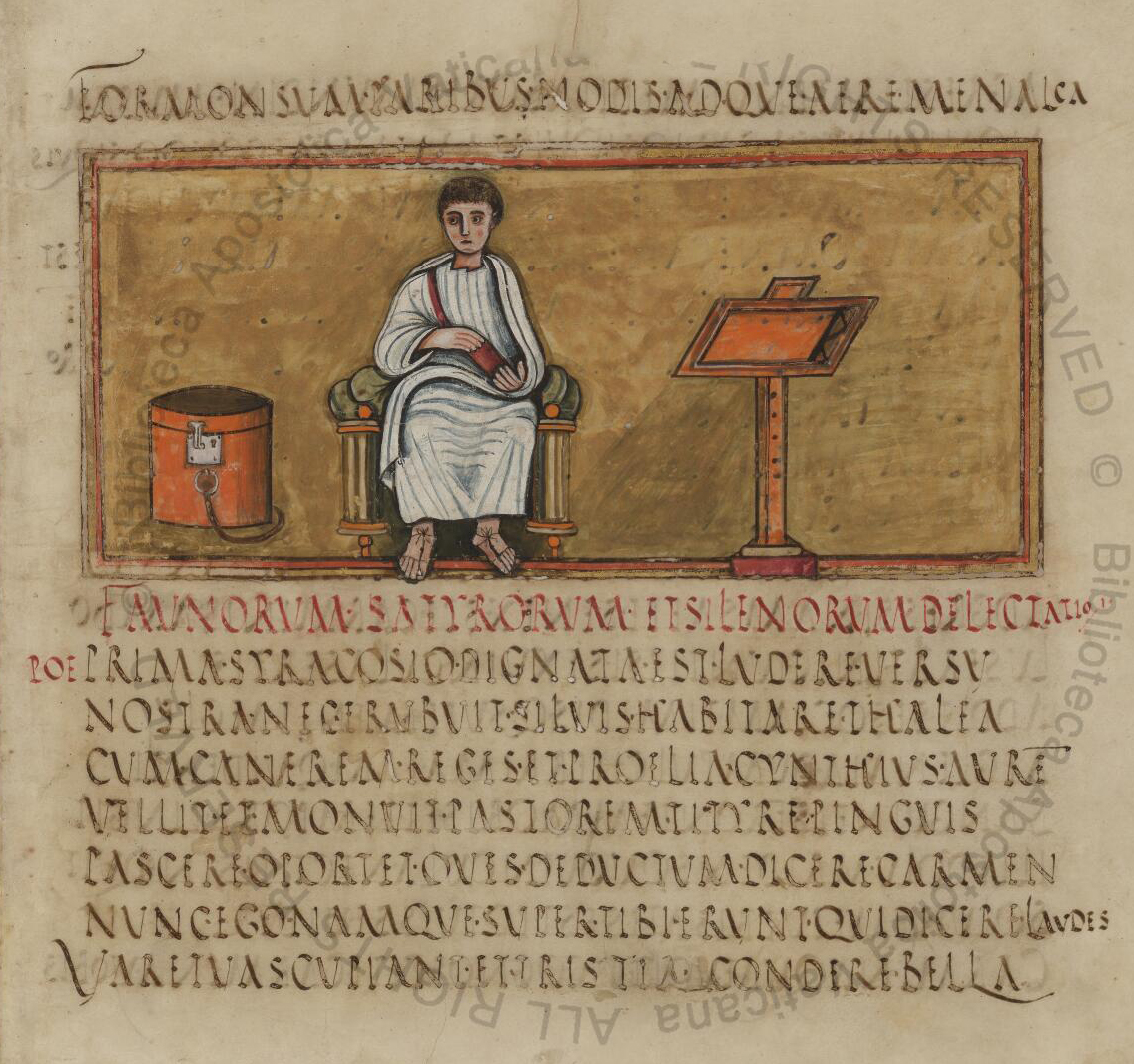
probatumne vobis est Vergilium, ut ab eo intellegi non potest qui sonum Latinae vocis ignorat, ita nec ab eo posse qui Graecam non hauserit extrema satietate doctrinam?
nam si fastidium facere non timerem, ingentia poteram volumina de his quae a penitissima Graecorum doctrina transtulisset implere: sed ad fidem rei propositae relata sufficient.’
“Some report that Homer was older by birth than Hesiod—among this number are Philochorus and Xenophanes. But others say he was younger, including the poet Lucius Accius and Ephorus the historian. In the first book of On Images, however, Marcus Varro says that there is little agreement about which was born first, but that what is not in bout is that they lived at the same time. Evidence from this comes from the inscription on the tripod which was allegedly put on Mt. Helikon.
Accius, still, in book one of the Didasalica uses somewhat superficial arguments…he continues ‘since Homer, when he recounts at the start of his poem that Achilles is the son of Peleus and does not add who Peleus is—which is something he would have added if he had not seen it already explained by Hesiod (Fr. 211). Similarly, when it comes to the Cyclops’ Accius says, ‘Homer would have highlighted the fact that he was one-eyed and would not have passed over such a marvelous detail if it had not already been popularized in the older poems of Hesiod.”
(2) alii Homerum quam Hesiodum maiorem natu fuisse scripserunt, in quis Philochorus et Xenophanes; alii minorem, in quis L. Accius poeta et Ephorus historiae scriptor. (3) M. autem Varro in primo De imaginibus, uter prior sit natus, parum constare dicit, sed non esse dubium, quin aliquo tempore eodem vixerint; idque ex epigrammate ostendi, quod in tripode scriptum est, qui in monte Helikone ab Hesiodo positus traditur. (4) Accius autem in primo didascalico levibus admodum argumentis utitur … (5) quod Homerus, inquit, cum in principio carminis Achillem esse filium Pelei diceret, quis esset Peleus, non addidit; quam rem procul, inquit, dubio dixisset, nisi ab Hesiodo iam dictum videret. de Cyclope itidem, inquit, vel maxime quod unoculus fuit, rem tam insignem non praeterisset, nisi aeque prioris Hesiodi carminibus involgatum esset.
“When Antagoras the poet had a performance at Thebes and obtained no honor, he said “Thebans, Odysseus screwed up when he covered his companions’ ears as he was sailing by the Sirens. It would have been right for him to hire you as sailors.”
“When Antagoras the Rhodian epic poet was reading his composition the Thebais in Thebes and no one was applauding him, he took the book and said, “You are rightly called Boiotians, for you all have cows’ ears!”
“Protagoras, when he was slandered by some poet because he didn’t welcome his poems, said “Wretch—it’s better for me to be slandered by you than to listen to your poems.”
“I used to tell you that Cestius, because he was Greek, suffered because of a lack of Latin words though he had an abundance of ideas. Thus, whenever he dared to describe something more broadly, he often stalled especially when he attempted to imitate some great genius.
This is the issue in this controversy. For, in his story, when he was telling about how his brother was given to him, he was pleased by this lonely and sad description: “night was laid out, and everything, judges, was singing under silent stars.” Julius Montanus, who was a companion of Tiberius and an exceptional poet, was claiming that he wanted to imitate Vergil’s line: ‘it was night and all the tired animals over the earth, the races of birds and beasts, were held by a deep sleep.’ “
Soleo dicere vobis Cestium Latinorum verborum inopia hominem Graecum laborasse, sensibus abundasse; itaque, quotiens latius aliquid describere ausus est, totiens substitit, utique cum se ad imitationem magni alicuius ingeni derexerat, sicut in hac controversia fecit. Nam in narratione, cum fratrem traditum sibi describeret, placuit sibi in hac explicatione una et infelici: nox erat concubia, et omnia, iudices, canentia sideribus muta erant. Montanus Iulius, qui comes fuit , egregius poeta, aiebat illum imitari voluisse Vergili descriptionem:
nox erat et terras animalia fessa per omnis,alituum pecudumque genus, sopor altus habebat
“The story goes that in Abydos there was a man who was afflicted with madness. He went into the theater and watched for many days as if there were actually people acting and applauded. When he had a respite from his affliction, he said that this was the most enjoyable time of his life.”
“Thrasyllos from the deme Aiksône endured an incredible and novel madness. For he left the city and went to the Peiraia and stayed there. He believed that all the ships that sailed in were his and he wrote down their names, checked the list when they left and rejoiced when they returned safely to the harbor again. He spent many years living with this sickness.
When his brother returned from Sicily, he took him to a doctor for treatment and he freed him from that sickness. But he often remembered the avocation of his sickness and used to say that he was never as happy as when he took pleasure at the sight of ships that weren’t his returning safely.”
“There’s a story of the tyrant of Troezen. Because he wanted to get rid of any plots and conspiracies against him, he ordered that no one could talk to anyone else in public or private. This was an impossible and harsh matter. But the people circumvented the tyrant’s command: they were nodding to each other and using hand gestures too. They also used angry, calm, or bright facial expressions. Each person was clear to all in his emotions, showing the suffering in his spirit on his face by grimacing at bad news or implacable conditions.
These actions caused the tyrant annoyance too—for he was believing that even silence accompanied by plentiful gestures was contriving something bad for him. So, he stopped this too.
One of those who was burdened and troubled by this absurdity was longing to end the monarchy. A group rose up with him and stood together sharing their tears. A report came to the tyrant that no one was using gestures any longer, because, instead, they were trafficking in tears. Because he was eager to stop this, he was proclaiming not only slavery of the tongue and gestures, but he was even trying to ban the freedom of the eyes we get from nature. So he went there without delay with his bodyguards to stop the tears. But as soon as the people saw him they took away his bodyguards’ weapons and killed the tyrant.”
112 “When Antagoras was about to cast a capital vote against someone he cried. Someone asked him “Why do you vote to condemn and cry?” He responded “It is necessary by nature to give our sympathy; the law demands my vote.”
211 “Demosthenes used to say that the laws are the sinews of democracy”
῾Ο αὐτὸς ἔφησε τοὺς νόμους δημοκρατίας νεῦρα.
229 “Demosthenes used to say that the laws are the soul of the state. “just as the body dies when bereft of the soul, so too the city perishes when there are no laws”