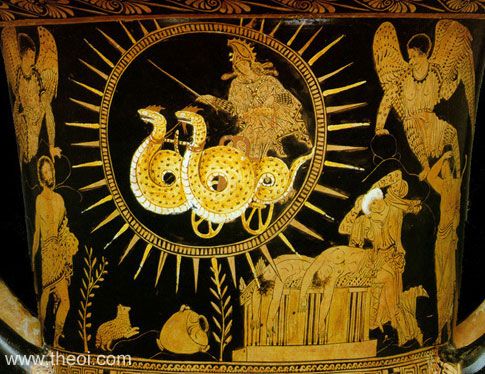
Medea, Preserver of Life

Medeia, Lifeguard: Diodorus Siculus 4.45-57

“The story goes that Medeia learned all the powers of drugs from her mother and her aunt but that she chose to use them in the opposite way. For she used to rescue those who were sailing from foreign countries from dangers and then she would ask her father by begging or appealing for the safety of those who were about to die. At times she would release her from prison herself and secure some safety for those who suffered misfortune. This is because Aietes, thanks to his own cruelty or because of the persuasion of his wife Hekate, had accepted a practice of murdering foreigners. While Medeia continued more and more to oppose her parents’ choice, people say that Aetes, because he suspected a conspiracy from his daughter, remanded her to something like house arrest [lit. “free imprisonment”]. Medeia, still, evaded this and fled to a certain precinct of Helios near the sea. This was at the time when the Argonauts were carried from the Taurian Chersonese and sailed during the night to the part of Kolkhis just mentioned where they happened to find Medeia wandering along the beach and learned from her the practice of foreigner-killing….”

Τὴν δὲ Μήδειαν ἱστοροῦσι μαθεῖν παρά τε τῆς μητρὸς καὶ τῆς ἀδελφῆς ἁπάσας τὰς τῶν φαρμάκων δυνάμεις, προαιρέσει δ᾿ ἐναντιωτάτῃ χρῆσθαι· διατελεῖν γὰρ τοὺς καταπλέοντας τῶν ξένων ἐξαιρουμένην ἐκ τῶν κινδύνων, καὶ ποτὲ μὲν παρὰ τοῦ πατρὸς αἰτεῖσθαι δεήσει καὶ χάριτι τὴν τῶν μελλόντων ἀπόλλυσθαι σωτηρίαν, ποτὲ δ᾿ αὐτὴν ἐκ τῆς φυλακῆς ἀφιεῖσαν προνοεῖσθαι τῆς τῶν ἀτυχούντων ἀσφαλείας· τὸν γὰρ Αἰήτην τὰ μὲν διὰ τὴν ἰδίαν ὠμότητα, τὰ δ᾿ ὑπὸ τῆς γυναικὸς Ἑκάτης πεισθέντα, προσδέξασθαι τὸ τῆς ξενοκτονίας νόμιμον. ἀντιπραττούσης δὲ τῆς Μηδείας ἀεὶ μᾶλλον τῇ προαιρέσει τῶν γονέων, φασὶ τὸν Αἰήτην ὑποπτεύσαντα τὴν ἐκ τῆς θυγατρὸς ἐπιβουλὴν εἰς ἐλευθέραν αὐτὴν ἀποθέσθαι φυλακήν· τὴν δὲ Μήδειαν διαδρᾶσαν καταφυγεῖν εἴς τι τέμενος Ἡλίου κείμενον παρὰ θάλατταν. καθ᾿ ὃν δὴ χρόνον τοὺς Ἀργοναύτας ἀπὸ τῆς Ταυρικῆς κομισθέντας νυκτὸς καταπλεῦσαι τῆς Κολχίδος εἰς τὸ προειρημένον τέμενος. ἔνθα δὴ περιτυχόντας τῇ Μηδείᾳ πλανωμένῃ παρὰ τὸν αἰγιαλόν, καὶ μαθόντας παρ᾿ αὐτῆς τὸ τῆς ξενοκτονίας νόμιμον…


Image result for Medea greek vase

Beauty Contests and Cretan Liars, Another Medea Tale

Medeia’s Beauty Contest: Fr. Gr. Hist (=Müller 4.10.1) Athenodorus of Eretria

“In the eighth book of his Notes, Athenodorus says that Thetis and Medeia competed over beauty in Thessaly and made Idomeneus the judge—he gave the victory to Thetis. Medeia, enraged, said that Kretans are always liars and she cursed him, that he would never speak the truth just has he had [failed to] in the judgment. And this is the reason that people say they believe that Kretans are liars. Athenodorus adds that Antiokhos records this in the second book of his Urban Legends.”

Ἀθηνόδωρος ἐν ὀγδόῳ Ὑπομνημάτων φησὶ Θέτιν καὶ Μήδειαν ἐρίσαι περὶ κάλλους ἐν Θεσσαλίᾳ, καὶ κριτὴν γενέσθαι Ἰδομενέα, καὶ προσνεῖμαι Θέτιδι τὴν νίκην. Μήδειαν δ ̓ ὀργισθεῖσαν εἰπεῖν· Κρῆτες ἀεὶ ψευσταὶ, καὶ ἐπαράσασθαι αὐτῷ, μηδέποτε ἀλήθειαν εἰπεῖν, ὥσπερ ἐπὶ τῆς κρίσεως ἐποίησε. Καὶ ἐκ τούτου φησὶ τοὺς Κρῆτας ψεύστας νομισθῆναι· παρατίθεται δὲ τοῦτο ἱστοροῦντα ὁ Ἀθηνόδωρος Ἀντίοχον ἐν δευτέρῳ τῶν Κατὰ πόλιν μυθικῶν.

Image result for Medea greek vase

Cf. Zenobius 4.62.10: “To be a Cretan: People use this phrase to mean lying and cheating. And they say it developed as a proverb from Idomeneus the Cretan. For, as the story goes, when there was a disagreement developed about the greater [share] among the Greeks at Troy and everyone was eager to acquire the heaped up bronze for themselves, they made Idomeneus the judge. Once he took open pledges from them that they would adhere to the judgments he would make, he put himself in from of all the rest! For this reason, it is called Kretizing.”

Κρητίζειν: ἐπὶ τοῦ ψεύδεσθαι καὶ ἀπατᾶν ἔταττον τὴν λέξιν, καὶ φασὶν ἀπὸ τοῦ ᾿Ιδομενέως τοῦ Κρητὸς τὴν παροιμίαν διαδοθῆναι. Λέγεται γὰρ διαφορᾶς ποτὲγενομένης τοῖς ἐν Τροίᾳ ῞Ελλησιν περὶ τοῦ μείζονος, καὶ  πάντων προθυμουμένων τὸν συναχθέντα χαλκὸν ἐκ τῶν λαφύρων πρὸς ἑαυτοὺς ἀποφέρεσθαι, γενόμενον κριτὴν τὸν ᾿Ιδομενέα, καὶ λαβόντα παρ’ αὐτῶν τὰς ἐνδεχομένας πίστεις ἐφ’ ᾧ κατακολουθῆσαι τοῖς κριθησομένοις, ἀντὶ πάντων τῶν ἀριστέων ἑαυτὸν προτάξαι. Διὸ λέγεσθαι τὸ Κρητίζειν.

Medea, Jason and their Children

It Was Jason’s Fault? Schol ad. Eur. Med. 264 (=Creophylus, fr. 3)

“Didymos opposes this and offers the material provided by Kreophulos: “For the story goes that when Medeia spent time in Korinth, Kreon was in power of the city and she killed him with drugs. Because she feared his friends and relatives, she fled to Athens but left her sons, who were not able to accompany her, because they were rather young, at the altar of Hera Akraia, since she believed that their father would arrange for their safety. And it was Kreon’s party who killed them and produced the story that Medeia didn’t only kill Kreon but killed her own children too.”

Δίδυμος δὲ ἐναντιοῦται τούτῳ καὶ παρατίθεται τὰ Κρεωφύλου ἔχοντα οὕτως· ‘τὴν γὰρ Μήδειαν λέγεται διατρίβουσαν ἐν Κορίνθῳ τὸν ἄρχοντα τότε τῆς πόλεως Κρέοντα ἀποκτεῖναι φαρμάκοις. δείσασαν δὲ τοὺς φίλους καὶ τοὺς συγγενεῖς αὐτοῦ φυγεῖν εἰς ᾿Αθήνας, τοὺς δὲ υἱοὺς, ἐπεὶ νεώτεροι ὄντες οὐκ ἠδύναντο ἀκολουθεῖν, ἐπὶ τὸν βωμὸν τῆς ᾿Ακραίας ῞Ηρας καθίσαι νομίσασαν τὸν πατέρα αὐτῶν φροντιεῖν τῆς σωτηρίας αὐτῶν. τοὺς δὲ Κρέοντος οἰκείους ἀποκτείναντας αὐτοὺς διαδοῦναι λόγον ὅτι ἡ Μήδεια οὐ μόνον τὸν Κρέοντα, ἀλλὰ καὶ τοὺς ἑαυτῆς παῖδας ἀπέκτεινε’.


She Was Trying to Make Her Children Immortal, Pausanias 2.3.10 (=Eumelus fr. 3= FGrH 451 F6)

“Later when no child of Marathon was left in Korinth, the Korinthians recalled Medeia from Iolkos and gave her the rule. Jason ruled in Korinth through her and had children with Medeia. As she gave birth to them, she kept burying them near the temple dedicated to Hera because she believe that they would become immortal this way. When she finally learned that she was mistaken in this hope and she was caught by Jason—for she was not able to beg a pardon from him, she went sailing back to Iolkos. For these reasons, she left and remanded control of Korinth to Sisyphos.”

τὸν ᾿Αλωέως καὶ τὴν ᾿Εφυραίων σχεῖν ἀρχήν· Κορίν-θου δὲ ὕστερον τοῦ Μαραθῶνος οὐδένα ὑπολ[ε]ιπομένου παῖδα, τοὺς Κορινθίους Μήδειαν μεταπεμψαμένους ἐξ ᾿Ιωλκοῦ παραδοῦναί οἱ τὴν ἀρχήν. βασιλεύειν μὲν δὴ δι’ αὐτὴν ᾿Ιάσονα ἐν Κορίνθῳ, Μηδείᾳ δὲ παῖδας μὲν γίνεσθαι, τὸ δὲ ἀεὶ τικτόμενον κατακρύπτειν αὐτὸ ἐς τὸ ἱερὸν φέρουσαν τῆς ῞Ηρας, κατακρύπτειν δὲ ἀθανάτους ἔσεσθαι νομίζουσαν· τέλος δὲ αὐτήν τε μαθεῖν ὡς ἡμαρτήκοι τῆς ἐλπίδος καὶ ἅμα ὑπὸ τοῦ ᾿Ιάσονος φωραθεῖσαν—οὐ γὰρ αὐτὸν ἔχειν δεομένῃ συγγνώμην, ἀποπλέοντα <δὲ> ἐς ᾿Ιωλκὸν οἴχεσθαι—, τούτων δὲ ἕνεκα ἀπελθεῖν καὶ Μήδειαν παραδοῦσαν Σισύφῳ τὴν ἀρχήν.


Image result for Medea greek vase

Lying Poets, Omitted Facts: More Alternative-Fact Medea

The Tragic Poets Omitted A Lot: Diodorus Siculus, 4.56

“On the whole, thanks to the tragedians’ eagerness for an embellished and different tale about Medeia to circulate, and since some wanted to ingratiate themselves with the Athenians, they claim that she took the son she had with Aigeus, Mêdos, to Kolkhos for safety. At the same time, Aietes—who had been violently expelled from power by his brother Perses—had repossessed his kingdom and Mêdos, Medeia’s son, killed Perses. Following this, once he gained control of a force, Mêdos attacked much of Asia below the Black Sea and came to dominate the region of Mêdia, named for him. But since we think it is unneeded and would take a long time to report all the stories people tell about Medeia, we will add the tales that were left out of the accounts of the Argonauts.”

Καθόλου δὲ διὰ τὴν τῶν τραγῳδῶν τερατείαν ποικίλη τις καὶ διάφορος ἱστορία περὶ Μηδείας ἐξενήνεκται, καί τινες χαρίζεσθαι βουλόμενοι τοῖς Ἀθηναίοις φασὶν αὐτὴν ἀναλαβοῦσαν τὸν ἐξ Αἰγέως Μῆδον εἰς Κόλχους διασωθῆναι· κατὰ δὲ τοῦτον τὸν χρόνον Αἰήτην ἐκ τῆς βασιλείας ὑπὸ τἀδελφοῦ Πέρσου βιαίως ἐκπεπτωκότα τὴν ἀρχὴν ἀνακτήσασθαι, Μήδου τοῦ Μηδείας ἀνελόντος τὸν Πέρσην· μετὰ δὲ ταῦτα δυνάμεως ἐγκρατῆ γενόμενον τὸν Μῆδον πολλὴν ἐπελθεῖν τῆς ὑπὲρ τὸν Πόντον Ἀσίας, καὶ κατασχεῖν τὴν ἀπ᾿ ἐκείνου Μηδίαν προσαγορευθεῖσαν. ἀλλὰ γὰρ τὸ πάσας τὰς ἀποφάσεις τῶν περὶ τῆς Μηδείας μυθολογησάντων ἀναγράφειν οὐκ ἀναγκαῖον ἄμα καὶ μακρὸν εἶναι κρίνοντες τὰ καταλειπόμενα τῆς περὶ τῶν Ἀργοναυτῶν ἱστορίας προσθήσομεν.


A Big Misunderstanding, Aristotle, Rhetoric 400b

“Another motif is to use something from mistakes made either to make an accusation or a defense. For example, in the Medeia of Karkinos, some accuse Medeia of killing her children because they had disappeared, at any rate. For Medeia made the mistake of sending her children away

Ἄλλος τόπος τὸ ἐκ τῶν ἁμαρτηθέντων κατηγορεῖν ἢ ἀπολογεῖσθαι, οἷον ἐν τῇ Καρκίνου Μηδείᾳ οἱ μὲν κατηγοροῦσιν ὅτι τοὺς παῖδας ἀπέκτεινεν, οὐ φαίνεσθαι γοῦν αὐτούς· ἥμαρτε γὰρ ἡ Μήδεια περὶ τὴν ἀποστολὴν τῶν παίδων.

Image result for Medea greek vase

Corinthians Are Liars: Aelian ,Varia Historia 5.21

“One story alleges that the account about Medeia is false.  For it says that she didn’t kill her children but that the Korinthians did. They report that the tale about the woman from Kolkhis and the drama were created by Euripides at the behest of the Korinthians and that the falsehood supplanted the truth thanks to the poet’s skill. They also claim that even to this day the Korinthians perform rites for the children because of their crime just as if they were fulfilling a debt owed to them.”


Λέγει τις λόγος τὴν φήμην τὴν κατὰ τῆς Μηδείας ψευδῆ εἶναι· μὴ γὰρ αὐτὴν ἀποκτεῖναι τὰ τέκνα ἀλλὰ Κορινθίους. τὸ δὲ μυθολόγημα τοῦτο ὑπὲρ τῆς Κολχίδος καὶ τὸ δρᾶμα Εὐριπίδην φασὶ διαπλάσαι δεηθέντων Κορινθίων, καὶ ἐπικρατῆσαι τοῦ ἀληθοῦς τὸ ψεῦδος διὰ τὴν τοῦ ποιητοῦ ἀρετήν. ὑπὲρ δὲ τοῦ τολμήματός φασι τῶν παίδων μέχρι τοῦ νῦν ἐναγίζουσι τοῖς παισὶ Κορίνθιοι, οἱονεὶ δασμὸν τούτοις ἀποδιδόντες.

Korinthian Women and the Plot Against Medea

Two passages from the Scholia to Euripides’ Medea explain why Euripides told the story he did and what the ‘real’ facts were behind it.

Schol. B ad. Eur. Med. 9.1-11

“There’s a story from the philosophers that is much repeated—one Parmeniskos also offers—that Euripides changed the murder of the children to Medea because he accepted five talents from the Korinthians. [He claims] that the children of Medea were killed by the Korinthians because they were angry over her ruling the city and they wanted there to be an end of her ruling in Korinth, because it was her paternal [right]. For this reason he changed the [responsibility] to Medea. Hippus presents [accounts] about her residency in Korinth, as does Hellanikos. Eumelos and Simonides report that Medeia ruled Korinth. In his work called On Isthmian Affairs, Mousaios reports that Medeia was immortal, and he explains this also in his work on The Festivals of Hera Akraia.”

πολυάϊκός τις λόγος φέρεται τῶν φιλοσόφων, ὃν καὶ Παρμενίσκος ἐκτίθησιν, ὡς ἄρα πέντε τάλαντα λαβὼν παρὰ Κορινθίων Εὐριπίδης μεταγάγοι τὴν σφαγὴν τῶν παίδων ἐπὶ τὴν Μήδειαν. ἀποσφαγῆναι γὰρ τοὺς παῖδας Μηδείας ὑπὸ Κορινθίων παροξυνθέντων ἐπὶ τῷ βασιλεύειν αὐτὴν θέλειν διὰ τὸ τὴν Κόρινθον πατρῴαν αὐτῆς λῆξιν εἶναι· ὃ μετήγαγεν ἐπὶ Μήδειαν. περὶ δὲ τῆς εἰς Κόρινθον μετοικήσεως ῞Ιππυς [frg. 3] ἐκτίθεται καὶ ῾Ελλάνικος [frg. 34]. ὅτι δὲ βεβασίλευκε τῆς Κορίνθου ἡ Μήδεια, Εὔμηλος [frg. 3] ἱστορεῖ καὶ Σιμωνίδης [frg. 48]· ὅτι δὲ καὶ ἀθάνατος ἦν ἡ Μήδεια, Μουσαῖος ἐν τῷ περὶ ᾿Ισθμίων [FHG IV p. 518a] ἱστορεῖ, ἅμα καὶ περὶ τῶν τῆς ᾿Ακραίας ῞Ηρας ἑορτῶν ἐκτιθείς: —B

Schol. B ad Eur. Med. 264.1-11

“Parmeniskos writes the following for this line: “Because the Korinthian women did not want to be ruled by a barbaric, potion-pouring woman, they conspired against her and [planned] to kill her children, seven boys and seven girls. [Euripides says that she only had two]. They fled, pursued, into the temple of Hera Akraia and they stayed there. But even then the Korinthians did not hold back: they slaughtered all of them at the altar. Then a plague fell over the city, and many bodies were perishing because of a sickness. They received an oracle that the god must be propitiated for the hunt of Medeia’s children.  This is why each year during the appointed time seven girls and boys from the noblest families return to the precinct of the goddess and appease their rage—and the anger of the goddess on their behalf—with sacrifices.”

Παρμενίσκος γράφει κατὰ λέξιν οὕτως· ‘ταῖς δὲ Κορινθίαις οὐ βουλομέναις ὑπὸ βαρβάρου καὶ φαρμακίδος γυναικὸς ἄρχεσθαι αὐτῇ τε ἐπιβουλεῦσαι καὶ τὰ τέκνα αὐτῆς ἀνελεῖν, ἑπτὰ μὲν ἄρσενα, ἑπτὰ δὲ θήλεα. [Εὐριπίδης δὲ δυσὶ μόνοις φησὶν αὐτὴν κεχρῆσθαι.] ταῦτα δὲ διωκόμενα καταφυγεῖν εἰς τὸ τῆς ᾿Ακραίας ῞Ηρας ἱερὸν καὶ ἐπὶ τὸ ἱερὸν καθίσαι. Κορινθίους δὲ αὐτῶν οὐδὲ οὕτως ἀπέχεσθαι, ἀλλ’ ἐπὶ τοῦ βωμοῦ πάντα ταῦτα ἀποσφάξαι. λοιμοῦ δὲ γενομένου εἰς τὴν πόλιν πολλὰ σώματα ὑπὸ τῆς νόσου διαφθείρεσθαι. μαντευομένοις δὲ αὐτοῖς χρησμῳδῆσαι τὸν θεὸν ἱλάσκεσθαι τὸ τῶν Μηδείας τέκνων ἄγος. ὅθεν Κορινθίοις μέχρι τῶν καιρῶν τῶν καθ’ ἡμᾶς καθ’ ἕκαστον ἐνιαυτὸν ἑπτὰ κούρους καὶ ἑπτὰ κούρας τῶν ἐπισημοτάτων ἀνδρῶν ἐναπενιαυτίζειν ἐν τῷ τῆς θεᾶς τεμένει καὶ μετὰ θυσιῶν ἱλάσκεσθαι τὴν ἐκείνων μῆνιν  καὶ τὴν δι’ ἐκείνους γενομένην τῆς θεᾶς ὀργήν’.

Image result for Medea vase
Alternative facts on vases

Medea’s Magic Was Really a Spa Treatment

Yesterday we posted some varying accounts on Medea’s power over rejuvenation. Here’s another alternative account.

Palaephatus, On Unbelievable Things

Palaephatus was a Hellenistic mythographer who tried to rationalize archaic myths by attributing their fantastic aspects to exaggeration and linguistic confusion.

“People say that Medeia used to make old men young by boiling them, but she didn’t actually make anyone young. Whomever she boiled, she killed. Something like this did happen. Medeia was the first to introduce the use of a red and black flower. She used it to make old men change from gray to dark again: for she dyed their white hair and changed it to black and red. She [also] was the first to discover that a hot bath was useful for people. She used a hot bath to treat those who wanted it, but not out in the open—so that none of the doctors would learn about it—and after she gave them a bath, she made them swear not to tell anyone. The name [people gave] to this warm bath was “parboiling” [parepsêsis]. Because people who took warm baths felt lighter and healthier afterwards, those who saw her cauldron and fire, were convinced that she boiled men. But Pelias, who was an old and weak, died during his bath. This is where the myth comes from.”


῾Η Μήδεια φασὶ <μὲ>ν ὡς ἀφέψουσα τοὺς πρεσβυτέρους νέους ἐποίει, οὐδένα δὲ δείκνυται νέον ποιήσασα· ὃν δὲ ἥψησε πάντως ἀπέκτεινεν. ἐγένετο δέ τι τοιοῦτον. Μήδεια πρώτη ἐφεῦρεν ἄνθος τὸ πυρρὸν καὶ τὸ μέλαν. τοὺς οὖν γέροντας ἐκ πολιῶν μέλανας <καὶ πυρροὺς> ἐποίει φαίνεσθαι· βάπτουσα γὰρ αὐτοὺς τὰς λευκὰς τρίχας εἰς μελαίνας  καὶ πυρρὰς μετέβαλεν. *** πυρίαν πρώτη Μήδεια ἐφεῦρεν ἀνθρώποις ὄφελος. ἐπυρία οὖν τοὺς βουλομένους, οὐκ ἐν τῷ προφανεῖ, ἵνα μή τις μάθῃ τῶν ἰατρῶν, πυριῶσα δὲ ὥρκου μηδενὶ μηνύειν. ὄνομα δὲἦν τῷ πυριάματι παρέψησις. ὥσπερ οὖν καὶ κουφότεροι καὶ ὑγιεινότεροι ἐγίνοντο οἱ ἄνθρωποι πυριώμενοι. ἐκ δὴ τούτου, ὁρῶντες παρ’ αὐτῇ λέβητας καὶ πῦρ, ἐπείσθησαν ὡς ἕψει τοὺς ἀνθρώπους. ὁ δὲ Πελίας, ἄνθρωπος γέρων καὶ ἀσθενής, πυριώμενος ἀπέθανεν. ἐντεῦθεν ὁ μῦθος.

Image result for Medea Pelias
Just a bath, nothing to fear.

Rejuvenate This: Medea’s Marvelous Magic

The typical tale of Medea has her trick the daughter’s of Pelias–the man who deprived Jason of a kingdom–into killing their father. She cuts and boils an old goat, mixes in some drugs, and a young goat emerges. The daughters of wicked Pelias try to do the same as a surprise for their father. And, surprise, they get daddy stew.

The scholia to Euripides’ Medea record other traditions where Medea uses her magic.

Schol ad Eur. Med. Arg. 10-22

“Pherekudês reports that Mêdeia made Jason young again by boiling him. The poet of the Nostoi says about his father Aisôn:

[She] quickly made Aison a dear young man
After wiping away old age with her clever plans
By boiling him with many drugs in a golden container.

Aiskyulos in his Nurses of Dionysos recounts that she also remade Dionysos’ nurses along with their husbands by boiling them. Staphulos says that Jason was killed in a certain way by Medea. For, he says, she told him to lie beneath the prow of the Argo because the ship was about to fall apart because of time. When the prow fell upon him, Jason died.”

Φερεκύδης [frg. 74] δὲ καὶ Σιμωνίδης [frg. 204] φασὶν ὡς ἡ Μήδεια ἀνεψήσασα τὸν ᾿Ιάσονα νέον ποιήσειε. περὶ δὲ τοῦ πατρὸς αὐτοῦ Αἴσονος ὁ τοὺς Νόστους ποιήσας φησὶν οὕτως [frg. 6]·

αὐτίκα δ’ Αἴσονα θῆκε φίλον κόρον ἡβώοντα
γῆρας ἀποξύσασ’ εἰδυίῃσι πραπίδεσσι
φάρμακα πόλλ’ ἕψουσ’ ἐπὶ χρυσείοισι λέβησιν.

Αἰσχύλος δ’ ἐν ταῖς Διονύσου τροφοῖς [frg. 50] ἱστορεῖ ὅτι καὶ τὰς Διονύσου τροφοὺς μετὰ τῶν ἀνδρῶν αὐτῶν ἀνεψήσασα ἐνεοποίησε. Στάφυλος [frg. 5] δέ φησι τὸν ᾿Ιάσονα τρόπον τινὰ ὑπὸ τῆς Μηδείας ἀναιρεθῆναι. ἐγκελεύσασθαι γὰρ αὐτὴν οὕτως ὑπὸ τῇ πρύμνῃ τῆς ᾿Αργοῦς αὐτὸν κατακοιμηθῆναι μελλούσης τῆς νεὼς διαλύεσθαι ὑπὸ τοῦ χρόνου. ἐπιπεσούσης γοῦν τῆς πρύμνης τῷ ᾿Ιάσονι τελευτῆσαι αὐτόν

Pottery: black-figured hydria (water-jar): Medea, Pelias and Peliad (shoulder: men and women with goat).

A hydria in the British Museum

On Homer’s Poverty and Lies

Dio Chrysosthom, Oration 11. 15-19

“First, men claim that Homer was a beggar in Greece because of poverty and lack of means. But they believe that this sort of a man is incapable of lying for the sake of those who gave him things, that he would not say the sorts of things he would intend only to please them! Yet people say that beggars today say nothing credible, no one ever provides one as a witness on anything, nor do they ever accept praise from them as something true. For they know that beggars say everything to manipulate, by necessity. And then they say that some people gave money to a beggar while others gave money to a madman and that they think the people then decided he was crazy when he was speaking truth rather than lying. Really, I am not so much rebuking Homer in these things. For nothing prevents a wise man from begging or seeming insane. But I am saying that, according to the belief people hold about Homer and these sort of men, nothing they say is believable.”

“Furthermore, they do not believe that lying is in Homer’s nature or that he employs this sort of thing at all. Yet he makes Odysseus lie the most, a man he praises, and he says that Autolykos even breaks an oath and that this was granted to him by Hermes! Nearly everyone agrees that Homer says nothing true about the gods, even those who praise him, and they try to offer various defenses, that he does not say these things because he means them but because he is riddling and using metaphor. What keeps him from speaking this way about men too? For, whoever speaks nothing manifestly true about the gods, but so much to the contrary that that people who encounter them take them as lies—and which bring no help to the singer—how would he hesitate to utter any kind of falsehood about men too? Many have previously noted that he has created gods grieving and groaning, wounded and nearly dying, and has added divine adulteries, bonding, and vows. I don’t wish to prosecute Homer, only to show what the truth was. I will also defend the matters as they seem to me. I say that he showed no hesitation in lying and did not think it a shame. I will move now to consider whether he was right or not.”

πρῶτον μὲν οὖν φασι τὸν ῞Ομηρον ὑπὸ πενίας τε καὶ ἀπορίας προσαιτεῖν ἐν τῇ ῾Ελλάδι· τὸν δὲ τοιοῦτον ἀδύνατον ἡγοῦνται ψεύσασθαι πρὸς χάριν τῶν διδόντων, οὐδ’ ἂν τὰ τοιαῦτα λέγειν ὁποῖα ἔμελλεν ἐκείνοις καθ’ ἡδονὴν ἔσεσθαι· τοὺς δὲ νῦν πτωχοὺς οὐδέν φασιν ὑγιὲς λέγειν, οὐδὲ μάρτυρα οὐδεὶς ἂν ἐκείνων οὐδένα ποιήσαιτο ὑπὲρ οὐδενός, οὐδὲ τοὺς ἐπαίνους τοὺς παρ’ αὐτῶν ἀποδέχονται ὡς ἀληθεῖς. ἴσασι γὰρ ὅτι πάντα θωπεύοντες ὑπ’ ἀνάγκης λέγουσιν. ἔπειτα δὲ εἰρήκασι τοὺς μὲν ὡς πτωχῷ, τοὺς δὲ ὡς μαινομένῳ ἀπάρχεσθαι, καὶ μᾶλλον οἴονται τοὺς τότε καταγνῶναι αὐτοῦ μανίαν τἀληθῆ λέγοντος ἢ ψευδομένου. οὐ μὴν ὅσον γε ἐπὶ τούτοις ψέγω ῞Ομηρον· κωλύει γὰρ οὐθὲν ἄνδρα σοφὸν πτωχεύειν οὐδὲ μαίνεσθαι δοκεῖν· ἀλλ’ ὅτι κατὰ τὴν ἐκείνων δόξαν, ἣν ἔχουσι περὶ ῾Ομήρου καὶ περὶ τῶν τοιούτων, εἰκός ἐστι μηθὲν ὑγιὲς εἶναι τῶν εἰρημένων ὑπ’ αὐτοῦ.

οὐ τοίνυν οὐδὲ τόδε νομίζουσιν, οὐκ εἶναι ἐν τῇ ῾Ομήρου φύσει τὸ ψεῦδος οὐδὲ ἀποδέχεσθαι αὐτὸν τοιοῦτον <οὐδέν>· πλεῖστα γοῦν τὸν ᾿Οδυσσέα πεποίηκε ψευδόμενον, ὃν μάλιστα ἐπῄνει, τὸν δὲ Αὐτόλυκον καὶ ἐπιορκεῖν φησι, καὶ τοῦτ’ αὐτῷ παρὰ τοῦ ῾Ερμοῦ δεδόσθαι. περὶ δὲ θεῶν πάντες, ὡς ἔπος εἰπεῖν, ὁμολογοῦσι μηθὲν ἀληθὲς λέγειν ῞Ομηρον καὶ οἱ πάνυ ἐπαινοῦντες αὐτόν, καὶ τοιαύτας ἀπολογίας πειρῶνται πορίζειν, ὅτι οὐ φρονῶν ταῦτ’ ἔλεγεν, ἀλλ’ αἰνιττόμενος καὶ μεταφέρων. τί οὖν κωλύει καὶ περὶ τῶν ἀνθρώπων αὐτὸν οὕτως εἰρηκέναι; ὅστις γὰρ περὶ θεῶν οὐ φανερῶς τἀληθῆ φησιν, ἀλλὰ τοὐναντίον οὕτως ὥστε τὰ ψευδῆ μᾶλλον ὑπολαμβάνειν τοὺς ἐντυγχάνοντας, καὶ ταῦτα μηδὲν ὠφελούμενος, πῶς ἂν περί γε ἀνθρώπων ὀκνήσειεν ὁτιοῦν ψεῦδος εἰπεῖν; καὶ ὅτι μὲν πεποίηκεν ἀλγοῦντας τοὺς θεοὺς καὶ στένοντας καὶ τιτρωσκομένους καὶ ἀποθνῄσκοντας σχεδόν, ἔτι δὲ μοιχείας καὶ δεσμὰ καὶ διεγγυήσεις θεῶν, οὐ λέγω, πρότερον εἰρημένα πολλοῖς. οὐδὲ γὰρ βούλομαι κατηγορεῖν ῾Ομήρου, μόνον δὲ ἐπιδεῖξαι τἀληθὲς ὡς γέγονεν· ἐπεί τοι καὶ ἀπολογήσομαι περὶ αὐτοῦ τὰ ἐμοὶ δοκοῦντα. ὅτι δὲ τὸ ψεῦδος οὐκ ὤκνει πάντων μάλιστα οὐδὲ αἰσχρὸν ἐνόμιζε, τοῦτο λέγω· πότερον δὲ ὀρθῶς ἢ μὴ παρίημι νῦν σκοπεῖν.


Image result for Dio Chrysostom
Trojan-War Truther Types on Tablet

The Tricks a Man Played to Become Tyrant

Over the past few months, I have been thinking about Peisistratos [more commonly, Pisistratus] and the games he played to gain and regain power in Athens. I have no idea why.

Herodotus, 1.59

Peisistratos becomes a tyrant through histrionic lies

“After that, [Hippokrates] had a son named Peisistratos. Then the Athenians on the coasts were in strife with those who lived inland and Megakles, the son of Almeôn, was the leader of the first group, and Lykourgos the son of Aristolaidos was the leader of the inlanders. Peisistratos, because he had designs on a tyranny, led a third faction; after he gathered his partisans and claimed to be a defender of the heartland-Greeks, he enacted the following plans. He wounded himself and his mules and then drove his wagon into the marketplace as if he had fled enemies who wished to kill him as he was traveling to the country. Because of this, he asked the people for a bodyguard under his power, since he had previously earned good repute as a general against the Megarians when he took Nisaia and displayed many other great accomplishments. The Athenian people, utterly deceived, permitted him to choose from the citizens men three hundred men who were not spear-bearers under Peisistratus but club-carriers: for they followed behind him, carrying clubs. Once these men rebelled with Peisistratos, they occupied the acropolis.”

γενέσθαι οἱ μετὰ ταῦτα τὸν Πεισίστρατον τοῦτον, ὃς στασιαζόντων τῶν παράλων καὶ τῶν ἐκ τοῦ πεδίου ᾿Αθηναίων, καὶ τῶν μὲν προεστεῶτος  Μεγακλέος τοῦ ᾿Αλκμέωνος, τῶν δὲ ἐκ τοῦ πεδίου Λυκούργου <τοῦ> ᾿Αριστολαΐδεω, καταφρονήσας τὴν τυραννίδα ἤγειρε τρίτην στάσιν, συλλέξας δὲ στασιώτας καὶ τῷ λόγῳ τῶν ὑπερακρίων προστὰς μηχανᾶται τοιάδε· τρωματίσας ἑωυτόν τε καὶ ἡμιόνους ἤλασε ἐς τὴν ἀγορὴν τὸ ζεῦγος ὡς ἐκπεφευγὼς τοὺς ἐχθρούς, οἵ μιν ἐλαύνοντα ἐς ἀγρὸν ἠθέλησαν ἀπολέσαι δῆθεν, ἐδέετό τε τοῦ δήμου φυλακῆς τινος πρὸς αὐτοῦ κυρῆσαι, πρότερον εὐδοκιμήσας ἐν τῇ πρὸς Μεγαρέας γενομένῃ στρατηγίῃ, Νίσαιάν τε ἑλὼν καὶ ἄλλα ἀποδεξάμενος μεγάλα ἔργα. ῾Ο δὲ δῆμος ὁ τῶν ᾿Αθηναίων ἐξαπατηθεὶς ἔδωκέ οἱ τῶν ἀστῶν καταλέξασθαι ἄνδρας τριηκοσίους οἳ δορυφόροι μὲν οὐκ ἐγένοντο Πεισιστράτου, κορυνηφόροι δέ· ξύλων γὰρ κορύνας ἔχοντες εἵποντό οἱ ὄπισθε. Συνεπαναστάντες δὲ οὗτοι ἅμα Πεισιστράτῳ ἔσχον τὴν ἀκρόπολιν. ῎Ενθα δὴ ὁ Πεισίστρατος


Peisistratos is exiled after ruling for a short time. But, with the help of a foreign tyrant, regains the tyranny through more deceit and stupidity

Image result for Pisistratus

Herodotus, 1.60

“Once Peisistratos accepted this argument and agreed to these proposals, they devised the dumbest plan for his return that I can find, by far, if, even then, those in Athens, said to be among the first of the Greeks in wisdom, devised these things. (From antiquity, the Greek people have been set apart from barbarians by being more clever and freer from silly stupidity). In the country there was a Paianiean woman—her name was Phuê—and she was three inches short of six feet and altogether fine looking. After they dressed her up in a panoply, they put her in a chariot, and adorned her with the kind of scene which would make her a completely conspicuous sight to be seen. Then they drove her into the city, sending heralds out in front of her, who were announcing after they entered the city the words they had been assigned, saying something like “O Athenians, receive Peisistratos with a good thought, a man Athena herself honored beyond all men as she leads him to her own acropolis.” They went everywhere saying these things. And as soon as the rumor circulated among the people, they believed that the woman was Athena herself: then they were praying to the woman and were welcoming Peisistratos!

After he regained the tyranny in the way I have narrated, Peisistratos married the daughter of Megakles in accordance with the agreement they made. But because he already had young sons and since the family of the Alkmeaonids were said to be cursed, he did not wish to have children with his newly wedded wife, and he was not having sex with her according to custom…”

᾿Ενδεξαμένου δὲ τὸν λόγον καὶ ὁμολογήσαντος ἐπὶ τούτοισι Πεισιστράτου, μηχανῶνται δὴ ἐπὶ τῇ κατόδῳ πρῆγμα εὐηθέστατον, ὡς ἐγὼ εὑρίσκω, μακρῷ  (ἐπεί γε ἀπεκρίθη ἐκ παλαιτέρου τοῦ βαρβάρου ἔθνεος τὸ ῾Ελληνικὸν ἐὸν καὶ δεξιώτερον καὶ εὐηθείης ἠλιθίου ἀπηλλαγμένον μᾶλλον), εἰ καὶ τότε γε οὗτοι ἐν ᾿Αθηναίοισι τοῖσι πρώτοισι λεγομένοισι εἶναι ῾Ελλήνων σοφίην μηχανῶνται τοιάδε. ᾿Εν τῷ δήμῳ τῷ Παιανιέϊ ἦν γυνή, τῇ οὔνομα ἦν Φύη, μέγαθος ἀπὸ τεσσέρων πήχεων ἀπολείπουσα τρεῖς δακτύλους καὶ ἄλλως εὐειδής. Ταύτην τὴν γυναῖκα σκευάσαντες πανοπλίῃ, ἐς ἅρμα ἐσβιβάσαντες καὶ προδέξαντες σχῆμα οἷόν τι ἔμελλε εὐπρεπέστατον φανέεσθαι ἔχουσα, ἤλαυνον ἐς τὸ ἄστυ, προδρόμους κήρυκας προπέμψαντες, οἳ τὰ ἐντεταλμένα ἠγόρευον ἀπικόμενοι ἐς τὸ ἄστυ, λέγοντες τοιάδε· «῏Ω ᾿Αθηναῖοι, δέκεσθε ἀγαθῷ νόῳ Πεισίστρατον, τὸν αὐτὴ ἡ ᾿Αθηναίη τιμήσασα ἀνθρώπων μάλιστα κατάγει ἐς τὴν ἑωυτῆς ἀκρόπολιν.» Οἱ μὲν δὴ ταῦτα διαφοιτῶντες ἔλεγον, αὐτίκα δὲ ἔς τε τοὺς δήμους φάτις ἀπίκετο ὡς ᾿Αθηναίη Πεισίστρατον κατάγει, καὶ <οἱ> ἐν τῷ ἄστεϊ πειθόμενοι τὴν γυναῖκα εἶναι αὐτὴν τὴν θεὸν προσεύχοντό τε τὴν ἄνθρωπον καὶ ἐδέκοντο Πεισίστρατον. ᾿Απολαβὼν δὲ τὴν τυραννίδα τρόπῳ τῷ εἰρημένῳ ὁ Πεισίστρατος κατὰ τὴν ὁμολογίην τὴν πρὸς Μεγακλέα γενομένην γαμέει τοῦ Μεγακλέος τὴν θυγατέρα. Οἷα δὲ παίδων τέ οἱ ὑπαρχόντων νεηνιέων καὶ λεγομένων ἐναγέων εἶναι τῶν᾿Αλκμεωνιδέων, οὐ βουλόμενός οἱ γενέσθαι ἐκ τῆς νεογάμου γυναικὸς τέκνα ἐμίσγετό οἱ οὐ κατὰ νόμον.


Post-fact is pre-fascism?  Seems like an understatement…

Three Alternative Cosmogonic Myths

Acusilaus, fr. 6b.

“Hesiod seems to me in his account to have made Khaos the first element, and then he developed Gaia [earth] first from there. But Acusilaos, as I understand it, posited that it was unknown in most places that Khaos was the first principle. And [he added] that two things came after this single beginning: Erebos [darkness, which was male, and Night, which was female. From these two having sex, he claimed that Aithera [sky/air], Erôs [sex] and Mêtis [wisdom] were born. According to the account of Eudêmos, [he claims] a great number of the rest of the gods were born in addition to these from those first [parents] too.”

῾Ησίοδος δέ μοι δοκεῖ πρῶτον γενέσθαι τὸ Χάος ἱστορῶν … τὴν δὲ Γῆνπρώτην ἐκεῖθεν παράγειν … ᾿Ακουσίλαος δὲ Χάος μοι ὑποτίθεσθαι δοκεῖ τὴν πρώτην ἀρχὴν ὡς πάντηι ἄγνωστον. τὰς δὲ δύο μετὰ τὴν μίαν·῎Ερεβος μὲν τὴν ἄρρενα, τὴν δὲ θήλειαν Νύκτα … ἐκ δὲ τούτων φησὶ
μιχθέντων Αἰθέρα γενέσθαι καὶ ῎Ερωτα καὶ Μῆτιν … παράγει δὲ ἐπὶτούτοις ἐκ τῶν αὐτῶν καὶ ἄλλων θεῶν πολὺν ἀριθμὸν κατὰ τὴν Εὐδήμου ἱστορίαν (F 117 Sp.).

Derveni Papyrus, Fr. 14F Benarbé

“Zeus was first born, Zeus with bright lightning was born last.
Zeus is the head, the middle, and from him all things come.
Zeus is the breath of all things and is the fate of all things.
Zeus is the king. Zeus of bright lightning is the ruler of everything.”

Ζεὺς πρῶτος <γένετο, Ζεὺς> ὕστατος <ἀργικέραυνος>
Ζεὺς κεφα<λή, Ζεὺς μέσ>σα, Διὸς δ’ ἐκ <π>άντα τέτ<υκται,>
<Ζεὺς πνοιὴ πάντων, Ζεὺς πάντων ἔπλετο> μοῖρα
Ζεὺς βασιλεύς, Ζεὺς δ’ ἀρχὸς ἁπάντων ἀργικέραυνος.

Procl. Comm. On Plato’s Rep. v.1-1= fr. 111f Benarbé

“Time [Khronos], that ageless, imperishable wit, gave birth to Sky [Aithêr]
And then great Void [Khasm], a monster here and there,
There was no boundary, no floor, nor any foundation.”

Αἰθέρα μὲν Χρόνος οὗτος ἀγήραος, ἀφθιτόμητις
γείνατο καὶ μέγα Χάσμα πελώριον ἔνθα καὶ ἔνθα,
οὐδέ τι πεῖραρ ὑπῆν, οὐ πυθμήν, οὐδέ τις ἕδρα.

t6-1kronos