“I have composed this work about unbelievable things because rather gullible people believe everything that is said because they are unfamiliar with wisdom or knowledge—but those who are naturally sharper and concerned with many things disbelieve that anything like these things happened at all.
It seems to be that everything which has been narrated happened—for names do not develop on their own when no story exists about them, instead the fact is there first and then a story develops later—but however many shapes and notions are described and existed in the past but do not exist now, these sorts of things never existed at all. For if anything existed at some point in the past, then it also exists now and will again in the future.
And I am always praising the authors Melissos and Lamiskos of Samos who say “What there was in the beginning exists now and will be. But the poets and the storytellers twisted what happened to more unbelievable and amazing things for the sake of surprising people. But I know that if these things couldn’t have happened at all they would not be stories.”
The Disturbing ‘Veil’ and “Double-Vision” of the Naïve White Liberal Anti-Racist Gaze
In the Odyssey, ancient Odysseus and his men accomplished yet another great feat of survival, blinding the one-eyed Cyclops to escape from his cave. One wonders today about the blinded single-eye of the good-natured, white liberal democrat: a view that sees itself as rabidly pro-justice, freedom, democracy, and the rest of the ideals that descend from the Western Enlightenment (made by and for white European men in the 18th century).
And, yet, this strange creature has a split double vision from its one eye. It ‘feels’ the dual threat of both Trumpian, right-wing, anti-democratic authoritarianismand the diverse social movements and protests against anti-Black racism leading to the tearing down of statues and what the right and left alike calls ‘cancel culture’ or the right asserts as the ‘indoctrination of the left.’
Is it fated for someone in a position of power to feel threatened at all times? If we turn to W. E. B. Du Bois’s ingenious insights on the ‘veil’ and ‘double-consciousness’ of being Black in America, one can think of another, inverted ‘veil’ and ‘double-consciousness’ of this blinded white liberal view today. The blinding strike of our historical present has led to a split within a single vision that lies beneath a kind of veil.
One can say the white liberal, democratic, maybe even progressive socialist and leftist view sees the world from within a veil that is not lifted. On the one hand, they see themselves through the eyes of two other groups: they claim how horrifying and vile white nationalism, supremacy, neo-Nazis, anti-Semites, and mostly anti-Black and other anti-Indigenous and POC, for example hatred of Latinx and Asians, are. They say in a silent voice of rage and hatred, a mixture of shame, guilt, and revulsion, that ‘we cannot be one of them,’ and that ‘the legacy of slavery and colonialism is not ours,’ as the philosopher Shannon Sullivan noted in her trenchant critique of white liberalism. The good-natured ones call those evil barbarians who espouse biological racism today the abhorrent ‘other,’ while reserving for themselves some sense of decency in claiming ‘we are different.’
But then, on the other hand, they see the other group of BIPOC facing multi-generational and daily humiliation, violence, and death: torrents of waves where past, present, and future co-mingle, at once stemming from both systematic and systemic racism that derive from and transcend white nationalists, the KKK, and Neo-Nazis. For this oppression permeates every institution and aspect of American society. Why not? Does it not come down to a fascination with ‘whiteness’ for those who live it and critique it? To them, the white liberal says, ‘I cannot possibly understand what it’s like to endure that racial oppression of non-whites,’ and ‘I want to speak out from within my silence but words escape me, and I relapse back into the silence I inhabit within the veil.’ Therefore, ‘I am in this world but not of it’ to quote the Gospel.
What can we learn from this split vision of positing and negating when it comes to two other groups that the white liberal tries to see and understand apart from itself? White supremacy is decried but also distanced so far to the point of paralyzing inaction while BIPOC suffer and die everywhere. They suffer at the hands of everyday white civilians, the militarized police, the heartless state, and the avarice corporations and their environmentally damaging atrocities, the terror continues. BIPOC, as the ‘other’, witness their suffering pornographically fetishized in white liberal discourse, but only to have this suffering doubled when the old discourse of the ‘free exchange of ideas,’ ‘tolerance of differing perspectives in a civil manner’ kicks in again. That old stalwart thinking quickly returns to diagnose the evil disease of ‘cancellation culture’ and ‘indoctrination of dogmatic intolerance’ in the ‘new religion’ of anti-racism, for example BLM.
What are we to make of this twenty-first century wounded Cyclops? The creature retains privilege as in the original myth since everything was provided for them, and they don’t have to work for what they have inherited. And that is called the utter, unfathomable, historical accident of either being born ‘white’ or ‘white enough to pass’ as such. If Marx analyzed the commodity, no one to this day has comparably or sufficiently analyzed ‘whiteness’ or ‘white passing.’
The self-denying person who says they are not reduced to biological ‘whiteness’ is the ultimate white liberal, democrat anti-racist. And this occurs across generations in our historical present, across the different generations who think they inhabit one single time-line. Here we find white supremacy and white privilege in a blind coexistence as it relates to the problem of time and therefore historical time. No whiteness exists apart from white supremacy. Color-blindness is privilege. So the blinded, fractured Cyclops does not see that problem.
They must consume everything that crosses their path in this split, double-vision, not even a double consciousness that is forever ‘irreconcilable’ for Black people as Du Bois said nearly 120 years ago and one can attribute to other POC today, albeit in intersectional terms. But this ruptured one-eyed giant called ‘white anti-racist liberalism’ doesn’t live in a cave, because there is no inside or outside distinction in the world of an eternal racism.
In some respect the veil – -as an illusion of real self-consciousness because one is always seeing oneself in relation to and different from the other — is itself the ultimate blind spot: the veil doesn’t exist at all. Rather, white supremacy becomes the mirror’s taint called ‘white liberalism’ and the objects that appear in the mirror are dialectically exchanged in the stasis of a perpetual motion: the white liberal must say I am not a ‘white supremacist’ while also failing to see the impossibility of pure connection with BIPOC because white liberals have the privilege of whiteness, and hence an-other type of ‘supremacy’ we are trying to name here.
This schizophrenic four-fold vision of identity and difference in the self-consciousness of the white liberal needs a new name: to be the same and different from white supremacy and same and different from BIPOC oppressed groups means one is never fully synthesized in two different ways. One can say that the ultimate giant, whose ideas shaped the white modern world to an extent like no other of his time, namely the imperialist Hegel, knew this well and suffered from it in the phantasm of truth called his ‘system and philosophy of world history.’
The dead bodies and skeletons slayed by systemic racism over colonialist centuries doom us to atrophy and entropy. At some point, this wounded creature will also perish on the lands they neither built nor own, and hopefully leaving a new world created not by the privileged gods but by a diverse, more humble humanity. We can call it the world after ‘Floyd.’
Rajesh Sampath is currently Associate Professor of the Philosophy of Justice, Rights, and Social Change at the Heller School for Social Policy and Management at Brandeis University. He completed his PhD at the University of California, Irvine in the humanities with a concentration in modern continental European philosophies of history and critical theory at the Critical Theory Institute. He studied under the French philosopher, Jacques Derrida, the founder of deconstruction. His areas of specialization center on the philosophy of history, historical time, and epochal shifts.
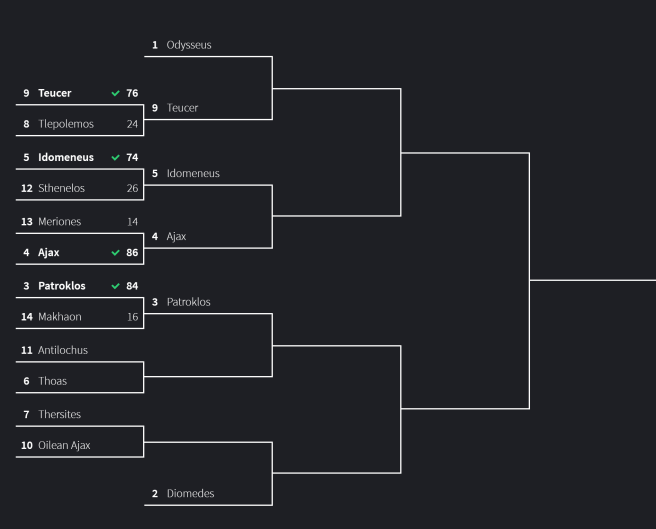
What turned out to be the closest contest of this tournament of favorites drew some strong interest from the crowd. Odysseus gave the Aitolian Thoas some advice as he prepared to face Antilokhos who could not seem to get away from his father Nestor. Indeed, the match itself was almost called off as that old Gerenian horseman could be heard extolling the importance of deep breaths and visualizing success to his youngest son.
Once he broke away from his father, he rushed straight at Thoas, dodging the first spear only to the second spear break straight through his shield and graze his thigh. The wound was minor, but Antilokhos slipped and fell on the ground, breaking his shield. For a moment, it looked like Antilokhos’ speed was nullified and in the stunned silence you could hear Achilles grumbling about how he should change his name to Antilakhos* since luck wasn’t on his side.
But as Thoas turned, dropped his shield and drew his sword, Antilokhos rolled quickly to his left where Thoas’ first spear had been deflected, and pulled it up just as Andraimon’s son tried to bring his sword down on him. Result? Aitolian with dislocated shoulder, and shredded muscles around the joint.
*lokhos means “ambush”, lakhos means “lot”.
This just might be the juiciest match-up of the first round. Indeed, there’s no way we’ll find another meeting of two potential wrestling heels: Thersites, a man so hated he unites Achilles, Agamemnon and Odysseus, and Ajax, son of Oileus, the Lokrian Homer sees fit to cover in cow-shit.
Thersites, from Aitolia is the son of Agrios who was the brother of Oineus, the king of Aitolia. If you’re keeping track, that makes him a kinsman of sorts with both Thoas and Diomedes. He does not show up in the catalogue of ships and we never actually see him fight. But we do hear a bit about him. Homer doesn’t describe many of the heroes physically, but Thersites gets six lines (2.216-221):
And he was the most shameful man who came to Troy.
He was cross-eyed and crippled in one foot. His shoulders
Were curved, dragged in toward his chest. And on top
His head was misshaped, and the hair on his head was sparse.
He was most hateful to both Achilles and Odysseus
For he was always reproaching them.
Modern scholars have written a lot about him too! Just because he’s most shameful does not mean he can’t be the second best too, does it? (The T scholion for this line helpfully notes: “most shameful: this is also said of an ape.” αἴσχιστος: τοῦτο καὶ ἐπὶ πιθήκου). The scholia report that Thersites fell off a cliff running from a boar and so his name—meaning “bold, audacious” might just be a joke. But in the criticisms he makes, another scholion also claims they say that [Thersites] is the poet’s agent, that he appropriates his essence ”Θερσίτης δ’ ἔτι: ἐπίτροπον τοῦ ποιητοῦ φασιν αὐτόν, σφετερισάμενον τὴν οὐσίαν. Because, Thersites may look scarier, but it is more frightening when you speak the Truth. Ajax, the lesser: The son of Oileus. Also called Lokrian Ajax. Another hero Homer spends time describing physically:
“The fast son of Oileus was leading the Lokrians
Smaller, not in any way as big as Telamonian Ajax
But much smaler. He was small and wore linen armor.
But he surpassed All the Greeks and the Achaeans in spear-play.”
So, the narrative takes pains to emphasize his smallness and his swiftness, but his character emerges elsewhere. He participates in the battles well and kills the “most” men at the end of book 13 thanks to his swiftness. But he argues nastily with Idomeneus during the chariot games, receiving in turn the address “Ajax, best at the quarrel, shit-for-brains…” (Αἶαν νεῖκος ἄριστε κακοφραδὲς…23.483.” And when he competes in the footrace, he slips in cow manure and falls in a pile of it (thanks to Athena). Of course, the assembled Greeks look on and laugh as he spits the shit from his mouth (23.780-784). Ajax is, of course, most famous for raping Kassandra on the altar of Athena and helping to derail the homecoming of the Achaeans. So, not a good guy.
So what’s the choice here? A bold-talker with no fighting history or a fast-running, linen-covered, creep-fest? And, to be honest, how much does it matter? The prize for this context is to get crushed by Diomedes.
The Achaeans watched with only passing interest as Patroklos and Makhaon began their match. In truth, even the gods found something else to occupy their endless time as Makhaon’s two spears bounced of Patroklos’ (borrowed) shield. Patroklos, too, seemed half invested, quipping weakly, “Makhaon, even in healing you’re second best at the fight” (δεύτερον ἄριστος μάχεσθαι*). Patroklos landed his first javelin into Makhaon’s right shoulder and Asklepios’ son yielded the fight. His brother Podaleirios came over to tend the wound.
*A rather obvious pun since makhesthai (“to fight”) sounds like Makhaon. Achilles later told him that he could have joked about how he was better at using a blade (makhaira) to heal than fight.
Now we turn to the best match of the tournament so far: Antilochus, Nestor’s son, vs. Thoas the Aitolian
Antilochus, the son of Nestor kills his first man in book four of the Iliad (457), he fights alongside Menelaos (5.577) and is a major part of the Greek offensive throughout books 5 and 13: in book 15 Menelaos marks him out, saying “other Greek is younger than you / is faster on his feet or as brave in battle as you are!” (᾿Αντίλοχον δ’ ὄτρυνε βοὴν ἀγαθὸς Μενέλαος· /᾿Αντίλοχ’ οὔ τις σεῖο νεώτερος ἄλλος ᾿Αχαιῶν, 15.568-569). And his swift feet carry him out of the battle to carry Achilles the news of Patroklos’ death (book 17). He is also memorable for his appearance in the funeral games where he is the audience for his father’s enigmatic instructions about the chariot race (12.305-348). And then part of the drama comes from Menelaos accusing him of cheating (and replaying some of the themes from the argument between Achilles and Agamemnon in Iliad 1). Out side of the Iliad, he is famous from the lost Aethiopis where he dies saving his father from Memnon, inciting Achilles’ rage (leading to Achilles’ death before the walls of Troy).
Antilochus is fast, he’s got the advice of Nestor and the favor of Achilles
Thoas the Aitolian, son of Andraimon, may be the youngest of the council of elders (after Achilles) and one of the Iliad’s best kept secrets (I may have some money on this one). One might imagine him a kind of replacement Diomedes, since he rules in Aitolia (the kingdom Tydeus was expelled from) and has some murky mythographical ties to Odysseus. At a critical moment in the epic, he stands up and is marked out as “best of the Aitolians at the spear / and in close combat but few of the Achaeans / could conquer him in the agora, whenever the young men struggled over speeches” (Αἰτωλῶν ὄχ’ ἄριστος ἐπιστάμενος μὲν ἄκοντι / ἐσθλὸς δ’ ἐν σταδίῃ· ἀγορῇ δέ ἑ παῦροι ᾿Αχαιῶν / νίκων, ὁππότε κοῦροι ἐρίσσειαν περὶ μύθων· 15.281–285).
Two young heroes. One with ties to Achilles, another linked to Odysseus. Two Achaeans enter, one man leaves. Who will it be?
Very few of the Greeks paid much attention to yesterday’s match sending Meriones against the bulwark of the Achaeans, since most assumed that Meriones would be expire in no more than a few words.
The Cretan captain, however, saved his breath and tried to outdance the larger Salaminian. He darted left to right, throwing his spears and having them glance off the massive shield of Telamon’s son. Ajax stood rather impassively, parrying thrusts and waiting until Meriones ran straight at him before he locked his hands together and swung them directly into the Cretan’s chest. The ax-swing blow launched him into the air. When he hit the ground, his armor rattled around him like dice in a jar.
As he struggled to get up to his elbows, Idomeneus bellowed with a laugh, “Charioteer, my brother, stay down before you get blood on the ground!*”
*A joke: in Greek, Idomeneus said… πρὶν ἐκχεῖν αἵμα ἐπ’ αἶαν, using the word aia-n for “ground” which sounds a lot like Aias, the son of Telamon.
Now we turn to a strange match-up: Patroklos son of Menoitios vs. Makhaon the son of Asklepios. Perhaps this is why Apollo dislikes him?
Patroklos: the son of Menoitios who fights alongside his angrier half, Achilles. He is not originally from Phthia, but grew up there in exile from Opos after he killed a child his own age in anger over a game of dice. He appears by Achilles’ side throughout the Iliad until he takes his place in battle and falls at Hektor’s hands (helped by Apollo and Euphorbos). He even patiently listens to Achilles’ singing (Πάτροκλος δέ οἱ οἶος ἐναντίος ἧστο σιωπῇ, / δέγμενος Αἰακίδην ὁπότε λήξειεν ἀείδων, 9.190-191).
Patroklos does everything for Achilles: he gives Briseis back, he makes food, he has a bed made up for Phoinix, he goes to see about Makhaon’s wound, and he leads the Myrmidons to Battle, and dies for him. (But he is not listed as one of the leaders of the Myrmidons in the Catalogue of Ships). In battle he’s a terror: he kills Sarpedon and almost breaks through the walls of Troy themselves. Before he dies he may just be the only one to temper Achilles’ rage: As a scholion states (Schol. BT a Il. 307b) “it is likely that Patroklos goes with Achilles when he is enraged for the purpose of calming his spirit. This is because he is kind, as is clear from the fact that he pities the Acheans” (εἰκότως τῷ ᾿Αχιλλεῖ θυμικῷ ὄντι ἤπιος ὢν Πάτροκλος πάρεστι πρὸς τὸ τὸν θυμὸν αὐτοῦ μαλάσσειν. ὅτι δὲ πρᾷός ἐστι, δῆλον ἐξ ὧν οἰκτείρει τοὺς ᾿Αχαιούς)
Makhaon, a healer and leader of the contingent from Oikhaliê, Trikke and Ithômê (yes, where?) is a son of Asklepios and led 30 ships to Troy. He administered his arts to Menelaos in the middle of battle (book 4) and was enjoying his own aristeia in book 11 until he was shot in the shoulder by Paris. He is so beloved by his companions that when Achilles witnesses his rescue in book 11 he sends Patroklos to inquire about him, setting off the sequence of events that will seal everyone’s fate. Also, Diogenes Laertius lets slip that he just might be Aristotle’s ancestor (Ἀριστοτέλης Νικομάχου καὶ Φαιστίδος Σταγειρίτης. ὁ δὲ Νικόμαχος ἦν ἀπὸ Νικομάχου τοῦ Μαχάονος τοῦ Ἀσκληπιοῦ, καθά φησιν Ἕρμιππος ἐν τῷ Περὶ Ἀριστοτέλους, 5.1).
Let’s be honest. This probably isn’t fair. But it just might come down to how mild a temper Patroklos actually has. Don’t take your feelings out about Aristotle on Makhaon. Diogenes might not trust his sources on this….
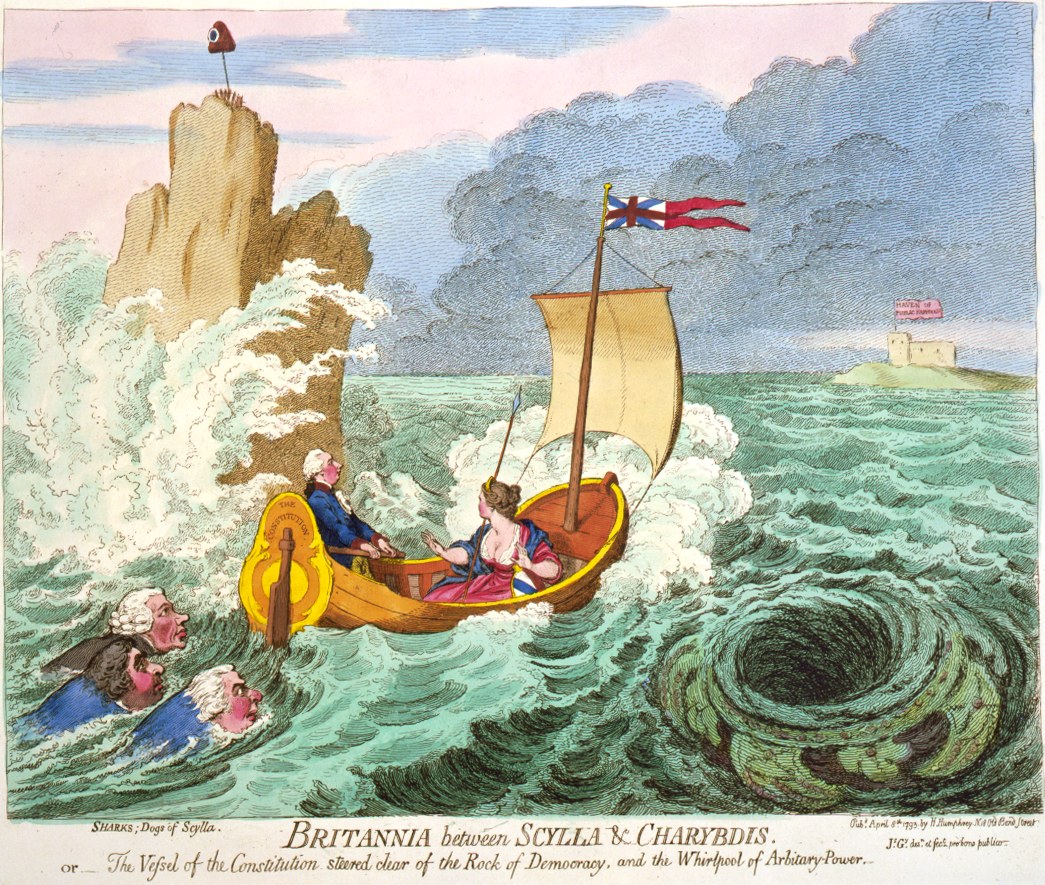
“Avoid Kharybdis and come close to Skyla.” This is similar to the saying, “I avoided it by finding a better evil”
They say about Skyla that she was a Tyrrhenian woman, something if a beast, who was a woman down to the navel but she grew dog heads beneath that point. The rest of her body was a serpent. This kind of a cerature is very silly to imagine. But here is the truth. There were the islands of the Tyrrenians, which used to raid the coasts of Sicily and the Ionian bay. There was a trirereme which had the named Skyla. That trireme used to overtake other ships often and use their food and there was many a story about it. Odysseus fled that ship. trusting a strong and favorable wind and he told this story in Corcyra to Alkinoos, how he was pursued and how he fled and what the shape of the ship was. From these stories, the myth was formed.”
“Charybdis is an obvious name for luxury and endless drinking. Homer has allegorized manifold shamelessness in Skylla, which is why she would logically have a belt of dogs, guardians for her rapacity, daring, and pugnacity. “
“But you, go away from “the smoke and the wave” and depart the ridiculous concerns of mortal life as from that fearsome Charybdis without touching it at all, don’t even, as the people say, brush it with your littlest toe.”
“For satiety seems to be becoming worn out in pleasures from the soul suffering in some way with the body, since the soul does not shirk from its pleasures. But when it is interwoven, as it is said, with the body, it suffers the same things as Odysseus, just as he was held, clinging to the fig tree, not because he desired it or delighted in it, but because he feared Charybdis lurking below him. The soul clings to the body and embraces it in this way not because of goodwill or gratitude but because it fears the uncertainty of death.
As wise Hesiod says, “the gods keep life concealed from human beings.” They have not tied the soul to the body with fleshly bonds, but they have devised and bound around the mind one cell and one guard, our uncertainty and distrust about our end. If a soul had faith in these things—“however so many await men when they die”, to quote Heraclitus—nothing would restrain it at all.”
A brief recap from yesterday’s match which pitted the hero-king of Crete, Idomeneus, against one of the Epigonoi, Sthenelos the sacker of Thebes.
Idomeneus stepped away from his corner where Nestor was still giving him instructions he had not heard and stood still, waiting for Sthenelos. Sthenelos, was talking heatedly with Phoinix, and the only words any word heard sound like “father”, “better”, and “destruction of Thebes”. Sthenelos turned around and said, “Hail, descendant of Minos, Lord of Crete,King of one hundred cities, the Son of Capaneus will bring you down like the city of seven-gated Thebes!”
#NANAIHB Round 1, Contest 2: Cretan King vs. Argive Robin
Idomeneus waited. Sthenelos hurled his first spear, and missed. The second lodged in Idomeneus’ shield without piercing it. Sthenelos drew his sword and charged, dropping it after he struck Idomeneus’ shield with all his force. Idomeneus was about to draw his sword when Diomedes caught his eye. The Cretan shrugged, raised his shield, and thwamped Sthenelos on the head. The light left the eyes of the Argive prince as he knelt to the ground. Unconscious, but still breathing.
As Idomeneus hefted his shield again, Epeios chuckled to Eurypulos, “ἴδε οἱ μένος!*”
*ide hoi menos: “look at his strength!” a play on the name Idomeneus
Today’s contest pits the Cretan Charioteer, Meriones, against the Salaminian Tower of Strength, Ajax. The winner will face Idomeneus in the next round, which will be super awkward if it is Meriones.
Meriones: In the first version of this bracket, Meriones had slipped out. But there was a roar from justice as people clamored to have him back in. So, who is he? He is the half-brother of Idomeneus, often called his charioteer and he has at least seven kills in the Iliad, where he is first named as “equal to man-slaying Enyalios” (Μηριόνης τ’ ἀτάλαντος ᾿Ενυαλίῳ ἀνδρειφόντῃ, 2.651). In book 7, he is one of the 9 who stands to face Hektor in a dual and he volunteers to join Diomedes on his night raid in book 10. In each case he is second only to the more famous Ajax and Odysseus. Perhaps his most humorous moment is when he rushes out of the battle in book 13 and meets Idomeneus, saying “I am going to see if there are any spears left / in our dwellings for I have just now broken the one I was holding / when I threw it at the spear of that super-manly Deiphobos” (ἔρχομαι εἴ τί τοι ἔγχος ἐνὶ κλισίῃσι λέλειπται / οἰσόμενος· τό νυ γὰρ κατεάξαμεν ὃ πρὶν ἔχεσκον / ἀσπίδα Δηϊφόβοιο βαλὼν ὑπερηνορέοντος, 13.256-258). He stands with Idomeneus in book 13 to rally again the Trojan attack. He’s fast, he’s good with the bow too.
Ajax: What is there to say about Ajax? Outside the Iliad he is most famous for losing to Odysseus in the judgment of Achilles’ arms. He is a son of Telamon, which by most accounts makes him Achilles’ cousin (Peleus and Telamon were brothers). He came to Troy from Salamis with 12 ships and was central in later traditions for arguing the ‘ownership’ of Salamis. He is by far the best man after Achilles and Helen describes him as the “monstrous tower of the Achaeans” (οὗτος δ’ Αἴας ἐστὶ πελώριος ἕρκος ᾿Αχαιῶν, 3.229) since both he and Idomeneus standout from afar. He tears battle lines apart singlehandedly! He carries a shield as large as a tower (Αἴας δ’ ἐγγύθεν ἦλθε φέρων σάκος ἠΰτε πύργον, 7.219). When he runs out of spears, well he’s hero enough to toss boulders at people. He duels Hektor (and then later Odysseus) to a draw. But for all these he seems pretty even-headed. IN book 9, he’s the one who breaks Achilles down a bit (Iliad 9.632-638):
“You are relentless: someone might even accept payment
for the murder of a brother or the death of his own child.
and after making great restitution, the killer remains in his country,
and though bereft, the other restrains his heart and mighty anger
once he has accepted the price. But the gods put an untouchable
and wicked rage in your heart over only a girl…”
Before we get to today’s match, here’s a brief recap from yesterday’s inaugural competition which saw the Pseudo-Rhodian Tlepolemos face off against the other son of Telamon, the Archer Teucer. Nestor stood as the corner man for the son of Herakles and Phoinix stood beside Telamon’s son.
Tlepolemos started out the contest by brandishing two spears in his massive right hand and mocking Teucer, saying “Bastard son of Telamon, smallest of the Achaeans, coward who hides behind brother’s shields! How do you expect to beat me, standing here alone, a lesser son of a lesser man against the massive scion of Herakles? I am going to….”
Tlepolemos was cut off mid-threat by an arrow piercing his throat. Teucer had turned and walked into the watching crowd before the arrow landed, muttering without a hint of a smile, “οὐ δὴ τλῆ τὸν πόλεμον”*
*ou dê tlêton polemon: “he didn’t endure this war”. A play on Tle-polemos’ name.
Today’s contest pits the Hero-King of Crete, Idomeneus against Sthenelos, Sacker of Thebes.
Idomeneus is a member of the council of elders, a grandson of Minos, and friend to Ajax. Meriones is his second in command. He is listed as one of the leaders Agamemnon might despoil instead of Achilles (along with Odysseus and Ajax) and heralded by the narrator as one of the best of the Pan-Achaeans (γέροντας ἀριστῆας Παναχαιῶν, along with Nestor, both Ajaxes, Odysseus, Diomedes, and Menelaos, 2.404-408). He came to Troy from Crete of 100 cities (2.649; the Odyssey gives him only 90 cities) with 80 ships. (For comparison, Agamemnon led 100 ships and Odysseus brought 12).
Idomeneus is central to the defense of the ships in book 13 and made it out of Troy alive. In the Odyssey, he may still be ruler of Crete (although some traditions have a harsher homecoming). It is not hard to imagine narrative traditions that center this Cretan hero more: he is blamed for unfairly distributed spoils (given as an etiology for “Cretan” meaning a “liar”) and is responsible elsewhere for Odysseus’ successful homecoming. If you were drafting a heroic lineup and you wanted Ajax-level performance for a much lower price, Idomeneus would be your man.
Sthenelos: This son of Kapaneus may not be a household name, but he’s the Robin to Diomedes’ Batman and they go everywhere and destroy everything together. The pair came fro Aros and Tiryns leading 80 ships between them with Euryalos as their third (Il. 2559-568)! Diomedes is so confident with his little buddy by his side that he declares “Run away with your ships to your darling fatherland! / We two–Sthenelos and I–will fight until we find / the end of Ilion–for we have come here with god on our side!” (φευγόντων σὺν νηυσὶ φίλην ἐς πατρίδα γαῖαν· / νῶϊ δ’ ἐγὼ Σθένελός τε μαχησόμεθ’ εἰς ὅ κε τέκμωρ / ᾿Ιλίου εὕρωμεν· σὺν γὰρ θεῷ εἰλήλουθμεν, 9.47-49). This kind of confidence is infectious. Sthenelos rejects Agamemnon’s attempt to rally them in Iliad 4, declaring (4.404–410):
“Son of Atreus, don’t lie when you know how to speak clearly.
We say we are better than our fathers:
we sacked foundation of seven-gated Thebes
even though we led a smaller army before bigger walls
because we were relying on the signs of the gods and Zeus’ help.
Those men perished because of their own recklessness.
Don’t put our fathers in the same honor.”
A friend of mine (not a classicist) found a vintage Latin Magnetic Poetry set and gave it to me. It’s not so much for Latinists as it is for English-speakers familiar with Latin: it’s got all the familiar phrases from law (habeas corpus) and Catholicism (in nomine patris) and general fancy talk (caveat emptor).
I decided to give it a go, and see what syntactically coherent sentences and phrases I could put together in classical-ish Latin. I set myself the rule of using every word in the kit, and not reusing any word that wasn’t duplicated in the kit. Don’t bother scanning them, as they’re not metrical, but who’s to say they aren’t Saturnians?
some Magnetic Poetry, in Latin, assembled during a frantic semester teaching Latin Prose Composition
Some of them sound like they could plausibly have been written or at least thought by an actual historical Roman:
ars firma uitae est scientia in libris life’s reliable skill is book-knowledge
homini est nihil beati humankind has no share of happiness
Magna Mater omnes forma mala amat the Great Mother loves everyone who has a bad body
uidi populum facile errare et labi ad bellum
I’ve seen the populace easily going astray and slipping towards war
aurea uox mea non est pura my golden voice is not pure
sic ego rebus maximis gratias non emeritus sum that’s why I haven’t earned thanks for my super-great accomplishments
Some had a feeling of banter that could, if you squint real hard, fit in a comedy of Plautus:
amor ab ipso bono quem hominem amas; te uici, Maria
I’m loved by the very nobleman whom you love; I’ve beaten you, Maria
idem sum de quo delirium est I’m the very guy everyone’s crazy about
tu Brute carpe artes pauperes salis dum gratia patris fiat tibi absurdo
you, Brutus, pick out the impoverished arts of wit so long as you’ve got your dad’s good will, you ridiculous man
aue homo quid in curriculum uadis de quo non bene cogito?
hey, dude, why are you wandering onto the racetrack that I don’t think well of?
Others entered the danger zone, of either hanky panky or sacrilege:
ueni ad opus sub toga filii proximi I got to work underneath the toga of the boy next door
coitus habeas tremens ante nauseam may you, trembling, have sex to the point of nausea
pax alma mirabilis pacifici Satanas domini beati toto anno aureo in cetera terra beata
the wondrous nourishing peace of the peace-bringing blessed lord, o Satan, within the entire golden year in the remaining blessed land
nosce unum partum e culpa dei: filius caueat de te pater et de poena dura et nomine minimo delicti
recognize one born out of God’s mistake: the Son is on guard against you, Father, and against harsh punishment and against the slightest name of criminal action
But the best ones took me into the realm of the bizarre:
lupus bipes Christum in flumina sequitur minima cum cura
a wolf walking on its hind legs chases Christ into the rivers he don’t give a fuck
alter emptor lupi mortui exit e gloria populi the dead wolf’s other buyer has lost the good reputation of the public
uiam inueniam aut bona faciam absentia nulla fide
I’ll find a way— or I’ll make all my property disappear with no regrets
mortem malo sed corpus magnum uirile ago per uitam annum perpetuum
I prefer death but I drag my giant manly body through life for an endless year
And in case it wasn’t clear what the whole Magnetic Poetry set was trying (with middling results) to do, notice that one standalone magnet at the top of the photo: LATIN.
I managed to use every single word in the kit, which means this page has the sum of all Latin Magnetic Poetry options — so now it’s your turn to mix & match. Post your handiwork in the comments!
My name is Mary McLoughlin, and I am the creator of the Playing Sappho project (and of many lyres). Playing Sappho is both the name of my project, and my website where I have a blog and YouTube page dedicated to helping people re-create the music of Sappho, through How-To guides on building lyres, and signing in Ancient Greek, as well as some overall background for Sappho and her context.
I designed this project in fulfillment of my Senior Independent Study at the College of Wooster. I deeply love Sappho’s work, but I did not feel like I could add anything significant to the current scholarly debate surrounding her. So, I thought it would be worthwhile to design a project of public history and accessibility. One of the problems with classics, and the study of Sappho, is that it happens almost exclusively at a level of academic discourse (which is what makes websites like Sententiae Antiquae so cool!).
I wanted to make Sappho’s music more accessible, in its entirety. Which meant also helping people build lyres on the cheap, and figuring out how to sing in ancient Greek. I have greatly enjoyed the opportunity to do this work, and post-graduation intend to keep the project going (and building better lyres). It’s important to understand my re-creation of Sappho’s performance is far from ‘accurate’. Today, not much is known about what her performance would have looked like (though I do agree with scholarship suggesting it was public and choral).
I do the best I can, but I am just one person, now in quarantine, as we all are. When I sing in ancient Greek I am trying to make it sound good to a modern ear, Sappho probably would have thought it sounded ridiculous. This project is a love letter to Sappho, and in a lot of ways I feel as though I’m a little kid putting on a grown woman’s appearance and mimicking her work. I am ‘playing’ at Sappho. I believe the beauty of her work is enough; and I hope to share it with others and encourage them to re-create it themselves.
All that being said, I made my fair share of mistakes. I had a ton of issues making different lyres. Bending wood/ other materials was a consistent problem for me in lyre building, as was my final design shape (my final lyre looks more like a lyra than a barbitos). I had issues sourcing materials, and had to compromise on my final lyre by using a turtle shell, rather than a tortoise shell. This lead to its own issues and challenges. I am by no means a skilled craftsman, and my inexperience lead to a lot of mistakes. I am very lucky I still have all my fingers after building several prototypes and my final lyre. I’m also not a great videographer, which is clear from my many videos of my project and process.
My biggest issue in this whole project is that I would often not refer back to my source material as often as I should have – which resulted in my final lyre being the wrong shape, and essentially looking like a different type of instrument (a good way to conceptualize this is that it’s as if I was trying to build a bass guitar, and I have an instrument that sounds like a bass guitar, but looks more like a really big guitar, rather than a bass one). I made the errors of someone unfamiliar with this sort of research and execution, which I am. Though I am fortune in that I did succeed, I have a final lyre which looks cool, and a functional website to showcase my platform.
I also want to make it clear that whatever success I did have is due to the tremendously skilled people that helped me throughout this entire process. I was really lucky to have amazing people help me (Such as Stefan Hagel, Michael Girbal, the creators of Lyreavlos, Sententiae Antiquae, my advisors, my parents, different technology experts and the wood shop technician at my college, to say nothing of all my friends and family who encouraged me). Overall, I was challenged by my absolute lack of knowledge and experience but I never let that hold me back. That doesn’t mean that I was successful or courageous, I just had a good idea which I felt could back up my lack of know-how. How well I executed that is up to debate, but I’m proud of the work I did. I truly hope other people can enjoy it.